


Jeremiah 32:3
Bible text: King James Version (1769 Blayney text) · Public domain
Bible text: King James Version with Strong's numbers · Public domain
Bible text: Berean Standard Bible · Public domain
Bible text: American Standard Version (1901) · Public domain
Bible text: World English Bible, Messianic edition · Public domain
Bible text: Geneva Bible (1599) · Public domain
Bible text: Young's Literal Translation · Public domain
- אֲשֶׁר'a·SherwhereH834RelParticle Relative
- כְּלָאוֹke·la·'Ohe had shut up himH3607V-Qal-Perf-3ms ¦ 3msVerb Qal Perfect 3rd Singular Masculineכְּלָאhe had shut upוֹhim
- צִדְקִיָּהוּtzid·ki·Ya·huZedekiahH6667N-proper-mNoun Proper Masculine
- מֶלֶךְMe·lekh[the] king ofH4428N-mscNoun Singular Masculine Construct
- יְהוּדָהye·hu·DahJudahH3063N-properNoun Proper Location
- לֵאמֹרle·Mor<to> sayingH559Prep-l ¦ V-Qal-InfVerb Qal Infinitive Constructלֵ<to>אמֹרsaying
- מַדּוּעַma·du·a'why?H4069InterrogParticle Interrogative
- אַתָּה'a·Tah[are] youH859Pro-2msPronoun Personal 2nd Singular Masculine
- נִבָּאni·Ba'prophesyingH5012V-Niphal-Prtcpl-msVerb Niphal Participle Singular Masculine Absolute
- לֵאמֹרle·Mor<to> sayingH559Prep-l ¦ V-Qal-InfVerb Qal Infinitive Constructלֵ<to>אמֹרsaying
- כֹּהkohthusH3541AdvAdverb
- אָמַר'a·Marhe saysH559V-Qal-Perf-3msVerb Qal Perfect 3rd Singular Masculine
- יְהוָהYah·wehYahwehH3068N-properNoun Proper Title
- הִנְנִיhi·Nihere IH2005Prt ¦ 1csParticle InterjectionהִנְhereנִיI
- נֹתֵןno·Ten[am] about to giveH5414V-Qal-Prtcpl-msVerb Qal Participle Singular Masculine Absolute
- אֶת'et<obj.>H853DirObjMParticle Object Indicator
- הָעִירha·'Irthe cityH5892Art ¦ N-fsNoun Singular Feminine Absoluteהָtheעִירcity
- הַזֹּאתha·Zot<the> thisH2063Art ¦ PrtParticle Demonstrativeהַ<the>זֹּאתthis
- בְּיַדbe·Yadin [the] hand ofH3027Prep-b ¦ N-cscNoun Singular common gender Constructבְּinיַד[the] hand of
- מֶלֶךְMe·lekh[the] king ofH4428N-mscNoun Singular Masculine Construct
- בָּבֶלba·VelBabylonH894N-properNoun Proper Location
- וּלְכָדָהּu·le·kha·Dahand he will capture itH3920Conj-w ¦ V-Qal-ConsecPerf-3ms ¦ 3fsVerb Qal Consecutive Perfect 3rd Singular Masculineוּandלְכָדָhe will captureהּit
English is a literal word-by-word gloss of the Hebrew, not the KJV's wording. Why?
This is the original text the KJV's translators worked from — each Hebrew word with its own literal English meaning in this verse, prepared by scholars at Tyndale House, Cambridge. The KJV translates whole sentences, not word by word, so its wording differs: one Hebrew word can become several English words, and the KJV may choose “the LORD” where the gloss reads “Yahweh”. Both are faithful — they answer different questions. For the KJV's own rendering, switch to the KJV text.
Details
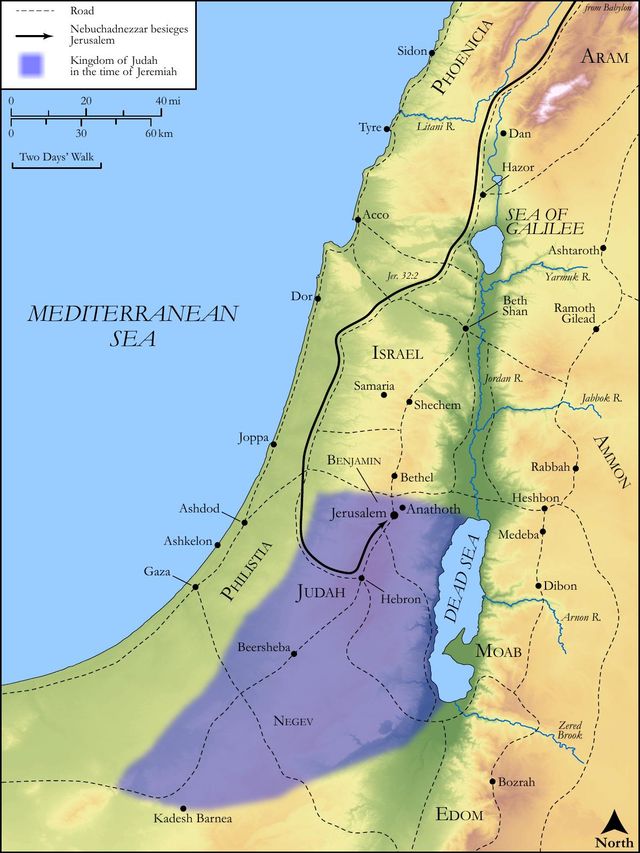
See on the biblical-era map
Study this verse
Public-domain commentary
Matthew Henry
From his Commentary on the Whole Bible. Henry comments on passages, not single verses — this entry covers Jeremiah 32:1–15. His four-level outline is real structure in the source text, so it is rendered as structure.
It appears by the date of this chapter that we are now coming very nigh to that fatal year which completed the desolations of Judah and Jerusalem by the Chaldeans. God's judgments came gradually upon them, but, they not meeting him by repentance in the way of his judgments, he proceeded in his controversy till all was laid waste, which was in the eleventh year of Zedekiah; now what is here recorded happened in the tenth. The king of Babylon's army had now invested Jerusalem and was carrying on the siege with vigour, not doubting but in a little time to make themselves masters of it, while the besieged had taken up a desperate resolution not to surrender, but to hold out to the last extremity. Now,
I.Jeremiah prophesies that both the city and the court shall fall into the hands of the king of Babylon.
He tells them expressly that the besiegers shall take the city as a prize, for God, whose city it was in a peculiar manner, will give it into their hands and put it out of his protection (Jer 32:3), - that, though Zedekiah attempt to make his escape, he shall be overtaken, and shall be delivered a prisoner into the hands of Nebuchadnezzar, shall be brought into his presence, to his great confusion and terror, he having made himself so obnoxious by breaking his faith with him, he shall hear the king of Babylon pronounce his doom, and see with what fury and indignation he will look upon him (His eyes shall behold his eyes, Jer 32:4), - that Zedekiah shall be carried to Babylon, and continue a miserable captive there, until God visit him, that is, till God put an end to his life by a natural death, as Nebuchadnezzar had long before put an end to his days by putting out his eyes. Note, Those that live in misery may be truly said to be visited in mercy when God by death takes them home to himself. And, lastly, he foretels that all their attempts to force the besiegers from their trenches shall be ineffectual: Though you fight with the Chaldeans, you shall not prosper; how should they, when God did not fight for them? Jer 32:5. See Jer 34:2, Jer 34:3.
II.For prophesying thus he is imprisoned, not in the common goal, but in the more creditable prison that was within the verge of the palace, in the king of Judah's house, and there not closely confined, but in custodia libera - in the court of the prison, where he might have good company, good air, and good intelligence brought him, and would be sheltered from the abuses of the mob; but, however, it was a prison, and Zedekiah shut him up in it for prophesying as he did, Jer 32:2, Jer 32:3. So far was he from humbling himself before Jeremiah, as he ought to have done (Ch2 36:12), that he hardened himself against him. Though he had formerly so far owned him to be a prophet as to desire him to enquire of the Lord for them (Jer 21:2), yet now he chides him for prophesying (Jer 32:3), and shuts him up in prison, perhaps not with design to punish him any further, but only to restrain him from prophesying any further, which was crime enough. Silencing God's prophets, though it is not so bad as mocking and killing them, is yet a great affront to the God of heaven. See how wretchedly the hearts of sinners are hardened by the deceitfulness of sin. Persecution was one of the sins for which God was now contending with them, and yet Zedekiah persists in it even now that he was in the depth of distress. No providences, no afflictions, will of themselves part between men and their sins, unless the grace of God work with them. Nay, some are made worse by those very judgments that should make them better.
III.Being in prison, he purchases from a near relation of his a piece of ground that lay in Anathoth, Jer 32:6, Jer 32:7, etc.
1.One would not have expected,
(1.)That a prophet should concern himself so far in the business of this world; but why not? Though ministers must not entangle themselves, yet they may concern themselves in the affairs of this life.
(2.)That one who had neither wife nor children should buy land. We find (Jer 16:2) that he had no family of his own; yet he may purchase for his own use while he lives, and leave it to the children of his relations when he dies.
(3.)One would little have thought that a prisoner should be a purchaser; how should he get money beforehand to buy land with? It is probably that he lived frugally, and saved something out of what belonged to him as a priest, which is no blemish at all to his character; but we have no reason to think that the people were kind, or that his being beforehand was owing to their generosity. Nay,
(4.)It was most strange of all that he should buy a piece of land when he himself knew that the whole land was now to be laid waste and fall into the hands of the Chaldeans, and then what good would this do him? But it was the will of God that he should buy it, and he submitted, though the money seemed to be thrown away. His kinsman came to offer it to him; it was not of his own seeking; he coveted not to lay house to house and field to field, but Providence brought it to him, and it was probably a good bargain; besides, the right of redemption belonged to him (Jer 32:8), and if he refused he would not do the kinsman's part. It is true he might lawfully refuse, but, being a prophet, in a thing of this nature he must do that which would be for the honour of his profession. It became him to fulfil all righteousness. It was land that lay within the suburbs of a priests' city, and, if he should refuse it, there was danger lest, in these times of disorder, it might be sold to one of another tribe, which was contrary to the law, to prevent which it was convenient for him to buy it. It would likewise be a kindness to his kinsman, who probably was at this time in great want of money. Jeremiah had but a little, but what he had he was willing to lay out in such a manner as might tend most to the honour of God and the good of his friends and country, which he preferred before his own private interests.
2.Two things may be observed concerning this purchase: -
(1.)How fairly the bargain was made. When Jeremiah knew by Hanameel's coming to him, as God had foretold he would, that it was the word of the Lord, that it was his mind that he should make this purchase, he made no more difficulty of it, but bought the field. And,
[1.]He was very honest and exact in paying the money. He weighted him the money, did not press him to take it upon his report, though he was his near kinsman, but weighed it to him, current money. It was seventeen shekels of silver, amounting to about forty shillings of our money. The land was probably but a little field and of small yearly value, when the purchase was so low; besides, the right of inheritance was in Jeremiah, so that he had only to buy out his kinsman's life, the reversion being his already. Some think this was only the earnest of a greater sum; but we shall not wonder at the smallness of the price if we consider what scarcity there was of money at this time and how little lands were counted upon.
[2.]He was very prudent and discreet in preserving the writings. They were subscribed before witnesses. One copy was sealed up, the other was open. One was the original, the other the counterpart; or perhaps that which was sealed up was for his own private use, the other that was open was to be laid up in the public register of conveyances, for any person concerned to consult. Due care and caution in things of this nature might prevent a great deal of injustice and contention. The deeds of purchase were lodged in the hands of Baruch, before witnesses, and he was ordered to lay them up in an earthen vessel (an emblem of the nature of all the securities this world can pretend to give us, brittle things and soon broken), that they might continue many days, for the use of Jeremiah's heirs, after the return out of captivity; for they might then have the benefit of this purchase. Purchasing reversions may be a kindness to those that come after us, and a good man thus lays up an inheritance for his children's children.
(2.)What was the design of having this bargain made. It was to signify that though Jerusalem was now besieged, and the whole country was likely to be laid waste, yet the time should come when houses, and fields, and vineyards should be again possessed in this land, Jer 32:15. As God appointed Jeremiah to confirm his predictions of the approaching destruction of Jerusalem by his own practice in living unmarried, so he now appointed him to confirm his predictions of the future restoration of Jerusalem by his own practice in purchasing this field. Note, It concerns ministers to make it to appear in their whole conversation that they do themselves believe that which they preach to others; and that they may do so, and impress it the more deeply upon their hearers, they must many a time deny themselves, as Jeremiah did in both these instances. God having promised that this land should again come into the possession of his people, Jeremiah will, on behalf of his heirs, put in for a share. Note, It is good to manage even our worldly affairs in faith, and to do common business with an eye to the providence and promise of God. Lucius Florus relates it as a great instance of the bravery of the Roman citizens that in the time of the second Punic war, when Hannibal besieged Rome and was very near making himself master of it, a field on which part of his army lay, being offered to sale at that time, was immediately purchased, in a firm belief that the Roman valour would raise the siege, lib. ii. cap. 6. And have not we much more reason to venture our all upon the word of God, and to embark in Zion's interests, which will undoubtedly be the prevailing interests at last? Non si male nunc et olim sic erit - Though now we suffer, we shall not suffer always.
Historical interpretation
Two Centuries of Reception
2 surviving comments on this verse. Each one is dated, so this reads as a timeline rather than a list.
Select a marker to jump to its quote. Markers stagger vertically where authors wrote within a few decades of each other.
Of course nothing is “too hard for the Lord.” But if we choose to apply this principle so extravagantly and harshly in our capricious imaginations, we may then make out God to have done anything we please, on the ground that it was not impossible for him to do it. We must not suppose, however, because he is able to do all things, that he has done what he has not done. But we must inquire whether he has really done it. God could, if he had liked, have furnished humankind with wings to fly with, just as he gave wings to kites. We must not, however, run to the conclusion that he did this because he was able to do it. He might also have extinguished Praxeas and all other heretics at once; it does not follow, however, that he did, simply because he was able. For it was necessary that there should be both kites and heretics; it was necessary also that the Father should be crucified. In one sense there will be something difficult even for God—namely, that which he has not done—not because he could not but because he would not do it. For with God, to be willing is to be able and to be unwilling is to be unable; all that he has willed, however, he has both been able to accomplish and has displayed his ability.
(Chapter XXXII, verse 1 and following). The word that was spoken to Jeremiah by the Lord in the tenth year of King Zedekiah of Judah, was the eighteenth year of King Nebuchadnezzar. At that time the army of the king of Babylon was besieging Jerusalem, and the prophet Jeremiah was confined in the courtyard of the prison, which was in the palace of the king of Judah. For King Zedekiah of Judah had locked him up, saying, 'Why do you prophesy, saying, "Thus says the Lord"? Not only the words and deeds of the prophets are an example to us for virtue. Jeremiah could have announced prosperity and enjoyed the friendship of King Zedekiah, but he preferred to obey God rather than men (Acts 5), and he who can destroy both soul and body in hell, rather than he who could only have power over the body (Matthew 10). And it should be noted that it was the tenth year of Zedekiah's reign, with Jerusalem already besieged and consumed by sword, famine, and plague, and captivity imminent. Yet Zedekiah persists in his decision, and to some extent demonstrates his clemency by ordering that he not be confined in a prison, but in the courtyard: a form of free custody, so that he could not escape, as if the entire Jerusalem, closed by fortifications, were not a common prison for its inhabitants. This is the twenty-second year of the reign of Nebuchadnezzar, who in the fourth year of King Jehoiakim's reign took control. However, the reason for the king's anger is that he speaks in the name of God, and he was commanded to do so.
Continue studying Jeremiah 32:3 across the web’s major study libraries — every link below opens this exact verse, chapter, or book on the destination site.
Read & Compare
 BibleGatewayThis verse in more than 200 translations and 70 languages.
 Bible.comThe YouVersion reader — hundreds of translations, reading plans, and highlights.
 ESV.orgCrossway's official English Standard Version reader.
 NET BibleThe NET translation with 60,000+ translators' notes on every rendering decision.
 STEP BibleTyndale House's free study tool — original text, vocabulary, and scholarly resources.
 BibliaLogos Bible Software's free web reader.
 USCCBThe New American Bible (Revised Edition) with the U.S. bishops' study notes.
Commentaries
 BibleHub CommentariesDozens of classic commentaries on this verse, gathered on one page.
 StudyLightMore than 100 commentary sets — the largest collection on the web.
 BibleRefPlain-English commentary on what this verse means, verse by verse.
 Enduring WordDavid Guzik's free commentary on this chapter, widely used by Bible teachers.
 Bible Study ToolsVerse commentary alongside Greek and Hebrew study aids.
Original Language & Research
- BibleHub InterlinearThe verse word by word — original language, transliteration, and English.
- BibleHub LexiconEvery word's original-language definition and Strong's entry.
 Blue Letter BibleDeep-study tools — Strong's numbers, concordance, and word studies.
 SefariaThe Hebrew text with Rashi and centuries of Jewish commentary.
Sermons, Hymns & Audio


TrulyRandomVerse is not affiliated with these sites and doesn’t control their content. They’re linked because they’re genuinely useful.
Summary
Jeremiah 32:3 succinctly describes the immediate reason for the prophet Jeremiah's imprisonment: King Zedekiah of Judah had him confined because he consistently prophesied that Jerusalem would be delivered into the hands of the king of Babylon. This verse captures the profound tension between divine revelation and human resistance, underscoring Jeremiah's unwavering commitment to proclaiming God's unwelcome message of impending judgment and the king's desperate, yet futile, attempt to silence a truth he refused to accept.
Context
ShowHideLiterary Context
This verse is strategically placed within a pivotal narrative section of Jeremiah, specifically at the outset of chapter 32, which immediately follows a series of prophecies concerning Judah's impending destruction and the subsequent restoration. Jeremiah 32 opens with the prophet already confined in the court of the guard, a detail established in Jeremiah 32:2. Verse 3 then provides the explicit, politically charged reason for his detention, setting the stage for the remarkable act of faith that follows: Jeremiah's divinely commanded purchase of a field in Anathoth (Jeremiah 32:6-15), an act symbolizing future restoration and the certainty of God's covenant promises even amidst present destruction. This immediate context highlights the prophet's unwavering obedience to God's word, even when it directly contradicts the prevailing political and military realities and leads to his personal suffering. The specific prophecy cited in verse 3 was not a new message but one Jeremiah had proclaimed for years, as seen in earlier pronouncements (e.g., Jeremiah 21:7).
Historical & Cultural Context
The events of Jeremiah 32:3 unfold during the dire final years of the Kingdom of Judah, specifically around 588-586 BC, as Nebuchadnezzar's Babylonian army laid siege to Jerusalem. King Zedekiah, installed as a puppet ruler by Nebuchadnezzar after the first deportation in 597 BC, found himself caught between loyalty to Babylon and the fervent nationalist desire to rebel, often swayed by false prophets and pro-Egyptian factions. The populace, including the king and his officials, largely rejected Jeremiah's prophecies of impending doom, preferring messages of peace and security propagated by other, more palatable, "prophets" (e.g., Jeremiah 28). Imprisonment was a common tactic used by rulers of that day to silence dissenting voices or individuals perceived as undermining national morale during wartime. Jeremiah's confinement in the "court of the guard" suggests a form of house arrest or detention within the palace complex, allowing him some limited interaction, as evidenced by his ability to engage in the land transaction described later in the chapter. The cultural expectation was that a prophet would speak for God, but when God's message was one of judgment and defeat, it was frequently met with hostility and persecution, a pattern evident throughout the history of true prophets in Israel (2 Chronicles 36:15-16).
Key Themes
ShowHideJeremiah 32:3 contributes significantly to several overarching themes within the book of Jeremiah. Firstly, it powerfully underscores the theme of Divine Sovereignty in Judgment, clearly articulating that the fall of Jerusalem is not merely a military defeat but a deliberate, orchestrated act of God ("I will give this city into the hand..."). This highlights God's ultimate control over nations and history, even employing pagan empires like Babylon as instruments of His divine will (e.g., Jeremiah 25:9). Secondly, the verse vividly illustrates the Persecution of True Prophets, as Jeremiah faces imprisonment for faithfully delivering an unpopular divine message, a recurring motif throughout his challenging ministry (e.g., Jeremiah 20:2). Thirdly, it emphasizes the severe Consequences of Disobedience, as Judah's persistent rebellion against God's covenant ultimately culminates in this catastrophic judgment, representing the culmination of centuries of turning away from the LORD (Lamentations 1:8).
Exposition and Analysis
ShowHideKey Word Analysis
ShowHideThis verb (H3607) signifies "to restrict," "hold back or in," "forbid," or "restrain." In this context, it vividly describes Zedekiah's act of imprisoning Jeremiah, a physical manifestation of the king's desperate attempt to suppress the prophetic word. It implies a forceful and deliberate act of confinement, aimed at silencing the prophet and preventing his message from reaching the people. The king sought to "restrain" God's messenger, but ironically, could not restrain God's message or His impending judgment.
This primitive root (H5012) means "to speak (or sing) by inspiration," encompassing both prediction and simple discourse. It emphasizes that Jeremiah's words were not his own opinions or political commentary but divinely inspired utterances. Zedekiah's question, "Wherefore dost thou prophesy?" reveals his frustration with Jeremiah's consistent claim of divine authority for his unwelcome message, highlighting the tension between human will and God's revealed truth.
This versatile primitive root (H5414) means "to give," but with a wide latitude of application, including "to put," "make," "appoint," or "deliver." Here, "I will give this city" signifies God's active agency and sovereign decision to deliver Jerusalem into the hands of Babylon. It is not merely a passive surrender but a deliberate divine act of judgment, underscoring that the impending conquest is part of God's plan, not just a result of military might.
Verse Breakdown
ShowHide"For Zedekiah king of Judah had shut him up"
This opening clause establishes the immediate historical context and identifies the agent of Jeremiah's confinement. King Zedekiah, the final reigning monarch of Judah, is directly responsible for the prophet's imprisonment, highlighting the direct conflict between the earthly ruler's desire for political stability and the divine message of judgment.
"saying, Wherefore dost thou prophesy, and say"
This segment reveals Zedekiah's direct challenge to Jeremiah. The king questions the legitimacy and purpose of Jeremiah's prophetic activity, indicating his profound frustration and perhaps a degree of disbelief or defiance towards the message being proclaimed. It implies that Jeremiah's prophecy was perceived as treasonous or demoralizing rather than a divine warning.
"Thus saith the LORD"
This is a crucial prophetic formula, asserting the divine origin and absolute authority of the message that follows. Jeremiah is not speaking his own words or political opinions; he is relaying a direct revelation from YHWH, the covenant God of Israel. This phrase elevates the subsequent declaration from human speculation to an unalterable divine decree.
"Behold, I will give this city into the hand of the king of Babylon"
This is the core of Jeremiah's offensive prophecy. It declares God's explicit intention to deliver Jerusalem—His holy city, where His temple stood—into the power and control of a foreign, pagan king. The "I will give" emphasizes God's sovereign agency in orchestrating this judgment, using Babylon as His instrument. The word "hand" (H3027, yâd) here functions figuratively to denote power, authority, and dominion.
"and he shall take it;"
This final clause confirms the certainty and inevitability of Jerusalem's capture. It reiterates that the king of Babylon will indeed seize the city, reinforcing the dire consequences of Judah's persistent disobedience and the undeniable fulfillment of God's prophetic word. The verb "take" (H3920, lâkad) conveys the decisive act of capture and occupation.
Literary Devices
ShowHideJeremiah 32:3 employs several powerful literary devices that enhance its impact. The most prominent is Direct Speech, as the verse quotes Zedekiah's challenging question and Jeremiah's authoritative prophetic declaration verbatim. This immediately draws the reader into the intense confrontation between king and prophet, making the conflict palpable. The phrase "Thus saith the LORD" functions as a potent Prophetic Formula, a recurring and authoritative marker that authenticates Jeremiah's words as direct divine revelation, not mere human opinion. This formula serves to underscore the gravity and certainty of the message, even as it highlights the king's rejection of God's ultimate authority. There is also a strong element of Irony in Zedekiah's actions; by imprisoning Jeremiah to silence him, the king inadvertently confirms the veracity of the prophet's message and the inevitability of his own impending downfall, as Jeremiah's confinement is a direct consequence of the very truth that will soon be fulfilled. Finally, the statement "I will give this city" demonstrates profound Divine Agency, portraying God as the ultimate actor behind these historical events, using the king of Babylon as His instrument of judgment.
Theological and Thematic Connections
ShowHideJeremiah 32:3 profoundly illustrates God's absolute sovereignty over human affairs and the severe consequences of rejecting divine truth. It reveals that the impending fall of Jerusalem was not a random geopolitical event, but a deliberate act of God's judgment, orchestrated to bring His rebellious people to account. This truth, though unwelcome and painful, underscores God's justice and His unwavering faithfulness to His covenant, even when it involves severe discipline. The verse also highlights the enduring tension between God's revealed will and humanity's stubborn resistance, a theme that resonates throughout biblical history and human experience. Jeremiah's unwavering commitment to proclaiming this unpopular truth, despite significant personal cost, serves as a powerful testament to the integrity and courage required of God's messengers.
Reflection and Application
ShowHideJeremiah 32:3 offers profound and enduring lessons for contemporary believers. It challenges us to honestly consider our own responses to unwelcome truths, particularly those that disrupt our comfort, challenge our preconceived notions of security, or demand repentance. Just as Zedekiah sought to silence Jeremiah, we too might be tempted to ignore, suppress, or rationalize away messages that call us to uncomfortable change or warn of difficult consequences. This verse powerfully reminds us that God remains absolutely sovereign even in times of chaos, judgment, and perceived defeat, actively working out His purposes through the rise and fall of nations and empires. Our call is to trust in His ultimate control and perfect plan, even when His methods are painful or His designs seem counterintuitive to our human desires for ease and immediate gratification. Furthermore, Jeremiah's unwavering faithfulness in the face of imprisonment, societal opposition, and personal suffering encourages us to stand firm in our convictions and to speak God's truth with courage and integrity, regardless of the personal cost or prevailing cultural opposition.
Questions for Reflection
ShowHideFAQ
ShowHideWhy did Zedekiah imprison Jeremiah?
ShowHideKing Zedekiah imprisoned Jeremiah because the prophet consistently delivered a message from the LORD that was deeply unpopular, politically inconvenient, and seen as undermining national morale. Jeremiah prophesied that Jerusalem would inevitably fall into the hands of the king of Babylon, stating that God Himself would "give this city into the hand of the king of Babylon" (Jeremiah 32:3). This message was perceived as defeatist and treasonous during a time of siege, directly contradicting the more optimistic but false prophecies being circulated by other prophets. Zedekiah's act was a desperate attempt to silence a voice that spoke of divine judgment and the certain defeat of Judah.
What does the phrase "Thus saith the LORD" signify in Jeremiah's prophecy?
ShowHideThe phrase "Thus saith the LORD" (Hebrew: Koh Amar YHWH) is a powerful and frequently used prophetic formula throughout the Old Testament. It signifies that the message being delivered is not the prophet's own opinion, speculation, or political commentary, but a direct, authoritative, and infallible revelation from God Himself, YHWH, the covenant God of Israel. Its inclusion in Jeremiah's prophecy underscored the divine origin and absolute certainty of his words, emphasizing that the impending fall of Jerusalem was a divine decree, not merely a human prediction. It served as a call for absolute obedience and trust in God's word, even when that word was unwelcome or brought dire tidings.
Was Jeremiah's prophecy of Jerusalem's fall fulfilled?
ShowHideYes, Jeremiah's prophecy regarding the fall of Jerusalem to the king of Babylon was definitively and tragically fulfilled. Shortly after the events of Jeremiah 32, in 586 BC, Nebuchadnezzar's Babylonian army breached the walls of Jerusalem, destroyed the city and the Temple, and carried the remaining inhabitants into exile (as detailed in Jeremiah 39 and Jeremiah 52). This historical event stands as a powerful testament to the accuracy of God's prophetic word and His sovereign control over the rise and fall of nations, demonstrating that His warnings are not idle threats but certain realities.
Christ-Centered Fulfillment
ShowHideJeremiah 32:3, with its poignant depiction of a prophet imprisoned for faithfully speaking God's unwelcome truth, finds profound Christ-centered fulfillment in the person and ministry of Jesus. Like Jeremiah, Jesus was the ultimate Prophet, speaking with unparalleled divine authority, often prefacing His declarations with "Truly, truly, I say to you" (e.g., John 3:3), echoing Jeremiah's "Thus saith the LORD." Yet, His message, particularly His pronouncements of judgment against Jerusalem for its persistent rejection of Him, was met with similar hostility and rejection by the religious and political authorities of His day (e.g., Matthew 23:37-39). Just as King Zedekiah sought to silence Jeremiah through imprisonment, the Jewish leaders sought to silence Jesus, ultimately leading to His unjust arrest, trial, and crucifixion (e.g., John 11:47-53). The prophecy that God would "give this city into the hand of the king of Babylon" foreshadows the ultimate judgment that would fall upon Jerusalem in AD 70, when it was destroyed by the Roman legions, a catastrophic event Jesus Himself had solemnly foretold (e.g., Luke 21:20-24). In both instances, divine judgment was executed through human instruments due to the people's persistent rebellion and rejection of God's messengers. However, the ultimate Christ-centered fulfillment lies not only in shared suffering but in Jesus' redemptive victory: unlike Jeremiah, who was a messenger of judgment and future hope, Jesus is the very embodiment of that hope, the Lamb of God who takes away the sin of the world (John 1:29), offering salvation and new life even amidst judgment. His suffering, rejection, and "imprisonment" on the cross ultimately led to the triumph of God's redemptive plan, fulfilling the deeper purpose behind all prophetic warnings and opening the way to eternal reconciliation.