


Jeremiah 32:4
- וְצִדְקִיָּהוּve·tzid·ki·Ya·huand ZedekiahH6667Conj-w ¦ N-proper-mNoun Proper MasculineוְandצִדְקִיָּהוּZedekiah
- מֶלֶךְMe·lekh[the] king ofH4428N-mscNoun Singular Masculine Construct
- יְהוּדָהye·hu·DahJudahH3063N-properNoun Proper Location
- לֹאlo'notH3808NegParticle Negative
- יִמָּלֵטyi·ma·Lethe will escapeH4422V-Niphal-Imperf-3msVerb Niphal Imperfect 3rd Singular Masculine
- מִיַּדmi·Yadfrom [the] hand ofH3027Prep-m ¦ N-cscNoun Singular common gender Constructמִfromיַּד[the] hand of
- הַכַּשְׂדִּיםha·kas·Dimthe ChaldeansH3778Art ¦ N-mpNoun Gentilic Plural Masculine AbsoluteהַtheכַּשְׂדִּיםChaldeans
- כִּיkiforH3588PrtParticle Conditional
- הִנָּתֹןhi·na·Toncertainly <to be given>H5414V-Niphal-InfAbsVerb Niphal Infinitive Absolute
- יִנָּתֵןyi·na·Tenhe will be givenH5414V-Niphal-Imperf-3msVerb Niphal Imperfect 3rd Singular Masculine
- בְּיַדbe·Yadin [the] hand ofH3027Prep-b ¦ N-cscNoun Singular common gender Constructבְּinיַד[the] hand of
- מֶלֶךְMe·lekh[the] king ofH4428N-mscNoun Singular Masculine Construct
- בָּבֶלba·VelBabylonH894N-properNoun Proper Location
- וְדִבֶּרve·di·berand it will speakH1696Conj-w ¦ V-Piel-ConsecPerf-3msVerb Piel Consecutive Perfect 3rd Singular Masculineוְandדִבֶּרit will speak
- פִּיוpivhis mouthH6310N-msc ¦ 3msNoun Singular Masculine Constructפִּיmouthוhis
- עִם'imwithH5973PrepPreposition
- פִּיוPivhis mouthH6310N-msc ¦ 3msNoun Singular Masculine Constructפִּיmouthוhis
- וְעֵינָיוve·'ei·Navand his eyesH5869Conj-w ¦ N-fdc ¦ 3msNoun Dual Feminine Constructוְandעֵינָיeyesוhis
- אֶת'et<obj.>H853DirObjMParticle Object Indicator
- עֵינָיוei·novhis eyesH5869N-fdc ¦ 3msNoun Dual Feminine Constructעֵינָיeyesוhis
- תִּרְאֶינָהtir·'Ei·nahthey will seeH7200V-Qal-Imperf-3fpVerb Qal Imperfect 3rd Plural Feminine
English is a literal word-by-word gloss of the Hebrew, not the KJV's wording. Why?
This is the original text the KJV's translators worked from — each Hebrew word with its own literal English meaning in this verse, prepared by scholars at Tyndale House, Cambridge. The KJV translates whole sentences, not word by word, so its wording differs: one Hebrew word can become several English words, and the KJV may choose “the LORD” where the gloss reads “Yahweh”. Both are faithful — they answer different questions. For the KJV's own rendering, switch to the KJV text.
Details
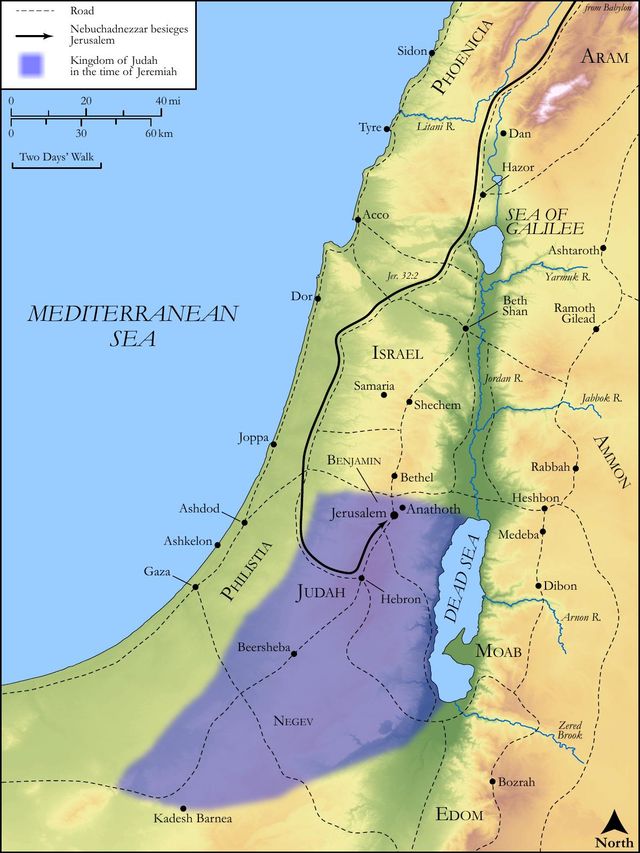
See on the biblical-era map
Study this verse
Public-domain commentary
Matthew Henry
From his Commentary on the Whole Bible. Henry comments on passages, not single verses — this entry covers Jeremiah 32:1–15. His four-level outline is real structure in the source text, so it is rendered as structure.
It appears by the date of this chapter that we are now coming very nigh to that fatal year which completed the desolations of Judah and Jerusalem by the Chaldeans. God's judgments came gradually upon them, but, they not meeting him by repentance in the way of his judgments, he proceeded in his controversy till all was laid waste, which was in the eleventh year of Zedekiah; now what is here recorded happened in the tenth. The king of Babylon's army had now invested Jerusalem and was carrying on the siege with vigour, not doubting but in a little time to make themselves masters of it, while the besieged had taken up a desperate resolution not to surrender, but to hold out to the last extremity. Now,
I.Jeremiah prophesies that both the city and the court shall fall into the hands of the king of Babylon.
He tells them expressly that the besiegers shall take the city as a prize, for God, whose city it was in a peculiar manner, will give it into their hands and put it out of his protection (Jer 32:3), - that, though Zedekiah attempt to make his escape, he shall be overtaken, and shall be delivered a prisoner into the hands of Nebuchadnezzar, shall be brought into his presence, to his great confusion and terror, he having made himself so obnoxious by breaking his faith with him, he shall hear the king of Babylon pronounce his doom, and see with what fury and indignation he will look upon him (His eyes shall behold his eyes, Jer 32:4), - that Zedekiah shall be carried to Babylon, and continue a miserable captive there, until God visit him, that is, till God put an end to his life by a natural death, as Nebuchadnezzar had long before put an end to his days by putting out his eyes. Note, Those that live in misery may be truly said to be visited in mercy when God by death takes them home to himself. And, lastly, he foretels that all their attempts to force the besiegers from their trenches shall be ineffectual: Though you fight with the Chaldeans, you shall not prosper; how should they, when God did not fight for them? Jer 32:5. See Jer 34:2, Jer 34:3.
II.For prophesying thus he is imprisoned, not in the common goal, but in the more creditable prison that was within the verge of the palace, in the king of Judah's house, and there not closely confined, but in custodia libera - in the court of the prison, where he might have good company, good air, and good intelligence brought him, and would be sheltered from the abuses of the mob; but, however, it was a prison, and Zedekiah shut him up in it for prophesying as he did, Jer 32:2, Jer 32:3. So far was he from humbling himself before Jeremiah, as he ought to have done (Ch2 36:12), that he hardened himself against him. Though he had formerly so far owned him to be a prophet as to desire him to enquire of the Lord for them (Jer 21:2), yet now he chides him for prophesying (Jer 32:3), and shuts him up in prison, perhaps not with design to punish him any further, but only to restrain him from prophesying any further, which was crime enough. Silencing God's prophets, though it is not so bad as mocking and killing them, is yet a great affront to the God of heaven. See how wretchedly the hearts of sinners are hardened by the deceitfulness of sin. Persecution was one of the sins for which God was now contending with them, and yet Zedekiah persists in it even now that he was in the depth of distress. No providences, no afflictions, will of themselves part between men and their sins, unless the grace of God work with them. Nay, some are made worse by those very judgments that should make them better.
III.Being in prison, he purchases from a near relation of his a piece of ground that lay in Anathoth, Jer 32:6, Jer 32:7, etc.
1.One would not have expected,
(1.)That a prophet should concern himself so far in the business of this world; but why not? Though ministers must not entangle themselves, yet they may concern themselves in the affairs of this life.
(2.)That one who had neither wife nor children should buy land. We find (Jer 16:2) that he had no family of his own; yet he may purchase for his own use while he lives, and leave it to the children of his relations when he dies.
(3.)One would little have thought that a prisoner should be a purchaser; how should he get money beforehand to buy land with? It is probably that he lived frugally, and saved something out of what belonged to him as a priest, which is no blemish at all to his character; but we have no reason to think that the people were kind, or that his being beforehand was owing to their generosity. Nay,
(4.)It was most strange of all that he should buy a piece of land when he himself knew that the whole land was now to be laid waste and fall into the hands of the Chaldeans, and then what good would this do him? But it was the will of God that he should buy it, and he submitted, though the money seemed to be thrown away. His kinsman came to offer it to him; it was not of his own seeking; he coveted not to lay house to house and field to field, but Providence brought it to him, and it was probably a good bargain; besides, the right of redemption belonged to him (Jer 32:8), and if he refused he would not do the kinsman's part. It is true he might lawfully refuse, but, being a prophet, in a thing of this nature he must do that which would be for the honour of his profession. It became him to fulfil all righteousness. It was land that lay within the suburbs of a priests' city, and, if he should refuse it, there was danger lest, in these times of disorder, it might be sold to one of another tribe, which was contrary to the law, to prevent which it was convenient for him to buy it. It would likewise be a kindness to his kinsman, who probably was at this time in great want of money. Jeremiah had but a little, but what he had he was willing to lay out in such a manner as might tend most to the honour of God and the good of his friends and country, which he preferred before his own private interests.
2.Two things may be observed concerning this purchase: -
(1.)How fairly the bargain was made. When Jeremiah knew by Hanameel's coming to him, as God had foretold he would, that it was the word of the Lord, that it was his mind that he should make this purchase, he made no more difficulty of it, but bought the field. And,
[1.]He was very honest and exact in paying the money. He weighted him the money, did not press him to take it upon his report, though he was his near kinsman, but weighed it to him, current money. It was seventeen shekels of silver, amounting to about forty shillings of our money. The land was probably but a little field and of small yearly value, when the purchase was so low; besides, the right of inheritance was in Jeremiah, so that he had only to buy out his kinsman's life, the reversion being his already. Some think this was only the earnest of a greater sum; but we shall not wonder at the smallness of the price if we consider what scarcity there was of money at this time and how little lands were counted upon.
[2.]He was very prudent and discreet in preserving the writings. They were subscribed before witnesses. One copy was sealed up, the other was open. One was the original, the other the counterpart; or perhaps that which was sealed up was for his own private use, the other that was open was to be laid up in the public register of conveyances, for any person concerned to consult. Due care and caution in things of this nature might prevent a great deal of injustice and contention. The deeds of purchase were lodged in the hands of Baruch, before witnesses, and he was ordered to lay them up in an earthen vessel (an emblem of the nature of all the securities this world can pretend to give us, brittle things and soon broken), that they might continue many days, for the use of Jeremiah's heirs, after the return out of captivity; for they might then have the benefit of this purchase. Purchasing reversions may be a kindness to those that come after us, and a good man thus lays up an inheritance for his children's children.
(2.)What was the design of having this bargain made. It was to signify that though Jerusalem was now besieged, and the whole country was likely to be laid waste, yet the time should come when houses, and fields, and vineyards should be again possessed in this land, Jer 32:15. As God appointed Jeremiah to confirm his predictions of the approaching destruction of Jerusalem by his own practice in living unmarried, so he now appointed him to confirm his predictions of the future restoration of Jerusalem by his own practice in purchasing this field. Note, It concerns ministers to make it to appear in their whole conversation that they do themselves believe that which they preach to others; and that they may do so, and impress it the more deeply upon their hearers, they must many a time deny themselves, as Jeremiah did in both these instances. God having promised that this land should again come into the possession of his people, Jeremiah will, on behalf of his heirs, put in for a share. Note, It is good to manage even our worldly affairs in faith, and to do common business with an eye to the providence and promise of God. Lucius Florus relates it as a great instance of the bravery of the Roman citizens that in the time of the second Punic war, when Hannibal besieged Rome and was very near making himself master of it, a field on which part of his army lay, being offered to sale at that time, was immediately purchased, in a firm belief that the Roman valour would raise the siege, lib. ii. cap. 6. And have not we much more reason to venture our all upon the word of God, and to embark in Zion's interests, which will undoubtedly be the prevailing interests at last? Non si male nunc et olim sic erit - Though now we suffer, we shall not suffer always.
Historical interpretation
Two Centuries of Reception
2 surviving comments on this verse. Each one is dated, so this reads as a timeline rather than a list.
Select a marker to jump to its quote. Markers stagger vertically where authors wrote within a few decades of each other.
Of course nothing is “too hard for the Lord.” But if we choose to apply this principle so extravagantly and harshly in our capricious imaginations, we may then make out God to have done anything we please, on the ground that it was not impossible for him to do it. We must not suppose, however, because he is able to do all things, that he has done what he has not done. But we must inquire whether he has really done it. God could, if he had liked, have furnished humankind with wings to fly with, just as he gave wings to kites. We must not, however, run to the conclusion that he did this because he was able to do it. He might also have extinguished Praxeas and all other heretics at once; it does not follow, however, that he did, simply because he was able. For it was necessary that there should be both kites and heretics; it was necessary also that the Father should be crucified. In one sense there will be something difficult even for God—namely, that which he has not done—not because he could not but because he would not do it. For with God, to be willing is to be able and to be unwilling is to be unable; all that he has willed, however, he has both been able to accomplish and has displayed his ability.
(Verses 4, 5) Behold, I will give this city into the hand of the king of Babylon, and he will capture it. And King Zedekiah of Judah will not escape from the hand of the Chaldeans, but he will be handed over to the king of Babylon, and they will speak face to face and his eyes will see his eyes. And Zedekiah will be taken to Babylon, and he will stay there until I visit him, says the Lord. But if you fight against the Chaldeans, you will not have success. This was the reason for the anger of the king, that he preferred falsehood over truth and said that both the city of Jerusalem and King Zedekiah would be captured. And what is even worse, he will see the face of the king of Babylon and speak humbly and as a captive, as the most powerful king's madness. For it is a more serious terror to see the one whom you fear, and to be subjected to the verbal accusation before enduring the torment of punishment. And he says that he will lead Zedekiah into Babylon, and he will be there. The Septuagint translates it as "one of whom is unwillingly dragged, the other one signifies willingly going." And he says that he will be there. The word is ambiguous, so as not to seem to prophesy torture and miseries. And what follows is: Until I visit him, says the Lord, and if you fight against the Chaldeans, you will have nothing prosperous, which is not found in the Septuagint. And he wisely moderated his opinion, which can be referred to both the good and the bad. For visitation, as I often said, signifies both consolation and punishment.
Continue studying Jeremiah 32:4 across the web’s major study libraries — every link below opens this exact verse, chapter, or book on the destination site.
Read & Compare
 BibleGatewayThis verse in more than 200 translations and 70 languages.
 Bible.comThe YouVersion reader — hundreds of translations, reading plans, and highlights.
 ESV.orgCrossway's official English Standard Version reader.
 NET BibleThe NET translation with 60,000+ translators' notes on every rendering decision.
 STEP BibleTyndale House's free study tool — original text, vocabulary, and scholarly resources.
 BibliaLogos Bible Software's free web reader.
 USCCBThe New American Bible (Revised Edition) with the U.S. bishops' study notes.
Commentaries
 BibleHub CommentariesDozens of classic commentaries on this verse, gathered on one page.
 StudyLightMore than 100 commentary sets — the largest collection on the web.
 BibleRefPlain-English commentary on what this verse means, verse by verse.
 Enduring WordDavid Guzik's free commentary on this chapter, widely used by Bible teachers.
 Bible Study ToolsVerse commentary alongside Greek and Hebrew study aids.
Original Language & Research
- BibleHub InterlinearThe verse word by word — original language, transliteration, and English.
- BibleHub LexiconEvery word's original-language definition and Strong's entry.
 Blue Letter BibleDeep-study tools — Strong's numbers, concordance, and word studies.
 SefariaThe Hebrew text with Rashi and centuries of Jewish commentary.
Sermons, Hymns & Audio


TrulyRandomVerse is not affiliated with these sites and doesn’t control their content. They’re linked because they’re genuinely useful.
Summary
Jeremiah 32:4 delivers a precise and unalterable prophecy concerning King Zedekiah, the final monarch of Judah. It unequivocally declares that Zedekiah will not escape the Babylonian forces, but will certainly be delivered into the hand of the king of Babylon. The prophecy further details a highly personal and humiliating encounter, stating that Zedekiah will speak face-to-face with Nebuchadnezzar, and their eyes will meet, signifying the complete, inescapable, and deeply personal fulfillment of divine judgment against Judah's rebellious king.
Context
ShowHideLiterary Context
This verse is situated within Jeremiah 32, a pivotal chapter in the prophet's ministry that masterfully juxtaposes impending judgment with future hope. Despite Jerusalem being under siege by the Babylonians and Jeremiah himself imprisoned in the court of the guard for prophesying the city's fall, God commands him to purchase a field in Anathoth (Jeremiah 32:6-15). This seemingly contradictory act serves as a powerful symbolic gesture of future restoration and God's faithfulness, even amidst immediate and severe judgment. Verse 4, however, grounds this hope in the stark reality of the present judgment, specifically detailing the inescapable fate of King Zedekiah. This prophecy of Zedekiah's capture and humiliation was precisely the message that led to Jeremiah's imprisonment by the king himself (Jeremiah 32:2-3). The immediate context thus highlights the absolute certainty of doom for the current leadership and the nation's present state, while simultaneously affirming God's unwavering promise of long-term faithfulness and restoration for His people beyond the exile.
Historical & Cultural Context
At the time of this prophecy, approximately 588-586 BC, Jerusalem was enduring its final, devastating siege by Nebuchadnezzar's Babylonian army. King Zedekiah (H6667, Tsidqîyâh), installed as a puppet king by Babylon after the first deportation of Judah's elite, had foolishly rebelled against his overlord, seeking alliances with Egypt that proved futile. This defiance was in direct opposition to Jeremiah's consistent counsel to submit to Babylon as God's instrument of judgment. Culturally, for a king to be captured and brought before a conquering monarch was the ultimate humiliation, signifying not just personal defeat but the complete subjugation of his kingdom and people. The direct, face-to-face encounter described in the prophecy underscores the profound degradation awaiting Zedekiah, stripping him of all royal dignity and power. The "Chaldeans" (H3778, Kasdîy) were the dominant ethnic group within the Neo-Babylonian Empire, often used synonymously with "Babylonians" (H894, Bâbel) in biblical texts, representing the formidable force executing God's judgment.
Key Themes
ShowHideJeremiah 32:4 powerfully articulates several core themes prevalent throughout the book of Jeremiah and the broader prophetic literature. Firstly, it highlights the inevitable judgment for persistent disobedience and covenant breaking. Zedekiah's inability to "escape" and his certain "delivery" into Babylonian hands underscore the absolute certainty of God's declared consequences for Judah's idolatry and rebellion. This theme is pervasive in Jeremiah, as seen in prophecies like Jeremiah 25:8-11. Secondly, the verse emphasizes divine sovereignty over nations and their leaders. Even the mighty Babylonian Empire, led by Nebuchadnezzar (H4428, melek, king), is portrayed as an instrument in God's hands, fulfilling His predetermined plan for Judah. This demonstrates that God remains in ultimate control, orchestrating historical events to achieve His purposes, a truth echoed in passages like Jeremiah 27:6. Finally, the prophecy conveys the theme of personal confrontation and humiliation. The vivid imagery of "mouth to mouth" and "eyes shall behold his eyes" speaks to the profound personal degradation and accountability Zedekiah would face, a direct consequence of his rejection of God's word through Jeremiah.
Exposition and Analysis
ShowHideKey Word Analysis
ShowHideThis primitive root means "to be smooth," implying "to escape (as if by slipperiness)." In this context, it signifies Zedekiah's utter inability to evade his fate. Despite any attempts he might make, God's decree ensures there will be no "slipping away" from the grasp of the Chaldeans. The use of "shall not escape" emphasizes the absolute certainty of his capture, leaving no room for hope of evasion and highlighting the futility of human resistance against divine will.
This versatile primitive root means "to give," used with a wide latitude of application including "to put," "to make," or "to hand over." Here, it powerfully conveys God's active role in Zedekiah's capture. It's not merely that he will be caught, but that he shall surely be given or handed over into the power of the king of Babylon. This highlights divine agency in the unfolding judgment, indicating that the Chaldeans are instruments of God's sovereign will, not merely acting on their own accord.
This word, often meaning "the open hand," is used here to signify power, control, or dominion. Zedekiah will not escape "out of the hand of the Chaldeans," meaning out of their control or grasp. Conversely, he will be "delivered into the hand of the king of Babylon," indicating his complete submission and transfer into Nebuchadnezzar's authority and dominion. The repetition of "hand" underscores the inescapable transfer of power and sovereignty, emphasizing the complete loss of Zedekiah's autonomy and the absolute control of his captors.
Verse Breakdown
ShowHide"And Zedekiah king of Judah shall not escape out of the hand of the Chaldeans,"
This opening clause establishes the absolute certainty of Zedekiah's capture. Despite his royal status and any efforts he might make to flee or resist, the prophecy declares that he will not succeed in evading the formidable Babylonian forces. This emphasizes the futility of human resistance when God's judgment is set in motion, highlighting the divine decree's unalterable nature.
"but shall surely be delivered into the hand of the king of Babylon,"
This phrase reinforces the first clause with even greater emphasis, utilizing a Hebrew idiom for absolute certainty ("surely be delivered"). It clarifies that Zedekiah's capture is not accidental but a predetermined act of divine intervention, where he will be actively "handed over" into the dominion and authority of Nebuchadnezzar. This underscores God's sovereignty in orchestrating the events, using the Babylonian king as His instrument of judgment.
"and shall speak with him mouth to mouth,"
This vivid imagery (H1696, dâbar for speak; H6310, peh for mouth) describes a direct, personal, and unmediated conversation between Zedekiah and Nebuchadnezzar. It signifies that there will be no intermediaries or diplomatic distance; the defeated king will be forced into an intimate, face-to-face encounter with his conqueror, likely involving interrogation, judgment, or the pronouncement of his fate. This directness underscores the profound humiliation and total loss of royal dignity.
"and his eyes shall behold his eyes;"
This final clause (H5869, ʻayin for eyes; H7200, râʼâh for behold) intensifies the personal nature of the confrontation. It paints a powerful picture of Zedekiah being compelled to look directly into the eyes of Nebuchadnezzar. This eye-to-eye contact symbolizes the ultimate submission, the acknowledgment of defeat, and the stripping away of all pretense or power. It is a moment of profound personal degradation and the visual confirmation of the prophecy's complete and inescapable fulfillment.
Literary Devices
ShowHideJeremiah 32:4 is rich in literary devices that amplify its prophetic power and emotional impact. The primary device is Prophecy itself, as the verse is a direct, declarative statement of a future event, presented with absolute certainty. This is reinforced by Repetition and Emphasis, particularly in phrases like "shall not escape" and "shall surely be delivered," which leave no doubt about the inevitability of Zedekiah's fate and the divine certainty behind it. The use of "mouth to mouth" and "eyes shall behold his eyes" employs a form of Merism (using two contrasting parts to represent a whole) to signify a complete and unmediated personal encounter, emphasizing the directness and inescapability of the confrontation. This also serves as powerful Imagery, painting a vivid mental picture of the humiliating meeting between the two kings. Furthermore, there is an element of Irony in Zedekiah's desperate attempts to escape, which are rendered futile by the divine decree that he will be brought directly before his conqueror. The precise detail of the prophecy also functions as a Foreshadowing of the historical fulfillment recorded in later biblical accounts, demonstrating God's meticulous control over history.
Theological and Thematic Connections
ShowHideJeremiah 32:4 stands as a stark testament to the unwavering truthfulness of God's prophetic word and His absolute sovereignty over human affairs. It underscores that divine judgment, once declared, is inescapable, regardless of human power or resistance. The humiliation of Zedekiah, a king, before Nebuchadnezzar serves as a potent reminder that even those in positions of ultimate earthly authority are subject to God's ultimate rule. This prophecy highlights the severe consequences of persistent disobedience and rebellion against God's revealed will, demonstrating that God holds His covenant people accountable. It also implicitly affirms God's justice, as the judgment meted out to Zedekiah and Judah was a direct result of their unfaithfulness, idolatry, and rejection of prophetic counsel. The detailed nature of the prophecy's fulfillment underscores God's meticulous attention to His declared word.
Reflection and Application
ShowHideJeremiah 32:4 offers profound lessons for contemporary believers, calling us to a deeper trust in God's character and Word. Firstly, it powerfully reinforces the absolute reliability of God's Word. Just as this specific and seemingly improbable prophecy concerning Zedekiah was fulfilled to the letter, so too can we trust in all of God's promises and warnings, whether concerning salvation, judgment, or future hope. It calls us to heed God's warnings seriously, recognizing that disobedience carries real and inevitable consequences, regardless of our status or perceived power. Secondly, the verse reminds us of God's ultimate sovereignty. Even in chaotic or seemingly uncontrollable circumstances, God remains on the throne, orchestrating events to fulfill His purposes. This should inspire both reverence and trust, knowing that His plans will prevail, even when they involve difficult or painful outcomes. Finally, Zedekiah's humiliation serves as a cautionary tale against pride and self-reliance, urging us to humble ourselves before God and align our lives with His will, rather than resisting His counsel or seeking our own escape routes from divine truth. Our true security lies not in our own strength or cunning, but in obedient submission to the Lord.
Questions for Reflection
ShowHideFAQ
ShowHideWas this prophecy literally fulfilled, and if so, how?
ShowHideYes, this prophecy was fulfilled with remarkable precision, as recorded in both Jeremiah 39:5 and 2 Kings 25:7. After Jerusalem was breached, Zedekiah attempted to escape through the king's garden, but he was captured in the plains of Jericho. He was indeed brought to Riblah, where he stood before Nebuchadnezzar, king of Babylon, fulfilling the "mouth to mouth" and "eyes shall behold his eyes" encounter. The fulfillment was even more tragic than the prophecy explicitly stated, as Nebuchadnezzar executed Zedekiah's sons before his eyes, and then put out Zedekiah's own eyes, before binding him in bronze chains and taking him to Babylon. This horrific outcome underscored the severity of God's judgment and the consequences of persistent rebellion.
Why was Zedekiah's fate so harsh, especially the personal confrontation?
ShowHideZedekiah's harsh fate was a direct consequence of his persistent rebellion against God's explicit word delivered through the prophet Jeremiah. God had commanded Judah to submit to Babylon as a form of divine discipline, and Jeremiah had consistently urged Zedekiah to comply. Zedekiah, however, repeatedly rebelled, trusting in human alliances (like with Egypt) over divine counsel (Jeremiah 37:7-10). The personal confrontation was significant because it symbolized the complete stripping away of his royal dignity and sovereignty. For a king, being brought face-to-face with his conqueror was not merely a military defeat but a profound public humiliation, demonstrating the absolute nature of God's judgment and the futility of resisting His will. It served as a powerful object lesson for all who would defy the Lord.
What is the significance of the phrase "mouth to mouth, and his eyes shall behold his eyes"?
ShowHideThis phrase is a powerful literary device emphasizing the direct, personal, and inescapable nature of the encounter between Zedekiah and Nebuchadnezzar. It signifies that there would be no intermediaries, no diplomatic distance, and no way for Zedekiah to avoid a direct confrontation with his conqueror. For a king, this was the ultimate humiliation, forcing him to acknowledge his defeat and the complete subjugation of his kingdom face-to-face. It underscored the thoroughness of God's judgment and the certainty of its fulfillment, leaving no doubt about Zedekiah's absolute loss of power and dignity. The direct eye contact, in particular, conveyed the stripping away of all pretense and the forced recognition of his conqueror's absolute authority.
Christ-Centered Fulfillment
ShowHideWhile Jeremiah 32:4 speaks of the judgment and humiliation of an earthly king, it foreshadows profound truths concerning the ultimate King, Jesus Christ. Zedekiah's inescapable capture and confrontation with Nebuchadnezzar, the instrument of God's judgment, ultimately points to the certainty of God's divine justice and the fulfillment of His word. In Christ, we see the ultimate King who willingly embraced humiliation, not as a consequence of His own sin, but as a path to redemption for humanity. Unlike Zedekiah, who was delivered into the hands of his enemy due to disobedience, Jesus, the Lamb of God who takes away the sin of the world, voluntarily delivered Himself into the hands of sinful men to fulfill the Father's redemptive plan (John 19:11). His "mouth to mouth" encounter was not with a conquering earthly king, but with His accusers, with Pilate, and ultimately with death itself, which He conquered through His resurrection. His "eyes beheld" the suffering of humanity, and through His suffering on the cross, He became the Victor over sin and death. The certainty of Zedekiah's fate highlights the even greater certainty of Christ's return, not as a defeated king, but as the triumphant King of kings and Lord of lords (Revelation 19:11-16), who will execute perfect justice and establish His eternal kingdom, a kingdom that "shall never be destroyed" (Daniel 2:44), contrasting sharply with the overthrown kingdom of Judah. Thus, Zedekiah's judgment serves as a stark reminder of God's unwavering commitment to His word, a commitment fully realized and supremely glorified in the person and redemptive work of Jesus Christ.