


Jeremiah 39:5
Bible text: King James Version (1769 Blayney text) · Public domain
Bible text: King James Version with Strong's numbers · Public domain
Bible text: Berean Standard Bible · Public domain
Bible text: American Standard Version (1901) · Public domain
Bible text: World English Bible, Messianic edition · Public domain
Bible text: Geneva Bible (1599) · Public domain
Bible text: Young's Literal Translation · Public domain
- וַיִּרְדְּפוּvai·yir·de·Fuand they pursuedH7291Conj-w ¦ V-Qal-ConsecImperf-3mpVerb Qal Consecutive Imperfect 3rd Plural Masculineוַandיִּרְדְּפוּthey pursued
- חֵילcheil[the] army ofH2428N-mscNoun Singular Masculine Construct
- כַּשְׂדִּיםkas·Dim[the] ChaldeansH3778N-properNoun Proper Location
- אַחֲרֵיהֶם'a·cha·rei·Hemafter themH310Adj-mpc ¦ 3mpAdjective Numerical Plural Masculine Constructאַחֲרֵיafterהֶםthem
- וַיַּשִּׂגוּvai·ya·Si·guand they overtookH5381Conj-w ¦ V-Hiphil-ConsecImperf-3mpVerb Hiphil Consecutive Imperfect 3rd Plural Masculineוַandיַּשִּׂגוּthey overtook
- אֶת'et<obj.>H853DirObjMParticle Object Indicator
- צִדְקִיָּהוּtzid·ki·ya·HuZedekiahH6667N-proper-mNoun Proper Masculine
- בְּעַרְבוֹתbe·'ar·Votin [the] plains ofH6160Prep-b ¦ N-fpcNoun Plural Feminine Constructבְּinעַרְבוֹת[the] plains of
- יְרֵחוֹye·re·ChoJerichoH3405N-properNoun Proper Location
- וַיִּקְחוּvai·yik·Chuand they seizedH3947Conj-w ¦ V-Qal-ConsecImperf-3mpVerb Qal Consecutive Imperfect 3rd Plural Masculineוַandיִּקְחוּthey seized
- אֹתוֹ'o·To<obj.> himH853DirObjM ¦ 3msParticle Object Indicatorאֹת<obj.>וֹhim
- וַיַּעֲלֻהוּVai·ya·'a·lu·huand they brought up himH5927Conj-w ¦ V-Hiphil-ConsecImperf-3mp ¦ 3msVerb Hiphil Consecutive Imperfect 3rd Plural Masculineוַandיַּעֲלֻthey brought upהוּhim
- אֶל'eltoH413PrepPreposition
- נְבוּכַדְרֶאצַּרne·vu·khad·re·TzarNebuchadnezzarH5019N-proper-mNoun Proper Masculine
- מֶלֶךְMe·lekh[the] king ofH4428N-mscNoun Singular Masculine Construct
- בָּבֶלba·VelBabylonH894N-properNoun Proper Location
- רִבְלָתָהriv·La·tahRiblah towardsH7247N-proper ¦ SfxNoun Proper LocationרִבְלָתָRiblahהtowards
- בְּאֶרֶץbe·'E·retzin [the] land ofH776Prep-b ¦ N-fscNoun Singular Feminine Constructבְּinאֶרֶץ[the] land of
- חֲמָתcha·MatHamathH2574N-properNoun Proper Location
- וַיְדַבֵּרvay·da·Berand he spokeH1696Conj-w ¦ V-Piel-ConsecImperf-3msVerb Piel Consecutive Imperfect 3rd Singular Masculineוַandיְדַבֵּרhe spoke
- אִתּוֹ'i·Towith himH854Prep ¦ 3msPreposition Definiteאִתּwithוֹhim
- מִשְׁפָּטִיםmish·pa·TimjudgmentsH4941N-mpNoun Plural Masculine Absolute
English is a literal word-by-word gloss of the Hebrew, not the KJV's wording. Why?
This is the original text the KJV's translators worked from — each Hebrew word with its own literal English meaning in this verse, prepared by scholars at Tyndale House, Cambridge. The KJV translates whole sentences, not word by word, so its wording differs: one Hebrew word can become several English words, and the KJV may choose “the LORD” where the gloss reads “Yahweh”. Both are faithful — they answer different questions. For the KJV's own rendering, switch to the KJV text.
Details
See on the biblical-era map
Study this verse
Public-domain commentary
Matthew Henry
From his Commentary on the Whole Bible. Henry comments on passages, not single verses — this entry covers Jeremiah 39:1–10. His two-level outline is real structure in the source text, so it is rendered as structure.
We were told, in the close of the foregoing chapter, that Jeremiah abode patiently in the court of the prison, until the day that Jerusalem was taken. He gave the princes no further disturbance by his prophesying, nor they him by their persecutions; for he had no more to say than what he had said, and, the siege being carried on briskly, God found them other work to do. See here what it came to.
I.The city is at length taken by storm; for how could it hold out when God himself fought against it? Nebuchadnezzar's army sat down before it in the ninth year of Zedekiah, in the tenth month (Jer 39:1), in the depth of winter. Nebuchadnezzar himself soon after retired to take his pleasure, and left his generals to carry on the siege: they intermitted it awhile, but soon renewed it with redoubled force and vigour. At length, in the eleventh year, in the fourth month, about midsummer, they entered the city, the soldiers being so weakened by famine, and all their provisions being now spent, that they were not able to make any resistance, Jer 39:2. Jerusalem was so strong a place that nobody would have believed the enemy could ever enter its gates, Lam 4:12. But sin had provoked God to withdraw his protection, and then, like Samson when his hair was cut, it was weak as other cities.
II.The princes of the king of Babylon take possession of the middle gate, Jer 39:3.
Some think that this was the same with that which is called the second gate (Zep 1:10), which is supposed to be in the middle wall that divided between one part of the city and the other. Here they cautiously made a half, and durst not go forward into so large a city, among men that perhaps would sell their lives as dearly as they could, until they had given directions for the searching of all places, that they might not be surprised by any ambush. They sat in the middle gate, thence to take a view of the city and give orders. The princes are here named, rough and uncouth names they are, to intimate what a sad change sin had made; there, where Eliakim and Hilkiah, who bore the name of the God of Israel, used to sit, now sit Nergal-sharezer, and Samgar-nebo, etc., who bore the names of the heathen gods. Rab-saris and Rab-mag are supposed to be not the names of distinct persons, but the titles of those whose names go before. Sarsechim was Rab-saris, that is, captain of the guard; and Nergal-sharezer, to distinguish him from the other of the same name that is put first, is called Ram-mag - camp-master, either muster-master or quarter-master: these and the other great generals sat in the gate. And now was fulfilled what Jeremiah prophesied long since (Jer 1:15), that the families of the kingdoms of the north should set every one his throne at the entering of the gates of Jerusalem. Justly do the princes of the heathen set up themselves there, where the gods of the heathen had been so often set up.
III.Zedekiah, having in disguise perhaps seen the princes of the king of Babylon take possession of one of the gates of the city, thought it high time to shift for his own safety, and, loaded with guilt and fear, he went out of the city, under no other protection but that of the night (Jer 39:4), which soon failed him, for he was discovered, pursued, and overtaken. Though he made the best of his way, he could make nothing of it, could not get forward, but in the plains of Jericho fell into the hands of the pursuers, Jer 39:5. Thence he was brought prisoner to Riblah, where the king of Babylon passed sentence upon him as a rebel, not sentence of death, but, one many almost say, a worse thing. For,
1.He slew his sons before his eyes, and they must all be little, some of them infants, for Zedekiah himself was now but thirty-two years of age. The death of these sweet babes must needs be so many deaths to himself, especially when he considered that his own obstinacy was the cause of it, for he was particularly told of this thing: They shall bring forth thy wives and children to the Chaldeans, Jer 38:23.
2.He slew all the nobles of Judah (Jer 39:6), probably not those princes of Jerusalem who had advised him to this desperate course (it would be a satisfaction to him to see them cut off), but the great men of the country, who were innocent of the matter.
3.He ordered Zedekiah to have his eyes put out (Jer 39:7), so condemning him to darkness for life who had shut his eyes against the clear light of God's word, and was of those princes who will not understand, but walk on in darkness, Psa 82:5.
4.He bound him with two brazen chains or fetters (so the margin reads it), to carry him away to Babylon, there to spend the rest of his days in misery. All this sad story we had before, Kg2 25:4, etc.
IV.Some time afterwards the city was burnt, temple and palace and all, and the wall of it broken down, Jer 39:8.
"O Jerusalem, Jerusalem! this comes of killing the prophets, and stoning those that were sent to thee. O Zedekiah, Zedekiah! this thou mightest have prevented if thou wouldst but have taken God's counsel, and yielded in time."
V.The people that were left were all carried away captives to Babylon, Jer 39:9.
Now they must bid a final farewell to the land of their nativity, that pleasant land, and to all their possessions and enjoyments in it, must be driven some hundreds of miles, like beasts, before the conquerors, that were now their cruel masters, must lie at their mercy in a strange land, and be servants to those who would be sure to rule them with rigour. The word tyrant is originally a Chaldee word, and is often used for lords by the Chaldee paraphrast, as if the Chaldeans, when they were lords, tyrannized more than any other: we have reason to think that the poor Jews had reason to say so. Some few were left behind, but they were the poor of the people, that had nothing to lose, and therefore never made any resistance. And they not only had their liberty, and were left to tarry at home, but the captain of the guard gave them vineyards and fields at the same time, such as they were never masters of before, Jer 39:10. Observe here,
1.The wonderful changes of Providence. Some are abased, others advanced, Sa1 2:5. The hungry are filled with good things, and the rich sent empty away. The ruin of some proves the rise of others. Let us therefore in our abundance rejoice as though we rejoiced not, and in our distresses weep as though we wept not.
2.The just retributions or Providence. The rich had been proud oppressors, and now they were justly punished for their injustice; the poor had been patient sufferers, and now they were graciously rewarded for their patience and amends made them for all their losses; for verily there is a God that judges in the earth, even in this world, much more in the other.
Historical interpretation
Historical reception
1 surviving comment on this verse from the historical church.
[Daniel 7:1] "In the first year of Belshazzar, King of Babylon, Daniel beheld a dream. And a vision of his head upon his bed. And when he wrote the dream down, he comprehended it in a few words and gave a brief summary of it, saying..." This section which we now undertake to explain, and also the subsequent section which we are going to discuss, is historically prior to the two previous sections. For this present section and that which follows it are recorded to have taken place in the first and third years of the reign of King Belshazzar (Jeremiah 39) [Jerome's citation of Jeremiah 39 seems quite pointless in this connection]. But the section which we read previously to the one just preceding this, is recorded to have taken place in the last year, indeed on the final day, of Belshaz-zar's reign. And we meet this phenomenon not only in Daniel but also in Jeremiah [cf. Jeremiah 35 and Jeremiah 34] and Ezekiel (Ezekiel 17), as we shall be able to show, if life spares us that long. But in the earlier portion of the book, the historical order has been followed, namely the events which occurred in the time of Nebuchadnezzar, and Belshazzar, and Darius or Cyrus. But in the passages now before us an account is given of various visions which were beheld on particular occasions and of which only the prophet himself was aware, and which therefore lacked any importance as signs or revelations so far as the barbarian nations were concerned. But they were written down only that a record of the things beheld might be preserved for posterity.
Continue studying Jeremiah 39:5 across the web’s major study libraries — every link below opens this exact verse, chapter, or book on the destination site.
Read & Compare
 BibleGatewayThis verse in more than 200 translations and 70 languages.
 Bible.comThe YouVersion reader — hundreds of translations, reading plans, and highlights.
 ESV.orgCrossway's official English Standard Version reader.
 NET BibleThe NET translation with 60,000+ translators' notes on every rendering decision.
 STEP BibleTyndale House's free study tool — original text, vocabulary, and scholarly resources.
 BibliaLogos Bible Software's free web reader.
 USCCBThe New American Bible (Revised Edition) with the U.S. bishops' study notes.
Commentaries
 BibleHub CommentariesDozens of classic commentaries on this verse, gathered on one page.
 StudyLightMore than 100 commentary sets — the largest collection on the web.
 BibleRefPlain-English commentary on what this verse means, verse by verse.
 Enduring WordDavid Guzik's free commentary on this chapter, widely used by Bible teachers.
 Bible Study ToolsVerse commentary alongside Greek and Hebrew study aids.
Original Language & Research
- BibleHub InterlinearThe verse word by word — original language, transliteration, and English.
- BibleHub LexiconEvery word's original-language definition and Strong's entry.
 Blue Letter BibleDeep-study tools — Strong's numbers, concordance, and word studies.
 SefariaThe Hebrew text with Rashi and centuries of Jewish commentary.
Sermons, Hymns & Audio


TrulyRandomVerse is not affiliated with these sites and doesn’t control their content. They’re linked because they’re genuinely useful.
Summary
Jeremiah 39:5 vividly recounts the climactic and tragic moment of King Zedekiah's capture by the Babylonian forces, marking the definitive culmination of Judah's rebellion and the fulfillment of divine judgment. After a desperate attempt to escape the besieged Jerusalem, Zedekiah and his remaining soldiers were swiftly overtaken in the open plains of Jericho. This verse precisely details their apprehension and subsequent presentation before the formidable Nebuchadnezzar, king of Babylon, at his military headquarters in Riblah in the land of Hamath, where the final, severe judgment against the last king of Judah was formally pronounced, sealing the fate of the Davidic monarchy and initiating the full Babylonian exile.
Context
ShowHideLiterary Context
Jeremiah 39 opens with a precise chronological marker, detailing the exact date of Jerusalem's breach and fall in Jeremiah 39:1-2. This immediate context places Jeremiah 39:5 squarely within the catastrophic aftermath of the city's collapse. The preceding verses vividly portray the relentless siege and the desperate conditions within Jerusalem, culminating in Zedekiah's nocturnal escape attempt through a secret gate, accompanied by his soldiers, as described in Jeremiah 39:4. Jeremiah 39:5 then immediately follows, narrating the swift and decisive pursuit and capture of the fleeing king. This verse serves as a pivotal turning point in the narrative, transitioning from the siege itself to the personal judgment upon the king and the subsequent dismantling of the kingdom, which is further elaborated in the severe consequences detailed in Jeremiah 39:6-7, including the execution of his sons and nobles, and Zedekiah's blinding and imprisonment.
Historical & Cultural Context
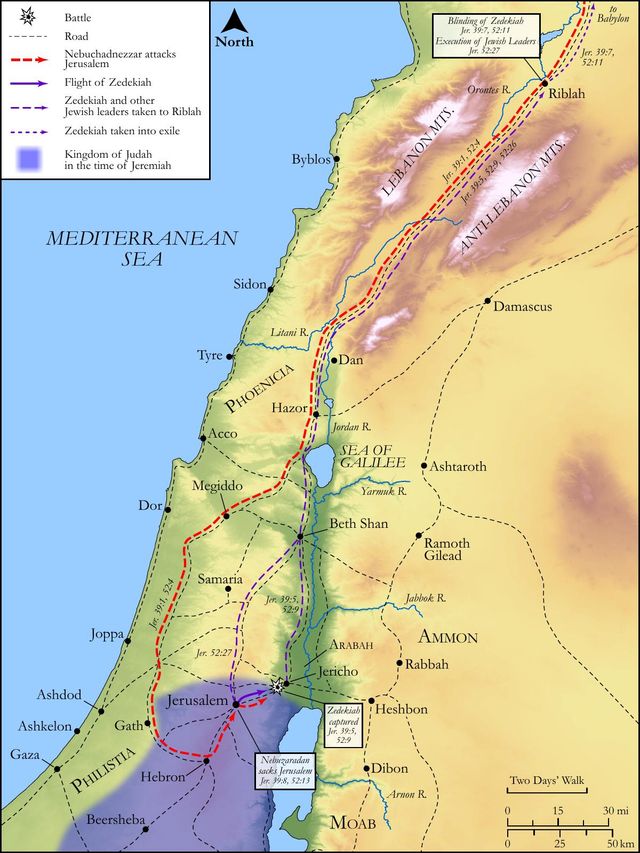
The events of Jeremiah 39:5 unfold during the final, brutal stages of the Neo-Babylonian Empire's dominance under Nebuchadnezzar II. Jerusalem had endured a grueling siege for over two years, a testament to both Babylonian military might and the city's desperate resilience. Jericho, strategically located in the Jordan Valley, offered a potential escape route for Zedekiah across the Jordan River into Transjordan. However, its open plains made it a vulnerable place for a fleeing party to be intercepted. Riblah, situated in the Orontes Valley in the land of Hamath (modern-day Syria), served as Nebuchadnezzar's primary military headquarters during his extensive campaigns against Judah and other western states. This strategic location allowed him to efficiently oversee military operations in the Levant without needing to return to distant Babylon. The practice of bringing captured kings before the conquering monarch for judgment was a common and deeply symbolic custom of conquering kings, signifying absolute victory and the vanquished king's complete subjugation. The severity of the judgment, often including blinding and the execution of heirs, was a typical means of ensuring no future rebellion and definitively erasing the defeated dynasty.
Key Themes
ShowHideThis verse powerfully underscores several key themes woven throughout the prophetic book of Jeremiah. It serves as a stark illustration of Divine Judgment and Consequences, demonstrating the inevitable and severe outcome of Judah's persistent rebellion against God and Zedekiah's stubborn refusal to heed God's warnings delivered through Jeremiah. The king's capture directly fulfills earlier prophecies concerning his fate, highlighting the undeniable Fulfillment of Prophecy (e.g., Jeremiah 32:4 explicitly states Zedekiah will be brought before the king of Babylon, and Jeremiah 34:3 foretells his personal confrontation with Nebuchadnezzar). Even amidst the actions of pagan kings and empires, the Sovereignty of God is profoundly evident; Nebuchadnezzar, though acting out of his own imperial ambitions, was an unwitting instrument in God's overarching plan to bring righteous judgment upon Judah for its pervasive idolatry and covenant unfaithfulness. Finally, Zedekiah's capture and subsequent fate mark the definitive End of an Era—the tragic collapse of the Davidic monarchy in Judah and the beginning of the long, painful period of the Babylonian captivity, a pivotal and transformative moment in Israelite history and a powerful testament to the wages of sin.
Exposition and Analysis
ShowHideKey Word Analysis
ShowHideFrom חוּל; "probably a force, whether of men, means or other resources; an army, wealth, virtue, valor, strength." In this context, "the Chaldeans' army" specifically denotes the formidable military might and well-resourced fighting force of the Babylonians. The term conveys not merely a collection of soldiers, but a powerful, effective, and relentless military apparatus capable of executing a successful and decisive pursuit and capture.
A primitive root; "to reach (literally or figuratively); ability, be able, attain (unto), (be able to, can) get, lay at, put, reach, remove, wax rich, [idiom] surely, (over-) take (hold of, on, upon)." Here, this verb precisely describes the successful culmination of the Chaldean pursuit, indicating that Zedekiah's desperate escape attempt was futile and that the Babylonians effectively "caught up with" and "apprehended" him, demonstrating their superior speed, strategic advantage, and determination.
From שָׁפַט; "properly, a verdict (favorable or unfavorable) pronounced judicially, especially a sentence or formal decree... abstractly, justice." When Nebuchadnezzar "gave judgment upon him," it was not a casual conversation or an informal decision, but a formal, authoritative pronouncement of sentence. This term underscores the legal, official, and severe nature of the proceedings, indicating that Zedekiah's fate was determined by a formal, albeit foreign and conquering, legal process, leading directly to the severe consequences detailed in the subsequent verses.
Verse Breakdown
ShowHide"But the Chaldeans' army pursued after them, and overtook Zedekiah in the plains of Jericho:"
This clause details the immediate and decisive action following Zedekiah's desperate escape from Jerusalem. The "Chaldeans' army" (the formidable Babylonian forces) did not relent but actively "pursued" the fleeing king and his remaining men with relentless determination. The phrase "overtook Zedekiah" highlights the swift and successful culmination of their pursuit, bringing an abrupt and ignominious end to the king's desperate flight. The specified location, "the plains of Jericho," is significant, as it was a relatively open and exposed area where escape was exceedingly difficult once spotted, and it lay on a common escape route towards the Jordan River, which Zedekiah likely intended to cross.
"and when they had taken him, they brought him up to Nebuchadnezzar king of Babylon to Riblah in the land of Hamath,"
This part describes the immediate and formal consequence of Zedekiah's capture. Zedekiah, now a prisoner of war, was "taken" and then "brought him up" (a phrase indicating a journey to a higher authority or a more significant, formal location) to the supreme commander of the Babylonian forces, King Nebuchadnezzar himself. The precise geographical location, "Riblah in the land of Hamath," identifies Nebuchadnezzar's established military headquarters. This detail emphasizes the formality and immense importance of the encounter, signifying that it was here, away from the chaos of the besieged city, that the ultimate and final decisions regarding Judah's future and Zedekiah's personal fate would be made by the conquering monarch.
"where he gave judgment upon him."
This final, concise clause succinctly states the ultimate purpose of Zedekiah's transportation to Riblah. Nebuchadnezzar, as the absolute victorious monarch, exercised his supreme authority to "give judgment" upon the captured king. This was a formal legal and political act, signifying the definitive end of Zedekiah's reign and the imposition of the conqueror's absolute will. This judgment would involve severe punishment, as detailed in the subsequent verses of Jeremiah 39, and would serve as a stark warning to any other potential rebels against Babylonian hegemony.
Literary Devices
ShowHideJeremiah 39:5 employs several potent literary devices to convey its powerful and tragic message. The rapid succession of active verbs—"pursued," "overtook," "taken," "brought him up," "gave judgment"—creates a compelling sense of Pacing and Dramatic Irony. The swiftness of Zedekiah's capture, immediately after his desperate and hopeful escape attempt, starkly underscores the futility of his resistance and the inevitability of God's predetermined judgment. The precise mention of specific geographical locations like "the plains of Jericho" and "Riblah in the land of Hamath" serves as Verisimilitude, grounding the narrative in concrete, historical reality and emphasizing the factual accuracy of the events. Furthermore, the entire scene functions as profound Symbolism: Zedekiah's ignominious capture represents the complete and irreversible collapse of the Davidic monarchy and the nation of Judah, while Nebuchadnezzar's pronouncement of "judgment" embodies the divine verdict against a disobedient people, even though it is delivered through the agency of a pagan king. The stark contrast between Zedekiah's initial hopeful flight and his ultimate, humiliating capture highlights the deep Tragedy of his choices and the severe consequences of his persistent rejection of prophetic warnings.
Theological and Thematic Connections
ShowHideJeremiah 39:5 serves as a stark and undeniable testament to the sovereign hand of God in human history, even amidst the seemingly chaotic events of war and political upheaval. Zedekiah's capture is not merely a military defeat but the direct fulfillment of divine prophecy, underscoring God's unwavering commitment to His spoken word and His unyielding justice. Despite Judah's persistent idolatry, covenant unfaithfulness, and stubborn refusal to repent, God remained faithful to His covenant, allowing judgment to fall as a necessary and righteous consequence of disobedience. This event profoundly reveals that no human power, no strategic escape, no political maneuvering can ultimately thwart the ultimate purposes of the Almighty. It highlights the timeless biblical principle that rebellion against divine truth inevitably leads to severe consequences, while also powerfully affirming God's ability to use even pagan rulers and empires as unwitting instruments for His righteous decrees and the execution of His divine plan.
Reflection and Application
ShowHideJeremiah 39:5 offers profound and timeless lessons for contemporary believers, serving as a powerful cautionary tale. Zedekiah's desperate flight and swift capture underscore the futility of resisting God's revealed will, even when it seems difficult or counter-intuitive. His dramatic downfall highlights the danger of relying on human strategies, political alliances, or personal ingenuity when God's judgment or a divine directive is at hand. For us today, this narrative calls for deep introspection into our own lives. Are we diligently heeding God's Word and the promptings of His Spirit, or are we, like Zedekiah, attempting to find our own way out of difficult situations, perhaps ignoring divine counsel or convenient truths? This verse powerfully reminds us that true security, lasting peace, and genuine freedom are found not in evasion, self-reliance, or rebellion, but in humble submission to God's sovereignty and His unchanging truth. It challenges us to trust God's perfect plan, even when it involves hardship, requires difficult choices, or seems counter to our immediate desires, knowing with certainty that His purposes will ultimately prevail for our good and His glory.
Questions for Reflection
ShowHideFAQ
ShowHideWhat was the significance of Riblah in this context?
ShowHideRiblah (H7247, meaning "fertile") was a strategically vital location in the land of Hamath (modern Syria), situated in the fertile Orontes Valley. For Nebuchadnezzar, it served as a crucial and well-established military headquarters during his extensive campaigns in the Levant. Its central location allowed him to efficiently maintain control over his vast forces, secure supply lines, and administer his conquered territories without needing to return to distant Babylon. This made it an ideal and logical place to bring captured dignitaries like Zedekiah for formal judgment and to consolidate Babylonian power over the entire region, as seen in this verse and further emphasized in 2 Kings 25:6-7.
Christ-Centered Fulfillment
ShowHideWhile Jeremiah 39:5 depicts the tragic end of an earthly king and the collapse of a human kingdom, it subtly but profoundly points forward to a greater King and an enduring, eternal Kingdom. Zedekiah, a descendant of David, ultimately failed to uphold the covenant and faced divine judgment, leading to the temporary cessation of the Davidic monarchy in Judah. This profound brokenness and the desperate need for a righteous, faithful King is a recurring prophetic theme throughout the Old Testament, powerfully foreshadowing the coming of Jesus Christ. Unlike Zedekiah, who desperately fled from judgment only to be captured and punished, Jesus, the true and perfect Son of David, willingly submitted to the ultimate judgment on the cross, not for His own sin, but as the spotless Lamb of God who bore the sins of humanity (2 Corinthians 5:21). His capture and trial were not a sign of His weakness or the futility of His mission, but a profound demonstration of His sovereign power and obedient love, as He Himself declared that no one could take His life from Him, but He laid it down freely (John 10:18). Furthermore, while Zedekiah's judgment at Riblah marked the definitive end of an era and a dynasty, Christ's judgment on the cross and His subsequent glorious resurrection established an eternal kingdom, one that will never be destroyed or overtaken (Daniel 7:14). He is the King who was "overtaken" by death in the tomb, only to conquer it decisively, offering true freedom, spiritual life, and an eternal inheritance to all who believe, thereby perfectly fulfilling the promise of a righteous Branch from David's line (Jeremiah 23:5-6).