


Jeremiah 52:26
Bible text: King James Version (1769 Blayney text) · Public domain
Bible text: Berean Standard Bible · Public domain
Bible text: American Standard Version (1901) · Public domain
Bible text: World English Bible, Messianic edition · Public domain
Bible text: Geneva Bible (1599) · Public domain
Bible text: Young's Literal Translation · Public domain
- וַיִּקַּחvai·yi·Kachand he tookH3947Conj-w ¦ V-Qal-ConsecImperf-3msVerb Qal Consecutive Imperfect 3rd Singular Masculineוַandיִּקַּחhe took
- אוֹתָם'o·Tam<obj.> themH853DirObjM ¦ 3mpParticle Object Indicatorאוֹתָ<obj.>םthem
- נְבוּזַרְאֲדָןne·vu·zar·'a·DanNebuzaradanH5018N-proper-mNoun Proper Masculine
- רַבrav[the] chief ofH7227N-mscNoun Singular Masculine Construct
- טַבָּחִיםta·ba·Chim[the] bodyguardsH2876N-mpNoun Plural Masculine Absolute
- וַיֹּלֶךְvai·Yo·lekhand he broughtH1980Conj-w ¦ V-Hiphil-ConsecImperf-3msVerb Hiphil Consecutive Imperfect 3rd Singular Masculineוַandיֹּלֶךְhe brought
- אוֹתָם'o·Tam<obj.> themH853DirObjM ¦ 3mpParticle Object Indicatorאוֹתָ<obj.>םthem
- אֶל'eltoH413PrepPreposition
- מֶלֶךְMe·lekh[the] king ofH4428N-mscNoun Singular Masculine Construct
- בָּבֶלba·VelBabylonH894N-properNoun Proper Location
- רִבְלָתָהriv·La·tahRiblah towardsH7247N-proper ¦ SfxNoun Proper LocationרִבְלָתָRiblahהtowards
English is a literal word-by-word gloss of the Hebrew, not the KJV's wording. Why?
This is the original text the KJV's translators worked from — each Hebrew word with its own literal English meaning in this verse, prepared by scholars at Tyndale House, Cambridge. The KJV translates whole sentences, not word by word, so its wording differs: one Hebrew word can become several English words, and the KJV may choose “the LORD” where the gloss reads “Yahweh”. Both are faithful — they answer different questions. For the KJV's own rendering, switch to the KJV text.
Details
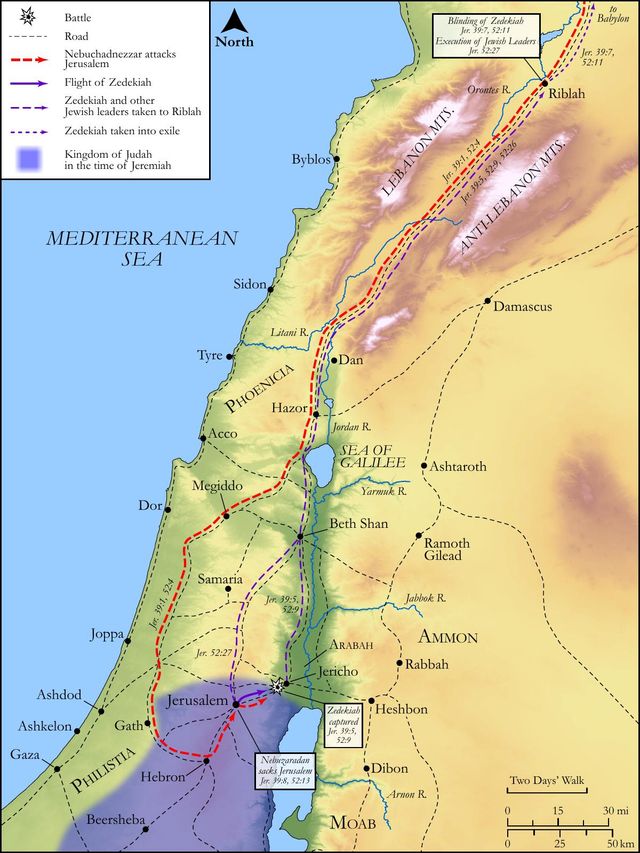
See on the biblical-era map
Study this verse
Public-domain commentary
Matthew Henry
From his Commentary on the Whole Bible. Henry comments on passages, not single verses — this entry covers Jeremiah 52:24–30.
We have here a very melancholy account, 1. Of the slaughter of some great men, in cold blood, at Riblah, seventy-two in number (according to the number of the elders of Israel, Num 11:24, Num 11:25), so they are computed, Kg2 25:18, Kg2 25:19. We read there of five out of the temple, two out of the city, five out of the court, and sixty out of the country. The account here agrees with that, except in one article; there it is said that there were five, here there were seven, of those that were near the king, which Dr. Lightfoot reconciles thus, that he took away seven of those that were near the king, but two of them were Jeremiah himself and Ebed-melech, who were both discharged, as we have read before, so that there were only five of them put to death, and so the number was reduced to seventy-two, some of all ranks, for they had all corrupted their way; and it is probable that such were made examples of as had been most forward to excite and promote the rebellion against the king of Babylon. Seraiah the chief priest is put first, whose sacred character could not exempt him from this stroke; how should it, when he himself had profaned it by sin? Seraiah the prince was a quiet prince (Jer 51:59), but perhaps Seraiah the priest was not so, but unquiet and turbulent, by which he had made himself obnoxious to the king of Babylon. The leaders of this people had caused them to err, and now they are in a particular manner made monuments of divine justice. 2. Of the captivity of the rest. Come and see how Judah was carried away captive out of his own land (Jer 52:27), and how it spued them out as it spued out the Canaanites that went before them, which God had told them it would certainly do if they trod in their steps and copied out their abominations, Lev 18:28. Now here is an account, (1.) Of two captivities which we had an account of before, one in the seventh year of Nebuchadnezzar (the same with that which is said to be in his eighth year, Kg2 24:12), another in his eighteenth year, the same with that which is said (Jer 52:12) to be in his nineteenth year. But the sums here are very small, in comparison with what we find expressed concerning the former (Kg2 24:14, Kg2 24:16), when there were 18,000 carried captive, whereas here they are said to be 3023; they are also small in comparison with what we may reasonably suppose concerning the latter; for, when all the residue of the people were carried away (Jer 52:15), one would think there should be more than 832 souls; therefore Dr. Lightfoot conjectures that, these accounts being joined to the story of the putting to death of the great men at Riblah, all that are here said to be carried away were put to death as rebels. (2.) Of a third captivity, not mentioned before, which was in the twenty-third year of Nebuchadnezzar, four years after the destruction of Jerusalem (Jer 52:30): Then Nebuzaradan came, and carried away 745 Jews; it is probable that this was done in revenge of the murder of Gedaliah, which was another rebellion against the king of Babylon, and that those who were now taken were aiders and abetters of Ishmael in that murder, and were not only carried away, but put to death for it; yet this is uncertain. If this be the sum total of the captives (all the persons were 4600, Jer 52:30), we may see how strangely they were reduced from what they had been, and may wonder as much how they came to be so numerous again as afterwards we find them; for it should seem that, as at first in Egypt, so again in Babylon, the Lord made them fruitful in the land of their affliction, and the more they were oppressed the more they multiplied. And the truth is, this people were often miracles both of judgment and mercy.
Continue studying Jeremiah 52:26 across the web’s major study libraries — every link below opens this exact verse, chapter, or book on the destination site.
Read & Compare
 BibleGatewayThis verse in more than 200 translations and 70 languages.
 Bible.comThe YouVersion reader — hundreds of translations, reading plans, and highlights.
 ESV.orgCrossway's official English Standard Version reader.
 NET BibleThe NET translation with 60,000+ translators' notes on every rendering decision.
 STEP BibleTyndale House's free study tool — original text, vocabulary, and scholarly resources.
 BibliaLogos Bible Software's free web reader.
 USCCBThe New American Bible (Revised Edition) with the U.S. bishops' study notes.
Commentaries
 BibleHub CommentariesDozens of classic commentaries on this verse, gathered on one page.
 StudyLightMore than 100 commentary sets — the largest collection on the web.
 BibleRefPlain-English commentary on what this verse means, verse by verse.
 Enduring WordDavid Guzik's free commentary on this chapter, widely used by Bible teachers.
 Bible Study ToolsVerse commentary alongside Greek and Hebrew study aids.
Original Language & Research
- BibleHub InterlinearThe verse word by word — original language, transliteration, and English.
- BibleHub LexiconEvery word's original-language definition and Strong's entry.
 Blue Letter BibleDeep-study tools — Strong's numbers, concordance, and word studies.
 SefariaThe Hebrew text with Rashi and centuries of Jewish commentary.
Sermons, Hymns & Audio


TrulyRandomVerse is not affiliated with these sites and doesn’t control their content. They’re linked because they’re genuinely useful.
Summary
Jeremiah 52:26 meticulously records a pivotal moment in the final stages of Judah's demise: the systematic collection and deportation of its remaining leaders by Nebuzaradan, the chief of Nebuchadnezzar's imperial guard, to Riblah. This act served as the definitive culmination of God's judgment against a disobedient Judah, marking the complete dismantling of its political and religious infrastructure and signifying the irreversible end of its independent kingdom, as its spiritual and societal architects were brought before their foreign conqueror for final sentencing.
Context
ShowHideLiterary Context
Jeremiah 52 functions as a historical appendix to the prophetic book, offering a detailed, factual account of Jerusalem's fall and the subsequent exile, thereby validating the prophecies of judgment articulated throughout Jeremiah. This chapter closely parallels the narrative found in 2 Kings 25, providing crucial historical grounding for Jeremiah's often dire pronouncements. Specifically, Jeremiah 52:26 follows the precise enumeration of prominent Judean captives in Jeremiah 52:24-25, including chief priests, temple officers, and royal advisors. The verse thus describes the final disposition of these captured elites, emphasizing the thoroughness of the Babylonian conquest and the complete eradication of Judah's leadership structure, leading them to the place of ultimate judgment.
Historical & Cultural Context
The events of Jeremiah 52:26 are set in the immediate aftermath of Jerusalem's destruction in 586 BC, a period of profound national trauma for Judah. Nebuzaradan was a high-ranking Babylonian official, serving as the "captain of the guard," a title indicating his role as chief of the royal bodyguard and, by extension, the king's executioner or enforcer of royal decrees. His involvement underscores the official, authoritative, and irreversible nature of the deportations. Riblah, situated in the land of Hamath (modern Syria), was strategically vital as King Nebuchadnezzar's military headquarters during his campaigns against the Levant, including Judah and Egypt. Culturally, Riblah gained infamy as the site where captured Judean royalty and officials faced brutal judgment and execution. It was here that King Zedekiah suffered the execution of his sons before his eyes, followed by his own blinding and subsequent deportation to Babylon, thereby cementing Riblah's grim reputation as the place where Judah's sovereignty was definitively extinguished.
Key Themes
ShowHideThis verse powerfully encapsulates several overarching theological and narrative themes central to Jeremiah and the broader Old Testament historical narrative. Firstly, it unmistakably demonstrates the Divine Judgment Fulfilled, illustrating that God's persistent warnings through His prophets, particularly Jeremiah, regarding Judah's chronic idolatry and covenant infidelity, were now being brought to a devastating culmination. The exile was not merely a geopolitical shift but a direct, divinely orchestrated consequence of national sin, as prophesied in Jeremiah 25:11. Secondly, the verse signifies The End of an Era, marking the definitive collapse of the independent Kingdom of Judah, the cessation of the Davidic monarchy's earthly reign, and the conclusion of the First Temple period. The removal of leadership to a foreign land for judgment symbolized the complete dismantling of the nation's political and religious identity. Finally, even amidst this profound devastation, the Sovereignty of God is strikingly evident. Nebuzaradan and Nebuchadnezzar, though pagan rulers, were unwitting instruments in God's hands, executing His divine purposes for His people, both in judgment and, ultimately, in preparing them for future restoration.
Exposition and Analysis
ShowHideKey Word Analysis
ShowHideThis is the proper name of the Babylonian general, a high-ranking official who served as the chief of Nebuchadnezzar's guard. His name, of foreign origin, signifies his Babylonian identity and his direct, authoritative role in the destruction of Jerusalem and the subsequent deportations. His prominence in this verse underscores the official and decisive nature of the actions taken against Judah's leadership.
This word denotes abundance, greatness, or chief rank. When combined with "guard" (ṭabbâch), it forms the title "chief of the guard" or "chief officer." It emphasizes Nebuzaradan's high authority and his position as the principal commander responsible for the royal household's security and, by extension, the execution of royal decrees, including judgments and deportations.
This term literally means "butcher" or "slaughterer," but in a broader sense, it refers to a "lifeguardsman" or "executioner." This dual meaning highlights the nature of Nebuzaradan's role: he was not only the commander of the king's personal security detail but also the one responsible for carrying out royal judgments, often involving executions. This title underscores the severity and finality of the fate awaiting the Judean captives.
Verse Breakdown
ShowHide"So Nebuzaradan the captain of the guard took them,"
This clause immediately identifies the principal agent of the action, Nebuzaradan, and his high-ranking, authoritative position within the Babylonian hierarchy. The phrase "took them" refers specifically to the prominent individuals enumerated in the preceding verses (Jeremiah 52:24-25), including chief priests, temple officers, royal advisors, and other influential figures. This signifies the systematic apprehension and removal of Judah's remaining spiritual and political leadership, emphasizing their powerlessness in the face of Babylonian might.
"and brought them"
This continues the action initiated by Nebuzaradan, emphasizing the physical transportation of the captives. It implies a deliberate, organized, and forceful movement, not a chaotic flight. This underscores the captives' complete submission to Babylonian authority and their forced relocation, marking a definitive break from their homeland and former status.
"to the king of Babylon to Riblah."
This specifies both the ultimate authority behind the deportation and the precise destination. The "king of Babylon" is Nebuchadnezzar, the supreme ruler whose will was being executed. Riblah was his strategic military headquarters, a place where he personally oversaw military operations and pronounced judgment on captured enemies. Bringing the Judean leaders to Riblah meant they were being presented directly before the ultimate authority of their conqueror for final sentencing, signifying the complete and irreversible subjugation of Judah.
Literary Devices
ShowHideThe verse primarily employs Metonymy, where "the king of Babylon" serves as a stand-in for the entire Babylonian imperial power and its absolute authority, rather than solely referring to Nebuchadnezzar as an individual. Symbolism is profoundly present, as Riblah functions as a powerful symbol of Babylonian might, conquest, and the place of ultimate judgment and execution for the vanquished Judean leadership. The precise actions of "taking" and "bringing" these specific individuals to such a notorious location carry significant Foreshadowing, subtly hinting at the severe judgments and executions that awaited many of them, as detailed in parallel historical accounts. Furthermore, the meticulous naming of Nebuzaradan and Riblah lends a strong sense of Historicity and verisimilitude to the narrative, firmly grounding the prophetic account in concrete historical events.
Theological and Thematic Connections
ShowHideJeremiah 52:26 stands as a stark testament to the fulfillment of divine judgment and the unwavering sovereignty of God over human history. It powerfully illustrates that God's repeated warnings against sin are not idle threats but will inevitably come to pass if His people persist in disobedience. The systematic dismantling of Judah's leadership and their forced deportation to Riblah underscore the devastating consequences of covenant unfaithfulness and idolatry. Yet, even in this profound moment of national catastrophe, God's ultimate control is strikingly evident; He used a pagan king and his officers as unwitting instruments to accomplish His righteous purposes, demonstrating that no human power can thwart His sovereign will. This event served not only as punishment but also as a crucible, intended to purge and refine a rebellious people, preparing them for a future hope and restoration that would eventually be realized according to His divine plan.
Reflection and Application
ShowHideJeremiah 52:26 serves as a potent reminder that actions have consequences, particularly in our relationship with a holy God. The thoroughness of the judgment meted out to Judah's leadership highlights the seriousness with which God views persistent disobedience and idolatry. For believers today, this passage calls for a sober self-examination of our own faithfulness to God's commands and a renewed commitment to living in humble obedience to His Word. It teaches us that God is sovereign even amidst the most devastating circumstances, using both righteous and unrighteous agents to accomplish His overarching purposes. While we may not face physical exile, we are called to recognize the spiritual consequences of drifting from God and to embrace repentance and reliance on His grace. This historical account reinforces the reliability of biblical prophecy and encourages us to trust in God's ultimate control, even when His ways are difficult to comprehend, finding solace in His unwavering character and His promise of ultimate restoration for those who turn to Him.
Questions for Reflection
ShowHideFAQ
ShowHideWho was Nebuzaradan and what was his role?
ShowHideNebuzaradan was a high-ranking Babylonian official, specifically the "captain of the guard" (Hebrew: rav-ṭabbâḥîm), a title that can be translated as "chief of the executioners" or "commander of the royal bodyguard" under King Nebuchadnezzar. His role was crucial in the final stages of the Babylonian conquest of Judah. He was responsible for overseeing the destruction of Jerusalem, the deportation of its inhabitants, and the administration of justice (including executions) for captured Judean leaders. His presence in Jeremiah 52:26 signifies the official and authoritative nature of the actions taken against Judah.
Why was Riblah a significant location in this context?
ShowHideRiblah was a strategically important city located in the land of Hamath (modern Syria), serving as King Nebuchadnezzar's primary military headquarters during his campaigns in the Levant, particularly against Judah and Egypt. It was a place of judgment and execution for captured enemies. For the Judeans, Riblah became a symbol of their subjugation and the end of their independence, as it was here that their kings and leaders, such as King Zedekiah, faced severe punishment and execution at the hands of the Babylonian king. Bringing the captives to Riblah meant they were being presented directly before the ultimate authority of their conqueror for final sentencing.
What does the phrase "captain of the guard" imply about Nebuzaradan's authority?
ShowHideThe Hebrew phrase translated "captain of the guard" (Hebrew: rav-ṭabbâḥîm) literally means "chief of the butchers" or "chief of the slaughterers." While this might suggest a gruesome role, it broadly refers to the commander of the royal bodyguard or the chief of the royal household's security. This position was exceptionally high-ranking, granting Nebuzaradan direct access to the king and immense authority. It implies his power not only over the king's personal security but also in carrying out the king's judgments, including executions and deportations, making him a formidable and feared figure in the Babylonian administration.
Christ-Centered Fulfillment
ShowHideJeremiah 52:26, detailing the final, devastating judgment upon Judah's leadership and their forced deportation to Riblah, finds its ultimate fulfillment and redemptive reversal in the person and redemptive work of Jesus Christ. The exile to Riblah symbolized the dire consequences of sin and rebellion, leading to separation from God's promised land and presence. Yet, Christ, the true King of Israel and the ultimate High Priest, willingly took upon Himself the ultimate "exile" and judgment for humanity's sin. He was "taken" and "brought" not to an earthly Riblah for a temporal judgment, but to the cross, where He bore the full wrath of God against sin, becoming the Lamb of God who takes away the sin of the world. His suffering and death, prophesied in passages like Isaiah 53:5, represent the perfect and final judgment on sin, so that all who believe in Him might be "brought" into God's presence and kingdom, rather than exiled. Through Christ's sacrifice, the curse of sin and the ultimate separation from God are overcome, offering true freedom and restoration that the returning exiles could only partially experience. He is the one who gathers His people, not for judgment unto death, but for eternal life, ushering in a new covenant where there is no more weeping or pain, as promised in Revelation 21:4, thereby fulfilling the deepest longings for a permanent return to God's presence.