


2 Kings 25:4
- וַתִּבָּקַעva·ti·ba·Ka'and it was broken intoH1234Conj-w ¦ V-Niphal-ConsecImperf-3fsVerb Niphal Consecutive Imperfect 3rd Singular Feminineוַandתִּבָּקַעit was broken into
- הָעִירha·'Irthe cityH5892Art ¦ N-fsNoun Singular Feminine Absoluteהָtheעִירcity
- וְכָלve·kholand allH3605Conj-w ¦ N-mscNoun Singular Masculine Constructוְandכָלall
- אַנְשֵׁי'an·Shei[the] men ofH582N-mpcNoun Plural Masculine Construct
- הַמִּלְחָמָהha·mil·cha·Mah<the> warH4421Art ¦ N-fsNoun Singular Feminine Absoluteהַ<the>מִּלְחָמָהwar
- הַלַּיְלָהha·Lay·lahthis nightH3915Art ¦ N-msNoun Singular Masculine Absoluteהַthisלַּיְלָהnight
- דֶּרֶךְDe·rekh[the] way ofH1870N-cscNoun Singular common gender Construct
- שַׁעַרSha·'ar[the] gateH8179N-msNoun Singular Masculine Absolute
- בֵּיןbeinbetweenH996Adj-mscAdjective Numerical Singular Masculine Construct
- הַחֹמֹתַיִםha·cho·mo·Ta·yimthe two wallsH2346Art ¦ N-fdNoun Dual Feminine Absoluteהַtheחֹמֹתַיִםtwo walls
- אֲשֶׁר'a·SherwhichH834RelParticle Relative
- עַל'al[was] atH5921PrepPreposition
- גַּןgan[the] garden ofH1588N-cscNoun Singular common gender Construct
- הַמֶּלֶךְha·Me·lekhthe kingH4428Art ¦ N-msNoun Singular Masculine Absoluteהַtheמֶּלֶךְking
- וְכַשְׂדִּיםve·khas·Dimand [the] ChaldeansH3778Conj-w ¦ N-mpNoun Gentilic Plural Masculine Absoluteוְandכַשְׂדִּים[the] Chaldeans
- עַל'al[were] onH5921PrepPreposition
- הָעִירha·'Irthe cityH5892Art ¦ N-fsNoun Singular Feminine Absoluteהָtheעִירcity
- סָבִיבsa·Vivall aroundH5439N-csNoun Singular common gender Absolute
- וַיֵּלֶךְvai·Ye·lekhand he wentH1980Conj-w ¦ V-Qal-ConsecImperf-3msVerb Qal Consecutive Imperfect 3rd Singular Masculineוַandיֵּלֶךְhe went
- דֶּרֶךְDe·rekh[the] direction ofH1870N-cscNoun Singular common gender Construct
- הָעֲרָבָהha·'a·ra·Vahthe ArabahH6160Art ¦ N-properNoun Proper LocationהָtheעֲרָבָהArabah
English is a literal word-by-word gloss of the Hebrew, not the KJV's wording. Why?
This is the original text the KJV's translators worked from — each Hebrew word with its own literal English meaning in this verse, prepared by scholars at Tyndale House, Cambridge. The KJV translates whole sentences, not word by word, so its wording differs: one Hebrew word can become several English words, and the KJV may choose “the LORD” where the gloss reads “Yahweh”. Both are faithful — they answer different questions. For the KJV's own rendering, switch to the KJV text.
Details
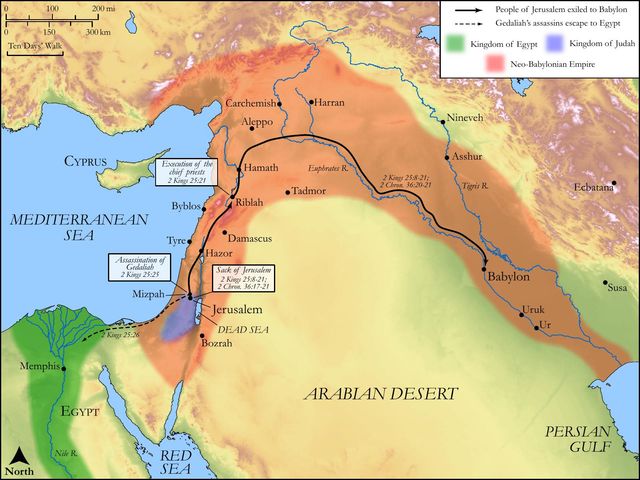
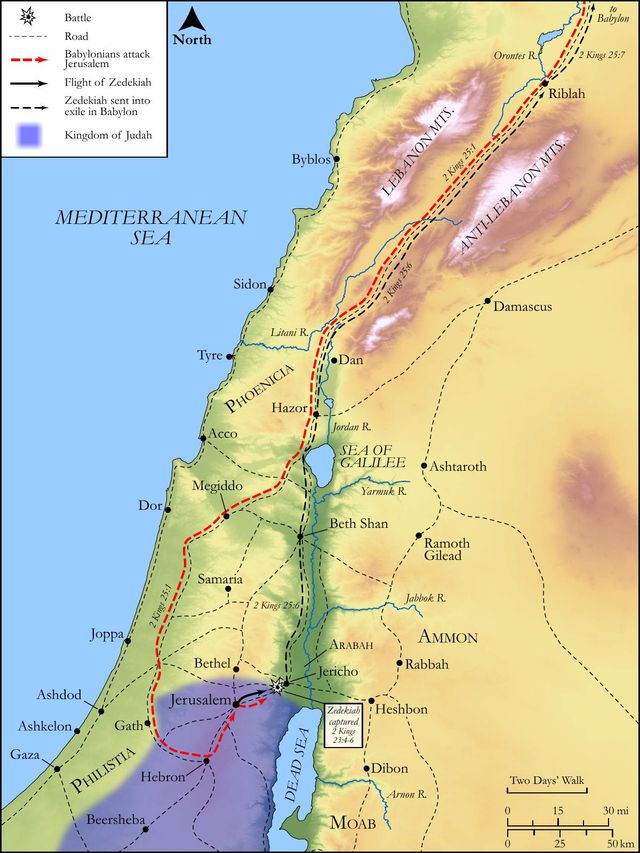
See on the biblical-era map
Study this verse
Public-domain commentary
Matthew Henry
From his Commentary on the Whole Bible. Henry comments on passages, not single verses — this entry covers 2 Kings 25:1–7. His two-level outline is real structure in the source text, so it is rendered as structure.
We left king Zedekiah in rebellion against the king of Babylon (Kg2 24:20), contriving and endeavouring to shake off his yoke, when he was no way able to do it, nor took the right method by making God his friend first. Now here we have an account of the fatal consequences of that attempt.
I.The king of Babylon's army laid siege to Jerusalem, Kg2 25:1.
What should hinder them when the country was already in their possession? Kg2 24:2. They built forts against the city round about, whence, by such arts of war as they then had, they battered it, sent into it instruments of death, and kept out of it the necessary supports of life. Formerly Jerusalem had been compassed with the favour of God as with a shield, but now their defence had departed from them and their enemies surrounded them on every side. Those that by sin have provoked God to leave them will find that innumerable evils will compass them about. Two years this siege lasted; at first the army retired, for fear of the king of Egypt (Jer 37:11), but, finding him not so powerful as they thought, they soon returned, with a resolution not to quit the city till they had made themselves masters of it.
II.During this siege the famine prevailed (Kg2 25:3), so that for a long time they ate their bread by weight and with care, Eze 4:16.
Thus they were punished for their gluttony and excess, their fulness of bread and feeding themselves without fear. At length there was no bread for the people of the land, that is, the common people, the soldiers, whereby they were weakened and rendered unfit for service. Now they ate their own children for want of food. See this foretold by one prophet (Eze 5:10) and bewailed by another, Lam 4:3, etc. Jeremiah earnestly persuaded the king to surrender (Jer 38:17), but his heart was hardened to his destruction.
III.At length the city was taken by storm:
it was broken up, Kg2 25:4. The besiegers made a breach in the wall, at which they forced their way into it. The besieged, unable any longer to defend it, endeavoured to quit it, and make the best of their way; and many, no doubt, were put to the sword, the victorious army being much exasperated by their obstinacy.
IV.The king, his family, and all his great men, made their escape in the night, by some secret passages which the besiegers either had not discovered or did not keep their eye upon, Kg2 25:4. But those as much deceive themselves who think to escape God's judgments as those who think to brave them; the feet of him that flees from them will as surely fail as the hands of him that fights against them. When God judges he will overcome. Intelligence was given to the Chaldeans of the king's flight, and which way he had gone, so that they soon overtook him, Kg2 25:5. His guards were scattered from him, every man shifting for his own safety. Had he put himself under God's protection, that would not have failed him now. He presently fell into the enemies' hands, and here we are told what they did with him.
1.He was brought to the king of Babylon, and tried by a council of war for rebelling against him who set him up, and to whom he had sworn fidelity. God and man had a quarrel with him for this; see Eze 17:16, etc. The king of Babylon now lay at Riblah (which lay between Judea and Babylon), that he might be ready to give orders both to his court at home and his army abroad.
2.His sons were slain before his eyes, though children, that this doleful spectacle, the last his eyes were to behold, might leave an impression of grief and horror upon his spirit as long as he lived. In slaying his sons, they showed their indignation at his falsehood, and in effect declared that neither he nor any of his were fit to be trusted, and therefore that they were not fit to live.
3.His eyes were put out, by which he was deprived of that common comfort of human life which is given even to those that are in misery, and to the bitter in soul, the light of the sun, by which he was also disabled for any service. He dreaded being mocked, and therefore would not be persuaded to yield (Jer 38:19), but that which he feared came upon him with a witness, and no doubt added much to his misery; for, as those that are deaf suspect that every body talks of them, so those that are blind suspect that every body laughs at them. By this two prophecies that seemed to contradict one another were both fulfilled. Jeremiah prophesied that Zedekiah should be brought to Babylon, Jer 32:5; Jer 34:3. Ezekiel prophesied that he should not see Babylon, Eze 12:13. He was brought thither, but, his eyes being put out, he did not see it. Thus he ended his days, before he ended his life.
4.He was bound in fetters of brass and so carried to Babylon. He that was blind needed not be bound (his blindness fettered him), but, for his greater disgrace, they led him bound; only, whereas common malefactors are laid in irons (Psa 105:18; Psa 107:10), he, being a prince, was bound with fetters of brass; but that the metal was somewhat nobler and lighter was little comfort, while still he was in fetters. Let it not seem strange if those that have been held in the cords of iniquity come to be thus held in the cords of affliction, Job 36:8.
Historical interpretation
Historical reception
1 surviving comment on this verse from the historical church.
What think you of Nebuchadnezzar? Have you not heard from Scripture that he was bloodthirsty, fierce, with the disposition of a lion? Have you not heard that he disinterred the kings? Have you not heard that he brought the people away into captivity? Have you not heard that he put the king’s sons to the sword before Zedekiah’s eyes and then blinded him? Have you not heard that he shattered the cherubim? I do not mean the invisible cherubim—it is blasphemy to think it—but the sculptured images and the mercy seat in the Holy of Holies, from the midst of which God was apt to speak with his voice. He trampled on the veil of sanctification, he took the censer and carried it away to a temple of idols; he seized all the offerings; he burned the temple to its foundations. What punishment did he not deserve for slaying kings, for burning the holy object, for reducing the people to captivity, for putting the sacred vessels in the temples of the idols? Did he not deserve ten thousand deaths?You have seen the enormity of his crimes. Turn now to the loving-kindness of God. Nebuchadnezzar was turned into a wild beast; he dwelled in the wilderness; God scourged him to save him. He had claws like a lion’s, for he had preyed on the saints. He had a lion’s mane, for he had been a ravening, roaring lion. He ate grass like an ox, for he had behaved like a brute beast, not knowing him who had given him his kingdom. His body was drenched with dew, because, after seeing the fire quenched by the dew, he had not believed. And what happened? Afterwards he says, “I, Nebuchadnezzar, raised my eyes to heaven … and I blessed the Most High, and I praised and glorified him who lives forever.” When therefore he acknowledged the Most High, and uttered words of thanksgiving to God, and repented of his past wickedness and recognized his own weakness, in that hour God restored to him his royal dignity.
What then? If God granted pardon and a kingdom to Nebuchadnezzar after such terrible crimes, when he had made confession, will he not grant you the remission of your sins if you repent and the kingdom of heaven if you live worthily? God is merciful and quick to forgiveness but slow to vengeance. Therefore let no one despair of salvation. Peter, the chief and foremost of the apostles, denied the Lord thrice before a little serving maid; but, moved to repentance, he wept bitterly. His weeping revealed his heartfelt repentance, and for that reason not only did he receive pardon for his denial but also retained his apostolic prerogative.
Continue studying 2 Kings 25:4 across the web’s major study libraries — every link below opens this exact verse, chapter, or book on the destination site.
Read & Compare
 BibleGatewayThis verse in more than 200 translations and 70 languages.
 Bible.comThe YouVersion reader — hundreds of translations, reading plans, and highlights.
 ESV.orgCrossway's official English Standard Version reader.
 NET BibleThe NET translation with 60,000+ translators' notes on every rendering decision.
 STEP BibleTyndale House's free study tool — original text, vocabulary, and scholarly resources.
 BibliaLogos Bible Software's free web reader.
 USCCBThe New American Bible (Revised Edition) with the U.S. bishops' study notes.
Commentaries
 BibleHub CommentariesDozens of classic commentaries on this verse, gathered on one page.
 StudyLightMore than 100 commentary sets — the largest collection on the web.
 BibleRefPlain-English commentary on what this verse means, verse by verse.
 Enduring WordDavid Guzik's free commentary on this chapter, widely used by Bible teachers.
 Bible Study ToolsVerse commentary alongside Greek and Hebrew study aids.
Original Language & Research
- BibleHub InterlinearThe verse word by word — original language, transliteration, and English.
- BibleHub LexiconEvery word's original-language definition and Strong's entry.
 Blue Letter BibleDeep-study tools — Strong's numbers, concordance, and word studies.
 SefariaThe Hebrew text with Rashi and centuries of Jewish commentary.
Sermons, Hymns & Audio


TrulyRandomVerse is not affiliated with these sites and doesn’t control their content. They’re linked because they’re genuinely useful.
Summary
This verse vividly portrays the catastrophic breach of Jerusalem's walls by the Babylonian forces, marking the tragic culmination of a prolonged siege and the effective end of the Kingdom of Judah. It captures the desperate, nocturnal flight of King Zedekiah and his soldiers, attempting to escape through a strategic gate near the king's garden, even as the Chaldean army maintained a complete encirclement of the city. This pivotal moment signifies the profound judgment against Judah for its persistent rebellion and idolatry, ushering in the Babylonian Exile.
Context
ShowHideLiterary Context
2 Kings 25:4 is situated at the dramatic climax of the book of 2 Kings, which meticulously chronicles the decline and eventual fall of both the Northern Kingdom of Israel and, finally, the Southern Kingdom of Judah. The preceding verses detail the relentless and devastating siege of Jerusalem by Nebuchadnezzar's forces, culminating in severe famine and the exhaustion of the city's resources, as poignantly described in 2 Kings 25:1-3. This verse describes the critical moment of the city's defenses being breached, serving as the narrative pivot point from the prolonged siege to the full execution of divine judgment. It directly precedes the capture of King Zedekiah and the subsequent destruction of Jerusalem and the temple, events powerfully narrated in 2 Kings 25:5-10, thus initiating the Babylonian exile. The passage underscores the fulfillment of prophetic warnings that permeate the book.
Historical & Cultural Context
The events of 2 Kings 25:4 transpired in 586 BC, marking the final, cataclysmic fall of Jerusalem after a siege initiated by Nebuchadnezzar II of Babylon. King Zedekiah, installed by Babylon as a vassal king, had foolishly rebelled against his overlord, leading to this devastating siege. The "Chaldees" refer to the Neo-Babylonian Empire, the dominant geopolitical power of the ancient Near East at this time. Jerusalem, a city renowned for its fortifications and strategic hilltop location, was considered a formidable stronghold. However, prolonged siege warfare, coupled with the ravages of famine, eventually broke its defenses. The mention of "the gate between two walls, which is by the king's garden" indicates a specific, likely less obvious or more discreet, escape route. Royal gardens were often located on the periphery of the main city walls, sometimes even outside them, making such a route plausible for a clandestine exit, highlighting the king's desperate attempt to evade capture and preserve the Davidic line.
Key Themes
ShowHideThis verse powerfully underscores several key themes prevalent throughout 2 Kings and the broader prophetic literature. Firstly, it highlights the theme of divine judgment against Judah for its persistent idolatry, covenant unfaithfulness, and rejection of prophetic warnings, particularly those delivered by Jeremiah, who had consistently urged submission to Babylon as God's instrument of judgment (e.g., Jeremiah 27). Secondly, it emphasizes the futility of human resistance when God's judgment is set; despite Zedekiah's desperate escape attempt and the city's formidable defenses, it ultimately fails, leading to his capture and the tragic end of the independent Davidic monarchy in Judah. Thirdly, the breach of the city and the king's flight symbolize the end of an era—the definitive end of the independent kingdom of Judah and the beginning of the Babylonian Exile, a pivotal and traumatic moment in Israelite history. This event serves as a stark reminder of the dire consequences of national disobedience and the unwavering fulfillment of God's word, whether in blessing or judgment, a theme echoed throughout Deuteronomy.
Exposition and Analysis
ShowHideKey Word Analysis
ShowHideThis primitive root signifies "to cleave," "to rend," "to break forth (into, out, in pieces, through, up)," or "to burst." Its use here emphasizes the sudden, violent, and complete nature of the breach in Jerusalem's defenses. It conveys not merely a weakening of the walls, but a catastrophic rupture, signifying the irreversible collapse of the city's protective barriers and, by extension, the kingdom's security and sovereignty.
This term refers to the Chaldeans, who were the dominant ethnic group within the Neo-Babylonian Empire. Their presence "round about" the city underscores the complete and suffocating encirclement of Jerusalem. This detail highlights the overwhelming numerical and strategic superiority of the besieging forces, rendering any escape attempt exceedingly perilous and ultimately futile. It identifies the specific instrument of God's judgment.
This primitive root means "to walk (literally or figuratively)," "to go," or "to depart." While the KJV translates it as "went," in the context of "fled by night," it captures the desperate movement of King Zedekiah. It denotes a hurried, intentional departure, albeit one born of extreme duress and fear, emphasizing the king's active, though ultimately unsuccessful, attempt to evade his captors.
Verse Breakdown
ShowHide"And the city was broken up"
This opening phrase immediately sets the scene of disaster and defeat. The passive voice indicates that Jerusalem's formidable defenses were overcome by an external, overwhelming force—the Babylonian army—signifying the end of the long and arduous siege and the fall of the capital city.
"and all the men of war fled by night"
Following the catastrophic breach, the military forces, including King Zedekiah himself, resorted to a desperate, clandestine escape. Fleeing "by night" emphasizes the secrecy, urgency, and shame of their attempt, hoping to evade detection by the vigilant besieging army under the cover of darkness.
"by the way of the gate between two walls, which is by the king's garden"
This clause precisely specifies the chosen escape route. The "gate between two walls" suggests a concealed, less-guarded, or perhaps a postern gate, designed for discreet movement rather than public thoroughfare. Its proximity to "the king's garden" indicates a path known intimately to the royal household, perhaps a private exit, underscoring the king's personal involvement and the desperation of his flight.
"(now the Chaldees were against the city round about:)"
This crucial parenthetical clause serves as an immediate and stark contextual detail. It highlights the extreme peril of the escape attempt, emphasizing that despite finding a hidden route, the Babylonian army had completely surrounded the city. This detail dramatically underscores the near impossibility of a successful escape and ominously foreshadows Zedekiah's inevitable capture.
"and the king went the way toward the plain."
This final clause identifies King Zedekiah as the central figure in this desperate flight and describes his immediate direction of travel. The "plain" (likely the Jordan Valley or the plains of Jericho to the east of Jerusalem) was a common escape route from the Judean hills, but it also offered little natural cover, making him highly vulnerable to pursuit by the swift Babylonian forces.
Literary Devices
ShowHideThe passage employs several potent literary devices to convey the gravity and pathos of the moment. Irony is powerfully evident in the transformation of the "king's garden," a place typically associated with beauty, peace, and royal leisure, into the desperate backdrop for a king's ignominious flight. This stark juxtaposition highlights the complete reversal of fortune for Zedekiah and his doomed kingdom. Foreshadowing is strongly present in the parenthetical note that "the Chaldees were against the city round about." This seemingly incidental detail immediately signals the futility of the escape attempt, ominously hinting at the tragic capture and blinding that will inevitably follow. The breaching of the city walls and the king's desperate flight also serve as profound Symbolism, representing the complete collapse of Judah's sovereignty, the definitive end of the independent Davidic monarchy, and the undeniable fulfillment of long-prophesied divine judgment. The entire scene is imbued with a deep sense of Pathos, evoking sympathy for the desperate king and the doomed city, even as it underscores the severe consequences of disobedience and unfaithfulness to God.
Theological and Thematic Connections
ShowHideThe fall of Jerusalem and the desperate flight of King Zedekiah are not merely historical events but profound theological statements that resonate throughout biblical theology. They represent the culmination of God's covenant curses for persistent disobedience, as meticulously outlined in the Mosaic Law (e.g., Deuteronomy 28) and reiterated with increasing urgency by the prophets. Despite God's remarkable patience, His numerous warnings through His messengers, and His desire for repentance, Judah's entrenched idolatry, pervasive injustice, and consistent rejection of His word led to this devastating judgment. This event powerfully underscores God's absolute sovereignty over nations and His unwavering commitment to His word, whether in blessing or in judgment. It serves as a stark reminder that even a chosen people, living in a city where God's temple resided, are not immune to the consequences of their actions when they turn away from Him. The fall of Jerusalem is a testament to God's justice and His ultimate control over human history.
Reflection and Application
ShowHideThe desperate flight of King Zedekiah from a breached Jerusalem offers a poignant and enduring lesson for all who seek to live faithfully before God. It serves as a powerful testament to the severe and inevitable consequences of ignoring divine warnings and persisting in rebellion against God's revealed will. Zedekiah's attempt to escape through a hidden gate, despite the overwhelming encirclement by the Chaldeans, symbolizes the profound futility of human ingenuity and strength when one is estranged from God's favor and facing the consequences of long-term spiritual decline. This narrative challenges us to consider our own lives: are we truly heeding God's warnings expressed in His Word, or are we, like Zedekiah, attempting to find our own "escape routes" from the consequences of our choices, rather than turning in humble and genuine repentance? The fall of Jerusalem reminds us that there are spiritual "walls" in our lives—boundaries of righteousness and obedience—that, once breached by persistent sin, can lead to devastating and unavoidable outcomes. It underscores the vital importance of humility, genuine repentance, and a steadfast commitment to seeking and obeying God's will before the point of no return is reached. Our ultimate security and true freedom lie not in strategic maneuvers or hidden passages, but in faithful reliance upon the Lord and obedience to His commands.
Questions for Reflection
ShowHideFAQ
ShowHideWhy was Jerusalem "broken up" and what does it signify?
ShowHideJerusalem was "broken up" because its formidable walls, after a prolonged and brutal siege by the Babylonian (Chaldean) army, were finally breached. This signifies the complete collapse of the city's defenses and its fall to the enemy, marking a devastating military defeat. Theologically, it represents the culmination of God's righteous judgment against Judah for its persistent idolatry, unfaithfulness to the covenant, and stubborn rejection of prophetic warnings. It marked the definitive end of the independent Kingdom of Judah and the beginning of the Babylonian Exile, a pivotal moment in Israelite history where God's people experienced the full weight of the consequences of their disobedience, as prophesied in books like Jeremiah.
What was the significance of King Zedekiah's escape attempt through "the king's garden"?
ShowHideKing Zedekiah's attempt to escape through "the gate between two walls, which is by the king's garden," highlights the desperation and ultimate futility of his situation. The "king's garden" likely refers to a private or less-guarded area on the city's periphery, suggesting a clandestine and strategic attempt to evade the encircling Babylonian forces. This choice of route underscores the king's personal desperation to escape his fate and preserve his life and the Davidic line. However, the parenthetical note in the verse ("now the Chaldees were against the city round about:") dramatically emphasizes that despite this seemingly clever route, the city was completely surrounded, making a successful escape nearly impossible. This futile attempt foreshadows his inevitable capture, as detailed in 2 Kings 25:5, and serves as a powerful symbol of human weakness and the inability to escape divine judgment through one's own efforts or cleverness.
Christ-Centered Fulfillment
ShowHideThe tragic fall of Jerusalem and the desperate, futile flight of King Zedekiah, while a stark testament to divine judgment against sin and human rebellion, ultimately point forward to the ultimate King and the ultimate deliverance found in Jesus Christ. Zedekiah's ignominious escape attempt, leading to his capture, blinding, and the end of his reign, stands in profound contrast to the voluntary, purposeful "flight" of Christ to the cross. While Zedekiah fled from an earthly enemy in a futile attempt to save his own life, Jesus, the true King of Israel and the Son of David, willingly laid down His life, not to escape judgment, but to bear the judgment for humanity's sin (e.g., Philippians 2:8). The breached walls of Jerusalem symbolize the brokenness, vulnerability, and spiritual death of a humanity separated from God by sin—a condition that Christ came to mend and overcome. He is the one who, unlike Zedekiah, truly escapes the power of death through His glorious resurrection, offering true freedom and an unshakeable, eternal kingdom to all who believe (e.g., Colossians 1:13-14). The judgment poured out on Jerusalem, though severe, foreshadows the greater judgment against sin that Christ absorbed on the cross, becoming the ultimate Lamb of God who takes away the sin of the world, providing an escape not from earthly enemies, but from eternal condemnation (e.g., John 1:29). In Christ, the "gate" is not one of desperate escape from impending doom, but rather the very means of abundant life and direct access to the Father (e.g., John 10:9).