


Deuteronomy 32:25
Bible text: King James Version (1769 Blayney text) · Public domain
Bible text: Berean Standard Bible · Public domain
Bible text: American Standard Version (1901) · Public domain
Bible text: World English Bible, Messianic edition · Public domain
Bible text: Geneva Bible (1599) · Public domain
Bible text: Young's Literal Translation · Public domain
- מִחוּץmi·Chutzfrom outsideH2351Prep-m ¦ N-msNoun Singular Masculine Absoluteמִfromחוּץoutside
- תְּשַׁכֶּלte·sha·kelit will make childlessH7921V-Piel-Imperf-3fsVerb Piel Imperfect 3rd Singular Feminine
- חֶרֶבChe·reva swordH2719N-fsNoun Singular Feminine Absolute
- וּמֵחֲדָרִיםu·me·cha·da·Rimand [will be] from inner roomsH2315Conj-w ¦ Prep-m ¦ N-mpNoun Plural Masculine Absoluteוּandמֵ[will be] fromחֲדָרִיםinner rooms
- אֵימָה'ei·MahterrorH367N-fsNoun Singular Feminine Absolute
- גַּםgambothH1571AdvAdverb
- בָּחוּרba·Churyoung manH970N-msNoun Singular Masculine Absolute
- גַּםgamas well asH1571AdvAdverb
- בְּתוּלָהbe·tu·Lahyoung womanH1330N-fsNoun Singular Feminine Absolute
- יוֹנֵקyo·Neka suckling-childH3243N-msNoun Singular Masculine Absolute
- עִם'imwithH5973PrepPreposition
- אִישׁ'isha person ofH376N-mscNoun Singular Masculine Construct
- שֵׂיבָהsei·Vahgray hairH7872N-fsNoun Singular Feminine Absolute
English is a literal word-by-word gloss of the Hebrew, not the KJV's wording. Why?
This is the original text the KJV's translators worked from — each Hebrew word with its own literal English meaning in this verse, prepared by scholars at Tyndale House, Cambridge. The KJV translates whole sentences, not word by word, so its wording differs: one Hebrew word can become several English words, and the KJV may choose “the LORD” where the gloss reads “Yahweh”. Both are faithful — they answer different questions. For the KJV's own rendering, switch to the KJV text.
Details
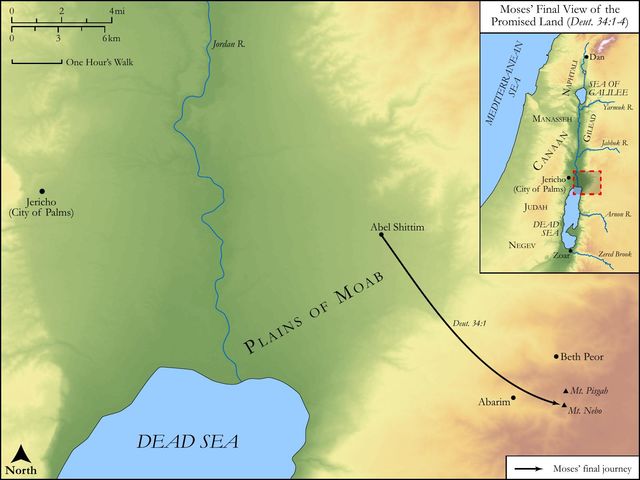
See on the biblical-era map
Study this verse
Public-domain commentary
Matthew Henry
From his Commentary on the Whole Bible. Henry comments on passages, not single verses — this entry covers Deuteronomy 32:19–25. His four-level outline is real structure in the source text, so it is rendered as structure.
The method of this song follows the method of the predictions in the foregoing chapter, and therefore, after the revolt of Israel from God, described in the foregoing verses, here follow immediately the resolves of divine Justice concerning them; we deceive ourselves if we think that God will be thus mocked by a foolish faithless people, that play fast and loose with him.
I.He had delighted in them, but now he would reject them with detestation and disdain, Deu 32:19.
When the Lord saw their treachery, and folly, and base ingratitude, he abhorred them, he despised them, so some read it. Sin makes us odious in the sight of the holy God; and no sinners are so loathsome to him as those that he has called, and that have called themselves, his sons and his daughters, and yet have been provoking to him. Note, The nearer any are to God in profession the more noisome are they to him if they are defiled in a sinful way, Psa 106:39, Psa 106:40.
II.He had given them the tokens of his presence with them and his favour to them; but now he would withdraw and hide his face from them, Deu 32:20. His hiding his face signifies his great displeasure; they had turned their back upon God, and now God would turn his back upon them (compare Jer 18:17 with Jer 2:27); but here it denotes also the slowness of God's proceedings against them in a way of judgment. They began in their apostasy with omissions of good, and so proceeded to commissions of evil. In like manner God will first suspend his favours, and let them see what the issue of that will be, what a friend they lose when they provoke God to depart, and will try whether this will bring them to repentance. Thus we find God hiding himself, as it were, in expectation of the event, Isa 57:17. To justify himself in leaving them he shows that they were such as there was no dealing with; for,
1.They were froward and a people that could not be pleased, or obstinate in sin, and that could not be convinced and reclaimed.
2.They were faithless, and a people that could not be trusted. When he saved them, and took them into covenant, he said, Surely they are children that will not lie (Isa 63:8); but when they proved otherwise, children in whom is no faith, they deserved to be abandoned, and that the God of truth should have no more to do with them.
III.He had done every thing to make them easy and to please them, but now he would do that against them which should be most vexatious to them. The punishment here answers the sin, Deu 32:21.
1.They had provoked God with despicable deities which were not gods at all, but vanities, creatures of their own imagination, that could not pretend either to merit or to repay the respects of their worshippers; the more vain and vile the gods were after which they went a whoring the greater was the offence to that great and good God whom they set them up in competition with and contradiction to. This put two great evils into their idolatry, Jer 2:13.
2.God would therefore plague them with despicable enemies, that were worthless, weak, and inconsiderable, and not deserving the name of a people, which was a great mortification to them, and aggravated the oppressions they groaned under The more base the people were that tyrannised over them the more barbarous they would be (none so insolent as a beggar on horseback), besides that it would be infamous to Israel, who had so often triumphed over great and mighty nations, to be themselves trampled upon by the weak and foolish, and to come under the curse of Canaan, who was to be a servant of servants. But God can make the weakest instrument a scourge to the strongest sinner; and those that by sin insult their might Creator are justly insulted by the meanest of their fellow-creatures. This was remarkably fulfilled in the days of the judges, when they were sometimes oppressed by the very Canaanites themselves, whom they had subdued, Jdg 4:2. But the apostle applies it to the conversion of the Gentiles, who had been a people not in covenant with God, and foolish in divine things, yet were brought into the church, sorely to the grief of the Jews, who upon all occasions showed a great indignation at it, which was both their sin and their punishment, as envy always is, Rom 10:19.
IV.He had planted them in a good land, and replenished them with all good things; but now he would strip them of all their comforts, and bring them to ruin. The judgments threatened are very terrible, Deu 32:22-25.
1.The fire of God's anger shall consume them, Deu 32:22. Are they proud of their plenty? It shall burn up the increase of the earth. Are they confident of their strength? It shall destroy the very foundations of their mountains: there is no fence against the judgments of God when they come with commission to lay all waste. It shall burn to the lowest hell, that is, it shall bring them to the very depth of misery in this world, which yet would be but a faint resemblance of the complete and endless misery of sinners in the other world. The damnation of hell (as our Saviour calls it) is the fire of God's anger, fastening upon the guilty conscience of a sinner, to its inexpressible and everlasting torment, Isa 30:33.
2.The arrows of God's judgments shall be spent upon them, till his quiver is quite exhausted, Deu 32:23. The judgments of God, like arrows, fly swiftly (Psa 64:7), reaching those at a distance who flatter themselves with hopes of escaping them, Psa 21:8, Psa 21:12. They come from an unseen hand, but wound mortally, for God never misses his mark, Kg1 22:34. The particular judgments here threatened are,
(1.)Famine: they shall be burnt, or parched, with hunger.
(2.)Pestilence and other diseases, here called burning heat and bitter destruction.
(3.)The insults of the inferior creatures: the teeth of beasts and the poison of serpents, Deu 32:24.
(4.)War and the fatal consequences of it, Deu 32:25.
[1.]Perpetual frights. When the sword is without, there cannot but be terror within. Co2 7:5, Without were fightings, within were fears. Those who cast off the fear of God are justly exposed to the fear of enemies.
[2.]Universal deaths. The sword of the Lord, when it is sent to lay all waste, will destroy without distinction; neither the strength of the young man nor the beauty of the virgin, neither the innocency of the suckling nor the gravity or infirmity of the man of gray hairs, will be their security from the sword when it devours one as well as another. Such devastation does war make, especially when it is pushed on by men as ravenous as wild beasts and as venomous as serpents, Deu 32:24. See here what mischief sin does, and reckon those fools that make a mock at it.
Continue studying Deuteronomy 32:25 across the web’s major study libraries — every link below opens this exact verse, chapter, or book on the destination site.
Read & Compare
 BibleGatewayThis verse in more than 200 translations and 70 languages.
 Bible.comThe YouVersion reader — hundreds of translations, reading plans, and highlights.
 ESV.orgCrossway's official English Standard Version reader.
 NET BibleThe NET translation with 60,000+ translators' notes on every rendering decision.
 STEP BibleTyndale House's free study tool — original text, vocabulary, and scholarly resources.
 BibliaLogos Bible Software's free web reader.
 USCCBThe New American Bible (Revised Edition) with the U.S. bishops' study notes.
Commentaries
 BibleHub CommentariesDozens of classic commentaries on this verse, gathered on one page.
 StudyLightMore than 100 commentary sets — the largest collection on the web.
 BibleRefPlain-English commentary on what this verse means, verse by verse.
 Enduring WordDavid Guzik's free commentary on this chapter, widely used by Bible teachers.
 Bible Study ToolsVerse commentary alongside Greek and Hebrew study aids.
Original Language & Research
- BibleHub InterlinearThe verse word by word — original language, transliteration, and English.
- BibleHub LexiconEvery word's original-language definition and Strong's entry.
 Blue Letter BibleDeep-study tools — Strong's numbers, concordance, and word studies.
 SefariaThe Hebrew text with Rashi and centuries of Jewish commentary.
Sermons, Hymns & Audio


TrulyRandomVerse is not affiliated with these sites and doesn’t control their content. They’re linked because they’re genuinely useful.
Summary
Deuteronomy 32:25, a potent declaration within the prophetic "Song of Moses," serves as a grim and comprehensive warning to ancient Israel. It vividly portrays the multifaceted and devastating nature of divine judgment that would inevitably befall the nation should they abandon their covenant fidelity to Yahweh and succumb to idolatry. This verse underscores the severity and totality of the consequences, depicting a society utterly consumed by both external warfare and internal dread, with no demographic spared from the impending calamity, from the most vulnerable to the most respected.
Context
ShowHideLiterary Context
Deuteronomy 32:25 is deeply embedded within "The Song of Moses" (Deuteronomy 32), a profound poetic composition delivered by Moses just prior to his death and Israel's imminent entry into the Promised Land. This song functions as a prophetic witness, recounting God's unwavering faithfulness to Israel despite their inherent tendency towards rebellion and outlining the covenant blessings for obedience alongside the severe curses for disobedience. It serves as a solemn, enduring reminder of the consequences of apostasy. Verse 25 specifically details the horrifying extent of these curses, emphasizing that divine judgment would be all-encompassing, affecting every segment of society from the most innocent to the most aged. The song as a whole serves as a legal testimony, a "witness" (Deuteronomy 31:19), against Israel, foreknowing their future unfaithfulness and the resulting divine discipline.
Historical & Cultural Context
The Song of Moses is delivered to a generation standing on the precipice of a new era, having witnessed God's miraculous provision and formidable judgment during their wilderness wanderings. They are poised to enter Canaan, a land teeming with pagan cultures and idolatrous practices, which would pose a constant temptation to deviate from the exclusive worship of Yahweh, as commanded by the first commandment. The covenant established at Sinai, meticulously reiterated and expounded upon in Deuteronomy, stipulated clear blessings for obedience and dire curses for disobedience. This verse, therefore, reflects the covenant of Sinai, where the LORD outlined the dire consequences for Israel should they break their allegiance. It also highlights the corporate nature of Israelite society, where the actions of the nation as a whole could bring judgment upon all its members, underscoring a collective responsibility before God.
Key Themes
ShowHideThis verse powerfully contributes to several overarching themes within Deuteronomy and the broader Pentateuch. Primarily, it underscores the theme of Divine Justice and Retribution, demonstrating God's unwavering righteousness against sin and covenant unfaithfulness. The comprehensive nature of the destruction, affecting "the young man and the virgin, the suckling also with the man of gray hairs," highlights the theme of Total Judgment, emphasizing that no one would be exempt from the widespread calamity brought about by national apostasy. Furthermore, the distinction between "the sword without" and "terror within" introduces the theme of Multifaceted Consequences, indicating that God's judgment would manifest through both external warfare and internal societal collapse or psychological dread. This dire prophecy reinforces the Seriousness of Disobedience and the sanctity of the covenant relationship, echoing warnings found in passages like Leviticus 26:25 and foreshadowing the historical experiences of Israel, such as the Babylonian exile described in Jeremiah 25:9-11. The song ultimately points to God's ultimate faithfulness, even in judgment, as a means to bring His people back to Himself (Deuteronomy 30:1-10).
Exposition and Analysis
ShowHideKey Word Analysis
ShowHideThis term (H2719) is derived from a root meaning "drought" or "to lay waste," and thus signifies a cutting instrument, often used for its destructive effect. In biblical contexts, chereb is a potent and frequently used metaphor for war, violence, and particularly divine wrath. It signifies an instrument of judgment, often wielded by God or by nations acting as His agents to bring about punishment for rebellion and sin. In this verse, "the sword without" specifically refers to external military assault and the devastation wrought by foreign enemies.
The word (H367) denotes fright, dread, panic, or horror. It suggests a profound internal disarray, psychological torment, or widespread fear that paralyzes a community from within. This internal "terror" could stem from famine, pestilence, internal strife, or the sheer psychological burden of divine abandonment and the consequences of moral decay, complementing the external threat of the sword. It speaks to a state of being consumed by fear from within their own borders.
This primitive root (H7921) primarily means "to miscarry" or "to suffer abortion." By analogy, it extends to "to bereave" or "to make childless." While translated as "destroy" in KJV, its deeper meaning here conveys a catastrophic loss of life, particularly focusing on the removal of children or the productive members of society, leading to a state of barrenness or depopulation. This nuance emphasizes the devastating impact on the future generations and the continuity of the nation, highlighting a profound and lasting desolation.
Verse Breakdown
ShowHide"The sword without"
This phrase refers to external threats, specifically warfare, invasion, and military conquest by foreign enemies. It signifies the physical destruction, death, and desolation that would come upon Israel from outside their borders as a direct consequence of their unfaithfulness to the covenant. This speaks to the external pressures and violence that would dismantle their society.
"and terror within"
In stark contrast to the external sword, this clause points to internal threats. "Terror" here implies a pervasive sense of dread, panic, and internal collapse—perhaps due to famine, disease, civil strife, or the psychological impact of divine judgment—that would consume the nation from within its own social fabric. It suggests a breakdown of order and a pervasive sense of fear and hopelessness among the people themselves.
"shall destroy both the young man and the virgin"
This specifies the initial demographic scope of the destruction, employing the primary meaning of shâkôl (to bereave/make childless). "Young man" (H970, bâchûwr, meaning "chosen" or "youth") and "virgin" (H1330, bᵉthûwlâh, meaning "separated" or "maid") represent the vibrant, productive, and future-bearing segment of society. Their destruction signifies the decimation of the nation's strength, hope, and continuity, crippling its ability to reproduce and thrive.
"the suckling [also] with the man of gray hairs"
This extends the scope of destruction to the absolute extremes of the age spectrum, completing the picture of comprehensive judgment. The "suckling" (H3243, yânaq, referring to a nursing child) represents the most innocent and vulnerable, utterly dependent on others, while the "man of gray hairs" (H7872, sêybâh, referring to old age and wisdom) represents the oldest, wisest, and most respected members of the community. This merism emphasizes the total, indiscriminate, and comprehensive nature of the judgment, sparing no one regardless of age, status, or vulnerability, ensuring that the entire societal structure is dismantled.
Literary Devices
ShowHideDeuteronomy 32:25 employs several powerful literary devices to convey its stark and unforgettable message of divine judgment. Merism is prominently used in the phrase "both the young man and the virgin, the suckling also with the man of gray hairs." This rhetorical device uses two contrasting or extreme parts (youth and age, male and female) to represent the entirety of the population, effectively communicating that the judgment would spare no one, from the youngest and most vulnerable to the oldest and most respected. The phrase "the sword without, and terror within" utilizes striking Antithesis and Metonymy. "Sword without" is a metonym for external military conflict and its destructive power, while "terror within" represents the internal psychological and societal collapse. The antithetical pairing highlights the dual, comprehensive nature of the impending calamity, attacking the nation from all sides—physically from without and psychologically/socially from within. The entire verse functions as a vivid Prophecy and a solemn Warning, painting a graphic picture of future desolation intended to impress upon Israel the gravity of covenant fidelity. The stark imagery evokes a sense of dread, serving as a powerful deterrent against apostasy.
Theological and Thematic Connections
ShowHideDeuteronomy 32:25 stands as a profound theological statement on God's justice, holiness, and the inviolable nature of His covenant. It reveals that God is not merely a benevolent provider but also a righteous judge who holds His people accountable for their fidelity. The comprehensive nature of the judgment underscores the corporate responsibility of Israel, where the nation's collective sin brings consequences upon all its members. This verse serves as a powerful reminder that while God is merciful and long-suffering, His patience has limits, and His divine order demands a response of obedience and worship. The "Song of Moses" as a whole, and this verse in particular, functions as a prophetic witness, foretelling the inevitable outcome of Israel's predicted apostasy and serving as a theological anchor for understanding later periods of national suffering and exile, such as the Assyrian and Babylonian captivities. It powerfully articulates the principle that divine judgment is a just response to persistent rebellion and a necessary act to uphold God's holy character and the sanctity of His covenant.
Reflection and Application
ShowHideDeuteronomy 32:25, though rooted in ancient covenant theology, carries profound and enduring relevance for believers today. It compels us to confront the seriousness of spiritual disobedience and the reality of divine judgment, not as arbitrary punishment, but as the inevitable consequence of turning away from the source of life and truth. While the New Covenant establishes grace through faith in Christ as the basis of salvation, the principle that choices have consequences remains. A life lived in defiance of God's revealed will can lead to internal turmoil, spiritual barrenness, and external struggles, even if not the same physical destruction as ancient Israel. This verse calls us to a deeper appreciation for God's holiness and a renewed commitment to faithful obedience, recognizing that true flourishing comes from aligning our lives with His divine purposes. It serves as a sober reminder that God is not to be trifled with, and His love, though boundless, is always intertwined with His justice. For the church, it underscores the importance of corporate faithfulness and the potential for a community to experience internal and external challenges when it drifts from its foundational commitment to Christ and His Word.
Questions for Reflection
ShowHideFAQ
ShowHideDoes this verse imply that God is cruel or arbitrary in His judgment?
ShowHideNo, this verse does not imply that God is cruel or arbitrary. Instead, it underscores God's perfect justice and holiness in the context of a specific covenant relationship. The judgment described here is a direct, pre-warned consequence of Israel's persistent and deliberate unfaithfulness to the covenant they willingly entered into with God at Sinai. Throughout Deuteronomy, God repeatedly lays out the blessings for obedience and the curses for disobedience (e.g., Deuteronomy 28). This verse is part of a prophetic song given by Moses as a "witness" against Israel, foreknowing their future rebellion. It highlights God's commitment to His own righteous character and the seriousness with which He views covenant breaking, demonstrating that His love is not sentimental but holy and just. The severity of the judgment reflects the gravity of the sin—turning away from the one true God to idolatry, which is a profound betrayal of the covenant relationship.
How does this Old Testament warning apply to believers under the New Covenant?
ShowHideWhile believers under the New Covenant are saved by grace through faith in Jesus Christ and are not under the Mosaic Law's covenant curses for salvation, the principles of God's holiness, the seriousness of sin, and the consequences of spiritual rebellion remain. This verse serves as a sober reminder that God is not indifferent to sin, and that persistent disobedience can lead to severe consequences in this life, even for believers. While not necessarily physical destruction in the same manner as ancient Israel, "terror within" can manifest as spiritual barrenness, internal turmoil, broken relationships, and a loss of God's manifest blessing and peace. The New Testament also warns against the consequences of rejecting Christ and living in unrepentance (e.g., Hebrews 10:26-31 and Romans 1:18-32). Ultimately, this verse points us to the absolute necessity of Christ, who bore the full weight of God's judgment for those who believe, thereby delivering us from the "sword without and terror within" of divine wrath.
Christ-Centered Fulfillment
ShowHideDeuteronomy 32:25, with its stark portrayal of comprehensive divine judgment, ultimately finds its profound Christ-centered fulfillment in two primary ways. First, it highlights the desperate need for a deliverer from such wrath. The "sword without" and "terror within" represent the just consequences of humanity's rebellion against a holy God. Jesus Christ, as the ultimate Lamb of God, fully absorbed this divine judgment on the cross, taking upon Himself the "sword" of God's wrath so that those who believe might be spared (Isaiah 53:5). He experienced the ultimate "terror within" as He cried out, "My God, my God, why have you forsaken me?" (Matthew 27:46), bearing the spiritual desolation of sin's separation from God. Second, this verse foreshadows the ultimate and final judgment that will be meted out to all who reject God's gracious provision in Christ. While believers are now under a new covenant of grace (Hebrews 8:6-13), the principle of divine justice remains, culminating in the final judgment where those outside of Christ will face eternal separation and the full weight of God's righteous anger (Revelation 20:11-15). Thus, Deuteronomy 32:25 not only warns of historical judgment but also powerfully points to the person and work of Christ as the sole means of escape from eternal judgment and the ultimate demonstration of God's justice and mercy.