


Isaiah 30:16
- וַתֹּאמְרוּva·To·me·Ruand you saidH559Conj-w ¦ V-Qal-ConsecImperf-2mpVerb Qal Consecutive Imperfect 2nd Plural Masculineוַandתֹּאמְרוּyou said
- לֹאlo'In-H3808NegParticle Negative
- כִיkhideedH3588PrtParticle Conditional
- עַל'alonH5921PrepPreposition
- סוּסsushorse[s]H5483N-msNoun Singular Masculine Absolute
- נָנוּסna·Nuswe will fleeH5127V-Qal-Imperf-1cpVerb Qal Imperfect 1st Plural common gender
- עַל'althere-H5921PrepPreposition
- כֵּןken-foreH3651AdvAdverb
- תְּנוּסוּןte·nu·Sunyou will flee !H5127V-Qal-Imperf-2mp ¦ SfxVerb Qal Imperfect 2nd Plural Masculineתְּנוּסוּyou will fleeן!
- וְעַלve·'aland onH5921Conj-w ¦ PrepPrepositionוְandעַלon
- קַלkalswift [horse][s]H7031Adj-msAdjective Singular Masculine Absolute
- נִרְכָּבnir·Kavwe will rideH7392V-Qal-Imperf-1cpVerb Qal Imperfect 1st Plural common gender
- עַל'althere-H5921PrepPreposition
- כֵּןken-foreH3651AdvAdverb
- יִקַּלּוּyi·Ka·luthey will prove swiftH7043V-Niphal-Imperf-3mpVerb Niphal Imperfect 3rd Plural Masculine
- רֹדְפֵיכֶםro·de·fei·Khem[those who] pursue youH7291V-Qal-Prtcpl-mp ¦ 2mpVerb Qal Participle Plural Masculine Constructרֹדְפֵי[those who] pursueכֶםyou
English is a literal word-by-word gloss of the Hebrew, not the KJV's wording. Why?
This is the original text the KJV's translators worked from — each Hebrew word with its own literal English meaning in this verse, prepared by scholars at Tyndale House, Cambridge. The KJV translates whole sentences, not word by word, so its wording differs: one Hebrew word can become several English words, and the KJV may choose “the LORD” where the gloss reads “Yahweh”. Both are faithful — they answer different questions. For the KJV's own rendering, switch to the KJV text.
Details
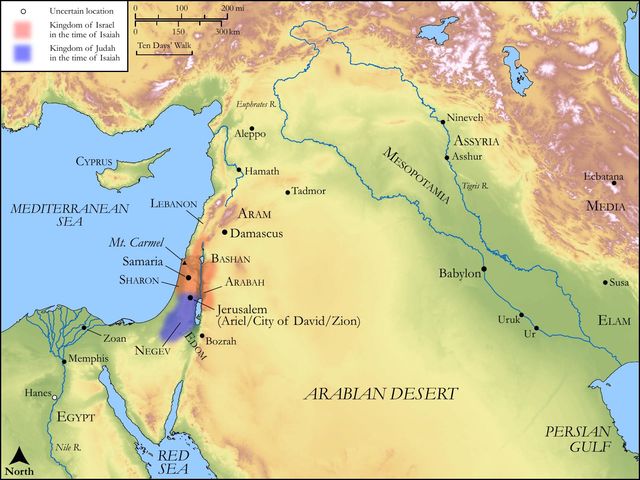
See on the biblical-era map
Study this verse
Public-domain commentary
Matthew Henry
From his Commentary on the Whole Bible. Henry comments on passages, not single verses — this entry covers Isaiah 30:8–17. His four-level outline is real structure in the source text, so it is rendered as structure.
Here, I. The preface is very awful. The prophet must not only preach this, but he must write it (Isa 30:8), write it in a table, to be hung up and exposed to public view; he must carefully note it, not in loose papers which might be lost or torn, but in a book, to be preserved for posterity, in perpetuam rei memoriam - for a standing testimony against this wicked generation; let it remain not only to the next succeeding ages, but for ever and ever, while the world stands; and so it shall, for the book of the scriptures no doubt, shall continue, and be read, to the end of time. Let it be written, 1. To shame the men of the present age, who would not hear and heed it when it was spoken. Let it be written, that it may not be lost; their children may profit by it, though they will not. 2. To justify God in the judgments he was about to ring upon them; people will be tempted to think he was too hard upon them, and over-severe, unless they know how very bad they were, how very provoking, and what fair means God tried with them before he brought it to this extremity. 3. For warning to others not to do as they did, lest they should fare as they fared. It is designed for admonition to those of the remotest place and age, even those upon whom the ends of the world have come, Co1 10:11. It may be of use for God's ministers not only to preach, but to write; for that which is written remains.
II.The character given of the profane and wicked Jews is very sad.
He must, if he will draw them in their own colours, write this concerning them (and we are sure he does not bear false witness against them, nor make them worse than they were, for the judgment of God is according to truth), That this is a rebellious people, Isa 30:9. The Jews were, for aught we know, the only professing people God had then in the world, and yet many of them were a rebellious people.
1.They rebelled against their own convictions and covenants: "They are lying children, that will not stand to what they say, that promise fair, but perform nothing;" when he took them into covenant with himself he said of them, Surely they are my people, children that will not lie (Isa 63:8); but they proved otherwise.
2.They rebelled against the divine authority: "They are children that will not hear the law of the Lord, nor heed it, but will do as they have a mind, let God himself say what he will to the contrary."
III.The charge drawn up against them is very high and the sentence passed upon them very dreadful.
Two things they here stand charged with, and their doom is read for both, a fearful doom: -
1.They forbade the prophets to speak to them in God's name, and to deal faithfully with them.
(1.)This their sin is described, Isa 30:10, Isa 30:11. They set themselves so violently against the prophets to hinder them from preaching, or at least from dealing plainly with them in their preaching, did so banter them and browbeat them, that they did in effect say to the seers, See not. They had the light, but they loved darkness rather. It was their privilege that they had seers among them, but they did what they could to put out their eyes - that they had prophets among them, but they did what they could to stop their mouths; for they tormented them in their wicked ways, Rev 11:10. Those that silence good ministers, and discountenance good preaching, are justly counted, and called, rebels against God. See what it was in the prophets' preaching with which they found themselves aggrieved.
[1.]The prophets told them of their faults, and warned them of their misery and danger by reason of sin, and they could not bear that. They must speak to them smooth things, must flatter them in their sins, and say that they did well, and there was no harm, no peril, in the course of life they lived in. Let a thing be ever so right and true, if it be not smooth, they will not hear it. But if it be agreeable to the good opinion they have of themselves, and will confirm them in that, though it be ever so false and ever so great a cheat upon them, they will have it prophesied to them. Those deserve to be deceived that desire to be so.
[2.]The prophets stopped them in their sinful pursuits, and stood in their way like the angel in Balaam's road, with the sword of God's wrath drawn in their hand; so that they could not proceed without terror. And this they took as a great insult. When they went on frowardly in the way of their hearts they said to the prophets, "Get you out of the way, turn aside out of the paths. What do you do in our way? Cannot you let us alone to do as we please?" Those have their hearts fully set in them to do evil that bid their faithful monitors to stand out of their way. Forbear, why shouldst thou be smitten? Ch2 25:16.
[3.]The prophets were continually telling them of the Holy One of Israel, what an enemy he is to sin ad how severely he will reckon with sinners; and this they could not endure to hear of. Both the thing itself and the expression of it were too serious for them; and therefore, if the prophets will speak to them, they will make it their bargain that they shall not call God the Holy One of Israel; for God's holiness is that attribute which wicked people most of all dread. Let us no more be troubled with that state-preface (as Mr. White calls it) to your impertinent harangues. Those have reason to fear perishing in their sins that cannot bear to be frightened out of them.
(2.)Now what is the doom passed upon them for this? We have it, Isa 30:12, Isa 30:13. Observe,
[1.]Who it is that gives judgment upon them: Thus saith the Holy One of Israel. That title of God which they particularly excepted against the prophet makes use of. Faithful ministers will not be driven from using such expressions as are proper to awaken sinners, though they be displeasing. We must tell men that God is the Holy One of Israel, and so they shall find him, whether they will hear or whether they will forbear.
[2.]What the ground of the judgment is: Because they despise this word - wither, in general, every word that the prophets said to them, or this word in particular, which declares God to be the Holy One of Israel: "they despise this, and will neither make it their fear, to stand in awe of it, nor make it their hope, to put any confidence in it; but, rather than they will be beholden to the Holy One of Israel, they will trust in oppression and perverseness, in the wealth they have got and the interest they have made by fraud and violence, or in the sinful methods they have taken for their own security, in contradiction to God and his will. On these they lean, and therefore it is just that they should fall." [3.] What the judgment is that is passed upon them: "This iniquity shall be to you as a breach ready to fall. This confidence of yours will be like a house built upon the sand, which will fall in the storm and bury the builder in the ruins of it. Your contempt of that word of God which you might build upon will make every thing else you trust like a wall that bulges out, which, if any weight be laid upon it, comes down, nay, which often sinks with its own weight." The ruin they would hereby bring upon themselves should be, First, A surprising ruin: The breaking shall come suddenly, at an instant, when they do not expect it, which will make it the more frightful, and when they are not prepared or provided for it, which will make it the more fatal. Secondly, An utter ruin, universal and irreparable: "Your and all your confidences shall be not only weak as the potter's clay (Isa 29:16), but broken to pieces as the potter's vessel. He that has the rod of iron shall break it (Psa 2:9) and he shall not spare, shall not have any regard to it, nor be in care to preserve or keep whole any part of it. But, when once it is broken so as to be unfit for use, let it be dashed, let it be crushed, all to pieces, so that there may not remain one sherd big enough to take up a little fire or water" - two things we have daily need of, and which poor people commonly fetch in a piece of a broken pitcher. They shall not only be as a bowing wall (Psa 62:3), but as a broken mug or glass, which is good for nothing, nor can ever be made whole again.
2.They slighted the gracious directions God gave them, not only how to secure themselves and make themselves safe, but how to compose themselves and make themselves easy; they would take their own way, Isa 30:15-17. Observe here,
(1.)The method God put them into for salvation and strength. The God that knew them, and knew what was proper for them, and desired their welfare, gave them this prescription; and it is recommended to us all. [1.] Would we be saved from the evil of every calamity, guarded against the temptation of it and secured from the curse of it, which are the only evil things in it? It must be in returning and rest, in returning to God and reposing in him as our rest. Let us return from our evil ways, into which we have gone aside, and rest and settle in the way of God and duty, and that is the way to be saved. "Return from this project of going down to Egypt, and rest satisfied in the will of God, and then you may trust him with your safety. In returning (in the thorough reformation of your hearts and lives) and in rest (in an entire submission of your souls to God and a complacency in him) you shall be saved." [2.] Would we be strengthened to do what is required of us and to bear what is laid upon us? It must be in quietness and in confidence; we must keep our spirits calm and sedate by a continual dependence upon God, and his power and goodness; we must retire into ourselves with a holy quietness, suppressing all turbulent and tumultuous passions, and keeping the peace in our own minds. And we must rely upon God with a holy confidence that he can do what he will and will do what is best for his people. And this will be our strength; it will inspire us with such a holy fortitude as will carry us with ease and courage through all the difficulties we may meet with.
(2.)The contempt they put upon this prescription; they would not take God's counsel, though it was so much for their own good. And justly will those die of their disease that will not take God for their physician. We are certainly enemies to ourselves if we will not be subjects to him. They would not so much as try the method prescribed: "But you said, No (Isa 30:16), we will not compose ourselves, for we will flee upon horses and we will ride upon the swift; we will hurry hither and thither to fetch in foreign aids." They think themselves wiser than God, and that they know what is good for themselves better than he does. When Sennacherib took all the fenced cities of Judah, those rebellious children would not be persuaded to sit still and patiently to expect God's appearing for them, as he did wonderfully at last; but they would shift for their own safety, and thereby they exposed themselves to so much the more danger.
(3.)The sentence passed upon them for this. Their sin shall be their punishment: "You will flee, and therefore you shall flee; you will be upon the full speed, and therefore so shall those be that pursue you." The dogs are most apt to run barking after him that rides fast. The conquerors protected those that sat still, but pursued those that made their escape; and so that very project by which they hoped to save themselves was justly their ruin and the most guilty suffered most. It is foretold, Isa 30:17,
[1.]That they should be easily cut off; they should be so dispirited with their own fears, increased by their flight, that one of the enemy should defeat a thousand of them, and five put an army to flight, which could never be unless their Rock had sold them Deu 32:30.
[2.]That they should be generally cut off, and only here and there one should escape alone in a solitary place, and be left for a spectacle too, as a beacon upon the top of a mountain, a warning to others to avoid the like sinful courses and carnal confidences.
Historical interpretation
Historical reception
1 surviving comment on this verse from the historical church.
(Verse 15 and following) For thus says the Lord God, the Holy One of Israel: If you return and rest, you shall be saved; in quietness and in trust shall be your strength. But you were unwilling, and you said, 'No! We will flee upon horses'; therefore you shall flee away, and, 'We will ride upon swift steeds'; therefore your pursuers shall be swift. One thousand at the threat of one; at the threat of five you shall flee. LXX: Thus says the Lord God, the Holy One of Israel: When you turn to me and groan, then you shall be saved, and you shall know where you have been: for you trusted in idols, your strength became vain; and you were unwilling to hear, but you said, 'We will flee upon horses'; therefore you shall flee; and, 'We will ride upon swift steeds'; therefore those who pursue you shall be swift. A thousand will flee at the threat of one, and at the threat of five, many will flee. The Holy One, whom I had kept silent about his name, is the Lord God, who speaks to you and through me and through Jeremiah (Jeremiah XII): If you repent and either abandon vices or the error of evil counsel, and remain in Judah, fearing not the attack of the Babylonians, but my commandments, you will be saved. Rest and hope in the Lord, and take hold of the strength of faith in my promises. You, who have despised the commandments of life and have said in despair, it will not be as you speak; instead, we will flee to the Egyptian horses and go swiftly to them in haste. Since you have said these things, you will indeed flee and enter Egypt with destructive haste; but the Babylonians will be faster, as they will pursue you all the way to Egypt, and such great terror and fear will hold Egypt that a thousand Egyptians will not be able to resist a single Chaldean, and the multitude of fleeing enemies, five against one, as we read in Deuteronomy: The Lord will cause you to fall before your enemies' eyes. By this passage, you will depart from them and flee through seven ways from their presence, and you will be scattered among all the kingdoms of the earth (Deut. XXVIII, 25, 32). According to the allegorical and Septuagint edition, the divine word encourages all sinners, especially heretics, to repent, so that when they have turned away from vices and have repented, they may be saved; and then they will understand where they were before, and that they had hoped in vain things. And when they are encouraged to repent, on the contrary, they trust in false teachers and in the uncertainties of the world: not wanting to hear the words of God, they long for Egyptian horses and rejoice in their swiftness, which the Lord has forbidden to be multiplied (Deuteronomy 17). Therefore, the men of the church will pursue them swiftly, and one warrior's voice, or five fighters (which we should understand to refer to the mind and the five senses), will not be able to withstand a thousand men and an undisciplined crowd fleeing.
Continue studying Isaiah 30:16 across the web’s major study libraries — every link below opens this exact verse, chapter, or book on the destination site.
Read & Compare
 BibleGatewayThis verse in more than 200 translations and 70 languages.
 Bible.comThe YouVersion reader — hundreds of translations, reading plans, and highlights.
 ESV.orgCrossway's official English Standard Version reader.
 NET BibleThe NET translation with 60,000+ translators' notes on every rendering decision.
 STEP BibleTyndale House's free study tool — original text, vocabulary, and scholarly resources.
 BibliaLogos Bible Software's free web reader.
 USCCBThe New American Bible (Revised Edition) with the U.S. bishops' study notes.
Commentaries
 BibleHub CommentariesDozens of classic commentaries on this verse, gathered on one page.
 StudyLightMore than 100 commentary sets — the largest collection on the web.
 BibleRefPlain-English commentary on what this verse means, verse by verse.
 Enduring WordDavid Guzik's free commentary on this chapter, widely used by Bible teachers.
 Bible Study ToolsVerse commentary alongside Greek and Hebrew study aids.
Original Language & Research
- BibleHub InterlinearThe verse word by word — original language, transliteration, and English.
- BibleHub LexiconEvery word's original-language definition and Strong's entry.
 Blue Letter BibleDeep-study tools — Strong's numbers, concordance, and word studies.
 SefariaThe Hebrew text with Rashi and centuries of Jewish commentary.
Sermons, Hymns & Audio


TrulyRandomVerse is not affiliated with these sites and doesn’t control their content. They’re linked because they’re genuinely useful.
Summary
Isaiah 30:16 powerfully depicts Judah's defiant rejection of God's counsel for quiet trust and rest, choosing instead to rely on their own perceived strength and swift military alliances, particularly with Egypt's renowned cavalry, to escape the looming Assyrian threat. The verse then pronounces a divine judgment that tragically mirrors their chosen path: their reliance on speed for escape will ironically become the very means of their downfall, as their pursuers will be even swifter, vividly illustrating the futility of human self-reliance when it stands in opposition to divine decree.
Context
ShowHideLiterary Context
This verse is deeply embedded within a profound prophetic oracle in Isaiah 30 that meticulously condemns Judah's decision to forge an alliance with Egypt against the formidable Assyrian Empire, rather than placing their trust solely in the Lord. Immediately preceding Isaiah 30:16, the Lord extends a gracious alternative in Isaiah 30:15, proclaiming, "In returning and rest shall ye be saved; in quietness and in confidence shall be your strength." This divine invitation to spiritual security, rooted in repentance and reliance on God's power, is met with a stubborn and explicit refusal, articulated in the opening words of verse 16. The subsequent verses in Isaiah 30 proceed to detail the severe consequences of their disobedience, ultimately leading to a promised, albeit delayed, restoration for those who eventually turn back to the Lord.
Historical & Cultural Context
During the time of Isaiah's ministry, the kingdom of Judah found itself precariously positioned between two dominant regional powers: the aggressively expanding Assyrian Empire to the north and east, and Egypt, a historical superpower to the south, which often offered alliances to smaller nations as a strategic buffer. The Assyrian threat was not merely theoretical but an imminent and terrifying reality, prompting Judah's leaders to seek pragmatic, human-centric solutions. Egypt was particularly renowned for its formidable cavalry, and horses symbolized military might, speed, and strategic advantage throughout the ancient Near East. Relying on horses for rapid escape or decisive battle was a common military tactic. However, for the covenant people of Israel, trusting in horses—or any foreign military aid—over the Lord was explicitly forbidden and considered a grave act of spiritual apostasy, demonstrating a profound lack of faith in God's unique ability to protect His people (Deuteronomy 17:16; Psalm 20:7). Thus, Judah's decision to "flee upon horses" and "ride upon the swift" was far more than a mere tactical choice; it represented a fundamental theological rejection of their covenant relationship with God.
Key Themes
ShowHideIsaiah 30:16 powerfully encapsulates several core themes that resonate throughout Isaiah's prophecy and the broader Old Testament narrative. Firstly, it vividly illustrates the Rejection of Divine Counsel, where humanity's stubborn will directly opposes God's clear, gracious, and life-giving instruction. This theme is foundational to understanding the covenant relationship and the dire consequences of disobedience. Secondly, the verse starkly contrasts Self-Reliance vs. God-Reliance. Judah's choice to trust in their own swiftness and military might, symbolized by their reliance on horses, directly opposes God's call for "quietness and confidence" in Him (Isaiah 30:15). This underscores the pervasive biblical truth that true strength, security, and salvation originate from God alone, not from human ingenuity, worldly power, or strategic alliances (Psalm 33:16-17). Finally, the passage powerfully demonstrates the Consequences of Disobedience and the principle of poetic justice, where the very means chosen for perceived salvation become the instrument of divine judgment. Their desired swift escape tragically transforms into a swift pursuit by their enemies, highlighting the inescapable nature of divine judgment when God's people turn away from His sovereign will.
Exposition and Analysis
ShowHideKey Word Analysis
ShowHideA primitive root meaning "to say," but used with extensive semantic latitude. In this specific context, it signifies a definitive, emphatic, and defiant declaration, "No." It is not merely an internal thought but an explicitly vocalized rejection, indicating a firm and rebellious resolve to disregard God's counsel. This "saying" is an active expression of rebellion, a verbalized refusal to align with divine wisdom and a conscious choice to pursue an alternative path.
A primitive root meaning "to flit, i.e. vanish away (subside, escape; causatively, chase, impel, deliver)." Here, it denotes the act of attempting to escape or run away from imminent danger. The people's stated intention is to "flee upon horses," indicating their chosen method of self-preservation through rapid movement and reliance on external, worldly aid, rather than through God's promised rest and protection. Their desired flight is one of self-rescue.
A contracted form of H7043 (qâlal), meaning "light; (by implication) rapid." This adjective precisely describes the horses upon which Judah intends to ride, emphasizing the speed they believe will secure their salvation. The powerful repetition of this concept—first in their boast ("ride upon the swift") and then in the divine judgment ("pursue you be swift")—highlights the central irony of the verse, where their perceived advantage in speed becomes the very means of their inevitable disadvantage and downfall.
Verse Breakdown
ShowHide"But ye said, No;"
This opening phrase immediately establishes the defiant and rebellious posture of the people of Judah. It is a direct, sharp, and emphatic rejection of God's preceding gracious offer of salvation through "returning and rest" and "quietness and confidence" in Isaiah 30:15. Their "No" signifies a conscious, stubborn, and willful refusal to trust in divine provision, opting instead for a human-devised strategy.
"for we will flee upon horses;"
This clause explicitly reveals the specific human solution that Judah preferred. Instead of finding security and rest in God, they declared their firm intention to escape the Assyrian threat by relying on military might, specifically the swiftness and power of horses, almost certainly referring to an alliance with Egypt, renowned for its formidable cavalry. This choice represents a profound reliance on visible, tangible worldly power over unseen divine protection.
"therefore shall ye flee:"
Here begins the pronouncement of divine judgment, a direct and ironic consequence mirroring their chosen action. Because they chose to "flee upon horses" as their self-appointed means of salvation, God declares that they will indeed "flee," but not in the way they intended or desired. This is the first layer of tragic irony, implying a flight of desperate rout and defeat, not a successful or triumphant escape.
"and, We will ride upon the swift;"
This clause reiterates and reinforces their self-reliant strategy, emphasizing their misplaced confidence in speed, agility, and superior mobility. "The swift" unequivocally refers to swift horses, solidifying their belief that such an advantage would guarantee their safety and success against their enemies.
"therefore shall they that pursue you be swift."
This is the devastating climax of the divine judgment, completing the ironic reversal with devastating precision. The very swiftness they sought for their own escape will be not only nullified but dramatically surpassed by the swiftness of their pursuers. Their human advantage is rendered utterly futile and is turned against them by God's sovereign hand, ensuring that their chosen path of self-reliance leads directly to inescapable defeat, capture, and judgment.
Literary Devices
ShowHideThe primary literary device at play in Isaiah 30:16 is Irony, specifically Poetic Justice. The people of Judah defiantly declare their intention to flee and ride upon swift horses, believing that their speed will guarantee their safety and escape. However, God's response turns their chosen means of salvation into the very instrument of their judgment: "therefore shall ye flee: and... therefore shall they that pursue you be swift." Their desired swiftness is not only rendered ineffective but is dramatically surpassed by the swiftness of their enemies, ensuring their capture and downfall. This creates a powerful and tragic irony, where their self-reliant solution leads directly to the precise opposite of their desired outcome. Additionally, there is a clear element of Parallelism in the structure of the verse, contrasting Judah's defiant declaration ("We will flee... We will ride") with God's pronouncement of judgment ("therefore shall ye flee... therefore shall they that pursue you be swift"). This structural parallelism powerfully reinforces the cause-and-effect relationship between their disobedience and its inevitable consequences. The deliberate Repetition of the concept of "swift" (Hebrew: qal) further emphasizes this ironic reversal, highlighting the ultimate futility of human effort when it stands in direct opposition to divine will.
Theological and Thematic Connections
ShowHideIsaiah 30:16 serves as a profound theological statement on the intrinsic nature of divine sovereignty versus human autonomy, and the inevitable, often ironic, consequences of choosing the latter over the former. It underscores the timeless biblical truth that true security, enduring strength, and genuine salvation are found not in human ingenuity, military might, political alliances, or any self-devised strategy, but in humble, unwavering reliance on God alone. Judah's defiant "No" to God's preceding gracious invitation to "rest and quietness" (Isaiah 30:15) reveals a deep-seated spiritual rebellion, a preference for visible, tangible, and controllable human solutions over the unseen, yet infinitely powerful, realm of faith. This passage teaches a critical lesson: when humanity attempts to outrun or outmaneuver God's purposes through self-devised strategies, God can and will turn those very strategies against them, demonstrating His absolute control and the ultimate futility of resisting His sovereign will. The devastating irony of their swift pursuers being swifter than their swift escape highlights God's absolute control over all circumstances, ensuring that His justice and redemptive purposes ultimately prevail.
Reflection and Application
ShowHideIsaiah 30:16 offers a timeless and sobering mirror for both personal and communal reflection in every generation. In our own lives, we are perpetually faced with challenges and anxieties that tempt us to bypass God's wisdom and instead rely on our own perceived strengths, accumulated resources, worldly connections, or clever strategies. Whether it's seeking financial security through questionable means, pursuing career advancement through compromise, attempting to solve relational conflicts without prayer and humility, or striving for self-improvement without divine grace, we often, implicitly or explicitly, say "No" to God's call for patient trust and quiet reliance. This verse serves as a stark reminder that such self-reliance, no matter how "swift" or ingeniously crafted our plans may seem, ultimately leads to a "fleeing" that is not escape but inevitable pursuit and downfall. True strength, lasting peace, and genuine security are found not in our ability to outmaneuver life's difficulties or outrun our fears, but in humbly surrendering our will to God's, embracing His promised rest, and trusting implicitly that His timing and methods are infinitely superior to our own. It calls us to deeply examine where we are truly placing our confidence and to repent of any areas where we are stubbornly resisting His divine counsel and gracious invitation to depend on Him.
Questions for Reflection
ShowHideFAQ
ShowHideWhy was Judah's reliance on horses and an alliance with Egypt considered a rejection of God?
ShowHideJudah's reliance on horses and an alliance with Egypt was considered a profound rejection of God for several interconnected reasons, deeply rooted in their covenant relationship. Firstly, it directly contradicted God's repeated commands for His people not to trust in military might, especially chariots and horses, or to form foreign alliances, but solely in Him. For instance, Deuteronomy 17:16 specifically forbade kings from multiplying horses, and Psalm 20:7 declares, "Some trust in chariots, and some in horses: but we will remember the name of the LORD our God." Secondly, and more fundamentally, it demonstrated a profound lack of faith in God's ability and willingness to protect His covenant people. God had just offered them "rest" and "quietness" as their true strength in Isaiah 30:15, but they chose a visible, tangible, human-devised solution instead. This act was not merely a tactical error in geopolitics but a spiritual rebellion, prioritizing worldly power and human ingenuity over divine faithfulness and sovereign provision, thereby breaking their covenant trust.
Christ-Centered Fulfillment
ShowHideIsaiah 30:16, with its stark portrayal of Judah's self-reliance leading to ironic judgment, powerfully foreshadows humanity's inherent tendency to reject God's gracious provision and seek salvation through its own efforts, a path that inevitably leads to futility and condemnation. Just as Judah sought swift horses to escape impending doom, fallen humanity often attempts to outrun the consequences of sin or achieve righteousness through its own "swift" deeds, adherence to laws, or philosophical constructs. However, Christ stands as the ultimate fulfillment and perfect antithesis to this self-reliant spirit. He is the one in whom "returning and rest" (Isaiah 30:15) are perfectly embodied and offered. Unlike Judah, who chose to flee from God's counsel, Jesus, the Lamb of God, willingly submitted to God's will, even to the point of death on a cross (Philippians 2:8). He did not rely on "horses" or human strength but on the power of God to accomplish salvation, becoming the true "strength" for all who trust in Him (1 Corinthians 1:24). Through His perfect obedience and sacrificial death, Christ provides the ultimate escape from the relentless pursuit of sin and death, not by our swiftness, but by His finished work, offering true rest and confidence to all who believe (Matthew 11:28-30). He is the swift deliverer who rescues us from the ultimate pursuer, Satan, and the judgment we deserve, by becoming the pursued on our behalf, triumphing over all hostile powers through the cross (Colossians 2:13-15).