


Isaiah 29:17
- הֲלוֹאha·lo'¿ notH3808Interrog ¦ NegParticle Negativeהֲ¿לוֹאnot
- עוֹד'OdyetH5750Adj-msAdjective Numerical Singular Masculine Absolute
- מְעַטme·'Ata little ofH4592N-mscNoun Singular Masculine Construct
- מִזְעָרmiz·'Ara littleH4213N-msNoun Singular Masculine Absolute
- וְשָׁבve·Shavand it will turnH7725Conj-w ¦ V-Qal-ConsecPerf-3msVerb Qal Consecutive Perfect 3rd Singular Masculineוְandשָׁבit will turn
- לְבָנוֹןle·va·NonLebanonH3844N-properNoun Proper Location
- לַכַּרְמֶלla·kar·Melinto <the> orchardH3759Prep-l ¦ N-msNoun Singular Masculine Absoluteלַinto <the>כַּרְמֶלorchard
- וְהַכַּרְמֶלve·ha·kar·Meland the orchardH3759Conj-w ¦ Art ¦ N-msNoun Singular Masculine Absoluteוְandהַtheכַּרְמֶלorchard
- לַיַּעַרlai·Ya·'arto <the> forestH3293Prep-l ¦ N-msNoun Singular Masculine Absoluteלַto <the>יַּעַרforest
- יֵחָשֵׁבye·cha·Shevit will be consideredH2803V-Niphal-Imperf-3msVerb Niphal Imperfect 3rd Singular Masculine
English is a literal word-by-word gloss of the Hebrew, not the KJV's wording. Why?
This is the original text the KJV's translators worked from — each Hebrew word with its own literal English meaning in this verse, prepared by scholars at Tyndale House, Cambridge. The KJV translates whole sentences, not word by word, so its wording differs: one Hebrew word can become several English words, and the KJV may choose “the LORD” where the gloss reads “Yahweh”. Both are faithful — they answer different questions. For the KJV's own rendering, switch to the KJV text.
Details
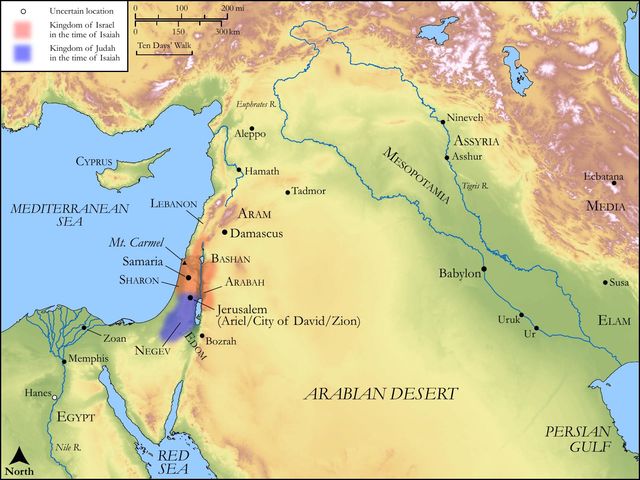
See on the biblical-era map
Study this verse
Public-domain commentary
Matthew Henry
From his Commentary on the Whole Bible. Henry comments on passages, not single verses — this entry covers Isaiah 29:17–24. His three-level outline is real structure in the source text, so it is rendered as structure.
Those that thought to hide their counsels from the Lord were said to turn things upside down (Isa 29:16), and they intended to do it unknown to God; but God here tells them that he will turn things upside down his way; and let us see whose word shall stand, his or theirs. They disbelieve Providence: "Wait awhile," says God, "and you shall be convinced by ocular demonstration that there is a God who governs the world, and that he governs it and orders all the changes that are in it for the good of his church." The wonderful revolution here foretold may refer primarily to the happy settlement of the affairs of Judah and Jerusalem after the defeat of Sennacherib's attempt, and the repose which good people then enjoyed, when they were delivered from the alarms of the sword both of war and persecution. But it may look further, to the rejection of the Jews at the first planting of the gospel (for their hypocrisy and infidelity were here foretold, Isa 29:13) and the admission of the Gentiles into the church.
I.In general, it is a great and surprising change that is here foretold, Isa 29:17.
Lebanon, that was a forest, shall be turned into a fruitful field; and Carmel, that was a fruitful field, shall become a forest. It is a counterchange. Note, Great changes, both for the better and for the worse, are often made in a very little while. It was a sign given them of the defeat of Sennacherib that the ground should be more than ordinarily fruitful (Isa 37:30): You shall eat this year such as grows of itself; food for man shall be (as food for beasts is) the spontaneous product of the soil. Then Lebanon became a fruitful field, so fruitful that that which used to be reckoned a fruitful field in comparison with it was looked upon but as a forest. When a great harvest of souls was gathered in to Christ from among the Gentiles then the wilderness was turned into a fruitful field; and the Jewish church, that had long been a fruitful field, became a desolate and deserted forest, Isa 54:1.
II.In particular,
1.Those that were ignorant shall become intelligent, Isa 29:18. Those that understood not this prophecy (but it was to them as a sealed book, Isa 29:11) shall, when it is accomplished, understand it, and shall acknowledge, not only the hand of God in the event, but the voice of God in the prediction of it: The deaf shall then hear the words of the book. The fulfilling of prophecy is the best exposition of it. The poor Gentiles shall then have divine revelation brought among them; and those that sat in darkness shall see a great light, those that were blind shall see out of obscurity; for the gospel was sent to them to open their eyes, Act 26:18. Observe, In order to the making of men fruitful in good affections and actions, the course God's grace takes with them is to open their understandings and make them hear the words of God's book.
2.Those that were erroneous shall become orthodox (Isa 29:24): Those that erred in spirit, that were under mistakes and misapprehensions concerning the words of the book and the meaning of them, shall come to understanding, to a right understanding of things; the Spirit of truth shall rectify their mistakes and lead them into all truth. This should encourage us to pray for those that have erred and are deceived, that God can, and often does, bring such to understanding. Those that murmured at the truths of God as hard sayings, and loved to pick quarrels with them, shall learn the true meaning of these doctrines, and then they will be better reconciled to them. Those that erred concerning the providence of God as to public affairs, and murmured at the disposals of it, when they shall see the issue of things shall better understand them and be aware of what God was designing in all, Hos 14:9.
3.Those that were melancholy shall become cheerful and pleasant (Isa 29:19): The meek also shall increase their joy in the Lord. Those who are poor in the world and poor in spirit, who, being in affliction, accommodate themselves to their affliction, are purely passive and not passionate, when they see God appearing for them, they shall add, or repeat, joy in the Lord. This intimates that even in their distress they kept up their joy in the Lord, but now they increased it. Note, Those who, when they are in trouble, can truly rejoice in God, shall soon have cause given them greatly to rejoice in him. When joy in the world is decreasing and fading joy in God is increasing and getting round. This shining light shall shine more and more; for that which is aimed at is that this joy may be full. Even the poor among men may rejoice in the Holy One of Israel, and their poverty needs not deprive them of that joy, Hab 3:17, Hab 3:18. And the meek, the humble, the patient, and dispassionate, shall grow in this joy. Note, The grace of meekness will contribute very much to the increase of our holy joy.
4.The enemies, that were formidable, shall become despicable. Sennacherib, that terrible one, and his great army, that put the country into such a consternation, shall be brought to nought (Isa 29:20), shall be quite disabled to do any further mischief. The power of Satan, that terrible one indeed, shall be broken by the prevalency of Christ's gospel; and those that were subject to bondage through fear of him that had the power of death shall be delivered, Heb 2:14, Heb 2:15.
5.The persecutors, that were vexatious, shall be quieted, and so those they were troublesome to shall be quiet from the fear of them. To complete the repose of God's people, not only the terrible one from abroad shall be brought to nought, but the scorners at home too shall be consumed and cut off by Hezekiah's reformation. Those are a happy people, and likely to be so, who, when God gives them victory and success against their terrible enemies abroad, take care to suppress vice, and profaneness, and the spirit of persecution, those more dangerous enemies at home. Or, They shall be consumed and cut off by the judgments of God, shall be singled out to be made examples of. Or, They shall insensibly waste away, being put to confusion by the fulfilling of those predictions which they had made a jest of. Observe what had been the wickedness of these scorners, for which they should be cut off. They had been persecutors of God's people and prophets, probably of the prophet Isaiah particularly, and therefore he complains thus feelingly of them and of their subtle malice. Some as informers and persecutors, others as judges, did all they could to take away his life, or at least his liberty. And this is very applicable to the chief priests and Pharisees, who persecuted Christ and his apostles, and for that sin they and their nation of scorners were cut off and consumed.
(1.)They ridiculed the prophets and the serious professors of religion; they despised them, and did their utmost to bring them into contempt; they were scorners, and sat in the seat of the scornful.
(2.)They lay in wait for an occasion against them. By their spies they watch for iniquity, to see if they can lay hold of any thing that is said or done that may be called an iniquity. Or they themselves watch for an opportunity to do mischief, as Judas did to betray our Lord Jesus.
(3.)They took advantage against them for the least slip of the tongue; and, if a thing were ever so little said amiss, it served them to ground an indictment upon. They made a man, though he were ever so wise and good a man, though he were a man of God, an offender for a word, a word mischosen or misplaced, when they could not but know that it was well meant, Isa 29:21. They cavilled at every word that the prophets spoke to them by way of admonition, though ever so innocently spoken, and without any design to affront them. They put the worst construction upon what was said, and made it criminal by strained innuendoes. Those who consider how apt we all are to speak unadvisedly, and to mistake what we hear, will think it very unjust and unfair to make a man an offender for a word.
(4.)They did all they could to bring those into trouble that dealt faithfully with them and told them of their faults. Those that reprove in the gates, reprovers by office, that were bound by the duty of their place, as prophets, as judges, and magistrates, to show people their transgressions, they hated these, and laid snares for them, as the Pharisees' emissaries, who were sent to watch our Saviour that they might entangle him in his talk (Mat 22:15), that they might have something to lay to his charge which might render him odious to the people or obnoxious to the government. So persecuted they the prophets; and it is next to impossible for the most cautious to place their words so warily as to escape such snares. See how base wicked people are, who bear ill-will to those who, out of good-will to them, seek to save their souls from death; and see what need reprovers have both of courage to do their duty and of prudence to avoid the snare.
(5.)They pervert judgment, and will never let an honest man carry an honest cause: They turn aside the just for a thing of nought; they condemn him, or give the cause against him, upon no evidence, no colour or pretence whatsoever. They run a man down, and misrepresent him, by all the little arts and tricks they can devise, as they did our Saviour. We must not think it strange if we see the best of men thus treated; the disciple is not greater than his Master. But wait awhile, and God will not only bring forth their righteousness, but cut off and consume these scorners.
6.Jacob, who was made to blush by the reproaches, and made to tremble by the threatenings, of his enemies, shall now be relieved both against his shame and against his fear, by the rolling away of those reproaches and the defeating of those threatenings (Isa 29:22): Thus the Lord saith who redeemed Abraham, that is, called him out of Ur of the Chaldees, and so rescued him from the idolatry of his fathers and plucked him as a brand out of the fire. He that redeemed Abraham out of his snares and troubles will redeem all that are by faith his genuine seed out of theirs. He that began his care of his church in the redemption of Abraham, when it and its Redeemer were in his loins, will not now cast off the care of it. Because the enemies of his people are so industrious both to blacken them and to frighten them, therefore he will appear for the house of Jacob, and they shall not be ashamed as they have been, but shall have wherewith to answer those that reproach them, nor shall their faces now wax pale; but they shall gather courage, and look their enemies in the face without change of countenance, as those have reason to do who have the God of Abraham on their side.
7.Jacob, who thought his family would be extinct and the entail of religion quite cut off, shall have the satisfaction of seeing a numerous progeny devoted to God for a generation, Isa 29:23.
(1.)He shall see his children, multitudes of believers and praying people, the spiritual seed of faithful Abraham and wrestling Jacob. Having his quiver full of these arrows, he shall not be ashamed (Isa 29:22) but shall speak with his enemy in the gate, Psa 127:5. Christ shall not be ashamed (Isa 50:7), for he shall see his seed (Isa 53:10); he sees some, and foresees more, in the midst of him, flocking to the church, and residing there.
(2.)His children are the work of God's hands; being formed by him, they are formed for him, his workmanship, created unto good works. It is some comfort to parents to think that their children are God's creatures, the work of the hands of his grace.
(3.)He and his children shall sanctify the name of God as their God, as the Holy One of Jacob, and shall fear and worship the God of Israel. This is opposed to his being ashamed and waxing pale; when he is delivered from his contempts and dangers he shall not magnify himself, but sanctify the Holy One of Jacob. If God make our condition easy, we must endeavour to make his name glorious. Parents and children are ornaments and comforts indeed to each other when they join in sanctifying the name of God. When parents give up their children, and children give up themselves, to God, to be to him for a name and a praise, then the forest will soon become a fruitful field.
Historical interpretation
Three Centuries of Reception
2 surviving comments on this verse. Each one is dated, so this reads as a timeline rather than a list.
Select a marker to jump to its quote. Markers stagger vertically where authors wrote within a few decades of each other.
(Verse 17 and following) Will not Lebanon soon become a fruitful field, and the fruitful field be regarded as a forest? On that day the deaf will hear the words of the scroll, and out of gloom and darkness the eyes of the blind will see. The meek will obtain fresh joy in the Lord, and the neediest people will exult in the Holy One of Israel. For the tyrant shall be no more, and the scoffer shall cease to be; all those alert to do evil shall be cut off. Why do people sin in words and overthrow the one who argues at the gate? And they turned away in vain from the just. Let the Jews and friends of simple history answer, those who seek fruit not on the tree, but only leaves and the shadow of words, which quickly wither and perish. How is it that in the coming of the Lord Savior (because from the time of Isaiah until the incarnation of the flesh, for the comparison of eternity, it is a short and small span of time) the mountain of Lebanon turned towards Phoenicia and moved to Mount Carmel? It is called in Hebrew Chermel, and it is near the border of Palestine and Phoenicia, overlooking Ptolemais: although another mountain in the holy scriptures is called Mount Carmel, where there was Nabal the Carmelite (1 Samuel 25), a foolish and wicked man, who had a wife named Abigail, who married David after her husband died; while her husband was alive, she could not marry David, so as not to be called an adulteress if she were associated with another man; and how is Carmel considered a desirable place and unfruitful trees? But since they are unable to express it, let them listen to Libanus, which means "whiteness", referring to the people of the Gentiles who, having been washed in the Lord and cleansed of their former filth, ascend as a whole world. They rely on the person of the Church as the bride of the Savior, and it is said about them in the Song of Songs: Who is this who comes up, shining white, leaning on her beloved? (Cant. VIII. 5) And let this people be transferred to Carmel, which means the knowledge of circumcision, so that they may recognize the mysteries of spiritual and true circumcision, and be in the place of the former people of the Jews. As for those who refuse to accept Christ, let them be considered as thorns and barren trees, which cannot praise the Lord with fruitful trees. But when Lebanon is changed into Carmel, and Carmel into a forest, then those who were deaf and could not hear the words of the prophetic book (of which we have spoken before, that all Holy Scripture is called one book, as Ecclesiastes says: 'The sayings of the wise are like goads, and like nails fixed deep in, given by one Shepherd') will hear and speak, to whom the Savior will say: Ephphatha (which means, 'Be opened') (Mark 7). And that which we translate, the eyes of the blind shall see darkness and mist, the interpretation of which is easy; Aquila and Theodotion and Symmachus translated: The eyes of the blind shall see darkness and mist: to show the sacraments of Christ to the people of the nations, who were previously blind, according to what is said: Dark water in the clouds of the sky (Ps. 17, 12). And in the same psalm it is written about God: He set darkness as his hiding place (Ibid. 12). And in Proverbs we read: This wise person will be wiser by hearing these things and will have possession of prudent governance and will understand parables and dark sayings spoken by the wise and enigmas (Prov. I, 5, 6). Moreover, Moses, in order to understand and see God (Exod. XX), entered into a cloud and darkness, of which it is said in the Psalm: Darkness is under his feet (Ps. XVII, 10). But when the blind or those who are initiated into mystical matters have first beheld these things or have lifted up their eyes from blindness and darkness to see, so that true light may arise for those sitting in darkness and the shadow of death, then the meek, of whom it is written: Blessed are the meek, for they shall inherit the earth (Matt. V, 4), whether they be the poor, of whom the leader says in the Psalms: This poor man cried out, and the Lord heard him (Ps. XXXIII, 7); and he who judges the poor people and will save the children of the poor (Ps. XIII, 9), of whom it is said to the Jews: You have despised the counsel of the poor, they shall add joy in the Lord, so that he who glories, may glory in the Lord (II Cor. X); and poor men or those in despair and contempt by men, who did not have knowledge of the law before, will exult in the Holy One of Israel, who says: Be holy, for I am holy (Lev. XI, 44). And there is rejoicing for every downfall: for he who prevailed has fallen. The deceiver, or the arrogant and proud one, is brought to an end, who said: With my strength I will do it, and with my wisdom I will remove the boundaries of nations and destroy their strength; who deceived everyone to such an extent that even the holy one said: My loins are filled with deceits (Psalm 38:8). And all those who kept watch over wickedness have been cut off or destroyed, for their wicked vigilance does not cease: they caused the whole human race to sin by blaspheming the Word of God and placing their mouths in heaven. But the demons, themselves wicked, made all men sin in speech, blaspheming with various teachings, and they would overthrow the one reproaching in the gate and in judgment as much as they could, and they made him turn away from righteousness, who was in the gates of the daughter of Zion, exalted from the gates of death; and he rebuked those who hated him in the gates. These things we understand concerning the devil and his angels, the Nazarenes consider them to be spoken against the scribes and Pharisees, because they failed in their second attempt, who before mocked the people with their wicked traditions; and they watched day and night to deceive the simple, who made men sin against the Word of God, to deny Christ the Son of God.
Note that [Paul] taught Greeks in Jerusalem, and Jews in Damascus which is a Gentile city, even though this should signify that Gentiles were to be included in the city of God and Jews were to fall into the faithlessness of the Gentiles, in accordance with what Isaiah said, “Lebanon shall be changed into Carmel, and Carmel shall be regarded as a wasteland.”
Continue studying Isaiah 29:17 across the web’s major study libraries — every link below opens this exact verse, chapter, or book on the destination site.
Read & Compare
 BibleGatewayThis verse in more than 200 translations and 70 languages.
 Bible.comThe YouVersion reader — hundreds of translations, reading plans, and highlights.
 ESV.orgCrossway's official English Standard Version reader.
 NET BibleThe NET translation with 60,000+ translators' notes on every rendering decision.
 STEP BibleTyndale House's free study tool — original text, vocabulary, and scholarly resources.
 BibliaLogos Bible Software's free web reader.
 USCCBThe New American Bible (Revised Edition) with the U.S. bishops' study notes.
Commentaries
 BibleHub CommentariesDozens of classic commentaries on this verse, gathered on one page.
 StudyLightMore than 100 commentary sets — the largest collection on the web.
 BibleRefPlain-English commentary on what this verse means, verse by verse.
 Enduring WordDavid Guzik's free commentary on this chapter, widely used by Bible teachers.
 Bible Study ToolsVerse commentary alongside Greek and Hebrew study aids.
Original Language & Research
- BibleHub InterlinearThe verse word by word — original language, transliteration, and English.
- BibleHub LexiconEvery word's original-language definition and Strong's entry.
 Blue Letter BibleDeep-study tools — Strong's numbers, concordance, and word studies.
 SefariaThe Hebrew text with Rashi and centuries of Jewish commentary.
Sermons, Hymns & Audio


TrulyRandomVerse is not affiliated with these sites and doesn’t control their content. They’re linked because they’re genuinely useful.
Summary
Isaiah 29:17 unveils a profound prophetic vision of radical transformation, foretelling a time when the desolate, proud, or spiritually barren will be miraculously turned into abundantly fruitful ground, and that which is already fruitful will be elevated to an unprecedented state of glory and abundance. This verse encapsulates God's sovereign power to reverse fortunes, bring forth unexpected spiritual and physical flourishing, and usher in a new era of divine discernment and blessing, signaling a dramatic shift from judgment to glorious restoration.
Context
ShowHideLiterary Context
Isaiah 29 is a complex prophetic oracle primarily directed against Jerusalem, referred to as "Ariel," a name possibly meaning "lion of God" or "altar hearth." The chapter begins with stern warnings of judgment for the city's spiritual stupor, blindness, and hypocrisy, characterized by outward religious observance without inward devotion, as highlighted in Isaiah 29:13. The people are depicted as spiritually deaf and blind, relying on human wisdom and alliances rather than trusting in the Lord. However, amidst these pronouncements of impending distress and divine discipline, the tone shifts dramatically in verses 17-24. This verse, Isaiah 29:17, marks the pivotal turning point from judgment to a glorious future, introducing themes of restoration, spiritual awakening, and a dramatic reversal of fortunes for God's people. It sets the stage for the subsequent promises of restored sight and hearing (Isaiah 29:18), joy for the humble, and the ultimate recognition of God's holiness and justice.
Historical & Cultural Context
The prophecy in Isaiah 29 likely dates to the late 8th century BCE, during a period of significant Assyrian threat to Judah. Jerusalem, though seemingly secure, faced deep spiritual decay and political instability, leaning on human alliances rather than divine trust. The imagery of "Lebanon" was culturally and symbolically significant in ancient Israel. The majestic cedars of Lebanon were renowned for their grandeur, strength, and beauty, often symbolizing pride, earthly power, and even idolatry in biblical literature (e.g., Isaiah 10:34). Its transformation into a "fruitful field" (Hebrew: karmel) would have evoked the fertile, cultivated lands of Palestine, particularly the coastal plain known for its vineyards and orchards, symbolizing productivity, blessing, and divine favor. The subsequent elevation of the "fruitful field" to be "esteemed as a forest" (ya'ar) suggests an even greater, perhaps overwhelming, abundance and density of growth, signifying an unprecedented level of blessing, spiritual maturity, and divine presence. The prophecy speaks to a people who understood the stark contrast between barrenness and fertility, desolation and flourishing, and who were accustomed to interpreting natural imagery as profound reflections of spiritual realities.
Key Themes
ShowHideThis verse contributes significantly to several major themes within Isaiah and broader biblical theology. Firstly, it underscores Radical Transformation and Divine Reversal, highlighting God's sovereign power to completely alter circumstances, turning the desolate into the fruitful and the ordinary into the extraordinary. This theme is central to Isaiah's message of hope amidst judgment, where God promises to do a "marvelous work and a wonder" (Isaiah 29:14). Secondly, it points to a profound Spiritual Awakening and Restoration. The physical transformation of the land mirrors a spiritual renewal among God's people, where spiritual blindness and deafness are replaced by true discernment and understanding, as promised in Isaiah 29:18). Thirdly, it emphasizes God's Faithfulness and Covenant Promises, assuring a future of blessing and flourishing for those who turn to Him, despite their past failures and spiritual apathy. This hope extends beyond mere physical prosperity to a deep, abiding relationship with the Lord, where the humble rejoice and the violent cease, as described in Isaiah 29:19-20).
Exposition and Analysis
ShowHideKey Word Analysis
ShowHideThis primitive root (H2803) properly means "to plait or interpenetrate," leading to meanings like "to weave," "to fabricate," or "to contrive." Figuratively, it implies mental effort: "to think," "regard," "value," or "compute." In this context, the fruitful field will not merely become a forest, but it will be regarded or valued as a forest. This suggests a profound change in perception, status, and inherent worth, an elevation in its significance and a recognition of its newfound majesty.
Derived from the root for "vineyard," karmel (H3759) refers to a "planted field," "garden," "orchard," or "vineyard." It signifies a fertile, cultivated, and highly productive area, often associated with rich agricultural bounty. Its transformation from being "Lebanon" (potentially symbolic of pride or desolation) to a karmel denotes a shift to spiritual fertility and productivity, a place where God's cultivation yields abundant fruit. The subsequent elevation of this karmel to be esteemed as a "forest" implies an even greater, perhaps overwhelming, abundance and density of growth, surpassing its already fruitful state.
This primitive root (H7725) means "to turn back" or "to return," but it also powerfully signifies "to reverse," "to restore," or "to cause to return to a former state," or even "to convert." Here, it conveys a complete and decisive reversal of condition. Lebanon, once a symbol of pride or desolation, will be utterly transformed, "turned" into something entirely different—a fertile field. This highlights God's active, immediate, and transformative intervention, not merely a gradual change but a divine reordering of reality.
Verse Breakdown
ShowHide"Is it not yet a very little while,"
This rhetorical question serves to emphasize the imminence and certainty of the prophecy. It suggests that the time of waiting for this dramatic, divinely orchestrated transformation is short, indicating God's swift and decisive action. It builds anticipation and assures the audience that the radical change about to be declared is not distant but on the very cusp of manifestation.
"and Lebanon shall be turned into a fruitful field,"
This clause describes the first and foundational stage of the transformation. "Lebanon," traditionally associated with majestic but often proud cedars, or even desolate and uncultivated areas, will undergo a complete reversal. It will be "turned" (a strong verb implying divine agency and a complete reversal of its nature) into a "fruitful field" (karmel), signifying a profound shift from barrenness, spiritual emptiness, or human pride to a state of rich cultivation, spiritual productivity, and divine blessing.
"and the fruitful field shall be esteemed as a forest?"
This second clause describes an even more astonishing and profound elevation. The "fruitful field," which itself represents a positive transformation and a state of blessing, will then be "esteemed" or "regarded" as a "forest" (ya'ar). This implies an exponential increase in density, abundance, and perhaps even majesty and wild, untamed growth. It suggests a level of spiritual flourishing, divine presence, and glory that surpasses even the initial state of fruitfulness, indicating an unprecedented outpouring of God's grace and an overwhelming manifestation of His kingdom's vitality.
Literary Devices
ShowHideIsaiah 29:17 is rich with Symbolism, where "Lebanon," "fruitful field," and "forest" are not merely literal landscapes but deeply represent spiritual realities. "Lebanon" often symbolizes human pride, loftiness, or spiritual barrenness, while the "fruitful field" (Karmel) represents fertility, cultivation, and spiritual productivity and blessing. The "forest" (Ya'ar) then signifies an even greater, perhaps overwhelming, abundance, density, and majesty of spiritual growth and divine presence, suggesting a wild, untamed, and supernaturally abundant flourishing. The verse also employs Hyperbole to emphasize the extraordinary nature of the transformation; the idea of a cultivated field becoming a wild forest, or a forest becoming a cultivated field, is a deliberate exaggeration to underscore the miraculous and counter-intuitive nature of God's work. Furthermore, the entire verse functions as a powerful example of Divine Reversal, a recurring and central theme in Isaiah. God is depicted as overturning the natural order and human expectations, bringing low the proud and exalting the humble, transforming desolation into abundance, and spiritual blindness into profound insight and flourishing.
Theological and Thematic Connections
ShowHideThis prophecy in Isaiah 29:17 speaks volumes about God's redemptive power and His unwavering commitment to transforming His people and their circumstances. It underscores the profound theological truth that God is not limited by present realities, human failures, or seemingly insurmountable desolation; He can bring life out of barrenness, honor out of humility, and spiritual abundance where there was once only spiritual emptiness. This radical transformation is not merely an external change but signifies a deep spiritual renewal, where hearts once hardened by pride or blinded by sin are opened to God's truth and grace. It points to a future where God's kingdom will manifest in unprecedented fruitfulness and glory, far surpassing any previous experience. This divine reversal is a testament to God's sovereignty, His boundless grace, and His ultimate plan for restoration, flourishing, and the full manifestation of His righteous reign.
Reflection and Application
ShowHideIsaiah 29:17 offers profound encouragement and a powerful call to hope for believers today. It reminds us that no situation, no matter how barren, proud, spiritually desolate, or seemingly impossible, is beyond God's transformative power. Whether in our personal lives, our families, our communities, or the broader spiritual landscape of the world, God is capable of bringing forth unexpected life, abundant fruitfulness, and unparalleled glory. This verse challenges us to look beyond our current circumstances and trust implicitly in God's ability to enact radical, positive change. It encourages us to cultivate hearts receptive to His Spirit, knowing that He desires to transform our spiritual "Lebanons"—areas of pride, stubbornness, or desolation—into "fruitful fields" of righteousness and then to elevate that fruitfulness to an even greater, forest-like abundance of His presence, power, and kingdom impact. It compels us to pray for and actively participate in God's ongoing work of renewal, believing that He can turn spiritual dryness into flourishing, and human pride into humble, vibrant worship.
Questions for Reflection
ShowHideFAQ
ShowHideWhat is the significance of "Lebanon" in this verse?
ShowHide"Lebanon" in this context is highly symbolic. Historically, it was renowned for its majestic cedars, which could represent strength, grandeur, and sometimes, in a negative sense, human pride or loftiness, as seen in Isaiah 10:34. Its transformation into a "fruitful field" signifies a profound shift from a state of barrenness, spiritual desolation, or human pride to one of fertility, productivity, and divine blessing. It represents God's ability to humble the proud and bring abundant life to the spiritually dead.
How does the "fruitful field" becoming a "forest" represent a greater transformation?
ShowHideThe progression from "Lebanon" to "fruitful field" (Karmel) and then to being "esteemed as a forest" (Ya'ar) illustrates an escalating degree of blessing and abundance. A "fruitful field" is cultivated and productive, representing a good state of spiritual flourishing. However, a "forest" implies an even greater density, wildness, and perhaps an overwhelming, untamed abundance of growth and life. It suggests a level of spiritual maturity, impact, and divine presence that far surpasses mere cultivation, indicating an unprecedented outpouring of God's grace and glory. It's a hyperbole used to convey an extraordinary, almost unimaginable, increase in blessing and spiritual vitality.
Christ-Centered Fulfillment
ShowHideIsaiah 29:17 finds its ultimate and most profound fulfillment in the person and redemptive work of Jesus Christ and the establishment of His kingdom. The prophecy of radical transformation—turning the desolate into the fruitful and the fruitful into a forest—is perfectly embodied in the spiritual renewal brought about by the Gospel. Jesus, the true vine, transforms barren hearts, once like the proud and desolate "Lebanon" of humanity's sin and rebellion, into "fruitful fields" through repentance and faith in Him. He takes those who were spiritually blind and deaf, as described earlier in Isaiah 29:18, and by His grace, gives them true spiritual sight and hearing, enabling them to perceive and respond to God's truth. Furthermore, the "fruitful field" being "esteemed as a forest" speaks powerfully to the exponential growth and overwhelming abundance of God's kingdom through the power of the Holy Spirit. What began as a small seed, like the mustard seed in Jesus' parable, grows into a vast spiritual forest, encompassing believers from every nation, tribe, and tongue, as envisioned in Revelation 7:9. This transformation is not merely external but deeply spiritual, as Christ cultivates within believers the fruit of the Spirit, leading to a life of ever-increasing abundance, glory, and impact, reflecting the very nature of God Himself.