


Isaiah 31:3
- וּמִצְרַיִםu·mitz·Ra·yimand EgyptH4714Conj-w ¦ N-properNoun Proper LocationוּandמִצְרַיִםEgypt
- אָדָם'a·Dam[is] humankindH120N-msNoun Singular Masculine Absolute
- וְלֹאve·lo'and notH3808Conj-w ¦ NegParticle Negativeוְandלֹאnot
- אֵל'ElGodH410N-msNoun Singular Masculine Absolute
- וְסוּסֵיהֶםve·su·sei·Hemand their horsesH5483Conj-w ¦ N-mpc ¦ 3mpNoun Plural Masculine Constructוְandסוּסֵיhorsesהֶםtheir
- בָּשָׂרba·Sar[are] fleshH1320N-msNoun Singular Masculine Absolute
- וְלֹאve·lo'and notH3808Conj-w ¦ NegParticle Negativeוְandלֹאnot
- רוּחַRu·achspiritH7307N-fsNoun Singular Feminine Absolute
- וַיהוָהva·Yah·wehand YahwehH3068Conj-w ¦ N-properNoun Proper TitleוַandיהוָהYahweh
- יַטֶּהya·Tehhe will stretch outH5186V-Hiphil-Imperf-3msVerb Hiphil Imperfect 3rd Singular Masculine
- יָדוֹya·Dohis handH3027N-csc ¦ 3msNoun Singular common gender Constructיָדhandוֹhis
- וְכָשַׁלve·kha·Shaland he will stumbleH3782Conj-w ¦ V-Qal-ConsecPerf-3msVerb Qal Consecutive Perfect 3rd Singular Masculineוְandכָשַׁלhe will stumble
- עוֹזֵרo·Zer[one who] helpsH5826V-Qal-Prtcpl-msVerb Qal Participle Singular Masculine Absolute
- וְנָפַלve·na·Faland he will fallH5307Conj-w ¦ V-Qal-ConsecPerf-3msVerb Qal Consecutive Perfect 3rd Singular Masculineוְandנָפַלhe will fall
- עָזֻר'a·Zur[one who] is helpedH5826V-Qal-PassPrtcpl-msVerb Qal Participle Passive Singular Masculine Absolute
- וְיַחְדָּוve·yach·Davand togetherH3162Conj-w ¦ AdvAdverbוְandיַחְדָּוtogether
- כֻּלָּםku·Lamall of themH3605N-msc ¦ 3mpNoun Singular Masculine Constructכֻּלָּall ofםthem
- יִכְלָיוּןyikh·la·Yunthey will come to an end !H3615V-Qal-Imperf-3mp ¦ SfxVerb Qal Imperfect 3rd Plural Masculineיִכְלָיוּthey will come to an endן!
English is a literal word-by-word gloss of the Hebrew, not the KJV's wording. Why?
This is the original text the KJV's translators worked from — each Hebrew word with its own literal English meaning in this verse, prepared by scholars at Tyndale House, Cambridge. The KJV translates whole sentences, not word by word, so its wording differs: one Hebrew word can become several English words, and the KJV may choose “the LORD” where the gloss reads “Yahweh”. Both are faithful — they answer different questions. For the KJV's own rendering, switch to the KJV text.
Details
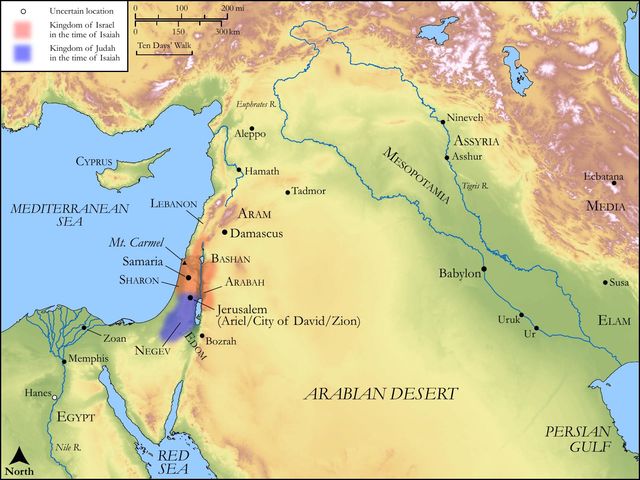
See on the biblical-era map
Study this verse
Public-domain commentary
Matthew Henry
From his Commentary on the Whole Bible. Henry comments on passages, not single verses — this entry covers Isaiah 31:1–5. His three-level outline is real structure in the source text, so it is rendered as structure.
This is the last of four chapters together that begin with woe; and they are all woes to the sinners that were found among the professing people of God, to the drunkards of Ephraim (Isa 28:1), to Ariel (Isa 29:1), to the rebellious children (Isa 30:1), and here to those that go down to Egypt for help; for men's relation to the church will not secure them from divine woes if they live in contempt of divine laws. Observe,
I.What the sin was that is here reproved, Isa 31:1.
1.Idolizing the Egyptians, and making court to them, as if happy were the people that had the Egyptians for their friends and allies. They go down to Egypt for help in every exigence, as if the worshippers of false gods had a better interest in heaven and were more likely to have success of earth than the servants of the living and true God. That which invited them to Egypt was that the Egyptians had many chariots to accommodate them with, and horses and horsemen that were strong; and, if they could get a good body of forces thence into their service, they would think themselves able to deal with the king of Assyria and his numerous army. Their kings were forbidden to multiply horses and chariots, and were told of the folly of trusting to them (Psa 20:7); but they think themselves wiser than their Bible.
2.Slighting the God of Israel: They look not to the Holy One of Israel, as if he were not worth taking notice of in this distress. They advise not with him, seek not his favour, nor are in any care to make him their friend.
II.The gross absurdity and folly of this sin.
1.They neglected one whom, if they would not hope in him, they had reason to fear. They do not seek the Lord, nor make their application to him, yet he also is wise, Isa 31:2. They are solicitous to get the Egyptians into an alliance with them, because they have the reputation of a politic people; and is not God wise too? and would not infinite wisdom, engaged on their side, stand them in more stead than all the policies of Egypt? They are at the pains of going down to Egypt, a tedious journey, when they might have had better advice, and better help, by looking up to heaven, and would not. But, if they will not court God's wisdom to act for them, they shall find it act against them. He is wise, too wise for them to outwit, and he will bring evil upon those who thus affront him. He will not call back his words as men do (because they are fickle and foolish), but he will arise against the house of the evil-doers, this cabal of them that go down to Egypt; God will appear to their confusion, according to the word that he has spoken, and will oppose the help they think to bring in from the workers of iniquity. Some think the Egyptians made it one condition of their coming into an alliance with him that they should worship the gods of Egypt, and they consented to it, and therefore they are both called evil-doers and workers of iniquity.
2.They trusted to those who were unable to help them and would soon appear to be so, Isa 31:3. Let them know that the Egyptians, whom they depend so much upon, are men and not God. As it is good for men to know themselves to be but men (Psa 9:20), so it is good for us to consider that those we love and trust to are but men. They therefore can do nothing without God, nothing against him, nothing in comparison with him. They are men, and therefore fickle and foolish, mutable and mortal, here to day and gone to morrow; they are men, and therefore let us not make gods of them, by making them our hope and confidence, and expecting that in them which is to be found in God only; they are not God, they cannot do that for us which God can do, and will, if we trust in him. Let us not then neglect him, to seek to them; let us not forsake the rock of ages for broken reeds, nor the fountain of living waters for broken cisterns. The Egyptians indeed have horses that are very strong; but they are flesh, and not spirit, and therefore, strong as they are, they may be wearied with a long march, and become unserviceable, or be wounded and slain in battle, and leave their riders to be ridden over. Every one knows this, that the Egyptians are not God and their horses are not spirit; but those that seek to them for help do not consider it, else they would not put such confidence in them. Sinners may be convicted of folly by the plainest and most self-evident truths, which they cannot deny, but will not believe.
3.They would certainly be ruined with the Egyptians they trusted in, Isa 31:3. When the Lord does but stretch out his hand how easily, how effectually, will he make them ashamed of their confidence in Egypt, and the Egyptians ashamed of the encouragement they gave them to trust in them; for he that helps and he that is helped shall fall together, and their mutual alliance shall prove their joint ruin. The Egyptians were shortly to be reckoned with, as appears by the burden of Egypt (ch. 19), and then those who fled to them for shelter and succour should fall with them; for there is no escaping the judgments of God. Evil pursues sinners, and it is just with God to make that creature a scourge to us which we make an idol of.
4.They took God's work out of his hands. They pretended a great deal of care to preserve Jerusalem, in advising to an alliance with Egypt; and, when others would not fall in with their measures, they pleaded self preservation, and went to Egypt themselves. Now the prophet here tells them that Jerusalem should be preserved without aid from Egypt and that those who tarried there should be safe when those who fled to Egypt should be ruined. Jerusalem was under God's protection, and therefore there was no occasion to put it under the protection of Egypt. But a practical distrust of God's all-sufficiency is at the bottom of all our sinful departures from him to the creature. The prophet tells them he had it from God's own mouth: Thus hath the Lord spoken to me. They might depend upon it,
(1.)That God would appear against Jerusalem's enemies with the boldness of a lion over his prey, Isa 31:4. When the lion comes out to seize his prey a multitude of shepherds come out against him; for it becomes neighbours to help one another when persons or goods are in danger. These shepherds dare not come near the lion; all they can do is to make a noise, and with that they think to frighten him off. But does he regard it? No: he will not be afraid of their voice, nor abase himself so far as to be in the least moved by it either to quit his prey or to make any more haste than otherwise he would do in seizing it. Thus will the Lord of hosts come down to fight for Mount Zion, with such an unshaken undaunted resolution not to be moved by any opposition; and he will as easily and irresistibly destroy the Assyrian army as a lion tears a lamb in pieces. Whoever appear against God, they are but like a multitude of poor simple shepherds shouting at a lion, who scorns to take notice of them or so much as to alter his pace for them. Surely those that have such a protector need not go to Egypt for help.
(2.)That God would appear for Jerusalem's friends with the tenderness of a bird over her young, Isa 31:5. God was ready to gather Jerusalem, as a hen gathers her brood under her wings (Mat 23:37); but those that trusted to the Egyptians would not be gathered. As birds flying to their nests with all possible speed, when they see them attacked, and fluttering about their nests with all possible concern, hovering over their young ones to protect them and drive away the assailants, with such compassion and affection will the Lord of hosts defend Jerusalem. As an eagle stirs up her young when they are in danger, takes them and bears them on her wings, so the Lord led Israel out of Egypt (Deu 32:11, Deu 32:12); and he has now the same tender concern for them that he had then, so that they need not flee into Egypt again for shelter. Defending, he will deliver it; he will so defend it as to secure the continuance of its safety, not defend it for a while and abandon it at last, but defend it so that it shall not fall into the enemies' hand. I will defend this city to save it, Isa 37:35. Passing over he will preserve it; the word for passing over is used in this sense only here and Exo 12:12, Exo 12:23, Exo 12:27, concerning the destroying angel's passing over the houses of the Israelites when he slew all the first-born of the Egyptians, to which story this passage refers. The Assyrian army was to be routed by a destroying angel, who should pass over Jerusalem, though that deserved to be destroyed, and draw his sword only against the besiegers. They shall be slain by the pestilence, but none of the besieged shall take the infection. Thus he will again pass over the houses of his people and secure them.
Historical interpretation
Historical reception
1 surviving comment on this verse from the historical church.
(Chapter 31, verses 1 onwards) Woe to those who go down to Egypt for help, who rely on horses, who trust in the multitude of their chariots and in the great strength of their horsemen, but do not look to the Holy One of Israel, or seek help from the Lord. Yet he too is wise and can bring disaster; he does not take back his words. He will rise up against the wicked nation, against those who help evildoers. Egypt is a man and not a God: and their horses are flesh, not spirit: and the Lord shall lay his hand upon them that help, and the helper shall fall down, and he that is helped shall fall, and they shall all be consumed together. After the burden of the beasts of the south, and the treasures of their riches for the people of Egypt shall exhaust their aid, which shall be of no profit to them, but for a shame and a reproach. Look now towards the land of the north wherein is the king of Babylon: where is now the old king of Assyria? Where are their gods in whom they trusted? Who is the king of Hamath, and of Arphad, and of the city of Sepharvaim, of Ana, and of Ava? And as for Hamath it had the beginning from Samaria: but Samaria and Jerusalem shall receive the reward of their trusting in him. For their God is with them and they glory in their king. With their horses and chariots they shall go up, and with their horsemen and their troops they shall come down, and they shall cover the land as a sea. And they shall pass through it unharmed: and they shall fall into captivity. And they that shall be gathered together against them, shall be confounded: and all the beasts of the field, and all the fowls of the air, and the birds of the sea shall be gathered together upon them: and the Lord will for them carry on a war, and will afflict them. Their strength shall be consumed with famine: and their birds shall be devoured with a burning heat, and with most grievous destruction: because they have despised the words of the Lord, and have depised the counsel of the holy one of Israel. And this is both the present and the past, where it is prescribed that the Jews should not go down to Egypt; here, because they have despised the Lord's command, it is prophesied that they will go down, and that both Israel and the Egyptians, both the fugitives and the helpers, will be slain by King Nebuchadnezzar of Babylon. Jeremiah speaks at length about this (Jeremiah 42). Woe therefore to those who go down to Egypt and despise the Lord's command in fear of the Chaldeans, hoping in idolaters who boast of having the worship of God, and relying on the help of horses, not knowing the scripture: A deceitful horse brings salvation (Psalm 32:17); and they have confidence in chariots, horses, and riders, not remembering that song: He has cast chariots and their riders into the sea (Exodus 15:1). And they did not trust in the Holy One of Israel, who promised them help through Jeremiah for those who remained in the land of Judah. And they did not seek the Lord; not that they did not seek, but that they disregarded the words of the one they sought. And this is also said of the wicked priests: They devour my people and do not call upon the Lord (Psalm 52:5,6). But the wise one, that is, the Lord, brought evil upon them, and the worst, namely Nebuchadnezzar, or rather, he brought about evil as a consequence, not as a personal intention; and he did not take away his words that he had spoken through the prophets. How will it rise up against the tribe of Judah, the house of the wicked, and against the help of the Egyptians, who work iniquity? For Egypt, or the Egyptians as the Septuagint translated, is a man and not God; and their horses are flesh and not spirit. Therefore, it is written in Jeremiah: Cursed is the man who puts his trust in man and has made flesh his strength, and his heart has turned away from the Lord. And he will be like a shrub in the desert, and shall not see when good comes (Jeremiah 17:5-6). And in another place it is written: The salvation of man is in vain (Ps. 59:13), or, as is better understood in the Hebrew, in man. And when the Lord stretches out His hand to punish, or turns away, under the metaphor of a charioteer, and loosens the reins of the horses that are running, the Egyptian helper will fall, and the help that was given to Israel. Indeed, we can understand this about those who, in times of persecution, tribulation, and distress, do not trust in the Lord, but in the help of the Egyptians, that is, of worldly men; not knowing that Abraham was in danger in Egypt, and that the people of God served in that region of mud and bricks, which is spiritually called the iron furnace. Wherefore also in the Apocalypse of John it is read: The place in which the Lord was crucified is spiritually called Sodom and Egypt (Al. Egyptian) (Apoc. XI, 8).
Continue studying Isaiah 31:3 across the web’s major study libraries — every link below opens this exact verse, chapter, or book on the destination site.
Read & Compare
 BibleGatewayThis verse in more than 200 translations and 70 languages.
 Bible.comThe YouVersion reader — hundreds of translations, reading plans, and highlights.
 ESV.orgCrossway's official English Standard Version reader.
 NET BibleThe NET translation with 60,000+ translators' notes on every rendering decision.
 STEP BibleTyndale House's free study tool — original text, vocabulary, and scholarly resources.
 BibliaLogos Bible Software's free web reader.
 USCCBThe New American Bible (Revised Edition) with the U.S. bishops' study notes.
Commentaries
 BibleHub CommentariesDozens of classic commentaries on this verse, gathered on one page.
 StudyLightMore than 100 commentary sets — the largest collection on the web.
 BibleRefPlain-English commentary on what this verse means, verse by verse.
 Enduring WordDavid Guzik's free commentary on this chapter, widely used by Bible teachers.
 Bible Study ToolsVerse commentary alongside Greek and Hebrew study aids.
Original Language & Research
- BibleHub InterlinearThe verse word by word — original language, transliteration, and English.
- BibleHub LexiconEvery word's original-language definition and Strong's entry.
 Blue Letter BibleDeep-study tools — Strong's numbers, concordance, and word studies.
 SefariaThe Hebrew text with Rashi and centuries of Jewish commentary.
Sermons, Hymns & Audio


TrulyRandomVerse is not affiliated with these sites and doesn’t control their content. They’re linked because they’re genuinely useful.
Summary
Isaiah 31:3 delivers a powerful prophetic warning to the kingdom of Judah, cautioning against the perilous folly of relying on human alliances and military might, particularly that of Egypt, instead of placing unwavering trust in the sovereign power of the Lord. The verse masterfully contrasts the inherent limitations and transient nature of human strength, characterized as "men" and "flesh," with the infinite, divine omnipotence of God, described as "God" and "spirit." It unequivocally declares that any confidence placed in earthly resources apart from divine guidance is utterly futile and will inevitably culminate in a collective downfall when the Lord decisively intervenes. This declaration powerfully underscores God's absolute supremacy and the certain judgment awaiting those who abandon Him for the illusion of worldly security.
Context
ShowHideLiterary Context
Isaiah 31:3 is strategically positioned within a series of prophetic oracles (Isaiah 28-33) that primarily condemn Judah's misguided foreign policy and spiritual rebellion. Chapters 30 and 31 specifically target Judah's "rebellious children" for their persistent inclination to seek help from Egypt without consulting Yahweh, thereby "adding sin to sin" Isaiah 30:1. The prophet consistently portrays such alliances as a source of profound shame and disgrace, asserting that genuine strength, salvation, and peace are found only in returning to God through repentance and quiet, unwavering trust Isaiah 30:15. The immediate preceding verses in Isaiah 31:1-2 vividly describe those who "go down to Egypt for help, and rely on horses, and trust in chariots," setting the stage for the dramatic contrast between human and divine power presented in verse 3. The subsequent verses in Isaiah 31 further elaborate on God's unwavering protection over Jerusalem and His ultimate plan to destroy Assyria, thereby demonstrating the utter futility of Judah's misplaced reliance on human strength.
Historical & Cultural Context
The late 8th century BCE was a period of intense geopolitical instability for the Judean kingdom, which faced the formidable and brutal expansion of the Neo-Assyrian Empire. King Hezekiah of Judah, like many regional rulers, found himself in a precarious position, forced to consider various strategies for national survival. Egypt, a long-standing regional power, was renowned for its impressive cavalry and military might, making it an appealing potential ally against the Assyrian threat. However, for prophets like Isaiah, such alliances represented a profound theological transgression—a betrayal of Judah's unique covenant relationship with Yahweh. The historical backdrop is one of desperate political maneuvering, pervasive fear, and a fervent search for security in a volatile world. Judah's temptation to align with Egypt mirrored a common ancient Near Eastern practice of forming strategic pacts, yet for God's chosen people, it signified a dangerous reliance on "flesh" rather than on the living God, a recurring theme of prophetic condemnation throughout the Old Testament.
Key Themes
ShowHideIsaiah 31:3 profoundly articulates several foundational themes central to the book of Isaiah and broader biblical theology. Firstly, it powerfully asserts the Divine Sovereignty of Yahweh, affirming His absolute control over human affairs and the ultimate impotence of human strength when arrayed against Him. The stark contrast between "men, and not God" and "flesh, and not spirit" underscores the infinite qualitative difference between the Creator and His creation, highlighting God's incomparable power. Secondly, it emphasizes the Futility of Worldly Alliances and Human Reliance, particularly when such reliance supplants or diminishes trust in God. Isaiah consistently warns that any perceived security sought apart from God is an illusion destined for ruin, a message powerfully echoed in passages such as Psalm 20:7, which declares, "Some trust in chariots and some in horses, but we trust in the name of the LORD our God." Similarly, Jeremiah 17:5 pronounces a curse upon those who trust in man. Lastly, the verse vividly illustrates God's Unstoppable Hand of Judgment and Deliverance. The phrase "When the LORD shall stretch out his hand" functions as a potent idiom signifying decisive divine intervention, whether for judgment upon the wicked or for the deliverance of His people, demonstrating that no human force can withstand His omnipotent will.
Exposition and Analysis
ShowHideKey Word Analysis
ShowHideThis term refers to human beings in general, often emphasizing their inherent mortality, weakness, and earthly nature, in stark contrast to the divine. Here, it highlights the intrinsic limitation and frailty of the Egyptians, despite their formidable military reputation, as mere mortals utterly incapable of delivering ultimate salvation or standing effectively against the power of God.
"flesh" denotes the physical, mortal, and transient aspect of living beings. In a theological context, it frequently signifies weakness, sinfulness, and dependence, standing in direct opposition to the divine "spirit." When applied to the horses, it underscores their natural, created limitation, lacking the enduring power or divine essence of the Almighty.
"hand" is a primitive word with a vast array of applications, frequently signifying power, means, direction, or agency. In this context, the idiom "stretch out his hand" (H5186 + H3027) is a powerful anthropomorphism, representing God's direct, forceful, and decisive action, whether in judgment or deliverance. It conveys the irresistible and sovereign power of God that no earthly force can withstand.
Verse Breakdown
ShowHide"Now the Egyptians [are] men, and not God;"
This opening clause immediately establishes a foundational theological distinction. It asserts the inherent limitation and mortality of the Egyptians, despite their formidable reputation as a military power. They are fundamentally human, subject to the same weaknesses and finite power as any other created being, thus being qualitatively different from the omnipotent and eternal God. This sets the stage for the profound futility of placing trust in them.
"and their horses flesh, and not spirit."
This clause extends the initial contrast to Egypt's renowned military strength, specifically their formidable cavalry. The phrase "horses flesh" emphasizes their natural, physical, and therefore limited nature, incapable of possessing the divine, life-giving, or all-powerful "spirit." This parallelism powerfully reinforces the idea that even the most impressive human military assets are ultimately weak, transient, and ineffective when compared to the enduring and irresistible power of God.
"When the LORD shall stretch out his hand, "
This pivotal clause introduces the moment of decisive divine intervention. "The LORD" (Yahweh, H3068) refers to the covenant God of Israel, the self-existent and eternal One. The idiom "stretch out his hand" signifies His active, direct, and irresistible power, implying a forceful act of judgment or deliverance that no human force can withstand, avert, or escape.
"both he that helpeth shall fall, and he that is holpen shall fall down, and they all shall fail together."
This concluding clause vividly describes the inevitable and comprehensive outcome of God's intervention. "He that helpeth" refers to Egypt, the supposed ally, and "he that is holpen" refers to Judah, the one seeking help. The repetition of "fall" (H3782, H5307) and the strong declaration that "they all shall fail together" (H3615, H3162) underscore the comprehensive, collective, and certain destruction awaiting those who rely on human strength instead of God. Their combined efforts will be utterly consumed, brought to an end, and rendered powerless by the Lord's supreme power.
Literary Devices
ShowHideIsaiah 31:3 is masterfully crafted with several literary devices that amplify its profound message. The most prominent is Contrast, which forms the very core of the verse's theological argument. The prophet starkly juxtaposes "men" with "God" and "flesh" with "spirit," highlighting the immeasurable and unbridgeable chasm between finite human power and infinite divine omnipotence. This contrast serves to expose the profound foolishness and spiritual danger of Judah's misplaced trust. Parallelism is also clearly evident in the structure of the first two clauses ("Now the Egyptians are men, and not God; and their horses flesh, and not spirit"), where the second clause reinforces and expands upon the first, creating a rhythmic and emphatic declaration that underscores the pervasive limitation of all human endeavors. Furthermore, the powerful phrase "When the LORD shall stretch out his hand" is a striking Anthropomorphism, attributing a human action (stretching out a hand) to God. This device makes God's power, direct intervention, and decisive judgment more tangible and comprehensible to the audience, emphasizing His active and irresistible role in human history. Finally, the repetition of "fall" and "fail" in the concluding clause creates a powerful sense of Anaphora and Emphasis, driving home the absolute certainty and comprehensive nature of the impending collapse for all who defy God's sovereign will.
Theological and Thematic Connections
ShowHideIsaiah 31:3 articulates a foundational biblical principle: true security, deliverance, and ultimate salvation are found exclusively in God, not in human strength, military might, or political alliances. It profoundly underscores the Creator-creature distinction, serving as a stark reminder of humanity's inherent limitations and absolute dependence on the divine. Theologically, this verse challenges any form of idolatry that elevates human wisdom, power, or material resources above the sovereign will and boundless provision of Yahweh. It functions as a timeless call to radical and unwavering trust in God alone, asserting that His intervention is decisive, irresistible, and renders all human efforts futile when they oppose or attempt to circumvent His divine purposes. This passage is a powerful statement on divine omnipotence and the inherent folly of self-reliance or reliance on any finite entity.
Reflection and Application
ShowHideIsaiah 31:3 remains profoundly relevant for believers today, challenging us to critically examine the true objects of our ultimate trust. In a world fraught with anxieties—whether economic instability, political turmoil, health crises, or personal struggles—it is incredibly tempting to place our confidence in human solutions: robust financial portfolios, impressive career achievements, influential connections, or even our own intellect, resilience, and strength. This verse serves as a potent and timeless reminder that all such "flesh" is inherently limited, transient, and will ultimately "fail" when confronted by the sovereign hand of God. True and lasting security, profound peace, and genuine deliverance are found only in leaning wholeheartedly on the infinite strength, boundless wisdom, and unfailing provision of the Lord. It calls us to cultivate a posture of humble dependence, recognizing that our greatest help comes not from what we can accumulate, control, or achieve, but from the One who is truly "God, and not men," "spirit, and not flesh." This spiritual reliance fosters a deeper, more resilient faith, liberating us from the anxieties of self-sufficiency and the inevitable disappointment of misplaced hopes.
Questions for Reflection
ShowHideFAQ
ShowHideWhat does the contrast between "men, and not God" and "flesh, and not spirit" truly signify?
ShowHideThis stark contrast is absolutely central to the verse's profound message. "Men" (H120, ʼâdâm') and "flesh" (H1320, bâsâr') refer to human beings and their physical nature, emphasizing their inherent weakness, mortality, and finite capabilities. They are created beings, fundamentally limited and subject to decay. In contrast, "God" (H410, ʼêl') and "spirit" (H7307, rûwach') refer to the divine, emphasizing infinite power, life, transcendence, and omnipotence. The spirit, particularly God's Spirit, is associated with life-giving power, supernatural strength, and divine essence. The verse thus highlights the vast, unbridgeable qualitative difference between the Creator and His creation, asserting that human strength, no matter how impressive or formidable it may appear, is utterly insignificant and ultimately powerless compared to God's divine power. It is a profound theological statement on the utter futility of trusting in anything less than the infinite, sovereign God.
Why was Judah so tempted to ally with Egypt, and what was God's consistent message about such alliances?
ShowHideJudah was intensely tempted to ally with Egypt primarily out of geopolitical necessity and overwhelming fear, as they faced the relentless and superior military might of the Assyrian Empire. Egypt was a prominent regional superpower with a renowned cavalry, making them appear to be a logical and powerful ally from a purely human strategic perspective. However, God's consistent message through His prophets, especially Isaiah, was that such alliances were a profound act of faithlessness and a direct betrayal of their covenant relationship with Yahweh. They demonstrated a fundamental lack of trust in God, who had historically proven Himself as Israel's faithful deliverer. God repeatedly warned that relying on foreign nations or military strength instead of Him would inevitably lead to shame, defeat, and divine judgment. For example, Isaiah 30:1-7 explicitly condemns this alliance, labeling it a "rebellious plan" that would bring only "disgrace" and "shame." God desired His people to trust solely in His covenant faithfulness and omnipotent power, promising that in "quietness and in trust shall be your strength" Isaiah 30:15.
Christ-Centered Fulfillment
ShowHideIsaiah 31:3, with its stark and uncompromising contrast between human weakness and divine power, finds its ultimate and profound fulfillment in the person and redemptive work of Jesus Christ. The verse powerfully exposes the inherent futility of relying on "flesh" for salvation or security, a truth resoundingly echoed throughout the New Testament. Humanity, in its fallen "flesh," is utterly incapable of saving itself or overcoming the pervasive power of sin and death Romans 7:18. Jesus, however, is not merely "men, and not God," but rather the incarnate God, fully divine and fully human, the very "spirit" of God made manifest in "flesh" John 1:14. His sinless life, sacrificial death, and glorious resurrection demonstrate the ultimate "stretch[ing] out of His hand" in a way that decisively defeats the powers of darkness and offers true, eternal salvation—something no human alliance, military might, or self-effort could ever achieve. Where Judah sought help from earthly chariots and horses, believers now find their ultimate and unfailing help in the "Lamb of God who takes away the sin of the world" John 1:29. The "flesh" of human effort, self-righteousness, and worldly wisdom "falls" and "fails" in the face of God's perfect standard, but Christ's perfect sacrifice provides the righteousness we desperately lack 2 Corinthians 5:21. His resurrection from the dead is the supreme demonstration of God's unstoppable hand, raising Him to victory and guaranteeing the triumph of all who place their trust in Him Romans 8:11. Thus, Isaiah's ancient warning against trusting in "flesh" ultimately points us to the absolute necessity of trusting in Christ alone, who is the divine "spirit" that gives life and the only one who can truly deliver us from our greatest enemies: sin, death, and the devil. He is the divine helper who will never fall, and in whom all who are "holpen" will stand secure for eternity Hebrews 7:25.