


Isaiah 31:4
- כִּיkiforH3588PrtParticle Conditional
- כֹהkhohthusH3541AdvAdverb
- אָמַר'a·marhe has saidH559V-Qal-Perf-3msVerb Qal Perfect 3rd Singular Masculine
- יְהוָהYah·wehYahwehH3068N-properNoun Proper Title
- אֵלַי'e·Laito meH413Prep ¦ 1csPrepositionאֵלַtoיme
- כַּאֲשֶׁרka·'a·Sherjust asH834Prep-k ¦ RelParticle Relativeכַּjustאֲשֶׁרas
- יֶהְגֶּהyeh·Gehit growlsH1897V-Qal-Imperf-3msVerb Qal Imperfect 3rd Singular Masculine
- הָאַרְיֵהha·'ar·Yehthe lionH738Art ¦ N-msNoun Singular Masculine Absoluteהָtheאַרְיֵהlion
- וְהַכְּפִירve·ha·ke·Firand the young lionH3715Conj-w ¦ Art ¦ N-msNoun Singular Masculine Absoluteוְandהַtheכְּפִירyoung lion
- עַל'aloverH5921PrepPreposition
- טַרְפּוֹtar·Poits preyH2964N-msc ¦ 3msNoun Singular Masculine Constructטַרְפּpreyוֹits
- אֲשֶׁר'a·SherthatH834RelParticle Relative
- יִקָּרֵאyi·ka·Re'it is summonedH7121V-Niphal-Imperf-3msVerb Niphal Imperfect 3rd Singular Masculine
- עָלָיו'a·Lavon itH5921Prep ¦ 3msPrepositionעָלָיonוit
- מְלֹאme·Lo'a multitude ofH4393N-mscNoun Singular Masculine Construct
- רֹעִיםro·'ImshepherdsH7462V-Qal-Prtcpl-mpVerb Qal Participle Plural Masculine Absolute
- מִקּוֹלָםmi·ko·Lamfrom their voiceH6963Prep-m ¦ N-msc ¦ 3mpNoun Singular Masculine Constructמִfromקּוֹלָvoiceםtheir
- לֹאlo'notH3808NegParticle Negative
- יֵחָתye·Chatit is dismayedH2865V-Niphal-Imperf-3msVerb Niphal Imperfect 3rd Singular Masculine
- וּמֵהֲמוֹנָםu·me·ha·mo·Namand from their tumultH1995Conj-w ¦ Prep-m ¦ N-msc ¦ 3mpNoun Singular Masculine Constructוּandמֵfromהֲמוֹנָtumultםtheir
- לֹאlo'notH3808NegParticle Negative
- יַעֲנֶהya·'a·Nehit cringesH6031V-Qal-Imperf-3msVerb Qal Imperfect 3rd Singular Masculine
- כֵּןKensoH3651AdvAdverb
- יֵרֵדye·Redhe will come downH3381V-Qal-Imperf-3msVerb Qal Imperfect 3rd Singular Masculine
- יְהוָהYah·wehYahwehH3068N-properNoun Proper Title
- צְבָאוֹתtze·va·'otof hostsH6635N-fpNoun Plural Feminine Absolute
- לִצְבֹּאlitz·Bo'to wage warH6633Prep-l ¦ V-Qal-InfVerb Qal Infinitive Constructלִtoצְבֹּאwage war
- עַל'alonH5921PrepPreposition
- הַרhar[the] mountain ofH2022N-mscNoun Singular Masculine Construct
- צִיּוֹןtzi·YonZionH6726N-properNoun Proper Location
- וְעַלve·'aland onH5921Conj-w ¦ PrepPrepositionוְandעַלon
- גִּבְעָתָהּgiv·'a·Tahits hillH1389N-fsc ¦ 3fsNoun Singular Feminine Constructגִּבְעָתָhillהּits
English is a literal word-by-word gloss of the Hebrew, not the KJV's wording. Why?
This is the original text the KJV's translators worked from — each Hebrew word with its own literal English meaning in this verse, prepared by scholars at Tyndale House, Cambridge. The KJV translates whole sentences, not word by word, so its wording differs: one Hebrew word can become several English words, and the KJV may choose “the LORD” where the gloss reads “Yahweh”. Both are faithful — they answer different questions. For the KJV's own rendering, switch to the KJV text.
Details
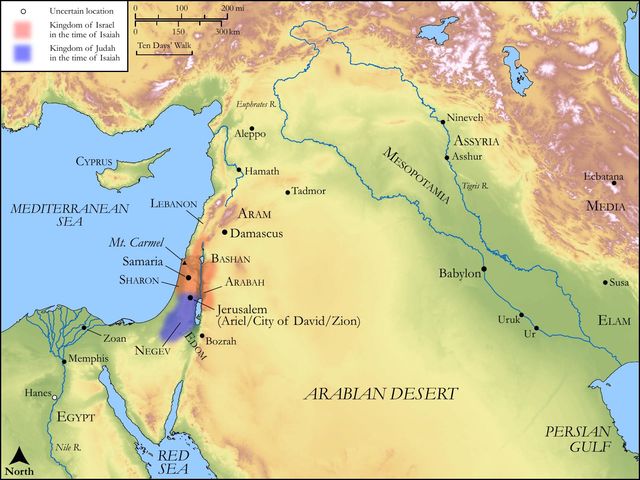
See on the biblical-era map
Study this verse
Public-domain commentary
Matthew Henry
From his Commentary on the Whole Bible. Henry comments on passages, not single verses — this entry covers Isaiah 31:1–5. His three-level outline is real structure in the source text, so it is rendered as structure.
This is the last of four chapters together that begin with woe; and they are all woes to the sinners that were found among the professing people of God, to the drunkards of Ephraim (Isa 28:1), to Ariel (Isa 29:1), to the rebellious children (Isa 30:1), and here to those that go down to Egypt for help; for men's relation to the church will not secure them from divine woes if they live in contempt of divine laws. Observe,
I.What the sin was that is here reproved, Isa 31:1.
1.Idolizing the Egyptians, and making court to them, as if happy were the people that had the Egyptians for their friends and allies. They go down to Egypt for help in every exigence, as if the worshippers of false gods had a better interest in heaven and were more likely to have success of earth than the servants of the living and true God. That which invited them to Egypt was that the Egyptians had many chariots to accommodate them with, and horses and horsemen that were strong; and, if they could get a good body of forces thence into their service, they would think themselves able to deal with the king of Assyria and his numerous army. Their kings were forbidden to multiply horses and chariots, and were told of the folly of trusting to them (Psa 20:7); but they think themselves wiser than their Bible.
2.Slighting the God of Israel: They look not to the Holy One of Israel, as if he were not worth taking notice of in this distress. They advise not with him, seek not his favour, nor are in any care to make him their friend.
II.The gross absurdity and folly of this sin.
1.They neglected one whom, if they would not hope in him, they had reason to fear. They do not seek the Lord, nor make their application to him, yet he also is wise, Isa 31:2. They are solicitous to get the Egyptians into an alliance with them, because they have the reputation of a politic people; and is not God wise too? and would not infinite wisdom, engaged on their side, stand them in more stead than all the policies of Egypt? They are at the pains of going down to Egypt, a tedious journey, when they might have had better advice, and better help, by looking up to heaven, and would not. But, if they will not court God's wisdom to act for them, they shall find it act against them. He is wise, too wise for them to outwit, and he will bring evil upon those who thus affront him. He will not call back his words as men do (because they are fickle and foolish), but he will arise against the house of the evil-doers, this cabal of them that go down to Egypt; God will appear to their confusion, according to the word that he has spoken, and will oppose the help they think to bring in from the workers of iniquity. Some think the Egyptians made it one condition of their coming into an alliance with him that they should worship the gods of Egypt, and they consented to it, and therefore they are both called evil-doers and workers of iniquity.
2.They trusted to those who were unable to help them and would soon appear to be so, Isa 31:3. Let them know that the Egyptians, whom they depend so much upon, are men and not God. As it is good for men to know themselves to be but men (Psa 9:20), so it is good for us to consider that those we love and trust to are but men. They therefore can do nothing without God, nothing against him, nothing in comparison with him. They are men, and therefore fickle and foolish, mutable and mortal, here to day and gone to morrow; they are men, and therefore let us not make gods of them, by making them our hope and confidence, and expecting that in them which is to be found in God only; they are not God, they cannot do that for us which God can do, and will, if we trust in him. Let us not then neglect him, to seek to them; let us not forsake the rock of ages for broken reeds, nor the fountain of living waters for broken cisterns. The Egyptians indeed have horses that are very strong; but they are flesh, and not spirit, and therefore, strong as they are, they may be wearied with a long march, and become unserviceable, or be wounded and slain in battle, and leave their riders to be ridden over. Every one knows this, that the Egyptians are not God and their horses are not spirit; but those that seek to them for help do not consider it, else they would not put such confidence in them. Sinners may be convicted of folly by the plainest and most self-evident truths, which they cannot deny, but will not believe.
3.They would certainly be ruined with the Egyptians they trusted in, Isa 31:3. When the Lord does but stretch out his hand how easily, how effectually, will he make them ashamed of their confidence in Egypt, and the Egyptians ashamed of the encouragement they gave them to trust in them; for he that helps and he that is helped shall fall together, and their mutual alliance shall prove their joint ruin. The Egyptians were shortly to be reckoned with, as appears by the burden of Egypt (ch. 19), and then those who fled to them for shelter and succour should fall with them; for there is no escaping the judgments of God. Evil pursues sinners, and it is just with God to make that creature a scourge to us which we make an idol of.
4.They took God's work out of his hands. They pretended a great deal of care to preserve Jerusalem, in advising to an alliance with Egypt; and, when others would not fall in with their measures, they pleaded self preservation, and went to Egypt themselves. Now the prophet here tells them that Jerusalem should be preserved without aid from Egypt and that those who tarried there should be safe when those who fled to Egypt should be ruined. Jerusalem was under God's protection, and therefore there was no occasion to put it under the protection of Egypt. But a practical distrust of God's all-sufficiency is at the bottom of all our sinful departures from him to the creature. The prophet tells them he had it from God's own mouth: Thus hath the Lord spoken to me. They might depend upon it,
(1.)That God would appear against Jerusalem's enemies with the boldness of a lion over his prey, Isa 31:4. When the lion comes out to seize his prey a multitude of shepherds come out against him; for it becomes neighbours to help one another when persons or goods are in danger. These shepherds dare not come near the lion; all they can do is to make a noise, and with that they think to frighten him off. But does he regard it? No: he will not be afraid of their voice, nor abase himself so far as to be in the least moved by it either to quit his prey or to make any more haste than otherwise he would do in seizing it. Thus will the Lord of hosts come down to fight for Mount Zion, with such an unshaken undaunted resolution not to be moved by any opposition; and he will as easily and irresistibly destroy the Assyrian army as a lion tears a lamb in pieces. Whoever appear against God, they are but like a multitude of poor simple shepherds shouting at a lion, who scorns to take notice of them or so much as to alter his pace for them. Surely those that have such a protector need not go to Egypt for help.
(2.)That God would appear for Jerusalem's friends with the tenderness of a bird over her young, Isa 31:5. God was ready to gather Jerusalem, as a hen gathers her brood under her wings (Mat 23:37); but those that trusted to the Egyptians would not be gathered. As birds flying to their nests with all possible speed, when they see them attacked, and fluttering about their nests with all possible concern, hovering over their young ones to protect them and drive away the assailants, with such compassion and affection will the Lord of hosts defend Jerusalem. As an eagle stirs up her young when they are in danger, takes them and bears them on her wings, so the Lord led Israel out of Egypt (Deu 32:11, Deu 32:12); and he has now the same tender concern for them that he had then, so that they need not flee into Egypt again for shelter. Defending, he will deliver it; he will so defend it as to secure the continuance of its safety, not defend it for a while and abandon it at last, but defend it so that it shall not fall into the enemies' hand. I will defend this city to save it, Isa 37:35. Passing over he will preserve it; the word for passing over is used in this sense only here and Exo 12:12, Exo 12:23, Exo 12:27, concerning the destroying angel's passing over the houses of the Israelites when he slew all the first-born of the Egyptians, to which story this passage refers. The Assyrian army was to be routed by a destroying angel, who should pass over Jerusalem, though that deserved to be destroyed, and draw his sword only against the besiegers. They shall be slain by the pestilence, but none of the besieged shall take the infection. Thus he will again pass over the houses of his people and secure them.
Historical interpretation
Historical reception
1 surviving comment on this verse from the historical church.
(Verses 4, 5.) For thus says the Lord to me: Just as when a lion roars, and a lion cub over its prey, when a multitude of shepherds come against it, it will not be afraid of their voices, nor terrified by their numbers; so the Lord of hosts will come down to fight upon Mount Zion and its hill. Like birds hovering, so the Lord of hosts will protect Jerusalem, protecting and delivering, passing over and saving. In manifestis unam ponimus editionem, maxime ubi nulla diversitas sensuum est. Caesis in Aegypto Israelitis et Aegyptiis, in quorum auxilio confidebant, revertentur (( Al. revertuntur)) in Jerusalem, Cyro regnante, captivi. Et per duas similitudines, Domini, qui se fore adjutorem promiserat, fortitudo monstratur. Sicut leo et catulus leonis esuriens, si cernat ovium gregem, nulla pastorum voce terretur, et multitudinem eorum conscius virium suarum despicit: sic Dominus exercituum praeliabitur, non contra montem Sion et collem ejus, super montem Sion contra adversarios illius. Let us give another comparison: Just as birds defend their offspring by flying over their nests, and whether they see a snake or a human, the birds and others approach their chicks, forgetting their weakness, they fight with their beaks and claws, and with a chattering voice they express their anguish: so the Lord will protect Jerusalem and deliver it by passing over, and He will save it. For 'passing over' in Hebrew is 'Phase', and it is translated as 'ὑπερβαίνων' by the interpreters, apart from the Septuagint. From which it is clear that Pascha, that is, the Lord's Passover, does not signify His passion, but His passage. Moreover, that the Lord acted as the protector in the likeness of birds over Jerusalem, He Himself testifies in the Gospel: 'Jerusalem, Jerusalem, you who kill the prophets and stone those sent to you' (Matt. XXIII, 37): how often have I desired to gather your children together, as a hen gathers her chicks under her wings, and you were not willing? And in Deuteronomy it is said of the Lord: He spread his wings and took them, and carried them on his shoulders (Deut. XXXII, 11).
Continue studying Isaiah 31:4 across the web’s major study libraries — every link below opens this exact verse, chapter, or book on the destination site.
Read & Compare
 BibleGatewayThis verse in more than 200 translations and 70 languages.
 Bible.comThe YouVersion reader — hundreds of translations, reading plans, and highlights.
 ESV.orgCrossway's official English Standard Version reader.
 NET BibleThe NET translation with 60,000+ translators' notes on every rendering decision.
 STEP BibleTyndale House's free study tool — original text, vocabulary, and scholarly resources.
 BibliaLogos Bible Software's free web reader.
 USCCBThe New American Bible (Revised Edition) with the U.S. bishops' study notes.
Commentaries
 BibleHub CommentariesDozens of classic commentaries on this verse, gathered on one page.
 StudyLightMore than 100 commentary sets — the largest collection on the web.
 BibleRefPlain-English commentary on what this verse means, verse by verse.
 Enduring WordDavid Guzik's free commentary on this chapter, widely used by Bible teachers.
 Bible Study ToolsVerse commentary alongside Greek and Hebrew study aids.
Original Language & Research
- BibleHub InterlinearThe verse word by word — original language, transliteration, and English.
- BibleHub LexiconEvery word's original-language definition and Strong's entry.
 Blue Letter BibleDeep-study tools — Strong's numbers, concordance, and word studies.
 SefariaThe Hebrew text with Rashi and centuries of Jewish commentary.
Sermons, Hymns & Audio


TrulyRandomVerse is not affiliated with these sites and doesn’t control their content. They’re linked because they’re genuinely useful.
Summary
Isaiah 31:4 presents a profoundly vivid and powerful simile, portraying the LORD's unwavering and ferocious commitment to defend Jerusalem (Mount Zion) against its adversaries. Drawing an analogy to a lion fiercely guarding its prey, unperturbed by a multitude of shepherds, the prophet assures Judah that God, identified as "the LORD of hosts," will personally descend to fight for His people. This declaration serves as both a magnificent promise of divine intervention and a stark warning against the futility of relying on human alliances, particularly with Egypt, in the face of the overwhelming Assyrian threat, ultimately affirming God's supreme power and resolute protection.
Context
ShowHideLiterary Context
Isaiah 31:4 is strategically positioned within a larger prophetic oracle (chapters 28-33) where the prophet Isaiah vehemently condemns Judah's misplaced trust in foreign alliances, specifically with Egypt, as a means of protection against the formidable Assyrian Empire. The verses immediately preceding this passage (Isaiah 31:1-3) explicitly pronounce a "woe" upon those who "go down to Egypt for help," highlighting the spiritual and practical folly of trusting in human military might—horses and chariots—rather than in the "Holy One of Israel." This particular verse, therefore, serves as the divine counter-argument, presenting God's own formidable, unshakeable, and personal commitment to defend Zion as the only true and effective source of security. It sharply contrasts human weakness and misplaced reliance with God's incomparable strength, faithfulness, and active intervention, setting the stage for further pronouncements of both judgment against Assyria and ultimate restoration for Judah.
Historical & Cultural Context
The historical backdrop for this prophecy, delivered in the late 8th century BCE, is the dire existential threat faced by the Southern Kingdom of Judah from the rapidly expanding and brutal Neo-Assyrian Empire. Assyria had already decisively conquered the Northern Kingdom of Israel (Samaria fell in 722 BCE) and was aggressively encroaching upon Judah, culminating in Sennacherib's campaign against Jerusalem in 701 BCE. In their desperation, many within Jerusalem's leadership, including King Hezekiah's officials, sought a military alliance with Egypt, a regional power known for its impressive chariotry and cavalry. This political maneuvering represented a profound act of unfaithfulness to God's covenant, which mandated exclusive trust in Him as Israel's deliverer. Culturally, the lion was a pervasive and powerful symbol throughout the ancient Near East, representing royalty, immense strength, ferocity, and protective instinct. This deeply ingrained cultural understanding would have made Isaiah's metaphor of God as a lion particularly impactful, immediately conveying God's unchallenged supremacy over all earthly powers, including the combined forces of Assyria and Egypt, and His unyielding commitment to His people.
Key Themes
ShowHideThis verse powerfully contributes to several overarching theological and narrative themes prevalent throughout the book of Isaiah. Firstly, it underscores the theme of Divine Protection and Deliverance, asserting unequivocally that God Himself is the ultimate and invincible defender of His people and His holy city, Zion. His commitment is portrayed as fierce, unyielding, and far surpassing any human military might or strategic alliance, providing the only true security. Secondly, it reinforces the theme of God's Sovereignty and Omnipotence, particularly through the majestic title "the LORD of hosts" (Yᵉhôvâh Tsâbâʼ), which signifies His absolute command over all heavenly and earthly armies, leaving no doubt about His ability to execute His will. This divine power stands in stark contrast to the limited capabilities of human armies and political maneuvering, as explicitly highlighted in passages like Isaiah 30:1-7, where Judah's reliance on Egypt is condemned. Finally, and perhaps most importantly, the verse implicitly, yet strongly, calls for Trust in God Alone. By vividly demonstrating God's formidable and protective nature, it serves as a divine rebuke to Judah's inclination to trust in chariots and horses, urging them instead to return to the LORD, for true and lasting security is found only in Him, a message powerfully echoed in Isaiah 26:3-4.
Exposition and Analysis
ShowHideKey Word Analysis
ShowHideThis word, often associated with a deep, guttural sound, conveys the lion's powerful and intimidating vocalization. In the context of the lion guarding its prey, it signifies a sound of possession, warning, and fierce determination. It is not a cry of fear or distress, but an assertion of dominance and an unshakeable resolve to protect what is its own. When applied to the LORD, it suggests His authoritative declaration and unyielding commitment to defend Zion, a sound that strikes fear into His enemies and assures His people.
This term means "to prostrate," "to break down," "to be dismayed," or "terrified." The text explicitly states the lion "will not be afraid," emphasizing its utter lack of fear or intimidation despite the "multitude of shepherds" called forth against it. This highlights the lion's (and thus God's) absolute confidence, invincibility, and unwavering resolve in the face of overwhelming opposition. It underscores that no earthly power, numerical superiority, or combined force can cause the LORD to falter, retreat, or abandon His divine purpose.
Meaning "to depress," "to humble oneself," or "to weaken," this word further emphasizes the lion's (and God's) unyielding stance. The lion will not "abase himself for the noise of them," meaning it will not be intimidated, yield, show any sign of weakness, or submit to the clamor, shouts, or threats of its adversaries. This illustrates God's steadfastness, His refusal to be swayed or diminished by the threats or numerical superiority of His enemies, and His absolute, uncompromised resolve to protect Zion.
Verse Breakdown
ShowHide"For thus hath the LORD spoken unto me,"
This opening clause immediately establishes the divine authority and infallible nature of the prophecy. Isaiah is not speaking his own words or opinions, but rather relaying a direct, verbatim revelation from YHWH, the covenant God of Israel. This declaration lends immense weight, certainty, and solemnity to the profound message that follows, grounding the subsequent powerful imagery in the immutable word of God.
"Like as the lion and the young lion roaring on his prey,"
This introduces the central and striking simile of the verse. The pairing of "the lion" (ʼărîy, referring to a mature, powerful lion) and "the young lion" (kᵉphîyr, a vigorous, emerging lion) emphasizes the full spectrum of leonine power—from seasoned, experienced prowess to youthful, untamed ferocity. Their collective "roaring on his prey" vividly depicts a creature fiercely asserting its claim, possessing its spoil, and protecting its acquisition, a sound meant to deter any challenger. This imagery immediately conjures a sense of untamed, irresistible power and an instinctual, unyielding protective nature.
"when a multitude of shepherds is called forth against him, [he] will not be afraid of their voice, nor abase himself for the noise of them:"
This clause intensifies the simile by introducing the opposition and highlighting the lion's (and God's) response. A "multitude of shepherds" represents a significant, organized, and seemingly overwhelming human force. Shepherds, though not professional warriors, would be armed (with staffs, slings, etc.) and united in their efforts to protect their flocks from a dangerous predator. Yet, the lion's response—utter fearlessness and refusal to "abase himself" (to be intimidated, yield, or show any sign of weakness) despite their collective "voice" or "noise" (their shouts, threats, or attempts to drive it away)—underscores its absolute dominance, unwavering resolve, and intrinsic invincibility.
"so shall the LORD of hosts come down to fight for mount Zion, and for the hill thereof."
This is the climactic application of the simile, directly connecting the lion's fierce and unyielding protection to God's promised action. "The LORD of hosts" (Yᵉhôvâh Tsâbâʼ) emphasizes God's supreme authority as the commander of all heavenly armies, reinforcing His limitless power and His position as the divine Warrior. His promise to "come down to fight" signifies active, personal, and decisive intervention on behalf of "mount Zion, and for the hill thereof" (referring specifically to Jerusalem and its sacred temple mount). This declaration assures Judah that God's defense will be as resolute, fearless, and effective as the lion's protection of its prey, guaranteeing the city's security against all enemies, regardless of their perceived strength or numbers.
Literary Devices
ShowHideThe primary and most impactful literary device employed in Isaiah 31:4 is a powerful Simile, explicitly comparing the LORD's protective action to that of a lion. The introductory phrase "Like as the lion...so shall the LORD" clearly establishes this comparison, drawing on the universally recognized attributes of a lion—strength, ferocity, territoriality, and an unyielding defense of its prey—to describe God's character and commitment. This simile is further enhanced by vivid Imagery, painting a compelling picture of a roaring lion standing firm and unperturbed against a "multitude of shepherds," allowing the reader to visualize the overwhelming power and fearlessness of God. The parallel use of "the lion and the young lion" also employs Merism, encompassing the full range of leonine power and vitality. Furthermore, there is a subtle element of Anthropomorphism, as God is described with human-like attributes of fighting and "coming down," though this serves to emphasize His active, personal intervention rather than a literal human form. Finally, the phrase "Mount Zion, and for the hill thereof" utilizes Synecdoche or Metonymy, where the specific geographical location (Mount Zion, the temple hill) represents the entire city of Jerusalem and, by extension, God's chosen people and His dwelling place, signifying the comprehensive nature of His protection.
Theological and Thematic Connections
ShowHideIsaiah 31:4 profoundly articulates the biblical truth of God's active, fierce, and unwavering protection of His people. It underscores that divine security is never contingent on human strength, political maneuvering, or military might, but solely on the sovereign power and unshakeable commitment of the "LORD of hosts." This passage serves as a timeless reminder that when faced with overwhelming odds, whether personal or national, the believer's ultimate refuge and defense are found exclusively in God alone, who is neither intimidated nor swayed by the clamor, threats, or numerical superiority of adversaries. His protective presence is a formidable shield, assuring His people that He will personally intervene and fight on their behalf, demonstrating His absolute faithfulness to His covenant promises.
Reflection and Application
ShowHideIsaiah 31:4 offers profound comfort and a challenging call to faithful living for believers today. In a world often characterized by instability, pervasive threats, and the seductive allure of human solutions, this verse compels us to critically re-evaluate where we place our ultimate trust. Just as Judah was tempted to rely on the formidable chariots and cavalry of Egypt, we too can be prone to seeking security and deliverance in financial stability, political systems, personal achievements, influential connections, or even our own perceived strength and wisdom. However, this passage powerfully reminds us that our true, unshakeable, and invincible defense comes solely from the sovereign "LORD of hosts," who is infinitely more formidable than any opposition we might ever face. When anxieties mount, when adversaries seem overwhelming, or when the "noise" and clamor of the world threaten to "abase" our spirit and diminish our faith, we are invited to remember the lion-like resolve of our God. He is not intimidated by the magnitude of our challenges, nor will He retreat from His covenant commitment to protect, sustain, and deliver those who trust in Him. This truth should inspire us to relinquish our anxieties, abandon self-reliant strategies, and confidently rest in His powerful and unwavering care, knowing with certainty that He will fight for us.
Questions for Reflection
ShowHideFAQ
ShowHideWhy does God compare Himself to a lion in this verse?
ShowHideGod compares Himself to a lion in Isaiah 31:4 to convey several powerful and essential attributes of His character and actions. In the ancient Near East, the lion was a universally recognized symbol of immense strength, royalty, ferocity, and an unyielding protective instinct over its territory and prey. By employing this simile, God emphasizes His absolute power, His sovereign authority, and His fierce, unwavering commitment to defend His people and His holy city, Mount Zion. Just as a lion fiercely guards its prey, unperturbed by any opposition, so too will the LORD of hosts stand firm and fight for Jerusalem, undeterred by the "noise" or strength of its enemies. This vivid imagery assures Judah of God's invincible resolve and His complete disregard for the threats of human armies, no matter how numerous or powerful.
What does the title "LORD of hosts" signify?
ShowHideThe title "LORD of hosts" (Hebrew: Yahweh Sabaoth) is a profound and frequently used divine title in the Old Testament, particularly prominent in prophetic books like Isaiah. The term "hosts" (tsâbâʼ) can refer to various organized masses: heavenly armies (angels), celestial bodies (stars), or earthly armies. When applied to God, it signifies His supreme authority and sovereignty as the divine Commander who commands all these "hosts." It portrays Him as the ultimate Warrior, the mighty General who possesses limitless power and commands all the forces of heaven and earth. In the context of Isaiah 31:4, this title underscores God's limitless power and His ability to intervene decisively and victoriously in human affairs, demonstrating that no earthly army or alliance, no matter how formidable, can stand against Him. It reinforces the central message that He alone is the true source of security, strength, and ultimate victory for His people.
Christ-Centered Fulfillment
ShowHideIsaiah 31:4, with its vivid portrayal of God as a fierce, unyielding protector, finds its ultimate and most profound fulfillment in the person and work of Jesus Christ. He is revealed in the New Testament as the "Lion of the tribe of Judah" (Revelation 5:5), embodying the very strength, sovereignty, and protective power attributed to the LORD in this prophecy. Just as the LORD promised to come down and fight for Mount Zion, Jesus Himself "came down" from heaven (John 6:38) to fight for the true, spiritual Zion—His Church, composed of all who believe. His life, atoning death on the cross, and glorious resurrection constituted the decisive battle, where He triumphed definitively over the ultimate enemies of humanity: sin, death, and the powers of darkness (Colossians 2:15). He is the Good Shepherd who lays down His life for His sheep (John 10:11), fiercely protecting them from spiritual predators and securing their eternal salvation. Furthermore, His promised return will be as the conquering King, establishing His eternal kingdom and bringing final, unassailable victory to His people (Revelation 19:11-16). Thus, the promise of divine, unwavering protection against all adversaries, so powerfully depicted in Isaiah, is fully realized and eternally secured in the person and redemptive work of Jesus Christ, who continues to be the ultimate defender, refuge, and hope for all who trust in Him.