


2 Chronicles 25:16
- וַיְהִיvay·Hiand it wasH1961Conj-w ¦ V-Qal-ConsecImperf-3msVerb Qal Consecutive Imperfect 3rd Singular Masculineוַandיְהִיit was
- בְּדַבְּרוֹbe·da·be·Rowhen he was speakingH1696Prep-b ¦ V-Piel-Inf ¦ 3msVerb Piel Infinitive Constructבְּwhenדַבְּרwas speakingוֹhe
- אֵלָיו'e·Lavto himH413Prep ¦ 3msPrepositionאֵלָיtoוhim
- וַיֹּאמֶרvai·Yo·merand he saidH559Conj-w ¦ V-Qal-ConsecImperf-3msVerb Qal Consecutive Imperfect 3rd Singular Masculineוַandיֹּאמֶרhe said
- לוֹloto himPrep-l ¦ 3msSuffix Personal 3rd Singular Masculineלtoוֹhim
- הַלְיוֹעֵץhal·yo·'Etz¿ into a counselorH3289Interrog ¦ Prep-l ¦ V-Qal-Prtcpl-msVerb Qal Participle Singular Masculine Absoluteהַ¿לְintoיוֹעֵץa counselor
- לַמֶּלֶךְla·Me·lekhof the kingH4428Prep-l ¦ N-msNoun Singular Masculine Absoluteלַof theמֶּלֶךְking
- נְתַנּוּךָne·ta·Nu·khahave we made youH5414V-Qal-Perf-1cp ¦ 2msVerb Qal Perfect 1st Plural common genderנְתַנּוּhave we madeךָyou
- חֲדַלcha·dalceaseH2308V-Qal-Imp-2msVerb Qal Imperative 2nd Singular Masculine
- לְךָle·Kha<for> yourselfPrep-l ¦ 2msSuffix Personal 2nd Singular Masculineלְ<for>ךָyourself
- לָמָּהLa·mah<to> why?H4100Prep-l ¦ InterrogPronoun Interrogativeלָ<to>מָּהwhy?
- יַכּוּךָya·Ku·khawill people strike down youH5221V-Hiphil-Imperf-3mp ¦ 2msVerb Hiphil Imperfect 3rd Plural Masculineיַכּוּwill people strike downךָyou
- וַיֶּחְדַּלvai·yech·Daland he ceasedH2308Conj-w ¦ V-Qal-ConsecImperf-3msVerb Qal Consecutive Imperfect 3rd Singular Masculineוַandיֶּחְדַּלhe ceased
- הַנָּבִיאha·na·Vi'the prophetH5030Art ¦ N-msNoun Singular Masculine Absoluteהַtheנָּבִיאprophet
- וַיֹּאמֶרvai·Yo·merand he saidH559Conj-w ¦ V-Qal-ConsecImperf-3msVerb Qal Consecutive Imperfect 3rd Singular Masculineוַandיֹּאמֶרhe said
- יָדַעְתִּיya·Da'·tiI knowH3045V-Qal-Perf-1csVerb Qal Perfect 1st Singular common gender
- כִּיkithatH3588PrtParticle Conditional
- יָעַץya·'Atzhe has plannedH3289V-Qal-Perf-3msVerb Qal Perfect 3rd Singular Masculine
- אֱלֹהִים'E·lo·HimGodH430N-mpNoun Plural Masculine Absolute
- לְהַשְׁחִיתֶךָle·hash·chi·Te·khato destroy youH7843Prep-l ¦ V-Hiphil-Inf ¦ 2msVerb Hiphil Infinitive Constructלְtoהַשְׁחִיתֶdestroyךָyou
- כִּיkiforH3588PrtParticle Conditional
- עָשִׂיתָ'a·Si·tayou have doneH6213V-Qal-Perf-2msVerb Qal Perfect 2nd Singular Masculine
- זֹּאתZotthisH2063PrtParticle Demonstrative
- וְלֹאve·Lo'and notH3808Conj-w ¦ NegParticle Negativeוְandלֹאnot
- שָׁמַעְתָּsha·Ma'·tayou have listenedH8085V-Qal-Perf-2msVerb Qal Perfect 2nd Singular Masculine
- לַעֲצָתִיla·'a·tza·Tito my counselH6098Prep-l ¦ N-fsc ¦ 1csNoun Singular Feminine Constructלַtoעֲצָתִcounselיmy
English is a literal word-by-word gloss of the Hebrew, not the KJV's wording. Why?
This is the original text the KJV's translators worked from — each Hebrew word with its own literal English meaning in this verse, prepared by scholars at Tyndale House, Cambridge. The KJV translates whole sentences, not word by word, so its wording differs: one Hebrew word can become several English words, and the KJV may choose “the LORD” where the gloss reads “Yahweh”. Both are faithful — they answer different questions. For the KJV's own rendering, switch to the KJV text.
Details
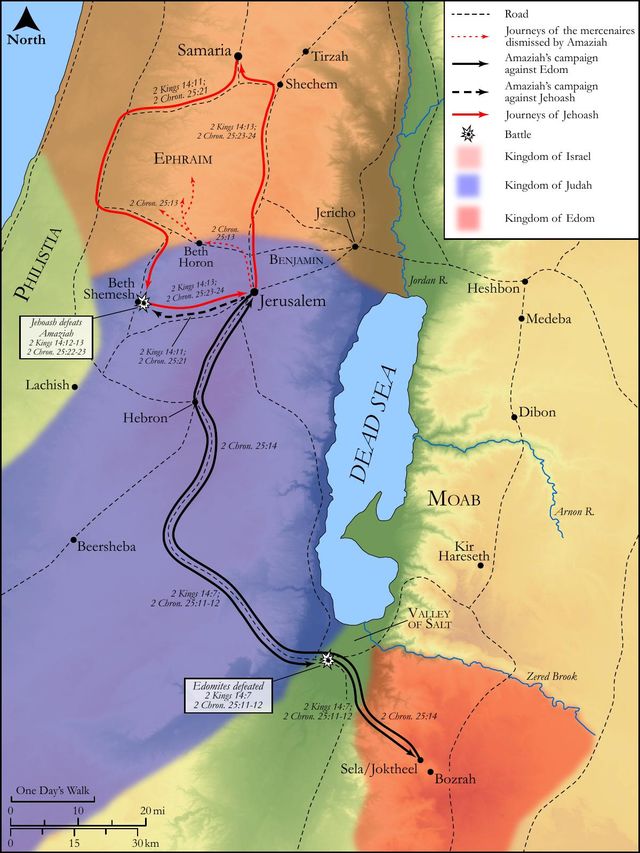
See on the biblical-era map
Study this verse
Public-domain commentary
Matthew Henry
From his Commentary on the Whole Bible. Henry comments on passages, not single verses — this entry covers 2 Chronicles 25:14–16. His two-level outline is real structure in the source text, so it is rendered as structure.
Here is, I. The revolt of Amaziah from the God of Israel to the gods of the Edomites. Egregious folly! Ahaz worshipped the gods of those that had conquered him, for which he had some little colour, Ch2 28:23. But to worship the gods of those whom he had conquered, who could not protect their own worshippers, was the greatest absurdity that could be. What did he see in the gods of the children of Seir that could tempt him to set them up for his gods and bow himself down before them? Ch2 25:14. If he had cast the idols down from the rock and broken them to pieces, instead of the prisoners, he would have manifested more of the piety as well as more of the pity of an Israelite; but perhaps for that barbarous inhumanity he was given up to this ridiculous idolatry.
II.The reproof which God sent to him, by a prophet, for this sin.
The anger of the Lord was kindled against him, and justly; yet, before he sent to destroy him, he sent to convince and reclaim him, and so to prevent his destruction. The prophet reasoned with him very fairly and very mildly: Why hast thou sought the favour of those gods which could not deliver their own people? Ch2 25:15. If men would but duly consider the inability of all those things to help them to which they have recourse when they forsake God, they would not be such enemies to themselves.
III.The check he gave to the reprover, Ch2 25:16.
He could say nothing in excuse of his own folly; the reproof was too just to be answered. But he fell into a passion with the reprover.
1.He taunted him as saucy and impertinent, and meddling with that which did not belong to him: Art thou made of the king's counsel? Could not a man speak reasonably to him, but he must be upbraided as usurping the place of a privy-counsellor? But, as a prophet, he really was made of the king's counsel by the King of kings, in duty to whom the king was bound not only to hear, but to ask and take his counsel.
2.He silenced him, bade him forbear and say not a word more to him. He said to the seer, See not, Isa 30:10. Men would gladly have their prophets thus under their girdles, as we say, to speak just when and what they would have them speak, and not otherwise.
3.He threatened him: "Why shouldst thou be smitten? It is at thy peril if thou sayest a word more of this matter." He seems to remind him of Zechariah's fate in the last reign, who was put to death for making bold with the king; and bids him take warning by him. Thus he justifies the killing of that prophet by menacing this, and so, in effect, makes himself guilty of the blood of both. He had hearkened to the prophet who ordered him to send back the army of Israel, and was ruled by him, though he contradicted his politics and lost him 100 talents, Ch2 25:10. But this prophet, who dissuaded him from worshipping the gods of the Edomites, he ran upon with an unaccountable rage, which must be attributed to the witchcraft of idolatry. He was easily persuaded to part with his talents of silver, but by no means with his gods of silver.
IV.The doom which the prophet passed upon him for this.
He had more to say to him by way of instruction and advice; but, finding him obstinate in his iniquity, he forbore. He is joined to idols; let him alone, Hos 4:17. Miserable is the condition of that man with whom the blessed Spirit, by ministers and conscience, forbears to strive, Gen 6:3. And both the reprovers in the gate and that in the bosom, if long brow-beaten and baffled, will at length forbear. So I gave them up to their own hearts' lusts. The secure sinner perhaps values himself upon it as a noble and happy achievement to have silenced his reprovers and monitors, and to get clear of them; but what comes of it? "I know that God has determined to destroy thee; it is a plain indication that thou art marked for ruin that thou hast done this, and hast not hearkened to my counsel." Those that are deaf to reproof are ripening apace for destruction, Pro 29:1.
Continue studying 2 Chronicles 25:16 across the web’s major study libraries — every link below opens this exact verse, chapter, or book on the destination site.
Read & Compare
 BibleGatewayThis verse in more than 200 translations and 70 languages.
 Bible.comThe YouVersion reader — hundreds of translations, reading plans, and highlights.
 ESV.orgCrossway's official English Standard Version reader.
 NET BibleThe NET translation with 60,000+ translators' notes on every rendering decision.
 STEP BibleTyndale House's free study tool — original text, vocabulary, and scholarly resources.
 BibliaLogos Bible Software's free web reader.
 USCCBThe New American Bible (Revised Edition) with the U.S. bishops' study notes.
Commentaries
 BibleHub CommentariesDozens of classic commentaries on this verse, gathered on one page.
 StudyLightMore than 100 commentary sets — the largest collection on the web.
 BibleRefPlain-English commentary on what this verse means, verse by verse.
 Enduring WordDavid Guzik's free commentary on this chapter, widely used by Bible teachers.
 Bible Study ToolsVerse commentary alongside Greek and Hebrew study aids.
Original Language & Research
- BibleHub InterlinearThe verse word by word — original language, transliteration, and English.
- BibleHub LexiconEvery word's original-language definition and Strong's entry.
 Blue Letter BibleDeep-study tools — Strong's numbers, concordance, and word studies.
 SefariaThe Hebrew text with Rashi and centuries of Jewish commentary.
Sermons, Hymns & Audio


TrulyRandomVerse is not affiliated with these sites and doesn’t control their content. They’re linked because they’re genuinely useful.
Summary
2 Chronicles 25:16 vividly portrays King Amaziah's audacious rejection of God's prophetic counsel, marking a tragic and irreversible turning point in his reign. Following a significant military victory, Amaziah inexplicably succumbed to idolatry, prompting a direct divine rebuke through an unnamed prophet. This verse captures Amaziah's arrogant dismissal of the prophet's warning, escalating to a thinly veiled threat of violence. In response, the prophet, discerning the king's hardened heart, ceases further persuasion and solemnly delivers God's unalterable decree of impending destruction, thereby underscoring the severe and inevitable consequences of persistent disobedience and spiritual pride.
Context
ShowHideLiterary Context
This verse is strategically placed within the narrative of King Amaziah's reign, immediately following his initial, albeit partial, obedience and subsequent military triumph over Edom. The preceding verses detail Amaziah's decision to hire Israelite mercenaries (2 Chronicles 25:6), his commendable, though costly, obedience to an unnamed prophet's instruction to dismiss them (2 Chronicles 25:7-10), and his resultant victory over the Edomites (2 Chronicles 25:11-13). However, this success tragically leads to a profound spiritual lapse: Amaziah brings back the idols of Seir and begins to worship them (2 Chronicles 25:14). God then sends a prophet to confront this egregious sin (2 Chronicles 25:15). Verse 16 captures the king's hostile and defiant reaction to this divine intervention, demonstrating a hardening of heart that stands in stark contrast to his earlier receptiveness. This rejection of God's final warning sets the inexorable trajectory for Amaziah's ultimate downfall, culminating in his defeat by Israel (2 Chronicles 25:17-24) and eventual assassination (2 Chronicles 25:27).
Historical & Cultural Context
King Amaziah ruled the Southern Kingdom of Judah from approximately 796-767 BC. His reign unfolded during a period of relative political stability but ongoing spiritual volatility within Judah. The practice of adopting and worshipping the deities of conquered nations was a common, yet strictly forbidden, act among ancient Near Eastern monarchs. This act was often an attempt to appropriate the perceived power of the defeated deity or to integrate new religious practices into the national cult. For Israel and Judah, however, such actions constituted a direct and severe violation of the Mosaic Covenant's foundational command against idolatry and syncretism, as articulated in passages like Deuteronomy 5:7-9. Prophets, like the unnamed messenger in this passage, served as God's direct spokespersons, often at significant personal risk, delivering divine messages of warning, rebuke, or promise to kings and the people. Their role was absolutely crucial in calling the nation back to covenant faithfulness, and rejecting their counsel was understood as tantamount to rejecting God Himself.
Key Themes
ShowHideThe narrative of Amaziah's reign, particularly as illuminated in 2 Chronicles 25, powerfully illustrates several recurring themes central to the Books of Chronicles. Firstly, it underscores the profound consequences of idolatry and covenant unfaithfulness, demonstrating how a king's spiritual choices directly impact the nation's destiny and divine favor. Amaziah's initial partial obedience, noted in 2 Chronicles 25:2, tragically gives way to blatant rebellion, revealing the insidious nature of spiritual pride and the corrupting power of sin. Secondly, the passage emphasizes the critical importance of heeding divine counsel, especially when delivered by God's appointed messengers. Amaziah's defiant rejection of the prophet's warning in 2 Chronicles 25:16 represents a tragic reversal of his earlier receptiveness, leading directly to his demise. Finally, the account highlights God's sovereign justice and the inevitability of divine judgment when warnings are ignored and hearts are persistently hardened. The prophet's final declaration, "God hath determined to destroy thee," reveals that there are limits to divine patience, and persistent rebellion will ultimately incur God's righteous wrath.
Exposition and Analysis
ShowHideKey Word Analysis
ShowHideThis verb (H2308) signifies "to cease," "to desist," or "to refrain." In the context of the prophet's action, it indicates that he stopped his attempts to persuade or reason with Amaziah. This cessation is not a sign of weakness or fear, but rather a profound recognition that the king's heart had become so hardened that further argument would be futile. The moment for counsel and repentance had passed; only the pronouncement of God's unalterable judgment remained. This dramatic cessation marks a critical shift in the divine interaction with Amaziah, signaling the end of God's persuasive grace and the onset of His determined justice.
The verb (H3289) means "to advise," "to consult," "to deliberate," or "to resolve/determine." Here, it conveys a sense of a firm, unchangeable, and decisive divine decree. It indicates that God's patience has reached its limit, and His judgment is now fixed and inevitable. This is not a conditional threat but a declaration of a settled divine purpose, a direct consequence of Amaziah's persistent idolatry and his arrogant rejection of God's final warning. The counsel is no longer for Amaziah's good, but God's determination concerning Amaziah's fate.
This verb (H7843) means "to decay," "to ruin," "to corrupt," or "to destroy." When used in conjunction with "determined," it conveys the absolute certainty and severity of the impending judgment. It implies a comprehensive ruin, not just a minor setback, but a complete undoing of Amaziah's reign and life. This destruction is presented as the direct and unavoidable consequence of Amaziah's actions and his hardened heart, demonstrating the ultimate outcome of defying the divine will.
Verse Breakdown
ShowHide"And it came to pass, as he talked with him, that [the king] said unto him, Art thou made of the king's counsel?"
This opening clause sets the scene, capturing the precise moment of direct confrontation between King Amaziah and the prophet. Amaziah's question is rhetorical, laced with sarcasm and contempt, serving to challenge the prophet's authority and legitimacy. By asking "Art thou made of the king's counsel?", Amaziah implies that the prophet is an unauthorized intruder, presuming to advise the king without royal appointment or sanction. This reveals Amaziah's inflated sense of self-importance and his utter disdain for divine authority when it contradicts his personal desires or perceived royal prerogative.
"forbear; why shouldest thou be smitten?"
This is Amaziah's direct, imperious command and a thinly veiled threat to the prophet. "Forbear" here is an imperative, meaning "stop speaking" or "desist from your counsel." The follow-up rhetorical question, "why shouldest thou be smitten?", is a clear implication of physical violence or even execution. Amaziah, in his pride and anger, is willing to silence God's messenger, demonstrating the depths of his rebellion and his readiness to use his royal power to suppress divine truth and maintain his sinful practices.
"Then the prophet forbare, and said, I know that God hath determined to destroy thee, because thou hast done this, and hast not hearkened unto my counsel."
This final, weighty statement encapsulates the tragic outcome of Amaziah's defiance. The prophet's "forbearing" (ceasing to argue or persuade) is not submission to Amaziah's threat but a solemn recognition that the time for persuasion is over. He then delivers God's final, irreversible verdict. "I know that God hath determined to destroy thee" is a declaration of certain and inevitable judgment. The reasons are explicitly stated: "because thou hast done this" (referring to his idolatry in 2 Chronicles 25:14) and "hast not hearkened unto my counsel" (his rejection of the prophet's warning in 2 Chronicles 25:15). This confirms that Amaziah's destruction is a direct, divine consequence of his persistent sin and hardened heart, sealing his fate.
Literary Devices
ShowHideThis verse is rich in Dramatic Irony, as Amaziah's attempt to silence the prophet inadvertently precipitates the very judgment he seeks to avoid. His arrogant question about the prophet's counsel and his threat of smiting him only serve to confirm his spiritual blindness and seal his fate. The prophet's "forbearing" creates a moment of profound Suspense before the inevitable pronouncement of judgment, emphasizing the gravity of the situation and the finality of God's decision. The entire interaction functions as a Climax in Amaziah's spiritual decline, marking the point of no return where divine patience gives way to divine decree. The Dialogue itself is highly charged, showcasing the stark contrast between human pride and divine authority, and the prophet's unwavering faithfulness in delivering an unpopular, yet crucial, message. The use of direct speech lends immediacy and visceral power to the confrontation, making the exchange feel intensely personal and consequential.
Theological and Thematic Connections
ShowHide2 Chronicles 25:16 serves as a stark theological warning against the perils of a hardened heart and the deliberate rejection of divine counsel. It underscores God's unwavering commitment to His covenant and His righteous justice in holding His people accountable for idolatry and disobedience. Amaziah's trajectory from partial obedience to outright rebellion, culminating in this defiant exchange, illustrates the principle that persistent rejection of God's truth leads to an irreversible state of judgment. God's patience is immense and longsuffering, but it is not infinite; there comes a point where His warnings cease, and His determined judgment is enacted. This verse highlights the solemn truth that true wisdom lies in humility and immediate repentance when confronted with God's word, rather than prideful resistance and defiance. It is a powerful reminder that God will not be mocked, and His word, whether of blessing or judgment, will ultimately stand.
Reflection and Application
ShowHideThe tragic account of King Amaziah in 2 Chronicles 25:16 offers profound and timeless lessons for contemporary believers. It serves as a powerful reminder that spiritual success or outward conformity to religious practices does not guarantee a truly devoted heart. Amaziah's initial obedience and military victory were quickly overshadowed by pride and idolatry, demonstrating how easily success can breed self-sufficiency and lead to a perilous spiritual decline. We are called to cultivate a heart that remains soft and receptive to God's voice, even when His counsel is challenging, confronts our cherished sins, or requires uncomfortable change. The danger lies not just in outright rebellion, but in the subtle hardening that occurs when we repeatedly dismiss warnings, whether from Scripture, the conviction of the Holy Spirit, or wise counsel from faithful brothers and sisters in Christ. This verse compels us to examine our own lives with honest introspection: Do we truly listen to God's word with a desire to obey, or do we, like Amaziah, threaten to silence uncomfortable truths that expose our shortcomings? Our spiritual well-being and eternal trajectory hinge on our willingness to humble ourselves and heed divine wisdom before we reach a point of no return, where God's patient counsel gives way to His determined judgment.
Questions for Reflection
ShowHideFAQ
ShowHideWhat does it mean that the prophet "forbare"?
ShowHideWhen King Amaziah threatened the prophet, telling him to "forbear" (stop speaking) or face being "smitten," the prophet indeed "forbare." This does not imply that he gave in to Amaziah's threat out of fear or weakness. Instead, the Hebrew word châdal (H2308) signifies that he ceased his attempts to persuade or reason with the king. It was a profound recognition that Amaziah's heart had become so hardened by pride and idolatry that further argument would be utterly useless. The time for pleading and an offer of repentance was over, and the time for God's definitive, unalterable judgment had arrived. It signifies a solemn shift from an opportunity for grace to a declaration of inevitable consequence, underscoring the severity of Amaziah's rejection of divine counsel as detailed in 2 Chronicles 25:15.
What was the "this" that Amaziah had "done" that led to his destruction?
ShowHideThe "this" refers directly to King Amaziah's egregious act of idolatry described in 2 Chronicles 25:14. After his military victory over the Edomites, Amaziah inexplicably brought back the gods of the people of Seir and set them up as his own gods, bowing down to them and burning incense to them. This was a direct and blatant violation of God's covenant with Israel, which strictly forbade the worship of any other gods. The prophet's declaration of destruction was a direct consequence of this profound spiritual betrayal and Amaziah's subsequent refusal to repent when confronted with God's truth. His actions demonstrated a complete disregard for the God who had granted him victory.
Christ-Centered Fulfillment
ShowHideWhile 2 Chronicles 25:16 powerfully illustrates the severe consequences of rejecting God's prophetic word under the Old Covenant, it also implicitly points to the ultimate fulfillment found in Christ. The prophet in this passage, though faithful, was merely a human messenger, and his message, though divine, was one of judgment for a specific act of rebellion. In contrast, Jesus Christ is the Prophet par excellence (Deuteronomy 18:15, fulfilled in Acts 3:22), the very Word of God incarnate (John 1:1). He came not primarily to condemn the world, but to offer salvation and reconciliation (John 3:17). However, just as Amaziah faced destruction for hardening his heart against God's messenger, so too does humanity face ultimate judgment for rejecting the perfect and final revelation of God in Jesus Christ. The New Testament warns of a greater condemnation for those who "neglect so great a salvation" offered through Christ (Hebrews 2:3). Yet, for those who humble themselves and heed His call, Christ offers not destruction, but eternal life and forgiveness, demonstrating God's ultimate mercy and grace that transcends the judgments of the Old Covenant, all made possible through His atoning sacrifice (Romans 5:8). The prophet's "forbearing" and declaration of judgment foreshadows the ultimate choice presented to all humanity: to embrace the counsel of Christ and live, or to reject Him and face the just and inevitable consequences.