


2 Chronicles 25:17
- וַיִּוָּעַץvai·yi·va·'Atzand he took counselH3289Conj-w ¦ V-Niphal-ConsecImperf-3msVerb Niphal Consecutive Imperfect 3rd Singular Masculineוַandיִּוָּעַץhe took counsel
- אֲמַצְיָהוּ'a·matz·Ya·huAmaziahH558N-proper-mNoun Proper Masculine
- מֶלֶךְMe·lekh[the] king ofH4428N-mscNoun Singular Masculine Construct
- יְהוּדָהye·hu·DahJudahH3063N-properNoun Proper Location
- וַיִּשְׁלַחVai·yish·lachand he sentH7971Conj-w ¦ V-Qal-ConsecImperf-3msVerb Qal Consecutive Imperfect 3rd Singular Masculineוַandיִּשְׁלַחhe sent
- אֶל'eltoH413PrepPreposition
- יוֹאָשׁyo·'AshJoashH3101N-proper-mNoun Proper Masculine
- בֶּןben[the] son ofH1121N-mscNoun Singular Masculine Construct
- יְהוֹאָחָזye·ho·'a·ChazJehoahazH3059N-proper-mNoun Proper Masculine
- בֶּןben[the] son ofH1121N-mscNoun Singular Masculine Construct
- יֵהוּאye·Hu'JehuH3058N-proper-mNoun Proper Masculine
- מֶלֶךְMe·lekh[the] king ofH4428N-mscNoun Singular Masculine Construct
- יִשְׂרָאֵלYis·ra·'ElIsraelH3478N-properNoun Proper Location
- לֵאמֹרle·Mor<to> sayingH559Prep-l ¦ V-Qal-InfVerb Qal Infinitive Constructלֵ<to>אמֹרsaying
- לְכָהle·khahcome !H1980V-Qal-Imp-2ms ¦ SfxVerb Qal Imperative 2nd Singular Masculineלְכָcomeה!
- נִתְרָאֶהnit·ra·'Ehlet us look at one anotherH7200V-Hithpael-Imperf-1cpVerb Hithpael Imperfect 1st Plural common gender
- פָנִיםfa·NimfacesH6440N-mpNoun Plural Masculine Absolute
English is a literal word-by-word gloss of the Hebrew, not the KJV's wording. Why?
This is the original text the KJV's translators worked from — each Hebrew word with its own literal English meaning in this verse, prepared by scholars at Tyndale House, Cambridge. The KJV translates whole sentences, not word by word, so its wording differs: one Hebrew word can become several English words, and the KJV may choose “the LORD” where the gloss reads “Yahweh”. Both are faithful — they answer different questions. For the KJV's own rendering, switch to the KJV text.
Details
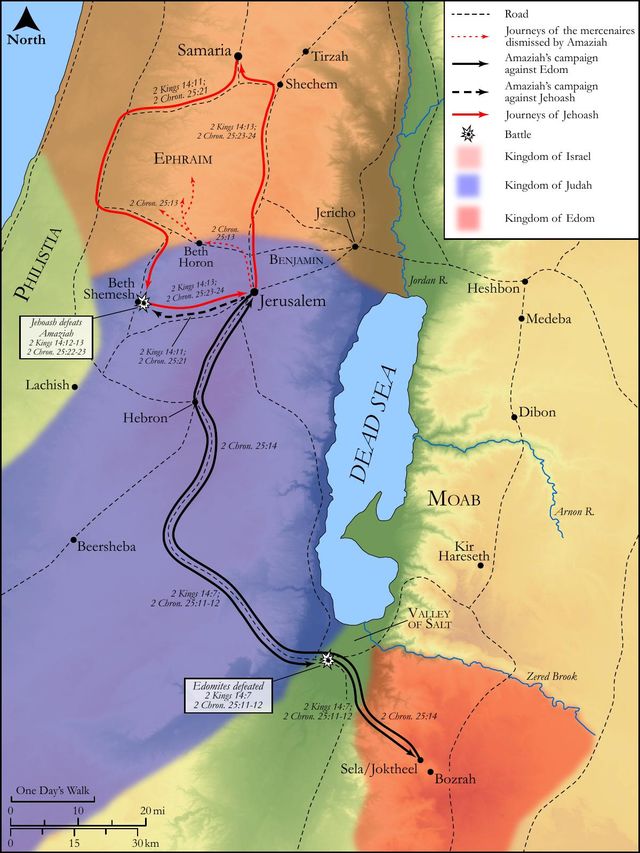
See on the biblical-era map
Study this verse
Public-domain commentary
Matthew Henry
From his Commentary on the Whole Bible. Henry comments on passages, not single verses — this entry covers 2 Chronicles 25:17–28. His three-level outline is real structure in the source text, so it is rendered as structure.
We have here this degenerate prince mortified by his neighbour and murdered by his own subjects.
I.Never was proud prince more thoroughly mortified than Amaziah was by Joash king of Israel.
1.This part of the story (which was as fully related Kg2 14:8, etc., as it is here) - embracing the foolish challenge which Amaziah sent to Joash (Ch2 25:17), his haughty scornful answer to it (Ch2 25:18), with the friendly advice he gave him to sit still and know when he was well off, (Ch2 25:19), - his wilfully persisting in his challenge (Ch2 25:20, Ch2 25:21), the defeat that was given him (Ch2 25:22), and the calamity he brought upon himself and his city thereby (Ch2 25:23, Ch2 25:24), - verifies two of Solomon's proverbs: - (1.) That a man's pride will bring him low, Pro 29:23. It goes before his destruction; not only procures it meritoriously, but is often the immediate occasion of it. He that exalteth himself shall be abased. (2.) That he that goes forth hastily to strive will probably not know what to do in the end thereof, when his neighbour has put him to shame, Pro 25:8. He that is fond of contention may have enough of it sooner than he thinks of.
2.But there are two passages in this story which we had not before in the Kings.
(1.)That Amaziah took advice before he challenged the king of Israel, Ch2 25:17. But of whom? Not of the prophet - he was not made of the king's counsel; but of his statesmen that would flatter him and bid him go up and prosper. It is good to take advice, but then it must be of those that are fit to advise us. Those that will not take advice from the word of God, which would guide them aright, will justly be left to the bad advice of those that will counsel them to their destruction. Let those be made fools that will not be made wise.
(2.)Amaziah's imprudence is here made the punishment of his impiety (Ch2 25:20): It was of the Lord; he left him to himself to act thus foolishly, that he and his people might be delivered into the hands of their enemies, because they had forsaken God and sought after the gods of Edom. Those that will not persuaded to do well for their souls will justly be given up to their own counsels to do ill for themselves even in their outward affairs.
II.Never was poor prince more violently pursued by his own subjects.
From the time that he departed from the Lord (so it may be read, Ch2 25:27) the hearts of his subjects departed from him, and they began to form a design against him in Jerusalem. It is probable they were exasperated against him more for his rashly engaging in a war against Israel than for his worshipping the gods of Edom. But at length the ferment grew so high, and he perceived the plot to be laid so deeply, that he thought fit to quit his royal city and flee to Lachish, either as a private place where he might be hid or as a strong place where he might be guarded; but they sent after him thither, and slew him there. By this the putting of him to death seems to have been done deliberately, and to have been the act, not of a disgusted servant or two, but of a considerable body that durst avow it. How unrighteous soever they were herein, God was righteous.
Continue studying 2 Chronicles 25:17 across the web’s major study libraries — every link below opens this exact verse, chapter, or book on the destination site.
Read & Compare
 BibleGatewayThis verse in more than 200 translations and 70 languages.
 Bible.comThe YouVersion reader — hundreds of translations, reading plans, and highlights.
 ESV.orgCrossway's official English Standard Version reader.
 NET BibleThe NET translation with 60,000+ translators' notes on every rendering decision.
 STEP BibleTyndale House's free study tool — original text, vocabulary, and scholarly resources.
 BibliaLogos Bible Software's free web reader.
 USCCBThe New American Bible (Revised Edition) with the U.S. bishops' study notes.
Commentaries
 BibleHub CommentariesDozens of classic commentaries on this verse, gathered on one page.
 StudyLightMore than 100 commentary sets — the largest collection on the web.
 BibleRefPlain-English commentary on what this verse means, verse by verse.
 Enduring WordDavid Guzik's free commentary on this chapter, widely used by Bible teachers.
 Bible Study ToolsVerse commentary alongside Greek and Hebrew study aids.
Original Language & Research
- BibleHub InterlinearThe verse word by word — original language, transliteration, and English.
- BibleHub LexiconEvery word's original-language definition and Strong's entry.
 Blue Letter BibleDeep-study tools — Strong's numbers, concordance, and word studies.
 SefariaThe Hebrew text with Rashi and centuries of Jewish commentary.
Sermons, Hymns & Audio


TrulyRandomVerse is not affiliated with these sites and doesn’t control their content. They’re linked because they’re genuinely useful.
Summary
2 Chronicles 25:17 chronicles a critical and ultimately ruinous decision by Amaziah, King of Judah, made in the immediate aftermath of his God-given victory over Edom and his subsequent descent into idolatry. Despite having just spurned a prophetic warning against his worship of Edomite gods, Amaziah, now inflated with pride and a deluded sense of invincibility, formally dispatched a challenge to Joash, King of Israel, initiating a direct military confrontation. This audacious and defiant declaration of war, born from spiritual rebellion and human arrogance, tragically set the stage for Judah's devastating defeat and contributed directly to Amaziah's eventual downfall.
Context
ShowHideLiterary Context
This verse is strategically positioned as the pivotal turning point in the narrative of Amaziah's reign, serving as the immediate catalyst for his undoing. It directly follows his significant military triumph against the Edomites in the Valley of Salt, a victory explicitly attributed to divine assistance after Amaziah had obediently dismissed the Israelite mercenaries, as detailed in 2 Chronicles 25:11-13. However, instead of offering gratitude and glory to God for this triumph, Amaziah shockingly brought back the idols of Edom and began to worship them, an egregious act of apostasy described in 2 Chronicles 25:14. A prophet was then sent by the Lord to confront Amaziah, but the king defiantly rejected this divine counsel, even threatening the prophet, as recorded in 2 Chronicles 25:15-16. Thus, his decision to challenge Joash of Israel is not an isolated incident but a direct, tragic consequence of his spiritual rebellion, pride, and rejection of God's clear warnings, setting the stage for the disastrous battle that unfolds in 2 Chronicles 25:18-24.
Historical & Cultural Context
The period of the divided monarchy was consistently marked by tension and intermittent conflict between the northern kingdom of Israel and the southern kingdom of Judah, despite their shared Abrahamic heritage. Since the schism under Rehoboam and Jeroboam (see 1 Kings 12), the two kingdoms frequently engaged in rivalry, border disputes, and outright warfare. Amaziah's challenge to Joash likely stemmed from a complex interplay of factors: the recent dismissal of Israelite mercenaries (who, after being paid but not allowed to fight alongside Judah, raided Judahite towns on their return, as noted in 2 Chronicles 25:9-10), a desire to assert Judah's dominance after his Edomite victory, or perhaps even a divine judgment using Joash as an instrument of consequence. The phrase "Come, let us see one another in the face" was a formal, well-understood idiom in the ancient Near East for issuing a direct challenge to battle, signifying a desire for a decisive military engagement rather than negotiation or diplomacy. The detailed lineage of Joash ("the son of Jehoahaz, the son of Jehu") serves to formally identify the rival king and emphasize the dynastic continuity of the northern kingdom, adding gravitas to the challenge.
Key Themes
ShowHideThis verse powerfully illustrates several overarching themes prevalent throughout the books of Chronicles and the broader Old Testament. Firstly, it highlights the destructive nature of Pride and Presumption, showing how Amaziah's success against Edom inflated his ego, leading him to believe he could conquer Israel despite having just offended God. This serves as a stark example of the biblical principle that "Pride goes before destruction, and a haughty spirit before a fall". Secondly, it underscores the theme of Rejection of Divine Counsel. Amaziah "took advice," but it was human counsel aligning with his own pride, not the divine wisdom he had just spurned from the prophet. His actions demonstrate a dangerous pattern of choosing self-will and human strategy over God's clear guidance, a theme echoed in passages like Proverbs 3:5-6. Thirdly, it reveals the persistent Inter-Kingdom Hostility between Judah and Israel, a recurring narrative element throughout the monarchical period. Finally, and most significantly, it foreshadows the Consequences of Disobedience and Idolatry. Amaziah's challenge to Joash, born directly from his idolatry and defiance, would lead to a devastating defeat for Judah, the plundering of Jerusalem, and ultimately, Amaziah's own tragic assassination, demonstrating God's unwavering justice against those who turn from Him, as seen in the warnings of Deuteronomy 28.
Exposition and Analysis
ShowHideKey Word Analysis
ShowHideThe verb יָעַץ (ya'ats) means "to advise; reflexively, to deliberate or resolve." While it can imply seeking wise counsel, in this context, it suggests a deliberation that is tragically devoid of divine input. Amaziah consulted with his human advisors, likely those who affirmed his inflated sense of power and desire for revenge, rather than heeding the prophet sent by God. This highlights a critical distinction between human wisdom and divine wisdom, with the former often leading to disaster when God's counsel is ignored.
The verb שָׁלַח (shalach) means "to send away, for, or out (in a great variety of applications)." Here, it denotes a formal dispatch, indicating a deliberate and official communication. This was not a casual remark but a solemn and public declaration of intent, a formal challenge delivered by envoys, underscoring the gravity and premeditated nature of Amaziah's decision to initiate hostilities.
This idiomatic phrase, derived from רָאָה (ra'ah) "to see" and פָּנִים (panim) "the face," literally translates to "to see faces." In the context of two opposing kings, it is a well-established ancient Near Eastern idiom for a direct challenge to battle, a call for a decisive military confrontation. It signifies a desire to meet on the battlefield, face to face, to settle a dispute by force of arms rather than through negotiation or diplomacy. Amaziah's use of this phrase conveys his aggressive intent, his confidence in his own strength, and his readiness for war.
Verse Breakdown
ShowHide"Then Amaziah king of Judah took advice"
This opening clause immediately draws attention to Amaziah's decision-making process. The phrase "took advice" suggests a deliberate, calculated move, but the preceding verses (2 Chronicles 25:14-16) reveal that this counsel was human, not divine. Having just rejected God's prophet, Amaziah relied on his own judgment and that of his earthly advisors, setting a dangerous precedent for his subsequent actions.
"and sent to Joash, the son of Jehoahaz, the son of Jehu, king of Israel, saying"
This specifies the recipient of Amaziah's challenge and the formal method of delivery. The detailed lineage of Joash ("the son of Jehoahaz, the son of Jehu") serves to clearly identify the reigning monarch of the northern kingdom, emphasizing the official, inter-kingdom nature of the communication. The act of "sending" implies a formal diplomatic or military challenge, not a casual taunt, elevating the tension between the two rival nations.
"Come, let us see one another in the face."
This is the heart of the verse, the direct challenge itself. As an idiom for battle, it encapsulates Amaziah's audacious and aggressive intent. It is an invitation to war, a declaration that he wished to resolve the underlying tensions and perhaps avenge past grievances (like the mercenary issue or general inter-kingdom rivalry) through a decisive military engagement. This challenge, however, was born not of strategic wisdom but of pride and spiritual blindness, ultimately leading to his downfall.
Literary Devices
ShowHideThe verse effectively employs several literary devices to convey its meaning and foreshadow future events. The most prominent is Idiom, specifically the phrase "Come, let us see one another in the face," which is a well-known ancient Near Eastern expression for a direct challenge to battle. This idiomatic language immediately communicates Amaziah's aggressive intent and his desire for a decisive military confrontation. Furthermore, the verse functions as Foreshadowing, as Amaziah's audacious challenge directly sets the stage for the disastrous battle that follows, where Judah suffers a crushing defeat. The king's prideful declaration here anticipates the humiliation and destruction that await him. There is also a strong element of Irony present; Amaziah "took advice," but the irony lies in the fact that he had just vehemently rejected divine advice from a prophet, choosing instead to follow human counsel that led him to ruin. This highlights the tragic contrast between the wisdom of God and the folly of man's pride.
Theological and Thematic Connections
ShowHide2 Chronicles 25:17 serves as a poignant illustration of the perilous consequences of pride and the rejection of divine counsel. Amaziah's actions demonstrate a fundamental theological error: mistaking God's blessing (victory over Edom) for personal prowess, which then fueled an arrogant self-reliance. This narrative underscores the biblical truth that success, when not properly attributed to God, can become a stumbling block, leading to spiritual blindness and disastrous decisions. His challenge to Joash, made after spurning God's warning, reveals a heart hardened by idolatry and defiance, inviting divine judgment rather than continued favor.
Reflection and Application
ShowHideAmaziah's story in 2 Chronicles 25:17 is a powerful and sobering mirror for believers today. It serves as a stark warning against the insidious nature of pride, especially in the wake of success or blessing. When God grants us victories, whether in personal struggles, professional achievements, or spiritual growth, the temptation to attribute that success to our own strength, wisdom, or effort can be overwhelming. Amaziah's immediate turn to idolatry and his subsequent defiant challenge to Israel after a divinely-aided victory illustrate how quickly a heart can become hardened and self-reliant when humility is abandoned. This narrative compels us to constantly examine our motives, to remain vigilant against the subtle creep of arrogance, and to consistently acknowledge God as the source of all good things. It reminds us that true wisdom lies not in human counsel or inflated self-confidence, but in humble submission to God's Word and His Spirit, even when His guidance seems counterintuitive or challenging to our desires.
Questions for Reflection
ShowHideFAQ
ShowHideWhy did Amaziah challenge Joash after his victory over Edom?
ShowHideAmaziah's challenge to Joash was a complex decision rooted primarily in his inflated pride and spiritual rebellion. After his significant, divinely-aided victory over Edom (see 2 Chronicles 25:11-13), Amaziah's ego was greatly boosted. Instead of giving glory to God, he brought back the Edomite idols and began to worship them, an act of severe apostasy (as described in 2 Chronicles 25:14). He then defiantly rejected a prophet's warning against this idolatry (found in 2 Chronicles 25:15-16). His challenge to Israel was likely fueled by this newfound arrogance, perhaps a desire to reclaim territory or settle old scores, such as the raiding of Judahite towns by the Israelite mercenaries he had dismissed before the Edomite war (referenced in 2 Chronicles 25:9-10). Ultimately, it was a decision born from a heart turned away from God, leading to divine judgment.
Christ-Centered Fulfillment
ShowHideAmaziah's tragic story, culminating in his prideful challenge in 2 Chronicles 25:17, stands in stark contrast to the perfect humility and divine wisdom embodied by Jesus Christ. Amaziah, a king of Judah, sought human counsel and acted out of self-exaltation, leading his kingdom to defeat and himself to a tragic end. In contrast, Jesus, the true King of Judah and the Son of God, consistently sought and submitted to the will of His Father, even to the point of death on a cross (as illuminated in Philippians 2:8). While Amaziah challenged an earthly king to a physical battle for earthly dominion, Christ engaged in a far greater spiritual warfare, confronting the powers of sin and death (see Colossians 2:15). His "face-to-face" encounter was not with an earthly adversary for personal gain, but with the very forces of evil, ultimately defeating them through His sacrifice and resurrection, securing eternal victory for all who believe (as proclaimed in 1 Corinthians 15:54-57). Amaziah's failure to heed divine counsel highlights humanity's desperate need for a perfect King, one who is Himself the embodiment of divine wisdom and who leads His people not to earthly defeat, but to eternal triumph through His own perfect obedience and self-sacrificial love, inviting us to "see His face" in glory (as promised in Revelation 22:4).