


2 Chronicles 25:13
- וּבְנֵיu·ve·Neiand [the] sons ofH1121Conj-w ¦ N-mpcNoun Plural Masculine Constructוּandבְנֵי[the] sons of
- הַגְּדוּדha·ge·Dudthe troopH1416Art ¦ N-msNoun Singular Masculine Absoluteהַtheגְּדוּדtroop
- אֲשֶׁר'a·SherwhichH834RelParticle Relative
- הֵשִׁיבhe·Shivhe had turned backH7725V-Hiphil-Perf-3msVerb Hiphil Perfect 3rd Singular Masculine
- אֲמַצְיָהוּ'a·matz·Ya·huAmaziahH558N-proper-mNoun Proper Masculine
- מִלֶּכֶתmi·Le·khetfrom goingH1980Prep-m ¦ V-Qal-InfVerb Qal Infinitive Constructמִfromלֶּכֶתgoing
- עִמּוֹi·Mowith himH5973Prep ¦ 3msPrepositionעִמּwithוֹhim
- לַמִּלְחָמָהla·mil·cha·Mahto the battleH4421Prep-l ¦ N-fsNoun Singular Feminine Absoluteלַto theמִּלְחָמָהbattle
- וַיִּפְשְׁטוּvai·yif·she·Tuand they made a raidH6584Conj-w ¦ V-Qal-ConsecImperf-3mpVerb Qal Consecutive Imperfect 3rd Plural Masculineוַandיִּפְשְׁטוּthey made a raid
- בְּעָרֵיbe·'a·Reion [the] cities ofH5892Prep-b ¦ N-mpcNoun Plural Masculine Constructבְּonעָרֵי[the] cities of
- יְהוּדָהye·hu·DahJudahH3063N-properNoun Proper Location
- מִשֹּׁמְרוֹןmi·sho·me·Ronfrom SamariaH8111Prep-m ¦ N-properNoun Proper LocationמִfromשֹּׁמְרוֹןSamaria
- וְעַדve·'adand toH5704Conj-w ¦ PrepPrepositionוְandעַדto
- בֵּיתbeitBethH1032N-properNoun Proper Location
- חוֹרוֹןcho·RonHoronH1032N-properNoun Proper Location
- וַיַּכּוּvai·ya·Kuand they struck downH5221Conj-w ¦ V-Hiphil-ConsecImperf-3mpVerb Hiphil Consecutive Imperfect 3rd Plural Masculineוַandיַּכּוּthey struck down
- מֵהֶםme·Hemof themPrep-m ¦ 3mpSuffix Personal 3rd Plural Masculineמֵofהֶםthem
- שְׁלֹשֶׁתshe·Lo·shetthreeH7969N-cscNoun Singular common gender Construct
- אֲלָפִים'a·la·Fimthousand<s>H505N-cpNoun Plural common gender Absolute
- וַיָּבֹזּוּvai·ya·Vo·zuand they plunderedH962Conj-w ¦ V-Qal-ConsecImperf-3mpVerb Qal Consecutive Imperfect 3rd Plural Masculineוַandיָּבֹזּוּthey plundered
- בִּזָּהbi·ZahplunderH961N-fsNoun Singular Feminine Absolute
- רַבָּהra·BahmuchH7227Adj-fsAdjective Singular Feminine Absolute
English is a literal word-by-word gloss of the Hebrew, not the KJV's wording. Why?
This is the original text the KJV's translators worked from — each Hebrew word with its own literal English meaning in this verse, prepared by scholars at Tyndale House, Cambridge. The KJV translates whole sentences, not word by word, so its wording differs: one Hebrew word can become several English words, and the KJV may choose “the LORD” where the gloss reads “Yahweh”. Both are faithful — they answer different questions. For the KJV's own rendering, switch to the KJV text.
Details
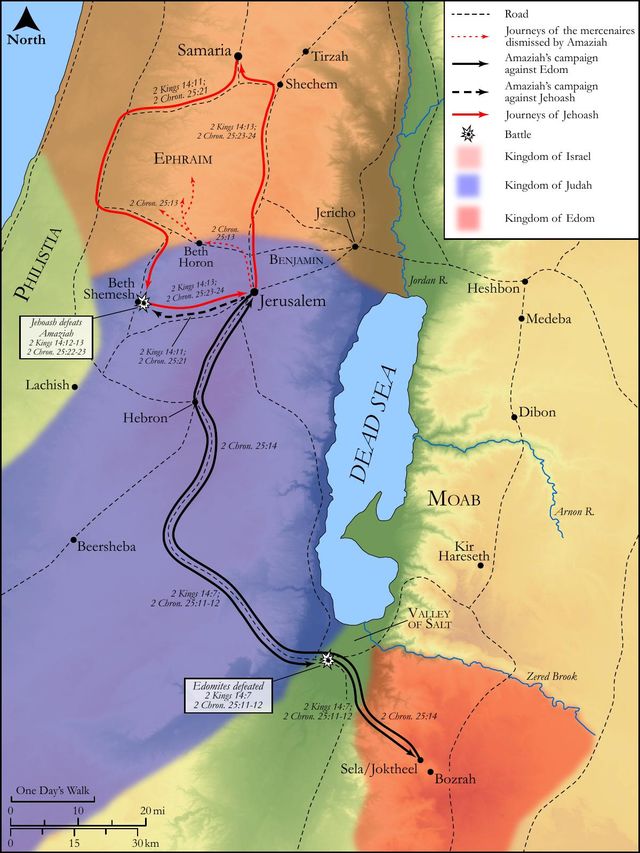
See on the biblical-era map
Study this verse
Public-domain commentary
Matthew Henry
From his Commentary on the Whole Bible. Henry comments on passages, not single verses — this entry covers 2 Chronicles 25:1–13. His three-level outline is real structure in the source text, so it is rendered as structure.
Here is, I. The general character of Amaziah: He did that which was right in the eyes of the Lord, worshipped the true God, kept the temple service a going, and countenanced religion in his kingdom; but he did not do it with a perfect heart (Ch2 25:2), that is, he was not a man of serious piety or devotion himself, nor had he any zeal for the exercises of religion. He was no enemy to it, but a cool and indifferent friend. Such is the character of too many in this Laodicean age: they do that which is good, but not with the heart, not with a perfect heart.
II.A necessary piece of justice which he did upon the traitors that murdered his father:
he put them to death, Ch2 25:3. Though we should suppose they intended to avenge on their king the death of the prophet (as was intimated, Ch2 24:25), yet this would by no means justify their wickedness; for they were not the avengers, but presumptuously took God's work out of his hands: and therefore Amaziah did what became him in calling them to an account for it, but forbade the putting of the children to death for the parents' sin, Ch2 25:4.
III.An expedition of his against the Edomites, who, some time ago, had revolted from under the dominion of Judah, to which he attempted to reduce them. Observe,
1.The great preparation he made for this expedition.
(1.)He mustered his own forces, and marshalled them (Ch2 25:5), and found Judah and Benjamin in all but 300,000 men that were fit for war, whereas, in Jehoshaphat's time, fifty or sixty years before, they were four times as many. Sin weakens a people, diminishes them, dispirits them, and lessens their number and figure.
(2.)He hired auxiliary troops out of the kingdom of Israel, Ch2 25:6. Finding his own kingdom defective in men, he thought to make up the deficiency with his money, and therefore took into his pay 100,000 Israelites. If he had advised with any of his prophets before he did this, or had but considered how little any of his ancestors got by their alliances with Israel, he would not have had this to undo again. But rashness makes work for repentance.
2.The command which God sent him by a prophet to dismiss out of his service the forces of Israel, Ch2 25:7, Ch2 25:8. He would not have him call in any assistance at all: it looked like distrust of God. If he made sure of God's presence, the army he had of his own was sufficient. But particularly he must not take in their assistance: For the Lord is not with the children of Ephraim, because they are not with him, but worship the calves. This was a good reason why he should not make use of them, because he could not depend upon them to do him any service. What good could be expected from those that had not God with them, nor his blessings upon their undertakings? It is comfortable to employ those who, we have reason to hope, have an interest in heaven, and dangerous to associate with those from whom the Lord has departed. The prophet assured him that if he persisted in his resolution to take these idolatrous apostate Israelites with him, in hopes thereby to make himself strong for the battle, it was at his peril; they would prove a dead weight to his army, would sink and betray it: "God shall make thee fall before the enemy, and these Israelites will be the ruin of thy cause; for God has power to help thee without them, and to cast thee down though thou hast them with thee."
3.The objection which Amaziah made against this command, and the satisfactory answer which the prophet gave to that objection, Ch2 25:9. The king had remitted 100 talents to the men of Israel for advance-money. "Now," says he, "if I send them back, I shall lose that: But what shall we do for the 100 talents?" This is an objection men often make against their duty: they are afraid of losing by it. "Regard not that," says the prophet: "The Lord is able to give thee much more than this; and, thou mayest depend upon it, he will not see thee lose by him. What are 100 talents between thee and him? He has ways enough to make up the loss to thee; it is below thee to speak of it." Note, A firm belief of God's all-sufficiency to bear us out in our duty, and to make up all the loss and damage we sustain in his service abundantly to our advantage, will make his yoke very easy and his burden very light. What is it to trust in God, but to be willing to venture the loss of any thing for him, in confidence of the goodness of the security he gives us that we shall not lose by him, but that whatever we part with for his sake shall be made up to us in kind or kindness. When we grudge to part with any thing for God and our religion, this should satisfy us, that God is able to give us much more than this. He is just, and he is good, and he is solvent. The king lost 100 talents by his obedience; and we find just that sum given to his grandson Jotham as a present (Ch2 27:5); then the principal was repaid, and, for interest, 10,000 measures of wheat and as many of barley.
4.His obedience to the command of God, which is upon record to his honour. He would rather lose his money, disoblige his allies, and dismiss a fourth part of his army just as they were going to take the field, than offend God: He separated the army of Ephraim, to go home again, Ch2 25:10. And they went home in great anger, taking it as a great affront thus to be made fools of, and to be cashiered as men not fit to be employed, and being perhaps disappointed of the advantages they promised themselves in spoil and plunder by joining with Judah against Edom. Men are apt to resent that which touches them in their profit or reputation, though it frees them from trouble.
5.His triumphs over the Edomites, Ch2 25:11, Ch2 25:12. He left dead upon the spot, in the field of battle, 10,000 men; 10,000 more he took prisoners, and barbarously killed them all by throwing them down some steep and craggy precipice. What provocation he had to exercise this cruelty towards them we are not told; but it was certainly very severe.
6.The mischief which the disbanded soldiers of Israel did to the cities of Judah, either in their return or soon after, Ch2 25:13. They were so enraged at being sent home that, if they might not go to share with Judah in the spoil of Edom, they would make a prey of Judah. Several cities that lay upon the borders they plundered, killing 3000 men that made resistance. But why should God suffer this to be done? Was it not in obedience to him that they were sent home, and yet shall the country thus suffer by it? Surely God's way is in the sea! Did not the prophet say that God was not with the children of Ephraim, and yet they are suffered to prevail against Judah? Doubtless God intended hereby to chastise those cities of Judah for their idolatries, which were found most in those parts that lay next to Israel. The men of Israel had corrupted them, and now they were made a plague to them. Satan both tempts and torments.
Continue studying 2 Chronicles 25:13 across the web’s major study libraries — every link below opens this exact verse, chapter, or book on the destination site.
Read & Compare
 BibleGatewayThis verse in more than 200 translations and 70 languages.
 Bible.comThe YouVersion reader — hundreds of translations, reading plans, and highlights.
 ESV.orgCrossway's official English Standard Version reader.
 NET BibleThe NET translation with 60,000+ translators' notes on every rendering decision.
 STEP BibleTyndale House's free study tool — original text, vocabulary, and scholarly resources.
 BibliaLogos Bible Software's free web reader.
 USCCBThe New American Bible (Revised Edition) with the U.S. bishops' study notes.
Commentaries
 BibleHub CommentariesDozens of classic commentaries on this verse, gathered on one page.
 StudyLightMore than 100 commentary sets — the largest collection on the web.
 BibleRefPlain-English commentary on what this verse means, verse by verse.
 Enduring WordDavid Guzik's free commentary on this chapter, widely used by Bible teachers.
 Bible Study ToolsVerse commentary alongside Greek and Hebrew study aids.
Original Language & Research
- BibleHub InterlinearThe verse word by word — original language, transliteration, and English.
- BibleHub LexiconEvery word's original-language definition and Strong's entry.
 Blue Letter BibleDeep-study tools — Strong's numbers, concordance, and word studies.
 SefariaThe Hebrew text with Rashi and centuries of Jewish commentary.
Sermons, Hymns & Audio


TrulyRandomVerse is not affiliated with these sites and doesn’t control their content. They’re linked because they’re genuinely useful.
Summary
Second Chronicles 25:13 vividly recounts the violent retaliation of the Israelite mercenaries whom King Amaziah of Judah had, by divine command, dismissed from his army. Despite the significant financial cost and the potential for angering these hired soldiers, Amaziah's obedience to God resulted in an immediate and devastating attack on Judahite cities, stretching from Samaria to Bethhoron. This punitive raid led to the slaughter of three thousand Judahites and the extensive plundering of their possessions, serving as a stark and painful consequence of an otherwise righteous act of faith.
Context
ShowHideLiterary Context
This verse is a critical turning point in the narrative of King Amaziah's early reign, immediately following his pivotal decision to obey the "man of God." Amaziah had assembled a formidable army, including one hundred thousand Israelite mercenaries, for a campaign against Edom, as detailed in 2 Chronicles 25:5-6. However, a prophet intervened, warning that God was not with the Northern Kingdom and that their inclusion would lead to Amaziah's defeat, a divine warning found in 2 Chronicles 25:7-8. Despite the substantial financial investment of one hundred talents of silver and the risk of antagonizing a large armed force, Amaziah chose obedience, sending the Israelite contingent home, as recorded in 2 Chronicles 25:9-10. Verse 13 then details the immediate, destructive consequence of this dismissal, occurring concurrently with Amaziah's subsequent victory over Edom, recounted in 2 Chronicles 25:11-12, highlighting the complex interplay of obedience, suffering, and divine blessing.
Historical & Cultural Context
The period of Amaziah's reign (c. 796-767 BC) was one of continued tension and occasional conflict between the divided kingdoms of Judah (south) and Israel (north). The Northern Kingdom, Israel, was characterized by pervasive idolatry, particularly the worship of golden calves established by Jeroboam I, which alienated them from true Yahweh worship centered in Jerusalem. This religious divergence often fueled political and military animosity. Hiring mercenary armies was a common practice in the ancient Near East, but their loyalty was primarily to their paymaster and the prospect of spoils. The Israelite mercenaries, feeling cheated out of their promised wages and the anticipated spoils of war, and likely already harboring resentment towards Judah, saw an opportunity for immediate retribution. The geographical scope, "from Samaria even unto Bethhoron," indicates a wide swath of Judahite territory, with Samaria being the capital of Israel and Bethhoron a strategic city on the border between Judah and Benjamin, demonstrating the extensive reach of the retaliatory raid.
Key Themes
ShowHideThis verse powerfully illustrates several key themes within 2 Chronicles and the broader biblical narrative. Firstly, it underscores the unforeseen consequences of obedience, demonstrating that following God's command does not always lead to immediate ease or prosperity, but can involve significant cost and suffering. Amaziah's righteous decision to sever an unholy alliance directly led to a devastating attack on his own people. Secondly, it highlights the danger of unsanctified alliances, emphasizing that seeking help or strength from those not aligned with God's will or character can backfire dramatically, even if initially perceived as strategically advantageous. The Israelite mercenaries, though militarily capable, were spiritually and politically unreliable. Finally, the event subtly points to divine sovereignty amidst adversity, as God's ultimate purpose for Amaziah – victory over Edom – was still achieved despite this painful setback. This incident serves as a prelude to Amaziah's later spiritual decline, where his initial obedience gives way to idolatry and further national suffering, as detailed in 2 Chronicles 25:14-16.
Exposition and Analysis
ShowHideKey Word Analysis
ShowHideThis verb (H6584) often describes a sudden, violent raid, an invasion, or a stripping away. It implies an aggressive, unprovoked attack with the intent to plunder and devastate. In this context, it vividly portrays the mercenaries' vengeful descent upon the unsuspecting cities of Judah, not as a formal battle but as a destructive incursion, characterized by overwhelming force and a lack of mercy.
This is a very common and versatile Hebrew verb (H5221), meaning to strike, hit, beat, kill, or defeat. Here, combined with "three thousand of them," it unequivocally refers to the killing of a significant number of Judahite inhabitants, emphasizing the lethal and brutal nature of the mercenaries' assault. It conveys the devastating human cost of the raid.
This verb (H962) means to plunder, loot, or seize as spoil. The accompanying phrase "much spoil" (H7227, rab for "much," and H961, bizzâh for "spoil") indicates the extensive and significant amount of goods, wealth, and possessions that were stolen from the Judahite cities. This act of looting was a primary motivation for the mercenaries' attack, compensating themselves for their dismissed wages and the anticipated spoils from the Edomite war.
Verse Breakdown
ShowHide"But the soldiers of the army which Amaziah sent back, that they should not go with him to battle"
This clause precisely identifies the perpetrators of the attack: the one hundred thousand Israelite mercenaries whom King Amaziah, in an act of obedience to the prophet's word, had dismissed from his ranks. Their dismissal, though divinely commanded, left them without their expected pay or the opportunity for plunder from the Edomite campaign, fueling their resentment and desire for retribution against Judah.
"fell upon the cities of Judah, from Samaria even unto Bethhoron"
This describes the scope and nature of the retaliatory attack. The mercenaries, instead of returning directly to Israel, turned their wrath upon Judah. The geographical markers "from Samaria" (H8111, the capital of the Northern Kingdom, indicating their point of origin or general direction) and "unto Bethhoron" (H1032, a strategic city on Judah's western border) delineate a wide area of devastation, signifying a widespread and coordinated assault on Judahite towns and villages.
"and smote three thousand of them, and took much spoil"
This details the devastating consequences of the raid. The phrase "smote three thousand (H7969, H505) of them" indicates a significant loss of life among the Judahite populace, a direct and bloody toll of the mercenaries' vengeance. The accompanying "took much spoil" highlights the extensive looting and plundering of Judah's resources, adding economic devastation to the human cost. This was a severe blow to Judah, demonstrating the immediate and painful repercussions of Amaziah's obedience.
Literary Devices
ShowHideThe narrative of 2 Chronicles 25:13 employs several effective literary devices. Irony is prominent, as Amaziah's act of obedience, intended to secure divine favor and victory, immediately results in a painful and costly attack on his own land and people. This unexpected negative consequence highlights the complex nature of faith and God's ways, which often defy human logic. There is also a strong element of Narrative Consequence, where the cause (Amaziah's dismissal of the mercenaries) is directly and swiftly followed by a clear effect (their retaliatory attack), emphasizing the immediate and tangible repercussions of his decision. Furthermore, the passage uses Contrast by juxtaposing this devastating attack on Judah with Amaziah's subsequent and divinely blessed victory over Edom, which is recounted immediately after this verse. This contrast underscores God's ability to work His purposes through both suffering and triumph, and that immediate hardship does not negate ultimate divine favor.
Theological and Thematic Connections
ShowHideThis verse powerfully illustrates that obedience to God, while always the right path, does not guarantee an absence of immediate hardship or unforeseen negative consequences. Amaziah's decision, though divinely inspired and ultimately leading to victory in the main campaign, incurred a significant and painful cost for his people. This teaches us that God's ways are higher than our ways, and His ultimate purposes may involve temporary suffering or loss as part of a larger, redemptive plan. It challenges a simplistic theology that equates obedience directly with immediate, tangible blessings and highlights the reality that faithfulness often demands sacrifice and enduring adversity, trusting that God's ultimate plan will prevail.
Reflection and Application
ShowHideThe experience of Amaziah in 2 Chronicles 25:13 offers a profound lesson for believers today: the path of obedience to God is not always smooth or free from immediate pain. Just as Amaziah faced a brutal reprisal for dismissing the mercenaries, we may encounter unexpected difficulties, criticism, or even loss when we choose to align ourselves with God's will over worldly wisdom, personal gain, or popular opinion. This passage calls us to cultivate a deeper trust in God's sovereign plan, recognizing that His ultimate purposes transcend our immediate circumstances. It encourages us to persevere in doing what is right, even when the short-term consequences are costly or confusing, confident that God's faithfulness will ultimately prevail and His wisdom will be vindicated. Our faith is truly tested not just in moments of overt temptation, but also when doing the right thing demands a significant personal or communal sacrifice.
Questions for Reflection
ShowHideFAQ
ShowHideWhy did God allow this devastating attack on Judah if Amaziah was obeying His command?
ShowHideGod allowed this attack for several profound reasons, even though Amaziah was obeying. Firstly, it served as a painful, immediate consequence of Amaziah's prior decision to hire the Israelite mercenaries in the first place. While God mercifully intervened to prevent a greater disaster in the war against Edom, the initial unholy alliance still had repercussions. Secondly, it was a test of Amaziah's faith and obedience. True obedience is often refined through fire, demonstrating whether one serves God only for immediate blessings or trusts Him even through adversity. Thirdly, it highlighted the inherent danger and unreliable nature of alliances not sanctioned by God, especially with those steeped in idolatry. The mercenaries' actions underscored the spiritual and practical perils of such partnerships. Finally, it may have served as a warning to Judah about the continuing spiritual dangers posed by the Northern Kingdom, even as God was working His larger plan for Amaziah's victory over Edom, as seen in 2 Chronicles 25:11-12.
Christ-Centered Fulfillment
ShowHideThe narrative of Amaziah's costly obedience in 2 Chronicles 25:13 finds its ultimate and perfect fulfillment in Jesus Christ. Amaziah's experience of suffering immediate loss for a righteous act foreshadows the infinitely greater suffering of the Son of God, who learned obedience through what he suffered. While Amaziah's obedience was imperfect and later faltered, Christ's obedience was absolute, leading Him to the cross, the ultimate act of self-sacrificial love. His suffering was not a consequence of His own sin, but the direct result of His perfect obedience to the Father's will to redeem humanity, as powerfully stated in Philippians 2:8. Just as Judah suffered a temporary setback before Amaziah's ultimate victory, believers are called to participate in Christ's sufferings, knowing that such trials produce perseverance and character, leading to hope, as articulated in Romans 5:3-5. The "spoil" taken by the mercenaries in 2 Chronicles 25:13 contrasts sharply with the glorious spoil Christ won through His obedience: victory over sin and death, and the eternal salvation of His people, a far greater and lasting triumph than any earthly conquest. We are called to follow in His steps, embracing the cost of discipleship, knowing that our temporary sufferings are light and momentary compared to the eternal glory that awaits us in Him, as encouraged in 1 Peter 2:21.