


2 Chronicles 25:3
- וַיְהִיvay·Hiand it wasH1961Conj-w ¦ V-Qal-ConsecImperf-3msVerb Qal Consecutive Imperfect 3rd Singular Masculineוַandיְהִיit was
- כַּאֲשֶׁרka·'a·Sherjust whenH834Prep-k ¦ RelParticle Relativeכַּjustאֲשֶׁרwhen
- חָזְקָהcha·ze·Kahit was secureH2388V-Qal-Perf-3fsVerb Qal Perfect 3rd Singular Feminine
- הַמַּמְלָכָהha·mam·la·Khahthe kingdomH4467Art ¦ N-fsNoun Singular Feminine Absoluteהַtheמַּמְלָכָהkingdom
- עָלָיו'a·Lavon himH5921Prep ¦ 3msPrepositionעָלָיonוhim
- וַיַּהֲרֹגvai·ya·ha·Rogand he killedH2026Conj-w ¦ V-Qal-ConsecImperf-3msVerb Qal Consecutive Imperfect 3rd Singular Masculineוַandיַּהֲרֹגhe killed
- אֶת'et<obj.>H853DirObjMParticle Object Indicator
- עֲבָדָיו'a·va·Davhis servantsH5650N-mpc ¦ 3msNoun Plural Masculine Constructעֲבָדָיservantsוhis
- הַמַּכִּיםha·ma·Kimwho had struck downH5221Art ¦ V-Hiphil-Prtcpl-mpVerb Hiphil Participle Plural Masculine Absoluteהַwhoמַּכִּיםhad struck down
- אֶת'et<obj.>H853DirObjMParticle Object Indicator
- הַמֶּלֶךְha·Me·lekhthe kingH4428Art ¦ N-msNoun Singular Masculine Absoluteהַtheמֶּלֶךְking
- אָבִיו'a·Vivhis fatherH1N-msc ¦ 3msNoun Singular Masculine Constructאָבִיfatherוhis
English is a literal word-by-word gloss of the Hebrew, not the KJV's wording. Why?
This is the original text the KJV's translators worked from — each Hebrew word with its own literal English meaning in this verse, prepared by scholars at Tyndale House, Cambridge. The KJV translates whole sentences, not word by word, so its wording differs: one Hebrew word can become several English words, and the KJV may choose “the LORD” where the gloss reads “Yahweh”. Both are faithful — they answer different questions. For the KJV's own rendering, switch to the KJV text.
Details
See on the biblical-era map
Study this verse
Public-domain commentary
Matthew Henry
From his Commentary on the Whole Bible. Henry comments on passages, not single verses — this entry covers 2 Chronicles 25:1–13. His three-level outline is real structure in the source text, so it is rendered as structure.
Here is, I. The general character of Amaziah: He did that which was right in the eyes of the Lord, worshipped the true God, kept the temple service a going, and countenanced religion in his kingdom; but he did not do it with a perfect heart (Ch2 25:2), that is, he was not a man of serious piety or devotion himself, nor had he any zeal for the exercises of religion. He was no enemy to it, but a cool and indifferent friend. Such is the character of too many in this Laodicean age: they do that which is good, but not with the heart, not with a perfect heart.
II.A necessary piece of justice which he did upon the traitors that murdered his father:
he put them to death, Ch2 25:3. Though we should suppose they intended to avenge on their king the death of the prophet (as was intimated, Ch2 24:25), yet this would by no means justify their wickedness; for they were not the avengers, but presumptuously took God's work out of his hands: and therefore Amaziah did what became him in calling them to an account for it, but forbade the putting of the children to death for the parents' sin, Ch2 25:4.
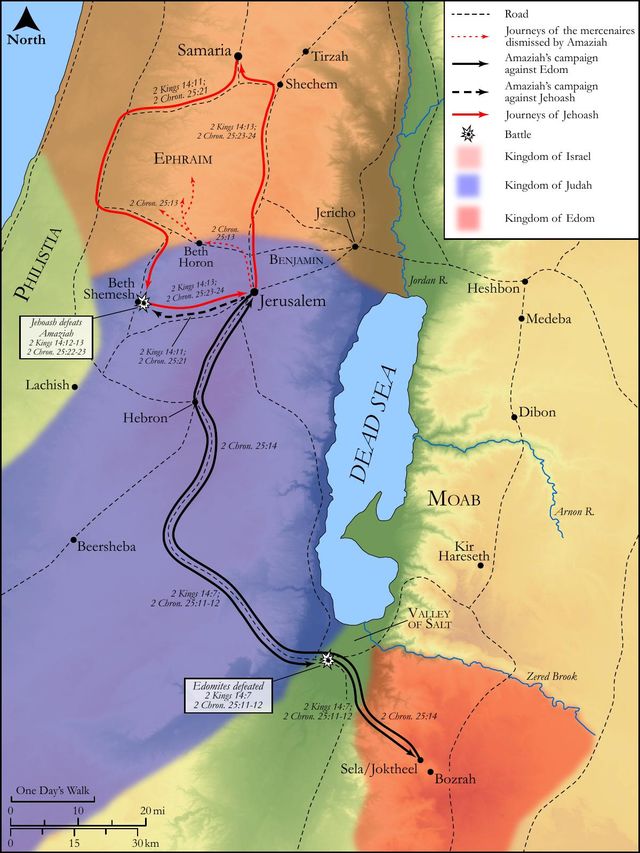
III.An expedition of his against the Edomites, who, some time ago, had revolted from under the dominion of Judah, to which he attempted to reduce them. Observe,
1.The great preparation he made for this expedition.
(1.)He mustered his own forces, and marshalled them (Ch2 25:5), and found Judah and Benjamin in all but 300,000 men that were fit for war, whereas, in Jehoshaphat's time, fifty or sixty years before, they were four times as many. Sin weakens a people, diminishes them, dispirits them, and lessens their number and figure.
(2.)He hired auxiliary troops out of the kingdom of Israel, Ch2 25:6. Finding his own kingdom defective in men, he thought to make up the deficiency with his money, and therefore took into his pay 100,000 Israelites. If he had advised with any of his prophets before he did this, or had but considered how little any of his ancestors got by their alliances with Israel, he would not have had this to undo again. But rashness makes work for repentance.
2.The command which God sent him by a prophet to dismiss out of his service the forces of Israel, Ch2 25:7, Ch2 25:8. He would not have him call in any assistance at all: it looked like distrust of God. If he made sure of God's presence, the army he had of his own was sufficient. But particularly he must not take in their assistance: For the Lord is not with the children of Ephraim, because they are not with him, but worship the calves. This was a good reason why he should not make use of them, because he could not depend upon them to do him any service. What good could be expected from those that had not God with them, nor his blessings upon their undertakings? It is comfortable to employ those who, we have reason to hope, have an interest in heaven, and dangerous to associate with those from whom the Lord has departed. The prophet assured him that if he persisted in his resolution to take these idolatrous apostate Israelites with him, in hopes thereby to make himself strong for the battle, it was at his peril; they would prove a dead weight to his army, would sink and betray it: "God shall make thee fall before the enemy, and these Israelites will be the ruin of thy cause; for God has power to help thee without them, and to cast thee down though thou hast them with thee."
3.The objection which Amaziah made against this command, and the satisfactory answer which the prophet gave to that objection, Ch2 25:9. The king had remitted 100 talents to the men of Israel for advance-money. "Now," says he, "if I send them back, I shall lose that: But what shall we do for the 100 talents?" This is an objection men often make against their duty: they are afraid of losing by it. "Regard not that," says the prophet: "The Lord is able to give thee much more than this; and, thou mayest depend upon it, he will not see thee lose by him. What are 100 talents between thee and him? He has ways enough to make up the loss to thee; it is below thee to speak of it." Note, A firm belief of God's all-sufficiency to bear us out in our duty, and to make up all the loss and damage we sustain in his service abundantly to our advantage, will make his yoke very easy and his burden very light. What is it to trust in God, but to be willing to venture the loss of any thing for him, in confidence of the goodness of the security he gives us that we shall not lose by him, but that whatever we part with for his sake shall be made up to us in kind or kindness. When we grudge to part with any thing for God and our religion, this should satisfy us, that God is able to give us much more than this. He is just, and he is good, and he is solvent. The king lost 100 talents by his obedience; and we find just that sum given to his grandson Jotham as a present (Ch2 27:5); then the principal was repaid, and, for interest, 10,000 measures of wheat and as many of barley.
4.His obedience to the command of God, which is upon record to his honour. He would rather lose his money, disoblige his allies, and dismiss a fourth part of his army just as they were going to take the field, than offend God: He separated the army of Ephraim, to go home again, Ch2 25:10. And they went home in great anger, taking it as a great affront thus to be made fools of, and to be cashiered as men not fit to be employed, and being perhaps disappointed of the advantages they promised themselves in spoil and plunder by joining with Judah against Edom. Men are apt to resent that which touches them in their profit or reputation, though it frees them from trouble.
5.His triumphs over the Edomites, Ch2 25:11, Ch2 25:12. He left dead upon the spot, in the field of battle, 10,000 men; 10,000 more he took prisoners, and barbarously killed them all by throwing them down some steep and craggy precipice. What provocation he had to exercise this cruelty towards them we are not told; but it was certainly very severe.
6.The mischief which the disbanded soldiers of Israel did to the cities of Judah, either in their return or soon after, Ch2 25:13. They were so enraged at being sent home that, if they might not go to share with Judah in the spoil of Edom, they would make a prey of Judah. Several cities that lay upon the borders they plundered, killing 3000 men that made resistance. But why should God suffer this to be done? Was it not in obedience to him that they were sent home, and yet shall the country thus suffer by it? Surely God's way is in the sea! Did not the prophet say that God was not with the children of Ephraim, and yet they are suffered to prevail against Judah? Doubtless God intended hereby to chastise those cities of Judah for their idolatries, which were found most in those parts that lay next to Israel. The men of Israel had corrupted them, and now they were made a plague to them. Satan both tempts and torments.
Continue studying 2 Chronicles 25:3 across the web’s major study libraries — every link below opens this exact verse, chapter, or book on the destination site.
Read & Compare
 BibleGatewayThis verse in more than 200 translations and 70 languages.
 Bible.comThe YouVersion reader — hundreds of translations, reading plans, and highlights.
 ESV.orgCrossway's official English Standard Version reader.
 NET BibleThe NET translation with 60,000+ translators' notes on every rendering decision.
 STEP BibleTyndale House's free study tool — original text, vocabulary, and scholarly resources.
 BibliaLogos Bible Software's free web reader.
 USCCBThe New American Bible (Revised Edition) with the U.S. bishops' study notes.
Commentaries
 BibleHub CommentariesDozens of classic commentaries on this verse, gathered on one page.
 StudyLightMore than 100 commentary sets — the largest collection on the web.
 BibleRefPlain-English commentary on what this verse means, verse by verse.
 Enduring WordDavid Guzik's free commentary on this chapter, widely used by Bible teachers.
 Bible Study ToolsVerse commentary alongside Greek and Hebrew study aids.
Original Language & Research
- BibleHub InterlinearThe verse word by word — original language, transliteration, and English.
- BibleHub LexiconEvery word's original-language definition and Strong's entry.
 Blue Letter BibleDeep-study tools — Strong's numbers, concordance, and word studies.
 SefariaThe Hebrew text with Rashi and centuries of Jewish commentary.
Sermons, Hymns & Audio


TrulyRandomVerse is not affiliated with these sites and doesn’t control their content. They’re linked because they’re genuinely useful.
Summary
Upon the secure establishment of his reign over Judah, King Amaziah executed the servants who had conspired to assassinate his father, King Joash. This decisive act served as a critical assertion of his royal authority, demonstrating his unwavering commitment to justice and his resolve to restore order and stability to the kingdom following a period of regicide and political upheaval.
Context
ShowHideLiterary Context
This verse immediately follows the tragic account of King Joash's assassination by his own servants (found in 2 Chronicles 24:25-27) and Amaziah's subsequent ascension to the throne. It marks the pivotal beginning of Amaziah's reign, detailing his initial, foundational steps to secure his position and address the profound betrayal and crime of regicide. The Chronicler presents this action as a necessary and just response to the destabilizing murder of the previous king. Crucially, 2 Chronicles 25:3 sets the immediate stage for the very next verse, 2 Chronicles 25:4, which provides a vital qualification to Amaziah's actions, highlighting his adherence to the Mosaic Law regarding individual accountability. This immediate follow-up demonstrates the Chronicler's profound interest in portraying Amaziah's early reign as one marked by both decisive justice and a foundational obedience to God's commands, distinguishing him from kings who acted purely out of personal vengeance.
Historical & Cultural Context
In the ancient Near East, the assassination of a monarch typically plunged a kingdom into profound chaos, often leading to power struggles, civil unrest, and further violence. New rulers frequently began their reigns by systematically eliminating potential rivals and those responsible for the previous king's downfall, thereby consolidating their power, deterring future conspiracies, and asserting their legitimacy. Amaziah's act of executing his father's murderers was, therefore, a culturally expected and politically strategic move to establish his authority and secure his rightful place on the throne. However, Judah's monarchy operated under a unique divine covenant and the Mosaic Law, unlike many surrounding nations. This divine law, particularly as articulated in Deuteronomy 24:16, strictly prohibited punishing children for the sins of their fathers. Amaziah's adherence to this principle, as noted in the subsequent verse, sets his actions apart from mere retaliatory vengeance and aligns them with God's prescribed justice, showcasing a king who understood and respected the divine framework governing his rule.
Key Themes
ShowHideAmaziah's initial act of justice in 2 Chronicles 25:3 contributes significantly to several overarching themes in the book of Chronicles. First, it powerfully underscores the theme of divine justice and accountability, demonstrating that heinous crimes, especially against God's anointed king, demand severe consequences. This act reflects the principle that God is a God of order and righteousness, who holds individuals accountable for their actions. Second, it highlights the critical theme of the consolidation of royal power and legitimacy, illustrating how a new monarch must establish firm control to ensure stability and deter future rebellion. This decisive action was essential for Amaziah to transition from a precarious succession to a secure and recognized reign. Third, and most profoundly when viewed in conjunction with 2 Chronicles 25:4, it introduces the crucial theme of righteous retribution within the bounds of God's law. While Amaziah exacted justice, the Chronicler immediately clarifies that he did so in accordance with the Law, emphasizing the paramount importance of obedience to divine commands even in the exercise of royal prerogative. This sets a moral and theological tone for his early reign, contrasting sharply with the unrighteousness and lawlessness that characterized some previous kings.
Exposition and Analysis
ShowHideKey Word Analysis
ShowHideThis verb, often translated as "to be strong," "to seize," or "to confirm," signifies the firm consolidation of power and authority. In this context, it conveys that Amaziah's reign was no longer tenuous or contested but had achieved sufficient stability and recognition. His authority was fully secured, allowing him to act decisively without fear of internal revolt or challenge to his throne. It implies a strategic period of waiting and preparation before taking this significant and public step, demonstrating prudence rather than impulsive reaction.
This primitive root means "to smite with deadly intent," "to kill," or "to murder." It indicates a deliberate, judicial, and decisive act of execution, not merely a skirmish or an accidental death. In this context, it refers to the lawful (within the king's prerogative and the Mosaic Law's provisions for capital crimes) execution of individuals found guilty of a capital offense, specifically regicide. The term underscores the finality and gravity of the punishment.
This fundamental word refers to a literal and immediate father. The inclusion of "his father" emphasizes the personal nature of the crime committed against King Joash and, by extension, against Amaziah's lineage and the divinely appointed Davidic dynasty. It highlights the profound betrayal inherent in the actions of the "servants" who killed the king, as their victim was not merely a ruler but the progenitor of the current king, making the act both a political and a deeply personal affront.
Verse Breakdown
ShowHide"Now it came to pass, when the kingdom was established to him"
This introductory clause sets the critical timing and prerequisite for Amaziah's subsequent action. It emphasizes that the king did not act immediately in a fit of rage or vengeance upon his father's death. Instead, he waited until his own position as king was secure, his authority unchallenged, and the stability of his rule firmly in place. This demonstrates a calculated, strategic approach to governance, ensuring that his act of justice would solidify his rule rather than provoke further instability or opposition. It speaks to wisdom and political acumen in the exercise of power.
"that he slew his servants"
This is the central action of the verse. Amaziah, now firmly in control and with his authority consolidated, took decisive action against those who had committed the heinous crime. The phrase "his servants" refers to those who had served his father, King Joash, and were directly responsible for the assassination. This highlights the internal nature of the threat to the monarchy and the king's resolute determination to purge his administration and kingdom of traitors. The act is presented as a direct, necessary, and justified consequence of their prior actions.
"that had killed the king his father"
This concluding phrase provides the explicit and undeniable justification for Amaziah's action. The execution was not arbitrary or based on personal vendetta but was a direct, lawful response to the capital crime of regicide. It underscores the principle of accountability for grave offenses, particularly against the divinely appointed monarch, and serves as a public declaration of justice for the slain King Joash, restoring moral and legal order to the kingdom.
Literary Devices
ShowHideThe Chronicler employs several potent literary devices in this concise verse to convey significant meaning and establish the tone of Amaziah's early reign. Narrative Economy is strikingly evident, as a profound act of royal justice and the consolidation of power are conveyed in a single, direct sentence. This brevity emphasizes the swiftness and decisiveness of Amaziah's action once his authority was secure, avoiding unnecessary elaboration to highlight the impact. There is also a powerful element of Juxtaposition between the chaotic and ignominious end of King Joash's reign (murdered by his own trusted servants) and the decisive, order-establishing beginning of Amaziah's rule. This stark contrast highlights Amaziah's initial strength and his commitment to reversing the instability and lawlessness that preceded him. Furthermore, this verse serves as a subtle yet significant Foreshadowing of Amaziah's character and the nature of his kingship, indicating a ruler capable of strong leadership and, at least initially, committed to upholding justice. This sets up the crucial detail in 2 Chronicles 25:4, where his adherence to the Mosaic Law is explicitly stated, demonstrating that his justice was not merely vengeance but principled action guided by divine command.
Theological and Thematic Connections
ShowHideAmaziah's execution of his father's murderers, while a specific historical event rooted in the political realities of ancient Israel, resonates with broader biblical themes concerning justice, divine sovereignty, and the inescapable consequences of sin. This act, coming from a divinely appointed king, powerfully reflects the principle that God is a God of justice who demands accountability for wrongdoing, especially for heinous crimes that undermine societal order and disrespect divinely ordained authority. While human justice is always imperfect and limited, the king, as God's earthly representative, was tasked with maintaining order and upholding righteousness in the land. This verse showcases an earthly ruler exercising his God-given authority to punish evil and establish stability, a necessary function for the well-being and moral integrity of the covenant community. It serves as a stark reminder that even within the Old Testament narrative, there is a clear expectation that leaders will administer justice and that there are severe consequences for rebellion, murder, and high treason.
Reflection and Application
ShowHideWhile the direct application of a king executing assassins in a modern context is limited, 2 Chronicles 25:3 offers profound and enduring principles for reflection on leadership, justice, and the restoration of order. It speaks to the universal need for justice and accountability in any society, organization, or even personal sphere of influence. Amaziah's deliberate action, taken only after his authority was "established," underscores the critical importance of wisdom, strategic timing, and a firm foundation when addressing deep-seated issues, administering consequences, or implementing significant change. It highlights that true leadership often requires decisive action to restore order, uphold righteousness, and ensure that wrongdoing does not go unaddressed, thereby preventing further decay or instability. Furthermore, when viewed in conjunction with the following verse, it powerfully reminds us that even in the pursuit of justice, there are divine boundaries and ethical considerations that must meticulously guide our actions, preventing retribution from devolving into indiscriminate vengeance or personal vendetta. We are called to seek justice, but always within the framework of God's revealed character, His commands, and His ultimate desire for righteousness and redemption.
Questions for Reflection
ShowHideFAQ
ShowHideWhy is it significant that Amaziah waited until "the kingdom was established to him" before acting?
ShowHideThe timing of Amaziah's action is profoundly significant for several reasons. First, it indicates a strategic, prudent, and politically astute approach to leadership. Had Amaziah acted immediately upon his father's death, before his authority was fully consolidated and recognized, his actions could have been perceived as a rash act of personal vengeance or could have provoked further instability, civil unrest, or even a challenge to his nascent reign. By waiting until his "kingdom was established," Amaziah ensured that his actions would be seen not as impulsive retribution but as a legitimate exercise of royal power and a necessary act of justice, thereby solidifying his reign rather than undermining it. This demonstrates his political acumen and his understanding that effective justice and the restoration of order require a stable and secure foundation from which to operate. It implies a king who was not driven by raw emotion but by a calculated resolve to bring order and accountability.
How does this act of "slew his servants" reconcile with biblical principles of mercy or forgiveness?
ShowHideThis verse describes a judicial act of capital punishment for a capital crime—specifically, regicide—not a personal act of vengeance or an presence of mercy in a private dispute. In the Old Testament, the king was God's appointed agent for maintaining justice, order, and the rule of law within the land. Murder, especially the murder of a king (who was God's anointed), was considered a heinous crime punishable by death under Mosaic Law, as clearly articulated in passages like Genesis 9:6 and implicitly throughout the legal codes of Israel. While the Bible certainly teaches and exemplifies mercy and forgiveness for personal offenses and provides avenues for repentance, it also unequivocally upholds the necessity of justice and accountability for societal crimes that threaten the fabric of the community and defy God's moral order. Crucially, the very next verse, 2 Chronicles 25:4, clarifies that Amaziah adhered strictly to the Mosaic Law by not punishing the children of the murderers, demonstrating that his justice was bounded by divine principles and not indiscriminate vengeance. This act, therefore, is presented as a necessary and lawful exercise of justice to restore order, uphold the sanctity of life, and protect the integrity of the throne.
Christ-Centered Fulfillment
ShowHideWhile King Amaziah's act of establishing justice through the execution of his father's murderers was a necessary and lawful act within the Old Testament context, it ultimately points to the far greater and perfect justice established by Jesus Christ. Earthly kings like Amaziah could only deal with external threats and temporal crimes, securing a physical kingdom through force and judicial retribution. Christ, the true and eternal King, established His kingdom not by slaying His enemies, but by offering Himself as the ultimate, perfect sacrifice for the sins of humanity. He dealt with the ultimate betrayal—humanity's rebellion and sin against a holy God—not through immediate retribution, but through atonement, bearing the just punishment Himself. In Christ, God's perfect justice is fully satisfied, and His boundless mercy is fully extended to all who believe. He is the one who truly establishes His spiritual kingdom, delivering us from the domain of darkness and transferring us into the glorious kingdom of His beloved Son (Colossians 1:13-14). Unlike Amaziah, whose reign ultimately faltered and ended in apostasy, Christ's throne is forever, and His kingdom is one of righteousness, peace, and joy in the Holy Spirit (Hebrews 1:8). He came not primarily as a conquering warrior to execute the wicked, but as the Lamb of God to take away the sin of the world (John 1:29), securing an eternal kingdom through grace and self-sacrifice rather than the sword. His ultimate return, however, will see Him as the righteous Judge, bringing perfect and final justice to all creation (Revelation 19:11).