


2 Kings 14:22
- הוּאhu'heH1931Pro-3msPronoun Personal 3rd Singular Masculine
- בָּנָהba·Nahhe builtH1129V-Qal-Perf-3msVerb Qal Perfect 3rd Singular Masculine
- אֶת'et<obj.>H853DirObjMParticle Object Indicator
- אֵילַת'ei·LatElathH359N-properNoun Proper Location
- וַיְשִׁבֶהָvay·shi·Ve·haand he restored itH7725Conj-w ¦ V-Hiphil-ConsecImperf-3ms ¦ 3fsVerb Hiphil Consecutive Imperfect 3rd Singular Masculineוַandיְשִׁבֶhe restoredהָit
- לִיהוּדָהli·hu·Dahto JudahH3063Prep-l ¦ N-properNoun Proper LocationלִtoיהוּדָהJudah
- אַחֲרֵי'a·cha·ReiafterH310Adj-mpcAdjective Numerical Plural Masculine Construct
- שְׁכַבshe·khavlay downH7901V-Qal-InfVerb Qal Infinitive Construct
- הַמֶּלֶךְha·Me·lekhthe kingH4428Art ¦ N-msNoun Singular Masculine Absoluteהַtheמֶּלֶךְking
- עִם'imwithH5973PrepPreposition
- אֲבֹתָיו'a·vo·Tavhis ancestorsH1N-fpc ¦ 3msNoun Plural Feminine Constructאֲבֹתָיancestorsוhis
English is a literal word-by-word gloss of the Hebrew, not the KJV's wording. Why?
This is the original text the KJV's translators worked from — each Hebrew word with its own literal English meaning in this verse, prepared by scholars at Tyndale House, Cambridge. The KJV translates whole sentences, not word by word, so its wording differs: one Hebrew word can become several English words, and the KJV may choose “the LORD” where the gloss reads “Yahweh”. Both are faithful — they answer different questions. For the KJV's own rendering, switch to the KJV text.
Details
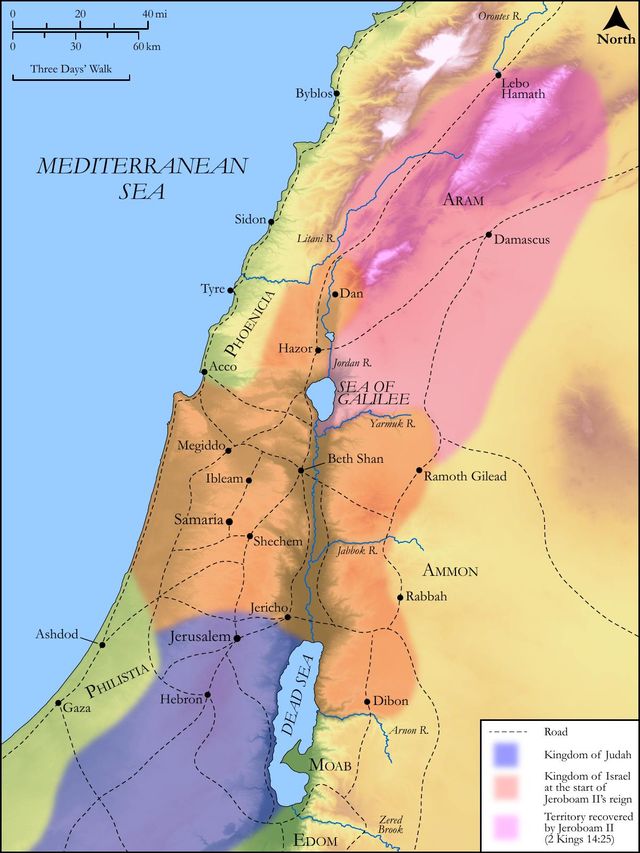
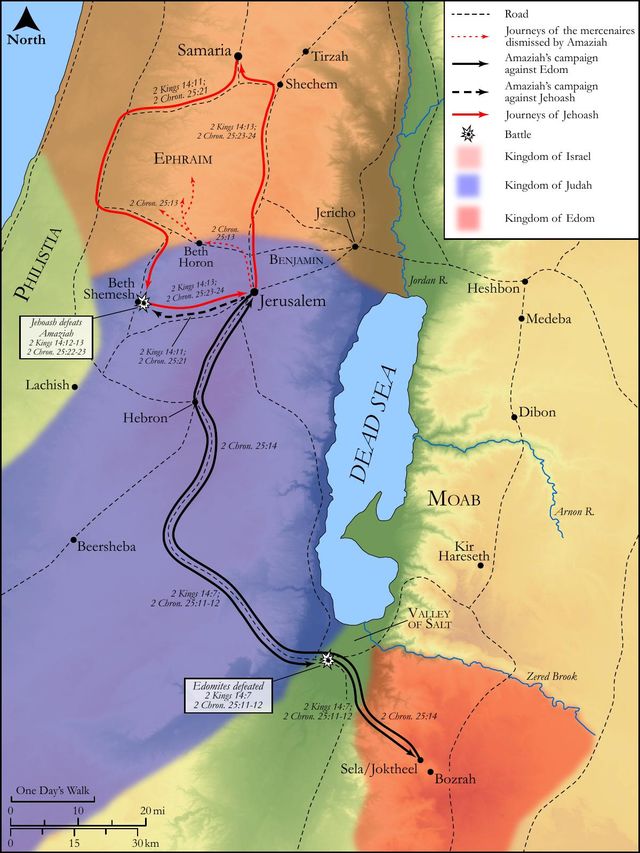
See on the biblical-era maps
Study this verse
Public-domain commentary
Matthew Henry
From his Commentary on the Whole Bible. Henry comments on passages, not single verses — this entry covers 2 Kings 14:15–22.
Here are three kings brought to their graves in these few verses: - 1. Joash king of Israel, Kg2 14:15, Kg2 14:16. We attended his funeral once before, Kg2 13:12, Kg2 13:13. But, because the historian had occasion to give a further account of his life and actions, he again mentions his death and burial. 2. Amaziah king of Judah. Fifteen years he survived his conqueror the king of Israel, Kg2 14:17. A man may live a great while after he has been shamed, may be thoroughly mortified (as Amaziah no doubt was) and yet not dead. His acts are said to be found written in his annals (Kg2 14:18), but not his might; for his cruelty when he was a conqueror over the Edomites, and his insolence when he challenged the king of Israel, showed him void of true courage. He was slain by his own subjects, who hated him for his maladministration (Kg2 14:19) and made Jerusalem too hot for him, the ignominious breach made in their walls being occasioned by his folly and presumption. He fled to Lachish. How long he continued concealed or sheltered there we are not told, but, at last, he was there murdered, Kg2 14:19. No further did the rage of the rebels extend, for they brought him in a chariot to Jerusalem, and buried him there among his ancestors. 3. Azariah succeeded Amaziah, but not till twelve years after his father's death, for Amaziah died in the fifteenth year of Jeroboam (as appears by comparing Kg2 14:23 with Kg2 14:2), but Azariah did not begin his reign till the twenty-seventh of Jeroboam (ch. 15:1), for he was but four years old at the death of his father, so that, for twelve years, till he came to be sixteen, the government was in the hands of protectors. He reigned very long (ch. 15:2) and yet the account of his reign is here industriously huddled up, and broken off abruptly (v. 22): He built Elath (which had belonged to the Edomites, but, it is probable, was recovered by his father, v. 7), after that the king slept with his fathers, as if that had been all he did that was worth mentioning, or rather it is meant of king Amaziah: he built it soon after Amaziah died.
Continue studying 2 Kings 14:22 across the web’s major study libraries — every link below opens this exact verse, chapter, or book on the destination site.
Read & Compare
 BibleGatewayThis verse in more than 200 translations and 70 languages.
 Bible.comThe YouVersion reader — hundreds of translations, reading plans, and highlights.
 ESV.orgCrossway's official English Standard Version reader.
 NET BibleThe NET translation with 60,000+ translators' notes on every rendering decision.
 STEP BibleTyndale House's free study tool — original text, vocabulary, and scholarly resources.
 BibliaLogos Bible Software's free web reader.
 USCCBThe New American Bible (Revised Edition) with the U.S. bishops' study notes.
Commentaries
 BibleHub CommentariesDozens of classic commentaries on this verse, gathered on one page.
 StudyLightMore than 100 commentary sets — the largest collection on the web.
 BibleRefPlain-English commentary on what this verse means, verse by verse.
 Enduring WordDavid Guzik's free commentary on this chapter, widely used by Bible teachers.
 Bible Study ToolsVerse commentary alongside Greek and Hebrew study aids.
Original Language & Research
- BibleHub InterlinearThe verse word by word — original language, transliteration, and English.
- BibleHub LexiconEvery word's original-language definition and Strong's entry.
 Blue Letter BibleDeep-study tools — Strong's numbers, concordance, and word studies.
 SefariaThe Hebrew text with Rashi and centuries of Jewish commentary.
Sermons, Hymns & Audio


TrulyRandomVerse is not affiliated with these sites and doesn’t control their content. They’re linked because they’re genuinely useful.
Summary
Second Kings 14:22 succinctly chronicles a pivotal achievement during the reign of King Azariah (also known as Uzziah) of Judah. This verse highlights his successful initiative in rebuilding and reclaiming the strategically vital port city of Elath, thereby restoring it to Judah's control. This significant accomplishment took place early in his reign, specifically after the death of his father, King Amaziah, signaling a period of renewed strength, economic vitality, and territorial reassertion for the southern kingdom.
Context
ShowHideLiterary Context
This verse immediately follows the detailed account of King Amaziah's assassination in Jerusalem and his subsequent burial with his ancestors in the City of David, as recorded in 2 Kings 14:19-20. It then introduces Azariah, Amaziah's son, who was made king by "all the people of Judah" at the tender age of sixteen, a detail found in 2 Kings 14:21. Verse 22, therefore, serves as an introductory highlight of Azariah's early reign, setting a tone of competence and success that would largely characterize his exceptionally long rule. His reign is further elaborated in 2 Kings 15:1-7 and extensively in 2 Chronicles 26. The phrase "after that the king slept with his fathers" is a common Deuteronomistic idiom marking royal succession and chronologically situating the new king's actions within the historical narrative.
Historical & Cultural Context
Elath (also known as Ezion-Geber, as indicated in 1 Kings 9:26) was a crucial seaport located at the northern tip of the Gulf of Aqaba, an arm of the Red Sea. Its control was paramount for access to lucrative trade routes extending to Arabia and Africa, facilitating the import of valuable goods like spices, gold, and exotic timbers. This port had been lost to Edom during the reign of Jehoram, a significant setback for Judah detailed in 2 Kings 8:20, representing a substantial economic and strategic blow. Azariah's rebuilding and restoration of Elath thus signifies a major geopolitical achievement, demonstrating Judah's renewed military strength and its capacity to reclaim lost territory, thereby reopening vital economic arteries and bolstering national prosperity. This act would have been seen as a clear sign of a strong, capable monarch taking the reins of the kingdom.
Key Themes
ShowHideThe verse contributes to several overarching themes within the books of Kings and Chronicles. Firstly, it underscores the theme of restoration and reassertion of national power, as Azariah reverses a previous loss and strengthens Judah's economic and territorial claims, echoing the broader narrative of God's faithfulness to His covenant people. Secondly, it highlights strategic leadership and foresight, as Azariah recognized and acted upon the vital importance of Elath for the kingdom's long-term prosperity and security. This aligns with the broader biblical narrative of kings who "did what was right in the eyes of the Lord" often experiencing periods of blessing and success, particularly in military and building endeavors, as seen in 2 Chronicles 26:6-15. Finally, the verse speaks to the continuity of the Davidic monarchy and the immediate impact of a new king in shaping the destiny of the nation following a period of transition or instability, demonstrating how a new reign could bring about a reversal of fortunes for the kingdom.
Exposition and Analysis
ShowHideKey Word Analysis
ShowHideA primitive root meaning "to build (literally and figuratively)." In this context, it signifies Azariah's comprehensive effort to re-establish the city's infrastructure, defenses, and administrative control. It suggests a significant investment of resources and labor to make Elath fully functional and secure as a Judahite possession once more, encompassing not just physical construction but the re-establishment of a thriving community.
Referring to a place name meaning "trees or a grove (i.e. palms)." This city, located at the northern tip of the Gulf of Aqaba, was a critical Red Sea port. Its significance lay in its strategic position for maritime trade routes to the south (Arabia, Africa) and its role as a naval base. Its reclamation by Azariah was a major economic and geopolitical victory for Judah, reversing its loss to Edom.
A primitive root meaning "to turn back (hence, away) transitively or intransitively, literally or figuratively." Its use here emphasizes that Azariah's action was not merely an act of conquest or new construction, but a deliberate effort to reclaim what had rightfully belonged to Judah but was lost. It highlights the reversal of a previous decline and the re-incorporation of a vital asset into the kingdom's economic and strategic framework, signifying a return to a former state of prosperity or control.
Verse Breakdown
ShowHide"He built Elath"
This clause directly attributes to King Azariah the initiative and accomplishment of rebuilding the city of Elath. This was likely a substantial undertaking, involving not only the construction of physical structures (e.g., fortifications, harbor facilities, dwellings) but also the establishment of a Judahite presence, administration, and possibly a military garrison to secure the port. It speaks to Azariah's early vision and capacity for large-scale development and strategic planning.
"and restored it to Judah"
This phrase clarifies the profound purpose and outcome of building Elath—it was to bring the city back under the sovereignty and control of the kingdom of Judah. This act reversed a period of foreign (Edomite) control, signifying a successful reassertion of Judah's territorial claims and a reclamation of its economic and strategic interests in the Red Sea trade. It was an act of national recovery, expansion, and a demonstration of renewed strength.
"after that the king slept with his fathers"
This temporal marker precisely indicates that Azariah's building and restoration of Elath occurred following the death of his father, King Amaziah (H4428). The phrase "slept with his fathers" (H7901 with H1) is a common biblical euphemism for death and burial with one's ancestors. This places the achievement squarely within the early years of Azariah's independent reign, suggesting that it was one of his immediate and significant undertakings as the new monarch, setting a precedent for a reign that would be largely characterized by strength and prosperity.
Literary Devices
ShowHideThe verse employs several literary techniques to convey its meaning efficiently and effectively. The most prominent is Euphemism, found in the phrase "slept with his fathers," which is a common biblical idiom used to refer to death and burial without using blunt language. This softens the reality of death while simultaneously emphasizing the continuity of the royal lineage and the peaceful transition of power. The verse also demonstrates remarkable Conciseness, packing significant historical, economic, and political information into a brief statement, a hallmark of the Deuteronomistic Historian's style in summarizing long reigns and highlighting key events. Implicitly, there is also an element of Contrast, as Azariah's successful early reign, marked by this strategic achievement, stands in contrast to the turbulent and ultimately tragic end of his father Amaziah's rule, which concluded with his assassination and flight, as detailed in 2 Kings 14:19-20.
Theological and Thematic Connections
ShowHideAzariah's act of restoring Elath reflects a broader biblical theme of divine enablement for leaders who seek the welfare of God's people and act with strategic wisdom. His success in reclaiming this vital port points to the Lord's blessing upon a king who, for a significant portion of his reign, "did what was right in the eyes of the Lord" (2 Kings 15:3). This restoration of territory and economic vitality was not merely a political achievement but a manifestation of God's covenant faithfulness to Judah, even amidst the nation's ongoing spiritual struggles. It underscores the principle that obedience and righteous leadership, though imperfect, often lead to prosperity and stability, while disobedience brings decline. This echoes the covenant promises of blessing for faithfulness found throughout the Torah, where God promises to establish and expand the boundaries of His people when they walk in His ways and keep His commands.
Reflection and Application
ShowHideKing Azariah's decisive action in rebuilding and restoring Elath offers a compelling blueprint for believers today, both individually and corporately. Just as he identified a lost and vital asset and dedicated himself to its restoration, we are called to discern areas in our lives, our families, our churches, or our communities that are broken, neglected, or in disarray. This might involve restoring fractured relationships, rebuilding trust, revitalizing a stagnant ministry, reclaiming lost spiritual disciplines, or investing in initiatives that bring flourishing to our neighborhoods. His strategic foresight reminds us that effective leadership, whether in a kingdom or in our personal sphere, requires not merely reacting to problems but proactively investing in long-term solutions that foster growth and well-being. The timing, "after that the king slept with his fathers," also speaks to the potential of new seasons or transitions as critical opportunities to initiate significant positive change, demonstrating vision and courage when responsibility falls upon us. While Azariah's later reign was marred by pride and its consequences, leading to leprosy (2 Chronicles 26:16-21), his early actions exemplify the potential for God-honoring leadership to bring about tangible blessing and restoration.
Questions for Reflection
ShowHideFAQ
ShowHideWhat was the significance of Elath, and why was its restoration important for Judah?
ShowHideElath, also known as Ezion-Geber, was a crucial seaport located at the northern tip of the Gulf of Aqaba, an arm of the Red Sea. Its strategic importance lay in its control over vital trade routes extending to the south and east, providing access to valuable resources like copper, gold, and spices from Arabia and Africa. It also served as a naval base for maritime expeditions, as seen during the prosperous reign of Solomon, who built a fleet there (1 Kings 9:26-28). Its loss, particularly to Edom during the reign of Jehoram (2 Kings 8:20), represented a significant economic and geopolitical setback for Judah, cutting off a vital source of wealth and influence. Azariah's act of rebuilding and restoring Elath therefore signified a major reassertion of Judah's influence, a revival of its economic power through renewed trade, and a strengthening of its national security. It marked a period of significant prosperity and expansion for the southern kingdom under his early reign, further detailed in 2 Chronicles 26.
Christ-Centered Fulfillment
ShowHideAzariah's restoration of Elath, a lost and vital asset, to Judah's control serves as a powerful earthly shadow of the far greater spiritual restoration accomplished by Jesus Christ. Just as Elath was lost due to human failing and reclaimed by a king, humanity was lost to sin and alienation from God, and only through the ultimate King, Jesus, could true restoration occur. Christ "built" and "restored" what was broken by sin, not merely a city, but the very relationship between God and humanity, establishing His kingdom not through military might but through sacrificial love. He is the one who "slept with his fathers" in death, yet conquered it, rising again to bring about a new era of spiritual prosperity and access to God's presence, far surpassing any earthly trade route. Through His atoning work, He reclaims those who were lost, bringing them into His glorious kingdom, making them "a chosen race, a royal priesthood, a holy nation, a people for his own possession, that you may proclaim the excellencies of him who called you out of darkness into his marvelous light" (1 Peter 2:9). This ultimate restoration is not of a port city, but of eternal life and fellowship with God, secured by the Lamb of God who takes away the sin of the world, making all things new and fulfilling the deepest longings of the human heart (Revelation 21:5).