


2 Kings 15:3
Bible text: King James Version (1769 Blayney text) · Public domain
Bible text: Berean Standard Bible · Public domain
Bible text: American Standard Version (1901) · Public domain
Bible text: World English Bible, Messianic edition · Public domain
Bible text: Geneva Bible (1599) · Public domain
Bible text: Young's Literal Translation · Public domain
- וַיַּעַשׂvai·Ya·'asand he didH6213Conj-w ¦ V-Qal-ConsecImperf-3msVerb Qal Consecutive Imperfect 3rd Singular Masculineוַandיַּעַשׂhe did
- הַיָּשָׁרhai·ya·Sharthe rightH3477Art ¦ Adj-msAdjective Singular Masculine Absoluteהַtheיָּשָׁרright
- בְּעֵינֵיbe·'ei·Neiin [the] eyes ofH5869Prep-b ¦ N-fdcNoun Dual Feminine Constructבְּinעֵינֵי[the] eyes of
- יְהוָהYah·wehYahwehH3068N-properNoun Proper Title
- כְּכֹלke·Kholaccording to allH3605Prep-k ¦ N-msNoun Singular Masculine Absoluteכְּaccording toכֹלall
- אֲשֶׁר'a·SherthatH834RelParticle Relative
- עָשָׂה'a·Sahhe had doneH6213V-Qal-Perf-3msVerb Qal Perfect 3rd Singular Masculine
- אֲמַצְיָהוּ'a·matz·Ya·huAmaziahH558N-proper-mNoun Proper Masculine
- אָבִיו'a·Vivhis fatherH1N-msc ¦ 3msNoun Singular Masculine Constructאָבִיfatherוhis
English is a literal word-by-word gloss of the Hebrew, not the KJV's wording. Why?
This is the original text the KJV's translators worked from — each Hebrew word with its own literal English meaning in this verse, prepared by scholars at Tyndale House, Cambridge. The KJV translates whole sentences, not word by word, so its wording differs: one Hebrew word can become several English words, and the KJV may choose “the LORD” where the gloss reads “Yahweh”. Both are faithful — they answer different questions. For the KJV's own rendering, switch to the KJV text.
Details
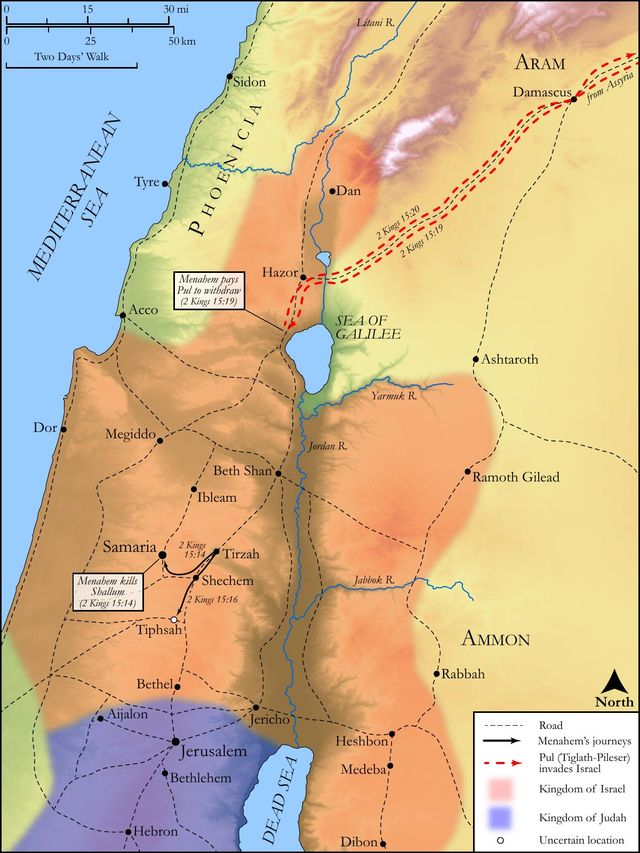
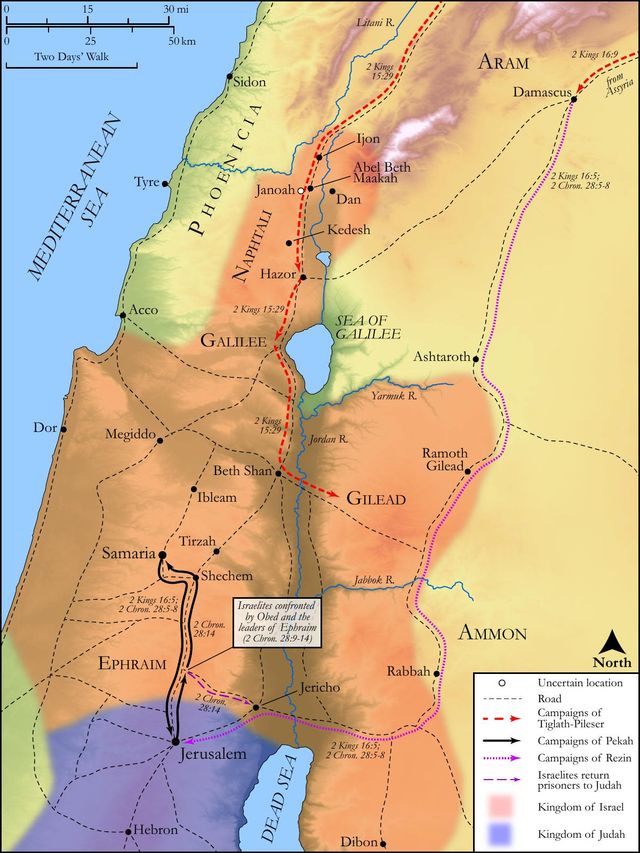
See on the biblical-era maps
Study this verse
Public-domain commentary
Matthew Henry
From his Commentary on the Whole Bible. Henry comments on passages, not single verses — this entry covers 2 Kings 15:1–7.
This is a short account of the reign of Azariah. 1. Most of it is general, and the same that has been given of others; he began young and reigned long (Kg2 15:2), did, for the most part, that which was right, Kg2 15:3 (it was happy for the kingdom that a good reign was a long one), only he had not zeal and courage enough to take away the high places, Kg2 15:4. 2. That which is peculiar, Kg2 15:5 (that God smote him with a leprosy) is more largely related, with the occasion of it, Ch2 26:16, etc., where we have also a fuller account of the glories of the former part of his reign, as well as of the disgraces of the latter part of it. He did that which was right, as Amaziah had done; like him, he began well, but failed before he finished. Here we are told, (1.) That he was a leper. The greatest of men are not only subject to the common calamities, but also to the common infirmities, of human nature; and, if they be guilty of any heinous sin, they lie as open as the meanest to the most grievous strokes of divine vengeance. (2.) God smote him with this leprosy, to chastise him for his presumptuous invasion of the priests' office. If great men be proud men, some way or other God will humble them, and make them know he is both above them and against them, for he resisteth the proud. (3.) That he was a leper to the day of his death. Though we have reason to think he repented and the sin was pardoned, yet, for warning to others, he was continued under this mark of God's displeasure as long as he lived, and perhaps it was for the good of his soul that he was so. (4.) That he dwelt in a separate house, as being made ceremonially unclean by the law, to the discipline of which, though a king, he must submit. He that presumptuously intruded into God's temple, and pretended to be a priest, was justly shut out from his own palace, and shut up as a prisoner or recluse, ever after. We suppose that his separate house was made as convenient and agreeable as might be. Some translate it a free house, where he had liberty to take his pleasure. However, it was a great mortification to one that had been so much a man of honour, and a man of business, as he had been, to be cut off from society and dwell always in a separate house: it would almost make life itself a burden, even to kings, though they have never any to converse with but their inferiors; the most contemplative men would soon be weary of it. (5.) That his son was his viceroy in the affairs both of his court (for he was over the house) and of his kingdom (for he was judging the people of the land); and it was both a comfort to him and a blessing to his kingdom that he had such a son to fill up his room.
Historical interpretation
Historical reception
1 surviving comment on this verse from the historical church.
In the book of Chronicles [it is written]: Uzziah “did what was right in the sight of the Lord, just as his father David, and God made him prosper.” “He built” fortresses “and palaces and high towers which were reinforced with iron bolts.” “But when he had become strong, he grew proud; he became an infidel to the Lord his God and entered the temple of the Lord to make the censer-bearers of perfumes smoke. But the priest Azariah went in after him and said to him, ‘It is not for you, king, [to make offerings].’ And the king was angered with the priests and ordered them to be driven out of the sanctuary. But at the same time a leprous disease broke out of the holy place on his forehead.” And when he died, “they did not bury him in the burial field that belonged to the kings, for they said, ‘He is leprous.’ ”He was struck with leprosy because, besides kingship, he dared arrogate priesthood, without remembering what had happened to the people of Dathan and Korah and what had happened to Jeroboam. That is why he received a punishment on a part of his body that was conspicuous. And since no prophet had reproached him, except for the priest Azariah, the gift of prophecy was withheld from [all prophets] until the death of Uzziah. And the bronze bull which they worshiped bellowed and produced a tremendous noise, while blood, ravaging and plagues reigned among the people. And the prophet Zechariah referred to these events when he said, “And you shall flee as you fled from the earthquake in the days of King Uzziah of Judah.”
Continue studying 2 Kings 15:3 across the web’s major study libraries — every link below opens this exact verse, chapter, or book on the destination site.
Read & Compare
 BibleGatewayThis verse in more than 200 translations and 70 languages.
 Bible.comThe YouVersion reader — hundreds of translations, reading plans, and highlights.
 ESV.orgCrossway's official English Standard Version reader.
 NET BibleThe NET translation with 60,000+ translators' notes on every rendering decision.
 STEP BibleTyndale House's free study tool — original text, vocabulary, and scholarly resources.
 BibliaLogos Bible Software's free web reader.
 USCCBThe New American Bible (Revised Edition) with the U.S. bishops' study notes.
Commentaries
 BibleHub CommentariesDozens of classic commentaries on this verse, gathered on one page.
 StudyLightMore than 100 commentary sets — the largest collection on the web.
 BibleRefPlain-English commentary on what this verse means, verse by verse.
 Enduring WordDavid Guzik's free commentary on this chapter, widely used by Bible teachers.
 Bible Study ToolsVerse commentary alongside Greek and Hebrew study aids.
Original Language & Research
- BibleHub InterlinearThe verse word by word — original language, transliteration, and English.
- BibleHub LexiconEvery word's original-language definition and Strong's entry.
 Blue Letter BibleDeep-study tools — Strong's numbers, concordance, and word studies.
 SefariaThe Hebrew text with Rashi and centuries of Jewish commentary.
Sermons, Hymns & Audio


TrulyRandomVerse is not affiliated with these sites and doesn’t control their content. They’re linked because they’re genuinely useful.
Summary
2 Kings 15:3 introduces the reign of King Azariah (also known as Uzziah) of Judah, providing the standard Deuteronomistic assessment that he "did that which was right in the sight of the LORD." However, this commendation is immediately qualified by the phrase "according to all that his father Amaziah had done," a crucial nuance that suggests Azariah's righteousness, while generally positive, was not absolute or perfect, mirroring the inconsistencies and moral compromises that characterized his predecessor's rule and hinting at a devotion that was commendable yet ultimately incomplete.
Context
ShowHideLiterary Context
This verse serves as the customary introductory formula for King Azariah's (Uzziah's) long reign in Judah, directly following the account of his father Amaziah in 2 Kings 14. The book of 2 Kings systematically presents the reigns of both Israelite and Judahite kings, typically beginning with a standardized regnal formula that includes details like the king's age at ascension, the length of his rule, his mother's name, and, most importantly, a theological evaluation of his fidelity to the Mosaic covenant. The recurring assessment, "did that which was right/evil in the sight of the LORD," is a central motif, serving as God's divine judgment on each monarch's adherence to exclusive Yahweh worship and the eradication of idolatry. The immediate qualification, "according to all that his father Amaziah had done," is highly significant, prompting the reader to recall Amaziah's own mixed and ultimately flawed record, detailed in 2 Kings 14:1-20 and more extensively in 2 Chronicles 25. This sets a nuanced expectation for Azariah's own rule, which, despite its prosperity, would also contain significant moral failings, as comprehensively elaborated in 2 Chronicles 26.
Historical & Cultural Context
Azariah/Uzziah's reign (c. 792-740 BC) was one of the longest and most prosperous in the history of the Southern Kingdom of Judah, lasting 52 years. This period witnessed a notable resurgence of Judahite power and influence, characterized by significant military victories, economic expansion, and extensive urban development and agricultural improvements, as vividly described in 2 Chronicles 26:6-15. Geographically, Judah was strategically positioned between formidable regional empires, and Uzziah's strong leadership was instrumental in maintaining its independence and expanding its territorial control. Culturally, the worship of Yahweh was the official state religion, but syncretistic practices and the persistent presence of "high places" (local altars for worship, often associated with pagan rites or unauthorized Yahwistic worship) remained a pervasive spiritual challenge, even for kings generally commended as "righteous." The phrase "in the sight of the LORD" profoundly underscores the conviction of Israel that a king's rule was ultimately accountable to the LORD, transcending mere human standards or political expediency. The explicit comparison to his father Amaziah is particularly insightful, as royal succession frequently involved a continuation of both political policies and religious practices, making the father's legacy a critical benchmark for the son's reign.
Key Themes
ShowHideThis verse introduces and reinforces several key themes that are central to the Deuteronomistic History, particularly within 2 Kings. Firstly, the theme of Divine Judgment and Assessment is paramount, as God is consistently presented as the ultimate arbiter of a king's righteousness, evaluating their adherence to His covenant. Secondly, the concept of Qualified Righteousness is prominently highlighted; the text demonstrates that even reigns deemed "good" were not necessarily perfectly devoted. The comparison to Amaziah, who began well but later succumbed to idolatry and pride (2 Chronicles 25:14-16), powerfully foreshadows Azariah's own eventual downfall due to pride (2 Chronicles 26:16-21). This illustrates the pervasive theme of Incomplete Obedience and the inherent dangers of a partial or conditional commitment to God. Thirdly, the verse underscores the profound Legacy and Influence of Leadership, demonstrating how the actions, character, and spiritual posture of a predecessor can significantly impact the successor, for both good and ill. While Azariah inherited a generally positive framework regarding Yahweh worship from Amaziah, he also inherited a susceptibility to pride and a failure to fully eradicate unauthorized worship, which ultimately led to his own divine judgment.
Exposition and Analysis
ShowHideKey Word Analysis
ShowHideThis adjective, derived from the root meaning "straight" or "upright," is a crucial term in the Deuteronomistic assessment of kings. When applied to a ruler, it signifies that their actions and policies were in general conformity with God's covenant laws, particularly regarding the exclusive worship of Yahweh and the rejection of idolatry. It implies a moral and spiritual rectitude, distinguishing them from kings who "did evil" in the Lord's sight. While indicating a positive general orientation, it does not necessarily denote absolute perfection.
This word, literally "eye," is used idiomatically in the phrase "in the sight of the LORD" (b'einei Yahweh). This expression emphasizes that the ultimate evaluation of a king's reign is not based on human opinion or political success, but on God's omniscient and sovereign judgment. It highlights the theological perspective of the biblical narrator, asserting that all human actions, especially those of leaders, are observed and judged by a higher, divine authority, underscoring God's active involvement in human history.
This primitive root is a broad verb meaning "to do" or "to make" in its widest application. In this verse, it appears twice: "he did" (va'ya'as) and "had done" (asah). Its repetition underscores the active nature of the king's conduct and the direct comparison being drawn. The verb signifies the execution of actions, whether "right" or otherwise, and in this context, highlights the continuity of behavior and policy between father and son.
Verse Breakdown
ShowHide"And he did [that which was] right in the sight of the LORD,"
This initial clause delivers a foundational positive divine assessment of King Azariah's reign. It indicates that, for the most part, his actions and policies were aligned with God's will and the requirements of the Mosaic covenant. This typically implies that he did not actively promote idolatry, maintained the official worship of Yahweh, and upheld a degree of justice within the kingdom. For many kings, this commendation would stand alone, signifying a commendable and blessed reign.
"according to all that his father Amaziah had done;"
This second clause introduces a profound and critical qualification that significantly alters the interpretation of the initial positive assessment. By explicitly comparing Azariah's righteousness to that of his father Amaziah, the text immediately injects a note of ambiguity and imperfection. Amaziah's reign, though starting well, was ultimately marred by pride, a turn to idolatry, and a lack of wholehearted devotion to God, leading to his tragic downfall and assassination. Therefore, Azariah's "right" actions are implicitly limited by the scope and quality of Amaziah's own flawed righteousness, suggesting that Azariah, too, may have exhibited inconsistencies, failed to fully eradicate all "high places" (as explicitly noted in 2 Kings 15:4), or succumbed to pride, as the Chronicler's account vividly details (2 Chronicles 26:16). This crucial qualification prevents an unqualified commendation and subtly hints at the underlying spiritual weaknesses that would eventually manifest in Azariah's long and otherwise prosperous reign.
Literary Devices
ShowHideThe verse employs Formulaic Language, characteristic of the Deuteronomistic History, in its opening assessment of Azariah's reign ("And he did that which was right in the sight of the LORD"). This standardized phrase provides a concise theological judgment on each monarch. However, the immediate addition of the Qualifying Clause ("according to all that his father Amaziah had done") introduces significant Nuance and Foreshadowing. This qualification is not merely a statement of fact but carries a subtle Irony, as Amaziah's "righteousness" was itself deeply flawed and ultimately incomplete. By explicitly linking Azariah to his father, the text utilizes Intertextual Reference, implicitly inviting the reader to recall Amaziah's full, complex, and ultimately mixed story from 2 Kings 14 and 2 Chronicles 25. This literary technique creates a sense of Anticipation for the reader, subtly prompting them to look for the ways in which Azariah's reign will mirror, or perhaps tragically repeat, the moral and spiritual shortcomings of his predecessor's complex legacy.
Theological and Thematic Connections
ShowHideThe nuanced assessment of Azariah's reign in 2 Kings 15:3 illuminates a profound theological truth: God's standard of righteousness is absolute and unwavering, and human obedience, even when outwardly commendable, can be incomplete or compromised by underlying spiritual flaws. The explicit comparison to Amaziah, a king whose initial faithfulness gave way to pride and idolatry, serves as a powerful reminder that outward conformity to religious practices does not equate to wholehearted, unreserved devotion. This verse implicitly teaches that true righteousness involves not just avoiding overt sin but cultivating a complete and unwavering commitment to God's covenant, free from the subtle influences of imperfect legacies, personal pride, or lingering spiritual compromises. It underscores the divine scrutiny under which all leaders, and indeed all believers, operate, reminding us that God sees beyond mere outward appearances to the true condition and motivations of the heart.
Reflection and Application
ShowHide2 Kings 15:3 offers a deeply instructive and sobering lesson for contemporary believers, challenging us to critically examine the quality and depth of our own obedience and devotion. Is our "righteousness" merely a qualified adherence, perhaps based on external conformity, cultural expectations, or the imperfect examples of others, or is it a wholehearted, unreserved pursuit of God's perfect and holy standard? The verse powerfully reminds us that even seemingly good actions can be subtly undermined by a lack of complete surrender, a lingering attachment to "high places" (whether literal idols or metaphorical areas of compromise in our lives), or the insidious creep of personal pride. We are called not merely to avoid gross sin, but to cultivate a devotion that is "without wavering" (Hebrews 10:23) and to diligently guard against the subtle compromises that can dilute our spiritual integrity and diminish our witness. Our lives, much like those of the ancient kings, are lived "in the sight of the LORD," and it is His perfect standard, supremely revealed in the person and work of Jesus Christ, that we should strive to emulate, seeking a righteousness that flows authentically from a transformed heart and an undivided loyalty.
Questions for Reflection
ShowHideFAQ
ShowHideWhat does "did that which was right in the sight of the LORD" mean for a king in ancient Israel/Judah?
ShowHideThis phrase is a standard theological assessment used by the biblical authors, particularly in the books of Kings and Chronicles, to evaluate the reigns of the monarchs. It signifies that the king generally adhered to the Mosaic covenant, especially regarding the exclusive worship of Yahweh and the rejection of idolatry and pagan practices. Kings who received this commendation typically did not promote Baal worship or other foreign deities, and they often maintained the official temple worship in Jerusalem. However, it did not necessarily mean they were perfect or that they eradicated all unauthorized forms of worship, such as the "high places" (as noted in 2 Kings 15:4 concerning Azariah/Uzziah). It indicated a fundamental commitment to Yahweh as the national God and a general alignment with covenantal expectations.
Why is the qualification "according to all that his father Amaziah had done" significant?
ShowHideThis qualification is profoundly crucial because it introduces a nuanced and somewhat negative assessment of Azariah's otherwise positive righteousness. King Amaziah, while initially doing "right" (2 Kings 14:3), later turned to idolatry, became proud, and pursued policies that ultimately led to his downfall and assassination (2 Chronicles 25:14-28). By explicitly comparing Azariah's reign to his father's, the text implies that Azariah's obedience was not absolute or wholehearted; it likely shared some of his father's flaws, such as pride, a failure to fully purge the land of unauthorized worship, or a lack of complete devotion. It suggests a "good, but with caveats" reign, foreshadowing the eventual pride and subsequent leprosy that afflicted Azariah himself (2 Chronicles 26:16).
Did Azariah (Uzziah) remove the "high places"?
ShowHideNo, the very next verse, 2 Kings 15:4, explicitly states, "Save that the high places were not removed: the people sacrificed and burnt incense still on the high places." This detail is a common qualification for many kings who otherwise "did right in the sight of the LORD." The "high places" were local altars, often on hilltops, where people offered sacrifices. While some may have been used for legitimate Yahwistic worship, many were associated with syncretistic practices or were simply unauthorized alternatives to the central temple worship in Jerusalem. Their continued existence indicated an incomplete religious reformation and a lingering spiritual compromise, even under otherwise righteous kings.
Christ-Centered Fulfillment
ShowHideThe qualified righteousness of King Azariah, "according to all that his father Amaziah had done," serves as a stark and poignant highlight of the inherent limitations of human kingship and the profound need for a perfect, unqualified King. While Azariah's reign was generally positive and brought prosperity to Judah, it was ultimately marred by the same inconsistencies, pride, and incomplete obedience that plagued his predecessors, culminating in his divine judgment of leprosy (2 Chronicles 26:16-21). This pervasive human inability to achieve perfect righteousness points forward with compelling clarity to Jesus Christ, the ultimate and flawless King. Unlike Azariah, whose obedience was qualified by an imperfect human legacy and personal failings, Jesus's righteousness is absolute, inherent, and divinely perfect. He "committed no sin, nor was any deceit found in his mouth" (1 Peter 2:22), perfectly fulfilling all righteousness required by God's law (Matthew 3:15). His reign is not "according to" any flawed human standard or the legacy of an imperfect father, but solely according to the perfect and eternal will of God the Father (John 6:38). Furthermore, while Azariah's pride led to his exclusion from the temple and public life, Christ, in His profound humility, entered the temple as the true High Priest and offered Himself as the ultimate, spotless sacrifice, thereby providing a perfect righteousness that is freely imputed to all who believe in Him (Romans 3:21-26). Thus, Azariah's qualified goodness serves as a powerful shadow, pointing to the unqualified, perfect, and saving righteousness found exclusively in Jesus Christ.