


2 Kings 15:2
Bible text: King James Version (1769 Blayney text) · Public domain
Bible text: King James Version with Strong's numbers · Public domain
Bible text: Berean Standard Bible · Public domain
Bible text: American Standard Version (1901) · Public domain
Bible text: World English Bible, Messianic edition · Public domain
Bible text: Geneva Bible (1599) · Public domain
Bible text: Young's Literal Translation · Public domain
- בֶּןbena son ofH1121N-mscNoun Singular Masculine Construct
- שֵׁשׁsheshsix-H8337N-csNoun Singular common gender Absolute
- עֶשְׂרֵה'es·RehteenH6240N-csNoun Singular common gender Absolute
- שָׁנָהsha·Nahyear[s]H8141N-fsNoun Singular Feminine Absolute
- הָיָהha·Yahhe wasH1961V-Qal-Perf-3msVerb Qal Perfect 3rd Singular Masculine
- בְמָלְכוֹve·ma·le·Khowhen he became kingH4427Prep-b ¦ V-Qal-Inf ¦ 3msVerb Qal Infinitive Constructבְwhenמָלְכbecame kingוֹhe
- וַחֲמִשִּׁיםva·cha·mi·Shimand fiftyH2572Conj-w ¦ N-mpNoun Plural Masculine Absoluteוַandחֲמִשִּׁיםfifty
- וּשְׁתַּיִםu·she·Ta·yimand twoH8147Conj-w ¦ N-fdNoun Dual Feminine Absoluteוּandשְׁתַּיִםtwo
- שָׁנָהsha·Nahyear[s]H8141N-fsNoun Singular Feminine Absolute
- מָלַךְma·Lakhhe reignedH4427V-Qal-Perf-3msVerb Qal Perfect 3rd Singular Masculine
- בִּירוּשָׁלִָםbi·ru·sha·Limin JerusalemH3389Prep-b ¦ N-properNoun Proper LocationבִּinירוּשָׁלִָםJerusalem
- וְשֵׁםve·Shemand [the] name ofH8034Conj-w ¦ N-mscNoun Singular Masculine Constructוְandשֵׁם[the] name of
- אִמּוֹ'i·Mohis motherH517N-fsc ¦ 3msNoun Singular Feminine Constructאִמּmotherוֹhis
- יְכָלְיָהוּye·khal·Ya·hu[was] JecholiahH3203N-proper-fNoun Proper Feminine
- מִירוּשָׂלִָםmi·ru·sha·Limfrom JerusalemH3389Prep-m ¦ N-properNoun Proper LocationמִfromירוּשָׂלִָםJerusalem
English is a literal word-by-word gloss of the Hebrew, not the KJV's wording. Why?
This is the original text the KJV's translators worked from — each Hebrew word with its own literal English meaning in this verse, prepared by scholars at Tyndale House, Cambridge. The KJV translates whole sentences, not word by word, so its wording differs: one Hebrew word can become several English words, and the KJV may choose “the LORD” where the gloss reads “Yahweh”. Both are faithful — they answer different questions. For the KJV's own rendering, switch to the KJV text.
Details
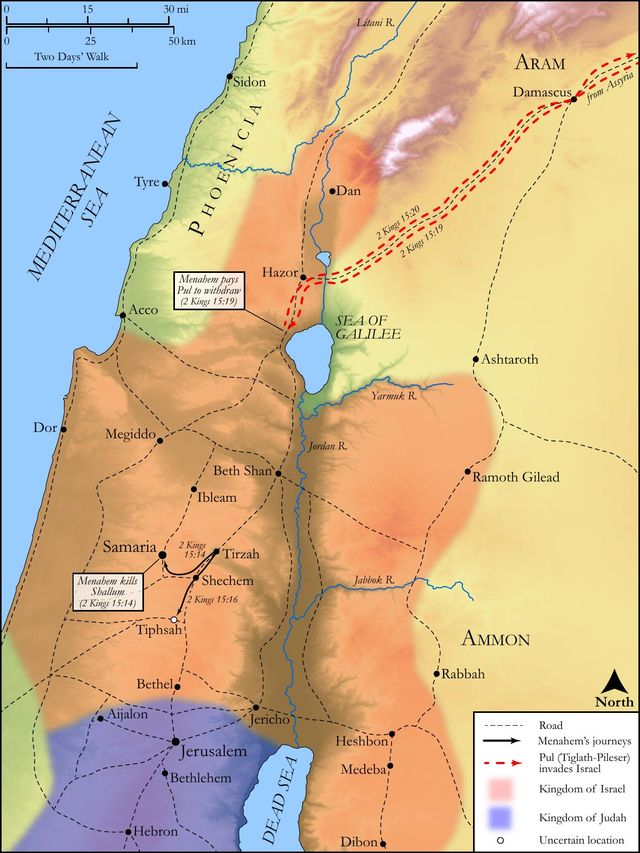
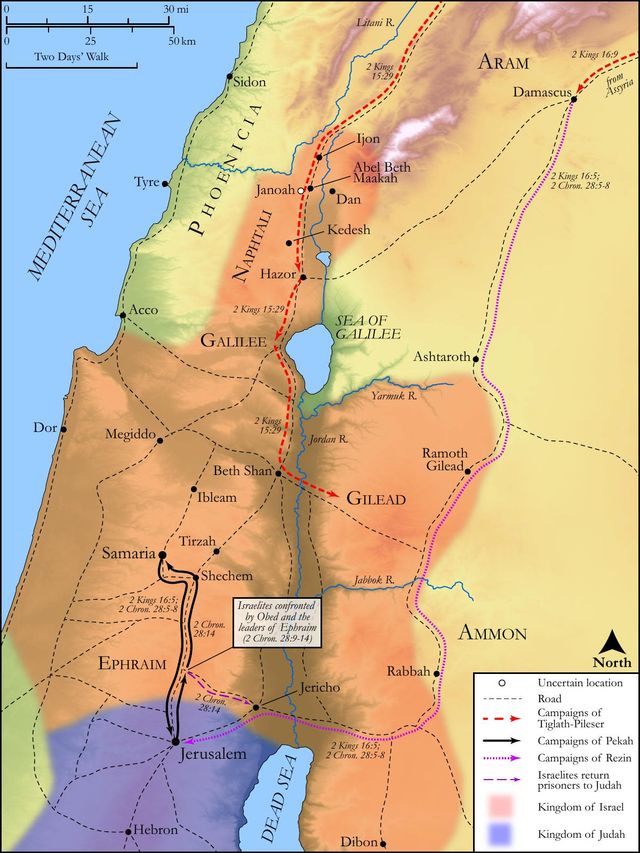
See on the biblical-era maps
Study this verse
Public-domain commentary
Matthew Henry
From his Commentary on the Whole Bible. Henry comments on passages, not single verses — this entry covers 2 Kings 15:1–7.
This is a short account of the reign of Azariah. 1. Most of it is general, and the same that has been given of others; he began young and reigned long (Kg2 15:2), did, for the most part, that which was right, Kg2 15:3 (it was happy for the kingdom that a good reign was a long one), only he had not zeal and courage enough to take away the high places, Kg2 15:4. 2. That which is peculiar, Kg2 15:5 (that God smote him with a leprosy) is more largely related, with the occasion of it, Ch2 26:16, etc., where we have also a fuller account of the glories of the former part of his reign, as well as of the disgraces of the latter part of it. He did that which was right, as Amaziah had done; like him, he began well, but failed before he finished. Here we are told, (1.) That he was a leper. The greatest of men are not only subject to the common calamities, but also to the common infirmities, of human nature; and, if they be guilty of any heinous sin, they lie as open as the meanest to the most grievous strokes of divine vengeance. (2.) God smote him with this leprosy, to chastise him for his presumptuous invasion of the priests' office. If great men be proud men, some way or other God will humble them, and make them know he is both above them and against them, for he resisteth the proud. (3.) That he was a leper to the day of his death. Though we have reason to think he repented and the sin was pardoned, yet, for warning to others, he was continued under this mark of God's displeasure as long as he lived, and perhaps it was for the good of his soul that he was so. (4.) That he dwelt in a separate house, as being made ceremonially unclean by the law, to the discipline of which, though a king, he must submit. He that presumptuously intruded into God's temple, and pretended to be a priest, was justly shut out from his own palace, and shut up as a prisoner or recluse, ever after. We suppose that his separate house was made as convenient and agreeable as might be. Some translate it a free house, where he had liberty to take his pleasure. However, it was a great mortification to one that had been so much a man of honour, and a man of business, as he had been, to be cut off from society and dwell always in a separate house: it would almost make life itself a burden, even to kings, though they have never any to converse with but their inferiors; the most contemplative men would soon be weary of it. (5.) That his son was his viceroy in the affairs both of his court (for he was over the house) and of his kingdom (for he was judging the people of the land); and it was both a comfort to him and a blessing to his kingdom that he had such a son to fill up his room.
Historical interpretation
Historical reception
1 surviving comment on this verse from the historical church.
In the book of Chronicles [it is written]: Uzziah “did what was right in the sight of the Lord, just as his father David, and God made him prosper.” “He built” fortresses “and palaces and high towers which were reinforced with iron bolts.” “But when he had become strong, he grew proud; he became an infidel to the Lord his God and entered the temple of the Lord to make the censer-bearers of perfumes smoke. But the priest Azariah went in after him and said to him, ‘It is not for you, king, [to make offerings].’ And the king was angered with the priests and ordered them to be driven out of the sanctuary. But at the same time a leprous disease broke out of the holy place on his forehead.” And when he died, “they did not bury him in the burial field that belonged to the kings, for they said, ‘He is leprous.’ ”He was struck with leprosy because, besides kingship, he dared arrogate priesthood, without remembering what had happened to the people of Dathan and Korah and what had happened to Jeroboam. That is why he received a punishment on a part of his body that was conspicuous. And since no prophet had reproached him, except for the priest Azariah, the gift of prophecy was withheld from [all prophets] until the death of Uzziah. And the bronze bull which they worshiped bellowed and produced a tremendous noise, while blood, ravaging and plagues reigned among the people. And the prophet Zechariah referred to these events when he said, “And you shall flee as you fled from the earthquake in the days of King Uzziah of Judah.”
Continue studying 2 Kings 15:2 across the web’s major study libraries — every link below opens this exact verse, chapter, or book on the destination site.
Read & Compare
 BibleGatewayThis verse in more than 200 translations and 70 languages.
 Bible.comThe YouVersion reader — hundreds of translations, reading plans, and highlights.
 ESV.orgCrossway's official English Standard Version reader.
 NET BibleThe NET translation with 60,000+ translators' notes on every rendering decision.
 STEP BibleTyndale House's free study tool — original text, vocabulary, and scholarly resources.
 BibliaLogos Bible Software's free web reader.
 USCCBThe New American Bible (Revised Edition) with the U.S. bishops' study notes.
Commentaries
 BibleHub CommentariesDozens of classic commentaries on this verse, gathered on one page.
 StudyLightMore than 100 commentary sets — the largest collection on the web.
 BibleRefPlain-English commentary on what this verse means, verse by verse.
 Enduring WordDavid Guzik's free commentary on this chapter, widely used by Bible teachers.
 Bible Study ToolsVerse commentary alongside Greek and Hebrew study aids.
Original Language & Research
- BibleHub InterlinearThe verse word by word — original language, transliteration, and English.
- BibleHub LexiconEvery word's original-language definition and Strong's entry.
 Blue Letter BibleDeep-study tools — Strong's numbers, concordance, and word studies.
 SefariaThe Hebrew text with Rashi and centuries of Jewish commentary.
Sermons, Hymns & Audio


TrulyRandomVerse is not affiliated with these sites and doesn’t control their content. They’re linked because they’re genuinely useful.
Summary
Second Kings 15:2 formally introduces Azariah, also known as Uzziah, marking the commencement of his remarkably long reign over the Southern Kingdom of Judah. This verse provides essential biographical details: his age at accession (sixteen years old), the extensive duration of his rule (fifty-two years) from Jerusalem, and the identity of his mother, Jecholiah, who was also from Jerusalem. These foundational facts establish the chronological, familial, and geographical context for one of Judah's most significant monarchs, whose lengthy tenure would encompass periods of great prosperity, military success, and a tragic personal downfall due to pride.
Context
ShowHideLiterary Context
This verse immediately follows 2 Kings 15:1, which synchronizes Judah's chronology by stating Azariah became king in the twenty-seventh year of Jeroboam II of Israel. The preceding chapter, 2 Kings 14, concludes the tumultuous reign of Azariah's father, Amaziah, who, despite an initially good start, ultimately turned away from the Lord and met a violent end. The introduction of Azariah's reign, particularly his young age and the unprecedented length of his rule, signals a new era for Judah, suggesting a potential for stability and growth after his father's instability. The consistent inclusion of the king's age at accession, the duration of his reign, and his mother's name is a standard, formulaic pattern in the Books of Kings, providing a structured framework for evaluating each monarch's adherence to the Davidic covenant and their overall impact on the nation's spiritual and political trajectory.
Historical & Cultural Context
Among the kingdoms of that day, the precise recording of a king's age at accession and the length of his reign served as vital chronological markers, indicating periods of stability or upheaval within a kingdom. The specific mention of the king's mother, Jecholiah of Jerusalem, was a distinctive practice in the Judahite royal records, less common in the Northern Kingdom of Israel. This detail served multiple critical purposes: it affirmed the king's legitimacy and his connection to the royal household, particularly the Davidic line, and often highlighted the significant influence of the queen mother (the gebirah) within the court. Her origin "of Jerusalem" further underscored the continuity of the Davidic dynasty and the central role of the capital city as the political and religious heartland of Judah. Historically, Azariah is more widely known by his alternative name, Uzziah, particularly in prophetic books like Isaiah 1:1 and in the more expansive account of his reign in 2 Chronicles 26. This dual naming convention (Azariah meaning "Yahweh has helped" and Uzziah meaning "My strength is Yahweh") is not uncommon in the Old Testament and likely reflects different scribal traditions or perhaps a personal name versus a throne name, both conveying a similar theological sentiment of reliance on God.
Key Themes
ShowHideThis verse contributes to several overarching themes present throughout the Books of Kings and the broader biblical narrative. Firstly, it introduces the theme of a Long and Influential Reign. Azariah's 52-year rule was one of the longest in Judah's history, surpassed only by Manasseh (2 Kings 21:1) and rivaling David's (2 Samuel 5:4). Such an extended period suggests a time of considerable stability and development for the kingdom, as further elaborated in 2 Chronicles 26:1-15. Secondly, the verse reinforces the theme of Royal Lineage and Legitimacy. The inclusion of his mother's name and her origin from Jerusalem emphasizes Azariah's firm rooting within the established Davidic dynasty and the unquestionable legitimacy of his claim to the throne. Finally, the mention of reigning "in Jerusalem" highlights the Significance of Jerusalem as the divinely chosen capital, the seat of the Davidic kings, and the spiritual center of the nation, where the Temple resided and God's covenant presence was uniquely manifested, as seen in passages like Psalm 122:1-9.
Exposition and Analysis
ShowHideKey Word Analysis
ShowHideWhile not explicitly translated as "son" in the KJV for "sixteen years old was he," the underlying Hebrew term H1121 (bên) is a fundamental word meaning "son" or "child." In this context, it is used idiomatically to denote age, literally "a son of sixteen years." This highlights the king's youth at accession, emphasizing his relatively early assumption of significant royal responsibility.
The verb "reign" (מָלַךְ, mâlak', H4427) signifies the exercise of royal authority, governing, and ruling as king. Beyond mere political power, in the context of the Books of Kings, this term carries profound theological weight. It implies a divinely sanctioned role, where the king is expected to serve as God's vice-regent, upholding justice, defending the covenant, and leading the people in faithfulness to Yahweh. Azariah's long reign, therefore, represents an extended period during which these divine expectations were placed upon him and the nation.
The name Jecholiah (יְכָלְיָה, Yᵉkolyâh', H3203) means "Yahweh will enable" or "Yahweh has prevailed." The inclusion of the queen mother's name was a distinctive feature of the Judahite royal records, often indicating her status and, at times, her influence within the court. While the text provides no further details about Jecholiah, her name itself is a theological statement, reflecting a common practice in ancient Israel to embed declarations of God's character or actions within personal names, acknowledging divine sovereignty.
Verse Breakdown
ShowHide"Sixteen years old was he when he began to reign"
This clause precisely states Azariah's age at the time of his accession to the throne. Assuming the throne at sixteen indicates a relatively young age for such a weighty responsibility, setting the stage for a reign that began with youthful vigor and potential, much like other young kings in Judah's history, such as Josiah (2 Kings 22:1) or Joash (2 Kings 12:1).
"and he reigned two and fifty years in Jerusalem"
This phrase highlights the extraordinary longevity of Azariah's rule, a remarkable period of 52 years. Such an extended reign implies a significant era of stability, continuity, and potentially prosperity for the kingdom of Judah. The specification "in Jerusalem" underscores the unbroken succession within the Davidic dynasty and the enduring centrality of the capital city as the political and religious heart of the nation, the seat of God's chosen king.
"And his mother's name [was] Jecholiah of Jerusalem"
This final clause identifies the queen mother as Jecholiah and specifies her origin as Jerusalem. This detail serves to legitimize the king's lineage, firmly connecting him to the royal house and the capital city. In ancient Judah, the queen mother often held a prominent position and could exert considerable influence, making her identification an important, standard part of the royal record.
Literary Devices
ShowHideThe verse primarily employs Factual Reporting, presenting concise, verifiable data about the king's accession. It functions as a crucial Chronological Marker, establishing the precise beginning and remarkable duration of Azariah's reign, which is essential for the overall historical framework and dating within the Books of Kings. Furthermore, the inclusion of the mother's name and origin serves as a Genealogical Record, affirming the king's legitimate place within the Davidic dynasty and his deep connection to the royal city of Jerusalem. These literary devices contribute to the historical reliability, systematic presentation, and authoritative tone characteristic of the biblical historical narratives, grounding the theological lessons within concrete historical facts.
Theological and Thematic Connections
ShowHideThis seemingly straightforward historical record carries profound theological implications. The remarkable longevity of Azariah's reign, a gift from God, speaks powerfully to divine providence and the Lord's continued faithfulness to His covenant with David, which promised an enduring dynasty (2 Samuel 7:16). Even when human kings are flawed, God's overarching plan for His people persists. The specific details provided—his age, the length of his reign, and his lineage—are not merely biographical but serve to frame a life lived under divine scrutiny, where human choices, whether for good or ill, have significant national consequences. Azariah's story, particularly as expanded in 2 Chronicles 26, illustrates the enduring biblical principle that even great success and divine blessing can be tragically marred by pride and disobedience, ultimately leading to severe judgment, reminding us that true strength comes from God alone.
Reflection and Application
ShowHideThe seemingly dry statistics presented in 2 Kings 15:2 invite us to reflect deeply on the nature of leadership, the passage of time, and the enduring impact of our choices. Azariah's 52-year reign, a testament to stability and initial divine favor, also serves as a poignant reminder that even a long and initially prosperous tenure can be ultimately defined by a moment of pride and disobedience, as vividly detailed in 2 Chronicles 26:16-21. This verse challenges us to consider that true success in any sphere of influence—whether in family, community, or professional life—is not merely about longevity, power, or outward achievement, but about consistent faithfulness to God's calling and profound humility in the face of His blessings. It prompts us to examine our own hearts, recognizing the subtle dangers of pride that can arise even after periods of great accomplishment, and to seek to finish well, not just to start strong. Our legacy is ultimately measured not by years or accomplishments alone, but by our integrity and obedience to the Lord throughout our entire journey.
Questions for Reflection
ShowHideFAQ
ShowHideWhy is the king called Azariah in 2 Kings but Uzziah in other books like 2 Chronicles and Isaiah?
ShowHideThe king introduced as Azariah in 2 Kings 15:2 is indeed the same individual referred to as Uzziah in the more extensive account found in 2 Chronicles 26 and in prophetic books such as Isaiah 1:1 and Amos 1:1. This dual naming convention for the same king is not uncommon in the Old Testament. Both names are Hebrew and carry similar theological meanings: Azariah (עֲזַרְיָה, Azaryāh') means "Yahweh has helped," and Uzziah (עֻזִּיָּה, Uzzîyāh') means "My strength is Yahweh." Scholars suggest several possibilities for this phenomenon: they might be alternative forms of the same name, a personal name versus a throne name, or simply variations reflecting different scribal traditions or regional pronunciations. Regardless, the biblical narrative consistently refers to the same historical figure, whose significant reign is extensively documented.
What was the significance of mentioning his mother, Jecholiah of Jerusalem?
ShowHideThe inclusion of the king's mother's name and her place of origin (Jecholiah of Jerusalem) was a standard and significant feature in the royal annals of Judah, though less common in the Northern Kingdom of Israel. This detail served several key purposes. Firstly, it helped to establish the king's legitimacy and his direct connection to the royal lineage, particularly the Davidic dynasty, which was crucial for the Judahite throne. Secondly, the queen mother (the gebirah) often held a position of significant influence and authority in the court, sometimes acting as a regent or an advisor, making her identity relevant to the king's rule. Lastly, mentioning her origin "of Jerusalem" further underscored the king's deep roots in the capital city, reinforcing the continuity and stability of the Davidic kingdom centered there, as Jerusalem was the divinely chosen city and the heart of Judah's spiritual and political life.
Christ-Centered Fulfillment
ShowHideThe reign of Azariah, though marked by significant achievements and remarkable longevity, ultimately highlights the inherent limitations and moral failures of human kingship, even among those who initially sought the Lord. His eventual downfall due to pride and subsequent leprosy, detailed in 2 Chronicles 26:16-21, serves as a stark reminder that no earthly king, no matter how powerful or long-reigning, can perfectly fulfill God's righteous standards or establish an eternal, unblemished kingdom. This narrative points us forward to the ultimate King, Jesus Christ, who alone perfectly embodies divine strength and wisdom. Unlike Azariah, whose strength was temporary and whose reign ended in judgment and isolation, Christ's reign is eternal and perfectly righteous. He is the true Son of David, whose kingdom "will have no end" (Luke 1:32-33). In Him, the Davidic covenant finds its complete and unblemished fulfillment, for He is the King who never fails, whose strength is always Yahweh, and who perfectly rules from the heavenly Jerusalem, bringing salvation and everlasting dominion to all who believe (Revelation 11:15). He is the King who reigns in humility and righteousness, offering perfect leadership where all human kings fall short.