


2 Chronicles 26:3
- בֶּןben[was] a son ofH1121N-mscNoun Singular Masculine Construct
- שֵׁשׁsheshsix-H8337N-csNoun Singular common gender Absolute
- עֶשְׂרֵה'es·RehteenH6240N-csNoun Singular common gender Absolute
- שָׁנָהsha·Nahyear[s]H8141N-fsNoun Singular Feminine Absolute
- עֻזִּיָּהוּ'u·zi·Ya·huUzziahH5818N-proper-mNoun Proper Masculine
- בְמָלְכוֹve·ma·le·Khowhen he became kingH4427Prep-b ¦ V-Qal-Inf ¦ 3msVerb Qal Infinitive Constructבְwhenמָלְכbecame kingוֹhe
- וַחֲמִשִּׁיםva·cha·mi·Shimand fiftyH2572Conj-w ¦ N-mpNoun Plural Masculine Absoluteוַandחֲמִשִּׁיםfifty
- וּשְׁתַּיִםu·she·Ta·yimand twoH8147Conj-w ¦ N-fdNoun Dual Feminine Absoluteוּandשְׁתַּיִםtwo
- שָׁנָהsha·Nahyear[s]H8141N-fsNoun Singular Feminine Absolute
- מָלַךְma·Lakhhe reignedH4427V-Qal-Perf-3msVerb Qal Perfect 3rd Singular Masculine
- בִּירוּשָׁלִָםbi·ru·sha·Limin JerusalemH3389Prep-b ¦ N-properNoun Proper LocationבִּinירוּשָׁלִָםJerusalem
- וְשֵׁםve·Shemand [the] name ofH8034Conj-w ¦ N-mscNoun Singular Masculine Constructוְandשֵׁם[the] name of
- אִמּוֹ'i·Mohis motherH517N-fsc ¦ 3msNoun Singular Feminine Constructאִמּmotherוֹhis
- יְכָלְיָהye·khi·le·yah[was] JecholiahH3203N-proper-fNoun Proper Feminine
- מִןminfromH4480PrepPreposition
- יְרוּשָׁלִָםye·ru·sha·LimJerusalemH3389N-properNoun Proper Location
English is a literal word-by-word gloss of the Hebrew, not the KJV's wording. Why?
This is the original text the KJV's translators worked from — each Hebrew word with its own literal English meaning in this verse, prepared by scholars at Tyndale House, Cambridge. The KJV translates whole sentences, not word by word, so its wording differs: one Hebrew word can become several English words, and the KJV may choose “the LORD” where the gloss reads “Yahweh”. Both are faithful — they answer different questions. For the KJV's own rendering, switch to the KJV text.
Details
See on the biblical-era map
Study this verse
Public-domain commentary
Matthew Henry
From his Commentary on the Whole Bible. Henry comments on passages, not single verses — this entry covers 2 Chronicles 26:1–15. His three-level outline is real structure in the source text, so it is rendered as structure.
We have here an account of two things concerning Uzziah: -
I.His piety.
In this he was not very eminent or zealous; yet he did that which was right in the sight of the Lord. He kept up the pure worship of the true God as his father did, and was better than his father, inasmuch as we have no reason to think he ever worshipped idols as his father did, no, not in his latter days, when his heart was lifted up. It is said (Ch2 26:5), He sought God in the days of Zechariah, who, some think, was the son of the Zechariah whom his grandfather Joash slew. This Zechariah was one that had understanding in the visions of God, either the visions which he himself was favoured with or the visions of the preceding prophets. He was well versed in prophecy, and conversed much with the upper world, was an intelligent, devout, good man; and, it seems, had great influence with Uzziah. Happy are the great men who have such about them and are willing to be advised by them; but unhappy those who seek God only while they have such with them and have not a principle in themselves to bear them out to the end.
II.His prosperity.
1.In general, as long as he sought the Lord, and minded religion, God made him to prosper. Note,
(1.)Those only prosper whom God makes to prosper; for prosperity is his gift.
(2.)Religion and piety are very friendly to outward prosperity. Many have found and owned this, that as long as they sought the Lord and kept close to their duty they prospered; but since they forsook God every thing has gone cross.
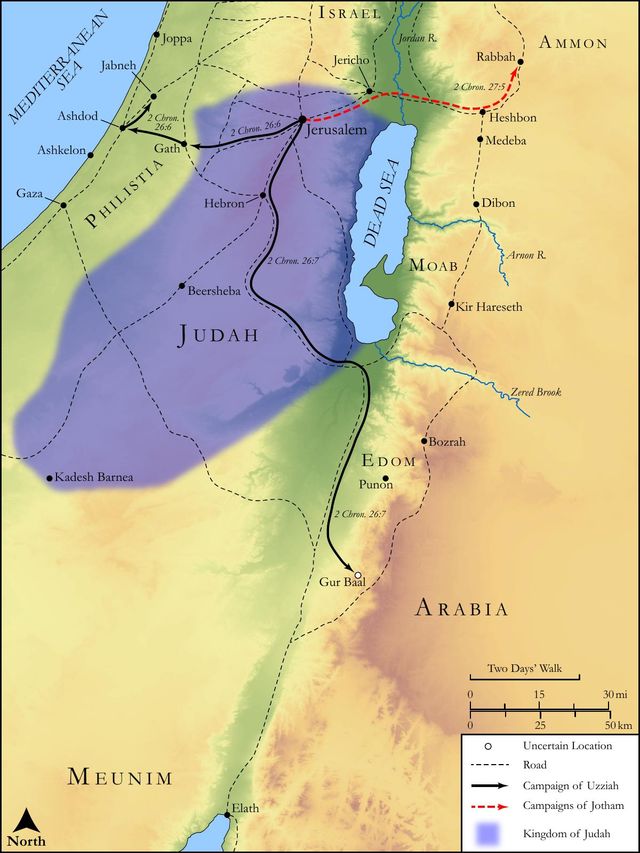
2.Here are several particular instances of his prosperity: - (1.) His success in his wars: God helped him (Ch2 26:7), and then he triumphed over the Philistines (those old enemies of God's people), demolished the fortifications of their cities, and put garrisons of his own among them, Ch2 26:6. He obliged the Ammonites to pay him tribute, Ch2 26:8. He made all quiet about him, and kept them in awe. (2.) The greatness of his fame and reputation. His name was celebrated throughout all the neighbouring countries (Ch2 26:8) and it was a good name, a name for good things with God and good people. This is true fame, and makes a man truly honourable. (3.) His buildings. While he acted offensively abroad, he did not neglect the defence of his kingdom at home, but built towers in Jerusalem and fortified them, Ch2 26:9. Much of the wall of Jerusalem was in his father's time broken down, particularly at the corner gate. But his best fortification of Jerusalem was his close adherence to the worship of God: if his father had not forsaken this the wall of Jerusalem would not have been broken down. While he fortified the city, he did not forget the country, but built towers in the desert too (Ch2 26:10), to protect the country people from the inroads of the plunderers, bands of whom sometimes alarmed them and plundered them, as Ch2 21:16. (4.) His husbandry. He dealt much in cattle and corn, employed many hands, and got much wealth by his dealing; for he took a pleasure in it: he loved husbandry (Ch2 21:10), and probably did himself inspect his affairs in the country, which was no disparagement to him, but an advantage, as it encouraged industry among his subjects. It is an honour to the husbandman's calling that one of the most illustrious princes of the house of David followed it and loved it. He was not one of those that delight in war, nor did he addict himself to sport and pleasure, but delighted in the innocent and quiet employments of the husbandman. (5.) His standing armies. He had, as it should seem, two military establishments. [1.] A host of fighting men that were to make excursions abroad. These went out to war by bands, Ch2 21:11. They fetched in spoil from the neighbouring countries by way of reprisal for the depredations they had so often made upon Judah, [2.] Another army for guards and garrisons, that were ready to defend the country in case it should be invaded, Ch2 21:12, Ch2 21:13. So great were their number and valour that they made war with mighty power; no enemy durst face them, or, at least, could stand before them. Men unarmed can do little in war. Uzziah therefore furnished himself with a great armoury, whence his soldiers were supplied with arms offensive and defensive (Ch2 21:14), spears, bows, and slings, shields, helmets, and habergeons: swords are not mentioned, because it is probable that every man had a sword of his own, which he wore constantly. Engines were invented, in his time, for annoying besiegers with darts and stones shot from the towers and bulwarks, Ch2 21:15. What a pity it is that the wars and fightings which come from men's lusts have made it necessary for cunning men to employ their skill in inventing instruments of death.
Continue studying 2 Chronicles 26:3 across the web’s major study libraries — every link below opens this exact verse, chapter, or book on the destination site.
Read & Compare
 BibleGatewayThis verse in more than 200 translations and 70 languages.
 Bible.comThe YouVersion reader — hundreds of translations, reading plans, and highlights.
 ESV.orgCrossway's official English Standard Version reader.
 NET BibleThe NET translation with 60,000+ translators' notes on every rendering decision.
 STEP BibleTyndale House's free study tool — original text, vocabulary, and scholarly resources.
 BibliaLogos Bible Software's free web reader.
 USCCBThe New American Bible (Revised Edition) with the U.S. bishops' study notes.
Commentaries
 BibleHub CommentariesDozens of classic commentaries on this verse, gathered on one page.
 StudyLightMore than 100 commentary sets — the largest collection on the web.
 BibleRefPlain-English commentary on what this verse means, verse by verse.
 Enduring WordDavid Guzik's free commentary on this chapter, widely used by Bible teachers.
 Bible Study ToolsVerse commentary alongside Greek and Hebrew study aids.
Original Language & Research
- BibleHub InterlinearThe verse word by word — original language, transliteration, and English.
- BibleHub LexiconEvery word's original-language definition and Strong's entry.
 Blue Letter BibleDeep-study tools — Strong's numbers, concordance, and word studies.
 SefariaThe Hebrew text with Rashi and centuries of Jewish commentary.
Sermons, Hymns & Audio


TrulyRandomVerse is not affiliated with these sites and doesn’t control their content. They’re linked because they’re genuinely useful.
Summary
Second Chronicles 26:3 serves as the formal introduction to King Uzziah (also known as Azariah), recording his age at ascension as sixteen, the impressive duration of his fifty-two-year reign from Jerusalem, and the name of his mother, Jecoliah of Jerusalem. This concise biographical entry sets the chronological and genealogical foundation for one of Judah's most significant and illustrative reigns, foreshadowing a period marked by initial divine blessing and remarkable prosperity, yet ultimately culminating in a tragic downfall due to pride and disobedience.
Context
ShowHideLiterary Context
This verse immediately follows the somber conclusion of King Amaziah's reign, which ended in his assassination and burial in Jerusalem (2 Chronicles 25:27-28). The Chronicler, consistent with his narrative pattern, swiftly transitions from one monarch to the next, establishing the new king's identity and the parameters of his rule. Uzziah's introduction is particularly significant because his reign is presented as a pivotal case study in the Chronicler's overarching theological thesis: that the prosperity and stability of Judah are directly correlated with the king's faithfulness to Yahweh. The detailed account of Uzziah's accomplishments and subsequent fall, beginning with this foundational verse, serves as a powerful illustration of the covenant blessings for obedience and the severe consequences of pride, a theme that will be extensively developed in the subsequent narrative of 2 Chronicles 26.
Historical & Cultural Context
In the ancient Near East, while young kings were not uncommon, assuming the throne at sixteen meant Uzziah likely began his rule under the guidance of regents or influential court officials, possibly including his mother. The consistent mention of the queen mother's name for Judean kings, unlike their northern Israelite counterparts, was a crucial practice. It served not only to establish legitimacy and lineage within the revered Davidic dynasty but also often highlighted the queen mother's significant political and social influence (the gebirah). Jerusalem, identified twice in this verse, was not merely the capital city but the spiritual and political heart of Judah, the site of the Temple, and the city uniquely chosen by God. This emphasis on Jerusalem underscores the king's connection to the covenant, the central place of worship, and the enduring promise associated with the Davidic line.
Key Themes
ShowHideThis introductory verse, though brief, is rich with thematic implications central to the Chronicler's theological agenda. It immediately introduces the theme of royal succession and divine appointment, emphasizing God's hand in establishing leaders. Uzziah's remarkably long reign of fifty-two years immediately signals stability and potential for significant impact, a characteristic the Chronicler frequently associates with God's favor and the king's initial faithfulness. The mention of his mother and Jerusalem reinforces the continuity of the Davidic covenant and the importance of the royal line connected to God's chosen city. Furthermore, the very brevity of this introduction, preceding a much longer account of his reign, subtly foreshadows the Chronicler's deep interest in the king's character and spiritual disposition. Uzziah's story will become a prime example of how initial success and divine blessing can be tragically undermined by the dangers of pride, as explicitly detailed later in 2 Chronicles 26:16.
Exposition and Analysis
ShowHideKey Word Analysis
ShowHideFrom the Hebrew roots for "strength" (‘oz) and "Yah" (a shortened form of Yahweh), this name literally means "strength of Jah." Theophoric names, incorporating a divine element, were common in ancient Israel and often reflected a family's piety or a hope associated with the child. For Uzziah, this name is profoundly ironic and poignant. His early reign was indeed characterized by strength and success, which the Chronicler attributes to God's help. However, his later downfall stemmed precisely from a shift in reliance, from the "strength of Jah" to his own perceived strength and pride.
This primitive root verb signifies the act of ruling as a king. Its semantic range includes "to ascend the throne" (inceptively), "to induct into royalty" (causatively), and by implication, "to take counsel." In the context of Chronicles, the verb mâlak is not merely a political descriptor but carries significant theological weight. The quality and duration of a king's "reign" are consistently presented as a direct reflection of his obedience or disobedience to God, making it a key indicator of divine favor or judgment. Uzziah's extended "reign" thus highlights the significant period of influence and responsibility he held.
This name is also theophoric, derived from the root yakol (to be able) and "Yah," meaning "Jah will enable." The inclusion of the queen mother's name (ʼêm) and her origin "of Jerusalem" (Yᵉrûwshâlaim) was a standard and significant practice for Judean kings. It served to establish the king's legitimacy and his clear lineage within the Davidic dynasty, connecting him to the established royal house and the sacred capital city. Her name, "Jah will enable," subtly echoes the theme of divine empowerment that initially characterized her son's successful rule.
Verse Breakdown
ShowHide"Sixteen years old [was] Uzziah when he began to reign"
This initial clause immediately establishes the chronological marker for Uzziah's ascension to the throne. His youth at the age of sixteen highlights the significant responsibility placed upon him at a tender age, implying either a regency or a remarkable precocity. It sets the stage for a reign that would be notable for its length and initial vigor.
"and he reigned fifty and two years in Jerusalem"
This segment details the extraordinary longevity of Uzziah's rule, marking it as one of the longest in Judah's history. The duration of fifty-two years signifies a period of remarkable stability, growth, and influence for the kingdom. The phrase "in Jerusalem" anchors his reign to the divinely chosen capital, emphasizing his connection to the Davidic covenant and the central place of worship.
"His mother's name also [was] Jecoliah of Jerusalem"
This final clause provides crucial genealogical information. The inclusion of the queen mother's name was a standard convention for Judean kings, serving to affirm legitimacy, lineage, and continuity within the royal house. Her origin "of Jerusalem" further reinforces the king's ties to the capital city and the established order, providing a complete and concise biographical introduction.
Literary Devices
ShowHideThe verse employs several literary devices to efficiently convey foundational information while subtly setting the stage for the narrative that follows. Biographical Detail is paramount, providing precise facts about Uzziah's age, the duration and location of his reign, and his mother's identity. This factual reporting grounds the narrative in historical reality. It also functions as a clear Chronological Marker, establishing the temporal boundaries of Uzziah's rule, which is essential for understanding the sequence and significance of subsequent events described by the Chronicler. Furthermore, there is subtle Foreshadowing at play. While the verse itself is purely descriptive, the Chronicler's audience would have been familiar with the full story of Uzziah. The introduction of such a long and initially prosperous reign, especially for a king whose name means "Yahweh is my strength," creates an expectation of significant events. This subtly hints at the dramatic turn his story will take, where his reliance shifts from God to himself, ultimately leading to his downfall and serving as a powerful cautionary tale.
Theological and Thematic Connections
ShowHideThis seemingly straightforward biographical verse serves as the foundational stone for a profound theological narrative in Chronicles. It introduces a king whose early life embodies the potential for God-given strength and prosperity when a leader aligns with divine will, yet whose later life will serve as a stark cautionary tale about the dangers of pride and self-reliance. The longevity of Uzziah's reign, emphasized here, underscores God's patience and the extended opportunities He grants for faithfulness, even as it highlights the tragic consequences of ultimately turning away. The Chronicler's consistent focus on the king's relationship with God is immediately set into motion, preparing the reader for a story that illustrates the direct correlation between a ruler's spiritual state and the nation's well-being.
Reflection and Application
ShowHideThis brief introduction to King Uzziah, detailing his age, the length of his reign, and his lineage, holds significant lessons for believers today. It underscores the immense responsibility that comes with any sphere of influence, regardless of age or experience. Uzziah's early ascension reminds us that God can use anyone, even the young, to accomplish His purposes, but it also highlights the critical importance of continued reliance on Him. The longevity of his reign speaks to the profound and lasting impact a leader can have, whether for good or ill. For us, this prompts reflection on our own "reigns"—our families, workplaces, communities, and personal lives. How are we stewarding the time, talents, and opportunities God has given us? Are we beginning well, seeking God's wisdom and strength, and are we committed to sustaining that humility throughout our journey, learning from Uzziah's initial success and ultimate failure? The inclusion of his mother's name also reminds us of the importance of our heritage and the influences that shape us, whether family, community, or spiritual mentors, and how these foundations can either support or challenge our walk with God.
Questions for Reflection
ShowHideFAQ
ShowHideWhy is the mother's name mentioned for kings in Judah but less often for kings in Israel?
ShowHideThe inclusion of the king's mother's name, often referred to as the "gebirah" or queen mother, was a distinctive and consistent practice for the kings of Judah (the Southern Kingdom), but rarely for the kings of Israel (the Northern Kingdom). This practice served several important purposes in Judah. Firstly, it helped to establish the king's legitimacy and his clear lineage within the Davidic dynasty, which was crucial for the stability and continuity of the throne. The Davidic covenant promised an enduring line, and identifying the mother helped confirm this. Secondly, the queen mother often held a significant and influential position within the royal court, sometimes even acting as a regent or advisor, and her identity was therefore important to the public record. Finally, it provided a unique identifier for each king, as many kings shared common names. This detail underscores the Chronicler's emphasis on the Davidic line and the unique covenant relationship God had with Judah through that lineage, contrasting with the often unstable and illegitimate successions in Israel, where queen mothers rarely held comparable status or were recorded.
Was Uzziah's reign truly successful, given his later downfall?
ShowHideUzziah's reign was undeniably successful for a significant period, particularly in its early decades. 2 Chronicles 26:6-15 details his extensive military victories against the Philistines, Arabs, and Meunites, his extensive building projects (fortifications, towers, cisterns), his agricultural innovations, and the development of a strong, well-equipped army. The text explicitly states that "God helped him" (2 Chronicles 26:7) and "his fame spread far and wide, for he was greatly helped until he became strong" (2 Chronicles 26:15). This period of prosperity and strength was a direct result of his initial faithfulness to God. However, this success was tragically marred by his pride. 2 Chronicles 26:16-21 records how, in his strength, he presumed to enter the Temple to burn incense, an act reserved for consecrated priests. For this transgression, he was struck with leprosy and lived in isolation until his death. Thus, Uzziah's reign is a complex narrative of initial divine blessing and remarkable achievement, ultimately overshadowed by a profound moral and spiritual failure, serving as a powerful biblical lesson on the corrupting influence of pride, even after significant success.
Christ-Centered Fulfillment
ShowHideWhile 2 Chronicles 26:3 introduces a mortal king whose reign, despite its initial promise and divine assistance, ultimately ends in the tragic consequence of pride and isolation, it subtly points to the profound need for a perfect King. Uzziah's name, "My strength is Yahweh," hints at a divine reliance that he himself ultimately failed to maintain, succumbing to the temptation of self-strength and self-exaltation. In stark contrast, Jesus Christ is the true King who perfectly embodies reliance on God, never succumbing to pride or self-exaltation, even to the point of humbling Himself and becoming obedient to death—even death on a cross. He is the ultimate Son of David, whose "reign" is not limited by age or time, but is eternal and without end, established not by human succession but by divine decree. Unlike Uzziah, whose strength eventually led to his downfall and isolation, Christ's strength is perfect, and He willingly took on human weakness to secure our salvation, breaking the power of sin and death. His "mother," Mary, is mentioned in the Gospels not for dynastic legitimacy in the earthly sense, but for the miraculous incarnation of God, establishing His unique identity as both fully God and fully man, the promised Messiah. Uzziah's story, with its blend of initial success and ultimate failure, underscores humanity's desperate need for a King whose reign is marked by perfect humility, enduring righteousness, and an unending kingdom, found only in Christ.