


2 Chronicles 26:9
Bible text: King James Version (1769 Blayney text) · Public domain
Bible text: Berean Standard Bible · Public domain
Bible text: American Standard Version (1901) · Public domain
Bible text: World English Bible, Messianic edition · Public domain
Bible text: Geneva Bible (1599) · Public domain
Bible text: Young's Literal Translation · Public domain
- וַיִּבֶןvai·Yi·venand he builtH1129Conj-w ¦ V-Qal-ConsecImperf-3msVerb Qal Consecutive Imperfect 3rd Singular Masculineוַandיִּבֶןhe built
- עֻזִּיָּהוּ'u·zi·Ya·huUzziahH5818N-proper-mNoun Proper Masculine
- מִגְדָּלִיםmig·da·LimtowersH4026N-mpNoun Plural Masculine Absolute
- בִּירוּשָׁלִַםbi·Ru·sha·Limin JerusalemH3389Prep-b ¦ N-properNoun Proper LocationבִּinירוּשָׁלִַםJerusalem
- עַל'alatH5921PrepPreposition
- שַׁעַרSha·'ar[the] gate ofH8179N-mscNoun Singular Masculine Construct
- הַפִּנָּהha·pi·Nahthe cornerH6438Art ¦ N-fsNoun Singular Feminine Absoluteהַtheפִּנָּהcorner
- וְעַלve·'aland atH5921Conj-w ¦ PrepPrepositionוְandעַלat
- שַׁעַרSha·'ar[the] gate ofH8179N-mscNoun Singular Masculine Construct
- הַגַּיְאha·Gay'the valleyH1516Art ¦ N-csNoun Singular common gender Absoluteהַtheגַּיְאvalley
- וְעַלve·'aland atH5921Conj-w ¦ PrepPrepositionוְandעַלat
- הַמִּקְצוֹעַha·mik·Tzo·a'the buttressH4740Art ¦ N-msNoun Singular Masculine Absoluteהַtheמִּקְצוֹעַbuttress
- וַיְחַזְּקֵםVay·cha·ze·Kemand he made strong themH2388Conj-w ¦ V-Piel-ConsecImperf-3ms ¦ 3mpVerb Piel Consecutive Imperfect 3rd Singular Masculineוַandיְחַזְּקֵhe made strongםthem
English is a literal word-by-word gloss of the Hebrew, not the KJV's wording. Why?
This is the original text the KJV's translators worked from — each Hebrew word with its own literal English meaning in this verse, prepared by scholars at Tyndale House, Cambridge. The KJV translates whole sentences, not word by word, so its wording differs: one Hebrew word can become several English words, and the KJV may choose “the LORD” where the gloss reads “Yahweh”. Both are faithful — they answer different questions. For the KJV's own rendering, switch to the KJV text.
Details
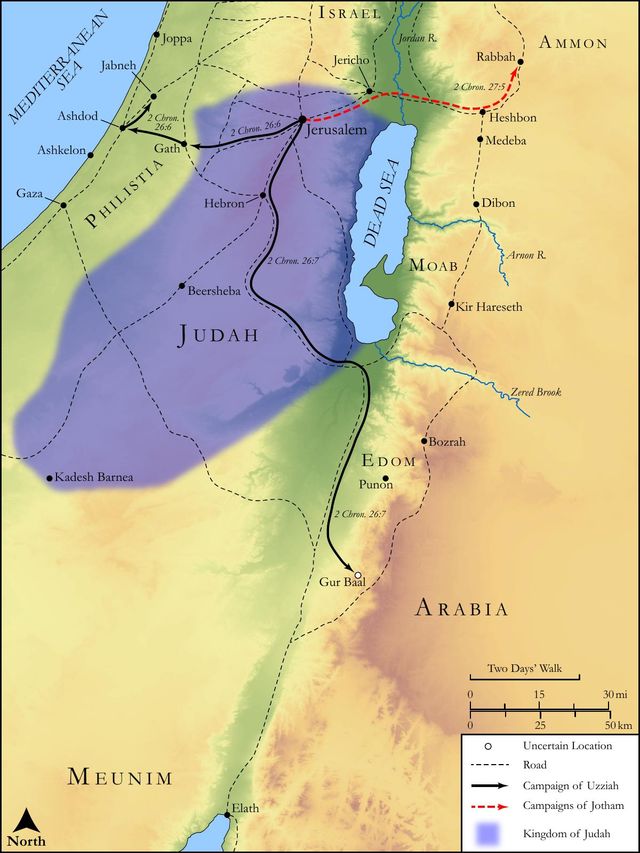
See on the biblical-era map
Study this verse
Public-domain commentary
Matthew Henry
From his Commentary on the Whole Bible. Henry comments on passages, not single verses — this entry covers 2 Chronicles 26:1–15. His three-level outline is real structure in the source text, so it is rendered as structure.
We have here an account of two things concerning Uzziah: -
I.His piety.
In this he was not very eminent or zealous; yet he did that which was right in the sight of the Lord. He kept up the pure worship of the true God as his father did, and was better than his father, inasmuch as we have no reason to think he ever worshipped idols as his father did, no, not in his latter days, when his heart was lifted up. It is said (Ch2 26:5), He sought God in the days of Zechariah, who, some think, was the son of the Zechariah whom his grandfather Joash slew. This Zechariah was one that had understanding in the visions of God, either the visions which he himself was favoured with or the visions of the preceding prophets. He was well versed in prophecy, and conversed much with the upper world, was an intelligent, devout, good man; and, it seems, had great influence with Uzziah. Happy are the great men who have such about them and are willing to be advised by them; but unhappy those who seek God only while they have such with them and have not a principle in themselves to bear them out to the end.
II.His prosperity.
1.In general, as long as he sought the Lord, and minded religion, God made him to prosper. Note,
(1.)Those only prosper whom God makes to prosper; for prosperity is his gift.
(2.)Religion and piety are very friendly to outward prosperity. Many have found and owned this, that as long as they sought the Lord and kept close to their duty they prospered; but since they forsook God every thing has gone cross.
2.Here are several particular instances of his prosperity: - (1.) His success in his wars: God helped him (Ch2 26:7), and then he triumphed over the Philistines (those old enemies of God's people), demolished the fortifications of their cities, and put garrisons of his own among them, Ch2 26:6. He obliged the Ammonites to pay him tribute, Ch2 26:8. He made all quiet about him, and kept them in awe. (2.) The greatness of his fame and reputation. His name was celebrated throughout all the neighbouring countries (Ch2 26:8) and it was a good name, a name for good things with God and good people. This is true fame, and makes a man truly honourable. (3.) His buildings. While he acted offensively abroad, he did not neglect the defence of his kingdom at home, but built towers in Jerusalem and fortified them, Ch2 26:9. Much of the wall of Jerusalem was in his father's time broken down, particularly at the corner gate. But his best fortification of Jerusalem was his close adherence to the worship of God: if his father had not forsaken this the wall of Jerusalem would not have been broken down. While he fortified the city, he did not forget the country, but built towers in the desert too (Ch2 26:10), to protect the country people from the inroads of the plunderers, bands of whom sometimes alarmed them and plundered them, as Ch2 21:16. (4.) His husbandry. He dealt much in cattle and corn, employed many hands, and got much wealth by his dealing; for he took a pleasure in it: he loved husbandry (Ch2 21:10), and probably did himself inspect his affairs in the country, which was no disparagement to him, but an advantage, as it encouraged industry among his subjects. It is an honour to the husbandman's calling that one of the most illustrious princes of the house of David followed it and loved it. He was not one of those that delight in war, nor did he addict himself to sport and pleasure, but delighted in the innocent and quiet employments of the husbandman. (5.) His standing armies. He had, as it should seem, two military establishments. [1.] A host of fighting men that were to make excursions abroad. These went out to war by bands, Ch2 21:11. They fetched in spoil from the neighbouring countries by way of reprisal for the depredations they had so often made upon Judah, [2.] Another army for guards and garrisons, that were ready to defend the country in case it should be invaded, Ch2 21:12, Ch2 21:13. So great were their number and valour that they made war with mighty power; no enemy durst face them, or, at least, could stand before them. Men unarmed can do little in war. Uzziah therefore furnished himself with a great armoury, whence his soldiers were supplied with arms offensive and defensive (Ch2 21:14), spears, bows, and slings, shields, helmets, and habergeons: swords are not mentioned, because it is probable that every man had a sword of his own, which he wore constantly. Engines were invented, in his time, for annoying besiegers with darts and stones shot from the towers and bulwarks, Ch2 21:15. What a pity it is that the wars and fightings which come from men's lusts have made it necessary for cunning men to employ their skill in inventing instruments of death.
Continue studying 2 Chronicles 26:9 across the web’s major study libraries — every link below opens this exact verse, chapter, or book on the destination site.
Read & Compare
 BibleGatewayThis verse in more than 200 translations and 70 languages.
 Bible.comThe YouVersion reader — hundreds of translations, reading plans, and highlights.
 ESV.orgCrossway's official English Standard Version reader.
 NET BibleThe NET translation with 60,000+ translators' notes on every rendering decision.
 STEP BibleTyndale House's free study tool — original text, vocabulary, and scholarly resources.
 BibliaLogos Bible Software's free web reader.
 USCCBThe New American Bible (Revised Edition) with the U.S. bishops' study notes.
Commentaries
 BibleHub CommentariesDozens of classic commentaries on this verse, gathered on one page.
 StudyLightMore than 100 commentary sets — the largest collection on the web.
 BibleRefPlain-English commentary on what this verse means, verse by verse.
 Enduring WordDavid Guzik's free commentary on this chapter, widely used by Bible teachers.
 Bible Study ToolsVerse commentary alongside Greek and Hebrew study aids.
Original Language & Research
- BibleHub InterlinearThe verse word by word — original language, transliteration, and English.
- BibleHub LexiconEvery word's original-language definition and Strong's entry.
 Blue Letter BibleDeep-study tools — Strong's numbers, concordance, and word studies.
 SefariaThe Hebrew text with Rashi and centuries of Jewish commentary.
Sermons, Hymns & Audio


TrulyRandomVerse is not affiliated with these sites and doesn’t control their content. They’re linked because they’re genuinely useful.
Summary
Second Chronicles 26:9 meticulously records King Uzziah's significant infrastructural and strategic accomplishments in Jerusalem. This verse specifically highlights his proactive construction and robust fortification of defensive towers at critical points along the city's walls, including the vulnerable Corner Gate, the strategic Valley Gate, and a key turning point. These ambitious building projects underscore Uzziah's astute leadership and Judah's flourishing prosperity during his early reign, reflecting a period of national strength and enhanced security directly attributed to divine blessing.
Context
ShowHideLiterary Context
This verse is intricately woven into the broader narrative of King Uzziah's reign, which dominates 2 Chronicles 26. The chapter commences by establishing Uzziah's youthful ascension to the throne at sixteen and the remarkable duration of his rule, fifty-2 years. Crucially, 2 Chronicles 26:5 immediately follows, declaring the foundational principle of his early success: "as long as he sought the LORD, God made him to prosper." Verses 6-8 detail his impressive military victories over the Philistines, Arabians, and Meunites, alongside the tribute received from the Ammonites. Verse 9, therefore, emerges as a natural consequence of this divinely-blessed prosperity and military prowess, demonstrating how Uzziah's stability translated into substantial infrastructural development and heightened national security for Judah's capital. The chapter's narrative arc then tragically shifts in 2 Chronicles 26:16-21, where Uzziah's hubris leads to his downfall and leprosy, providing a stark and poignant contrast to his earlier successes and underscoring the Chronicler's theological message about the consequences of disobedience.
Historical & Cultural Context
King Uzziah, also identified as Azariah in 2 Kings 15:1-7, governed Judah from approximately 792-740 BC. His long and predominantly successful reign marked a significant period of recovery and expansion for the southern kingdom following a preceding era of decline. Jerusalem, as the revered capital, was paramount to Judah's identity, religious life, and national security. The fortification of city walls was an absolute necessity for ancient Near Eastern monarchs, directly influencing a kingdom's capacity to withstand sieges and deter potential invaders. Gates were universally recognized as the most vulnerable points in any defensive perimeter, necessitating robust reinforcement. Similarly, corners or turns in the wall often created salient points that could be exploited by attackers, thereby requiring additional towers or bastions. Uzziah's extensive building projects, which also encompassed agricultural development and military innovation as described in 2 Chronicles 26:10-15, vividly illustrate the economic stability, strategic foresight, and advanced engineering capabilities characteristic of his early, divinely-favored rule.
Key Themes
ShowHideThis verse significantly contributes to several overarching themes within 2 Chronicles and the broader Deuteronomistic history. Firstly, it powerfully highlights Strategic Leadership, showcasing Uzziah's wisdom and foresight in meticulously identifying and fortifying Jerusalem's most critical defensive points, rather than engaging in indiscriminate construction. This demonstrates a king who understood military strategy and urban planning. Secondly, it underscores the theme of Prosperity and Stability, as the very ability to undertake such large-scale and resource-intensive building projects is a direct indicator of Judah's robust economic health and political tranquility under Uzziah's reign. This prosperity is explicitly and repeatedly linked to his seeking the Lord, as stated in 2 Chronicles 26:5. Thirdly, the verse emphasizes Security and Defense, as the primary purpose of these towers and fortifications was to bolster Jerusalem's protection, providing elevated positions for defenders and significantly enhancing the city's resilience against external threats. Finally, it subtly yet profoundly reinforces the Chronicler's overarching theological theme of Divine Blessing through Obedience, where Uzziah's early successes, including these impressive fortifications, are presented as a direct and tangible consequence of his devotion and faithfulness to God.
Exposition and Analysis
ShowHideKey Word Analysis
ShowHideThis primitive root signifies not merely construction but also the act of establishing or setting up, encompassing both literal building and figurative acts of creation or restoration. In this context, Uzziah's "building" implies a deliberate, foundational act of establishing and improving Jerusalem's infrastructure, reflecting a period of stability and growth. The term also carries connotations of permanence and the creation of something enduring.
Derived from a root meaning "to be great" or "to grow up," this noun refers to elevated structures distinguished by their size or height. In ancient city defense, towers served as crucial vantage points for observation, platforms for archers and slingers, and structural reinforcements for the city walls. Their construction by Uzziah signifies a significant investment in enhancing Jerusalem's defensive capabilities and projecting an image of strength.
This primitive root conveys a wide range of meanings, including to be strong, courageous, to strengthen, to repair, or to fasten upon. Here, it specifically denotes the act of making the structures robust and secure against attack. Uzziah not only built new towers but also actively "fortified" them, indicating a comprehensive approach to defense that ensured these structures were not merely erected but rendered resilient and capable of withstanding siege, thereby enhancing the city's overall security.
Verse Breakdown
ShowHide"Moreover Uzziah built towers in Jerusalem"
This opening clause immediately establishes King Uzziah as the central figure and proactive agent, highlighting his initiative in undertaking substantial construction projects within the capital city. The plural "towers" signifies a significant investment in defensive infrastructure, reflecting a period of national strength, abundant resources, and strategic foresight under his reign.
"at the corner gate, and at the valley gate, and at the turning [of the wall]"
This detailed enumeration specifies the precise and highly strategic locations of Uzziah's building efforts. The "corner gate" (likely the Corner Gate on the northwest side) and the "valley gate" (probably the Valley Gate on the west or southwest, leading into the Hinnom Valley) were known entry points and inherently vulnerable. The "turning [of the wall]" (Hebrew maqtsôwaʻ) refers to a critical angle, projection, or salient point in the city wall, often a natural weak spot susceptible to concentrated attack. This precision underscores Uzziah's strategic acumen and thoroughness in identifying and addressing Jerusalem's most critical and exposed defensive points.
"and fortified them"
This concluding phrase emphasizes not merely the construction of new towers but also their subsequent strengthening and reinforcement. It implies a comprehensive and meticulous approach to defense, ensuring that these newly built structures were robust, resilient, and fully capable of withstanding prolonged assault. This act of "fortifying" underscores Uzziah's commitment to maximizing Jerusalem's impregnability and enhancing the overall security of the city.
Literary Devices
ShowHideThe verse primarily employs Enumeration and Specificity to underscore the thoroughness and strategic nature of Uzziah's extensive building program. By meticulously listing the "corner gate," the "valley gate," and the "turning [of the wall]," the Chronicler highlights that Uzziah's efforts were not haphazard or merely decorative, but precisely targeted at Jerusalem's most critical and vulnerable defensive points, thereby emphasizing his exceptional foresight and competence as a ruler. This detailed listing also functions as a form of Emphasis, drawing the reader's attention to the significant scale, precision, and strategic importance of these architectural achievements. Furthermore, the very act of "building towers" and "fortifying them" serves as a powerful Symbolism of strength, security, and the profound prosperity that characterized Uzziah's early reign, a prosperity explicitly and repeatedly linked by the Chronicler to his obedience and devotion to God.
Theological and Thematic Connections
ShowHideThis verse, while describing tangible physical fortifications, carries profound and enduring theological implications. Uzziah's remarkable ability to undertake such massive, strategic, and resource-intensive building projects was a direct and undeniable result of God's blessing upon his early reign. As explicitly stated in 2 Chronicles 26:5, "as long as he sought the LORD, God made him to prosper." This narrative powerfully illustrates the principle that divine favor often enables human flourishing and the successful execution of significant endeavors, particularly those that contribute to the well-being, security, and stability of God's people. The fortifications of Jerusalem can thus be seen as a tangible expression of God's protective hand over His chosen city and people, mediated through the faithful leadership of a king who, at least initially, walked in obedience.
Reflection and Application
ShowHideKing Uzziah's diligent and strategic efforts to fortify Jerusalem offer timeless principles for our own lives, both individually and communally. Just as he meticulously identified and strengthened the vulnerable points of the city, we are called to proactively assess and reinforce the "walls" of our spiritual, emotional, relational, and even physical well-being. This involves investing in foundational strengths during times of peace and prosperity, rather than passively waiting for crises to expose weaknesses. It speaks to the profound importance of proactive preparation through consistent spiritual disciplines, cultivating strong and healthy relationships, and wise stewardship of all the resources God has entrusted to us. We must courageously identify our "corner gates" and "valley gates"—those areas where we are most susceptible to temptation, attack, or decay—and intentionally fortify them with God's wisdom, His Word, and the empowering strength of His Spirit. Uzziah's early success, rooted in his seeking the Lord, serves as a powerful reminder that true security, lasting achievement, and genuine prosperity are ultimately dependent on divine blessing and our humble alignment with God's perfect will.
Questions for Reflection
ShowHideFAQ
ShowHideWhat was the significance of Uzziah building towers at specific locations like the "corner gate" and "valley gate"?
ShowHideThe specific mention of the "corner gate," "valley gate," and "turning [of the wall]" in 2 Chronicles 26:9 highlights King Uzziah's exceptional strategic genius and thoroughness in defense planning. In ancient cities, gates were universally recognized as the weakest points in a wall, as they provided necessary access but also potential entry for invaders. Fortifying them with towers provided elevated platforms for defenders, allowing them to rain down arrows or stones on attackers, and also served as strongpoints to control access. Similarly, corners or significant turns in the wall (the "turning of the wall" or Hebrew ham-miqṣo‘a‘) were often vulnerable salients that could be exploited by an enemy seeking to breach the defenses. By meticulously reinforcing these particular locations, Uzziah demonstrated a sophisticated understanding of military architecture and a profound commitment to making Jerusalem as impregnable as possible, reflecting a strong, well-resourced, and strategically led kingdom under his early rule.
How does Uzziah's later life impact the understanding of his building achievements?
ShowHideWhile 2 Chronicles 26:9 celebrates Uzziah's impressive building achievements and military successes, the broader narrative of 2 Chronicles 26 serves as a profound cautionary tale. Verse 5 explicitly states that "as long as he sought the LORD, God made him to prosper," establishing the divine source of his early flourishing. However, 2 Chronicles 26:16 reveals the tragic turning point: "But when he was strong, his heart was lifted up to his destruction." Uzziah's pride led him to usurp the sacred priestly function of burning incense in the temple, an act for which he was immediately struck with leprosy and remained isolated until his death. This tragic end underscores a crucial theological message: even remarkable human achievements, divinely enabled, can be overshadowed and ultimately undone by pride, disobedience, and a departure from humble reliance on God. His early success in building and fortifying Jerusalem was a direct result of God's blessing on his obedience, making his later fall a poignant reminder of the fleeting nature of human glory and security when divorced from a humble and obedient relationship with the Almighty.
Christ-Centered Fulfillment
ShowHideWhile 2 Chronicles 26:9 describes the physical fortifications of an earthly city, it points to a deeper, eternal spiritual reality fully realized in Christ. Just as King Uzziah meticulously built towers to secure Jerusalem, Jesus Christ is the ultimate "strong tower" and "fortress" for His people, a truth powerfully echoed in Proverbs 18:10 and Psalm 91:2. In Him, believers find complete and unwavering security, an impenetrable defense against spiritual adversaries, and refuge from the storms of life. The physical walls of Jerusalem, designed to protect its inhabitants from external threats, foreshadow the spiritual protection and eternal security offered through Christ's atoning work on the cross. His sacrifice not only breaks down the "dividing wall of hostility" between God and humanity, and between Jew and Gentile (Ephesians 2:14), but also builds up a new, living spiritual temple—the Church—with Christ Himself as the foundational cornerstone (Ephesians 2:20-22). Ultimately, the glorious vision of the New Jerusalem in Revelation 21 reveals a city that needs no physical walls or gates for defense, for "the glory of God gives it light, and the Lamb is its lamp" (Revelation 21:23), signifying that in Christ, our security is not in human fortifications or earthly might, but in the very presence, power, and eternal light of God Himself.