


2 Kings 14:13
- וְאֵתve·'Etand <obj.>H853Conj-w ¦ DirObjMParticle Object Indicatorוְandאֵת<obj.>
- אֲמַצְיָהוּ'a·matz·Ya·huAmaziahH558N-proper-mNoun Proper Masculine
- מֶלֶךְMe·lekh[the] king ofH4428N-mscNoun Singular Masculine Construct
- יְהוּדָהye·hu·DahJudahH3063N-properNoun Proper Location
- בֶּןben[the] son ofH1121N-mscNoun Singular Masculine Construct
- יְהוֹאָשׁye·ho·'AshJehoashH3060N-proper-mNoun Proper Masculine
- בֶּןben[the] son ofH1121N-mscNoun Singular Masculine Construct
- אֲחַזְיָהוּ'a·chaz·Ya·huAhaziahH274N-proper-mNoun Proper Masculine
- תָּפַשׂta·Fashe seizedH8610V-Qal-Perf-3msVerb Qal Perfect 3rd Singular Masculine
- יְהוֹאָשׁye·ho·'AshJehoashH3060N-proper-mNoun Proper Masculine
- מֶלֶךְMe·lekh[the] king ofH4428N-mscNoun Singular Masculine Construct
- יִשְׂרָאֵלYis·ra·'ElIsraelH3478N-properNoun Proper Location
- בְּבֵיתbe·Veitat BethH1053Prep-b ¦ N-properNoun Proper LocationבְּatבֵיתBeth
- שָׁמֶשׁSha·meshShemeshH1053N-properNoun Proper Location
- וַיָּבֹאvai·ya·vo·'u'and he cameH935Conj-w ¦ V-Qal-ConsecImperf-3msVerb Qal Consecutive Imperfect 3rd Singular Masculineוַandיָּבֹאhe came
- יְרוּשָׁלִַםye·Ru·sha·LimJerusalemH3389N-properNoun Proper Location
- וַיִּפְרֹץvai·yif·Rotzand he made a breachH6555Conj-w ¦ V-Qal-ConsecImperf-3msVerb Qal Consecutive Imperfect 3rd Singular Masculineוַandיִּפְרֹץhe made a breach
- בְּחוֹמַתbe·cho·Matin [the] wall ofH2346Prep-b ¦ N-fscNoun Singular Feminine Constructבְּinחוֹמַת[the] wall of
- יְרוּשָׁלִַםye·ru·sha·LimJerusalemH3389N-properNoun Proper Location
- בְּשַׁעַרbe·Sha·'arat [the] gate ofH8179Prep-b ¦ N-mscNoun Singular Masculine Constructבְּatשַׁעַר[the] gate of
- אֶפְרַיִם'ef·Ra·yimEphraimH669N-proper-mNoun Proper Masculine
- עַד'adtoH5704PrepPreposition
- שַׁעַרSha·'ar[the] gate ofH8179N-mscNoun Singular Masculine Construct
- הַפִּנָּהha·pi·Nahthe cornerH6438Art ¦ N-fsNoun Singular Feminine Absoluteהַtheפִּנָּהcorner
- אַרְבַּע'ar·Ba'fourH702N-cscNoun Singular common gender Construct
- מֵאוֹתme·'othundred<s>H3967N-fpNoun Plural Feminine Absolute
- אַמָּה'a·Mahcubit[s]H520N-fsNoun Singular Feminine Absolute
English is a literal word-by-word gloss of the Hebrew, not the KJV's wording. Why?
This is the original text the KJV's translators worked from — each Hebrew word with its own literal English meaning in this verse, prepared by scholars at Tyndale House, Cambridge. The KJV translates whole sentences, not word by word, so its wording differs: one Hebrew word can become several English words, and the KJV may choose “the LORD” where the gloss reads “Yahweh”. Both are faithful — they answer different questions. For the KJV's own rendering, switch to the KJV text.
Details
See on the biblical-era map
Study this verse
Public-domain commentary
Matthew Henry
From his Commentary on the Whole Bible. Henry comments on passages, not single verses — this entry covers 2 Kings 14:8–14. His two-level outline is real structure in the source text, so it is rendered as structure.
For several successions after the division of the kingdoms that of Judah suffered much by the enmity of Israel. After Asa's time, for several successions, it suffered more by the friendship of Israel, and by the alliance and affinity made with them. But now we meet with hostility between them again, which had not been for some ages before.
I.Amaziah, upon no provocation, and without showing any cause of quarrel, challenged Joash into the field (Kg2 14:8):
"Come, let us look one another in the face; let us try our strength in battle." Had he challenged him to a personal duel only, the error would have remained with himself, but each must bring all their forces into the field, and thousands of lives on both sides must be sacrificed to his capricious humour. Hereby he showed himself proud, presumptuous, and prodigal of blood. Some think that he intended to avenge the injury which the dismissed disgusted Israelites had lately done to his country, in their return (Ch2 25:13), and that he had also the vanity to think of subduing the kingdom of Israel, and reuniting it to Judah. A fool's lips thus enter into contention, and his mouth calleth for strokes. Those that challenge are chargeable with that beginning of strife, which is as the letting forth of water. He that is eager either to fight or to go to law may perhaps have enough of it quickly, and be the first that repents it.
II.Joash sent him a grave rebuke for his challenge, with advice to withdraw it, Kg2 14:9, Kg2 14:10.
1.He mortifies his pride, by comparing himself to a cedar, a stately tree, and Amaziah to a thistle, a sorry weed, telling him he was so far from fearing him that he despised him, and scorned as much to have any thing to do with him, or make any alliance with him, as the cedar would to match his daughter to a thistle. The ancient house of David he thinks not worthy to be named the same day with the house of Jehu, though an upstart. How may a humble man smile to hear two proud and scornful men set their wits on work to vilify and undervalue one another!
2.He foretels his fall: A wild beast trode down the thistle, and so put an end to his treaty with the cedar; so easily does Joash think his forces can crush Amaziah, and so unable does he think him to make any resistance.
3.He shows him the folly of his challenge: "Thou hast indeed smitten Edom, a weak, unarmed, undisciplined body of men, and therefore thinkest thou canst carry all before thee and subdue the regular forces of Israel with as much ease. Thy heart has lifted thee up." See where the root of all sin lies; it is in the heart, thence it flows, and that must bear the blame. It is not Providence, the event, the occasion (whatever it is), that makes men proud, or secure, or discontented, or the like, but it is their own heart that does it. "Thou art proud of the blow thou hast given to Edom, as if that had made thee formidable to all mankind." Those wretchedly deceive themselves that magnify their own performances, and, because they have been blessed with some little success and reputation, conclude themselves fit for any thing and no less sure of it.
4.He counsels him to be content with the honour he has won, and not to hazard that, by grasping at more that was out of his reach: Why shouldst thou meddle to thy hurt, as fools often do, that will be meddling? Pro 20:3. Many would have had wealth and honour enough if they had but known when they had enough. He warns him of the consequence, that it would be fatal not to himself only, but to his kingdom, which he ought to protect.
III.Amaziah persisted in his resolution, and the issue was bad; he had better have tarried at home, for Joash gave him such a look in the face as put him to confusion. Challengers commonly prove to be on the losing side.
1.His army was routed and dispersed, Kg2 14:12. Josephus says, When they were to engage they were struck with such terror that they did not strike a stroke, but every one made the best of his way.
2.He himself was taken prisoner by the king of Israel, and then had enough of looking him in the face. Amaziah's pedigree comes in here somewhat abruptly (the son of Joash, the son of Ahaziah), because perhaps he had gloried in the dignity of his ancestors, or because he now smarted for their iniquity.
3.The conqueror entered Jerusalem, which tamely opened to him, and yet he broke down their wall (and, as Josephus says, drove his chariot in triumph through the breach), in reproach to them, and that he might, when he pleased, take possession of the royal city.
4.He plundered Jerusalem, took away all that was valuable, and returned to Samaria, laden with spoils, Kg2 14:14. It was said of Joash that he did that which was evil in the sight of the Lord, and of Amaziah that he did that which was right; and yet Joash triumphs thus over Amaziah, and why so? Because God would show, in Amaziah's fate, that he resists the proud, or because, whatever they were otherwise, Joash had lately been respectful to one of God's prophets (Kg2 13:14), but Amaziah had been abusive to another (Ch2 25:16), and God will honour those who honour him in his prophets, but those who despise them, and him in them, shall be lightly esteemed.
Continue studying 2 Kings 14:13 across the web’s major study libraries — every link below opens this exact verse, chapter, or book on the destination site.
Read & Compare
 BibleGatewayThis verse in more than 200 translations and 70 languages.
 Bible.comThe YouVersion reader — hundreds of translations, reading plans, and highlights.
 ESV.orgCrossway's official English Standard Version reader.
 NET BibleThe NET translation with 60,000+ translators' notes on every rendering decision.
 STEP BibleTyndale House's free study tool — original text, vocabulary, and scholarly resources.
 BibliaLogos Bible Software's free web reader.
 USCCBThe New American Bible (Revised Edition) with the U.S. bishops' study notes.
Commentaries
 BibleHub CommentariesDozens of classic commentaries on this verse, gathered on one page.
 StudyLightMore than 100 commentary sets — the largest collection on the web.
 BibleRefPlain-English commentary on what this verse means, verse by verse.
 Enduring WordDavid Guzik's free commentary on this chapter, widely used by Bible teachers.
 Bible Study ToolsVerse commentary alongside Greek and Hebrew study aids.
Original Language & Research
- BibleHub InterlinearThe verse word by word — original language, transliteration, and English.
- BibleHub LexiconEvery word's original-language definition and Strong's entry.
 Blue Letter BibleDeep-study tools — Strong's numbers, concordance, and word studies.
 SefariaThe Hebrew text with Rashi and centuries of Jewish commentary.
Sermons, Hymns & Audio


TrulyRandomVerse is not affiliated with these sites and doesn’t control their content. They’re linked because they’re genuinely useful.
Summary
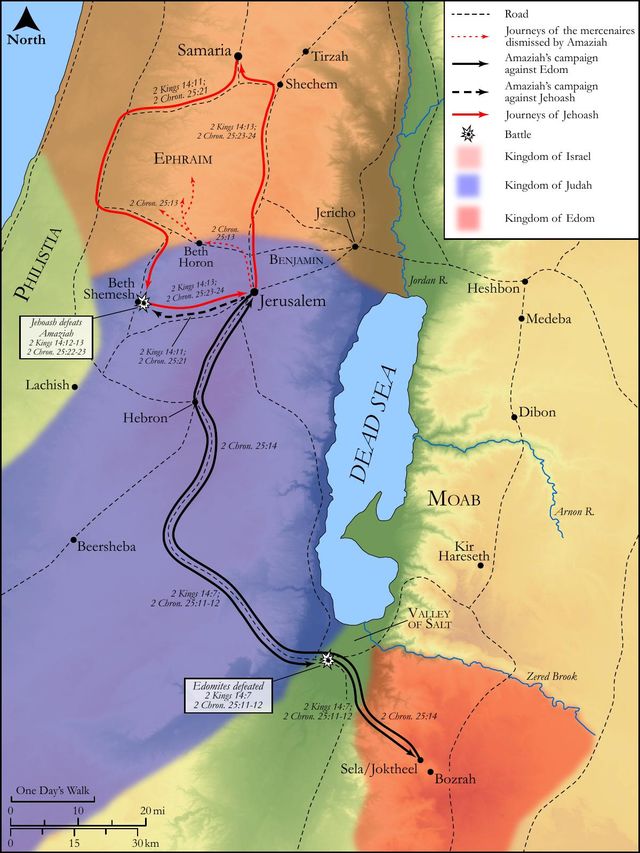
Second Kings 14:13 records the devastating culmination of King Amaziah of Judah's ill-advised war against King Jehoash of Israel, detailing Amaziah's capture at Bethshemesh and Jehoash's triumphant entry into Jerusalem. This verse vividly portrays the subsequent humiliation inflicted upon Judah's capital, as Jehoash strategically demolished a significant portion of its formidable walls, a stark and enduring symbol of Israel's dominance and Judah's profound vulnerability.
Context
ShowHideLiterary Context
This verse immediately follows the account of the decisive battle between Judah and Israel at Bethshemesh, where King Amaziah's forces were completely routed, and he himself was captured by King Jehoash (2 Kings 14:11-12). The narrative arc leading to this humiliation begins with Amaziah's arrogant challenge to Jehoash, fueled by his recent victory over Edom (2 Kings 14:8). Jehoash's dismissive yet prophetic parable, warning Amaziah against his pride, sets the stage for the inevitable downfall (2 Kings 14:9-10). The broader narrative in 2 Kings 14 consistently links Amaziah's initial success against Edom (2 Kings 14:7) to his subsequent pride and idolatry, which, as elaborated in the parallel account in 2 Chronicles 25:14-16, directly led to the catastrophic defeat at Bethshemesh and the subsequent desecration of Jerusalem's defenses.
Historical & Cultural Context
The period of the divided monarchy, following the split of Israel after Solomon's reign, was frequently marked by internecine conflict between the Northern Kingdom of Israel and the Southern Kingdom of Judah, despite their shared ancestry and covenantal heritage. Jerusalem, as the capital of Judah and the revered site of the Temple, possessed immense religious, political, and symbolic significance. Its walls were not merely physical defenses but potent symbols of its security, divine protection, and national identity. The act of "breaking down the wall" was far more than a military maneuver; it was a profound act of subjugation, humiliation, and a clear demonstration of absolute dominance over the defeated city. The "Gate of Ephraim" and the "Corner Gate" were critical points along Jerusalem's northern wall, a historically vulnerable sector, making the 400-cubit (approximately 600 feet or 180 meters) breach a substantial, strategically important, and deeply insulting act of destruction.
Key Themes
ShowHideThis verse powerfully illustrates several recurring themes prevalent within the books of Kings and the broader biblical narrative. Firstly, it underscores the severe consequences of pride and arrogance, particularly in leadership. Amaziah's overconfidence, inflated by his victory over Edom, directly precipitated his humiliating defeat and the suffering of his kingdom. Secondly, it highlights the destructive nature of inter-kingdom strife between Israel and Judah, demonstrating how internal divisions weakened both nations and left them vulnerable to external threats and internal decay. Thirdly, the breaching of Jerusalem's walls emphasizes the profound vulnerability of human defenses and the temporary nature of earthly security, particularly when divine favor is withdrawn due to unfaithfulness or disobedience. Finally, when read in conjunction with the parallel account in 2 Chronicles 25:20, this event serves as a clear and sobering example of divine discipline and judgment against a king who turned away from the Lord.
Exposition and Analysis
ShowHideKey Word Analysis
ShowHideDerived from the Hebrew words for "house" and "sun," meaning "house of (the) sun," this city was strategically located in the Shephelah, a border region between Judah and Philistia. While its name might allude to ancient sun worship practices, by this period, it primarily functioned as a significant geographical marker. Its designation as the site of the decisive battle makes Bethshemesh synonymous with Judah's catastrophic defeat and Amaziah's capture, marking the pivotal moment of Jerusalem's subsequent subjugation.
This primitive root verb signifies "to break out," "to burst forth," or "to make a breach." In this context, it conveys a forceful, destructive action, indicating not merely a minor opening but a significant, deliberate demolition of the wall. The use of pârats emphasizes the complete and intentional nature of Jehoash's act, designed to assert dominance, humiliate Judah, and leave Jerusalem exposed and vulnerable, fulfilling the idea of "breaking out" of the city's defenses.
This feminine active participle, meaning "a wall of protection," refers to the fortified defensive structure of a city. The term emphasizes the protective function of the wall. Its destruction, as described in this verse, therefore represents the direct removal of Jerusalem's primary means of defense and, by extension, the stripping away of its security and perceived invincibility. The breaking of the chôwmâh was a direct assault on the city's very identity and safety.
Verse Breakdown
ShowHide"And Jehoash king of Israel took Amaziah king of Judah, the son of Jehoash the son of Ahaziah, at Bethshemesh"
This opening clause immediately establishes the dramatic reversal of fortunes, identifying the triumphant victor (Jehoash of Israel) and the utterly vanquished (Amaziah of Judah). Amaziah's capture by the king of the rival northern kingdom at Bethshemesh, the very site of the battle, signifies a complete and utter defeat, stripping him of his royal dignity and rendering him a prisoner of war. The detailed lineage provided for Amaziah (son of Jehoash, son of Ahaziah) serves to precisely identify him and perhaps underscore the historical continuity of the Davidic line, now brought low in a moment of profound humiliation.
"and came to Jerusalem"
Following the capture of the king, Jehoash's march on Jerusalem was a logical and expected next step for a victorious monarch seeking to consolidate his triumph and assert full authority. This move was not merely about occupying the city but about demonstrating his power and the extent of Judah's defeat over its capital. It sets the stage for the ultimate act of desecration and public humiliation, solidifying his dominance.
"and brake down the wall of Jerusalem from the gate of Ephraim unto the corner gate, four hundred cubits."
This final clause details the specific act of desecration and humiliation inflicted upon the capital. The demolition of a significant section of Jerusalem's wall, spanning 400 cubits (approximately 600 feet) between two key gates (the Gate of Ephraim and the Corner Gate), was a calculated act to dismantle the city's defenses and symbolize Judah's broken power. It left the capital vulnerable and served as a lasting, visible monument to Jehoash's victory and Amaziah's folly, a permanent scar on the city's fortifications and a testament to its subjugation.
Literary Devices
ShowHideThe narrative of 2 Kings 14:13 employs several potent literary devices to convey its message. Irony is profoundly evident, as Amaziah, initially victorious and emboldened by divine help against Edom, succumbs to pride and challenges a rival, only to be utterly defeated and humiliated. His overconfidence, rather than leading to further glory, precipitates his downfall, a classic biblical theme illustrating the dangers of hubris. The act of "breaking down the wall" functions as powerful Symbolism, representing not just a physical breach but the shattering of Judah's security, its national prestige, and its perceived divine protection, all direct consequences of Amaziah's unfaithfulness and pride. This event also serves as a subtle Foreshadowing of future destructions of Jerusalem, particularly the Babylonian exile, where the city's walls would again be breached, signaling a more profound and comprehensive judgment upon the kingdom. The inclusion of precise geographical details and measurements (Bethshemesh, Gate of Ephraim, Corner Gate, four hundred cubits) lends a strong sense of historical veracity and emphasizes the tangible, devastating impact of this event.
Theological and Thematic Connections
ShowHideThe humiliation of Amaziah and the breaching of Jerusalem's walls in 2 Kings 14:13 resonate deeply with broader theological themes concerning divine sovereignty, the pervasive consequences of pride, and the true nature of security. This event serves as a stark reminder that human strength, military prowess, or even past successes are no guarantee of future favor or protection when a leader or nation deviates from God's will. Amaziah's defeat underscores the biblical principle that God often uses seemingly lesser powers (Israel, in this case) as instruments to humble the proud and execute His righteous judgment. The vulnerability of Jerusalem's physical defenses, despite its status as the "City of God" and the dwelling place of the Temple, powerfully highlights that true security and lasting protection lie not in human fortifications or military might, but in faithful obedience and unwavering reliance upon the Lord.
Reflection and Application
ShowHideThe narrative of Amaziah's downfall and Jerusalem's humiliation in 2 Kings 14:13 provides a timeless and potent cautionary tale for individuals and communities alike. It compels us to deeply examine the true sources of our confidence and the underlying motivations behind our actions. Amaziah's initial success against Edom, rather than fostering humility and gratitude, tragically inflated his pride, leading him to challenge a rival with whom he had no legitimate quarrel. This serves as a powerful reminder that achievements, wealth, power, or even spiritual successes can become dangerous snares if they lead us away from humble dependence on God and into self-reliance, arrogance, or a false sense of invincibility. True wisdom involves discerning God's will, heeding wise counsel (even when it comes from unexpected or seemingly "weaker" sources), and recognizing that our ultimate security and strength come from Him alone, not from our own might or the perceived impregnability of our "walls." The vulnerability of Jerusalem's physical defenses, despite its profound spiritual significance, teaches us that no earthly protection is absolute, and our ultimate trust must be placed in the Lord, who alone is our true refuge, strength, and unwavering defense.
Questions for Reflection
ShowHideFAQ
ShowHideWhy did Amaziah challenge Jehoash, and what was the significance of the battle at Bethshemesh?
ShowHideAmaziah, having recently achieved a decisive victory over Edom (2 Kings 14:7), became arrogant and overconfident, believing his success was due to his own strength rather than divine favor. He initiated the challenge to Jehoash, king of Israel, perhaps seeking to reassert Judah's dominance over the northern kingdom, to avenge past grievances, or simply out of pride. The battle at Bethshemesh was highly significant because it resulted in a catastrophic defeat for Judah, with Amaziah himself being captured (2 Kings 14:12). This outcome was widely understood as divine judgment for Amaziah's pride and his turning to idolatry after his Edomite victory, as explicitly stated in the parallel account in 2 Chronicles 25:14-16.
What was the symbolic and practical significance of Jehoash breaking down Jerusalem's wall?
ShowHideThe act of breaking down Jerusalem's wall was profoundly significant on multiple levels, both practical and symbolic. Practically, it severely compromised the city's defenses, rendering it vulnerable to future attacks and unequivocally demonstrating Israel's military superiority. Symbolically, it was an act of extreme humiliation for Judah and its capital. Jerusalem's walls represented its strength, security, and the perceived divine protection it enjoyed. Their breach signified the breaking of Judah's power, a visible sign of God's displeasure and judgment upon Amaziah and his kingdom. It asserted Jehoash's absolute dominance and left a lasting, physical scar on the city's fortifications, serving as a constant reminder of Judah's defeat and subjugation.
Christ-Centered Fulfillment
ShowHideThe narrative of Amaziah's pride-driven downfall and the breaching of Jerusalem's walls in 2 Kings 14:13, while a somber account of human folly and divine discipline, ultimately points us to the perfect kingship and redemptive work of Jesus Christ. Amaziah, a king of the Davidic line, failed to secure his kingdom, his pride leading to its humiliation and vulnerability. In stark contrast, Jesus, the true Son of David and the King of Kings, perfectly embodies humility and obedience, even to the point of death on a cross (Philippians 2:8). While Jerusalem's physical walls were broken, foreshadowing its eventual destruction, Christ came to break down far more significant spiritual walls—the wall of hostility between Jew and Gentile, creating one new humanity (Ephesians 2:14), and the barrier of sin that separates humanity from God, by canceling the record of debt that stood against us (Colossians 2:14). Unlike Amaziah, whose reign ended in defeat and disgrace, Jesus's reign is eternal, establishing a kingdom that cannot be shaken, a spiritual reality that transcends earthly fortifications (Hebrews 12:28). He is the foundation of the New Jerusalem, whose walls are salvation and gates are praise, a city whose security rests not on human fortifications but on the glorious presence of God Himself and the Lamb (Revelation 21:23-25). Thus, Amaziah's broken walls serve as a powerful backdrop, highlighting the ultimate and eternal security found only in Christ, who perfectly fulfills the promise of a King who builds up, rather than breaks down, His people, offering an everlasting peace that no earthly power can breach.