


2 Kings 14:9
Bible text: King James Version (1769 Blayney text) · Public domain
Bible text: King James Version with Strong's numbers · Public domain
Bible text: Berean Standard Bible · Public domain
Bible text: American Standard Version (1901) · Public domain
Bible text: World English Bible, Messianic edition · Public domain
Bible text: Geneva Bible (1599) · Public domain
Bible text: Young's Literal Translation · Public domain
- וַיִּשְׁלַחvai·yish·Lachand he sentH7971Conj-w ¦ V-Qal-ConsecImperf-3msVerb Qal Consecutive Imperfect 3rd Singular Masculineוַandיִּשְׁלַחhe sent
- יְהוֹאָשׁye·ho·'AshJehoashH3060N-proper-mNoun Proper Masculine
- מֶלֶךְMe·lekh[the] king ofH4428N-mscNoun Singular Masculine Construct
- יִשְׂרָאֵלYis·ra·'ElIsraelH3478N-properNoun Proper Location
- אֶל'eltoH413PrepPreposition
- אֲמַצְיָהוּ'a·matz·Ya·huAmaziahH558N-proper-mNoun Proper Masculine
- מֶלֶךְMe·lekh[the] king ofH4428N-mscNoun Singular Masculine Construct
- יְהוּדָהye·hu·DahJudahH3063N-properNoun Proper Location
- לֵאמֹרle·Mor<to> sayingH559Prep-l ¦ V-Qal-InfVerb Qal Infinitive Constructלֵ<to>אמֹרsaying
- הַחוֹחַha·Cho·ach<the> thornbushH2336Art ¦ N-msNoun Singular Masculine Absoluteהַ<the>חוֹחַthornbush
- אֲשֶׁר'a·SherwhichH834RelParticle Relative
- בַּלְּבָנוֹןba·le·va·Non[was] in <the> LebanonH3844Prep-b ¦ N-properNoun Proper Locationבַּ[was] in <the>לְּבָנוֹןLebanon
- שָׁלַחSha·lachit sentH7971V-Qal-Perf-3msVerb Qal Perfect 3rd Singular Masculine
- אֶל'eltoH413PrepPreposition
- הָאֶרֶזha·'E·rez<the> cedarH730Art ¦ N-msNoun Singular Masculine Absoluteהָ<the>אֶרֶזcedar
- אֲשֶׁר'a·SherwhichH834RelParticle Relative
- בַּלְּבָנוֹןba·le·va·nOn[was] in <the> LebanonH3844Prep-b ¦ N-properNoun Proper Locationבַּ[was] in <the>לְּבָנוֹןLebanon
- לֵאמֹרle·Mor<to> sayingH559Prep-l ¦ V-Qal-InfVerb Qal Infinitive Constructלֵ<to>אמֹרsaying
- תְּנָהte·nahgive !H5414V-Qal-Imp-2ms ¦ SfxVerb Qal Imperative 2nd Singular Masculineתְּנָgiveה!
- אֶת'et<obj.>H853DirObjMParticle Object Indicator
- בִּתְּךָbi·te·Khayour daughterH1323N-fsc ¦ 2msNoun Singular Feminine Constructבִּתְּdaughterךָyour
- לִבְנִיliv·Nito my sonH1121Prep-l ¦ N-msc ¦ 1csNoun Singular Masculine Constructלִtoבְנִsonיmy
- לְאִשָּׁהle·'i·Shahto a wifeH802Prep-l ¦ N-fsNoun Singular Feminine Absoluteלְtoאִשָּׁהa wife
- וַתַּעֲבֹרva·ta·'a·Vorand it passed byH5674Conj-w ¦ V-Qal-ConsecImperf-3fsVerb Qal Consecutive Imperfect 3rd Singular Feminineוַandתַּעֲבֹרit passed by
- חַיַּתchai·Yat[the] animal ofH2416N-fscNoun Singular Feminine Construct
- הַשָּׂדֶהha·sa·Dehthe fieldH7704Art ¦ N-msNoun Singular Masculine Absoluteהַtheשָּׂדֶהfield
- אֲשֶׁר'a·SherwhichH834RelParticle Relative
- בַּלְּבָנוֹןba·le·va·Non[was] in <the> LebanonH3844Prep-b ¦ N-properNoun Proper Locationבַּ[was] in <the>לְּבָנוֹןLebanon
- וַתִּרְמֹסva·tir·Mosand it trampledH7429Conj-w ¦ V-Qal-ConsecImperf-3fsVerb Qal Consecutive Imperfect 3rd Singular Feminineוַandתִּרְמֹסit trampled
- אֶת'et<obj.>H853DirObjMParticle Object Indicator
- הַחוֹחַha·Cho·achthe thornbushH2336Art ¦ N-msNoun Singular Masculine Absoluteהַtheחוֹחַthornbush
English is a literal word-by-word gloss of the Hebrew, not the KJV's wording. Why?
This is the original text the KJV's translators worked from — each Hebrew word with its own literal English meaning in this verse, prepared by scholars at Tyndale House, Cambridge. The KJV translates whole sentences, not word by word, so its wording differs: one Hebrew word can become several English words, and the KJV may choose “the LORD” where the gloss reads “Yahweh”. Both are faithful — they answer different questions. For the KJV's own rendering, switch to the KJV text.
Details
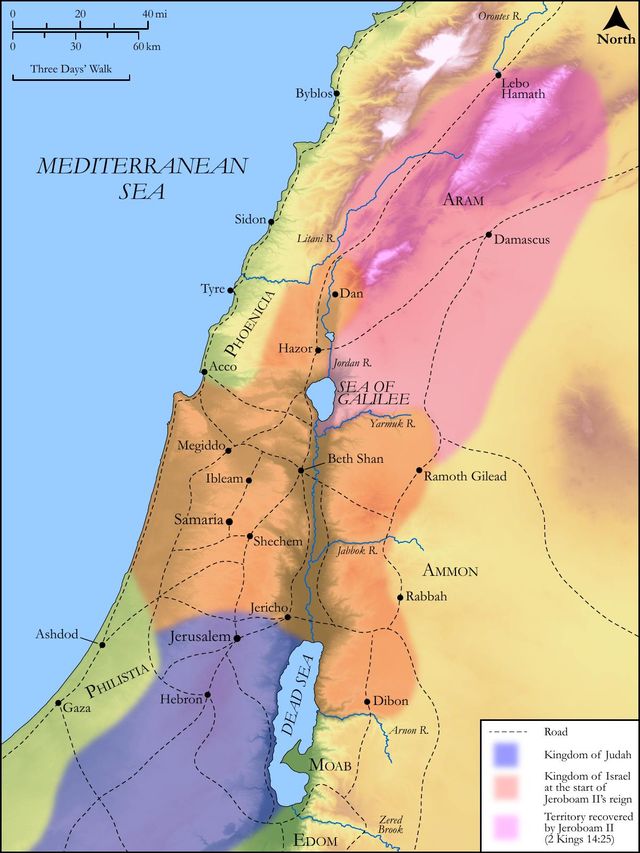
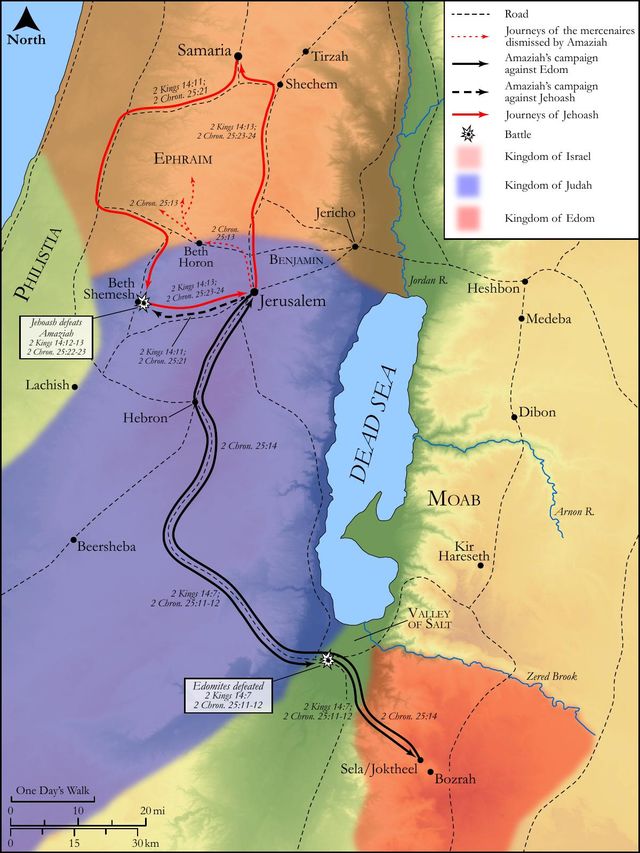
See on the biblical-era maps
Study this verse
Public-domain commentary
Matthew Henry
From his Commentary on the Whole Bible. Henry comments on passages, not single verses — this entry covers 2 Kings 14:8–14. His two-level outline is real structure in the source text, so it is rendered as structure.
For several successions after the division of the kingdoms that of Judah suffered much by the enmity of Israel. After Asa's time, for several successions, it suffered more by the friendship of Israel, and by the alliance and affinity made with them. But now we meet with hostility between them again, which had not been for some ages before.
I.Amaziah, upon no provocation, and without showing any cause of quarrel, challenged Joash into the field (Kg2 14:8):
"Come, let us look one another in the face; let us try our strength in battle." Had he challenged him to a personal duel only, the error would have remained with himself, but each must bring all their forces into the field, and thousands of lives on both sides must be sacrificed to his capricious humour. Hereby he showed himself proud, presumptuous, and prodigal of blood. Some think that he intended to avenge the injury which the dismissed disgusted Israelites had lately done to his country, in their return (Ch2 25:13), and that he had also the vanity to think of subduing the kingdom of Israel, and reuniting it to Judah. A fool's lips thus enter into contention, and his mouth calleth for strokes. Those that challenge are chargeable with that beginning of strife, which is as the letting forth of water. He that is eager either to fight or to go to law may perhaps have enough of it quickly, and be the first that repents it.
II.Joash sent him a grave rebuke for his challenge, with advice to withdraw it, Kg2 14:9, Kg2 14:10.
1.He mortifies his pride, by comparing himself to a cedar, a stately tree, and Amaziah to a thistle, a sorry weed, telling him he was so far from fearing him that he despised him, and scorned as much to have any thing to do with him, or make any alliance with him, as the cedar would to match his daughter to a thistle. The ancient house of David he thinks not worthy to be named the same day with the house of Jehu, though an upstart. How may a humble man smile to hear two proud and scornful men set their wits on work to vilify and undervalue one another!
2.He foretels his fall: A wild beast trode down the thistle, and so put an end to his treaty with the cedar; so easily does Joash think his forces can crush Amaziah, and so unable does he think him to make any resistance.
3.He shows him the folly of his challenge: "Thou hast indeed smitten Edom, a weak, unarmed, undisciplined body of men, and therefore thinkest thou canst carry all before thee and subdue the regular forces of Israel with as much ease. Thy heart has lifted thee up." See where the root of all sin lies; it is in the heart, thence it flows, and that must bear the blame. It is not Providence, the event, the occasion (whatever it is), that makes men proud, or secure, or discontented, or the like, but it is their own heart that does it. "Thou art proud of the blow thou hast given to Edom, as if that had made thee formidable to all mankind." Those wretchedly deceive themselves that magnify their own performances, and, because they have been blessed with some little success and reputation, conclude themselves fit for any thing and no less sure of it.
4.He counsels him to be content with the honour he has won, and not to hazard that, by grasping at more that was out of his reach: Why shouldst thou meddle to thy hurt, as fools often do, that will be meddling? Pro 20:3. Many would have had wealth and honour enough if they had but known when they had enough. He warns him of the consequence, that it would be fatal not to himself only, but to his kingdom, which he ought to protect.
III.Amaziah persisted in his resolution, and the issue was bad; he had better have tarried at home, for Joash gave him such a look in the face as put him to confusion. Challengers commonly prove to be on the losing side.
1.His army was routed and dispersed, Kg2 14:12. Josephus says, When they were to engage they were struck with such terror that they did not strike a stroke, but every one made the best of his way.
2.He himself was taken prisoner by the king of Israel, and then had enough of looking him in the face. Amaziah's pedigree comes in here somewhat abruptly (the son of Joash, the son of Ahaziah), because perhaps he had gloried in the dignity of his ancestors, or because he now smarted for their iniquity.
3.The conqueror entered Jerusalem, which tamely opened to him, and yet he broke down their wall (and, as Josephus says, drove his chariot in triumph through the breach), in reproach to them, and that he might, when he pleased, take possession of the royal city.
4.He plundered Jerusalem, took away all that was valuable, and returned to Samaria, laden with spoils, Kg2 14:14. It was said of Joash that he did that which was evil in the sight of the Lord, and of Amaziah that he did that which was right; and yet Joash triumphs thus over Amaziah, and why so? Because God would show, in Amaziah's fate, that he resists the proud, or because, whatever they were otherwise, Joash had lately been respectful to one of God's prophets (Kg2 13:14), but Amaziah had been abusive to another (Ch2 25:16), and God will honour those who honour him in his prophets, but those who despise them, and him in them, shall be lightly esteemed.
Historical interpretation
Historical reception
1 surviving comment on this verse from the historical church.
The thorn bush [mentioned here] is a tiny plant and herb and is not the blackberry bush, [whose fruits] we eat. “Since, if ever,” he says, “the thorn bush were sent to a cedar, saying, ‘Give your daughter to my son for a wife,’ it would be an insult and an act of derision, since the thorn bush is much smaller than the cedar, so you, Amaziah, do not differ at all from the thorn bush, if compared with my power.” By the cedar and the wild beast Jehoash signifies himself.
Continue studying 2 Kings 14:9 across the web’s major study libraries — every link below opens this exact verse, chapter, or book on the destination site.
Read & Compare
 BibleGatewayThis verse in more than 200 translations and 70 languages.
 Bible.comThe YouVersion reader — hundreds of translations, reading plans, and highlights.
 ESV.orgCrossway's official English Standard Version reader.
 NET BibleThe NET translation with 60,000+ translators' notes on every rendering decision.
 STEP BibleTyndale House's free study tool — original text, vocabulary, and scholarly resources.
 BibliaLogos Bible Software's free web reader.
 USCCBThe New American Bible (Revised Edition) with the U.S. bishops' study notes.
Commentaries
 BibleHub CommentariesDozens of classic commentaries on this verse, gathered on one page.
 StudyLightMore than 100 commentary sets — the largest collection on the web.
 BibleRefPlain-English commentary on what this verse means, verse by verse.
 Enduring WordDavid Guzik's free commentary on this chapter, widely used by Bible teachers.
 Bible Study ToolsVerse commentary alongside Greek and Hebrew study aids.
Original Language & Research
- BibleHub InterlinearThe verse word by word — original language, transliteration, and English.
- BibleHub LexiconEvery word's original-language definition and Strong's entry.
 Blue Letter BibleDeep-study tools — Strong's numbers, concordance, and word studies.
 SefariaThe Hebrew text with Rashi and centuries of Jewish commentary.
Sermons, Hymns & Audio


TrulyRandomVerse is not affiliated with these sites and doesn’t control their content. They’re linked because they’re genuinely useful.
Summary
King Jehoash of Israel delivers a scathing and condescending parable to Amaziah, the king of Judah, who, emboldened by a recent military success, had rashly challenged Israel to war. The allegory depicts a lowly thistle in Lebanon presumptuously proposing a marriage alliance with a majestic cedar from the same region. Before the union can materialize, a wild beast casually passes by and effortlessly tramples the thistle. This vivid and pointed fable serves as Jehoash's sharp rebuke and a prophetic warning, likening Amaziah's audacious challenge to the thistle's folly and foreshadowing Judah's inevitable and humiliating defeat at the hands of the more powerful northern kingdom.
Context
ShowHideLiterary Context
This pivotal verse is embedded within a narrative that meticulously details the reign of Amaziah in Judah and Jehoash in Israel. The preceding verses in 2 Kings 14 establish Amaziah's initial righteous, though imperfect, rule and his significant military triumph over the Edomites in the Valley of Salt, a victory that garnered him considerable renown, as seen in 2 Kings 14:7. It is this success that directly inflates his ego, prompting him to issue a direct challenge to Jehoash of Israel in 2 Kings 14:8. Jehoash's parable in 2 Kings 14:9 is his immediate, contemptuous, and prophetic response, setting the stage for the ensuing conflict where Judah is decisively defeated and humiliated, as recorded in 2 Kings 14:11-12. The narrative structure masterfully emphasizes the direct cause-and-effect relationship between Amaziah's prideful challenge and his subsequent downfall.
Historical & Cultural Context
The late 9th to early 8th century BCE was a tumultuous period for the divided kingdoms of Israel and Judah, characterized by fluctuating alliances, internal strife, and external threats. While sharing a common heritage, their political and religious trajectories often diverged, leading to intermittent conflict. The "cedar of Lebanon" was an iconic symbol of strength, majesty, and enduring power throughout Scripture, frequently associated with royalty, divine favor, and significant architectural feats like Solomon's Temple, which extensively utilized cedar from Lebanon, as noted in 1 Kings 5:6. In stark contrast, the "thistle" represented something common, weak, easily trampled, and often a symbol of desolation or worthlessness. The mention of "Lebanon" grounds the parable in familiar and potent imagery, renowned for its majestic forests and abundant wildlife. The concept of a marriage alliance between royal families was a common diplomatic tool to forge peace or consolidate power, making the thistle's proposed union with the cedar particularly audacious and absurd given the vast power disparity it implied.
Key Themes
ShowHideJehoash's parable in this verse is a potent contributor to several overarching themes prevalent in 2 Kings and the broader Deuteronomistic History. The foremost theme is pride and its devastating consequences, vividly exemplified by Amaziah's hubris, which, fueled by a minor victory, leads directly to his catastrophic defeat. His challenge, born of overconfidence, perfectly illustrates the biblical adage that "pride goes before destruction, and a haughty spirit before a fall," as articulated in Proverbs 16:18. The narrative also underscores the theme of divine sovereignty and human folly, presenting Amaziah's actions as not merely foolish but as divinely permitted, perhaps even orchestrated, as a judgment for his idolatry (2 Chronicles 25:20). Furthermore, the parable starkly highlights the power dynamics between Israel and Judah, with Israel (the cedar) asserting its clear military and political dominance over Judah (the thistle), reflecting the shifting fortunes and political realities of the two kingdoms during this era.
Exposition and Analysis
ShowHideKey Word Analysis
ShowHideThis term (חוח, H2336) refers to a prickly, thorny plant or briar, often found in neglected or wild areas. Biblically, it frequently symbolizes worthlessness, desolation, or an impediment, as seen in Isaiah 34:13. In Jehoash's parable, it is a deliberate and demeaning metaphor for Amaziah and the kingdom of Judah, portraying them as insignificant, easily overcome, and ultimately, a mere nuisance. The choice of this imagery strips Amaziah of any perceived dignity or strength, emphasizing his perceived vulnerability.
The cedar (ארז, H730) of Lebanon was celebrated in Israel and among the nations round about for its immense size, strength, durability, and majestic appearance. It was a highly prized timber used in monumental constructions, including royal palaces and temples, as exemplified in 1 Kings 6:9. In Scripture, the cedar frequently symbolizes power, prominence, stability, and even pride, as in Psalm 92:12. Here, the cedar represents Jehoash and the kingdom of Israel, asserting their superior strength, unassailable position, and royal majesty in contrast to Judah.
This word (חי, H2416), often used in conjunction with "of the field" (שָׂדֶה, H7704), refers to an untamed, living creature, typically a predator. In the context of the parable, the "wild beast" (literally "beast of the field") is an external, unpredictable, and overwhelming force that effortlessly destroys the thistle. It symbolizes the inevitable and crushing defeat awaiting Amaziah, emphasizing the ease with which a stronger power (Israel) could overcome Judah. The beast's casual act of trampling underscores the thistle's utter insignificance and the futility of its challenge.
Verse Breakdown
ShowHide"And Jehoash the king of Israel sent to Amaziah king of Judah, saying"
This opening clause establishes the direct and formal diplomatic communication between the two reigning monarchs. It sets the immediate context for the parable, highlighting that Jehoash's response is a direct reply to Amaziah's challenge, even though the reply itself is deeply informal and insulting. The act of "sending" a message indicates a deliberate and official exchange, which quickly escalates into a thinly veiled threat.
"The thistle that [was] in Lebanon sent to the cedar that [was] in Lebanon, saying, Give thy daughter to my son to wife"
This is the heart of Jehoash's allegorical message. The "thistle" (representing Amaziah and Judah) is depicted as making an absurd and presumptuous marriage proposal to the "cedar" (representing Jehoash and Israel). A marriage alliance would typically signify equality, mutual respect, and shared benefit, but the imagery immediately negates this, emphasizing the vast disparity in power, status, and dignity. The thistle's audacious request underscores Amaziah's severe overestimation of his own strength and a dangerous underestimation of Israel's. The repeated setting "in Lebanon" reinforces the natural hierarchy and common environment of these plants, making the thistle's ambition even more preposterous.
"and there passed by a wild beast that [was] in Lebanon, and trode down the thistle"
This final clause delivers the parable's devastating punchline and serves as a stark warning. The "wild beast" represents an overwhelming, destructive force—in this context, clearly Jehoash's army, or perhaps the inevitable, divinely ordained consequences of Amaziah's foolishness. The act of "troding down" (Hebrew: ramas, H7429) signifies a complete, effortless, and humiliating crushing, emphasizing the thistle's utter vulnerability and the ease with which it is annihilated. This swift destruction functions as a clear prophecy of Judah's impending defeat, highlighting the futility of Amaziah's challenge and the severe consequences of his pride.
Literary Devices
ShowHide2 Kings 14:9 is rich in literary devices that amplify its message and underscore Jehoash's contempt. The primary device is Allegory or Fable, where the characters (thistle, cedar, wild beast) and their actions serve as symbolic representations of deeper political and theological realities. This pervasive use of Symbolism is central to the parable's impact: the thistle embodies Amaziah and the kingdom of Judah, signifying weakness, insignificance, and vulnerability; the cedar represents Jehoash and the kingdom of Israel, conveying strength, majesty, and dominance; and the wild beast foreshadows the destructive power of Israel's army. The phrase "in Lebanon" adds a layer of Irony, as Lebanon was renowned for its magnificent cedars, making the thistle's presence and audacious ambition there even more out of place and absurd. The entire parable functions as potent Foreshadowing, directly predicting the outcome of the impending conflict between Judah and Israel, where Amaziah's forces are indeed "trodden down" by Jehoash's army, as vividly recounted in 2 Kings 14:12. The concise and impactful nature of the parable also demonstrates Jehoash's astute Rhetorical Skill, delivering a powerful, dismissive, and prophetic warning without needing lengthy explanations, thereby asserting his intellectual and military superiority.
Theological and Thematic Connections
ShowHideThe theological implications of Jehoash's parable extend far beyond a mere political warning; they deeply resonate with profound biblical themes concerning divine judgment on human pride and the inevitable consequences of foolish counsel. Amaziah's arrogance, inflated by a recent military success, blinds him to the true power dynamics and the wisdom of humility. The parable implicitly suggests that God often permits or even orchestrates the downfall of the proud, using human adversaries as instruments of correction or judgment. It powerfully underscores the timeless biblical principle that true strength and enduring security derive not from self-exaltation or boasting, but from a humble acknowledgment of one's place before God and the diligent exercise of wisdom in all endeavors. The swift and decisive trampling of the thistle serves as a stark reminder that human boasting is fleeting, ultimately powerless against superior forces, whether human or divinely appointed.
Reflection and Application
ShowHideJehoash's parable in 2 Kings 14:9 offers timeless and profound wisdom for navigating personal and relational challenges in our own lives. It serves as a potent and sobering reminder that inflated self-perception, particularly after experiencing a measure of success or achievement, can lead to disastrous and humiliating outcomes. Like Amaziah, we can become so consumed by our own accomplishments or perceived strengths that we fail to accurately assess reality, leading us to engage in conflicts or pursue endeavors for which we are fundamentally ill-equipped. This passage calls us to cultivate genuine humility, recognizing that true and lasting strength lies not in boasting or rashly challenging others, but in prudent self-awareness, wise counsel, and ultimately, reliance on divine wisdom. It encourages us to actively avoid unnecessary confrontations, to prioritize peace over pride, and to carefully weigh the potential, often severe, consequences of our actions, understanding that folly frequently invites its own destruction. Ultimately, this parable challenges us to critically examine whether our aspirations and actions are rooted in a realistic assessment of our capabilities and humble dependence on God, or in a dangerous and self-deceptive overestimation of our own power.
Questions for Reflection
ShowHideFAQ
ShowHideWhat was the specific challenge Amaziah issued to Jehoash?
ShowHideAmaziah's challenge, explicitly stated in 2 Kings 14:8, was a direct and formal provocation: "Come, let us look one another in the face." This was a Hebrew idiom for a declaration of war, inviting Jehoash to a direct military confrontation. Amaziah, fresh from his significant victory over the Edomites in the Valley of Salt (2 Kings 14:7), was likely emboldened by this success and perhaps sought to reassert Judah's dominance or reclaim territory previously lost to the northern kingdom of Israel.
Why did Jehoash respond with a parable instead of a direct refusal or threat?
ShowHideJehoash's use of a parable was a highly sophisticated and effective rhetorical strategy. It allowed him to convey a dismissive, condescending, and prophetic warning without engaging in a lengthy or dignified debate. The vivid imagery of the thistle and the cedar immediately established the vast power disparity between Judah and Israel in Jehoash's eyes. By employing a fable, he could mock Amaziah's audacity, highlight his perceived insignificance, and clearly foreshadow the inevitable defeat without explicitly stating, "I will crush you." It was a powerful and intellectually superior way to communicate his contempt and the utter futility of Amaziah's challenge, thereby demonstrating his own perceived wisdom and dominance.
What happened after this exchange?
ShowHideDespite Jehoash's clear and contemptuous warning, Amaziah stubbornly refused to listen. The text of 2 Chronicles 25:20 clarifies that this stubbornness was "of God, that he might deliver them into the hand of their enemies, because they sought after the gods of Edom." As a direct consequence, Jehoash mobilized his army and marched to Judah. The two armies clashed at Beth-shemesh, where Judah suffered a crushing defeat, and Amaziah himself was captured. Jehoash then proceeded to Jerusalem, where he systematically broke down a significant portion of the city wall, plundered the treasures of the temple and the king's house, and took hostages before returning to Samaria. This devastating outcome, detailed in 2 Kings 14:11-14, literally and humiliatingly fulfilled the parable's prediction of the thistle being "trodden down."
Christ-Centered Fulfillment
ShowHideWhile 2 Kings 14:9 primarily serves as a historical warning against the perils of human pride and folly, its underlying themes find profound and ultimate reversal and redefinition in the person and work of Jesus Christ. The stark contrast between the weak and the strong, the humble and the proud, is central to the Gospel narrative. Unlike Amaziah, who sought glory and dominance through military might, Christ exemplified true strength through radical humility and self-sacrifice. He is indeed the majestic "root of Jesse" (Isaiah 11:10), the true and ultimate "cedar" of God's eternal kingdom, yet He "made himself nothing, by taking the very nature of a servant, being made in human likeness" (Philippians 2:7). Far from trampling the weak, Jesus consistently lifted them up, declaring a counter-cultural beatitude: "Blessed are the meek, for they shall inherit the earth" (Matthew 5:5). The "wild beast" that trampled the thistle in the parable can be seen as a foreshadowing of the destructive power of sin and death, forces that Christ definitively conquered, not by overwhelming force, but through His obedient death on the cross and triumphant resurrection (Colossians 2:15). Thus, this ancient parable, though depicting human arrogance and its inevitable downfall, ultimately points forward to the divine humility and redemptive power of the true King, who, though infinitely mighty, chose to be "trodden down" for our salvation, thereby transforming weakness into ultimate and eternal victory.