


2 Kings 14:8
Bible text: King James Version (1769 Blayney text) · Public domain
Bible text: King James Version with Strong's numbers · Public domain
Bible text: Berean Standard Bible · Public domain
Bible text: American Standard Version (1901) · Public domain
Bible text: World English Bible, Messianic edition · Public domain
Bible text: Geneva Bible (1599) · Public domain
Bible text: Young's Literal Translation · Public domain
- אָז'azthenH227AdvAdverb
- שָׁלַחsha·Lachhe sentH7971V-Qal-Perf-3msVerb Qal Perfect 3rd Singular Masculine
- אֲמַצְיָה'a·matz·YahAmaziahH558N-proper-mNoun Proper Masculine
- מַלְאָכִיםmal·'a·KhimmessengersH4397N-mpNoun Plural Masculine Absolute
- אֶל'eltoH413PrepPreposition
- יְהוֹאָשׁye·ho·'AshJehoashH3060N-proper-mNoun Proper Masculine
- בֶּןben[the] son ofH1121N-mscNoun Singular Masculine Construct
- יְהוֹאָחָזye·ho·'a·ChazJehoahazH3059N-proper-mNoun Proper Masculine
- בֶּןben[the] son ofH1121N-mscNoun Singular Masculine Construct
- יֵהוּאye·Hu'JehuH3058N-proper-mNoun Proper Masculine
- מֶלֶךְMe·lekh[the] king ofH4428N-mscNoun Singular Masculine Construct
- יִשְׂרָאֵלYis·ra·'ElIsraelH3478N-properNoun Proper Location
- לֵאמֹרle·Mor<to> sayingH559Prep-l ¦ V-Qal-InfVerb Qal Infinitive Constructלֵ<to>אמֹרsaying
- לְכָהle·Khahcome !H1980V-Qal-Imp-2ms ¦ SfxVerb Qal Imperative 2nd Singular Masculineלְכָcomeה!
- נִתְרָאֶהnit·ra·'Ehlet us look at one anotherH7200V-Hithpael-Imperf-1cpVerb Hithpael Imperfect 1st Plural common gender
- פָנִיםfa·NimfacesH6440N-mpNoun Plural Masculine Absolute
English is a literal word-by-word gloss of the Hebrew, not the KJV's wording. Why?
This is the original text the KJV's translators worked from — each Hebrew word with its own literal English meaning in this verse, prepared by scholars at Tyndale House, Cambridge. The KJV translates whole sentences, not word by word, so its wording differs: one Hebrew word can become several English words, and the KJV may choose “the LORD” where the gloss reads “Yahweh”. Both are faithful — they answer different questions. For the KJV's own rendering, switch to the KJV text.
Details
See on the biblical-era maps
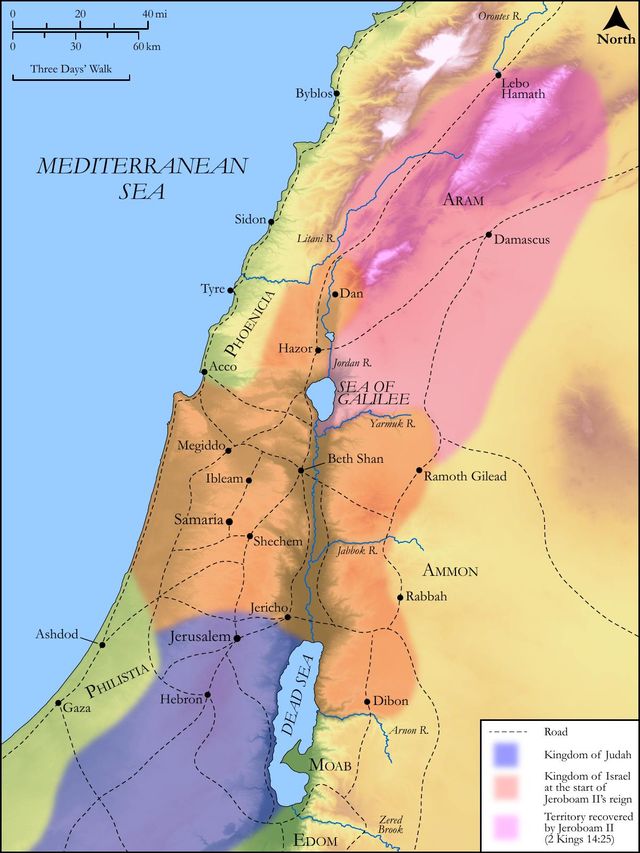
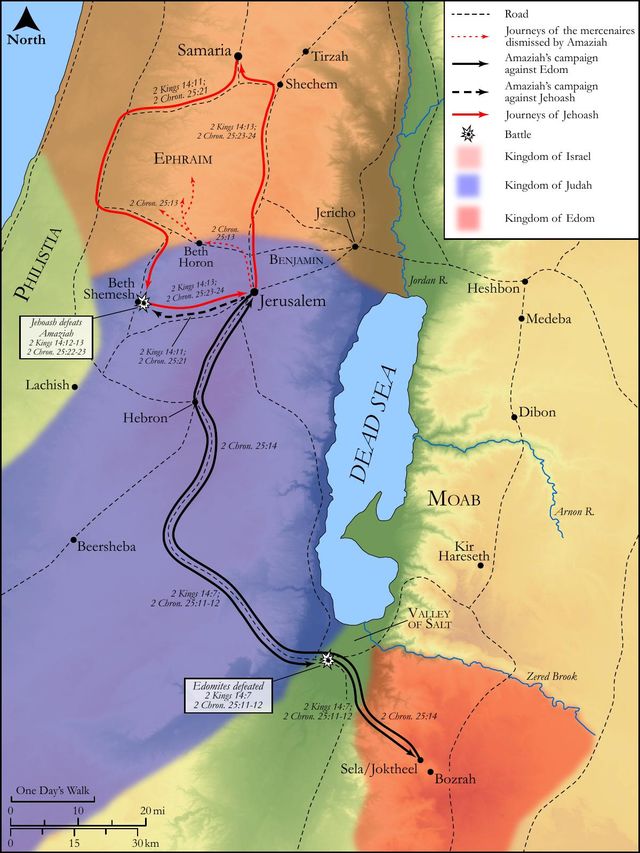
Study this verse
Public-domain commentary
Matthew Henry
From his Commentary on the Whole Bible. Henry comments on passages, not single verses — this entry covers 2 Kings 14:8–14. His two-level outline is real structure in the source text, so it is rendered as structure.
For several successions after the division of the kingdoms that of Judah suffered much by the enmity of Israel. After Asa's time, for several successions, it suffered more by the friendship of Israel, and by the alliance and affinity made with them. But now we meet with hostility between them again, which had not been for some ages before.
I.Amaziah, upon no provocation, and without showing any cause of quarrel, challenged Joash into the field (Kg2 14:8):
"Come, let us look one another in the face; let us try our strength in battle." Had he challenged him to a personal duel only, the error would have remained with himself, but each must bring all their forces into the field, and thousands of lives on both sides must be sacrificed to his capricious humour. Hereby he showed himself proud, presumptuous, and prodigal of blood. Some think that he intended to avenge the injury which the dismissed disgusted Israelites had lately done to his country, in their return (Ch2 25:13), and that he had also the vanity to think of subduing the kingdom of Israel, and reuniting it to Judah. A fool's lips thus enter into contention, and his mouth calleth for strokes. Those that challenge are chargeable with that beginning of strife, which is as the letting forth of water. He that is eager either to fight or to go to law may perhaps have enough of it quickly, and be the first that repents it.
II.Joash sent him a grave rebuke for his challenge, with advice to withdraw it, Kg2 14:9, Kg2 14:10.
1.He mortifies his pride, by comparing himself to a cedar, a stately tree, and Amaziah to a thistle, a sorry weed, telling him he was so far from fearing him that he despised him, and scorned as much to have any thing to do with him, or make any alliance with him, as the cedar would to match his daughter to a thistle. The ancient house of David he thinks not worthy to be named the same day with the house of Jehu, though an upstart. How may a humble man smile to hear two proud and scornful men set their wits on work to vilify and undervalue one another!
2.He foretels his fall: A wild beast trode down the thistle, and so put an end to his treaty with the cedar; so easily does Joash think his forces can crush Amaziah, and so unable does he think him to make any resistance.
3.He shows him the folly of his challenge: "Thou hast indeed smitten Edom, a weak, unarmed, undisciplined body of men, and therefore thinkest thou canst carry all before thee and subdue the regular forces of Israel with as much ease. Thy heart has lifted thee up." See where the root of all sin lies; it is in the heart, thence it flows, and that must bear the blame. It is not Providence, the event, the occasion (whatever it is), that makes men proud, or secure, or discontented, or the like, but it is their own heart that does it. "Thou art proud of the blow thou hast given to Edom, as if that had made thee formidable to all mankind." Those wretchedly deceive themselves that magnify their own performances, and, because they have been blessed with some little success and reputation, conclude themselves fit for any thing and no less sure of it.
4.He counsels him to be content with the honour he has won, and not to hazard that, by grasping at more that was out of his reach: Why shouldst thou meddle to thy hurt, as fools often do, that will be meddling? Pro 20:3. Many would have had wealth and honour enough if they had but known when they had enough. He warns him of the consequence, that it would be fatal not to himself only, but to his kingdom, which he ought to protect.
III.Amaziah persisted in his resolution, and the issue was bad; he had better have tarried at home, for Joash gave him such a look in the face as put him to confusion. Challengers commonly prove to be on the losing side.
1.His army was routed and dispersed, Kg2 14:12. Josephus says, When they were to engage they were struck with such terror that they did not strike a stroke, but every one made the best of his way.
2.He himself was taken prisoner by the king of Israel, and then had enough of looking him in the face. Amaziah's pedigree comes in here somewhat abruptly (the son of Joash, the son of Ahaziah), because perhaps he had gloried in the dignity of his ancestors, or because he now smarted for their iniquity.
3.The conqueror entered Jerusalem, which tamely opened to him, and yet he broke down their wall (and, as Josephus says, drove his chariot in triumph through the breach), in reproach to them, and that he might, when he pleased, take possession of the royal city.
4.He plundered Jerusalem, took away all that was valuable, and returned to Samaria, laden with spoils, Kg2 14:14. It was said of Joash that he did that which was evil in the sight of the Lord, and of Amaziah that he did that which was right; and yet Joash triumphs thus over Amaziah, and why so? Because God would show, in Amaziah's fate, that he resists the proud, or because, whatever they were otherwise, Joash had lately been respectful to one of God's prophets (Kg2 13:14), but Amaziah had been abusive to another (Ch2 25:16), and God will honour those who honour him in his prophets, but those who despise them, and him in them, shall be lightly esteemed.
Historical interpretation
Nine Centuries of Reception
2 surviving comments on this verse. Each one is dated, so this reads as a timeline rather than a list.
Select a marker to jump to its quote. Markers stagger vertically where authors wrote within a few decades of each other.
The thorn bush [mentioned here] is a tiny plant and herb and is not the blackberry bush, [whose fruits] we eat. “Since, if ever,” he says, “the thorn bush were sent to a cedar, saying, ‘Give your daughter to my son for a wife,’ it would be an insult and an act of derision, since the thorn bush is much smaller than the cedar, so you, Amaziah, do not differ at all from the thorn bush, if compared with my power.” By the cedar and the wild beast Jehoash signifies himself.
Let us see one another: This was a challenge to fight.
Continue studying 2 Kings 14:8 across the web’s major study libraries — every link below opens this exact verse, chapter, or book on the destination site.
Read & Compare
 BibleGatewayThis verse in more than 200 translations and 70 languages.
 Bible.comThe YouVersion reader — hundreds of translations, reading plans, and highlights.
 ESV.orgCrossway's official English Standard Version reader.
 NET BibleThe NET translation with 60,000+ translators' notes on every rendering decision.
 STEP BibleTyndale House's free study tool — original text, vocabulary, and scholarly resources.
 BibliaLogos Bible Software's free web reader.
 USCCBThe New American Bible (Revised Edition) with the U.S. bishops' study notes.
Commentaries
 BibleHub CommentariesDozens of classic commentaries on this verse, gathered on one page.
 StudyLightMore than 100 commentary sets — the largest collection on the web.
 BibleRefPlain-English commentary on what this verse means, verse by verse.
 Enduring WordDavid Guzik's free commentary on this chapter, widely used by Bible teachers.
 Bible Study ToolsVerse commentary alongside Greek and Hebrew study aids.
Original Language & Research
- BibleHub InterlinearThe verse word by word — original language, transliteration, and English.
- BibleHub LexiconEvery word's original-language definition and Strong's entry.
 Blue Letter BibleDeep-study tools — Strong's numbers, concordance, and word studies.
 SefariaThe Hebrew text with Rashi and centuries of Jewish commentary.
Sermons, Hymns & Audio


TrulyRandomVerse is not affiliated with these sites and doesn’t control their content. They’re linked because they’re genuinely useful.
Summary
Second Kings 14:8 records a pivotal moment in the history of the divided monarchy, detailing King Amaziah of Judah's audacious challenge to King Jehoash of Israel. Fresh from a decisive victory over Edom, Amaziah, seemingly emboldened by his success and perhaps a burgeoning sense of pride, dispatches messengers to Jehoash with the provocative invitation, "Come, let us look one another in the face." This seemingly innocuous phrase, a Hebrew idiom for a declaration of war or a direct challenge to battle, sets the stage for a calamitous confrontation between the two Hebrew kingdoms, highlighting themes of hubris, inter-kingdom rivalry, and the perilous consequences of rash decisions.
Context
ShowHideLiterary Context
This verse immediately follows Amaziah's significant military triumph over Edom in the Valley of Salt, where he slew ten thousand Edomites and captured Sela, renaming it Joktheel, as recounted in 2 Kings 14:7. This victory appears to be the direct catalyst for Amaziah's challenge to Jehoash. The narrative then proceeds to detail Jehoash's dismissive parable in 2 Kings 14:9-10, followed by Amaziah's refusal to heed the warning, leading to the catastrophic battle at Beth-shemesh where Judah is decisively defeated, Jerusalem's wall is breached, and the temple treasury is plundered, as described in 2 Kings 14:11-14. The challenge in 2 Kings 14:8, therefore, serves as the dramatic hinge between Amaziah's initial success and his subsequent downfall.
Historical & Cultural Context
The period of the divided monarchy was characterized by frequent tension, occasional open warfare, and shifting alliances between the northern kingdom of Israel and the southern kingdom of Judah, despite their shared ancestry and religious heritage. Amaziah ruled Judah from 796-767 BC, while Jehoash reigned over Israel from 798-782 BC. Both kings had recently achieved military successes: Amaziah against Edom, and Jehoash against the Arameans, recovering cities previously lost, as detailed in 2 Kings 13:25. The phrase "Come, let us look one another in the face" was a recognized Hebrew idiom, not an invitation for diplomacy, but a direct and formal declaration of intent to engage in military confrontation, a challenge to single combat or full-scale battle. This cultural understanding underscores the provocative nature of Amaziah's message. Furthermore, the parallel account in 2 Chronicles 25:17-20 reveals that Amaziah's challenge followed his adoption of Edomite idols, suggesting a spiritual decline that likely fueled his arrogance and impaired his judgment.
Key Themes
ShowHideThis verse is central to several overarching themes within 2 Kings and the broader historical books. Firstly, it powerfully illustrates the theme of pride and hubris, demonstrating how success can dangerously inflate one's ego, leading to rash and ill-advised decisions. Amaziah's overconfidence, stemming from his victory over Edom, blinds him to the greater strength and experience of Jehoash. Secondly, it highlights the persistent inter-kingdom rivalry and fratricidal conflict between Judah and Israel. Despite their common heritage, the two kingdoms frequently engaged in destructive warfare, weakening both against external threats. This rivalry often stemmed from a lack of trust, political ambition, and spiritual divergence, as seen in the broader narrative of 1 Kings and 2 Kings. Finally, the passage underscores the theme of consequences of ungodly counsel and impulsive action. Amaziah's challenge appears to be made without divine consultation or wise counsel, leading directly to Judah's defeat and humiliation, a stark reminder that human wisdom alone is insufficient for true prosperity and peace, a principle echoed in Proverbs 16:18.
Exposition and Analysis
ShowHideKey Word Analysis
ShowHideFrom אָמַץ (amats, "to be strong") and יָהּ (Yah, a shortened form of Yahweh). The name means "strength of Jah" or "strengthened by Yahweh." Ironically, despite his name signifying divine strength, Amaziah's actions in this verse demonstrate reliance on his own perceived strength and a departure from seeking Yahweh's counsel. His recent victory over Edom, though attributed to God's help in 2 Chronicles 25:8, seems to have inflated his human pride, making him forget the true source of his strength.
From יְהֹוָה (Yahweh) and possibly אֵשׁ (esh, "fire"). The name means "Jehovah-fired" or "Yahweh has supported/given." Jehoash was a more formidable and experienced king than Amaziah, having recently recovered territories from Aram. His shrewd and confident response to Amaziah's challenge (2 Kings 14:9-10) stands in sharp contrast to Amaziah's impulsiveness, highlighting his own strength and the folly of Amaziah's provocation.
A primitive root meaning "to see, literally or figuratively." In this context, combined with "face," it denotes a direct, unmediated confrontation. The verb implies a deliberate act of engagement, a readiness to perceive and be perceived in a decisive encounter. It moves beyond mere observation to a challenge for a definitive showdown, where the outcome will be determined by direct engagement.
Verse Breakdown
ShowHide"Then Amaziah sent messengers to Jehoash, the son of Jehoahaz son of Jehu, king of Israel, saying,"
This opening clause establishes the initiator of the conflict and the recipient of the challenge. Amaziah, king of Judah, takes the proactive step of initiating hostilities, indicating his aggressive intent. The full lineage of Jehoash is given, emphasizing his identity as the reigning monarch of the northern kingdom, a direct descendant of the powerful and often ruthless Jehu, whose dynasty had been established through a violent coup. This detail implicitly highlights the political weight and historical context of the challenge, underscoring that Amaziah is challenging a well-established and formidable royal line.
"Come, let us look one another in the face."
This is the core of Amaziah's message and the essence of the verse. As discussed in the key word analysis, this is a Hebrew idiom for a formal declaration of war. It signifies a direct challenge to battle, an invitation to a decisive military confrontation. Amaziah, emboldened by his recent victory over Edom, is not seeking negotiation or diplomacy but rather a direct armed conflict to assert his dominance or settle a perceived grievance. The phrase conveys a sense of directness, boldness, and a willingness to engage in a definitive showdown, leaving no room for misinterpretation of his hostile intentions.
Literary Devices
ShowHideThe primary literary device at play in 2 Kings 14:8 is Idiom. The phrase "Come, let us look one another in the face" is a well-established Hebrew idiom for a declaration of war or a direct challenge to battle, rather than a literal invitation for a meeting. This idiomatic expression immediately signals the aggressive and confrontational nature of Amaziah's intent, setting the tone for the ensuing conflict. Furthermore, there is an element of Dramatic Irony present for the reader. While Amaziah issues this challenge with apparent confidence and bravado, the biblical narrative, particularly in the subsequent verses, reveals the catastrophic outcome for Judah. The reader knows that Amaziah's pride will lead to his downfall, creating a sense of foreboding as he issues this seemingly confident challenge. The brevity and directness of the challenge also contribute to the Conciseness of the narrative, efficiently conveying a momentous decision with profound implications.
Theological and Thematic Connections
ShowHideThe challenge issued by Amaziah in 2 Kings 14:8 serves as a profound theological statement on the dangers of human pride and the consequences of acting without divine wisdom. Amaziah's recent military success over Edom, rather than fostering humility and gratitude, appears to have inflated his self-importance, leading him to provoke a stronger adversary. This act of hubris stands in stark contrast to the biblical emphasis on humility and reliance on God, illustrating that even divinely granted victories can become stumbling blocks if not received with a proper spirit. The ensuing conflict between Judah and Israel is a tragic manifestation of the brokenness within God's covenant people, highlighting the destructive nature of internal strife and the failure to live in unity under God's sovereignty. This episode underscores the truth that God often allows the natural consequences of human folly to unfold, even for His chosen leaders, as a means of instruction and judgment.
Reflection and Application
ShowHideAmaziah's impulsive challenge in 2 Kings 14:8 offers timeless lessons for believers today, particularly concerning the pitfalls of pride and the necessity of wise, Spirit-led decision-making. In a world that often celebrates self-reliance and aggressive ambition, Amaziah's story serves as a sobering reminder that true strength and lasting success are found not in human prowess or inflated ego, but in humble dependence on God. Our achievements, whether personal or professional, can become dangerous catalysts for arrogance if we fail to acknowledge God as the ultimate source of our abilities and blessings. Before making significant decisions, especially those with far-reaching consequences for ourselves or others, we are called to pause, seek God's counsel through prayer and His Word, and consult with godly mentors. Rushing into conflicts or challenges based on emotion, perceived strength, or past victories without divine wisdom often leads to regrettable outcomes, mirroring Judah's defeat. Let us cultivate a spirit of humility, recognizing that "pride goes before destruction," and instead, walk in wisdom, seeking God's face before we "look one another in the face" in any significant confrontation.
Questions for Reflection
ShowHideFAQ
ShowHideWas Amaziah's challenge to Jehoash justified?
ShowHideFrom a human perspective, Amaziah's challenge was likely fueled by a combination of factors: his recent military victory over Edom, a desire to assert Judah's dominance over Israel, and possibly a sense of grievance or perceived slight. However, the biblical narrative, particularly in 2 Chronicles 25:17-20, strongly suggests that the challenge was not justified or divinely sanctioned. It was born out of pride, possibly exacerbated by his turning to Edomite idols, and was made without seeking God's will. Jehoash's dismissive parable in 2 Kings 14:9-10 highlights the folly of Amaziah's challenge, portraying Judah as a weak thistle provoking a mighty cedar. The disastrous outcome for Judah (2 Kings 14:11-14) further confirms that it was an ill-advised and ultimately unjustifiable act from a spiritual standpoint.
Christ-Centered Fulfillment
ShowHideAmaziah's challenge to "look one another in the face" is a poignant illustration of humanity's fallen tendency towards pride, conflict, and self-destruction, a stark contrast to the humility and self-sacrifice embodied by Jesus Christ. While Amaziah, puffed up by earthly victory, sought to confront and dominate, Christ, though truly victorious over sin and death, came not to be served but to serve, and to give His life as a ransom for many (Mark 10:45). Where Amaziah's pride led to the defeat and humiliation of his kingdom, Christ's humility and obedience, even to the point of death on a cross, led to ultimate victory and the establishment of an eternal kingdom (Philippians 2:8-11). Jesus truly "looked sin in the face" on the cross, not with a challenge of human might, but with divine love and sacrificial atonement, conquering the ultimate adversary for us (Colossians 2:15). His call is not to provoke earthly battles out of pride, but to humble ourselves, take up our cross, and follow Him, finding true strength in weakness and ultimate victory through surrender (Matthew 16:24-25). In Christ, the destructive cycle of human pride and inter-kingdom rivalry is broken, replaced by the unifying power of His Spirit and the call to peace and reconciliation (Ephesians 2:14-16).