


2 Chronicles 25:24
- וְכָלve·kholand allH3605Conj-w ¦ N-mscNoun Singular Masculine Constructוְandכָלall
- הַזָּהָבha·za·Havthe goldH2091Art ¦ N-msNoun Singular Masculine Absoluteהַtheזָּהָבgold
- וְהַכֶּסֶףve·ha·Ke·sefand the silverH3701Conj-w ¦ Art ¦ N-msNoun Singular Masculine Absoluteוְandהַtheכֶּסֶףsilver
- וְאֵתve·'Etand <obj.>H853Conj-w ¦ DirObjMParticle Object Indicatorוְandאֵת<obj.>
- כָּלkolallH3605N-mscNoun Singular Masculine Construct
- הַכֵּלִיםHa·ke·limthe articlesH3627Art ¦ N-mpNoun Plural Masculine Absoluteהַtheכֵּלִיםarticles
- הַנִּמְצְאִיםha·nim·tze·'Imwhich were foundH4672Art ¦ V-Niphal-Prtcpl-mpVerb Niphal Participle Plural Masculine Absoluteהַwhichנִּמְצְאִיםwere found
- בְּבֵיתbe·veitin [the] house ofH1004Prep-b ¦ N-mscNoun Singular Masculine Constructבְּinבֵית[the] house of
- הָאֱלֹהִיםha·'E·lo·Him<the> GodH430Art ¦ N-mpNoun Plural Masculine Absoluteהָ<the>אֱלֹהִיםGod
- עִם'imwithH5973PrepPreposition
- עֹבֵד'o·VedObed-H5654N-proper-mNoun Proper Masculine
- אֱדוֹם'e·DomEdomH5654N-proper-mNoun Proper Masculine
- וְאֶתve·'Etand <obj.>H853Conj-w ¦ DirObjMParticle Object Indicatorוְandאֶת<obj.>
- אֹצְרוֹת'o·tze·rOt[the] treasures ofH214N-fpcNoun Plural Feminine Construct
- בֵּיתbeit[the] house ofH1004N-mscNoun Singular Masculine Construct
- הַמֶּלֶךְha·Me·lekhthe kingH4428Art ¦ N-msNoun Singular Masculine Absoluteהַtheמֶּלֶךְking
- וְאֵתve·'Etand <obj.>H853Conj-w ¦ DirObjMParticle Object Indicatorוְandאֵת<obj.>
- בְּנֵיbe·Nei[the] sons ofH1121N-mpcNoun Plural Masculine Construct
- הַתַּעֲרֻבוֹתha·ta·'a·ru·Votthe pledgesH8594Art ¦ N-fpNoun Plural Feminine Absoluteהַtheתַּעֲרֻבוֹתpledges
- וַיָּשָׁבvai·Ya·shovand he returnedH7725Conj-w ¦ V-Qal-ConsecImperf-3msVerb Qal Consecutive Imperfect 3rd Singular Masculineוַandיָּשָׁבhe returned
- שֹׁמְרוֹןsho·me·RonSamariaH8111N-properNoun Proper Location
English is a literal word-by-word gloss of the Hebrew, not the KJV's wording. Why?
This is the original text the KJV's translators worked from — each Hebrew word with its own literal English meaning in this verse, prepared by scholars at Tyndale House, Cambridge. The KJV translates whole sentences, not word by word, so its wording differs: one Hebrew word can become several English words, and the KJV may choose “the LORD” where the gloss reads “Yahweh”. Both are faithful — they answer different questions. For the KJV's own rendering, switch to the KJV text.
Details
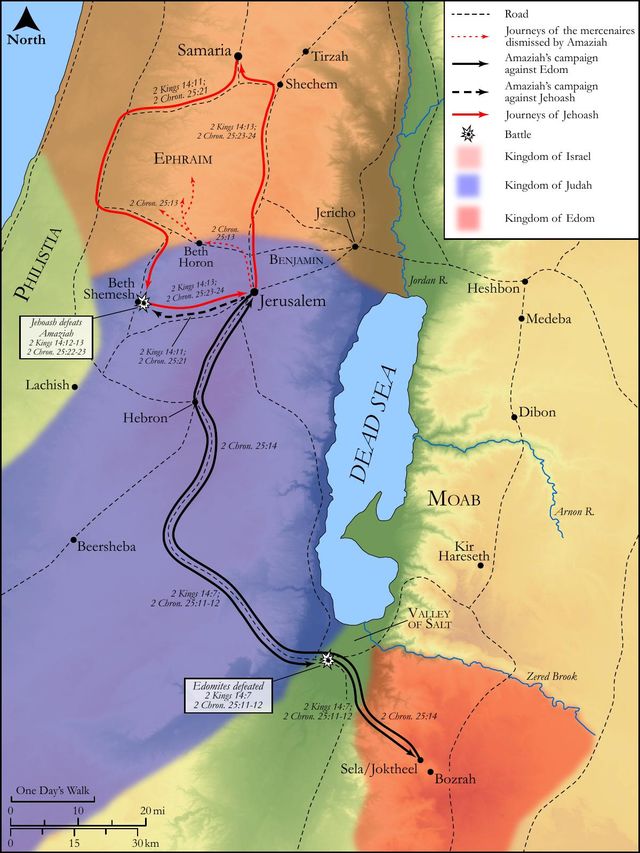
See on the biblical-era map
Study this verse
Public-domain commentary
Matthew Henry
From his Commentary on the Whole Bible. Henry comments on passages, not single verses — this entry covers 2 Chronicles 25:17–28. His three-level outline is real structure in the source text, so it is rendered as structure.
We have here this degenerate prince mortified by his neighbour and murdered by his own subjects.
I.Never was proud prince more thoroughly mortified than Amaziah was by Joash king of Israel.
1.This part of the story (which was as fully related Kg2 14:8, etc., as it is here) - embracing the foolish challenge which Amaziah sent to Joash (Ch2 25:17), his haughty scornful answer to it (Ch2 25:18), with the friendly advice he gave him to sit still and know when he was well off, (Ch2 25:19), - his wilfully persisting in his challenge (Ch2 25:20, Ch2 25:21), the defeat that was given him (Ch2 25:22), and the calamity he brought upon himself and his city thereby (Ch2 25:23, Ch2 25:24), - verifies two of Solomon's proverbs: - (1.) That a man's pride will bring him low, Pro 29:23. It goes before his destruction; not only procures it meritoriously, but is often the immediate occasion of it. He that exalteth himself shall be abased. (2.) That he that goes forth hastily to strive will probably not know what to do in the end thereof, when his neighbour has put him to shame, Pro 25:8. He that is fond of contention may have enough of it sooner than he thinks of.
2.But there are two passages in this story which we had not before in the Kings.
(1.)That Amaziah took advice before he challenged the king of Israel, Ch2 25:17. But of whom? Not of the prophet - he was not made of the king's counsel; but of his statesmen that would flatter him and bid him go up and prosper. It is good to take advice, but then it must be of those that are fit to advise us. Those that will not take advice from the word of God, which would guide them aright, will justly be left to the bad advice of those that will counsel them to their destruction. Let those be made fools that will not be made wise.
(2.)Amaziah's imprudence is here made the punishment of his impiety (Ch2 25:20): It was of the Lord; he left him to himself to act thus foolishly, that he and his people might be delivered into the hands of their enemies, because they had forsaken God and sought after the gods of Edom. Those that will not persuaded to do well for their souls will justly be given up to their own counsels to do ill for themselves even in their outward affairs.
II.Never was poor prince more violently pursued by his own subjects.
From the time that he departed from the Lord (so it may be read, Ch2 25:27) the hearts of his subjects departed from him, and they began to form a design against him in Jerusalem. It is probable they were exasperated against him more for his rashly engaging in a war against Israel than for his worshipping the gods of Edom. But at length the ferment grew so high, and he perceived the plot to be laid so deeply, that he thought fit to quit his royal city and flee to Lachish, either as a private place where he might be hid or as a strong place where he might be guarded; but they sent after him thither, and slew him there. By this the putting of him to death seems to have been done deliberately, and to have been the act, not of a disgusted servant or two, but of a considerable body that durst avow it. How unrighteous soever they were herein, God was righteous.
Continue studying 2 Chronicles 25:24 across the web’s major study libraries — every link below opens this exact verse, chapter, or book on the destination site.
Read & Compare
 BibleGatewayThis verse in more than 200 translations and 70 languages.
 Bible.comThe YouVersion reader — hundreds of translations, reading plans, and highlights.
 ESV.orgCrossway's official English Standard Version reader.
 NET BibleThe NET translation with 60,000+ translators' notes on every rendering decision.
 STEP BibleTyndale House's free study tool — original text, vocabulary, and scholarly resources.
 BibliaLogos Bible Software's free web reader.
 USCCBThe New American Bible (Revised Edition) with the U.S. bishops' study notes.
Commentaries
 BibleHub CommentariesDozens of classic commentaries on this verse, gathered on one page.
 StudyLightMore than 100 commentary sets — the largest collection on the web.
 BibleRefPlain-English commentary on what this verse means, verse by verse.
 Enduring WordDavid Guzik's free commentary on this chapter, widely used by Bible teachers.
 Bible Study ToolsVerse commentary alongside Greek and Hebrew study aids.
Original Language & Research
- BibleHub InterlinearThe verse word by word — original language, transliteration, and English.
- BibleHub LexiconEvery word's original-language definition and Strong's entry.
 Blue Letter BibleDeep-study tools — Strong's numbers, concordance, and word studies.
 SefariaThe Hebrew text with Rashi and centuries of Jewish commentary.
Sermons, Hymns & Audio


TrulyRandomVerse is not affiliated with these sites and doesn’t control their content. They’re linked because they’re genuinely useful.
Summary
This verse starkly recounts the devastating plunder of Jerusalem by King Jehoash of Israel following his decisive victory over King Amaziah of Judah. It details the seizure of all gold, silver, sacred Temple vessels (specifically those stored with Obed-Edom), and the treasures from the royal palace, along with the taking of high-ranking hostages. These spoils were then transported back to Samaria, serving as a tangible and humiliating testament to Judah's profound defeat, Amaziah's catastrophic misjudgment, and the severe consequences of divine judgment for his pride and apostasy.
Context
ShowHideLiterary Context
2 Chronicles 25:24 marks the calamitous climax of King Amaziah's reign, immediately following Judah's crushing defeat by Israel. The Chronicler meticulously builds to this moment of national humiliation, beginning with Amaziah's initial military success against Edom, which was quickly followed by his egregious error of adopting Edomite idols and worshipping them 2 Chronicles 25:14. Despite a direct prophetic warning from God, Amaziah defiantly refused to repent, instead arrogantly challenging King Jehoash of Israel to battle 2 Chronicles 25:17. Jehoash's wise parable, cautioning Amaziah against overreaching, was likewise dismissed. The narrative explicitly attributes Amaziah's hardened resolve to divine will, stating it was "of God, that he might deliver them into the hand of their enemies, because they sought after the gods of Edom" 2 Chronicles 25:20. The ensuing battle at Beth-shemesh resulted in Judah's complete rout, Amaziah's capture, and a significant breach in Jerusalem's defensive wall 2 Chronicles 25:23. Therefore, verse 24 serves as the final, tangible evidence of this catastrophic defeat, detailing the immense treasures and human collateral Jehoash seized before returning to his capital, underscoring the severity of God's judgment.
Historical & Cultural Context
This event transpired during the turbulent period of the divided monarchy, a time frequently marked by political tension and military conflict between the northern kingdom of Israel and the southern kingdom of Judah. In the ancient Near East, the plundering of a defeated nation's temple and royal palace was a common and profoundly symbolic act of conquest. It signified not only economic gain but also total subjugation, the humiliation of the defeated deity (or, in this monotheistic context, the perceived abandonment by Yahweh due to His people's sin), and the complete triumph of the victor. The Temple in Jerusalem was far more than a mere structure; it was the spiritual and national heart of Judah, the designated dwelling place of Yahweh, and the repository of immense national wealth. Its desecration and plunder were thus an unparalleled national catastrophe, underscoring the severity of God's judgment and the fragility of even sacred spaces when covenant fidelity is abandoned. The practice of taking "hostages" (typically sons of nobles or high officials) was a standard geopolitical maneuver to ensure future compliance, tribute payments, or to prevent rebellion, further cementing Judah's subordinate status under Israel's dominion. The mention of "Obededom" in connection with the Temple treasures likely refers to a specific storage area within the Temple complex or a family line responsible for its custody, rather than the individual Obed-Edom from David's era.
Key Themes
ShowHideThe narrative of 2 Chronicles 25, culminating in this verse, powerfully illustrates several core theological and narrative themes. Central among these is the theme of Divine Retribution and the Consequences of Disobedience. Amaziah's dramatic downfall is explicitly presented as a direct consequence of his pride and, more significantly, his flagrant apostasy in worshipping Edomite idols after experiencing God's blessing. This powerfully highlights God's Sovereignty in Judgment, demonstrating His active intervention in human history, even using one of His own covenant nations (Israel against Judah) as an instrument of discipline when His people turn away from Him and violate His covenant. The plundering of the "house of God" underscores the Vulnerability of Sacred Spaces when the people entrusted with them become unfaithful, challenging any notion that the Temple itself offered automatic protection regardless of the nation's spiritual state. It serves as a stark reminder that God's presence and protection are conditional upon covenant faithfulness. Finally, the event exemplifies the destructive nature of Inter-kingdom Strife, where the ongoing rivalry and warfare between Israel and Judah often led to immense suffering and loss for both nations, tragically distracting them from their true calling as God's unified people.
Exposition and Analysis
ShowHideKey Word Analysis
ShowHideFrom an unused root meaning "to shimmer," this term refers to the precious metal, gold. In this context, it represents the accumulated wealth and material security of the kingdom of Judah, both from the royal treasury and potentially from the Temple's dedicated reserves. Its seizure signifies the economic devastation and stripping of Judah's material glory.
Meaning "something prepared," this term encompasses any apparatus, implement, utensil, or vessel. In the context of the "house of God," it specifically refers to the sacred implements, utensils, and furnishings used in the worship services of the Temple. Their removal was not merely a theft of valuable items but an act of profound sacrilege and desecration, symbolizing the stripping away of Judah's spiritual dignity and the violation of God's holy dwelling place.
Literally meaning "sons of pledge" or "sons of security," this refers to high-ranking individuals, typically sons of nobles or officials, taken by the conquering power. Their purpose was to serve as human collateral, guaranteeing the defeated nation's future loyalty, payment of tribute, or prevention of rebellion. Their seizure was a clear and devastating sign of Judah's complete subjugation and loss of national autonomy and dignity.
Verse Breakdown
ShowHide"And [he took] all the gold and the silver"
This phrase details the primary material spoils of war, representing the vast economic wealth of the kingdom. The seizure of gold and silver from both the royal palace and the Temple signifies a comprehensive plundering of Judah's financial resources, leaving the kingdom impoverished and vulnerable.
"and all the vessels that were found in the house of God with Obededom"
This clause highlights the sacrilegious aspect of the plunder. "The house of God" explicitly names the Temple in Jerusalem, the spiritual heart of Judah. The mention of "with Obededom" likely refers to a specific treasury chamber or storage area within the Temple complex, perhaps under the care of a Levitical family or official named Obed-Edom, indicating the precise location from which these sacred items were taken. The removal of these vessels, dedicated to Yahweh's service, was a direct affront to God and a profound humiliation for Judah.
"and the treasures of the king's house"
Distinct from the Temple's sacred items, this refers to the accumulated wealth, regalia, and personal riches stored within the royal palace. Its plunder signifies the complete overthrow of the monarchy's power, prestige, and the personal wealth of the king, further emphasizing the totality of Judah's defeat.
"the hostages also"
This refers to the capture of high-ranking individuals, likely sons of the Judean elite, to be held as collateral. This was a standard practice in ancient warfare to ensure the defeated nation's future compliance, payment of tribute, or to prevent rebellion. It served as a tangible and deeply humiliating symbol of Judah's subjugation and loss of national sovereignty.
"and returned to Samaria"
This final clause indicates the victorious King Jehoash's return to his capital city, Samaria, with his immense spoils. It marks the successful completion of his punitive expedition and the full realization of Judah's defeat, bringing the narrative of this particular conflict to a decisive and somber close.
Literary Devices
ShowHideThe Chronicler employs several potent literary devices to underscore the gravity of Judah's defeat and the divine hand in its unfolding. There is a profound sense of Irony in Amaziah's fate; having achieved a great victory over Edom with divine assistance, he then succumbs to destructive pride and idolatry, leading to his swift and humiliating downfall at the hands of a kingdom he arrogantly provoked. The plundering of both the Temple and the king's house serves as powerful Symbolism, representing the complete collapse of Judah's security, divine favor, and national identity due to its sin. The removal of the sacred vessels is particularly poignant, symbolizing the spiritual desecration and the breaking of the covenant relationship. The narrative uses Contrast to highlight the rapid transition from Amaziah's initial triumph to his utter humiliation, underscoring the swiftness and severity of divine judgment. Furthermore, the detailed enumeration of the spoils ("all the gold and the silver," "all the vessels," "the treasures," "the hostages") creates a sense of Verisimilitude, making the account feel historically precise and emphasizing the immense scale of the loss suffered by Judah.
Theological and Thematic Connections
ShowHideThe plunder of Jerusalem and its sacred treasures in 2 Chronicles 25:24 serves as a profound theological statement on the direct consequences of covenant unfaithfulness and pride. It powerfully illustrates that God's covenant promises of blessing are conditional upon obedience, and His warnings of judgment are not idle threats. Amaziah's actions, particularly his idolatry after experiencing God's blessing in the Edomite campaign, directly provoked divine wrath, leading to the stripping away of national wealth, sacred items, and even human freedom. This event underscores God's sovereign control over history, demonstrating His willingness to use even one of His own people's enemies (Israel against Judah) as an instrument of discipline when His people persist in sin. The vulnerability of the Temple, despite its sacred status, teaches that outward religious forms or structures do not guarantee divine protection when the heart of the people is far from God. This incident foreshadows later, even more devastating destructions of the Temple due to continued apostasy, reinforcing the consistent biblical principle that true security lies in faithful obedience to God.
Reflection and Application
ShowHideThe historical account of 2 Chronicles 25:24 offers timeless and sobering lessons for believers today. Amaziah's trajectory from victory to utter defeat, driven by pride and idolatry, serves as a powerful cautionary tale. It reminds us that spiritual success or material blessing can, ironically, become fertile ground for arrogance and self-reliance if not carefully guarded by humility and gratitude. We are called to consistently examine our hearts, ensuring that our allegiance remains solely with God and that nothing, whether tangible possessions, personal achievements, or even our own self-image, usurps His rightful place. The swift and severe consequences of Amaziah's disobedience underscore the importance of heeding divine warnings, whether they come through Scripture, the prompting of the Holy Spirit, or the wise counsel of godly individuals. Furthermore, the plundering of the Temple, a place of profound spiritual significance, highlights the truth that even our most sacred institutions, ministries, or personal spiritual disciplines can become vulnerable if we, as God's people, drift into unfaithfulness. We are called to be faithful stewards of all that God entrusts to us—our spiritual heritage, our gifts, our resources—recognizing that true security lies not in what we possess, but in our steadfast relationship with Him.
Questions for Reflection
ShowHideFAQ
ShowHideWas this the first time the Temple was plundered?
ShowHideNo, this was not the first time the Temple in Jerusalem had been plundered. The first recorded instance occurred during the reign of Rehoboam, Solomon's son, when Shishak, king of Egypt, attacked Jerusalem and carried off the treasures of the house of the Lord and the treasures of the king's house ([1_kings/14-25 "1 Kings 14:25 - Shishak Plunders the Temple"]; [2_chronicles/12-9 "2 Chronicles 12:9 - Shishak Plunders the Temple"]). This instance by King Jehoash of Israel is another in a series of desecrations and losses that highlight the vulnerability of the Temple when God's people were unfaithful, foreshadowing the ultimate and complete destruction and plunder by the Babylonians centuries later 2 Kings 25:13.
Who was Obededom mentioned in this verse?
ShowHideThe "Obededom" mentioned in 2 Chronicles 25:24 is not the same individual Obed-Edom, the Gittite, who faithfully housed the Ark of the Covenant during David's reign and was blessed by God ([2_samuel/6-10 "2 Samuel 6:10 - Obed-Edom Houses the Ark"]; [1_chronicles/13-13 "1 Chronicles 13:13 - Obed-Edom Houses the Ark"]). That Obed-Edom lived centuries earlier. In this context, "with Obededom" most likely refers to a specific storage area within the Temple complex or a designated treasury chamber that might have been named after the family or lineage of Obed-Edom, who were known as gatekeepers and treasurers of the Temple in earlier times 1 Chronicles 26:15. This detail specifies the exact location within the Temple from which the sacred vessels were taken, emphasizing the precise nature of the plunder.
Christ-Centered Fulfillment
ShowHideThe plundering of the Temple in 2 Chronicles 25:24, a direct consequence of Judah's profound unfaithfulness and pride, profoundly foreshadows the ultimate vulnerability of all earthly institutions and the absolute necessity of a perfect, enduring sanctuary. The physical Temple, meant to house God's presence, repeatedly suffered desecration and plunder, becoming a poignant symbol of humanity's sin and its devastating effects. This points forward to Jesus Christ as the true and ultimate Temple, the very dwelling place of God among humanity (John 2:19). Unlike the earthly temple, which could be plundered and destroyed, Christ's body was raised indestructible, signifying His eternal victory over sin and death. The "treasures" taken by Jehoash, representing the fleeting wealth and security of an unfaithful kingdom, contrast sharply with the immeasurable spiritual riches found in Christ, who offers an inheritance that is imperishable, undefiled, and unfading, kept in heaven for believers (1 Peter 1:4). Furthermore, the taking of "hostages" by Jehoash symbolizes the universal bondage of humanity to sin and its consequences. Christ, however, came not to take captives, but to set them free, declaring His mission to "proclaim liberty to the captives" (Isaiah 61:1 fulfilled in Luke 4:18). Amaziah's pride leading to his downfall finds its ultimate contrast in Christ's profound humility, who, though equal with God, emptied Himself and became obedient to death on a cross (Philippians 2:5), thereby securing salvation and true freedom for all who believe. Ultimately, the narrative of a plundered temple and a defeated people points forward to the new covenant, where God's presence dwells not in a building made with hands, but in the hearts of believers through the Holy Spirit (1 Corinthians 3:16), and culminates in the glorious vision of the New Jerusalem, where there is no temple, for the Lord God Almighty and the Lamb are its temple (Revelation 21:22).