


2 Chronicles 12:9
Bible text: King James Version (1769 Blayney text) · Public domain
Bible text: King James Version with Strong's numbers · Public domain
Bible text: Berean Standard Bible · Public domain
Bible text: American Standard Version (1901) · Public domain
Bible text: World English Bible, Messianic edition · Public domain
Bible text: Geneva Bible (1599) · Public domain
Bible text: Young's Literal Translation · Public domain
- וַיַּעַלvai·Ya·'aland he came upH5927Conj-w ¦ V-Qal-ConsecImperf-3msVerb Qal Consecutive Imperfect 3rd Singular Masculineוַandיַּעַלhe came up
- שִׁישַׁקshi·ShakShishakH7895N-proper-mNoun Proper Masculine
- מֶלֶךְMe·lekh[the] king ofH4428N-mscNoun Singular Masculine Construct
- מִצְרַיִםmitz·ra·YimEgyptH4714N-properNoun Proper Location
- עַל'alonH5921PrepPreposition
- יְרוּשָׁלִַםye·ru·sha·LimJerusalemH3389N-properNoun Proper Location
- וַיִּקַּחvai·yi·Kachand he tookH3947Conj-w ¦ V-Qal-ConsecImperf-3msVerb Qal Consecutive Imperfect 3rd Singular Masculineוַandיִּקַּחhe took
- אֶת'et<obj.>H853DirObjMParticle Object Indicator
- אֹצְרוֹת'o·tze·Rot[the] treasures ofH214N-fpcNoun Plural Feminine Construct
- בֵּיתbeit[the] house ofH1004N-mscNoun Singular Masculine Construct
- יְהוָהYah·wehYahwehH3068N-properNoun Proper Title
- וְאֶתve·'Etand <obj.>H853Conj-w ¦ DirObjMParticle Object Indicatorוְandאֶת<obj.>
- אֹצְרוֹת'o·tze·rOt[the] treasures ofH214N-fpcNoun Plural Feminine Construct
- בֵּיתbeit[the] house ofH1004N-mscNoun Singular Masculine Construct
- הַמֶּלֶךְha·Me·lekhthe kingH4428Art ¦ N-msNoun Singular Masculine Absoluteהַtheמֶּלֶךְking
- אֶת'et<obj.>H853DirObjMParticle Object Indicator
- הַכֹּלha·Kol<the> everythingH3605Art ¦ N-msNoun Singular Masculine Absoluteהַ<the>כֹּלeverything
- לָקָחla·Kachhe tookH3947V-Qal-Perf-3msVerb Qal Perfect 3rd Singular Masculine
- וַיִּקַּחvai·yi·Kachand he tookH3947Conj-w ¦ V-Qal-ConsecImperf-3msVerb Qal Consecutive Imperfect 3rd Singular Masculineוַandיִּקַּחhe took
- אֶת'et<obj.>H853DirObjMParticle Object Indicator
- מָגִנֵּיma·gi·Nei[the] shields ofH4043N-mpcNoun Plural Masculine Construct
- הַזָּהָבha·za·Hav<the> goldH2091Art ¦ N-msNoun Singular Masculine Absoluteהַ<the>זָּהָבgold
- אֲשֶׁר'a·SherwhichH834RelParticle Relative
- עָשָׂה'a·Sahhe had madeH6213V-Qal-Perf-3msVerb Qal Perfect 3rd Singular Masculine
- שְׁלֹמֹהshe·lo·MohSolomonH8010N-proper-mNoun Proper Masculine
English is a literal word-by-word gloss of the Hebrew, not the KJV's wording. Why?
This is the original text the KJV's translators worked from — each Hebrew word with its own literal English meaning in this verse, prepared by scholars at Tyndale House, Cambridge. The KJV translates whole sentences, not word by word, so its wording differs: one Hebrew word can become several English words, and the KJV may choose “the LORD” where the gloss reads “Yahweh”. Both are faithful — they answer different questions. For the KJV's own rendering, switch to the KJV text.
Details
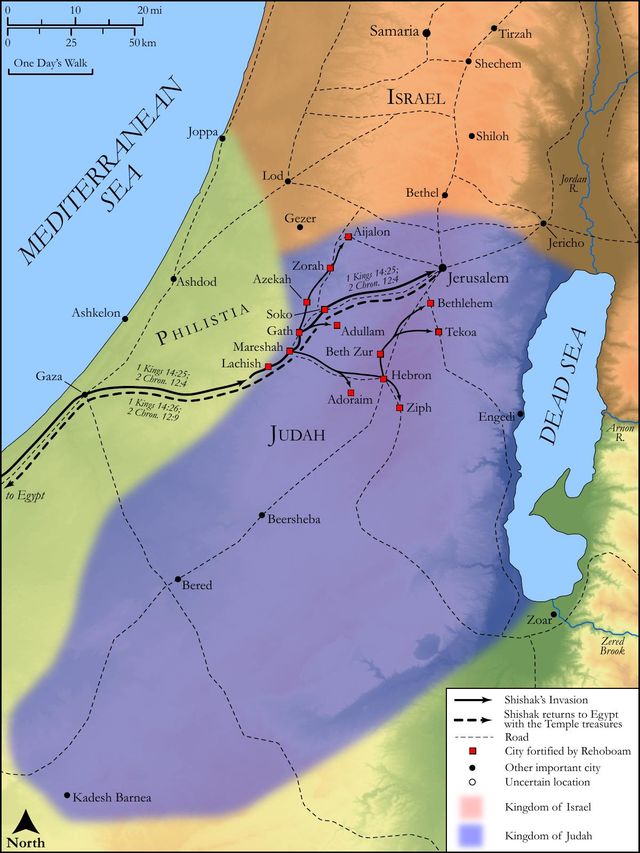
See on the biblical-era map
Study this verse
Public-domain commentary
Matthew Henry
From his Commentary on the Whole Bible. Henry comments on passages, not single verses — this entry covers 2 Chronicles 12:1–12. His four-level outline is real structure in the source text, so it is rendered as structure.
Israel was very much disgraced and weakened by being divided into two kingdoms; yet the kingdom of Judah, having both the temple and the royal city, both the house of David and the house of Aaron, might have done very well if they had continued in the way of their duty; but here we have all out of order there.
I.Rehoboam and his people left God:
He forsook the law of the Lord, and so in effect forsook God, and all Israel with him, Ch2 12:1. He had his happy triennium, when he walked in the way of David and Solomon (Ch2 11:17), but it expired, and he grew remiss in the worship of God; in what instances we are not told, but he fell off, and Judah with him, here called Israel, because they walked in the evil ways into which Jeroboam had drawn the kingdom of Israel. Thus he did when he had established the kingdom and strengthened himself. As long as he thought his throne tottered he kept to his duty, that he might make God his friend; but, when he found it stood pretty firmly, he thought he had no more occasion for religion; he was safe enough without it. Thus the prosperity of fools destroys them. Jeshurun waxed fat and kicked. When men prosper, and are in no apprehension of troubles, they are ready to say to God, Depart from us.
II.God quickly brought troubles upon them, to awaken them, and recover them to repentance, before their hearts were hardened.
It was but in the fourth year of Rehoboam that they began to corrupt themselves, and in the fifth year the king of Egypt came up against them with a vast army, took the fenced cities of Judah, and came against Jerusalem, Ch2 12:2, Ch2 12:3, Ch2 12:4. This great calamity coming upon them so soon after they began to desert the worship of God, by a hand they had little reason to suspect (having had a great deal of friendly correspondence with Egypt in the last reign), and coming with so much violence that all the fenced cities of Judah, which Rehoboam had lately fortified and garrisoned and on which he relied much for the safety of his kingdom, fell immediately into the hands of the enemy, without making any resistance, plainly showed that it was from the Lord, because they had transgressed against him.
III.Lest they should not readily or not rightly understand the meaning of this providence, God by the word explains the rod, Ch2 12:5.
When the princes of Judah had all met at Jerusalem, probably in a great council of war, to concert measures for their own safety in this critical juncture, he sent a prophet to them, the same that had brought them an injunction from God not to fight against the ten tribes (Ch2 11:2), Shemaiah by name; he told them plainly that the reason why Shishak prevailed against them was not because they had been impolitic in the management of their affairs (which perhaps the princes in this congress were at this time scrutinizing), but because they had forsaken God. God never leaves any till they first leave him.
IV.The rebukes both of the word and of the rod being thus joined, the king and princes humbled themselves before God for their iniquity, penitently acknowledged the sin, and patiently accepted the punishment of it, saying, The Lord is righteous, Ch2 12:6. "We have none to blame but ourselves; let God be clear when he judgeth." Thus it becomes us, when we are under the rebukes of Providence, to justify God and judge ourselves. Even kings and princes must either bend or break before God, either be humbled or be ruined.
V.Upon the profession they made of repentance God showed them some favour, saved them from ruin, and yet left them under some remaining fears of the judgment, to prevent their revolt again.
1.God, in mercy, prevented the destruction they were now upon the brink of. Such a vast and now victorious army as Shishak had, having made themselves masters of all the fenced cities, what could be expected but that the whole country, and even Jerusalem itself, would in a little time be theirs? But when God saith, Here shall the proud waves be stayed, the most threatening force strangely dwindles and becomes impotent. Here again the destroying angel, when he comes to Jerusalem, is forbidden to destroy it: "My wrath shall not be poured out upon Jerusalem; not at this time, not by this hand, not utterly to destroy it," Ch2 12:7, Ch2 12:12. Note, Those that acknowledge God righteous in afflicting them shall find him gracious. Those that humble themselves before him shall find favour with him. So ready is the God of mercy to take the first occasion to show mercy. If we have humbled hearts under humbling providences, the affliction has done its work, and it shall either be removed or the property of it altered.
2.He granted them some deliverance, not complete, but in part; he gave them some advantages against the enemy, so that they recruited a little; he gave them deliverance for a little while, so some. They reformed but partially, and for a little while, soon relapsing again; and, as their reformation was, so was their deliverance. Yet it is said (Ch2 12:12), in Judah things went well, and began to look with a better face.
(1.)In respect of piety. There were good things in Judah (so it is in the margin), good ministers, good people, good families, who were made better by the calamities of their country. Note, In times of great corruption and degeneracy it is some comfort if there be a remnant among whom good things ar found; this is a ground of hope in Israel.
(2.)In respect of prosperity. In Judah things went ill when all the fenced cities were taken (Ch2 12:4), but when they repented the posture of their affairs altered, and things went well. Note, If things do not go so well as we could wish, yet we have reason to take notice of it with thankfulness if they go better than was to have been expected, better than formerly, and better than we deserved. We should own God's goodness if he do but grant us some deliverance.
3.Yet he left them to smart sorely by the hand of Shishak, both in their liberty and in their wealth.
(1.)In their liberty (Ch2 12:8): They shall be his servants (that is, they shall lie much at his mercy and be put under contribution by him, and some of them perhaps be taken prisoners and held in captivity by him), that they may know my service, and the service of the kingdoms of the countries. They complained, it may be, of the strictness of their religion, and forsook the law of the Lord (Ch2 12:1) because they thought it a yoke to hard, too heavy, upon them. "Well," saith God, "let them better themselves if they can; let the neighbouring princes rule them awhile, since they are not willing that I should rule them, and let them try how they like that. They might have served God with joyfulness and gladness of heart, and would not; let them serve their enemies then in hunger and thirst (Deu 28:47, Deu 28:48), till they think of returning to their first Master, for then it was better with them," Hos 2:7. This, some think, is the meaning of Eze 20:24, Eze 20:25. Because they despised my statutes, I gave them statutes that were not good. Note,
[1.]The more God's service is compared with other services the more reasonable and easy it will appear.
[2.]Whatever difficulties or hardships we may imagine there are in the way of obedience, it is better a thousand times to go through them than to expose ourselves to the punishment of disobedience. Are the laws of temperance thought hard? The effects of intemperance will be much harder. The service of virtue is perfect liberty; the service of lust is perfect slavery.
(2.)In their wealth. The king of Egypt plundered both the temple and the exchequer, the treasuries of both which Solomon left very full; but he took them away; yea, he took all, all he could lay his hands on, Ch2 12:9. This was what he came for. David and Solomon, who walked in the way of God, filled the treasuries, one by war and the other by merchandise; but Rehoboam, who forsook the law of God, emptied them. The taking away of the golden shields, and the substituting of brazen ones in their place (Ch2 12:9-11), we had an account of before, Kg1 14:25-28.
Continue studying 2 Chronicles 12:9 across the web’s major study libraries — every link below opens this exact verse, chapter, or book on the destination site.
Read & Compare
 BibleGatewayThis verse in more than 200 translations and 70 languages.
 Bible.comThe YouVersion reader — hundreds of translations, reading plans, and highlights.
 ESV.orgCrossway's official English Standard Version reader.
 NET BibleThe NET translation with 60,000+ translators' notes on every rendering decision.
 STEP BibleTyndale House's free study tool — original text, vocabulary, and scholarly resources.
 BibliaLogos Bible Software's free web reader.
 USCCBThe New American Bible (Revised Edition) with the U.S. bishops' study notes.
Commentaries
 BibleHub CommentariesDozens of classic commentaries on this verse, gathered on one page.
 StudyLightMore than 100 commentary sets — the largest collection on the web.
 BibleRefPlain-English commentary on what this verse means, verse by verse.
 Enduring WordDavid Guzik's free commentary on this chapter, widely used by Bible teachers.
 Bible Study ToolsVerse commentary alongside Greek and Hebrew study aids.
Original Language & Research
- BibleHub InterlinearThe verse word by word — original language, transliteration, and English.
- BibleHub LexiconEvery word's original-language definition and Strong's entry.
 Blue Letter BibleDeep-study tools — Strong's numbers, concordance, and word studies.
 SefariaThe Hebrew text with Rashi and centuries of Jewish commentary.
Sermons, Hymns & Audio


TrulyRandomVerse is not affiliated with these sites and doesn’t control their content. They’re linked because they’re genuinely useful.
Summary
Second Chronicles 12:9 meticulously records the devastating invasion of Pharaoh Shishak of Egypt against Jerusalem during the fifth year of King Rehoboam's reign. This pivotal event details the comprehensive plunder of both the sacred treasures from the Temple of the LORD and the vast wealth from the king's palace, including the iconic golden shields crafted by King Solomon. This act of divine judgment stripped Judah of its material and symbolic glory, marking a profound decline from the kingdom's former splendor and serving as a tangible consequence of their apostasy.
Context
ShowHideLiterary Context
This verse is strategically placed within the narrative of King Rehoboam's reign, immediately following the division of the united monarchy. The Chronicler meticulously establishes the spiritual rationale for Shishak's invasion in the preceding verses, highlighting that Rehoboam and all Israel "forsook the law of the LORD" 2 Chronicles 12:1. The prophet Shemaiah then delivers a direct divine pronouncement, declaring that because they had abandoned God, He would deliver them into Shishak's hand 2 Chronicles 12:5. Therefore, 2 Chronicles 12:9 serves as the precise and dramatic fulfillment of this prophecy, vividly depicting the tangible and humiliating consequences of Judah's spiritual infidelity. The subsequent verses 2 Chronicles 12:10-12 describe the replacement of the golden shields with inferior bronze ones and God's subsequent partial mercy due to the people's humbling, underscoring the immediate aftermath and the enduring impact of this significant judgment.
Historical & Cultural Context
The invasion detailed in 2 Chronicles 12:9 is a historically corroborated event, occurring around 925 BCE. Pharaoh Shishak is widely identified with Sheshonk I, the founder of Egypt's 22nd Dynasty, whose military campaign into Canaan is well-documented in Egyptian records, including a prominent relief at the Temple of Karnak that lists numerous cities he conquered in both Judah and Israel. This invasion transpired in the fifth year of Rehoboam's reign, a period characterized by political instability following the kingdom's split. The "treasures of the house of the LORD" refer to the immense accumulation of gold, silver, and sacred vessels that King Solomon had dedicated to the Temple during its construction and dedication 1 Kings 7:51 and 2 Chronicles 5:1. Similarly, the "treasures of the king's house" denote the vast royal wealth amassed during Solomon's prosperous reign. The "shields of gold" were not primarily for warfare but were ceremonial, used by Solomon's guard for display and procession, symbolizing his unparalleled wealth and the kingdom's glory 1 Kings 10:16-17 and 2 Chronicles 9:15-16. Their seizure by Shishak was a profound humiliation, a visible sign of Judah's diminished status and the direct consequence of their unfaithfulness.
Key Themes
ShowHideThis verse powerfully encapsulates several key themes central to the Chronicler's overarching theological message. Foremost among these is the consequences of disobedience and divine judgment. The invasion is presented not as a mere geopolitical incident but as a direct, divinely orchestrated punishment for Judah's apostasy and their abandonment of the LORD's law, echoing the covenant curses outlined in Deuteronomy 28. Another prominent theme is the diminished glory and loss of splendor. The plundering of the Temple and royal palace, particularly the symbolic golden shields, stands in stark contrast to the magnificent wealth and glory of Solomon's reign, thereby symbolizing Judah's spiritual and national decline. This loss is further emphasized by the subsequent replacement of the golden shields with inferior bronze ones 2 Chronicles 12:10. Finally, the narrative profoundly underscores God's sovereignty in judgment and His corrective discipline. Even in allowing an enemy nation to plunder His people, God demonstrates His ultimate control, using this severe act as a means to humble Judah and call them back to faithfulness, ultimately showing mercy when they repented 2 Chronicles 12:6-7.
Exposition and Analysis
ShowHideKey Word Analysis
ShowHideThis refers to Pharaoh Sheshonk I, the founder of the 22nd Dynasty of Egypt. His appearance in the biblical narrative, corroborated by Egyptian historical records (such as the Karnak relief depicting his campaign), underscores the historical veracity of this account. His invasion was not a random geopolitical event but a divinely ordained instrument of judgment against Judah, fulfilling prophetic pronouncements.
The term "treasures" denotes a depository or storehouse of accumulated wealth, encompassing precious metals (gold, silver) and valuable articles. The text specifically distinguishes between "treasures of the house of the LORD" (sacred Temple wealth, H1004 bayith for house of the LORD, H3068 Yᵉhôvâh for LORD) and "treasures of the king's house" (royal palace wealth, H4428 melek for king, H1004 bayith for house). This comprehensive plunder signifies a complete stripping away of both the nation's material security and its sacred endowment, representing a profound loss of national prosperity and divine favor.
These were not ordinary battle shields but ceremonial items, numbering 200 large and 300 small, made by Solomon (H6213 ʻâsâh) and displayed in the House of the Forest of Lebanon. They were potent symbols of Solomon's unparalleled wealth (H2091 zâhâb for gold), prestige, and the magnificent glory of his reign (H8010 Shᵉlômôh for Solomon). Their seizure (H3947 lâqach) was a highly visible and humiliating sign of Judah's decline, representing the loss of the kingdom's former splendor and outward display of power.
Verse Breakdown
ShowHide"So Shishak king of Egypt came up against Jerusalem"
This opening clause establishes the direct action and the agent of judgment. The connective "So" links this event as a direct consequence of Judah's preceding unfaithfulness. Shishak (H7895 Shîyshaq), a powerful foreign king (H4428 melek) from Egypt (H4714 Mitsrayim), is presented as the divinely appointed instrument through whom God's judgment is executed against His disobedient people, as he "came up" (H5927 ʻâlâh) against Jerusalem (H3389 Yᵉrûwshâlaim).
"and took away the treasures of the house of the LORD, and the treasures of the king's house; he took all"
This segment details the extensive scope and completeness of the plunder. The Temple (H1004 bayith), the spiritual heart of the nation and repository of sacred wealth dedicated to the LORD (H3068 Yᵉhôvâh), was desecrated and stripped of its "treasures" (H214 ʼôwtsâr). Simultaneously, the royal palace, representing the political and economic power of the kingdom, was also emptied of its "treasures." The emphatic phrase "he took all" (H3947 lâqach) underscores the totality of the loss, signifying a comprehensive stripping away of Judah's material security and national pride.
"he carried away also the shields of gold which Solomon had made"
This specific mention highlights a particularly poignant and symbolic loss. These "shields" (H4043 mâgên) of "gold" (H2091 zâhâb), emblematic of Solomon's (H8010 Shᵉlômôh) unparalleled wealth and the zenith of Israel's glory, were not merely valuable objects but potent symbols of divine blessing and national prestige. Their removal (H3947 lâqach) signifies a profound degradation from the glorious era of Solomon, marking a visible decline in Judah's status and a tangible sign of God's withdrawal of favor due to their sin.
Literary Devices
ShowHideThe verse employs several potent literary devices to convey its profound message. Symbolism is paramount, with the "treasures of the house of the LORD" and especially the "shields of gold" serving as powerful symbolic representations. The Temple treasures represent the nation's spiritual wealth and God's past blessings, while the golden shields symbolize the peak of Solomon's glory and the kingdom's outward splendor. Their loss, therefore, profoundly symbolizes the spiritual and national decline of Judah. There is also an element of irony present; the very wealth and glory accumulated through God's blessing during Solomon's reign become the target of divine judgment when the people turn away from Him. This creates a stark contrast between the opulence and security of Solomon's time and the impoverished, humiliated state under Rehoboam, emphasizing the direct link between obedience and prosperity, and disobedience and decline in the Chronicler's theology.
Theological and Thematic Connections
ShowHideThe account in 2 Chronicles 12:9 is a vivid theological statement on the consequences of covenant unfaithfulness. It underscores the profound biblical principle that divine blessings are conditional upon obedience, and turning away from God inevitably leads to judgment and loss. The plundering of Jerusalem's treasures, both sacred and royal, serves as a tangible manifestation of God's displeasure with Judah's apostasy. It reminds us that material wealth and national glory, while often perceived as signs of divine favor, are ultimately fleeting and can be stripped away when a people or an individual deviates from God's path. This event is not merely a historical record but a profound lesson in the sovereignty of God, who uses even foreign powers to enact His righteous judgments and to call His people back to repentance. It reveals that true security and lasting prosperity are found not in accumulated possessions or outward displays of power, but in a faithful and obedient relationship with the LORD.
Reflection and Application
ShowHideThe narrative of Shishak's invasion and the plundering of Jerusalem's treasures in 2 Chronicles 12:9 serves as a timeless and sobering reminder for individuals and communities today. Just as Judah's material and symbolic glory was diminished due to their departure from God's law, so too can our lives experience spiritual and even tangible decline when we neglect our relationship with the divine. This verse compels us to examine the foundations of our security and prosperity. Are we placing our trust in earthly possessions, achievements, or outward appearances—our "golden shields"—rather than in the unfailing provision and protection of God? The fleeting nature of the Temple's treasures and the king's wealth highlights that true and lasting riches are not found in what we accumulate, but in our obedience and devotion to God. This account calls us to cultivate a heart of faithfulness, recognizing that genuine spiritual vitality and security are rooted in our walk with the Lord, not in the perishable things of this world. It challenges us to prioritize God's will and His kingdom above all else, lest we, like Judah, experience a stripping away of what we hold dear, revealing the emptiness of a life lived apart from Him.
Questions for Reflection
ShowHideFAQ
ShowHideWas Shishak's invasion a complete destruction of Jerusalem?
ShowHideNo, Shishak's invasion was a punitive raid and plunder, not a complete destruction of Jerusalem. While the city's treasures were thoroughly looted, Jerusalem itself was spared from total devastation. This sparing was attributed to the humbling of King Rehoboam and the princes of Israel, who repented before the LORD, leading God to declare through the prophet Shemaiah that He would not pour out His wrath completely 2 Chronicles 12:6-7. The city was subjected to servitude to Shishak, but its existence was preserved.
What happened to the golden shields mentioned here?
ShowHideThe golden shields, which were ceremonial and symbolic of Solomon's immense wealth and the kingdom's glory, were taken away by Shishak as part of the plunder. 2 Chronicles 12:10 explicitly states that King Rehoboam subsequently replaced them with bronze shields. This replacement with an inferior material served as a stark and visible symbol of the kingdom's diminished glory and wealth, marking a significant decline from the splendor of Solomon's reign.
Christ-Centered Fulfillment
ShowHideThe plundering of Jerusalem's treasures and the loss of the golden shields in 2 Chronicles 12:9 foreshadow a profound spiritual truth fulfilled in Christ. The Old Covenant's reliance on material symbols of glory, such as the Temple's physical wealth and the king's golden shields, proved to be fleeting and vulnerable to earthly powers, mirroring humanity's inherent inability to maintain righteousness and secure lasting blessing through its own efforts. This event underscores the temporary nature of earthly kingdoms and their treasures, pointing to the need for a more enduring and incorruptible glory. Jesus Christ, the true King, embodies the ultimate and unfading glory, not of this world, but from God John 1:14. He is the true "treasure" in whom "are hidden all the treasures of wisdom and knowledge" Colossians 2:3. Unlike the physical Temple, which could be plundered, Christ's body is the true Temple John 2:19-21, and His sacrifice on the cross paid the ultimate price for sin, securing an eternal inheritance that can never be taken away 1 Peter 1:4. Where Judah lost its physical shields, believers in Christ are equipped with the "shield of faith" Ephesians 6:16, a spiritual defense that triumphs over the schemes of the enemy, securing a glory that far surpasses any earthly splendor.