


2 Chronicles 12:8
Bible text: King James Version (1769 Blayney text) · Public domain
Bible text: Berean Standard Bible · Public domain
Bible text: American Standard Version (1901) · Public domain
Bible text: World English Bible, Messianic edition · Public domain
Bible text: Geneva Bible (1599) · Public domain
Bible text: Young's Literal Translation · Public domain
- כִּיkiforH3588PrtParticle Conditional
- יִהְיוּyih·yuthey will becomeH1961V-Qal-Imperf-3mpVerb Qal Imperfect 3rd Plural Masculine
- לוֹloof himPrep-l ¦ 3msSuffix Personal 3rd Singular Masculineלofוֹhim
- לַעֲבָדִיםla·'a·va·Dim<into> subjectsH5650Prep-l ¦ N-mpNoun Plural Masculine Absoluteלַ<into>עֲבָדִיםsubjects
- וְיֵדְעוּve·ye·de·'Uso they may knowH3045Conj-w ¦ V-Qal-ConjImperf-3mpVerb Qal Conjunction+Imperfect 3rd Plural Masculineוְsoיֵדְעוּthey may know
- עֲבוֹדָתִיa·Vo·da·Timy serviceH5656N-fsc ¦ 1csNoun Singular Feminine Constructעֲבוֹדָתִserviceיmy
- וַעֲבוֹדַתva·'a·vo·Datand [the] service ofH5656Conj-w ¦ N-fscNoun Singular Feminine Constructוַandעֲבוֹדַת[the] service of
- מַמְלְכוֹתmam·le·Khot[the] kingdoms ofH4467N-fpcNoun Plural Feminine Construct
- הָאֲרָצוֹתha·'a·ra·Tzotthe landsH776Art ¦ N-fpNoun Plural Feminine Absoluteהָtheאֲרָצוֹתlands
English is a literal word-by-word gloss of the Hebrew, not the KJV's wording. Why?
This is the original text the KJV's translators worked from — each Hebrew word with its own literal English meaning in this verse, prepared by scholars at Tyndale House, Cambridge. The KJV translates whole sentences, not word by word, so its wording differs: one Hebrew word can become several English words, and the KJV may choose “the LORD” where the gloss reads “Yahweh”. Both are faithful — they answer different questions. For the KJV's own rendering, switch to the KJV text.
Details
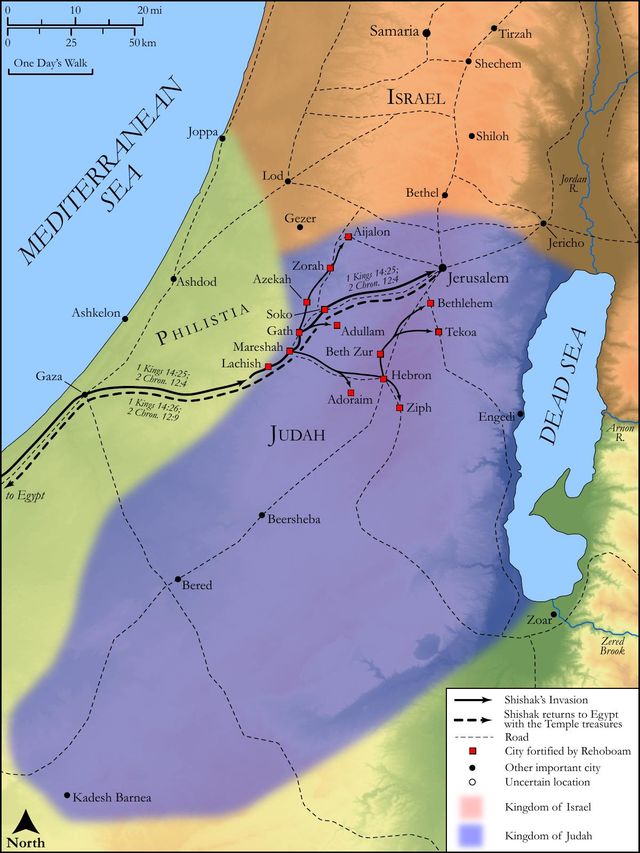
See on the biblical-era map
Study this verse
Public-domain commentary
Matthew Henry
From his Commentary on the Whole Bible. Henry comments on passages, not single verses — this entry covers 2 Chronicles 12:1–12. His four-level outline is real structure in the source text, so it is rendered as structure.
Israel was very much disgraced and weakened by being divided into two kingdoms; yet the kingdom of Judah, having both the temple and the royal city, both the house of David and the house of Aaron, might have done very well if they had continued in the way of their duty; but here we have all out of order there.
I.Rehoboam and his people left God:
He forsook the law of the Lord, and so in effect forsook God, and all Israel with him, Ch2 12:1. He had his happy triennium, when he walked in the way of David and Solomon (Ch2 11:17), but it expired, and he grew remiss in the worship of God; in what instances we are not told, but he fell off, and Judah with him, here called Israel, because they walked in the evil ways into which Jeroboam had drawn the kingdom of Israel. Thus he did when he had established the kingdom and strengthened himself. As long as he thought his throne tottered he kept to his duty, that he might make God his friend; but, when he found it stood pretty firmly, he thought he had no more occasion for religion; he was safe enough without it. Thus the prosperity of fools destroys them. Jeshurun waxed fat and kicked. When men prosper, and are in no apprehension of troubles, they are ready to say to God, Depart from us.
II.God quickly brought troubles upon them, to awaken them, and recover them to repentance, before their hearts were hardened.
It was but in the fourth year of Rehoboam that they began to corrupt themselves, and in the fifth year the king of Egypt came up against them with a vast army, took the fenced cities of Judah, and came against Jerusalem, Ch2 12:2, Ch2 12:3, Ch2 12:4. This great calamity coming upon them so soon after they began to desert the worship of God, by a hand they had little reason to suspect (having had a great deal of friendly correspondence with Egypt in the last reign), and coming with so much violence that all the fenced cities of Judah, which Rehoboam had lately fortified and garrisoned and on which he relied much for the safety of his kingdom, fell immediately into the hands of the enemy, without making any resistance, plainly showed that it was from the Lord, because they had transgressed against him.
III.Lest they should not readily or not rightly understand the meaning of this providence, God by the word explains the rod, Ch2 12:5.
When the princes of Judah had all met at Jerusalem, probably in a great council of war, to concert measures for their own safety in this critical juncture, he sent a prophet to them, the same that had brought them an injunction from God not to fight against the ten tribes (Ch2 11:2), Shemaiah by name; he told them plainly that the reason why Shishak prevailed against them was not because they had been impolitic in the management of their affairs (which perhaps the princes in this congress were at this time scrutinizing), but because they had forsaken God. God never leaves any till they first leave him.
IV.The rebukes both of the word and of the rod being thus joined, the king and princes humbled themselves before God for their iniquity, penitently acknowledged the sin, and patiently accepted the punishment of it, saying, The Lord is righteous, Ch2 12:6. "We have none to blame but ourselves; let God be clear when he judgeth." Thus it becomes us, when we are under the rebukes of Providence, to justify God and judge ourselves. Even kings and princes must either bend or break before God, either be humbled or be ruined.
V.Upon the profession they made of repentance God showed them some favour, saved them from ruin, and yet left them under some remaining fears of the judgment, to prevent their revolt again.
1.God, in mercy, prevented the destruction they were now upon the brink of. Such a vast and now victorious army as Shishak had, having made themselves masters of all the fenced cities, what could be expected but that the whole country, and even Jerusalem itself, would in a little time be theirs? But when God saith, Here shall the proud waves be stayed, the most threatening force strangely dwindles and becomes impotent. Here again the destroying angel, when he comes to Jerusalem, is forbidden to destroy it: "My wrath shall not be poured out upon Jerusalem; not at this time, not by this hand, not utterly to destroy it," Ch2 12:7, Ch2 12:12. Note, Those that acknowledge God righteous in afflicting them shall find him gracious. Those that humble themselves before him shall find favour with him. So ready is the God of mercy to take the first occasion to show mercy. If we have humbled hearts under humbling providences, the affliction has done its work, and it shall either be removed or the property of it altered.
2.He granted them some deliverance, not complete, but in part; he gave them some advantages against the enemy, so that they recruited a little; he gave them deliverance for a little while, so some. They reformed but partially, and for a little while, soon relapsing again; and, as their reformation was, so was their deliverance. Yet it is said (Ch2 12:12), in Judah things went well, and began to look with a better face.
(1.)In respect of piety. There were good things in Judah (so it is in the margin), good ministers, good people, good families, who were made better by the calamities of their country. Note, In times of great corruption and degeneracy it is some comfort if there be a remnant among whom good things ar found; this is a ground of hope in Israel.
(2.)In respect of prosperity. In Judah things went ill when all the fenced cities were taken (Ch2 12:4), but when they repented the posture of their affairs altered, and things went well. Note, If things do not go so well as we could wish, yet we have reason to take notice of it with thankfulness if they go better than was to have been expected, better than formerly, and better than we deserved. We should own God's goodness if he do but grant us some deliverance.
3.Yet he left them to smart sorely by the hand of Shishak, both in their liberty and in their wealth.
(1.)In their liberty (Ch2 12:8): They shall be his servants (that is, they shall lie much at his mercy and be put under contribution by him, and some of them perhaps be taken prisoners and held in captivity by him), that they may know my service, and the service of the kingdoms of the countries. They complained, it may be, of the strictness of their religion, and forsook the law of the Lord (Ch2 12:1) because they thought it a yoke to hard, too heavy, upon them. "Well," saith God, "let them better themselves if they can; let the neighbouring princes rule them awhile, since they are not willing that I should rule them, and let them try how they like that. They might have served God with joyfulness and gladness of heart, and would not; let them serve their enemies then in hunger and thirst (Deu 28:47, Deu 28:48), till they think of returning to their first Master, for then it was better with them," Hos 2:7. This, some think, is the meaning of Eze 20:24, Eze 20:25. Because they despised my statutes, I gave them statutes that were not good. Note,
[1.]The more God's service is compared with other services the more reasonable and easy it will appear.
[2.]Whatever difficulties or hardships we may imagine there are in the way of obedience, it is better a thousand times to go through them than to expose ourselves to the punishment of disobedience. Are the laws of temperance thought hard? The effects of intemperance will be much harder. The service of virtue is perfect liberty; the service of lust is perfect slavery.
(2.)In their wealth. The king of Egypt plundered both the temple and the exchequer, the treasuries of both which Solomon left very full; but he took them away; yea, he took all, all he could lay his hands on, Ch2 12:9. This was what he came for. David and Solomon, who walked in the way of God, filled the treasuries, one by war and the other by merchandise; but Rehoboam, who forsook the law of God, emptied them. The taking away of the golden shields, and the substituting of brazen ones in their place (Ch2 12:9-11), we had an account of before, Kg1 14:25-28.
Continue studying 2 Chronicles 12:8 across the web’s major study libraries — every link below opens this exact verse, chapter, or book on the destination site.
Read & Compare
 BibleGatewayThis verse in more than 200 translations and 70 languages.
 Bible.comThe YouVersion reader — hundreds of translations, reading plans, and highlights.
 ESV.orgCrossway's official English Standard Version reader.
 NET BibleThe NET translation with 60,000+ translators' notes on every rendering decision.
 STEP BibleTyndale House's free study tool — original text, vocabulary, and scholarly resources.
 BibliaLogos Bible Software's free web reader.
 USCCBThe New American Bible (Revised Edition) with the U.S. bishops' study notes.
Commentaries
 BibleHub CommentariesDozens of classic commentaries on this verse, gathered on one page.
 StudyLightMore than 100 commentary sets — the largest collection on the web.
 BibleRefPlain-English commentary on what this verse means, verse by verse.
 Enduring WordDavid Guzik's free commentary on this chapter, widely used by Bible teachers.
 Bible Study ToolsVerse commentary alongside Greek and Hebrew study aids.
Original Language & Research
- BibleHub InterlinearThe verse word by word — original language, transliteration, and English.
- BibleHub LexiconEvery word's original-language definition and Strong's entry.
 Blue Letter BibleDeep-study tools — Strong's numbers, concordance, and word studies.
 SefariaThe Hebrew text with Rashi and centuries of Jewish commentary.
Sermons, Hymns & Audio


TrulyRandomVerse is not affiliated with these sites and doesn’t control their content. They’re linked because they’re genuinely useful.
Summary
Second Chronicles 12:8 encapsulates a pivotal moment in Judah's history, revealing God's pedagogical intent behind the subjugation of King Rehoboam and his people to Shishak, King of Egypt. Following their widespread apostasy, God permitted this foreign invasion not for their utter annihilation, but as a severe yet redemptive lesson. The verse articulates God's desire for His people to experientially discern the profound qualitative difference between the liberating, covenantal "service" owed to Him and the burdensome, oppressive "service" demanded by earthly kingdoms. This divine discipline aimed to reorient their hearts, demonstrating the inherent consequences of forsaking the Lord and the incomparable value of true devotion to Him.
Context
ShowHideLiterary Context
This verse is strategically placed within the narrative of King Rehoboam's early reign in 2 Chronicles 12. The preceding verses establish Rehoboam's initial period of strength and prosperity, followed by his and Judah's tragic apostasy, as they "forsook the law of the Lord" (2 Chronicles 12:1). This spiritual rebellion directly provoked God's judgment, manifested through the invasion of Shishak, King of Egypt, who swiftly advanced against Jerusalem (2 Chronicles 12:2-5). When the prophet Shemaiah delivered God's message of impending destruction, Rehoboam and the princes of Israel (referring to Judah) humbled themselves, acknowledging God's righteousness (2 Chronicles 12:6). In response to their genuine humility, God mercifully promised not to destroy them completely but to allow them to become servants to Shishak. Verse 8 then provides the divine rationale for this mitigated judgment, emphasizing the pedagogical purpose behind their subjugation, contrasting the nature of God's service with that of earthly powers.
Historical & Cultural Context
The invasion by Shishak (Sheshonk I), occurring in the fifth year of Rehoboam's reign (approximately 925 BC), is a historically significant event, corroborated by Egyptian monumental inscriptions, notably at the Karnak Temple. During this period, Egypt, under its 22nd Dynasty, was actively reasserting its political and economic influence over the Levant. For Judah, this meant a return to servitude under a foreign king, as in the days of the judges, a common arrangement among the nations of that day where conquered peoples served their overlords with tribute, resources, and sometimes labor. The "service of the kingdoms of the countries" would have entailed heavy taxation, forced labor, loss of national sovereignty, and potentially the imposition of foreign customs or religious practices, all designed to extract wealth and control. The plundering of the Temple and royal palace treasures by Shishak (2 Chronicles 12:9) further underscored the profound humiliation and the tangible loss of divine protection that accompanied their covenant disobedience. This event served as a stark, lived-out reminder of the covenant curses articulated in Deuteronomy 28, particularly the threat of foreign subjugation for forsaking the Lord.
Key Themes
ShowHideThis verse powerfully illuminates several enduring theological themes central to the Chronicler's message. Firstly, it highlights Divine Discipline, showcasing God's sovereign use of difficult circumstances and even foreign oppression as a corrective measure for His covenant people when they stray from Him. This discipline, though painful, is rooted in His unwavering commitment to their spiritual well-being and covenant relationship, reflecting the principle that "the Lord disciplines those he loves" (Hebrews 12:6). Secondly, it underscores The Nature of Service, drawing a profound and intentional contrast between "my service" (serving the Lord) and "the service of the kingdoms of the countries" (serving earthly rulers and systems). God's intention is for His people to experientially grasp the vast difference between the freedom, blessing, and joy found in serving Him and the bondage, burdens, and spiritual emptiness associated with serving worldly powers (Matthew 6:24). Thirdly, the verse exemplifies the principle of Learning Through Experience. God's purpose was not merely punitive but profoundly pedagogical; by enduring the harsh realities of serving a foreign king, Judah would gain a clear, visceral understanding of the preferable and liberating nature of serving the Lord. This reflects a broader biblical pattern where God allows trials and consequences to foster growth, discernment, and a deeper appreciation for His ways and character (Romans 5:3-5).
Exposition and Analysis
ShowHideKey Word Analysis
ShowHideThis noun, derived from the verb 'avad (to serve, work, worship), carries a broad semantic range. It can refer to a slave, a bondservant, a subject, or even a worshipper. In this context, when applied to Judah becoming Shishak's "servants," it primarily denotes forced subjugation, tribute, and loss of autonomy. However, the underlying concept of "service" sets up the crucial contrast with "my service," implying a deeper spiritual dimension to the term that transcends mere physical labor.
This verb signifies far more than mere intellectual understanding or factual acquaintance; it implies an intimate, experiential, and often transformative knowledge. God desired Judah to "know" His service not just by hearing about it or observing it from afar, but by personally experiencing the stark contrast with foreign domination. This kind of knowing involves a deep, personal realization that shapes one's perspective, informs one's choices, and leads to a profound appreciation for God's ways and the consequences of departing from them.
This is the pivotal term in the verse, appearing twice, emphasizing the central contrast. Also derived from 'avad, it can mean work, labor, servitude, or cultic worship/ministry. "My service" refers to the worship, obedience, and covenantal relationship with Yahweh, which is meant to be liberating, life-giving, and brings divine blessing. "The service of the kingdoms of the countries" refers to the burdensome, oppressive, and often idolatrous demands of human empires. The experience of the latter was intended to illuminate the true nature and incomparable value of the former, highlighting the stark difference between divine sovereignty and human tyranny.
Verse Breakdown
ShowHide"Nevertheless they shall be his servants"
This phrase marks a significant turning point, indicating a mitigation of God's initial judgment. As implied by the severity of Shishak's invasion, complete destruction was a real possibility. However, because Rehoboam and the princes humbled themselves before the Lord (2 Chronicles 12:6), God's wrath was averted from utter annihilation (2 Chronicles 12:7). Yet, the consequences of their sin remained. The pronoun "his" refers to Shishak, King of Egypt. Judah would now be subject to foreign rule, paying tribute, and enduring the burdens of servitude to a foreign king, a direct and painful consequence of forsaking God's law and covenant.
"that they may know my service"
This clause explicitly states God's primary pedagogical purpose behind the subjugation. God's ultimate desire was not merely punishment, but restoration through experiential learning. "My service" encompasses the joyful, willing obedience to God's covenant, the freedom found in His commands, and the blessings of His protection and provision. It is a service of love, devotion, and faithfulness, leading to true life and peace. God intended for them to gain an intimate, personal understanding of its true nature.
"and the service of the kingdoms of the countries"
This contrasts sharply with "my service," providing the necessary foil for Judah's experiential learning. It refers to the oppressive, burdensome, and often idolatrous demands of earthly powers and human empires. Such service entails loss of freedom, heavy taxation, forced labor, and spiritual compromise. By experiencing the harsh realities of serving a foreign king, Judah would gain a clear, undeniable, and visceral understanding of the preferable, liberating, and life-affirming nature of serving the Lord. The juxtaposition highlights the profound difference between divine sovereignty and human tyranny.
Literary Devices
ShowHideThe primary literary device powerfully employed in 2 Chronicles 12:8 is Contrast. The verse explicitly sets up a stark dichotomy between "my service" (God's service) and "the service of the kingdoms of the countries." This fundamental opposition is central to the verse's meaning, highlighting the qualitative difference between a life lived in willing obedience to God and one subjected to the burdensome demands of worldly powers. This contrast serves a profound Didactic purpose, as the entire experience of subjugation is designed by God to teach Judah a crucial and lasting lesson. The consequence of their apostasy (serving Shishak) is directly linked to the desired outcome (experientially knowing the difference between the two forms of service), making the narrative a clear moral and theological instruction. There is also an element of Irony inherent in the situation: by forsaking the "easy yoke" of God's law and seeking autonomy or relying on worldly alliances, Judah found themselves under the much heavier, oppressive yoke of a foreign oppressor. This ironic outcome underscores the futility and self-defeating nature of rebellion against divine order.
Theological and Thematic Connections
ShowHideSecond Chronicles 12:8 powerfully illustrates God's consistent pattern of using consequences, even severe ones, to draw His people back to Himself. It underscores the profound theological principle that true freedom, security, and flourishing are found only in covenant faithfulness and devoted service to God, not in reliance on worldly systems, human power, or self-sufficiency. This divine discipline is not vindictive but profoundly redemptive, aiming to cultivate a deeper, experiential appreciation for the unique and liberating nature of God's benevolent rule. The painful experience of forced servitude under Shishak was designed to be a tangible, visceral reminder of the blessings forfeited by abandoning God's "service" and the heavy burdens incurred by embracing "the service of the kingdoms of the countries." This theological truth resonates throughout Scripture, emphasizing the exclusive claim God has on His people's allegiance and the inherent spiritual bondage that results from divided loyalties or outright rebellion against His divine will.
Reflection and Application
ShowHideFor believers today, 2 Chronicles 12:8 offers a timeless and crucial lesson on the consequences of spiritual drifting and, more importantly, on God's redemptive purpose in discipline. When we, like ancient Judah, become complacent in our faith, prioritize worldly pursuits, or subtly shift our allegiance from God to "the kingdoms of the countries"—whether that be materialism, career advancement, social status, self-reliance, or any idol—God, in His loving sovereignty, may permit difficult circumstances to enter our lives. These challenges are not always punitive, but often serve as a profound wake-up call, designed to bring us back to a deeper, experiential understanding of what it truly means to serve Him. This verse reminds us that true freedom, peace, and security are found in exclusive devotion to God, not in relying on fleeting worldly systems, possessions, or human power. Our experiences, both good and bad, can be profound teachers in discerning the path of life and the incomparable value of God's service over any earthly alternative. It calls us to examine our allegiances and reaffirm our commitment to the Lord, recognizing that His "service" is perfect freedom and the only path to genuine flourishing.
Questions for Reflection
ShowHideFAQ
ShowHideWhy would God allow His people to be enslaved if He is good?
ShowHideGod's goodness is multifaceted, encompassing both His boundless love and His unwavering justice. In this instance, He allowed Judah to become "servants" to Shishak not out of malice or a desire for their suffering, but as a direct, covenantal consequence of their widespread disobedience and apostasy (2 Chronicles 12:1). This act was a form of divine discipline, intended to be pedagogical and redemptive rather than purely punitive. God's ultimate purpose was for them to "know" experientially the stark difference between the liberating blessings and protection found in serving Him and the burdensome oppression of serving worldly powers. This aligns perfectly with the biblical principle that God disciplines those He loves (Hebrews 12:6) to lead them to repentance, spiritual maturity, and a deeper understanding of His ways, ultimately for their good and His glory. It was a partial judgment, graciously mitigated by their humility (2 Chronicles 12:7), preventing total destruction and offering a clear path back to a right relationship with Him.
What is the difference between "my service" and "the service of the kingdoms of the countries"?
ShowHideThe verse highlights a profound theological and practical distinction, presenting a foundational choice for humanity. "My service" refers to serving the Lord, which involves willing obedience to His commands, devoted worship, unwavering trust, and living in a covenant relationship with Him. This service, though it requires submission to God's will, paradoxically leads to true freedom, profound peace, enduring joy, and divine protection (John 8:36). As Jesus Himself declared, His "yoke is easy and His burden is light" (Matthew 11:30). In stark contrast, "the service of the kingdoms of the countries" represents submission to earthly powers, systems, and values that are often oppressive, fleeting, and ultimately spiritually empty. This service is characterized by heavy burdens, loss of autonomy, potential spiritual compromise, and a relentless focus on temporary gains and worldly accolades. It inevitably leads to spiritual bondage, as one cannot serve two masters (Matthew 6:24), and ultimately results in spiritual death and separation from God (Romans 6:23).
Christ-Centered Fulfillment
ShowHideWhile 2 Chronicles 12:8 describes an Old Testament historical event of divine discipline and pedagogical intent for the nation of Judah, it powerfully foreshadows the greater spiritual realities fulfilled in Jesus Christ. Humanity, in its fallen state, is inherently enslaved to "the service of the kingdoms of the countries"—the kingdom of sin, death, and the world system that stands in opposition to God, often under the dominion of Satan (John 8:34, Romans 6:16). Just as Judah experienced the harshness of earthly servitude to learn the incomparable value of God's service, so too does humanity, through its inherent brokenness and the futility of worldly pursuits, come to recognize its desperate need for a different kind of Master. Jesus Christ, the ultimate Servant of God (Philippians 2:7), came precisely to liberate us from this spiritual bondage. He declares that His "yoke is easy and His burden is light" (Matthew 11:28-30), offering true rest and freedom from the oppressive demands of sin and the law. Through His atoning sacrifice on the cross, we are bought with a price and transferred from the dominion of darkness into His glorious kingdom (Colossians 1:13), becoming willing servants of righteousness and heirs of eternal life (Romans 6:18). Thus, the temporary, physical servitude of Judah points to the eternal, spiritual liberation and joyful service found exclusively in Christ, who alone can set us truly free.