


2 Chronicles 25:25
- וַיְחִיvay·Chiand he livedH2421Conj-w ¦ V-Qal-ConsecImperf-3msVerb Qal Consecutive Imperfect 3rd Singular Masculineוַandיְחִיhe lived
- אֲמַצְיָהוּ'a·matz·Ya·huAmaziahH558N-proper-mNoun Proper Masculine
- בֶןven[the] son ofH1121N-mscNoun Singular Masculine Construct
- יוֹאָשׁyo·'AshJoashH3101N-proper-mNoun Proper Masculine
- מֶלֶךְMe·lekh[the] king ofH4428N-mscNoun Singular Masculine Construct
- יְהוּדָהye·hu·DahJudahH3063N-properNoun Proper Location
- אַחֲרֵי'a·cha·ReiafterH310Adj-mpcAdjective Numerical Plural Masculine Construct
- מוֹתMot[the] death ofH4194N-mscNoun Singular Masculine Construct
- יוֹאָשׁyo·'AshJoashH3101N-proper-mNoun Proper Masculine
- בֶּןben[the] son ofH1121N-mscNoun Singular Masculine Construct
- יְהוֹאָחָזye·ho·'a·ChazJehoahazH3059N-proper-mNoun Proper Masculine
- מֶלֶךְMe·lekh[the] king ofH4428N-mscNoun Singular Masculine Construct
- יִשְׂרָאֵלYis·ra·'ElIsraelH3478N-properNoun Proper Location
- חֲמֵשׁcha·Meshfif-H2568N-cscNoun Singular common gender Construct
- עֶשְׂרֵה'es·RehteenH6240N-csNoun Singular common gender Absolute
- שָׁנָהsha·Nahyear[s]H8141N-fsNoun Singular Feminine Absolute
English is a literal word-by-word gloss of the Hebrew, not the KJV's wording. Why?
This is the original text the KJV's translators worked from — each Hebrew word with its own literal English meaning in this verse, prepared by scholars at Tyndale House, Cambridge. The KJV translates whole sentences, not word by word, so its wording differs: one Hebrew word can become several English words, and the KJV may choose “the LORD” where the gloss reads “Yahweh”. Both are faithful — they answer different questions. For the KJV's own rendering, switch to the KJV text.
Details
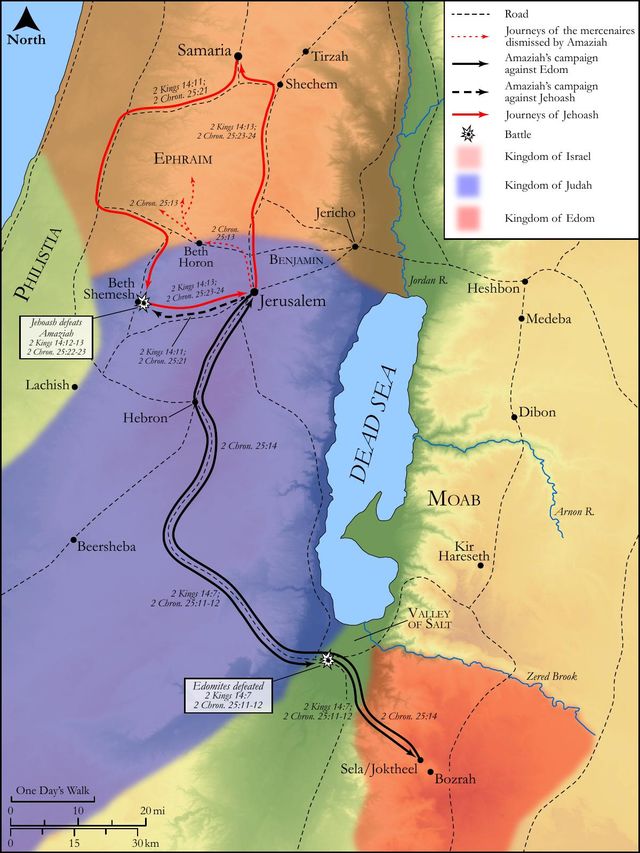
See on the biblical-era map
Study this verse
Public-domain commentary
Matthew Henry
From his Commentary on the Whole Bible. Henry comments on passages, not single verses — this entry covers 2 Chronicles 25:17–28. His three-level outline is real structure in the source text, so it is rendered as structure.
We have here this degenerate prince mortified by his neighbour and murdered by his own subjects.
I.Never was proud prince more thoroughly mortified than Amaziah was by Joash king of Israel.
1.This part of the story (which was as fully related Kg2 14:8, etc., as it is here) - embracing the foolish challenge which Amaziah sent to Joash (Ch2 25:17), his haughty scornful answer to it (Ch2 25:18), with the friendly advice he gave him to sit still and know when he was well off, (Ch2 25:19), - his wilfully persisting in his challenge (Ch2 25:20, Ch2 25:21), the defeat that was given him (Ch2 25:22), and the calamity he brought upon himself and his city thereby (Ch2 25:23, Ch2 25:24), - verifies two of Solomon's proverbs: - (1.) That a man's pride will bring him low, Pro 29:23. It goes before his destruction; not only procures it meritoriously, but is often the immediate occasion of it. He that exalteth himself shall be abased. (2.) That he that goes forth hastily to strive will probably not know what to do in the end thereof, when his neighbour has put him to shame, Pro 25:8. He that is fond of contention may have enough of it sooner than he thinks of.
2.But there are two passages in this story which we had not before in the Kings.
(1.)That Amaziah took advice before he challenged the king of Israel, Ch2 25:17. But of whom? Not of the prophet - he was not made of the king's counsel; but of his statesmen that would flatter him and bid him go up and prosper. It is good to take advice, but then it must be of those that are fit to advise us. Those that will not take advice from the word of God, which would guide them aright, will justly be left to the bad advice of those that will counsel them to their destruction. Let those be made fools that will not be made wise.
(2.)Amaziah's imprudence is here made the punishment of his impiety (Ch2 25:20): It was of the Lord; he left him to himself to act thus foolishly, that he and his people might be delivered into the hands of their enemies, because they had forsaken God and sought after the gods of Edom. Those that will not persuaded to do well for their souls will justly be given up to their own counsels to do ill for themselves even in their outward affairs.
II.Never was poor prince more violently pursued by his own subjects.
From the time that he departed from the Lord (so it may be read, Ch2 25:27) the hearts of his subjects departed from him, and they began to form a design against him in Jerusalem. It is probable they were exasperated against him more for his rashly engaging in a war against Israel than for his worshipping the gods of Edom. But at length the ferment grew so high, and he perceived the plot to be laid so deeply, that he thought fit to quit his royal city and flee to Lachish, either as a private place where he might be hid or as a strong place where he might be guarded; but they sent after him thither, and slew him there. By this the putting of him to death seems to have been done deliberately, and to have been the act, not of a disgusted servant or two, but of a considerable body that durst avow it. How unrighteous soever they were herein, God was righteous.
Continue studying 2 Chronicles 25:25 across the web’s major study libraries — every link below opens this exact verse, chapter, or book on the destination site.
Read & Compare
 BibleGatewayThis verse in more than 200 translations and 70 languages.
 Bible.comThe YouVersion reader — hundreds of translations, reading plans, and highlights.
 ESV.orgCrossway's official English Standard Version reader.
 NET BibleThe NET translation with 60,000+ translators' notes on every rendering decision.
 STEP BibleTyndale House's free study tool — original text, vocabulary, and scholarly resources.
 BibliaLogos Bible Software's free web reader.
 USCCBThe New American Bible (Revised Edition) with the U.S. bishops' study notes.
Commentaries
 BibleHub CommentariesDozens of classic commentaries on this verse, gathered on one page.
 StudyLightMore than 100 commentary sets — the largest collection on the web.
 BibleRefPlain-English commentary on what this verse means, verse by verse.
 Enduring WordDavid Guzik's free commentary on this chapter, widely used by Bible teachers.
 Bible Study ToolsVerse commentary alongside Greek and Hebrew study aids.
Original Language & Research
- BibleHub InterlinearThe verse word by word — original language, transliteration, and English.
- BibleHub LexiconEvery word's original-language definition and Strong's entry.
 Blue Letter BibleDeep-study tools — Strong's numbers, concordance, and word studies.
 SefariaThe Hebrew text with Rashi and centuries of Jewish commentary.
Sermons, Hymns & Audio


TrulyRandomVerse is not affiliated with these sites and doesn’t control their content. They’re linked because they’re genuinely useful.
Summary
Second Chronicles 25:25 serves as a poignant chronological marker in the narrative of King Amaziah of Judah, succinctly stating that he survived for fifteen years following the death of King Joash of Israel. This seemingly straightforward historical detail encapsulates a period of profound consequence for Amaziah, marking the aftermath of his humiliating defeat at Beth-shemesh and preceding his eventual assassination, thereby underscoring the enduring repercussions of his spiritual decline and political folly.
Context
ShowHideLiterary Context
This verse is strategically placed at the conclusion of a significant segment detailing Amaziah's reign, specifically following the account of his disastrous war with King Joash of Israel. The preceding verses in 2 Chronicles 25 meticulously chronicle Amaziah's initial commendable acts, his decisive victory over Edom, and his subsequent catastrophic descent into idolatry after his triumph (2 Chronicles 25:14). His hubris then led him to provoke Joash, which resulted in Judah's crushing defeat, Amaziah's capture, the breaching of Jerusalem's walls, and the plundering of the Temple treasury (2 Chronicles 25:20-24). Consequently, verse 25 functions as a concise bridge, summarizing the duration of Amaziah's life after this profound humiliation and before the chapter's concluding verses detail his ultimate demise through a conspiracy (2 Chronicles 25:27-28). It thus highlights a prolonged period of a troubled and declining reign.
Historical & Cultural Context
The historical period encompassed by 2 Chronicles 25 falls within the era of the Divided Monarchy, a time characterized by frequent, often destructive, conflicts between the northern kingdom of Israel and the southern kingdom of Judah, despite their shared ancestral and religious heritage. King Amaziah ruled Judah from approximately 796-767 BC, while King Joash ruled Israel from around 798-782 BC. The specific mention of Joash's death is chronologically significant, as it marks the end of a powerful adversary for Judah and provides a precise anchor for dating Amaziah's remaining years. Culturally, the institution of kingship in both Judah and Israel was profoundly intertwined with religious fidelity; a monarch's success or failure was consistently interpreted through the lens of their obedience or disobedience to Yahweh, a principle vividly illustrated by Amaziah's trajectory from initial faithfulness to apostasy and subsequent downfall. The Chronicler's emphasis on the duration of Amaziah's life after Joash's death subtly underscores the lingering and prolonged consequences of Amaziah's spiritual and political missteps.
Key Themes
ShowHideThis verse significantly contributes to several overarching themes consistently emphasized by the Chronicler. Primarily, it powerfully reinforces the theme of retributive justice, where a king's actions, particularly their loyalty and obedience to God, directly determine the prosperity or decline of their reign. Amaziah's initial success followed by his tragic downfall due to idolatry and pride is a quintessential example, with the "fifteen years" serving as a period of living under the shadow of divine judgment and its unfolding consequences. Secondly, it vividly illustrates the fragility and consequences of the Divided Monarchy, showcasing the destructive internal conflicts between Judah and Israel that weakened both kingdoms and diverted their focus from their covenantal obligations to God. The devastating battle at Beth-shemesh, which led to Amaziah's profound humiliation, serves as a stark reminder of this internal strife. Lastly, the verse functions as a crucial chronological marker, highlighting the Chronicler's meticulous attention to historical detail and the passage of time, which is frequently linked to the spiritual state of the kings and the nation, as observed throughout the broader narrative of 2 Chronicles.
Exposition and Analysis
ShowHideKey Word Analysis
ShowHide"to live, whether literally or figuratively; causatively, to revive." In this context, it signifies Amaziah's continued physical existence and reign. However, the Chronicler's narrative implies that this "living" was not a period of flourishing or restoration, but rather a prolonged existence under the weight of divine judgment and the consequences of his apostasy, leading to a state of decline rather than revival.
"properly, the hind part; generally used as an adverb or conjunction, after (in various senses)." This preposition is crucial, establishing a precise temporal relationship. It highlights that Amaziah's fifteen years of continued life and rule occurred subsequent to a pivotal event – the death of his victorious adversary, Joash. This emphasizes a post-crisis period, during which the repercussions of his earlier choices continued to unfold.
Comprising H2568 ("five") and H6240 ("ten") for "fifteen," and H8141 ("a year"). This precise numerical detail provides an exact chronological duration for the remainder of Amaziah's reign after Joash's death. It underscores that Amaziah did not immediately perish from his defeat but endured for a substantial period. For the Chronicler, such specific timeframes often serve to emphasize the long-term effects of a king's choices, allowing for the full manifestation of divine judgment and the eventual outworking of consequences, setting the stage for his eventual assassination.
Verse Breakdown
ShowHide"And Amaziah the son of Joash king of Judah"
This initial clause clearly identifies the primary subject of the verse, King Amaziah, specifying his lineage as the son of Joash and his royal affiliation with the southern kingdom of Judah. This immediately grounds the statement within the historical and dynastic context of the Davidic monarchy.
"lived after the death of Joash son of Jehoahaz king of Israel"
This central segment provides the critical chronological and relational reference point. It explicitly states that Amaziah's life and reign extended beyond the demise of his northern counterpart, King Joash of Israel, who had previously inflicted a devastating and humiliating defeat upon Judah. This juxtaposition highlights Amaziah's continued existence despite the national catastrophe he had brought about, and the passing of his victorious foe.
"fifteen years"
This concluding phrase quantifies the duration of Amaziah's post-Joash life. It precisely states that this period was not brief but extended for a decade and a half, allowing for the full weight of his earlier actions—his idolatry, pride, and foolish challenge—to manifest in his continued reign and ultimately, his tragic end. It serves as a precise historical detail that anchors the narrative within the Chronicler's meticulous chronological framework.
Literary Devices
ShowHideThe Chronicler employs several subtle yet effective literary devices in this concise verse. Primarily, it functions as a Chronological Marker, providing a precise temporal anchor for Amaziah's post-defeat reign, explicitly linking it to the death of his adversary, Joash. This meticulous precision is characteristic of the Chronicler's historical methodology, which often uses such details to structure the narrative and emphasize the unfolding of divine providence. There is also a strong element of Juxtaposition, as the verse explicitly contrasts Amaziah's continued life with Joash's death. This subtly highlights the irony of Amaziah surviving his victorious opponent only to face a prolonged period of decline, internal unrest, and a conspiratorial end. Furthermore, one can discern a subtle Foreshadowing in this seemingly neutral statement. The mention of Amaziah's continued life after such a significant defeat and without any indication of genuine repentance hints at the unresolved consequences and the lingering divine judgment that would ultimately culminate in his assassination, as detailed in the subsequent verses of the chapter.
Theological and Thematic Connections
ShowHide2 Chronicles 25:25, though a simple chronological statement, carries profound theological weight by underscoring the long-term consequences of spiritual compromise and pride. Amaziah's survival for fifteen years after his defeat and Joash's death is not presented as a sign of divine favor or a period of restoration, but rather as a prolonged season during which the seeds of his earlier idolatry and foolish challenge bore bitter fruit. His reign, though extended, was marked by the loss of respect, the lingering humiliation of a breached wall and plundered Temple, and ultimately, a conspiracy that ended his life. This serves as a stark reminder that God's judgment, while sometimes immediate, can also unfold over time, allowing for a prolonged experience of the repercussions of disobedience. It highlights the Chronicler's consistent theological message: faithfulness to God leads to blessing and stability, while apostasy and pride inevitably lead to decline and judgment, even if the full consequences are not immediately apparent.
Reflection and Application
ShowHideThe life of King Amaziah, particularly the fifteen years chronicled in this verse, offers a profound and sobering cautionary tale for believers today. It powerfully illustrates that merely surviving a crisis or even outliving an adversary does not equate to spiritual victory, restored favor, or a renewed relationship with God. Amaziah's extended life after his defeat was not a period of repentance and spiritual renewal, but rather one overshadowed by the persistent and unfolding consequences of his earlier choices—his idolatry, his pride, and his foolish disregard for divine warnings. This narrative serves as a vital reminder that a "good start" in faith, while commendable, is insufficient; enduring faithfulness, humility, and consistent obedience are paramount throughout our entire spiritual journey. We must vigilantly guard our hearts against the insidious creep of pride and the subtle allure of idols, whether they manifest as material possessions, worldly success, self-reliance, or even our own accomplishments. The lingering, destructive effects of Amaziah's unaddressed sin serve as a powerful warning: unrepentant pride and spiritual compromise can lead to a prolonged period of decline and ultimately, a tragic end, even if one physically endures the initial fallout. Our true victory is found not in outliving our earthly enemies, but in living fully for Christ, consistently seeking His will, and humbly submitting to His refining work in every season of our lives.
Questions for Reflection
ShowHideFAQ
ShowHideWhy does the Chronicler specifically mention Amaziah living "after the death of Joash" and for "fifteen years"?
ShowHideThe Chronicler's specific mention of Amaziah living "after the death of Joash" and for "fifteen years" serves multiple crucial purposes. Chronologically, it provides a precise historical marker, anchoring the duration of Amaziah's reign following his humiliating defeat by Joash of Israel. Theologically, it highlights that Amaziah did not immediately die from his defeat, but continued to rule for a significant period. This prolonged period allowed the full weight of the consequences of his spiritual apostasy and pride to unfold. It underscores that divine judgment, while certain, is not always instantaneous and can involve a prolonged experience of the repercussions of sin, allowing for the full outworking of a king's choices. For the Chronicler, such meticulous details often emphasize the principle that a king's actions have long-term effects on their reign and the nation, leading to a period of decline and eventual tragic end, as seen in Amaziah's assassination in 2 Chronicles 25:27. It implicitly suggests that these fifteen years were not a period of restoration or divine favor, but rather one of continued spiritual and political decay, a living testament to the consequences of unrepentant sin.
Christ-Centered Fulfillment
ShowHideWhile 2 Chronicles 25:25 primarily serves as a historical and chronological marker within the narrative of a flawed earthly king, it indirectly points to the profound contrast between human kingship, marked by frailty and sin, and the perfect, enduring reign of Christ. Amaziah's "fifteen years" after Joash's death were a period of lingering shame, political instability, and ultimate decline, culminating in his assassination. His life, marked by initial promise followed by pride and idolatry, stands in stark contrast to the reign of Jesus, the true and eternal King. Unlike Amaziah, whose survival after defeat merely prolonged a troubled and ultimately failed reign, Christ's "death and resurrection" (Romans 6:9-10) was not a defeat but the ultimate, decisive victory over sin, death, and all spiritual adversaries. He "lived after" His triumph over the grave, not for a mere fifteen years, but for eternity, establishing a kingdom that "shall have no end" (Luke 1:33). Where Amaziah's pride led to a breached wall and plundered treasury, Christ's profound humility and perfect obedience unto death secured an eternal inheritance for His people (Hebrews 9:15). The tragic and ignominious end of Amaziah's extended but troubled reign highlights humanity's desperate need for a perfect, faithful King—one whose life and rule are not marred by sin, whose victory is absolute, and whose reign brings eternal life, true peace, and ultimate justice, found only in Jesus Christ, the "King of kings and Lord of lords" (Revelation 19:16).