


2 Chronicles 25:21
- וַיַּעַלvai·Ya·'aland he went upH5927Conj-w ¦ V-Qal-ConsecImperf-3msVerb Qal Consecutive Imperfect 3rd Singular Masculineוַandיַּעַלhe went up
- יוֹאָשׁyo·'AshJoashH3101N-proper-mNoun Proper Masculine
- מֶלֶךְMe·lekh[the] king ofH4428N-mscNoun Singular Masculine Construct
- יִשְׂרָאֵלYis·ra·'ElIsraelH3478N-properNoun Proper Location
- וַיִּתְרָאוּvai·yit·ra·'Uand they looked at one anotherH7200Conj-w ¦ V-Hithpael-ConsecImperf-3mpVerb Hithpael Consecutive Imperfect 3rd Plural Masculineוַandיִּתְרָאוּthey looked at one another
- פָנִיםfa·NimfacesH6440N-mpNoun Plural Masculine Absolute
- הוּאhu'heH1931Pro-3msPronoun Personal 3rd Singular Masculine
- וַאֲמַצְיָהוּva·'a·matz·Ya·huand AmaziahH558Conj-w ¦ N-proper-mNoun Proper MasculineוַandאֲמַצְיָהוּAmaziah
- מֶלֶךְMe·lekh[the] king ofH4428N-mscNoun Singular Masculine Construct
- יְהוּדָהye·hu·DahJudahH3063N-properNoun Proper Location
- בְּבֵיתbe·Veitat BethH1053Prep-b ¦ N-properNoun Proper LocationבְּatבֵיתBeth
- שֶׁמֶשׁShe·meshShemeshH1053N-properNoun Proper Location
- אֲשֶׁר'a·SherwhichH834RelParticle Relative
- לִיהוּדָהli·hu·Dah[belonged] to JudahH3063Prep-l ¦ N-properNoun Proper Locationלִ[belonged] toיהוּדָהJudah
English is a literal word-by-word gloss of the Hebrew, not the KJV's wording. Why?
This is the original text the KJV's translators worked from — each Hebrew word with its own literal English meaning in this verse, prepared by scholars at Tyndale House, Cambridge. The KJV translates whole sentences, not word by word, so its wording differs: one Hebrew word can become several English words, and the KJV may choose “the LORD” where the gloss reads “Yahweh”. Both are faithful — they answer different questions. For the KJV's own rendering, switch to the KJV text.
Details
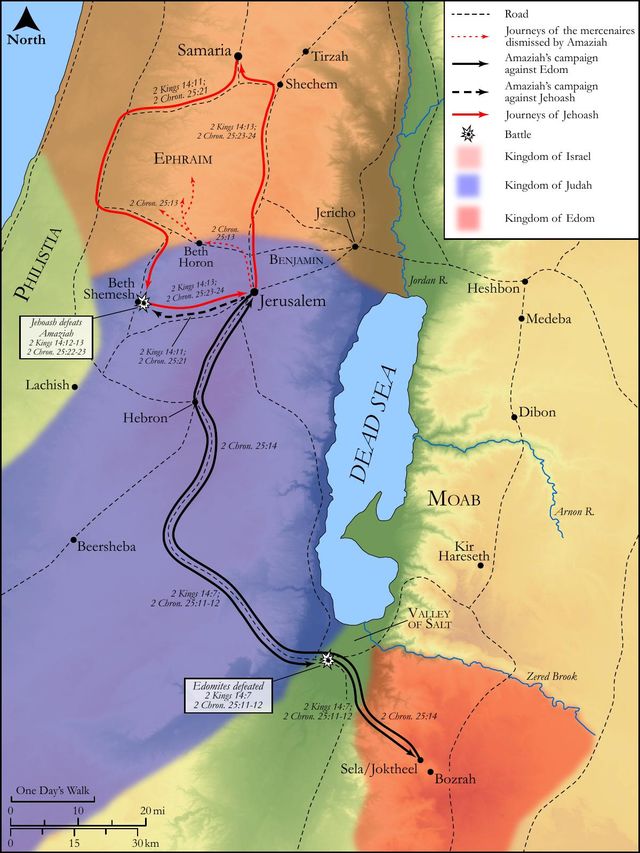
See on the biblical-era map
Study this verse
Public-domain commentary
Matthew Henry
From his Commentary on the Whole Bible. Henry comments on passages, not single verses — this entry covers 2 Chronicles 25:17–28. His three-level outline is real structure in the source text, so it is rendered as structure.
We have here this degenerate prince mortified by his neighbour and murdered by his own subjects.
I.Never was proud prince more thoroughly mortified than Amaziah was by Joash king of Israel.
1.This part of the story (which was as fully related Kg2 14:8, etc., as it is here) - embracing the foolish challenge which Amaziah sent to Joash (Ch2 25:17), his haughty scornful answer to it (Ch2 25:18), with the friendly advice he gave him to sit still and know when he was well off, (Ch2 25:19), - his wilfully persisting in his challenge (Ch2 25:20, Ch2 25:21), the defeat that was given him (Ch2 25:22), and the calamity he brought upon himself and his city thereby (Ch2 25:23, Ch2 25:24), - verifies two of Solomon's proverbs: - (1.) That a man's pride will bring him low, Pro 29:23. It goes before his destruction; not only procures it meritoriously, but is often the immediate occasion of it. He that exalteth himself shall be abased. (2.) That he that goes forth hastily to strive will probably not know what to do in the end thereof, when his neighbour has put him to shame, Pro 25:8. He that is fond of contention may have enough of it sooner than he thinks of.
2.But there are two passages in this story which we had not before in the Kings.
(1.)That Amaziah took advice before he challenged the king of Israel, Ch2 25:17. But of whom? Not of the prophet - he was not made of the king's counsel; but of his statesmen that would flatter him and bid him go up and prosper. It is good to take advice, but then it must be of those that are fit to advise us. Those that will not take advice from the word of God, which would guide them aright, will justly be left to the bad advice of those that will counsel them to their destruction. Let those be made fools that will not be made wise.
(2.)Amaziah's imprudence is here made the punishment of his impiety (Ch2 25:20): It was of the Lord; he left him to himself to act thus foolishly, that he and his people might be delivered into the hands of their enemies, because they had forsaken God and sought after the gods of Edom. Those that will not persuaded to do well for their souls will justly be given up to their own counsels to do ill for themselves even in their outward affairs.
II.Never was poor prince more violently pursued by his own subjects.
From the time that he departed from the Lord (so it may be read, Ch2 25:27) the hearts of his subjects departed from him, and they began to form a design against him in Jerusalem. It is probable they were exasperated against him more for his rashly engaging in a war against Israel than for his worshipping the gods of Edom. But at length the ferment grew so high, and he perceived the plot to be laid so deeply, that he thought fit to quit his royal city and flee to Lachish, either as a private place where he might be hid or as a strong place where he might be guarded; but they sent after him thither, and slew him there. By this the putting of him to death seems to have been done deliberately, and to have been the act, not of a disgusted servant or two, but of a considerable body that durst avow it. How unrighteous soever they were herein, God was righteous.
Continue studying 2 Chronicles 25:21 across the web’s major study libraries — every link below opens this exact verse, chapter, or book on the destination site.
Read & Compare
 BibleGatewayThis verse in more than 200 translations and 70 languages.
 Bible.comThe YouVersion reader — hundreds of translations, reading plans, and highlights.
 ESV.orgCrossway's official English Standard Version reader.
 NET BibleThe NET translation with 60,000+ translators' notes on every rendering decision.
 STEP BibleTyndale House's free study tool — original text, vocabulary, and scholarly resources.
 BibliaLogos Bible Software's free web reader.
 USCCBThe New American Bible (Revised Edition) with the U.S. bishops' study notes.
Commentaries
 BibleHub CommentariesDozens of classic commentaries on this verse, gathered on one page.
 StudyLightMore than 100 commentary sets — the largest collection on the web.
 BibleRefPlain-English commentary on what this verse means, verse by verse.
 Enduring WordDavid Guzik's free commentary on this chapter, widely used by Bible teachers.
 Bible Study ToolsVerse commentary alongside Greek and Hebrew study aids.
Original Language & Research
- BibleHub InterlinearThe verse word by word — original language, transliteration, and English.
- BibleHub LexiconEvery word's original-language definition and Strong's entry.
 Blue Letter BibleDeep-study tools — Strong's numbers, concordance, and word studies.
 SefariaThe Hebrew text with Rashi and centuries of Jewish commentary.
Sermons, Hymns & Audio


TrulyRandomVerse is not affiliated with these sites and doesn’t control their content. They’re linked because they’re genuinely useful.
Summary
2 Chronicles 25:21 precisely captures the critical juncture preceding the calamitous conflict between the two Hebrew kingdoms, Judah and Israel. It meticulously records the direct, face-to-face confrontation between King Amaziah of Judah and King Joash of Israel at Bethshemesh, a city situated within Judah's territory. This verse serves as the narrative's point of no return, irrevocably setting the stage for Amaziah's divinely ordained defeat, a consequence of his escalating pride, persistent refusal to heed prophetic counsel, and profound descent into idolatry following his initial victory over Edom.
Context
ShowHideLiterary Context
This verse acts as the immediate and dramatic prelude to the devastating battle between Judah and Israel, marking the culmination of King Amaziah's narrative arc of spiritual decline. Following his initial, albeit partial, obedience to God and a significant military victory over Edom, detailed in 2 Chronicles 25:11-12, Amaziah committed a grave spiritual error by adopting the idols of Edom and worshipping them, as recorded in 2 Chronicles 25:14. Despite a stern warning from a prophet, Amaziah's heart was hardened, a state explicitly attributed to God's sovereign will to deliver him into the hands of his enemies because of his profound idolatry (2 Chronicles 25:15-20). Inflated with arrogance stemming from his recent success, Amaziah foolishly challenged Joash, King of Israel, to battle (2 Chronicles 25:17). Joash's condescending parable about a thistle and a cedar (2 Chronicles 25:18) served as a clear warning against Amaziah's pride, but the king of Judah defiantly refused to listen. Thus, 2 Chronicles 25:21 brings the two kings to the field, signifying the inevitable clash and the onset of divine judgment.
Historical & Cultural Context
The historical backdrop of 2 Chronicles 25 is the divided monarchy, a tragic reality for God's people since the schism that occurred after Solomon's reign, as narrated in 1 Kings 12. Relations between Judah (the southern kingdom) and Israel (the northern kingdom) were frequently strained, characterized by periods of both uneasy alliance and open warfare. Bethshemesh, meaning "House of the Sun," was a significant city located in the Shephelah, a low-lying region situated between the Judean hills and the Philistine plain. Its strategic importance made it a frequently contested border town. The fact that the battle occurred within Judah's territory, specifically at Bethshemesh, underscores that Joash's "going up" represented a deliberate invasion of Judah, not merely a neutral meeting. Culturally, royal challenges to battle were not uncommon in the ancient Near East, often driven by perceived slights, territorial disputes, or, as in this case, a king's overconfidence and hubris. This narrative highlights the ongoing spiritual decline within both kingdoms, particularly Judah under Amaziah, which tragically led to such internal strife, a stark contrast to God's original design for a unified, faithful nation.
Key Themes
ShowHideThis verse powerfully contributes to several overarching themes within 2 Chronicles and the broader biblical narrative. Firstly, it starkly underscores the Consequences of Pride and Arrogance. Amaziah's inflated ego, fueled by his recent victory over Edom, directly led him to provoke a stronger adversary, resulting in his catastrophic downfall. Secondly, the narrative explicitly highlights Divine Judgment and Sovereignty. God's hand is seen actively orchestrating Amaziah's defeat as a direct consequence of his spiritual unfaithfulness and profound idolatry, particularly his adoption of Edomite gods, as clearly stated in 2 Chronicles 25:20. This demonstrates that God holds even kings accountable for their actions and that His justice prevails. Thirdly, the verse tragically illustrates the Internal Conflict and Disunity within the divided kingdom, a recurring and sorrowful theme throughout the books of Kings and Chronicles. The confrontation between two kings of God's chosen people, leading to bloodshed, stands as a poignant reminder of the brokenness caused by sin and departure from God's covenant. Lastly, it implicitly touches on the Peril of Idolatry, as Amaziah's turning to foreign gods directly precipitates his judgment and ultimate defeat.
Exposition and Analysis
ShowHideKey Word Analysis
ShowHideThe Hebrew verb עָלָה (ʻâlâh), Strong's H5927, signifies an ascent, whether literally going uphill or, more frequently in military contexts, "going up" to battle or to attack a fortified city. Here, it denotes Joash's decisive and aggressive military movement to engage Amaziah, accepting the challenge and initiating the confrontation. It implies a purposeful, determined advance into enemy territory.
The verb רָאָה (râʼâh), Strong's H7200, means "to see" or "to behold." When combined with "face" (pânîym), as in "saw one another in the face," it forms a powerful idiom (râʼû pânîym). This idiom denotes a direct, personal, and unavoidable confrontation, often in a hostile or confrontational context. It is not merely a casual meeting but a poised readiness for combat, where the leaders themselves are present on the field, indicating the inevitability and seriousness of the impending battle. It emphasizes a point of no return, where negotiation or retreat are no longer options.
The name בֵּית שֶׁמֶשׁ (Bêyth Shemesh), Strong's H1053, literally means "House of the Sun," pointing to an ancient cultic site. Its strategic location in the Shephelah, a border region between Judah and Philistia, made it a frequently contested area. For the battle to occur here, within Judah's territory ("which belongeth to Judah"), highlights Joash's successful invasion and the direct threat posed to Amaziah's kingdom on its home ground, underscoring the severity of the conflict.
Verse Breakdown
ShowHide"So Joash the king of Israel went up;"
This initial clause establishes Joash's active role and initiative in response to Amaziah's challenge. It signifies his military mobilization and aggressive advance into Judahite territory, setting the immediate stage for the direct and climactic confrontation. This movement is a deliberate act of war.
"and they saw one another in the face, [both] he and Amaziah king of Judah,"
This is the pivotal core of the verse, emphasizing the intensely personal and direct nature of the encounter between the two reigning monarchs. The Hebrew idiom "saw one another in the face" (râʼû pânîym) underscores that this was a decisive, confrontational meeting, signifying the irreversible point of no return for the impending battle. It highlights the exceptionally high stakes, with both kings personally present on the battlefield, ready for the inevitable clash.
"at Bethshemesh, which [belongeth] to Judah."
This concluding clause precisely specifies the geographical location of the confrontation. Bethshemesh's position unequivocally within Judah's borders emphasizes that Israel had successfully invaded Judah, bringing the conflict directly to Amaziah's home kingdom. This detail intensifies the gravity of the situation for Judah, signifying a direct assault on its sovereignty and territory.
Literary Devices
ShowHideThe verse employs several potent literary devices to convey its dramatic and theological significance. Foreshadowing is prominently featured, as the direct, face-to-face confrontation of the kings at Bethshemesh immediately precedes the detailed account of Judah's crushing defeat in the subsequent verses. This meeting is presented as the irreversible point of no return, signaling the inevitable conflict and its dire consequences. There is a strong element of Irony present; Amaziah, fresh from a significant victory over Edom, now faces a humiliating defeat at the hands of his own kin, a direct consequence of his pride and idolatry. The narrative also employs Geographical Significance, with Bethshemesh, a city explicitly stated as "belonging to Judah," serving as the battleground. This detail underscores the invasion of Judahite territory by Israel, intensifying the sense of internal strife and the direct threat to Amaziah's kingdom. Finally, the phrase "saw one another in the face" functions as a powerful Idiom, conveying the direct, unavoidable, and highly charged nature of the encounter, far beyond a mere visual recognition, emphasizing the imminent and personal clash of wills.
Theological and Thematic Connections
ShowHideThe confrontation at Bethshemesh serves as a stark theological lesson on the perils of pride and the certainty of divine judgment for unrepentant sin, particularly idolatry. Amaziah's success against Edom inflated his ego, leading him to defiantly disregard God's prophet and foolishly provoke a stronger adversary. This narrative powerfully illustrates God's sovereignty, even in allowing human choices to lead to their natural, yet divinely ordained, consequences. The internal conflict between Judah and Israel also serves as a tragic reminder of the fractured nature of God's people when they deviate from His covenant and succumb to sin. God's justice is unwavering, and He will oppose the proud, even those in positions of power, demonstrating that true strength and security lie not in human might or past victories, but in humble obedience to Him.
Reflection and Application
ShowHideThe poignant story of Amaziah's downfall, culminating in the fateful confrontation at Bethshemesh, serves as a timeless and profound warning for believers today. Like Amaziah, we can easily become blinded by our past successes, allowing an insidious pride to subtly creep into our hearts and distort our judgment. Whether in personal achievements, spiritual growth, professional triumphs, or even ministry successes, humility is not merely a virtue but a paramount necessity for sustained faithfulness. This passage underscores the critical importance of actively seeking and humbly heeding wise counsel, especially when it comes from God's messengers or His Word, even if it challenges our ego, our comfortable plans, or our preconceived notions. Amaziah's stubborn refusal to listen to the prophet, coupled with his turning to idolatry, powerfully illustrates that unrepentant sin and spiritual arrogance can inevitably lead to self-inflicted wounds and severe divine discipline. We are powerfully reminded that God's judgment is not arbitrary or capricious, but a just and righteous response to unfaithfulness. Therefore, we must constantly examine our hearts for any form of idolatry – anything that subtly or overtly takes God's rightful place – and cultivate a spirit of profound dependence on Him, rather than presumptuously relying on our own strength, wisdom, or past victories.
Questions for Reflection
ShowHideFAQ
ShowHideWhy did God allow this battle to happen, especially since both were kings of Israel/Judah?
ShowHideThe narrative explicitly states that God allowed this battle to occur as a direct consequence and judgment for Amaziah's profound unfaithfulness. After his initial victory over Edom, Amaziah committed a grave sin by adopting the Edomite idols and beginning to worship them (2 Chronicles 25:14). Despite a prophet's clear and direct warning, Amaziah defiantly refused to repent, hardening his heart against God's word. 2 Chronicles 25:20 declares, "Now Amaziah would not hear; for it came of God, that he might deliver them into the hand of their enemies, because they sought after the gods of Edom." God, in His perfect sovereignty and unwavering justice, allowed Amaziah's pride and idolatry to lead him into a conflict that would result in his decisive defeat, thereby demonstrating that He holds even His covenant people, including their kings, fully accountable for their sin and disobedience.
What is the significance of Bethshemesh as the battle location?
ShowHideBethshemesh, whose name literally means "House of the Sun," was a strategically important city located in the Shephelah, a low-lying region situated between the Judean hills and the Philistine plain. It frequently served as a border town and was, therefore, a contested area. Its significance in this context lies in the explicit detail that it "belongeth to Judah," meaning the battle took place squarely on Amaziah's home turf. This signifies that Joash, King of Israel, had successfully invaded Judahite territory, making the confrontation a direct assault on Amaziah's kingdom, rather than a mere border skirmish or a neutral meeting. This detail profoundly underscored the gravity of the internal conflict and the direct threat posed to Judah's sovereignty and very existence. Historically, Bethshemesh is also notably known as the place where the Ark of the Covenant was returned by the Philistines (1 Samuel 6), adding a layer of historical and theological resonance to the location.
Christ-Centered Fulfillment
ShowHideThe tragic confrontation between Amaziah and Joash at Bethshemesh, born of pride, idolatry, and the fractured state of God's people, finds its ultimate resolution and profound reversal in the person and work of Jesus Christ. While Amaziah's inflated pride led to his catastrophic downfall and the further division of the earthly kingdom, Christ embodies perfect humility, choosing to empty Himself and take on the very form of a servant, even to the ignominious point of death on a cross (Philippians 2:5-8). Unlike Amaziah, who foolishly turned to false gods and idols, Jesus is the one true God, the divine Son who came to reconcile humanity to the Father, breaking down the dividing wall of hostility that had separated people from God and from each other (Ephesians 2:14). The "face-to-face" confrontation at Bethshemesh led only to defeat, further brokenness, and national humiliation, but Christ's ultimate "face-to-face" encounter with sin, death, and the powers of darkness on the cross resulted in glorious, decisive victory, disarming the principalities and authorities (Colossians 2:15). He willingly took upon Himself the divine judgment for our pride and idolatry, enduring the wrath that Amaziah experienced as a consequence of his sin, so that we might receive immeasurable grace, forgiveness, and reconciliation with God (Isaiah 53:5). Through Christ, the divided kingdom of humanity, fractured by sin and rebellion, is brought into a unified, eternal kingdom where He reigns as the Prince of Peace, bringing true unity, an end to all strife, and everlasting righteousness (Luke 1:33).