


1 Chronicles 13:13
Bible text: King James Version (1769 Blayney text) · Public domain
Bible text: Berean Standard Bible · Public domain
Bible text: American Standard Version (1901) · Public domain
Bible text: World English Bible, Messianic edition · Public domain
Bible text: Geneva Bible (1599) · Public domain
Bible text: Young's Literal Translation · Public domain
- וְלֹאve·lo'and notH3808Conj-w ¦ NegParticle Negativeוְandלֹאnot
- הֵסִירhe·Sirhe turned asideH5493V-Hiphil-Perf-3msVerb Hiphil Perfect 3rd Singular Masculine
- דָּוִידda·VidDavidH1732N-proper-mNoun Proper Masculine
- אֶת'et<obj.>H853DirObjMParticle Object Indicator
- הָאָרוֹןha·'a·Ronthe arkH727Art ¦ N-msNoun Singular Masculine Absoluteהָtheאָרוֹןark
- אֵלָיו'e·Lavto himselfH413Prep ¦ 3msPrepositionאֵלָיtoוhimself
- אֶל'eltoH413PrepPreposition
- עִיר'ir[the] city ofH5892N-fscNoun Singular Feminine Construct
- דָּוִידda·VidDavidH1732N-proper-mNoun Proper Masculine
- וַיַּטֵּהוּvai·ya·Te·huand he turned aside itH5186Conj-w ¦ V-Hiphil-ConsecImperf-3ms ¦ 3msVerb Hiphil Consecutive Imperfect 3rd Singular Masculineוַandיַּטֵּhe turned asideהוּit
- אֶל'eltoH413PrepPreposition
- בֵּיתbeit[the] house ofH1004N-mscNoun Singular Masculine Construct
- עֹבֵד'oedObed-H5654N-proper-mNoun Proper Masculine
- אֱדֹם'e·DomEdomH5654N-proper-mNoun Proper Masculine
- הַגִּתִּיha·gi·Tithe GittiteH1663Art ¦ N-msNoun Gentilic Singular Masculine AbsoluteהַtheגִּתִּיGittite
English is a literal word-by-word gloss of the Hebrew, not the KJV's wording. Why?
This is the original text the KJV's translators worked from — each Hebrew word with its own literal English meaning in this verse, prepared by scholars at Tyndale House, Cambridge. The KJV translates whole sentences, not word by word, so its wording differs: one Hebrew word can become several English words, and the KJV may choose “the LORD” where the gloss reads “Yahweh”. Both are faithful — they answer different questions. For the KJV's own rendering, switch to the KJV text.
Details
See on the biblical-era map
Study this verse
Public-domain commentary
Matthew Henry
From his Commentary on the Whole Bible. Henry comments on passages, not single verses — this entry covers 1 Chronicles 13:9–14.
This breach upon Uzza, which caused all the joy to cease, we had an account of, Sa2 6:6, etc. 1. Let the sin of Uzza warn us all to take heed of presumption, rashness, and irreverence, in dealing about holy things (Ch1 13:9), and not to think that a good intention will justify a bad action. In our communion with God we must carefully watch over our own hearts, lest familiarity breed contempt, and we think God is in any way beholden to us. 2. Let the punishment of Uzza convince us that the God with whom we have to do is a jealous God. His death, like that of Nadab and Abihu, proclaims aloud that God will be sanctified in those that come nigh unto him (Lev 10:3), and that the nearer any are to him the more displeased he is with their presumptions. Let us not dare to trifle with God in our approaches to him; and yet let us, through Christ, come boldly to the throne of grace; for we are under the dispensation of liberty and grace, not of bondage and terror. 3. Let the damp this gave to the joy of Israel be a memorandum to us always to rejoice with trembling, and to serve the Lord with fear, even when we serve him with gladness. 4. Let David's displeasure upon this occasion caution us to take heed to our spirits when we are under divine rebukes, lest, instead of submitting to God, we quarrel with him. If God be angry with us, shall we dare to be angry with him? 5. Let the stop thus put to the solemnity caution us not to be driven off from our duty by those providences which are only intended to drive us from our sins. David should have gone on with the work notwithstanding the breach made upon Uzza; so might the breach have been made up. 6. Let the blessing which the ark brought with it to the house of Obed-edom encourage us to welcome God's ordinances into our houses, as those that believe the ark is a guest that nobody shall lose by; not let it be less precious to us for its being to some a stone of stumbling and a rock of offence. If the gospel be to some a savour of death unto death, as the ark was to Uzza, yet let us receive it in the love of it and it will be to us a saviour of life unto life.
Continue studying 1 Chronicles 13:13 across the web’s major study libraries — every link below opens this exact verse, chapter, or book on the destination site.
Read & Compare
 BibleGatewayThis verse in more than 200 translations and 70 languages.
 Bible.comThe YouVersion reader — hundreds of translations, reading plans, and highlights.
 ESV.orgCrossway's official English Standard Version reader.
 NET BibleThe NET translation with 60,000+ translators' notes on every rendering decision.
 STEP BibleTyndale House's free study tool — original text, vocabulary, and scholarly resources.
 BibliaLogos Bible Software's free web reader.
 USCCBThe New American Bible (Revised Edition) with the U.S. bishops' study notes.
Commentaries
 BibleHub CommentariesDozens of classic commentaries on this verse, gathered on one page.
 StudyLightMore than 100 commentary sets — the largest collection on the web.
 BibleRefPlain-English commentary on what this verse means, verse by verse.
 Enduring WordDavid Guzik's free commentary on this chapter, widely used by Bible teachers.
 Bible Study ToolsVerse commentary alongside Greek and Hebrew study aids.
Original Language & Research
- BibleHub InterlinearThe verse word by word — original language, transliteration, and English.
- BibleHub LexiconEvery word's original-language definition and Strong's entry.
 Blue Letter BibleDeep-study tools — Strong's numbers, concordance, and word studies.
 SefariaThe Hebrew text with Rashi and centuries of Jewish commentary.
Sermons, Hymns & Audio


TrulyRandomVerse is not affiliated with these sites and doesn’t control their content. They’re linked because they’re genuinely useful.
Summary
1 Chronicles 13:13 details a critical pivot in King David's initial attempt to bring the Ark of the Covenant to Jerusalem. Following the tragic, divinely ordained death of Uzzah, David's joyous procession was abruptly halted by fear and a profound realization of God's holiness. Consequently, David abandoned his immediate plan to house the sacred Ark in his capital, instead diverting it to the residence of Obed-Edom the Gittite, a decision that unexpectedly ushered in a period of remarkable divine blessing.
Context
ShowHideLiterary Context
This verse is strategically placed at the climax of David's first, ill-fated endeavor to transport the Ark of God to Jerusalem. The preceding narrative in 1 Chronicles 13:1-8 describes the grand assembly and David's zealous, yet unbiblical, decision to transport the Ark on a new cart, rather than by the divinely prescribed method of carrying it on poles by the Kohathite Levites, as detailed in Numbers 4:15. The narrative reaches its terrifying peak in 1 Chronicles 13:9-10, where Uzzah, attempting to steady the Ark, is struck dead by God for touching it. This shocking event profoundly transforms David's initial joy into anger and then deep fear, as explicitly stated in 1 Chronicles 13:12. Verse 13, therefore, serves as the immediate consequence of this fear, marking the temporary suspension of David's grand plan and setting the stage for the Ark's three-month sojourn in Obed-Edom's house, which is then followed by the properly orchestrated transfer in 1 Chronicles 15.
Historical & Cultural Context
The Ark of the Covenant was the preeminent symbol of Yahweh's presence among Israel, containing the tablets of the Ten Commandments, Aaron's rod, and a pot of manna. Its handling was governed by extremely strict Mosaic laws, primarily found in the book of Numbers. Only specific Levite clans, the Kohathites, were permitted to carry it, and then only by poles inserted through rings, never by direct touch or on a cart. David's initial method, while perhaps influenced by Philistine practices (as seen in 1 Samuel 6:7-8), was a direct violation of these divine stipulations. David's reign was characterized by his efforts to consolidate the kingdom and establish Jerusalem as both the political and religious capital. Bringing the Ark to Jerusalem was central to this vision. The designation "Obed-Edom the Gittite" is significant; while "Gittite" often refers to an inhabitant of the Philistine city of Gath, scriptural genealogies (e.g., 1 Chronicles 26:4-5) identify Obed-Edom as a Levite, specifically a Korahite gatekeeper. This suggests "Gittite" likely refers to his residence in Gath-Rimmon, a Levitical city (Joshua 21:24), confirming his suitability and understanding of the sacred protocols for hosting the Ark.
Key Themes
ShowHideThis verse powerfully underscores several major themes within the book of 1 Chronicles and the broader biblical narrative. Firstly, it highlights the absolute holiness and sovereignty of God. The Uzzah incident, leading to David's fear and the Ark's diversion, serves as a stark reminder that God is not to be approached or handled casually, but on His own terms, with profound reverence and strict obedience to His commands. Secondly, it emphasizes the necessity of obedience to God's revealed will. David's initial zeal was commendable, but his method was flawed, demonstrating that good intentions do not supersede divine instruction. This incident forces David to learn the importance of meticulous adherence to God's law. Thirdly, the verse subtly introduces the theme of divine blessing, which becomes explicitly evident in the subsequent verse, 1 Chronicles 13:14. The temporary lodging of the Ark, born out of fear, unexpectedly becomes a conduit of abundant blessing for Obed-Edom's household, illustrating God's gracious favor upon those who honor His presence, even in unforeseen circumstances.
Exposition and Analysis
ShowHideKey Word Analysis
ShowHideThis term refers to the Ark of the Covenant, the most sacred object in Israel, symbolizing God's throne, His presence among His people, and the covenant relationship. Its presence signified divine authority and blessing, but also demanded strict adherence to the laws governing its handling, underscoring God's unapproachable holiness and the severe consequences of irreverence.
From the root meaning "to stretch or spread out," this verb here implies "to bend away" or "to turn aside." It vividly describes David's abrupt change of course for the Ark, diverting it from its intended destination in Jerusalem. This action was a direct consequence of his fear and a recognition that the Ark could not proceed without proper reverence and adherence to divine protocol.
"Obed-Edom" means "servant of Edom" or "servant of the Lord." The "Gittite" designation indicates his origin or residence in Gath-Rimmon, a Levitical city. This identity is crucial, as Obed-Edom was a Levite (a Korahite), making him knowledgeable about the proper care and reverence due to the Ark, thus his house became a suitable, albeit temporary, sanctuary for the sacred object.
Verse Breakdown
ShowHide"So David brought not the ark [home] to himself to the city of David,"
This clause reveals David's immediate and decisive change of plans. The connective "so" links directly to the fear and anger David experienced after Uzzah's death. His initial ambition to bring the Ark "home to himself" into his personal city, Jerusalem, was abruptly halted. This decision was not merely a logistical one but a profound response to God's manifest holiness and a recognition that the Ark could not be treated as a mere national trophy or personal possession without dire consequences.
"but carried it aside into the house of Obededom the Gittite."
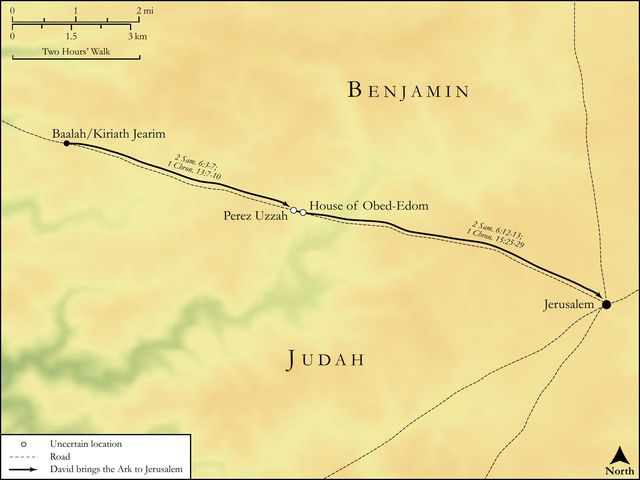
This second clause details the alternative action David took. Instead of proceeding to Jerusalem, the Ark was "carried aside," indicating a diversion from its intended path. The choice of Obed-Edom's house was likely based on its proximity to the site of Uzzah's death (Perez-Uzzah) and David's knowledge of Obed-Edom's Levitical lineage, which would ensure appropriate care for the sacred object. This temporary lodging, though born of fear and uncertainty, paradoxically became the setting for a powerful demonstration of God's blessing, paving the way for David's later, more reverent approach.
Literary Devices
ShowHideThe verse employs several effective literary devices. Contrast is prominent, juxtaposing David's initial enthusiastic but flawed attempt to bring the Ark to his capital with his sudden fear-driven decision to divert it. The intended destination, the "City of David," stands in stark contrast to the unexpected, temporary resting place in "the house of Obed-Edom," highlighting the disruption of human plans by divine intervention. There is also an element of irony; the mighty King David, who desires to establish God's presence in his capital, is rendered incapable of doing so by his own error, while a seemingly less prominent figure, Obed-Edom, becomes the unexpected recipient of God's manifest blessing. This narrative choice serves to underscore God's sovereignty over human status and ambition. Furthermore, the verse serves as a subtle form of foreshadowing, hinting at the divine favor that would rest upon Obed-Edom's house, which is explicitly detailed in the very next verse.
Theological and Thematic Connections
ShowHide1 Chronicles 13:13 profoundly illustrates the unapproachable holiness of God and the absolute necessity of approaching Him on His own terms, not ours. David's initial, well-intentioned but presumptuous method of transporting the Ark on a cart, contrary to divine command, resulted in a swift and severe judgment. This incident served as a stark reminder that God's presence, while a source of blessing, is also a consuming fire for those who disregard His revealed will. David's fear was a healthy, albeit painful, lesson in reverence, forcing him to re-evaluate his understanding of God's character and the protocols for worship. The subsequent blessing on Obed-Edom's house, where the Ark was properly honored, further emphasizes that divine favor flows from obedience and reverence, even in unexpected and temporary circumstances.
Reflection and Application
ShowHideThis verse serves as a powerful reminder that our zeal for God, however fervent, must always be tempered by a profound reverence for His holiness and a diligent adherence to His revealed will. David's initial failure, born from good intentions but flawed execution, teaches us that God is concerned not only with "what" we do for Him, but "how" we do it. We are called to approach God not with casual familiarity or presumptuousness, but with a humble and obedient heart, recognizing His transcendent majesty. The unexpected blessing on Obed-Edom's house further encourages us, demonstrating that God's presence, when honored, brings abundant favor, even in circumstances that initially seem like setbacks or diversions. It challenges us to trust God's timing and methods, even when they differ from our own well-laid plans, and to recognize that His blessings can manifest in the most surprising places when His holiness is respected.
Questions for Reflection
ShowHideFAQ
ShowHideWhy was Uzzah struck dead for touching the Ark, and how did this affect David?
ShowHideUzzah was struck dead because his action, though seemingly well-intentioned, violated a direct divine command regarding the Ark's handling. According to Numbers 4:15, only the Kohathite Levites were permitted to carry the Ark, and then only by its poles; touching the Ark directly was strictly forbidden under penalty of death, as it represented God's unapproachable holiness. God's judgment underscored His absolute sovereignty and the seriousness of His commands. This event profoundly affected David, transforming his initial joy into anger and then deep fear (1 Chronicles 13:11-12). He recognized the immense gravity of God's holiness and questioned his own ability to host such a sacred object, leading to the decision to divert the Ark.
Who was Obed-Edom, and why was the Ark placed in his house?
ShowHideObed-Edom was a Levite, specifically a Korahite, from Gath-Rimmon, a Levitical city (1 Chronicles 26:4). His Levitical heritage meant he would have been familiar with the proper reverence and care due to the Ark. The Ark was placed in his house out of necessity and David's immediate fear. After Uzzah's death, David was unwilling to bring the Ark into Jerusalem due to the perceived danger (1 Chronicles 13:12), so he needed a safe, temporary resting place for it. Obed-Edom's house, likely nearby the site of the tragedy, provided this immediate solution, and his Levitical background made him a suitable caretaker.
What is the significance of the Ark being diverted from the "City of David"?
ShowHideThe diversion of the Ark from the "City of David" (Jerusalem) is highly significant. It highlights David's initial failure to understand and adhere to God's specific instructions for handling sacred things, despite his good intentions. This temporary setback meant a delay in establishing Jerusalem as the spiritual center of Israel, a key part of David's vision. More importantly, it underscored God's sovereignty over human plans and His unyielding demand for holiness and obedience. The Ark's detour served as a divine pause, allowing David time to learn the proper way to approach God's presence, leading to a more reverent and successful transfer later (1 Chronicles 15).
Christ-Centered Fulfillment
ShowHideThe narrative of David's attempt to bring the Ark to Jerusalem, culminating in its diversion to Obed-Edom's house, finds its ultimate fulfillment in Jesus Christ. The Ark of the Covenant, representing God's dwelling place among His people, with its strict access requirements and the need for mediation, foreshadowed the coming of the One in whom God's presence would fully and permanently dwell. Jesus is the true "Ark," the Word made flesh, who tabernacled among us (John 1:14), embodying the very presence of God in human form. Unlike Uzzah's fatal touch or David's initial flawed attempt, Christ perfectly fulfilled all righteousness and obeyed every divine command, making Him the only one truly worthy to approach God. Through His perfect life, atoning death, and resurrection, Jesus has opened a new and living way into the very presence of God, not through adherence to external rituals or fear-driven avoidance, but through grace by faith (Hebrews 10:19-20). The blessing that rested upon Obed-Edom's house, where God's presence was honored, points to the infinitely greater blessing now available to all who welcome Christ into their lives. Believers, through union with Christ, become temples of the Holy Spirit (1 Corinthians 6:19), carrying God's presence not in a physical chest, but within their very being. The ultimate "City of David" where God's presence eternally resides is the New Jerusalem, where God Himself will dwell with His people, and the Lamb is its lamp (Revelation 21:3 and Revelation 21:23).