


1 Chronicles 13:12
Bible text: King James Version (1769 Blayney text) · Public domain
Bible text: Berean Standard Bible · Public domain
Bible text: American Standard Version (1901) · Public domain
Bible text: World English Bible, Messianic edition · Public domain
Bible text: Geneva Bible (1599) · Public domain
Bible text: Young's Literal Translation · Public domain
- וַיִּירָאvai·yi·Ra'and he fearedH3372Conj-w ¦ V-Qal-ConsecImperf-3msVerb Qal Consecutive Imperfect 3rd Singular Masculineוַandיִּירָאhe feared
- דָוִידda·VidDavidH1732N-proper-mNoun Proper Masculine
- אֶת'et<obj.>H853DirObjMParticle Object Indicator
- הָאֱלֹהִיםha·'E·lo·Him<the> GodH430Art ¦ N-mpNoun Plural Masculine Absoluteהָ<the>אֱלֹהִיםGod
- בַּיּוֹםbai·Yomon the dayH3117Prep-b ¦ N-msNoun Singular Masculine Absoluteבַּon theיּוֹםday
- הַהוּאha·Hu'<the> thatH1931Art ¦ Pro-3msPronoun Personal 3rd Singular Masculineהַ<the>הוּאthat
- לֵאמֹרle·Mor<to> sayingH559Prep-l ¦ V-Qal-InfVerb Qal Infinitive Constructלֵ<to>אמֹרsaying
- הֵיךְheikhhow?H1963InterrogParticle Interrogative
- אָבִיא'a·Vi'will I bringH935V-Hiphil-Imperf-1csVerb Hiphil Imperfect 1st Singular common gender
- אֵלַי'e·Laito myselfH413Prep ¦ 1csPrepositionאֵלַtoיmyself
- אֵת'et<obj.>H853DirObjMParticle Object Indicator
- אֲרוֹן'a·Ron[the] ark ofH727N-mscNoun Singular Masculine Construct
- הָאֱלֹהִיםha·'E·lo·Him<the> GodH430Art ¦ N-mpNoun Plural Masculine Absoluteהָ<the>אֱלֹהִיםGod
English is a literal word-by-word gloss of the Hebrew, not the KJV's wording. Why?
This is the original text the KJV's translators worked from — each Hebrew word with its own literal English meaning in this verse, prepared by scholars at Tyndale House, Cambridge. The KJV translates whole sentences, not word by word, so its wording differs: one Hebrew word can become several English words, and the KJV may choose “the LORD” where the gloss reads “Yahweh”. Both are faithful — they answer different questions. For the KJV's own rendering, switch to the KJV text.
Details
See on the biblical-era map
Study this verse
Public-domain commentary
Matthew Henry
From his Commentary on the Whole Bible. Henry comments on passages, not single verses — this entry covers 1 Chronicles 13:9–14.
This breach upon Uzza, which caused all the joy to cease, we had an account of, Sa2 6:6, etc. 1. Let the sin of Uzza warn us all to take heed of presumption, rashness, and irreverence, in dealing about holy things (Ch1 13:9), and not to think that a good intention will justify a bad action. In our communion with God we must carefully watch over our own hearts, lest familiarity breed contempt, and we think God is in any way beholden to us. 2. Let the punishment of Uzza convince us that the God with whom we have to do is a jealous God. His death, like that of Nadab and Abihu, proclaims aloud that God will be sanctified in those that come nigh unto him (Lev 10:3), and that the nearer any are to him the more displeased he is with their presumptions. Let us not dare to trifle with God in our approaches to him; and yet let us, through Christ, come boldly to the throne of grace; for we are under the dispensation of liberty and grace, not of bondage and terror. 3. Let the damp this gave to the joy of Israel be a memorandum to us always to rejoice with trembling, and to serve the Lord with fear, even when we serve him with gladness. 4. Let David's displeasure upon this occasion caution us to take heed to our spirits when we are under divine rebukes, lest, instead of submitting to God, we quarrel with him. If God be angry with us, shall we dare to be angry with him? 5. Let the stop thus put to the solemnity caution us not to be driven off from our duty by those providences which are only intended to drive us from our sins. David should have gone on with the work notwithstanding the breach made upon Uzza; so might the breach have been made up. 6. Let the blessing which the ark brought with it to the house of Obed-edom encourage us to welcome God's ordinances into our houses, as those that believe the ark is a guest that nobody shall lose by; not let it be less precious to us for its being to some a stone of stumbling and a rock of offence. If the gospel be to some a savour of death unto death, as the ark was to Uzza, yet let us receive it in the love of it and it will be to us a saviour of life unto life.
Continue studying 1 Chronicles 13:12 across the web’s major study libraries — every link below opens this exact verse, chapter, or book on the destination site.
Read & Compare
 BibleGatewayThis verse in more than 200 translations and 70 languages.
 Bible.comThe YouVersion reader — hundreds of translations, reading plans, and highlights.
 ESV.orgCrossway's official English Standard Version reader.
 NET BibleThe NET translation with 60,000+ translators' notes on every rendering decision.
 STEP BibleTyndale House's free study tool — original text, vocabulary, and scholarly resources.
 BibliaLogos Bible Software's free web reader.
 USCCBThe New American Bible (Revised Edition) with the U.S. bishops' study notes.
Commentaries
 BibleHub CommentariesDozens of classic commentaries on this verse, gathered on one page.
 StudyLightMore than 100 commentary sets — the largest collection on the web.
 BibleRefPlain-English commentary on what this verse means, verse by verse.
 Enduring WordDavid Guzik's free commentary on this chapter, widely used by Bible teachers.
 Bible Study ToolsVerse commentary alongside Greek and Hebrew study aids.
Original Language & Research
- BibleHub InterlinearThe verse word by word — original language, transliteration, and English.
- BibleHub LexiconEvery word's original-language definition and Strong's entry.
 Blue Letter BibleDeep-study tools — Strong's numbers, concordance, and word studies.
 SefariaThe Hebrew text with Rashi and centuries of Jewish commentary.
Sermons, Hymns & Audio


TrulyRandomVerse is not affiliated with these sites and doesn’t control their content. They’re linked because they’re genuinely useful.
Summary
1 Chronicles 13:12 vividly portrays King David's profound fear and spiritual reorientation following the tragic, divinely-ordained death of Uzzah. This pivotal verse captures David's dawning realization of God's absolute holiness and the non-negotiable necessity of approaching Him strictly on His own terms, compelling a critical reevaluation of how the sacred presence of the Ark of God should be handled.
Context
ShowHideLiterary Context
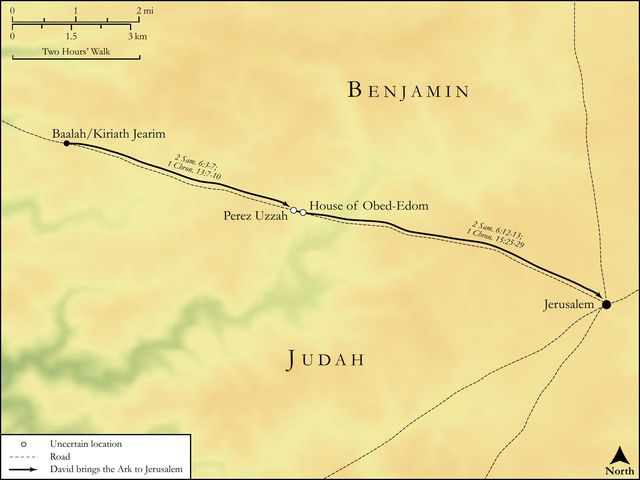
This verse directly follows the catastrophic incident of Uzzah's death, as recorded in 1 Chronicles 13:9-11 (compare with 2 Samuel 6:6-8). David had embarked on a grand procession to transport the Ark of the Covenant from Kiriath-Jearim to Jerusalem, with the noble intention of centralizing Israelite worship and establishing God's presence within his newly unified capital. The initial atmosphere was one of fervent celebration and enthusiastic anticipation, as detailed in 1 Chronicles 13:7-8. However, the sudden and severe divine judgment on Uzzah shattered this jubilation, transforming David's celebratory mood into one of intense fear and even anger. His poignant question in 1 Chronicles 13:12 reflects a stark and terrifying realization that God's holiness is utterly uncompromising and not to be trifled with. This profound shift in understanding immediately led to the temporary diversion of the Ark to the house of Obed-Edom, as recorded in 1 Chronicles 13:13. This moment serves as a critical turning point in David's reign, forcing him to pause, reconsider his methods, and diligently seek out proper divine instruction for handling sacred matters.
Historical & Cultural Context
The Ark of the Covenant was undeniably the most sacred object in ancient Israel, serving as the tangible representation of God's throne and His covenant presence among His chosen people (see Exodus 25:22). Its handling was meticulously governed by strict Mosaic laws, particularly those detailed in Numbers 4:15 and Numbers 7:9. David's decision to transport the Ark on a new cart, while perhaps appearing practical or even influenced by the Philistine method of returning the Ark (as seen in 1 Samuel 6:7-8), constituted a direct and serious violation of these explicit divine commands. The incident with Uzzah profoundly underscores the deep cultural understanding of divine holiness (qodesh) within Israel, where God's unique and transcendent nature demanded absolute adherence to His prescribed ways, sharply distinguishing Him from the more casually approached pagan deities. David, as the king, bore the ultimate responsibility for upholding God's law, and this tragic event served as a severe and unforgettable lesson in the dire consequences of presuming upon God's grace without meticulous obedience to His revealed will.
Key Themes
ShowHideThe narrative surrounding 1 Chronicles 13:12 powerfully illuminates several foundational themes. Firstly, it emphatically underscores God's uncompromising holiness and transcendence. The swift and decisive judgment on Uzzah demonstrates unequivocally that God is not merely a benevolent or distant deity but a holy sovereign who demands to be approached exclusively on His terms, not according to human convenience, innovation, or good intentions. Secondly, the passage highlights the absolute necessity of precise obedience to divine law. Despite David's undeniably good intentions to bring the Ark to Jerusalem, his failure to follow God's explicit and detailed instructions for its transport led directly to tragic consequences, illustrating a crucial theological principle: good intentions, however noble, can never substitute for faithful adherence to God's revealed will. Thirdly, David's visceral reaction introduces the profound theme of reverential fear (yare') as a proper, necessary, and spiritually healthy response to God's immense power and sanctity. This fear is not merely terror or dread, but a deep, worshipful awe that recognizes divine authority and the imperative for absolute submission. Finally, the incident serves as a crucial lesson in learning from failure. David's profound fear prompts him to pause, meticulously re-evaluate his entire approach, and ultimately seek out God's prescribed methods for handling sacred things, leading to a successful and obedient second attempt to bring the Ark to Jerusalem, as detailed in 1 Chronicles 15.
Exposition and Analysis
ShowHideKey Word Analysis
ShowHideThis Hebrew verb (H3372) carries a rich and multifaceted semantic range, encompassing both a visceral "to be terrified" or "to dread" and a profound "to revere" or "to stand in awe of." In the immediate context of David's reaction to Uzzah's sudden death, yârêʼ signifies an overwhelming, immediate terror at the raw and uncompromising display of God's judgment and power. However, this initial, instinctual fear quickly matures into a deeper, reverential awe. David's subsequent question, "How shall I bring the ark of God [home] to me?" reveals that his fear is not merely a desire to escape punishment, but a dawning, deep recognition of God's immense holiness and the meticulousness and obedience required in serving Him. It marks a critical transition for David from a casual or human-centric approach to a more God-centered, humble, and obedient posture.
This term (H430), a plural form often used with the article to refer specifically to the supreme God, signifies the divine being who is the object of David's fear and reverence. It emphasizes the transcendent, all-powerful, and holy nature of the God of Israel. The fact that David was "afraid of God" directly attributes the tragedy to divine agency and underscores that the incident was not a random accident but a direct manifestation of God's character and His uncompromising standards. This term highlights the ultimate authority and sovereignty of the Lord, before whom all humanity must humble itself and obey.
Verse Breakdown
ShowHide"And David was afraid of God that day"
This clause directly and emphatically links David's emotional state to the preceding catastrophic event—Uzzah's death. His fear is explicitly stated as being "of God," indicating that he immediately recognized the divine hand and sovereign will behind the tragedy. It was not merely a fear of an unfortunate accident, but a profound and terrifying realization of God's absolute holiness and the severe, immediate consequences of violating His explicit commands. This fear was immediate, overwhelming, and effectively halted the entire joyous procession. It signifies a moment of stark spiritual clarity for David, forcing him to confront the unvarnished reality of God's immutable character.
"saying, How shall I bring the ark of God [home] to me?"
This deeply rhetorical question reveals David's utter perplexity, his sudden sense of inadequacy, and the immense weight of responsibility that now bore down upon him. The initial, celebratory, and perhaps somewhat presumptuous attempt to bring the Ark to Jerusalem was abruptly and tragically interrupted by divine judgment, leading David to question his own capacity, understanding, and methods. The phrase "home to me" implies bringing it to Jerusalem, his capital, with the intention of centralizing worship and establishing the Ark's presence there. However, the "how" now takes on a new, urgent, and profoundly spiritual meaning: it is no longer just about practical logistics, but about understanding and meticulously adhering to God's divinely prescribed methods for handling His sacred and holy presence. This question marks a pivotal shift from human initiative and presumption to a humble recognition of divine requirements and a desperate search for God's revealed will.
Literary Devices
ShowHideThe verse employs several potent literary devices to convey its profound message. The most prominent is Contrast, highlighting the stark and sudden shift between the initial joyous, celebratory mood of the procession and the immediate, terrifying fear that grips David. This dramatic and abrupt transition underscores the immense gravity of the divine judgment and the immediate, sobering impact it had on the king and all present. The verse also powerfully utilizes Rhetorical Question ("How shall I bring the ark of God [home] to me?"), which is not posed to elicit an answer from others, but rather to express David's profound internal struggle, his deep perplexity, and his dawning realization of his own inadequacy in the face of God's holiness. This question serves to emphasize the critical shift from human presumption and self-reliance to a humble and desperate search for divine instruction and proper reverence. Furthermore, the passage contains a significant element of Foreshadowing, as David's fear and subsequent pause ultimately lead to a period of intense reflection, diligent study of the Law, and a more careful, obedient, and ultimately successful approach to bringing the Ark to Jerusalem in 1 Chronicles 15, demonstrating that this initial, tragic failure was a necessary catalyst for future spiritual growth and obedience.
Theological and Thematic Connections
ShowHide1 Chronicles 13:12 stands as a powerful and enduring theological statement about the inherent nature of God and humanity's proper, indeed necessary, response to His holiness. It unequivocally underscores that God is not to be approached casually, presumptuously, or on human terms, but rather with profound reverence, meticulous care, and strict obedience to His revealed will. The tragic incident with Uzzah and David's subsequent overwhelming fear emphasize that God's holiness is not merely an abstract concept or a benign attribute, but a dynamic, active, and demanding aspect of His character that necessitates specific, careful, and divinely-ordained interaction. This event highlights the extreme danger of presumption and the severe consequences that inevitably follow the disregard of divine commands, even when human intentions may seem outwardly good or well-meaning. It teaches a foundational truth: that true worship and effective service to God must be deeply rooted in humble obedience and a profound respect for God's character, rather than relying on human innovation, convenience, or perceived efficiency. David's fear was, in essence, a righteous and appropriate response, leading him to a deeper, more accurate understanding of God's majesty and the absolute need to align his actions precisely with divine law.
Reflection and Application
ShowHideDavid's profound experience in 1 Chronicles 13:12 offers timeless and crucial lessons for believers in every generation. While we now live under the glorious New Covenant of grace, the fundamental truth of God's unchanging holiness remains eternally valid. His nature still demands profound reverence, and His authoritative Word still calls for diligent obedience. We, as fallen human beings, are perpetually prone to approaching God with a casualness that often borders on presumption, sometimes prioritizing our personal comfort, innovative methods, or perceived efficiency over diligent and faithful adherence to His revealed will. David's overwhelming fear serves as a stark reminder that genuine worship, effective service, and true spiritual flourishing flow directly from a deep, reverential awe of God, recognizing His supreme authority and the profound seriousness of His commands. This does not imply living in constant terror or dread, but rather cultivating a reverential fear that inspires profound humility, meticulous study of His Word, and an ardent desire to honor Him in all things. When we inevitably encounter setbacks, failures, or consequences for our disobedience, like David, we are called to pause, reflect deeply, earnestly seek God's wisdom, and humbly align our paths and methods with His perfect will, trusting implicitly that His ways are always superior and ultimately lead to true blessing.
Questions for Reflection
ShowHideFAQ
ShowHideWhy was Uzzah punished so severely for merely touching the Ark?
ShowHideUzzah's punishment was indeed severe because his action, though seemingly instinctual and well-intentioned to prevent the Ark from falling, was a direct and egregious violation of God's explicit commands regarding the handling of the Ark. According to Numbers 4:15, only Kohathite Levites were permitted to carry the Ark, and they were strictly commanded to do so using poles, never touching the sacred object itself. The Ark represented God's holy presence, His very throne among His people, and any unauthorized contact or disregard for His prescribed methods was an affront to His absolute holiness and sovereignty. This incident, much like the death of Nadab and Abihu for offering "unauthorized fire" in Leviticus 10:1-2, served as a stark, uncompromising demonstration that God's holiness demands absolute adherence to His terms, not human convenience, good intentions, or perceived necessity. It was not merely about the physical touch, but about the profound disrespect for divine law and the sacredness of God's unapproachable presence.
What does David's fear teach us about God's character?
ShowHideDavid's initial fear, which was one of terror, teaches us that God is supremely holy, just, and utterly sovereign. He is not to be trifled with, and His commands are not arbitrary suggestions but expressions of His perfect character. This incident reveals that God's holiness is active, dynamic, and demands a specific, reverent approach. While God is infinitely gracious and merciful, His character also encompasses a consuming fire (Hebrews 12:29) that judges disobedience. David's fear, as it matured, transformed into a deeper, reverential awe, demonstrating that a proper and accurate understanding of God's multifaceted character inevitably leads to humility, obedience, and a profound respect for His majesty. It underscores the timeless truth that God will be honored precisely in the way He prescribes, not in the way humanity devises or prefers.
How did David eventually succeed in bringing the Ark to Jerusalem after this initial failure?
ShowHideDavid learned an absolutely crucial and transformative lesson from this tragic event. Instead of pressing on presumptuously or defiantly, he paused, humbled himself, and diligently sought God's specific instructions. He meticulously consulted the Mosaic Law and discovered the precise, divinely ordained method for transporting the Ark. In 1 Chronicles 15:2, David declared, "No one is to carry the ark of God but the Levites; for the Lord chose them to carry the ark of the Lord and to minister before him forever." He then meticulously prepared the Levites, ensured they were sanctified according to the Law, and made certain they carried the Ark on poles on their shoulders, exactly as prescribed (1 Chronicles 15:13-15). This time, the procession was not only successful but also filled with appropriate worship, reverence, and overflowing joy, powerfully demonstrating that humble obedience to God's Word is paramount for His blessing and presence.
Christ-Centered Fulfillment
ShowHideThe profound fear experienced by David in 1 Chronicles 13:12, born from a direct and terrifying encounter with God's uncompromising holiness, powerfully foreshadows the ultimate and perfect solution to humanity's inherent inability to approach a perfectly holy God. The Ark of the Covenant, though a sacred symbol of God's presence among His people, was fundamentally a veiled and dangerous presence, inaccessible and perilous to those who presumed upon it without strict adherence to divine law. This Old Testament narrative, therefore, points with striking clarity to the absolute necessity of a perfect mediator and a new, living way of access. In the New Testament, Jesus Christ is revealed as the ultimate "Ark of God," the very dwelling place of God among humanity, the Word made flesh who "dwelt among us" (John 1:14). He is the only one who perfectly fulfills all the righteous requirements of God's law, living a life of absolute and unwavering obedience, and offering Himself as the perfect, once-for-all sacrifice for sin. Through His atoning work on the cross, Jesus opened a new and living way to the Father, a way not predicated on human performance, ritualistic adherence, or outward ceremony, but on His perfect obedience and His shed blood (Hebrews 10:19-20). The "fear of God" for the New Covenant believer is gloriously transformed from a terror of judgment into a filial reverence, a deep and loving respect, and an awe for our heavenly Father, who is both perfectly holy and infinitely merciful. We are now graciously invited to draw near to God's throne of grace with confidence, not because we are inherently worthy, but solely because Christ has made us worthy through His imputed righteousness and perfect sacrifice (Hebrews 4:16). While God's holiness remains eternally immutable, our access is no longer mediated by an external, dangerous object and strict, perilous rituals, but by the indwelling Holy Spirit of Christ, enabling us to approach God as beloved, adopted children (Romans 8:15). Thus, David's profound fear in 1 Chronicles 13:12 ultimately points us to the glorious, liberating truth that in Christ, the holy God is now perfectly and safely accessible, and our reverent obedience is a joyful response of love and profound gratitude for His saving grace.