


1 Chronicles 13:11
Bible text: King James Version (1769 Blayney text) · Public domain
Bible text: Berean Standard Bible · Public domain
Bible text: American Standard Version (1901) · Public domain
Bible text: World English Bible, Messianic edition · Public domain
Bible text: Geneva Bible (1599) · Public domain
Bible text: Young's Literal Translation · Public domain
- וַיִּחַרvai·Yi·charand it burnedH2734Conj-w ¦ V-Qal-ConsecImperf-3msVerb Qal Consecutive Imperfect 3rd Singular Masculineוַandיִּחַרit burned
- לְדָוִידle·da·Vidto DavidH1732Prep-l ¦ N-proper-mNoun Proper MasculineלְtoדָוִידDavid
- כִּיkiforH3588PrtParticle Conditional
- פָרַץfa·Ratzhe had broken outH6555V-Qal-Perf-3msVerb Qal Perfect 3rd Singular Masculine
- יְהוָהYah·wehYahwehH3068N-properNoun Proper Title
- פֶּרֶץPe·retza breaking outH6556N-msNoun Singular Masculine Absolute
- בְּעֻזָּאbe·'u·Za'against UzzahH5798Prep-b ¦ N-proper-mNoun Proper MasculineבְּagainstעֻזָּאUzzah
- וַיִּקְרָאvai·yik·Ra'and he calledH7121Conj-w ¦ V-Qal-ConsecImperf-3msVerb Qal Consecutive Imperfect 3rd Singular Masculineוַandיִּקְרָאhe called
- לַמָּקוֹםla·ma·Kom<to> the placeH4725Prep-l ¦ N-msNoun Singular Masculine Absoluteלַ<to> theמָּקוֹםplace
- הַהוּאha·Hu'<the> thatH1931Art ¦ Pro-3msPronoun Personal 3rd Singular Masculineהַ<the>הוּאthat
- פֶּרֶץPe·retzPerezH6560N-properNoun Proper Location
- עֻזָּא'u·Za'UzzahH6560N-properNoun Proper Location
- עַד'aduntilH5704PrepPreposition
- הַיּוֹםhai·Yomthe dayH3117Art ¦ N-msNoun Singular Masculine Absoluteהַtheיּוֹםday
- הַזֶּהha·Zeh<the> thisH2088Art ¦ PrtParticle Demonstrativeהַ<the>זֶּהthis
English is a literal word-by-word gloss of the Hebrew, not the KJV's wording. Why?
This is the original text the KJV's translators worked from — each Hebrew word with its own literal English meaning in this verse, prepared by scholars at Tyndale House, Cambridge. The KJV translates whole sentences, not word by word, so its wording differs: one Hebrew word can become several English words, and the KJV may choose “the LORD” where the gloss reads “Yahweh”. Both are faithful — they answer different questions. For the KJV's own rendering, switch to the KJV text.
Details
See on the biblical-era map
Study this verse
Public-domain commentary
Matthew Henry
From his Commentary on the Whole Bible. Henry comments on passages, not single verses — this entry covers 1 Chronicles 13:9–14.
This breach upon Uzza, which caused all the joy to cease, we had an account of, Sa2 6:6, etc. 1. Let the sin of Uzza warn us all to take heed of presumption, rashness, and irreverence, in dealing about holy things (Ch1 13:9), and not to think that a good intention will justify a bad action. In our communion with God we must carefully watch over our own hearts, lest familiarity breed contempt, and we think God is in any way beholden to us. 2. Let the punishment of Uzza convince us that the God with whom we have to do is a jealous God. His death, like that of Nadab and Abihu, proclaims aloud that God will be sanctified in those that come nigh unto him (Lev 10:3), and that the nearer any are to him the more displeased he is with their presumptions. Let us not dare to trifle with God in our approaches to him; and yet let us, through Christ, come boldly to the throne of grace; for we are under the dispensation of liberty and grace, not of bondage and terror. 3. Let the damp this gave to the joy of Israel be a memorandum to us always to rejoice with trembling, and to serve the Lord with fear, even when we serve him with gladness. 4. Let David's displeasure upon this occasion caution us to take heed to our spirits when we are under divine rebukes, lest, instead of submitting to God, we quarrel with him. If God be angry with us, shall we dare to be angry with him? 5. Let the stop thus put to the solemnity caution us not to be driven off from our duty by those providences which are only intended to drive us from our sins. David should have gone on with the work notwithstanding the breach made upon Uzza; so might the breach have been made up. 6. Let the blessing which the ark brought with it to the house of Obed-edom encourage us to welcome God's ordinances into our houses, as those that believe the ark is a guest that nobody shall lose by; not let it be less precious to us for its being to some a stone of stumbling and a rock of offence. If the gospel be to some a savour of death unto death, as the ark was to Uzza, yet let us receive it in the love of it and it will be to us a saviour of life unto life.
Continue studying 1 Chronicles 13:11 across the web’s major study libraries — every link below opens this exact verse, chapter, or book on the destination site.
Read & Compare
 BibleGatewayThis verse in more than 200 translations and 70 languages.
 Bible.comThe YouVersion reader — hundreds of translations, reading plans, and highlights.
 ESV.orgCrossway's official English Standard Version reader.
 NET BibleThe NET translation with 60,000+ translators' notes on every rendering decision.
 STEP BibleTyndale House's free study tool — original text, vocabulary, and scholarly resources.
 BibliaLogos Bible Software's free web reader.
 USCCBThe New American Bible (Revised Edition) with the U.S. bishops' study notes.
Commentaries
 BibleHub CommentariesDozens of classic commentaries on this verse, gathered on one page.
 StudyLightMore than 100 commentary sets — the largest collection on the web.
 BibleRefPlain-English commentary on what this verse means, verse by verse.
 Enduring WordDavid Guzik's free commentary on this chapter, widely used by Bible teachers.
 Bible Study ToolsVerse commentary alongside Greek and Hebrew study aids.
Original Language & Research
- BibleHub InterlinearThe verse word by word — original language, transliteration, and English.
- BibleHub LexiconEvery word's original-language definition and Strong's entry.
 Blue Letter BibleDeep-study tools — Strong's numbers, concordance, and word studies.
 SefariaThe Hebrew text with Rashi and centuries of Jewish commentary.
Sermons, Hymns & Audio


TrulyRandomVerse is not affiliated with these sites and doesn’t control their content. They’re linked because they’re genuinely useful.
Summary
1 Chronicles 13:11 records King David's profound displeasure and emotional distress following the Lord's sudden and fatal judgment upon Uzza. This tragic incident occurred during the initial, flawed attempt to transport the Ark of the Covenant to Jerusalem, resulting in the site being named Perezuzza, meaning "breach of Uzza," as a permanent memorial to the divine intervention and the severe consequences of disregarding God's sacred commands and holiness.
Context
ShowHideLiterary Context
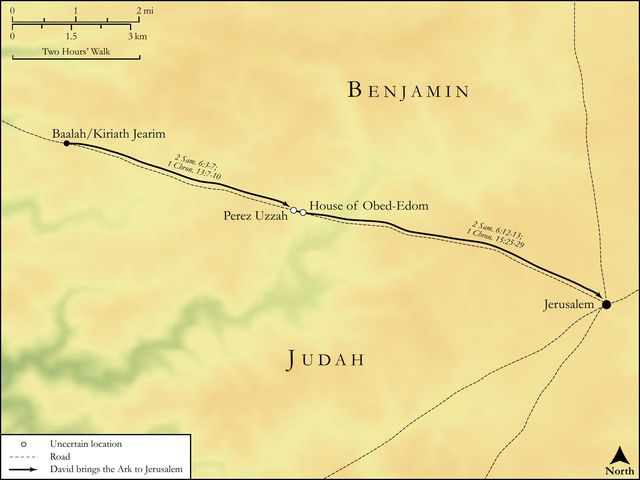
This verse is deeply embedded within the narrative of David's earnest, yet initially misinformed, efforts to establish Jerusalem as the spiritual and political capital of Israel by bringing the Ark of the Covenant there. The preceding verses 1 Chronicles 13:7-10 detail the celebratory procession, the Ark's placement on a new cart (a deviation from Mosaic law), and Uzza's fatal error of reaching out to steady it. Immediately following this verse, 1 Chronicles 13:12-14 describes David's fear and his decision to halt the Ark's journey, diverting it to the house of Obed-Edom, where it remained for three months. The Chronicler's account, which closely parallels 2 Samuel 6, emphasizes the critical importance of proper worship and strict adherence to God's prescribed methods, serving as a pivotal moment that compels David and the nation to confront God's absolute holiness.
Historical & Cultural Context
The Ark of the Covenant was the preeminent symbol of God's presence and covenant with Israel, functioning as His earthly throne. Its handling was meticulously prescribed by Mosaic Law, specifically requiring it to be carried on the shoulders of Kohathite Levites using poles inserted into its rings (Exodus 25:12-15 and Numbers 4:15). David's decision to transport the Ark on a new cart, while perhaps well-intentioned and efficient, and possibly influenced by the Philistines' method of returning the Ark (1 Samuel 6:7-8), directly violated these divine commands. In Israel, the holiness of God and the strict protocols for approaching Him were well known from Sinai, where bounds were set about the mount. The sudden death of Uzza underscored that God's holiness was not merely a theological abstraction but a profound reality demanding meticulous adherence to His revealed will, especially concerning the symbols of His presence and the manner of His worship.
Key Themes
ShowHideThe incident of Uzza's death and David's reaction in 1 Chronicles 13 powerfully articulates several key theological themes. Foremost is the absolute holiness and sovereignty of God, demonstrating that He is not to be approached casually or on human terms, but solely on His own prescribed terms. This event underscores the consequences of disobedience, even when intentions may seem good or practical. Uzza's action, though perhaps an instinctive attempt to prevent the Ark from falling, was a direct violation of God's command not to touch the Ark, revealing a profound lack of proper reverence and understanding of its sacredness. David's "displeasure" highlights the human struggle to reconcile divine judgment with human understanding, ultimately leading to a deeper lesson in reverence and humble submission to God's ways. The naming of "Perezuzza" serves as a lasting memorial to divine judgment and a perpetual reminder of the gravity of God's commands and the importance of reverent obedience.
Exposition and Analysis
ShowHideKey Word Analysis
ShowHideThe Hebrew verb H2734 (חָרָה, ḥārâh) literally means "to glow or grow warm," and figuratively, "to blaze up" with anger, zeal, or jealousy. In this context, it describes David's intense emotional reaction. It signifies a profound inner burning, reflecting not necessarily anger at God, but a complex mixture of shock, grief, frustration that his well-intentioned plan had gone tragically awry, and perhaps even fear and confusion regarding the unexpected severity of God's judgment. It powerfully conveys a human struggle to comprehend divine justice and holiness.
The Hebrew noun H6556 (פֶּרֶץ, pereṣ) denotes "a break," "a breaking forth," or "a gap." It describes a sudden, violent, and often destructive breaking through of a barrier or a sudden outpouring. Here, it vividly portrays the immediate, forceful, and decisive nature of God's judgment upon Uzza, emphasizing that it was a direct, divine intervention that "burst forth" against him, creating a sudden rupture in life.
This is a compound place name, H6560 (פֶּרֶץ עֻזָּא, pereṣ ‘uzzā'), directly derived from the Hebrew words for "breach" and "Uzza." It literally means "breach of Uzza" or "the bursting forth against Uzza." The naming of the place served as an etiological marker, permanently commemorating the site of God's judgment and ensuring that the event and its profound lesson about divine holiness and human accountability would not be forgotten by future generations.
Verse Breakdown
ShowHide"And David was displeased"
This clause reveals King David's immediate and profound emotional response to the sudden death of Uzza. His "displeasure" (or "anger" in some translations) was a complex emotional state, likely encompassing shock, deep grief for Uzza, frustration that his grand and well-intentioned project to bring the Ark to Jerusalem had been tragically interrupted, and perhaps even fear or confusion regarding the seemingly harsh and unexpected divine judgment. It underscores the human difficulty in fully grasping God's absolute holiness and the strictness of His commands, especially when viewed through the lens of human compassion or logic.
"because the LORD had made a breach upon Uzza"
This phrase unequivocally attributes Uzza's death to a direct act of divine judgment. The "breach" (H6556, pereṣ) signifies a sudden, decisive, and forceful intervention from God. Uzza's action of touching the Ark, even if an instinctive attempt to stabilize it, was a direct violation of God's explicit command that only Levites from the family of Kohath could carry the Ark, and even they were forbidden to touch it directly or look upon it (Numbers 4:15). God's immediate and severe response underscores the gravity of His holiness and the dire consequences of treating sacred things lightly or disregarding His specific, revealed instructions for worship and service.
"wherefore that place is called Perezuzza to this day"
This concluding clause explains the origin of the place name, "Perezuzza" (H6560, pereṣ ‘uzzā'), which literally means "breach of Uzza." The naming served as a permanent memorial, ensuring that the location would forever be associated with this profound divine judgment. It functioned as a constant, tangible reminder to Israel of the absolute holiness of God, the seriousness of His commands, and the vital importance of approaching Him in the precise manner He prescribes, rather than according to human innovation, convenience, or well-meaning but disobedient actions.
Literary Devices
ShowHideThe passage employs several significant literary devices. The most prominent is Etiology, as the verse explicitly explains the origin of the place name "Perezuzza," directly linking it to the "breach" or divine judgment upon Uzza. This etiological naming serves to memorialize the event, ensuring its lasting impact and lesson for future generations. There is also an element of Irony in David's initial attempt to bring the Ark; though motivated by good intentions to centralize worship and honor God, it was executed in a manner that disregarded God's explicit instructions, leading to tragic consequences. This highlights the tension between human zeal and divine precision. Furthermore, the Ark itself functions as powerful Symbolism of God's holy presence, emphasizing that it is not merely an object but a representation of the unapproachable, transcendent nature of the Almighty, demanding utmost reverence and adherence to His established protocols. The phrase "to this day" functions as a Formulaic Expression, common in historical narratives to attest to the enduring truth and memory of the event described.
Theological and Thematic Connections
ShowHideThe incident at Perezuzza is a stark reminder of God's absolute holiness and the necessity of approaching Him on His terms, not our own. It teaches that while good intentions may be present, they do not supersede God's revealed will or negate the consequences of disobedience to His specific commands. God's judgment on Uzza was not arbitrary but a demonstration of His unwavering commitment to His own purity and the sanctity of His presence, serving as a powerful object lesson for all Israel about the reverence due to Him. This event underscores that God's nature is consistent; His holiness demands respect and obedience, and His justice ensures that His divine order is upheld, even at a cost. It foreshadows the need for a perfect mediator and a new covenant where access to God is granted through divine provision.
Reflection and Application
ShowHideThe challenging narrative of Uzza and Perezuzza offers profound and enduring lessons for believers today. It compels us to critically examine our own approach to God, reminding us that while we now live under a covenant of grace, the foundational truth of God's absolute holiness remains immutable. We are called to cultivate a deep and abiding sense of reverence for God, not merely out of fear, but out of a profound respect for His character, His infinite wisdom, and the supreme authority of His Word. This means diligently seeking to understand and obey His commands, rather than relying on our own ideas of what is good, convenient, or expedient. The passage challenges us to consider if we, like Uzza, might be treating God's sacred things—His Word, His church, our worship, His name, His mission—with a casualness or presumption that borders on irreverence. David's subsequent learning from this tragedy, leading him to properly transport the Ark according to God's instructions, models the vital importance of humility, repentance, and a willingness to align our actions and worship precisely with God's revealed will.
Questions for Reflection
ShowHideFAQ
ShowHideWhy was Uzza's punishment so severe for what seemed like a well-intentioned act?
ShowHideUzza's punishment was severe because it constituted a direct and blatant violation of God's explicit commands regarding the handling of the Ark of the Covenant. The Ark was the most sacred object in Israel, symbolizing God's holy presence, and specific instructions were given in the Mosaic Law (e.g., Numbers 4:15) that only certain Levites (the Kohathites) could carry it by poles, and no one, not even those Levites, was permitted to touch the Ark itself. Uzza's act, though perhaps an instinctive attempt to stabilize the Ark, demonstrated a profound disregard for God's holiness and the sanctity of His commands. God's immediate judgment served as a powerful object lesson, not just for Uzza, but for David and all Israel, emphasizing that God's holiness is absolute and that His commands are not arbitrary suggestions but require meticulous obedience. It prevented a casual or irreverent approach to God's presence from becoming normalized, thereby safeguarding the integrity of Israel's worship and their understanding of God's nature.
Christ-Centered Fulfillment
ShowHideThe severity of God's judgment at Perezuzza, though a difficult passage, powerfully underscores the unapproachable holiness of God under the Old Covenant—a holiness that humanity, marred by sin, could not directly encounter without peril. This incident, therefore, deepens our appreciation for the New Covenant, where the "breach" between a holy God and sinful humanity has been definitively healed, not by human effort or adherence to rituals, but by the perfect life, atoning death, and glorious resurrection of Jesus Christ. Jesus is the ultimate Ark of God's presence, the very embodiment of God dwelling among us, yet unlike the physical Ark, He invites us to draw near. The strict protocols and the fear associated with touching the Old Covenant Ark are superseded by the invitation to approach God with confidence through the shed blood of Christ (Hebrews 4:16). While God's holiness remains eternally unchanged, our access to Him is profoundly transformed. Uzza's death highlights the gravity of sin and the absolute necessity of a perfect mediator. Christ, the Lamb of God who takes away the sin of the world, bore the "breach" of God's righteous wrath against sin on the cross, making a new and living way for us to enter into a reconciled relationship with a holy God, not through our own flawed efforts or "good intentions," but through faith in His perfect obedience and substitutionary sacrifice (Romans 5:1-2). The lesson of Perezuzza, then, is not to fear God in a way that keeps us distant, but to marvel at the boundless grace that allows us to draw near, always remembering the immense cost of that access and the unblemished holiness of the One we worship (Hebrews 10:19-22).