


Deuteronomy 34:6
Bible text: King James Version (1769 Blayney text) · Public domain
Bible text: Berean Standard Bible · Public domain
Bible text: American Standard Version (1901) · Public domain
Bible text: World English Bible, Messianic edition · Public domain
Bible text: Geneva Bible (1599) · Public domain
Bible text: Young's Literal Translation · Public domain
- וַיִּקְבֹּרvai·yik·Borand he buriedH6912Conj-w ¦ V-Qal-ConsecImperf-3msVerb Qal Consecutive Imperfect 3rd Singular Masculineוַandיִּקְבֹּרhe buried
- אֹתוֹ'o·To<obj.> himH853DirObjM ¦ 3msParticle Object Indicatorאֹת<obj.>וֹhim
- בַגַּיְva·gaYin the valleyH1516Prep-b ¦ N-csNoun Singular common gender Absoluteבַin theגַּיְvalley
- בְּאֶרֶץbe·'E·retzin [the] land ofH776Prep-b ¦ N-fscNoun Singular Feminine Constructבְּinאֶרֶץ[the] land of
- מוֹאָבmo·'AvMoabH4124N-properNoun Proper Location
- מוּלmulopposite toH4136N-mscNoun Singular Masculine Construct
- בֵּיתbeitBethH1047N-properNoun Proper Location
- פְּעוֹרpe·'orPeorH1047N-properNoun Proper Location
- וְלֹאve·lo'and notH3808Conj-w ¦ NegParticle Negativeוְandלֹאnot
- יָדַעya·Da'he knowsH3045V-Qal-Perf-3msVerb Qal Perfect 3rd Singular Masculine
- אִישׁ'ishanyoneH376N-msNoun Singular Masculine Absolute
- אֶת'et<obj.>H853DirObjMParticle Object Indicator
- קְבֻרָתוֹke·Vu·ra·Tohis burial placeH6900N-fsc ¦ 3msNoun Singular Feminine Constructקְבֻרָתburial placeוֹhis
- עַד'aduntilH5704PrepPreposition
- הַיּוֹםhai·Yomthe dayH3117Art ¦ N-msNoun Singular Masculine Absoluteהַtheיּוֹםday
- הַזֶּהha·Zeh<the> thisH2088Art ¦ PrtParticle Demonstrativeהַ<the>זֶּהthis
English is a literal word-by-word gloss of the Hebrew, not the KJV's wording. Why?
This is the original text the KJV's translators worked from — each Hebrew word with its own literal English meaning in this verse, prepared by scholars at Tyndale House, Cambridge. The KJV translates whole sentences, not word by word, so its wording differs: one Hebrew word can become several English words, and the KJV may choose “the LORD” where the gloss reads “Yahweh”. Both are faithful — they answer different questions. For the KJV's own rendering, switch to the KJV text.
Details
See on the biblical-era map
Study this verse
Public-domain commentary
Matthew Henry
From his Commentary on the Whole Bible. Henry comments on passages, not single verses — this entry covers Deuteronomy 34:5–8. His two-level outline is real structure in the source text, so it is rendered as structure.
Here is, I. The death of Moses (Deu 34:5): Moses the servant of the Lord died. God told him he must not go over Jordan, and, though at first he prayed earnestly for the reversing of the sentence yet God's answer to his prayer sufficed him, and now he spoke no more of that matter, Deu 3:26. Thus our blessed Saviour prayed that the cup might pass from him, yet, since it might not, he acquiesced with, Father, thy will be done. Moses had reason to desire to live a while longer in the world. He was old, it is true, but he had not yet attained to the years of the life of his fathers; his father Amram lived to be 137; his grandfather Kohath 133; his great grandfather Levi 137; Exo 6:16-20. And why must Moses, whose life was more serviceable than any of theirs, die at 120, especially since he felt not the decays of age, but was as fit for service as ever? Israel could ill spare him at this time; his conduct and his converse with God would be as great a happiness to them in the conquest of Canaan as the courage of Joshua. It bore hard upon Moses himself, when he had gone through all the fatigues of the wilderness, to be prevented from enjoying the pleasures of Canaan; when he had borne the burden and heat of the day, to resign the honour of finishing the work to another, and that not his son, but his servant, who must enter into his labours. We may suppose that this was not pleasant to flesh and blood. But the man Moses was very meek; God will have it so, and he cheerfully submits. 1. He is here called the servant of the Lord, not only as a good man (all the saints are God's servants), but as a useful man, eminently useful, who had served God's counsels in bringing Israel out of Egypt, and leading them through the wilderness. It was more his honour to be the servant of the Lord. than to be king in Jeshurun. 2. Yet he dies. Neither his piety nor his usefulness would exempt him from the stroke of death. God's servants must die that they may rest from their labours, receive their recompense, and make room for others. When God's servants are removed, and must serve him no longer on earth, they go to serve him better, to serve him day and night in his temple. 3. He dies in the land of Moab, short of Canaan, while as yet he and his people were in an unsettled condition and had not entered into their rest. In the heavenly Canaan there will be no more death. 4. He dies according to the word of the Lord. At the mouth of the Lord; so the word is. The Jews say, "with a kiss from the mouth of God." No doubt, he died very easily (it was an euthanasia - a delightful death), there were no bands in his death; and he had in his death a most pleasing taste of the love of God to him: but that he died at the mouth of the Lord means no more but that he died in compliance with the will of God. Note, The servants of the Lord, when they have done all their other work, must die at last, in obedience to their Master, and be freely willing to go home whenever he sends for them, Act 21:13.
II.His burial, Deu 34:6.
It is a groundless conceit of some of the Jews that Moses was translated to heaven as Elijah was, for it is expressly said that he died and was buried; yet probably he was raised to meet Elias, to grace the solemnity of Christ's transfiguration.
1.God himself buried him, namely, by the ministry of angels, which made this funeral, though very private, yet very magnificent. Note, God takes care of the dead bodies of his servants; as their death is precious, so is their dust, not a grain of it shall be lost, but the covenant with it shall be remembered. When Moses was dead, God buried him; when Christ was dead, God raised him, for the law of Moses was to have an end, but not the gospel of Christ. Believers are dead to the law that they might be married to another, even to him who is raised from the dead, Rom 7:4. It should seem Michael, that is, Christ (as some think), had the burying of Moses, for by him the Mosaical ordinances were abolished and taken out of the way, nailed to his cross, and buried in his grave, Col 2:14.
2.He was buried in a valley over against Beth-peor. How easily could the angels that buried him have conveyed him over Jordan and buried him with the patriarchs in the cave of Machpelah! But we must learn not be over-solicitous about the place of our burial. If the soul be at rest with God, the matter is not great where the body rests. One of the Chaldee paraphrasts says, "He was buried over against Beth-peor, that, whenever Baal-peor boasted of the Israelites being joined to him, the grave of Moses over against his temple might be a check to him." 3. The particular place was not known, lest the children of Israel, who were so very prone to idolatry, should have enshrined and worshipped the dead body of Moses, that great founder and benefactor of their nation. It is true that we read not, among all the instances of their idolatry, that they worshipped relics, the reason of which perhaps was because they were thus prevented from worshipping Moses, and so could not for shame worship any other. Some of the Jewish writers say that the body of Moses was concealed, that necromancers, who enquired of the dead, might not disquiet him, as the witch of Endor did Samuel, to bring him up. God would not have the name and memory of his servant Moses thus abused. Many think this was the contest between Michael and the devil about the body of Moses, mentioned Jde 1:9. The devil would make the place known that it might be a snare to the people, and Michael would not let him. Those therefore who are for giving divine honours to the relics of departed saints side with the devil against Michael our prince.
III.His age, Deu 34:7. His life was prolonged,
1.To old age. He was 120 years old, which, though far short of the years of the patriarchs, yet much exceeded the years of most of his contemporaries, for the ordinary age of man had been lately reduced to seventy, Psa 90:10. The years of the life of Moses were three forties. The first forty he lived a courtier, at ease and in honour in Pharaoh's court; the second forty he lived a poor desolate shepherd in Midian; the third forty he lived a king in Jeshurun, in honour and power, but encumbered with a great deal of care and toil: so changeable is the world we live in, and alloyed with such mixtures; but the world before us is unmixed and unchangeable.
2.To a good old age: His eye was not dim (as Isaac's, Gen 27:1, and Jacob's, Gen 48:10), nor was his natural force abated; there was no decay either of the strength of his body or of the vigour and activity of his mind, but he could still speak, and write, and walk as well as ever. His understanding was as clear, and his memory as strong, as ever. "His visage was not wrinkled," say some of the Jewish writers; "he had lost never a tooth," say others; and many of them expound it of the shining of his face (Exo 34:30), that that continued to the last. This was the general reward of his services; and it was in particular the effect of his extraordinary meekness, for that is a grace which is, as much as any other, health to the navel and marrow to the bones. Of the moral law which was given by Moses, though the condemning power be vacated to true believers, yet the commands are still binding, and will be to the end of the world; the eye of them is not waxen dim, for they shall discern the thoughts and intents of the heart, nor is their natural force or obligation abated but still we are under the law to Christ.
IV.The solemn mourning that there was for him, Deu 34:8.
It is a debt owing to the surviving honour of deceased worthies to follow them with our tears, as those who loved and valued them, are sensible of our loss of them, and are truly humbled for those sins which have provoked God to deprive us of them; for penitential tears very fitly mix with these. Observe,
1.Who the mourners were: The children of Israel. They all conformed to the ceremony, whatever it was, though some of them perhaps, who were ill-affected to his government, were but mock-mourners; yet we may suppose there were those among them who had formerly quarrelled with him and his government, and perhaps had been of those who spoke of stoning him, who now were sensible of their loss, and heartily lamented him when he was removed from them, though they knew not how to value him when he was with them. Thus those who had murmured were made to learn doctrine, Isa 29:24. Note, The loss of good men, especially good governors, is to be much lamented and laid to heart: those are stupid who do not consider it.
2.How long they mourned: Thirty days. So long the formality lasted, and we may suppose there were some in whom the mourning continued much longer. Yet the ending of the days of weeping and mourning for Moses is an intimation that, how great soever our losses have been, we must not abandon ourselves to perpetual grief; we must suffer the wound at least to heal up in time. If we hope to go to heaven rejoicing, why should we resolve to go to the grave mourning? The ceremonial law of Moses is dead and buried in the grave of Christ; but the Jews have not yet ended the days of their mourning for it.
Historical interpretation
Fourteen Centuries of Reception
3 surviving comments on this verse. Each one is dated, so this reads as a timeline rather than a list.
Select a marker to jump to its quote. Markers stagger vertically where authors wrote within a few decades of each other.
Two godly benefits did his Lord accomplish for Moses in not making known his tomb to the children of Israel. He rejoiced that his adversaries should not know it and cast forth his bones from his tomb; and in the second place, that the children of his people should not know it and make his tomb a place of worship, for he was accounted as God in the eyes of the children of his people.
God had granted the gift of being buried in secret ground to only one of his friends, for it was right that so great a distinction should be appropriate only for that body which had shone from the close presence and conversation of God. Thus when Moses had performed his duties as man, he could take joy in having God alone as witness of his grave.
He buried him: viz. by the ministry of angels, and would have the place of his burial to be unknown, lest the Israelites, who were so prone to idolatry, might worship him with divine honours.
Continue studying Deuteronomy 34:6 across the web’s major study libraries — every link below opens this exact verse, chapter, or book on the destination site.
Read & Compare
 BibleGatewayThis verse in more than 200 translations and 70 languages.
 Bible.comThe YouVersion reader — hundreds of translations, reading plans, and highlights.
 ESV.orgCrossway's official English Standard Version reader.
 NET BibleThe NET translation with 60,000+ translators' notes on every rendering decision.
 STEP BibleTyndale House's free study tool — original text, vocabulary, and scholarly resources.
 BibliaLogos Bible Software's free web reader.
 USCCBThe New American Bible (Revised Edition) with the U.S. bishops' study notes.
Commentaries
 BibleHub CommentariesDozens of classic commentaries on this verse, gathered on one page.
 StudyLightMore than 100 commentary sets — the largest collection on the web.
 BibleRefPlain-English commentary on what this verse means, verse by verse.
 Enduring WordDavid Guzik's free commentary on this chapter, widely used by Bible teachers.
 Bible Study ToolsVerse commentary alongside Greek and Hebrew study aids.
Original Language & Research
- BibleHub InterlinearThe verse word by word — original language, transliteration, and English.
- BibleHub LexiconEvery word's original-language definition and Strong's entry.
 Blue Letter BibleDeep-study tools — Strong's numbers, concordance, and word studies.
 SefariaThe Hebrew text with Rashi and centuries of Jewish commentary.
Sermons, Hymns & Audio


TrulyRandomVerse is not affiliated with these sites and doesn’t control their content. They’re linked because they’re genuinely useful.
Summary
Deuteronomy 34:6 concludes the earthly journey of Moses, the preeminent prophet and lawgiver, by describing his unique burial. Following his death on Mount Nebo, the Lord Himself took charge of Moses' interment in an undisclosed valley in Moab, specifically "over against Bethpeor." The striking detail that "no man knoweth of his sepulchre unto this day" underscores divine sovereignty, prevents potential idolatry of Moses' grave, and highlights his unparalleled relationship with God, setting him apart even in death.
Context
ShowHideLiterary Context
This verse is situated in the final chapter of Deuteronomy, which serves as the poignant epilogue to Moses' life and ministry and the concluding book of the Pentateuch. Deuteronomy 34 provides a solemn account of Moses' final ascent of Mount Nebo to view the Promised Land, a privilege granted by God despite his inability to enter it (Deuteronomy 34:1-4). His subsequent death, "according to the word of the Lord," is recorded in Deuteronomy 34:5, immediately preceding this extraordinary account of his divine burial. The narrative flow then transitions seamlessly from Moses' passing to the affirmation of Joshua's Spirit-filled leadership as his successor (Deuteronomy 34:9), ensuring the continuity of God's covenant purposes. This final chapter not only brings Moses' unparalleled story to a close but also prepares the reader for the subsequent book of Joshua, which details Israel's entry into and conquest of Canaan under new leadership, with the hidden grave ensuring that the focus shifts from the departed leader to God's ongoing guidance and the future inheritance.
Historical & Cultural Context
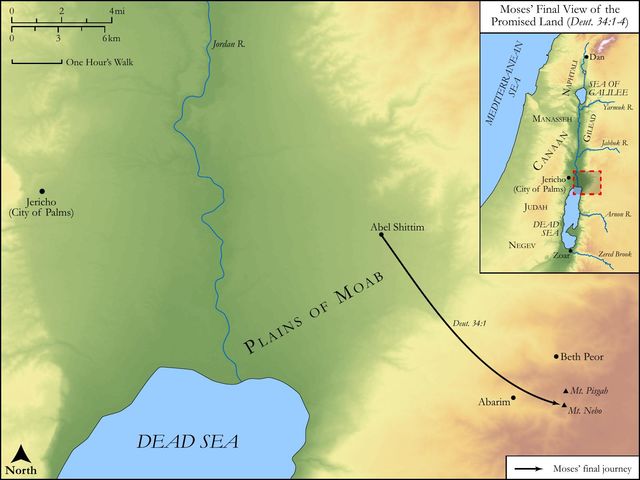
The events of Deuteronomy 34 occur on the plains of Moab, east of the Jordan River, as the Israelites stand poised to enter the Promised Land after forty years of wilderness wandering. Moses' death here marks the definitive end of an era of direct divine leadership through him. Culturally, the practice of burying the dead was deeply significant in Israel, as when Abraham bought a burying place for Sarah, and among the nations graves often served as places of remembrance and even veneration for ancestors or revered figures. Knowing the precise location of a significant person's tomb was common and frequently led to the establishment of shrines or memorial sites. The mention of "Bethpeor" is particularly significant; it was a place associated with the infamous incident where Israel engaged in idolatry and sexual immorality with the Moabites and Midianites, worshipping Baal of Peor (Numbers 25:1-5). By burying Moses "over against Bethpeor" yet keeping his grave unknown, God subtly reinforces His protective stance against idolatry, preventing the very people who had fallen prey to pagan worship from turning Moses' resting place into a shrine. This divine act preempted a potential spiritual snare for a people prone to backsliding.
Key Themes
ShowHideDeuteronomy 34:6 contributes significantly to several overarching themes within Deuteronomy and the broader Pentateuch. Firstly, it powerfully illustrates Divine Sovereignty over life and death, as God Himself takes charge of Moses' burial, demonstrating His ultimate control even over the final resting place of His most esteemed servant. This highlights God's meticulous care and providential oversight. Secondly, the hidden nature of the grave highlights God's proactive Prevention of Idolatry. Knowing the reverence the Israelites held for Moses, God divinely intervened to ensure his tomb would not become a site of worship, thereby protecting His people from a spiritual snare, echoing the stern warnings against idolatry found throughout the book of Deuteronomy. Thirdly, it underscores the Uniqueness of Moses' Relationship with God. His death and burial are unlike any other, setting him apart as the unparalleled prophet through whom God communicated His law and with whom God spoke "face to face" (Deuteronomy 34:10). Finally, the verse subtly marks the Transition of Leadership from Moses to Joshua, ensuring that the people's focus shifts from the past leader to God's continued faithfulness through the new leader and the journey ahead into the Promised Land, emphasizing that God's work continues beyond any single human instrument.
Exposition and Analysis
ShowHideKey Word Analysis
ShowHideThis verb (H6912) typically describes the human act of interment. However, in this context, the subject of the verb is implicitly God, as stated in the preceding verse (Deuteronomy 34:5) where the Lord takes Moses. This divine action elevates the act beyond a mere human burial, signifying God's direct, personal involvement and profound care for His servant, even in death. It underscores the sacredness and unparalleled nature of Moses' end, demonstrating God's ultimate sovereignty over life and demise.
This noun (H6900) refers to a grave, tomb, or burial place. The fact that this "qᵉbûwrâh" is explicitly stated to be unknown to any human highlights the deliberate and enduring mystery surrounding Moses' final resting place. It is a physical location, yet supernaturally concealed, emphasizing God's purposeful design to prevent its discovery and potential misuse. This concealment is a testament to God's foresight and protective care for His people against future idolatry.
This verb (H3045) signifies to know, perceive, ascertain, or be acquainted with. The declaration that "no man knoweth" uses this term to emphasize the absolute and enduring secrecy surrounding Moses' grave. It implies a divine act of concealment that actively prevents human discovery. This lack of human knowledge is not accidental but a divinely ordained condition, reinforcing the theological purpose of preventing the veneration of Moses' burial site.
Verse Breakdown
ShowHide"And he buried him"
The subject "he" refers unequivocally to the Lord Himself, as established in Deuteronomy 34:5, which states, "So Moses the servant of the Lord died there in the land of Moab, according to the word of the Lord." This direct divine action in burying Moses is highly unusual and profoundly significant, demonstrating God's ultimate sovereignty over life and death, and His personal, meticulous care for His faithful servant. It sets Moses' burial apart from any other human interment, underscoring his unique status.
"in a valley in the land of Moab, over against Bethpeor"
This clause provides a geographical location that is specific enough to place the event generally within the Transjordanian region but vague enough to prevent precise identification. Moab was the territory east of the Dead Sea where Israel was encamped before entering Canaan. "Bethpeor" was a known location in Moab, infamous for the Israelites' egregious sin of idolatry and immorality with Baal of Peor (Numbers 25:3). Placing Moses' unknown grave "over against" or opposite such a site subtly reinforces God's intention to prevent any future idolatry associated with Moses, using the very memory of past sin as a backdrop for divine protection.
"but no man knoweth of his sepulchre unto this day"
This is the most striking and enduring detail of the verse. The absolute secrecy surrounding Moses' grave, maintained "unto this day" (the time of the Deuteronomic narrator or later compilation), is a deliberate act of divine providence. Its primary purpose was to prevent the Israelites, who were historically prone to idolatry, from turning Moses' burial site into a shrine or object of worship, thereby diverting their devotion from God alone. It underscores that even the greatest human leader must not be elevated to a position that rivals God's unique glory and exclusive right to worship.
Literary Devices
ShowHideThe passage employs several potent literary devices to convey its profound theological message. Divine Anthropomorphism is evident in the depiction of God performing the human act of burying Moses, emphasizing His direct and personal involvement in the life and death of His servant. This elevates the event beyond a mere human passing, highlighting God's intimate relationship with Moses. The hidden grave also functions as a Precautionary Tale or Preventative Measure, subtly demonstrating God's foresight and proactive steps to safeguard His people's purity of worship by removing a potential object of idolatry. The enduring mystery of the unknown grave creates an Enigma, a deliberate divine act that highlights God's ways as inscrutable and higher than human understanding, inviting awe rather than comprehension. Finally, there is a powerful Contrast between the immense public life and leadership of Moses and the utterly private, divinely concealed nature of his death and burial, underscoring his unparalleled status while simultaneously preventing his veneration.
Theological and Thematic Connections
ShowHideDeuteronomy 34:6 is a profound statement on divine sovereignty, the nature of true worship, and the unique role of God's chosen servants. God's direct involvement in Moses' burial, and the subsequent concealment of his grave, serves as a powerful theological safeguard. It teaches that God alone is to be worshipped and that even the most revered human figures, like Moses, must not become objects of veneration that detract from the exclusive worship due to the Creator. This divine act demonstrates God's jealous love for His people, protecting them from the spiritual dangers of hero-worship and idolatry, which had been a recurring struggle for Israel throughout their wilderness journey, notably at Baal-Peor. It also speaks to God's meticulous care for His faithful, even in death, ensuring their legacy serves His purposes alone and points only to Him.
Reflection and Application
ShowHideThe mystery surrounding Moses' burial in Deuteronomy 34:6 offers profound lessons for believers today. It calls us to reflect on the absolute sovereignty of God, who orchestrates every detail of our lives, including our end. Just as God personally oversaw Moses' burial to prevent idolatry, He continues to work in our lives, often in ways unseen or misunderstood, always for our ultimate good and His glory. This passage serves as a perpetual warning against the human tendency to elevate leaders, experiences, or even spiritual gifts to a place of undue reverence, thereby detracting from the exclusive worship of God. Our devotion must remain singularly focused on the Lord, recognizing that even the greatest human instruments are but vessels for His divine purpose. We are reminded that some things are meant to remain mysteries, known only to God, and our faith is perfected not in knowing all answers, but in trusting the One who knows all things and works all things according to His perfect will, always for His glory and our sanctification.
Questions for Reflection
ShowHideFAQ
ShowHideWhy did God bury Moses Himself, and why is his grave unknown?
ShowHideGod buried Moses Himself, as clearly implied by the text, and kept his grave unknown for several key theological reasons. Firstly, it powerfully demonstrates God's absolute sovereignty over all aspects of life and death, even for His most esteemed servant. This act underscores God's personal care and ultimate authority. Secondly, and perhaps most importantly, it was a divine preventative measure against idolatry. Moses was revered by the Israelites as the great lawgiver and prophet who led them out of Egypt. If his burial site were known, there was a significant risk that the people, who were historically prone to idolatry (as evidenced by the golden calf incident in Exodus 32 and the Baal-peor incident in Numbers 25), might turn his tomb into a shrine or object of worship, diverting their devotion from God alone. By concealing his grave, God protected His people from this spiritual snare, ensuring their worship remained pure and directed solely to Him. It also underscored Moses' unique status as a prophet whose end was entirely in God's hands, preventing any human claim over his final resting place.
Christ-Centered Fulfillment
ShowHideThe mysterious, divinely concealed burial of Moses in Deuteronomy 34:6, while marking the end of the old covenant era, finds profound Christ-centered fulfillment. Moses, as the great lawgiver and prophet, served as a significant type of Christ, the ultimate Prophet and the fulfillment of the Law (John 1:17). The hidden grave of Moses served to prevent the veneration of a human figure, ensuring that all worship would be directed to God. This perfectly anticipates the New Covenant reality where Christ alone is to be worshipped and glorified, as the one through whom God has fully revealed Himself and through whom we have access to the Father (Hebrews 1:1-3). While Moses led Israel to the threshold of the earthly Promised Land, his death marked the limit of the Law's ability to bring full salvation and entry into rest. Christ, however, through His death and glorious resurrection, leads His people into the true, eternal rest and inheritance, the heavenly Canaan (Hebrews 4:8-10). Unlike Moses' hidden grave, Christ's tomb was revealed to be empty, not to prevent idolatry, but to proclaim His triumph over death and His glorious resurrection, inviting all to worship Him as the living Lord and Savior (Matthew 28:5-7). Thus, Moses' unique burial, preventing the worship of the servant, ultimately points to the One who is truly worthy of all worship and who brings the ultimate fulfillment of God's promises.