


Deuteronomy 3:29
Bible text: King James Version (1769 Blayney text) · Public domain
Bible text: Berean Standard Bible · Public domain
Bible text: American Standard Version (1901) · Public domain
Bible text: World English Bible, Messianic edition · Public domain
Bible text: Geneva Bible (1599) · Public domain
Bible text: Young's Literal Translation · Public domain
- וַנֵּשֶׁבva·Ne·shevand we remainedH3427Conj-w ¦ V-Qal-ConsecImperf-1cpVerb Qal Consecutive Imperfect 1st Plural common genderוַandנֵּשֶׁבwe remained
- בַּגָּיְאba·Gay'in the valleyH1516Prep-b ¦ N-csNoun Singular common gender Absoluteבַּin theגָּיְאvalley
- מוּלmulopposite toH4136N-mscNoun Singular Masculine Construct
- בֵּיתbeitBethH1047N-properNoun Proper Location
- פְּעוֹרpe·'orPeorH1047N-properNoun Proper Location
English is a literal word-by-word gloss of the Hebrew, not the KJV's wording. Why?
This is the original text the KJV's translators worked from — each Hebrew word with its own literal English meaning in this verse, prepared by scholars at Tyndale House, Cambridge. The KJV translates whole sentences, not word by word, so its wording differs: one Hebrew word can become several English words, and the KJV may choose “the LORD” where the gloss reads “Yahweh”. Both are faithful — they answer different questions. For the KJV's own rendering, switch to the KJV text.
Details
See on the biblical-era maps
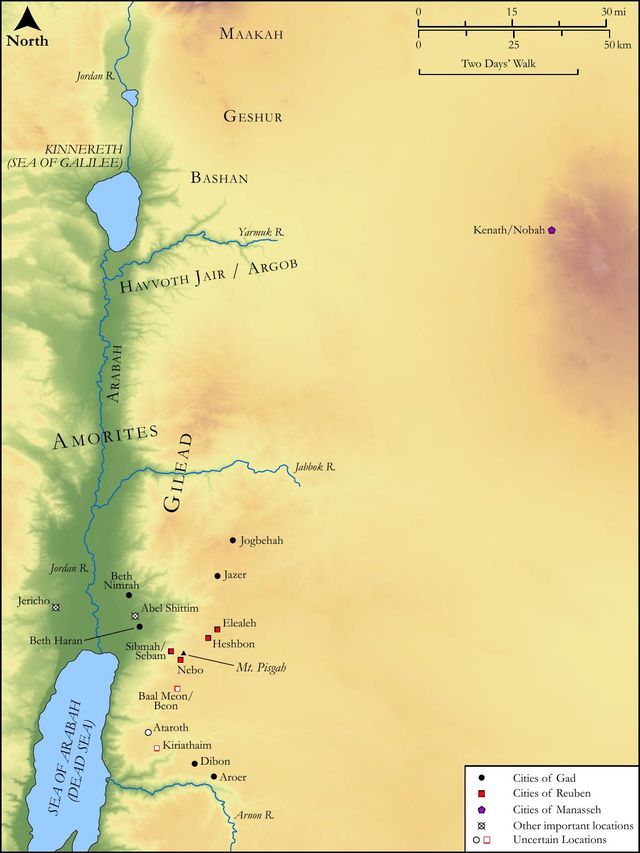
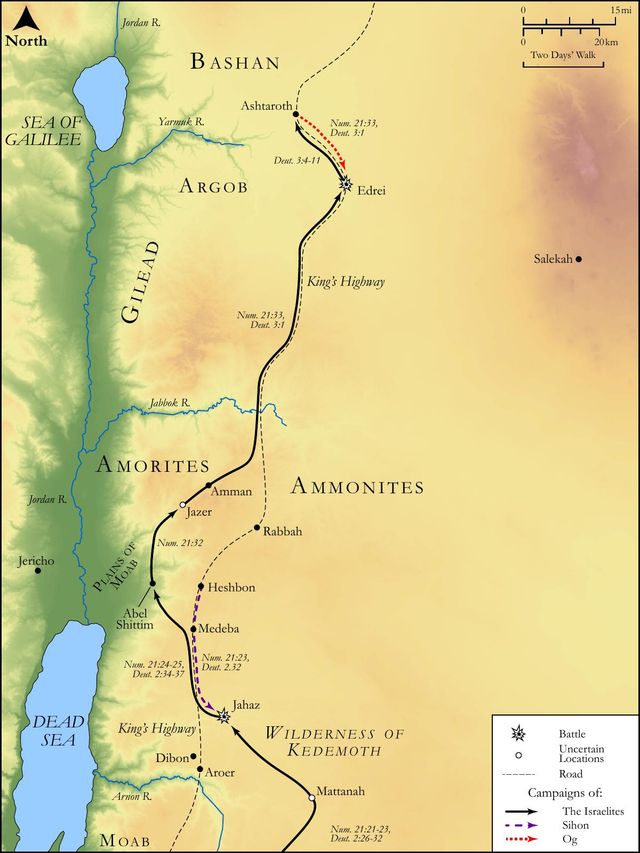
Study this verse
Public-domain commentary
Matthew Henry
From his Commentary on the Whole Bible. Henry comments on passages, not single verses — this entry covers Deuteronomy 3:21–29. His four-level outline is real structure in the source text, so it is rendered as structure.
Here is I. The encouragement which Moses gave to Joshua, who was to succeed him in the government, Deu 3:21, Deu 3:22. He commanded him not to fear. This those that are aged and experienced in the service of God should do all they can to strengthen the hands of those that are young, and setting out in religion. Two things he would have him consider for his encouragement: - 1. What God has done. Joshua had seen what a total defeat God had given by the forces of Israel to these two kings, and thence he might easily infer, so shall the Lord do to all the rest of the kingdoms upon which we are to make war. He must not only infer thence that thus the Lord can do with them all, for his arm is not shortened, but thus he will do, for his purpose is not changed; he that has begun will finish; as for God, his work is perfect. Joshua had seen it with his own eyes. And the more we have seen of the instances of divine wisdom, power, and goodness, the more inexcusable we are if we fear what flesh can do unto us. 2. What God had promised. The Lord your God he shall fight for you; and that cause cannot but be victorious which the Lord of hosts fights for. If God be for us, who can be against us so as to prevail? We reproach our leader if we follow him trembling.
II.The prayer which Moses made for himself, and the answer which God gave to that prayer.
1.His prayer was that, if it were God's will, he might go before Israel over Jordan into Canaan. At that time, when he had been encouraging Joshua to fight Israel's battles, taking it for granted that he must be their leader, he was touched with an earnest desire to go over himself, which expresses itself not in any passionate and impatient complaints, or reflections upon the sentence he was under, but in humble prayers to God for a gracious reversing of it. I besought the Lord. Note, We should never allow any desires in our hearts which we cannot in faith offer up to God by prayer; and what desires are innocent, let them be presented to God. We have not because we ask not. Observe,
(1.)What he pleads here. Two things: - [1.] The great experience which he had had of God's goodness to him in what he had done for Israel: "Thou hast begun to show thy servant thy greatness. Lord, perfect what thou hast begun. Thou hast given me to see thy glory in the conquest of these two kings, and the sight has affected me with wonder and thankfulness. O let me see more of the outgoings of my God, my King! This great work, no doubt, will be carried on and completed; let me have the satisfaction of seeing it." Note, the more we see of God's glory in his works the more we shall desire to see. The works of the Lord are great, and therefore are sought out more and more of all those that have pleasure therein. [2.] The good impressions that had been made upon his heart by what he had seen: For what God is there in heaven or earth that can do according to thy works? The more we are affected with what we have seen of God, of his wisdom, power, and goodness, the better we are prepared for further discoveries. Those shall see the works of God that admire him in them. Moses had thus expressed himself concerning God and his works long before (Exo 15:11), and he still continues of the same mind, that there are no works worthy to be compared with God's works, Psa 86:8.
(2.)What he begs: I pray thee let me go over, Deu 3:25. God had said he should not go over; yet he prays that he might, not knowing but that the threatening was conditional, for it was not ratified with an oath, as that concerning the people was, that they should not enter. Thus Hezekiah prayed for his own life, and David for the life of his child, after both had ben expressly threatened; and the former prevailed, though the latter did not. Moses remembered the time when he had by prayer prevailed with God to recede from the declarations which he had made of his wrath against Israel, Exo 32:14. And why might he not hope in like manner to prevail for himself? Let me go over and see the good land. Not, "Let me go over and be a prince and a ruler there;" he seeks not his own honour, is content to resign the government to Joshua; but, "Let me go to be a spectator of thy kindness to Israel, to see what I believe concerning the goodness of the land of promise." How pathetically does he speak of Canaan, that good land, that goodly mountain! Note, Those may hope to obtain and enjoy God's favours that know how to value them. What he means by that goodly mountain we may learn from Psa 78:54, where it is said of God's Israel that he brought them to the border of his sanctuary, even to this mountain which his right hand had purchased, where it is plainly to be understood of the whole land of Canaan, yet with an eye to the sanctuary, the glory of it.
2.God's answer to this prayer had in it a mixture of mercy and judgment, that he might sing unto God of both.
(1.)There was judgment in the denial of his request, and that in something of anger too: The Lord was wroth with me for your sakes, Deu 3:26. God not only sees sin in his people, but is much displeased with it; and even those that are delivered from the wrath to come may yet lie under the tokens of God's wrath in this world, and may be denied some particular favour which their hearts are much set upon. God is a gracious, tender, loving Father; but he is angry with his children when they do amiss, and denies them many a thing that they desire and are ready to cry for. But how was he wroth with Moses for the sake of Israel? Either,
[1.]For that sin which they provoked him to; see Psa 106:32, Psa 106:33. Or,
[2.]The removal of Moses at that time, when he could so ill be spared, was a rebuke to all Israel, and a punishment of their sin. Or,
[3.]It was for their sakes, that it might be a warning to them to take heed of offending God by passionate and unbelieving speeches at any time, after the similitude of his transgression; for, if this were done to such a green tree, what should be done to the dry? He acknowledges that God would not hear him. God had often heard him for Israel, yet he would not hear him for himself. It was the prerogative of Christ, the great Intercessor, to be heard always; yet of him his enemies said, He saved others, himself he could not save, which the Jews would not have upbraided him with had they considered that Moses, their great prophet, prevailed for others, but for himself he could not prevail. Though Moses, being one of the wrestling seed of Jacob, did not seek in vain, yet he had not the thing itself which he sought for. God may accept our prayers, and yet not grant us the very thing we pray for.
(2.)Here is mercy mixed with this wrath in several things: - [1.] God quieted the spirit of Moses under the decree that had gone forth by that word (Deu 3:26), Let it suffice thee. With this word, no doubt, a divine power went to reconcile Moses to the will of God, and to bring him to acquiesce in it. If God does not by his providence give us what we desire, yet, if by his grace he makes us content without it, it comes much to one. "Let it suffice thee to have God for they father, and heaven for thy portion, though thou hast not every thing thou wouldest have in this world. Be satisfied with this, God is all-sufficient." [2.] He put an honour upon his prayer in directing him not to insist upon this request: Speak no more to me of this matter. It intimates that what God does not think fit to grant we should not think fit to ask, and that God takes such a pleasure in the prayer of the upright that it is no pleasure to him, no, not in any particular instance, to give a denial to it. [3.] He promised him a sight of Canaan from the top of Pisgah, Deu 3:27. Though he should not have the possession of it, he should have the prospect of it; not to tantalize him, but such a sight of it as would yield him true satisfaction, and would enable him to form a very clear and pleasing idea of that promised land. Probably Moses had not only his sight preserved for other purposes, but greatly enlarged for this purpose; for, if he had not had such a sight of it as others could not have from the same place, it would have been no particular favour to Moses, nor the matter of a promise. Even great believers, in this present state, see heaven but at a distance. [4.] He provided him a successor, one who should support the honour of Moses and carry on and complete that glorious work which the heart of Moses was so much upon, the bringing of Israel to Canaan, and settling them there (Deu 3:28): Charge Joshua and encourage him in this work. Those to whom God gives a charge, he will be sure to give encouragement to. And it is a comfort to the church's friends (when they are dying and going off) to see God's work likely to be carried on by other hands, when they are silent in the dust.
Continue studying Deuteronomy 3:29 across the web’s major study libraries — every link below opens this exact verse, chapter, or book on the destination site.
Read & Compare
 BibleGatewayThis verse in more than 200 translations and 70 languages.
 Bible.comThe YouVersion reader — hundreds of translations, reading plans, and highlights.
 ESV.orgCrossway's official English Standard Version reader.
 NET BibleThe NET translation with 60,000+ translators' notes on every rendering decision.
 STEP BibleTyndale House's free study tool — original text, vocabulary, and scholarly resources.
 BibliaLogos Bible Software's free web reader.
 USCCBThe New American Bible (Revised Edition) with the U.S. bishops' study notes.
Commentaries
 BibleHub CommentariesDozens of classic commentaries on this verse, gathered on one page.
 StudyLightMore than 100 commentary sets — the largest collection on the web.
 BibleRefPlain-English commentary on what this verse means, verse by verse.
 Enduring WordDavid Guzik's free commentary on this chapter, widely used by Bible teachers.
 Bible Study ToolsVerse commentary alongside Greek and Hebrew study aids.
Original Language & Research
- BibleHub InterlinearThe verse word by word — original language, transliteration, and English.
- BibleHub LexiconEvery word's original-language definition and Strong's entry.
 Blue Letter BibleDeep-study tools — Strong's numbers, concordance, and word studies.
 SefariaThe Hebrew text with Rashi and centuries of Jewish commentary.
Sermons, Hymns & Audio


TrulyRandomVerse is not affiliated with these sites and doesn’t control their content. They’re linked because they’re genuinely useful.
Summary
Deuteronomy 3:29 serves as a concise yet profoundly significant geographical marker, concluding Moses' historical review of Israel's wilderness journey and their recent victories east of the Jordan. It pinpoints their final encampment in the valley opposite Bethpeor, a strategic and symbolically charged location. This verse acts as a pivotal transition, signaling the imminent end of the wilderness wandering and the threshold of the Promised Land, setting the stage for Moses' culminating discourses and the nation's entry into their inheritance.
Context
ShowHideLiterary Context
Deuteronomy 3:29 concludes a significant section (Deuteronomy 1:6-3:29) where Moses recounts the journey from Horeb to the plains of Moab. Specifically, it follows Moses' recap of the decisive victories over King Sihon of Heshbon and King Og of Bashan, detailed in Deuteronomy 2:26-37 and Deuteronomy 3:1-11, and the subsequent allocation of their lands to the Reubenites, Gadites, and the half-tribe of Manasseh, described in Deuteronomy 3:12-20. The verses immediately preceding this one (Deuteronomy 3:21-28) detail Moses' charge to Joshua, his successor, and God's reiteration that Moses himself would not enter the Promised Land. Thus, the encampment in the valley over against Bethpeor marks the physical culmination of the forty-year journey and the narrative pivot point before Moses delivers his final, extensive instructions and covenant stipulations in the chapters that follow, beginning with the powerful exhortation in Deuteronomy 4.
Historical & Cultural Context
The "valley over against Bethpeor" refers to a specific geographical location in the plains of Moab, east of the Jordan River and opposite Jericho. Bethpeor, meaning "House of Peor," was a site associated with the worship of Baal-Peor, a local Moabite deity. This location is infamous in Israel's history for the tragic incident recounted in Numbers 25:1-5, where Israel engaged in idolatry and sexual immorality with Moabite and Midianite women, incurring God's severe judgment. The fact that Israel encamped here, on the very border of the Promised Land, yet at a place known for pagan worship and past national sin, underscores the constant spiritual vigilance required of God's people. Culturally, this encampment would have been a massive undertaking, housing potentially millions of people, their livestock, and possessions, requiring a broad valley for such a large community to settle temporarily before the momentous crossing of the Jordan River.
Key Themes
ShowHideThis seemingly simple geographical statement is rich with thematic significance. It highlights The Threshold of Promise, as Israel stands on the very brink of entering the land God promised to Abraham, Isaac, and Jacob (Deuteronomy 1:8). It underscores Divine Faithfulness and Guidance, demonstrating that despite Israel's frequent rebellions and the challenges of the wilderness, God has faithfully led them to this strategic staging ground, poised for the momentous entry. Furthermore, the proximity to Bethpeor subtly introduces the theme of Spiritual Vigilance and Warning, reminding both Moses' original audience and future generations of the ever-present danger of idolatry and compromise, even when on the cusp of divine blessing. The location itself serves as a silent, yet potent, reminder of the lessons learned and the temptations that still lurked at the very borders of their inheritance.
Exposition and Analysis
ShowHideKey Word Analysis
ShowHideThis primitive root properly means "to sit down," but by implication, it extends to "dwell, remain, settle." In this context, it signifies a deliberate and perhaps extended encampment, not merely passing through. It implies a period of resting, preparation, organization, and final instruction before the momentous entry into the Promised Land. This verb marks a pause in their forty-year journey, a moment of consolidation before the next divine command.
This term refers to a gorge or a low-lying area, often between hills. Such a topographical feature would have been ideal for accommodating the vast Israelite encampment, providing sufficient space for tents, livestock, and the logistical needs of a large community. It contrasts with the rugged wilderness terrain they had often traversed, suggesting a more stable and strategic location for their final staging ground before the invasion of Canaan.
Literally meaning "House of Peor," this is a geographical place name that also denotes a cultic site dedicated to the pagan deity Peor. The association with Baal-Peor, as seen in the infamous incident of Israel's sin in Numbers 25, imbues this seemingly neutral geographical marker with profound spiritual significance. It highlights the constant spiritual battle Israel faced against the idolatrous practices of the surrounding nations, even as they stood on the threshold of God's promised inheritance.
Verse Breakdown
ShowHide"So we abode"
The pronoun "we" refers to Moses and the entire Israelite community. The conjunction "So" (or "Thus") indicates a conclusion or a result of the preceding narrative, specifically their successful journey and victories over the Transjordanian kings. The verb "abode" signifies a settled, albeit temporary, encampment, marking a significant pause in their forty-year wilderness journey. It implies a period of waiting, reflection, and final preparation before the next major divine directive.
"in the valley"
This specifies the type of terrain chosen for their encampment. A "valley" or plain would have been necessary to accommodate the immense population of Israel. It suggests a practical and strategic location, providing space and perhaps resources for such a large gathering before the final push into Canaan.
"over against Bethpeor"
This precise geographical marker places their encampment directly opposite Bethpeor. While providing a clear location, it also carries immense symbolic weight. Bethpeor was a known site of pagan worship and, more significantly, the place where Israel had previously succumbed to idolatry and immorality. Its mention here serves as a subtle, yet potent, reminder of past failures and the ongoing spiritual dangers, even as they stood on the precipice of fulfilling God's promises.
Literary Devices
ShowHideDeuteronomy 3:29, though brief, employs several significant literary devices. The most prominent is Geographical Marker as Symbolic Foreshadowing. The specific mention of "Bethpeor" is not merely a topographical detail; it immediately evokes the tragic events of Numbers 25. This serves as a subtle, yet powerful, reminder of Israel's past failures and the constant temptation to idolatry, even as they are on the verge of entering the Promised Land. The location itself becomes a silent warning, foreshadowing the ongoing spiritual battles and the need for unwavering obedience in the land. Additionally, the verse functions as a Transition Marker, signaling the end of the historical review and the beginning of Moses' final legislative and hortatory discourses. Its concise nature also exemplifies Understatement, as a single, simple sentence encapsulates the culmination of forty years of wandering and the dramatic shift from wilderness journey to the brink of settled inheritance, laden with both promise and peril.
Theological and Thematic Connections
ShowHideDeuteronomy 3:29, marking Israel's encampment at the threshold of the Promised Land, beautifully encapsulates the themes of divine faithfulness, human responsibility, and the nature of God's covenant. It highlights God's unwavering commitment to His promises, bringing His people through forty years of wilderness wandering to the very border of their inheritance, despite their repeated failures and rebellions. This moment of pause signifies a divine appointment, a time for final preparation and instruction before entering a new phase of their relationship with God. Yet, the specific location "over against Bethpeor" serves as a stark reminder that even on the cusp of blessing, the spiritual battle is ever-present. God's grace leads them to the promise, but their continued obedience is required to fully possess and enjoy it, underscoring that the journey of faith is not merely about reaching a destination, but about maintaining fidelity to God throughout.
Reflection and Application
ShowHideDeuteronomy 3:29, though a seemingly simple geographical statement, holds profound relevance for the spiritual journey of believers today. It speaks to those moments in life when we find ourselves at a "Bethpeor"—a place of waiting, preparation, or even potential temptation, just before a significant step forward in our faith or life's calling. This verse reminds us that God faithfully brings us to these thresholds, even when our past has been imperfect. It calls us to acknowledge His unwavering guidance and provision that has led us this far. However, it also serves as a crucial warning: even on the brink of new blessings and divine promises, vigilance against spiritual compromise, idolatry, and moral laxity is absolutely essential. Just as Israel stood poised to enter the land, yet vulnerable to the influences of Bethpeor, we too must remain alert to the subtle temptations that can arise even in periods of anticipation and transition. These divine pauses are not merely delays, but opportunities for deep reflection, renewed commitment to God's Word, and spiritual fortification for the challenges and blessings that lie ahead.
Questions for Reflection
ShowHideFAQ
ShowHideWhy is the specific location "Bethpeor" mentioned here?
ShowHideThe mention of "Bethpeor" is significant for several reasons. First, it provides a precise geographical marker, indicating Israel's final encampment on the eastern side of the Jordan River before entering Canaan. This detail helps to ground the narrative in a specific historical context. Second, and more importantly, Bethpeor was a notorious site associated with the worship of the pagan deity Baal-Peor. This location is infamous in Israel's history because it was where the Israelites succumbed to idolatry and sexual immorality with Moabite and Midianite women, leading to a devastating plague from God (Numbers 25:1-9). By mentioning Bethpeor, Moses subtly reminds the Israelites of their past failures and the ever-present danger of spiritual compromise, even as they stand on the threshold of God's promised blessings. It serves as a historical and spiritual warning.
What is the significance of this verse being the last in chapter 3?
ShowHideDeuteronomy 3:29 serves as a crucial literary and thematic transition point. It marks the conclusion of Moses' detailed historical recap of Israel's journey from Horeb to the plains of Moab, including their victories over Sihon and Og and the allocation of land east of the Jordan. By ending chapter 3 with this verse, Moses effectively signals a pause in the narrative, a strategic encampment before the momentous crossing of the Jordan. It sets the stage for the extensive and vital discourses that follow in the rest of Deuteronomy, where Moses delivers his final instructions, laws, and exhortations to the new generation before they enter the Promised Land. This verse acts as a bridge, closing one major section of the book and preparing the audience for the next, emphasizing that Israel is now poised for their ultimate inheritance.
Christ-Centered Fulfillment
ShowHideDeuteronomy 3:29, depicting Israel at the threshold of the earthly Promised Land, finds its ultimate and profound fulfillment in Jesus Christ. The wilderness journey of Israel, culminating at Bethpeor, foreshadows the greater spiritual pilgrimage of humanity and the ultimate rest found in God. While Moses, due to his sin, could only lead Israel to the border of Canaan, Jesus is the greater Moses who truly brings His people into the promised inheritance. He is the one who leads us not merely to an earthly land, but into the spiritual rest and eternal life that God has prepared for us (Hebrews 4:1-11). The "valley over against Bethpeor," a place of past temptation and sin, highlights humanity's inherent vulnerability to idolatry and compromise. Yet, Christ is our perfect High Priest and Lamb of God, who takes away the sin of the world (John 1:29), conquering sin and death where Israel failed. He is the true "House of God" (John 2:19-21) in whom we find refuge and true worship, far superior to any pagan sanctuary. Through His finished work on the cross, Jesus has opened the way for us to enter into God's presence and inherit the heavenly Canaan, a place prepared for us (John 14:1-3). Our "abode" in this life, like Israel's at Bethpeor, is often a place of waiting and preparation, but our hope is securely anchored in the one who has already entered the heavenly sanctuary on our behalf, ensuring our ultimate inheritance and rest in Him (Hebrews 9:24).