


2 Samuel 6:6
- וַיָּבֹאוּvai·ya·Vo·'uand they cameH935Conj-w ¦ V-Qal-ConsecImperf-3mpVerb Qal Consecutive Imperfect 3rd Plural Masculineוַandיָּבֹאוּthey came
- עַד'adtoH5704PrepPreposition
- גֹּרֶןGo·ren[the] threshing floor ofH1637N-fscNoun Singular Feminine Construct
- נָכוֹןna·KhonNaconH5225N-proper-mNoun Proper Masculine
- וַיִּשְׁלַחvai·yish·Lachand he stretched outH7971Conj-w ¦ V-Qal-ConsecImperf-3msVerb Qal Consecutive Imperfect 3rd Singular Masculineוַandיִּשְׁלַחhe stretched out
- עֻזָּא'u·Za'UzzahH5798N-proper-mNoun Proper Masculine
- אֶל'eltoH413PrepPreposition
- אֲרוֹן'a·Ron[the] ark ofH727N-mscNoun Singular Masculine Construct
- הָאֱלֹהִיםha·'E·lo·Him<the> GodH430Art ¦ N-mpNoun Plural Masculine Absoluteהָ<the>אֱלֹהִיםGod
- וַיֹּאחֶזvai·Yo·chezand he took holdH270Conj-w ¦ V-Qal-ConsecImperf-3msVerb Qal Consecutive Imperfect 3rd Singular Masculineוַandיֹּאחֶזhe took hold
- בּוֹboon <the> itPrep-b ¦ 3msSuffix Personal 3rd Singular Masculineבּon <the>וֹit
- כִּיkiforH3588PrtParticle Conditional
- שָׁמְטוּsha·me·Tuthey had stumbledH8058V-Qal-Perf-3cpVerb Qal Perfect 3rd Plural common gender
- הַבָּקָרha·ba·Karthe ox[en]H1241Art ¦ N-csNoun Singular common gender Absoluteהַtheבָּקָרox[en]
English is a literal word-by-word gloss of the Hebrew, not the KJV's wording. Why?
This is the original text the KJV's translators worked from — each Hebrew word with its own literal English meaning in this verse, prepared by scholars at Tyndale House, Cambridge. The KJV translates whole sentences, not word by word, so its wording differs: one Hebrew word can become several English words, and the KJV may choose “the LORD” where the gloss reads “Yahweh”. Both are faithful — they answer different questions. For the KJV's own rendering, switch to the KJV text.
Details
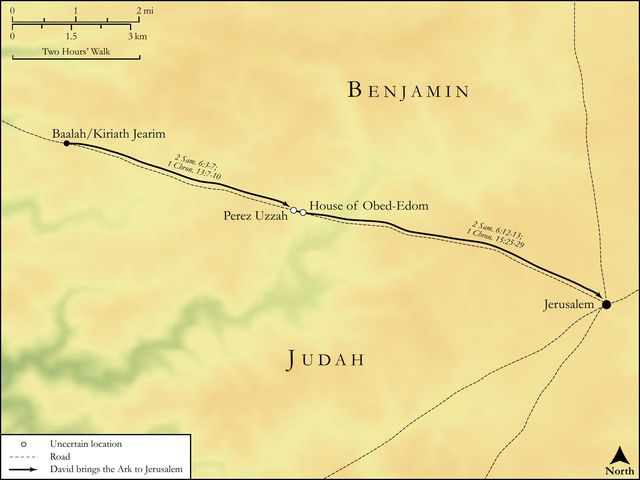
See on the biblical-era maps

Study this verse
Public-domain commentary
Matthew Henry
From his Commentary on the Whole Bible. Henry comments on passages, not single verses — this entry covers 2 Samuel 6:6–11. His two-level outline is real structure in the source text, so it is rendered as structure.
We have here Uzzah struck dead for touching the ark, when it was upon its journey towards the city of David, a sad providence, which damped their mirth, stopped the progress of the ark, and for the present, dispersed this great assembly, which had come together to attend it, and sent them home in a fright.
I.Uzzah's offence seems very small.
He and his brother Ahio, the sons of Abinadab, in whose house the ark had long been lodged, having been used to attend it, to show their willingness to prefer the public benefit to their own private honour and advantage, undertook to drive the cart in which the ark was carried, this being perhaps the last service they were likely to do it; for others would be employed about it when it came to the city of David. Ahio went before, to clear the way, and, if need were, to lead the oxen. Uzzah followed close to the side of the cart. It happened that the oxen shook it, Sa2 6:6. The critics are not agreed about the signification of the original word: They stumbled (so our margin); they kicked (so some), perhaps against the goad with which Uzzah drove them; they stuck in the mire, by some. By some accident or other the ark was in danger of being overthrown. Uzzah thereupon laid hold of it, to save it from falling, we have reason to think with a very good intention, to preserve the reputation of the ark and to prevent a bad omen. Yet this was his crime. Uzzah was a Levite, but priests only might touch the ark. The law was express concerning the Kohathites, that, though they were to carry the ark by the staves, yet they must not touch any holy thing, lest they die, Num 4:15. Uzzah's long familiarity with the ark, and the constant attendance he had given to it, might occasion his presumption, but would not excuse it.
II.His punishment for this offence seems very great (Sa2 6:7):
The anger of the Lord was kindled against him (for in sacred things he is a jealous God) and he smote him there for his rashness, as the word is, and struck him dead upon the spot. There he sinned, and there he died, by the ark of God; even the mercy-seat would not save him. Why was God thus severe with him?
1.The touching of the ark was forbidden to the Levites expressly under pain of death - lest they die; and God, by this instance of severity, would show how he might justly have dealt with our first parents, when they had eaten that which was forbidden under the same penalty - lest you die.
2.God saw the presumption and irreverence of Uzzah's heart. Perhaps he affected to show, before this great assembly, how bold he could make with the ark, having been so long acquainted with it. Familiarity, even with that which is most awful, is apt to breed contempt.
3.David afterwards owned that Uzzah died for an error they were all guilty of, which was carrying the ark in a cart. Because it was not carried on the Levites' shoulders, the Lord made that breach upon us, Ch1 15:13. But Uzzah was singled out to be made an example, perhaps because he had been most forward in advising that way of conveyance; however he had fallen into another error, which was occasioned by that. Perhaps the ark was not covered, as it should have been, with the covering of badgers' skins (Num 4:6), and that was a further provocation.
4.God would hereby strike an awe upon the thousands of Israel, would convince them that the ark was never the less venerable for its having been so long in mean circumstances, and thus he would teach them to rejoice with trembling, and always to treat holy things with reverence and holy fear.
5.God would hereby teach us that a good intention will not justify a bad action; it will not suffice to say of that which is ill done that it was well meant. He will let us know that he can and will secure his ark, and needs not any man's sin to help him to do it.
6.If it was so great a crime for one to lay hold on the ark of the covenant that had no right to do so, what is it for those to lay claim to the privileges of the covenant that come not up to the terms of it? To the wicked God says, What hast thou to do to take my covenant in thy mouth? Psa 50:16. Friend, how camest thou in hither? If the ark was so sacred, and not to be touched irreverently, what is the blood of the covenant? Heb 10:29.
III.David's feelings on the infliction of this stroke were keen, and perhaps not altogether as they should have been.
He should have humbled himself under God's hand, confessed his error, acknowledged God's righteousness, and deprecated the further tokens of his displeasure, and then have gone on with the good work he had in hand. But we find,
1.He was displeased. It is not said because Uzzah had affronted God, but because God had made a breach upon Uzzah (Sa2 6:8): David's anger was kindled. It is the same word that is used for God's displeasure, Sa2 6:7. Because God was angry, David was angry and out of humour. As if God might not assert the honour of his ark, and frown upon one that touched it rudely, without asking David leave. Shall mortal man pretend to be more just than God, arraign his proceedings, or charge him with iniquity? David did not now act like himself, like a man after God's own heart. It is not for us to be displeased at any thing that God does, how unpleasing soever it is to us. The death of Uzzah was indeed an eclipse to the glory of a solemnity which David valued himself upon more than any thing else, and might give birth to some speculations among those that were disaffected to him, as if God were departing from him too; but he ought nevertheless to have subscribed to the righteousness and wisdom of God in it, and not to have been displeased at it. When we lie under God's anger we must keep under our own.
2.He was afraid, Sa2 6:9. It should seem he was afraid with amazement; for he said, How shall the ark of the Lord come to me? As if God sought advantages against all that were about him, and was so extremely tender of his ark that there was no dealing with it; and therefore better for him to keep it at a distance. Que procul a Jove, procul a fulmine - To retire from Jove is to retire from the thunder-bolt. He should rather have said, "Let the ark come to me, and I will take warning by this to treat it with more reverence." Provoke me not (says God, Jer 25:6) and I will do you no hurt. Or this may be looked upon as a good use which David made of this tremendous judgment. He did not say, "Surely Uzzah was a sinner above all men, because he suffered such things," but is concerned for himself, as one conscious, not only of his own unworthiness of God's favour, but his obnoxiousness to God's displeasure. "God might justly strike me dead as he did Uzzah. My flesh trembles for fear of thee," Psa 119:120. This God intends in his judgments, that others may hear and fear. David therefore will not bring the ark into his own city (Sa2 6:10) till he is better prepared for its reception.
3.He took care to perpetuate the remembrance of this stroke by a new name he gave to the place: Perez-uzzah, the breach of Uzzah, Sa2 6:8. He had been lately triumphing in the breach made upon his enemies, and called the place Baal-perazim, a place of breaches. But here is a breach upon his friends. When we see one breach, we should consider that we know not where the next will be. The memorial of this stroke would be a warning to posterity to take heed of all rashness and irreverence in dealing about holy things; for God will be sanctified in those that come nigh unto him.
4.He lodged the ark in a good house, the house of Obed-edom a Levite, which happened to be near the place where this disaster happened, and there, (1.) It was kindly entertained and welcomed, and continued there three months, Sa2 6:10, Sa2 6:11. Obed-edom knew what slaughter the ark had made among the Philistines that imprisoned it and the Bethshemites that looked into it. He saw Uzzah struck dead for touching it, and perceived that David himself was afraid of meddling with it; yet he cheerfully invites it to his own house, and opens his doors to it without fear, knowing it was a savour of death unto death only to those that treated it ill. "O the courage," says bishop Hall, "of an honest and faithful heart! nothing can make God otherwise than amiable to his own people: even his very justice is lovely." (2.) It paid well for its entertainment: The Lord blessed Obed-edom and all his household. The same hand that punished Uzzah's proud presumption rewarded Obed-edom's humble boldness, and made the ark to him a savour of life unto life. Let none think the worse of the gospel for the judgements inflicted on those that reject it, but set in opposition to them the blessings it brings to those that duly receive it. None ever had, nor ever shall have, reason to say that it is in vain to serve God. Let masters of families be encouraged to keep up religion in their families, and to serve God and the interests of his kingdom with their houses and estates, for that is the way to bring a blessing upon all they have. The ark is a guest which none shall lose by that bid it welcome. Josephus says that, whereas before Obed-edom was poor, on a sudden, in these three months, his estate increased, to the envy of his neighbours. Piety is the best friend to prosperity. In wisdom's left hand are riches and honour. His household shared in the blessing. It is good living in a family that entertains the ark, for all about it will fare the better for it.
Historical interpretation
Historical reception
3 surviving comments on this verse. Each one is dated, so this reads as a timeline rather than a list.
Select a marker to jump to its quote. Markers stagger vertically where authors wrote within a few decades of each other.
When the people of the Hebrews were bringing back the ark of the Lord to Jerusalem, Uzzah, from the house of Abinadab the Israelite, who had touched the side of the ark without having examined his conscience, was slain. And yet he had drawn near not to take anything from it but to hold it up when it was leaning because of the stumbling of a young ox. So great a concern was there of reverence toward God that God did not accept bold hands even out of help. The Lord also proclaims the same thing, saying, “Everyone who is clean shall eat of the flesh, and whichever soul touches the flesh of the sacrifice of well-being and has his uncleanness upon him, that soul shall be cut off from his people.” Are these things which existed long ago, and now they do not happen in this way? What then? Has God ceased to care for what concerns us? Has he withdrawn beyond the view of the world, and does he look down from heaven upon no one? Is his forbearance really ignorance? God forbid, you will say. Therefore he sees what we do but he waits, indeed, and endures patiently, and he grants an opportunity for repentance and holds out his own Christ to postpone [the end], so that they whom he has redeemed may not readily perish. Understand this well, you sinner: you are observed by God; you can appease him if you want to.
They [the Galatians] had, in fact, only introduced one or two commandments, circumcision and the observance of days, but he [Paul] says that the gospel was subverted, in order to show that a slight adulteration vitiates the whole. For as he who but partially pares away the image on a royal coin renders the whole spurious, so he who swerves ever so little from the pure faith soon proceeds from this to graver errors and becomes entirely corrupted. Where then are those who charge us with being contentious in separating from heretics and say that there is no real difference between us except what arises from our ambition? Let them hear Paul’s assertion, that those who had but slightly innovated, subverted the gospel. … Don’t you know that even under the old covenant, a man who gathered sticks on the sabbath, and transgressed a single commandment, and that not a great one, was punished with death? And that Uzzah, who supported the ark when on the point of being overturned, was struck suddenly dead, because he had intruded upon an office which did not pertain to him? Wherefore if to transgress the sabbath and to touch the falling ark drew down the wrath of God so signally as to deprive the offender of even a momentary respite, shall he who corrupts unutterably awe-inspiring doctrines find excuse and pardon? Assuredly not. A lack of zeal in small matters is the cause of all our calamities; and because slight errors escape fitting correction, great ones creep in. As in the body, a neglect of wounds generates fever, mortification and death; so in the soul, slight evils overlooked open the door to graver ones.
We read in the law that even those who seem to have acted lightly against the sacred commandments have, nevertheless, been punished most severely. This is that we might understand that nothing which pertains to God must be considered lightly, because even what seems to be very little in fault is made great by the injury to God. What did Uzzah, the Levite of God, do against the heavenly command when he tried to steady the tottering ark of the Lord? There was nothing on this point prescribed by the law. Yet, immediately when he steadied the ark, he was struck down. Not that he was insolent in manner or undutiful in mind. Yet he was undutiful in his very act, because he went beyond his orders.
Continue studying 2 Samuel 6:6 across the web’s major study libraries — every link below opens this exact verse, chapter, or book on the destination site.
Read & Compare
 BibleGatewayThis verse in more than 200 translations and 70 languages.
 Bible.comThe YouVersion reader — hundreds of translations, reading plans, and highlights.
 ESV.orgCrossway's official English Standard Version reader.
 NET BibleThe NET translation with 60,000+ translators' notes on every rendering decision.
 STEP BibleTyndale House's free study tool — original text, vocabulary, and scholarly resources.
 BibliaLogos Bible Software's free web reader.
 USCCBThe New American Bible (Revised Edition) with the U.S. bishops' study notes.
Commentaries
 BibleHub CommentariesDozens of classic commentaries on this verse, gathered on one page.
 StudyLightMore than 100 commentary sets — the largest collection on the web.
 BibleRefPlain-English commentary on what this verse means, verse by verse.
 Enduring WordDavid Guzik's free commentary on this chapter, widely used by Bible teachers.
 Bible Study ToolsVerse commentary alongside Greek and Hebrew study aids.
Original Language & Research
- BibleHub InterlinearThe verse word by word — original language, transliteration, and English.
- BibleHub LexiconEvery word's original-language definition and Strong's entry.
 Blue Letter BibleDeep-study tools — Strong's numbers, concordance, and word studies.
 SefariaThe Hebrew text with Rashi and centuries of Jewish commentary.
Sermons, Hymns & Audio


TrulyRandomVerse is not affiliated with these sites and doesn’t control their content. They’re linked because they’re genuinely useful.
Summary
Second Samuel 6:6 recounts a pivotal and tragic moment during King David's initial attempt to bring the Ark of the Covenant to Jerusalem. As the Ark, transported on a new cart, reached Nachon's threshingfloor, the oxen stumbled, causing Uzzah to instinctively reach out and steady the sacred object. This seemingly protective act, however, directly violated God's explicit commands regarding the Ark's handling, resulting in Uzzah's immediate death by divine judgment and abruptly halting the joyous procession, forcing a profound re-evaluation of God's holiness and human obedience.
Context
ShowHideLiterary Context
This verse is situated within the broader narrative of King David's reign, specifically his efforts to consolidate the kingdom and establish Jerusalem as its spiritual and political heart. Following his anointing as king over all Israel and the capture of Jerusalem (see 2 Samuel 5), David's next significant undertaking is to relocate the Ark of the Covenant from Kiriath-jearim, where it had resided for approximately seventy years (compare 1 Samuel 7:1-2), to his new capital. The chapter commences with a grand, celebratory procession involving thirty thousand chosen men, vibrant music, and enthusiastic dancing, reflecting David's fervent devotion. However, the chosen method of transport—a new cart drawn by oxen—directly contravened the Mosaic Law, which explicitly stipulated that the Ark was to be carried by poles on the shoulders of the Kohathite Levites. This foundational act of disobedience, despite the apparent zeal, sets the stage for the tragic events at Nachon's threshingfloor, introducing a profound tension between human enthusiasm and divine instruction that permeates the narrative's unfolding.
Historical & Cultural Context
The Ark of the Covenant was the most sacred artifact in ancient Israel, serving as the tangible representation of God's dwelling presence among His people, His throne, and the very embodiment of the covenant He had established with them. Its handling was governed by extremely strict divine protocols meticulously detailed in the Pentateuch (e.g., Numbers 4). The incident at Nachon's threshingfloor, a common agricultural site typically used for separating grain from chaff, starkly highlights the contrast between the mundane and the profoundly sacred. Culturally, threshingfloors were open, public spaces, making Uzzah's sudden death a highly visible and impactful event that would have deeply impressed and terrified all witnesses. The decision to transport the Ark on a new cart, while perhaps appearing modern or efficient to David's contemporaries, regrettably mirrored the Philistine method of returning the Ark (compare 1 Samuel 6:7-11), a method born of ignorance, not divine command. This historical precedent of God's severe judgment on those who mishandled the Ark, even among the Philistines (see 1 Samuel 5), should have served as a potent and sobering warning to the Israelites concerning the gravity of divine holiness.
Key Themes
ShowHideThis verse powerfully articulates several critical theological and narrative themes. Firstly, it profoundly emphasizes the holiness and sovereignty of God, demonstrating unequivocally that He is not to be approached on human terms, with human ingenuity, or according to human convenience, but strictly according to His revealed will and prescribed methods. The Ark's sanctity was paramount, demanding absolute reverence and meticulous adherence to divine commands, even in seemingly urgent or unforeseen situations. Secondly, the event underscores the severe danger of disobedience, even when human intentions appear benign or well-meaning. Uzzah's act, while perhaps an attempt to prevent damage to the Ark, was a direct transgression of God's explicit prohibition against touching it (compare Numbers 4:15). This serves as a stark and enduring reminder that God's ways are infinitely higher than human ways, and His commands are non-negotiable, irrespective of perceived necessity. Finally, the narrative reveals the theme of reverence for sacred things, teaching that familiarity, proximity, or perceived necessity does not negate the absolute requirement for strict obedience and profound awe in the presence of the divine. The incident forces David and all of Israel to confront the overwhelming gravity of God's holiness and the dire consequences of treating His sacred presence with anything less than perfect, humble obedience.
Exposition and Analysis
ShowHideKey Word Analysis
ShowHideMeaning "prepared" or "established." The name of the threshingfloor, "Nachon," ironically contrasts with the unpreparedness and instability of the situation that unfolds there. It could also simply be the proper name of an individual, "Nachon," whose threshingfloor it was. The location, a common public agricultural space, is significant as it makes the subsequent divine judgment a public spectacle, serving as a powerful lesson for all who witnessed it.
Meaning "strength" or "might." This name carries a profound and tragic irony, as Uzzah's attempt to provide "strength" or stability to the Ark by touching it resulted in his own destruction by divine strength. His name thus becomes a poignant reminder of the futility and danger of human strength when it presumes upon or disregards divine holiness and explicit command.
A primitive root meaning "to seize (often with the accessory idea of holding in possession)." This verb describes Uzzah's decisive and firm grasp on the Ark. While his intention was likely to stabilize it, the act of "taking hold" directly violated the divine prohibition against touching the Ark, highlighting the tension between a human instinct to intervene and God's absolute demand for adherence to His prescribed boundaries for His sacred presence.
A primitive root meaning "to fling down; incipiently to jostle; figuratively, to let alone, desist, remit." It describes the violent jolt or stumble of the oxen, which created the precarious situation for the Ark. The shaking implies a loss of control and stability, directly leading to Uzzah's fatal intervention. This detail highlights that the crisis arose from the unauthorized method of transport, setting the stage for the subsequent, fatal act of disobedience.
Verse Breakdown
ShowHide"And when they came to Nachon's threshingfloor"
This clause precisely establishes the geographical setting for the tragic event. The grand procession, which had commenced with jubilant celebration and widespread joy, reaches a specific, identifiable location—a common, open agricultural area. This public setting underscores the public nature of the impending divine judgment, ensuring that it served as a clear and unforgettable lesson for all of Israel. The journey was not yet complete, indicating that God's patience had a limit, and His absolute holiness would be asserted at a critical, unexpected juncture.
"Uzzah put forth [his hand] to the ark of God, and took hold of it"
This describes Uzzah's immediate, decisive, and ultimately fatal action. The phrase "put forth his hand" emphasizes a deliberate, though perhaps instinctive, reach. "Took hold of it" indicates a firm, protective grasp, an attempt to prevent the Ark from falling. While his intention might have been to safeguard the Ark, this action was a direct and grave violation of God's explicit command that only the Kohathite Levites could carry the Ark by its poles, and absolutely no one, not even the Levites themselves, was permitted to touch the Ark (see Numbers 4:15, Numbers 4:19-20). This highlights the profound tension between human logic, good intentions, and the absolute authority of divine command.
"for the oxen shook [it]"
This final clause provides the immediate catalyst and justification for Uzzah's action. The oxen, pulling the cart, stumbled, jolted, or perhaps slipped, causing the Ark to become unstable and appear to be in danger of falling. This detail emphasizes the inherent precariousness and impropriety of transporting the Ark on a cart, a method not sanctioned by God, and sets up the "emergency" situation to which Uzzah reacted. It underscores that the entire tragic sequence arose from a prior act of disobedience (the unauthorized method of transport), leading directly to a subsequent, fatal act of disobedience.
Literary Devices
ShowHideThe narrative of 2 Samuel 6:6 masterfully employs several powerful literary devices to convey its profound theological message. Irony is deeply embedded, particularly in Uzzah's name, which means "my strength," as his attempt to provide "strength" or stability to the Ark results in his own demise by divine power. There is also striking situational irony as the joyous, celebratory procession abruptly transforms into a scene of sudden death, fear, and lamentation. The verse functions as a moment of foreshadowing, hinting at the broader, recurring theme of the severe consequences of disobedience to God's explicit commands that will manifest throughout Israel's history. The Ark itself serves as potent symbolism, representing not merely a physical object, but the very tangible presence, holiness, and covenant relationship of God with His people. Uzzah's death is a stark symbolic act, demonstrating God's unyielding demand for absolute obedience and profound reverence, even when human intentions appear benign or protective. Furthermore, the narrative employs pathos, evoking deep pity, terror, and awe in the reader as the festive celebration abruptly morphs into tragedy, powerfully highlighting the awesome, unapproachable, and sometimes terrifying nature of divine holiness.
Theological and Thematic Connections
ShowHideThe incident at Nachon's threshingfloor stands as a profound theological statement on the intrinsic nature of God and humanity's proper relationship to Him. It unequivocally underscores God's absolute holiness, demonstrating that He is utterly distinct from His creation and cannot be approached casually, presumptuously, or according to human wisdom or convenience. His commands, particularly those concerning His sacred presence, are not mere suggestions but divine mandates, and disobedience, even if seemingly well-intentioned or born of perceived necessity, carries severe and immediate consequences. This event reveals that God's holiness is not merely an abstract concept but a consuming, active reality that demands profound reverence and precise obedience. It teaches that human zeal for God, however fervent, must always be tempered by accurate knowledge of His Word and humble submission to His prescribed ways, emphasizing that God's glory and His methods are inextricably linked. The narrative also highlights the pervasive danger of presumption—the erroneous assumption that good intentions or perceived urgency can override or excuse direct transgression of divine law.
Reflection and Application
ShowHideThe tragic account of Uzzah at Nachon's threshingfloor remains a timeless and profoundly sobering lesson for believers across all generations. While we no longer interact with a physical Ark of the Covenant, the foundational principles of God's unapproachable holiness, the absolute necessity of obedience, and the inherent danger of treating sacred things lightly endure with undiminished relevance. This narrative calls us to cultivate a profound and reverential awe for God Himself, for His infallible Word, and for the specific means by which He has chosen to reveal Himself and interact with humanity. It challenges us to meticulously examine our own hearts, honestly asking if our zeal for God is genuinely matched by diligent study of His commands and humble submission to His revealed will, or if we are prone to "helping God" in ways He has not sanctioned or even explicitly forbidden. It serves as a potent reminder that our worship, our service, and indeed every facet of our daily lives must be characterized by deep awe and unwavering obedience, acknowledging that God is not merely a benevolent friend but also a holy, righteous, and sovereign Lord. True reverence means approaching God strictly on His terms, not ours, trusting implicitly in His perfect wisdom even when His ways seem counter-intuitive, inconvenient, or even harsh from a human perspective.
Questions for Reflection
ShowHideFAQ
ShowHideWas Uzzah's death unjust, given his seemingly good intentions to prevent the Ark from falling?
ShowHideFrom a purely human perspective, Uzzah's action might appear to be a natural, even commendable, attempt to prevent the Ark from falling or being damaged. However, from God's divine perspective, it was a direct and grave violation of His explicit commands regarding the Ark's handling. The Mosaic Law, particularly in Numbers 4:15, strictly forbade anyone, except the Kohathite Levites carrying it by its poles, from touching the Ark itself, under penalty of death. God's holiness is absolute and uncompromisable, and His commands are non-negotiable. The severity of Uzzah's punishment underscores the profound gravity of God's holiness and the seriousness of disobedience, even if the intention was ostensibly to "help" God or protect His sacred object. It was not about Uzzah's heart or perceived good intentions, but about the inviolable sanctity of God's presence and the absolute necessity of adhering to His revealed will. The incident served as a powerful, albeit tragic, lesson to David and all Israel about the awesome nature of God and the perilous danger of treating His sacred things lightly or presumptuously.
Christ-Centered Fulfillment
ShowHideThe tragic account of Uzzah and the Ark of the Covenant, while a sobering reminder of God's unapproachable holiness and humanity's inherent limitations under the Old Covenant, powerfully points forward to the person and redemptive work of Jesus Christ. The Ark symbolized God's dwelling presence among His people, a presence that was both glorious and dangerously consuming, requiring strict adherence to prescribed rituals and the mediation of appointed priests. Uzzah's death vividly highlights humanity's utter inability to bridge the chasm to a holy God on its own terms; human effort, even when seemingly well-intentioned or protective, falls woefully short and incurs divine judgment. However, in Christ, we witness the ultimate and perfect fulfillment of what the Ark imperfectly foreshadowed. Jesus is the true dwelling place of God among humanity, the very embodiment of "God with us" (Matthew 1:23). He is the ultimate High Priest, infinitely superior to any Kohathite Levite, who perfectly upholds God's law and, through His sinless life and sacrificial death, provides the only legitimate and righteous way to approach a holy God. Unlike Uzzah, who touched the Ark and died, Jesus, by taking on human flesh and bearing the sin of the world, became the "Lamb of God who takes away the sin of the world" (John 1:29). He is the one who perfectly navigated the demands of divine holiness, offering Himself as the once-for-all sacrifice, thereby opening a new and living way into God's very presence (Hebrews 10:19-20). Thus, Uzzah's death, a stark testament to the old covenant's limitations and humanity's inherent sinfulness, profoundly magnifies the boundless grace and perfect mediation found exclusively in Christ, through whom we can now boldly approach the throne of grace, finding mercy and help in our time of need (Hebrews 4:16).