


1 Chronicles 13:9
Bible text: King James Version (1769 Blayney text) · Public domain
Bible text: Berean Standard Bible · Public domain
Bible text: American Standard Version (1901) · Public domain
Bible text: World English Bible, Messianic edition · Public domain
Bible text: Geneva Bible (1599) · Public domain
Bible text: Young's Literal Translation · Public domain
- וַיָּבֹאוּvai·ya·Vo·'uand they cameH935Conj-w ¦ V-Qal-ConsecImperf-3mpVerb Qal Consecutive Imperfect 3rd Plural Masculineוַandיָּבֹאוּthey came
- עַד'adtoH5704PrepPreposition
- גֹּרֶןGo·ren[the] threshing floor ofH1637N-fscNoun Singular Feminine Construct
- כִּידֹןki·DonKidonH3592N-proper-mNoun Proper Masculine
- וַיִּשְׁלַחvai·yish·Lachand he stretched outH7971Conj-w ¦ V-Qal-ConsecImperf-3msVerb Qal Consecutive Imperfect 3rd Singular Masculineוַandיִּשְׁלַחhe stretched out
- עֻזָּא'u·Za'UzzahH5798N-proper-mNoun Proper Masculine
- אֶת'et<obj.>H853DirObjMParticle Object Indicator
- יָדוֹya·Dohis handH3027N-csc ¦ 3msNoun Singular common gender Constructיָדhandוֹhis
- לֶאֱחֹזle·'e·Chozto graspH270Prep-l ¦ V-Qal-InfVerb Qal Infinitive Constructלֶtoאֱחֹזgrasp
- אֶת'et<obj.>H853DirObjMParticle Object Indicator
- הָאָרוֹןha·'a·Ronthe arkH727Art ¦ N-msNoun Singular Masculine Absoluteהָtheאָרוֹןark
- כִּיkiforH3588PrtParticle Conditional
- שָׁמְטוּsha·me·Tuthey stumbledH8058V-Qal-Perf-3cpVerb Qal Perfect 3rd Plural common gender
- הַבָּקָרha·ba·Karthe ox[en]H1241Art ¦ N-csNoun Singular common gender Absoluteהַtheבָּקָרox[en]
English is a literal word-by-word gloss of the Hebrew, not the KJV's wording. Why?
This is the original text the KJV's translators worked from — each Hebrew word with its own literal English meaning in this verse, prepared by scholars at Tyndale House, Cambridge. The KJV translates whole sentences, not word by word, so its wording differs: one Hebrew word can become several English words, and the KJV may choose “the LORD” where the gloss reads “Yahweh”. Both are faithful — they answer different questions. For the KJV's own rendering, switch to the KJV text.
Details
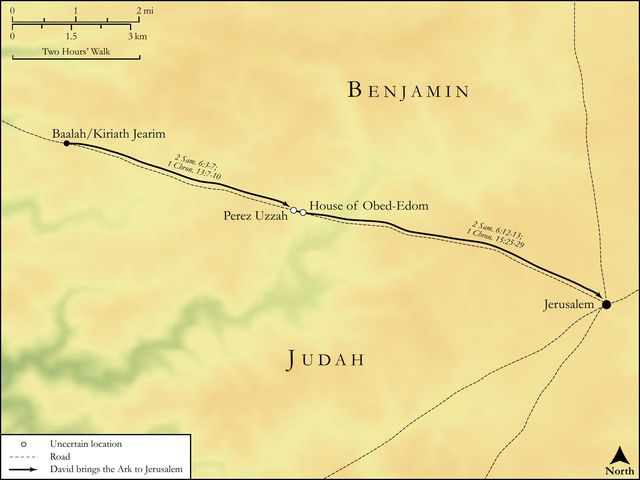
See on the biblical-era map
Study this verse
Public-domain commentary
Matthew Henry
From his Commentary on the Whole Bible. Henry comments on passages, not single verses — this entry covers 1 Chronicles 13:9–14.
This breach upon Uzza, which caused all the joy to cease, we had an account of, Sa2 6:6, etc. 1. Let the sin of Uzza warn us all to take heed of presumption, rashness, and irreverence, in dealing about holy things (Ch1 13:9), and not to think that a good intention will justify a bad action. In our communion with God we must carefully watch over our own hearts, lest familiarity breed contempt, and we think God is in any way beholden to us. 2. Let the punishment of Uzza convince us that the God with whom we have to do is a jealous God. His death, like that of Nadab and Abihu, proclaims aloud that God will be sanctified in those that come nigh unto him (Lev 10:3), and that the nearer any are to him the more displeased he is with their presumptions. Let us not dare to trifle with God in our approaches to him; and yet let us, through Christ, come boldly to the throne of grace; for we are under the dispensation of liberty and grace, not of bondage and terror. 3. Let the damp this gave to the joy of Israel be a memorandum to us always to rejoice with trembling, and to serve the Lord with fear, even when we serve him with gladness. 4. Let David's displeasure upon this occasion caution us to take heed to our spirits when we are under divine rebukes, lest, instead of submitting to God, we quarrel with him. If God be angry with us, shall we dare to be angry with him? 5. Let the stop thus put to the solemnity caution us not to be driven off from our duty by those providences which are only intended to drive us from our sins. David should have gone on with the work notwithstanding the breach made upon Uzza; so might the breach have been made up. 6. Let the blessing which the ark brought with it to the house of Obed-edom encourage us to welcome God's ordinances into our houses, as those that believe the ark is a guest that nobody shall lose by; not let it be less precious to us for its being to some a stone of stumbling and a rock of offence. If the gospel be to some a savour of death unto death, as the ark was to Uzza, yet let us receive it in the love of it and it will be to us a saviour of life unto life.
Continue studying 1 Chronicles 13:9 across the web’s major study libraries — every link below opens this exact verse, chapter, or book on the destination site.
Read & Compare
 BibleGatewayThis verse in more than 200 translations and 70 languages.
 Bible.comThe YouVersion reader — hundreds of translations, reading plans, and highlights.
 ESV.orgCrossway's official English Standard Version reader.
 NET BibleThe NET translation with 60,000+ translators' notes on every rendering decision.
 STEP BibleTyndale House's free study tool — original text, vocabulary, and scholarly resources.
 BibliaLogos Bible Software's free web reader.
 USCCBThe New American Bible (Revised Edition) with the U.S. bishops' study notes.
Commentaries
 BibleHub CommentariesDozens of classic commentaries on this verse, gathered on one page.
 StudyLightMore than 100 commentary sets — the largest collection on the web.
 BibleRefPlain-English commentary on what this verse means, verse by verse.
 Enduring WordDavid Guzik's free commentary on this chapter, widely used by Bible teachers.
 Bible Study ToolsVerse commentary alongside Greek and Hebrew study aids.
Original Language & Research
- BibleHub InterlinearThe verse word by word — original language, transliteration, and English.
- BibleHub LexiconEvery word's original-language definition and Strong's entry.
 Blue Letter BibleDeep-study tools — Strong's numbers, concordance, and word studies.
 SefariaThe Hebrew text with Rashi and centuries of Jewish commentary.
Sermons, Hymns & Audio


TrulyRandomVerse is not affiliated with these sites and doesn’t control their content. They’re linked because they’re genuinely useful.
Summary
1 Chronicles 13:9 meticulously details a critical and tragic juncture during King David's initial, ill-fated endeavor to transport the Ark of the Covenant to Jerusalem. As the sacred Ark, mounted on a new cart drawn by oxen, traversed the landscape, its journey was abruptly halted at the threshingfloor of Chidon when the animals stumbled. In a moment of perceived crisis, Uzza, a member of the procession, instinctively reached out his hand to stabilize the Ark, an act that, despite its apparent good intention, constituted a direct transgression of divine law and immediately precipitated a profound divine judgment, fundamentally altering David's understanding of God's unapproachable holiness.
Context
ShowHideLiterary Context
This verse is intricately woven into the broader narrative of 1 Chronicles, specifically paralleling 2 Samuel 6, which recounts King David's fervent desire to centralize the worship of Yahweh in Jerusalem. Having established his capital, David sought to bring the Ark of the Covenant, which had resided at Kiriath-jearim for decades, into his new city. The preceding verses in 1 Chronicles 13 describe David's consultation with the leaders of Israel, the enthusiastic gathering of the entire nation, and the commencement of a grand, celebratory procession. Crucially, the chosen method of transport—a new cart drawn by oxen—is presented as a stark deviation from the explicit Mosaic instructions for handling the Ark, which unequivocally mandated its carriage by Kohathite Levites using poles (Numbers 4:15). This procedural error sets the stage for the divine judgment that immediately follows Uzza's action, compelling David to halt the procession and later correct his approach, as detailed in 1 Chronicles 15:2.
Historical & Cultural Context
The Ark of the Covenant was far more than a mere religious artifact; it was the quintessential symbol of God's tangible presence, His divine throne, and the embodiment of His covenant relationship with Israel. Its handling was governed by exceptionally strict divine laws, meticulously designed to underscore God's absolute holiness, transcendence, and the profound reverence due to Him. Threshingfloors were ubiquitous, open-air agricultural sites, typically situated on elevated ground to catch the wind for winnowing, making them public and highly visible locations. The use of a new cart for transport, while perhaps intended as an act of honor, was a practice adopted from the Philistines (1 Samuel 6:7-8) rather than adhering to Israel's own divinely revealed Mosaic law. This cultural assimilation of a foreign method into Israelite worship highlights a critical tension: the clash between human ingenuity or well-intentioned zeal and the unwavering specificity of divine command. The incident served as a stark, public, and unforgettable lesson to David and all Israel concerning the profound reverence, precise obedience, and sacred boundaries required when approaching the Holy God.
Key Themes
ShowHideThe tragic incident at the threshingfloor of Chidon (also known as Nachon in 2 Samuel 6:6) powerfully underscores several foundational theological themes. Firstly, it emphatically highlights God's Absolute Holiness and Sovereignty. The Ark served as the earthly representation of God's unapproachable glory, and its sacredness demanded strict adherence to divine commands, demonstrating unequivocally that God's ways are non-negotiable and His character immutable. Secondly, the event vividly illustrates The Danger of Disobedience, even when seemingly prompted by commendable intentions. Uzza's act, though perhaps an instinctive attempt to prevent the Ark from falling, constituted a direct transgression of God's explicit law concerning its handling, leading to immediate and severe divine judgment (1 Chronicles 13:10). This emphasizes that human reasoning, no matter how logical or well-meaning, cannot override divine revelation. Finally, the narrative powerfully teaches the necessity of Reverence and Awe in approaching God. It served as a vital, albeit profoundly tragic, reminder to David and all Israel that God must be approached solely on His terms, not according to human convenience, presumption, or innovation, thereby fostering a deeper and more accurate understanding of true worship.
Exposition and Analysis
ShowHideKey Word Analysis
ShowHideThis name, meaning "strength" or "my strength," carries profound irony within the narrative. Uzza, whose very name signifies power, is tragically struck down by the ultimate strength of God for presuming to "strengthen" or steady the Ark. This act, however well-intentioned, was a direct violation of God's explicit command concerning the Ark's handling. His name thus becomes a poignant reminder of the futility and danger of human strength when it attempts to usurp divine authority or disregard divine commands, especially concerning the sacred.
Specifically, the Ark of the Covenant (אֲרוֹן הַבְּרִית, 'aron habbĕrît), this was the most sacred artifact in Israelite worship. It was a wooden chest overlaid with gold, containing the tablets of the Law, Aaron's rod, and a pot of manna. More profoundly, it symbolized God's very presence among His people, His earthly throne, and the place where He met with His people (the mercy seat above the Ark). Its sanctity was paramount, and its handling was strictly regulated by divine law, emphasizing God's transcendence and the absolute necessity of a holy approach.
This primitive word denotes the open hand, often indicating power, means, or direction. In this context, Uzza's "put forth his hand" signifies a direct, physical, and volitional act of contact with the Ark. This seemingly simple action, however, was a direct violation of God's explicit prohibition against touching the Ark (Numbers 4:15), transforming a natural human reflex into an act of profound spiritual presumption and disobedience. The hand, a tool of human agency, here becomes the instrument of transgression.
Verse Breakdown
ShowHide"And when they came unto the threshingfloor of Chidon"
This clause precisely establishes the geographical and temporal setting for the unfolding drama. The grand, celebratory procession, filled with music and joy, reaches a common agricultural site, a place of public visibility and ordinary activity. The sudden arrival at this specific location underscores the abruptness and public nature of the impending divine intervention, marking this threshingfloor as the precise point of crisis and divine judgment.
"Uzza put forth his hand to hold the ark"
This is the pivotal action of the verse, the direct cause of the subsequent divine judgment. Uzza, likely a Levite though not of the Kohathite family designated for carrying the Ark, extends his hand to physically grasp the sacred object. This act, while perhaps an instinctive attempt to prevent the Ark from falling, directly violated God's explicit command that no one, except designated Kohathite Levites carrying it by poles, should touch the Ark itself, lest they die (Numbers 4:15). It represents a human attempt to manage, control, or "help" the sacred, presuming upon God's absolute holiness and sovereign care.
"for the oxen stumbled"
This final clause provides the immediate catalyst for Uzza's ill-fated action. The oxen, drawing the cart upon which the Ark was improperly placed, experienced a sudden jolt, slip, or fall, threatening the stability and integrity of the Ark. This detail highlights the perceived emergency that prompted Uzza's intervention, yet it simultaneously underscores the human perspective that failed to recognize God's sovereign control over His own sacred presence, even amidst perceived danger or instability. The stumbling of the oxen reveals the inadequacy of the chosen mode of transport and precipitates the moment of Uzza's fatal presumption.
Literary Devices
ShowHideThe narrative in 1 Chronicles 13:9 masterfully employs several key literary devices to convey its profound theological message and heighten its dramatic impact. The most evident is foreshadowing, as the stumbling oxen and Uzza's impulsive, unauthorized reach immediately precede the divine judgment described in the very next verse, creating a palpable and ominous sense of impending doom. The name Uzza itself carries a deep irony: meaning "my strength," it stands in stark contrast to his immediate demise, powerfully highlighting the futility and danger of human strength when it presumes to act independently of or in defiance of divine holiness. The Ark of the Covenant functions as a potent symbolism, representing not merely a physical object but the very tangible presence, unapproachable glory, and throne of God among His people, rendering any unauthorized touch a direct affront to divine majesty. Furthermore, the setting, a threshingfloor, a place inherently associated with separation (chaff from grain), subtly serves as a symbolic backdrop for the sudden and decisive separation Uzza experiences from the living, underscoring the severity of God's judgment and the clarity of His sacred boundaries.
Theological and Thematic Connections
ShowHideThe incident at the threshingfloor of Chidon stands as a powerful and enduring theological lesson on the absolute holiness of God and the non-negotiable necessity of approaching Him strictly on His own terms. Uzza's death, though seemingly harsh from a human perspective, was not an arbitrary act but a profound demonstration of God's unwavering commitment to His revealed will and the inviolable sanctity of His presence. It underscores that sincere intentions, while commendable and often necessary, can never supersede or justify deviation from explicit divine commands, particularly concerning worship and the handling of sacred things. God's character demands profound reverence, and His instructions are not mere suggestions but divinely established boundaries for our good and His glory. This tragic event deeply impacted King David, leading him into a period of fear, introspection, and ultimately, a corrected, obedient approach to transporting the Ark, emphasizing that true worship is characterized by both passionate zeal and meticulous adherence to God's revealed Word.
Reflection and Application
ShowHideUzza's story from 1 Chronicles 13:9 remains a potent and challenging reminder for believers today that while we live under the glorious new covenant of grace, the fundamental truth of God's unchanging holiness and His demand for reverence endure. This narrative compels us to critically examine our own approach to God, ensuring that our zeal for His kingdom is always tempered by profound reverence and that our good intentions are meticulously aligned with His revealed will. We are called to worship and serve God not according to human wisdom, convenience, or emotional impulse, but according to the precise directives of His Word, recognizing that true faith involves both passionate devotion and humble, obedient submission. This account serves as a solemn caution against spiritual presumption, reminding us that God's sacred presence is not to be trifled with, nor His commands disregarded, even in moments of perceived crisis or well-meaning intervention. It teaches us the paramount importance of diligently understanding and respecting divine boundaries, fostering a deeper and more profound awe for the One who is truly set apart and worthy of all honor.
Questions for Reflection
ShowHideFAQ
ShowHideWhy was Uzza's punishment so severe for what seemed like a helpful act?
ShowHideUzza's punishment, though seemingly harsh from a human perspective, was a profound and necessary demonstration of God's absolute holiness and the critical importance of strict obedience to His specific commands regarding the Ark of the Covenant. The Ark symbolized God's very presence, His throne, and His covenant with His people; it was not merely a piece of religious furniture. God had explicitly commanded that only Kohathite Levites were permitted to carry the Ark, and only by poles inserted through its rings, with no one touching the Ark itself, lest they die (Numbers 4:15). Uzza's act, while perhaps an instinctive attempt to prevent the Ark from falling, was a direct violation of this divine prohibition. God's severity underscored that His holiness is not to be trifled with, and His commands are not arbitrary suggestions but foundational principles for a right relationship with Him. This incident served as a foundational lesson for David and all Israel at the very beginning of David's reign, establishing the necessary reverence and fear of God essential for proper worship and a holy relationship with the Almighty. It taught them unequivocally that God must be approached on His terms, not human ones, no matter how well-intentioned or seemingly practical.
Is this account contradicted by the parallel in 2 Samuel 6:6, which mentions "Nachon" instead of "Chidon"?
ShowHideNo, there is no contradiction between the accounts in 1 Chronicles 13:9 and 2 Samuel 6:6. The minor difference in place names (Chidon vs. Nachon) is best understood as either two names for the same location, or perhaps "Nachon" was the name of the owner of the threshingfloor, or even a slight textual variation that does not alter the substance of the event. Such variations are common in ancient texts and do not diminish the historical accuracy or the profound theological message of the narrative. Both accounts consistently describe the same critical event: the oxen stumbled, Uzza reached out to steady the Ark, and he was struck down by God. The core message regarding God's unapproachable holiness and the severe consequences of disobedience remains identical and powerfully consistent across both biblical records, reinforcing the divine lesson for David and for all Israel.
Christ-Centered Fulfillment
ShowHideThe tragic account of Uzza's death at the threshingfloor of Chidon, resulting from a well-intentioned but unauthorized touch of God's holy Ark, powerfully foreshadows the profound and transformative shift brought about by Jesus Christ. In the Old Covenant, God's holiness was so absolute and unapproachable that direct contact with His sacred symbols, outside of His divinely prescribed means, led to immediate death. The Ark, representing God's dwelling among His people, simultaneously highlighted the insurmountable barrier of sin that separated fallen humanity from a holy God. However, in Christ, this dynamic is fundamentally and gloriously transformed. Jesus is the ultimate "Ark" of God's presence, the very embodiment of God dwelling among us in human flesh (John 1:14). Through His perfect life of obedience, His atoning death on the cross, and His glorious resurrection, Christ has definitively removed the barrier of sin that once made God's presence dangerous to sinful humanity. He is the new and living way to the Father (John 14:6), perfectly fulfilling the Law's demands for holiness and making direct, confident access to God possible. We are no longer kept at a fearful distance by the threat of divine judgment for unintentional trespasses, but are now invited to draw near to the throne of grace with boldness and confidence—not presumption—through the precious blood of Jesus (Hebrews 4:16 and Hebrews 10:19-22). Uzza's story serves as an enduring reminder of God's unchanging holiness, while Christ's completed work reveals the boundless grace by which that holiness has been perfectly satisfied and gloriously reconciled to us, inviting us into intimate fellowship.