


1 Chronicles 13:10
Bible text: King James Version (1769 Blayney text) · Public domain
Bible text: Berean Standard Bible · Public domain
Bible text: American Standard Version (1901) · Public domain
Bible text: World English Bible, Messianic edition · Public domain
Bible text: Geneva Bible (1599) · Public domain
Bible text: Young's Literal Translation · Public domain
- וַיִּחַרvai·yi·charand it burnedH2734Conj-w ¦ V-Qal-ConsecImperf-3msVerb Qal Consecutive Imperfect 3rd Singular Masculineוַandיִּחַרit burned
- אַף'af[the] anger ofH639N-mscNoun Singular Masculine Construct
- יְהוָהYah·wehYahwehH3068N-properNoun Proper Title
- בְּעֻזָּאbe·'u·Za'on UzzahH5798Prep-b ¦ N-proper-mNoun Proper MasculineבְּonעֻזָּאUzzah
- וַיַּכֵּהוּvai·ya·Ke·huand he struck down himH5221Conj-w ¦ V-Hiphil-ConsecImperf-3ms ¦ 3msVerb Hiphil Consecutive Imperfect 3rd Singular Masculineוַandיַּכֵּhe struck downהוּhim
- עַל'alonH5921PrepPreposition
- אֲשֶׁר'a·SherthatH834RelParticle Relative
- שָׁלַחsha·Lachhe had stretched outH7971V-Qal-Perf-3msVerb Qal Perfect 3rd Singular Masculine
- יָדוֹya·Dohis handH3027N-csc ¦ 3msNoun Singular common gender Constructיָדhandוֹhis
- עַל'alonH5921PrepPreposition
- הָאָרוֹןha·'a·Ronthe arkH727Art ¦ N-msNoun Singular Masculine Absoluteהָtheאָרוֹןark
- וַיָּמָתvai·Ya·motand he diedH4191Conj-w ¦ V-Qal-ConsecImperf-3msVerb Qal Consecutive Imperfect 3rd Singular Masculineוַandיָּמָתhe died
- שָׁםshamthereH8033AdvAdverb
- לִפְנֵיlif·Nei<to> beforeH6440Prep-l ¦ N-mpcNoun Plural Masculine Constructלִ<to>פְנֵיbefore
- אֱלֹהִים'E·lo·HimGodH430N-mpNoun Plural Masculine Absolute
English is a literal word-by-word gloss of the Hebrew, not the KJV's wording. Why?
This is the original text the KJV's translators worked from — each Hebrew word with its own literal English meaning in this verse, prepared by scholars at Tyndale House, Cambridge. The KJV translates whole sentences, not word by word, so its wording differs: one Hebrew word can become several English words, and the KJV may choose “the LORD” where the gloss reads “Yahweh”. Both are faithful — they answer different questions. For the KJV's own rendering, switch to the KJV text.
Details
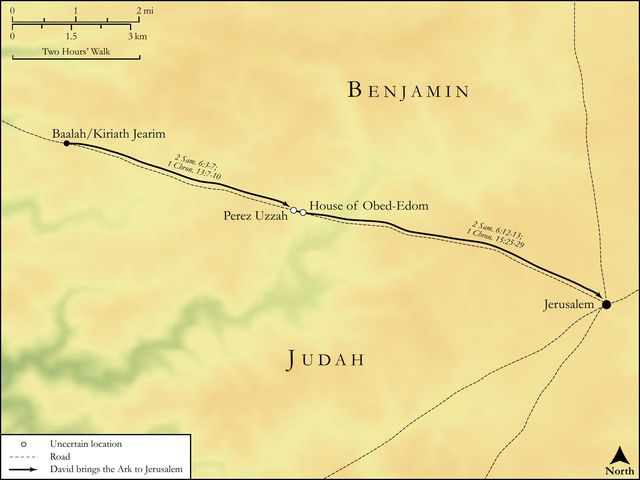
See on the biblical-era map
Study this verse
Public-domain commentary
Matthew Henry
From his Commentary on the Whole Bible. Henry comments on passages, not single verses — this entry covers 1 Chronicles 13:9–14.
This breach upon Uzza, which caused all the joy to cease, we had an account of, Sa2 6:6, etc. 1. Let the sin of Uzza warn us all to take heed of presumption, rashness, and irreverence, in dealing about holy things (Ch1 13:9), and not to think that a good intention will justify a bad action. In our communion with God we must carefully watch over our own hearts, lest familiarity breed contempt, and we think God is in any way beholden to us. 2. Let the punishment of Uzza convince us that the God with whom we have to do is a jealous God. His death, like that of Nadab and Abihu, proclaims aloud that God will be sanctified in those that come nigh unto him (Lev 10:3), and that the nearer any are to him the more displeased he is with their presumptions. Let us not dare to trifle with God in our approaches to him; and yet let us, through Christ, come boldly to the throne of grace; for we are under the dispensation of liberty and grace, not of bondage and terror. 3. Let the damp this gave to the joy of Israel be a memorandum to us always to rejoice with trembling, and to serve the Lord with fear, even when we serve him with gladness. 4. Let David's displeasure upon this occasion caution us to take heed to our spirits when we are under divine rebukes, lest, instead of submitting to God, we quarrel with him. If God be angry with us, shall we dare to be angry with him? 5. Let the stop thus put to the solemnity caution us not to be driven off from our duty by those providences which are only intended to drive us from our sins. David should have gone on with the work notwithstanding the breach made upon Uzza; so might the breach have been made up. 6. Let the blessing which the ark brought with it to the house of Obed-edom encourage us to welcome God's ordinances into our houses, as those that believe the ark is a guest that nobody shall lose by; not let it be less precious to us for its being to some a stone of stumbling and a rock of offence. If the gospel be to some a savour of death unto death, as the ark was to Uzza, yet let us receive it in the love of it and it will be to us a saviour of life unto life.
Historical interpretation
Historical reception
1 surviving comment on this verse from the historical church.
Wherefore if to transgress the Sabbath, and to touch the falling Ark, drew down the wrath of God so signally as to deprive the offender of even a momentary respite, shall he who corrupts unutterably awful doctrines find excuse and pardon? Assuredly not. A want of zeal in small matters is the cause of all our calamities; and because slight errors escape fitting correction, greater ones creep in. As in the body, a neglect of wounds generates fever, mortification, and death; so in the soul, slight evils overlooked open the door to graver ones. (St. John Chrysostom Commentary on Gal 1:7)
Continue studying 1 Chronicles 13:10 across the web’s major study libraries — every link below opens this exact verse, chapter, or book on the destination site.
Read & Compare
 BibleGatewayThis verse in more than 200 translations and 70 languages.
 Bible.comThe YouVersion reader — hundreds of translations, reading plans, and highlights.
 ESV.orgCrossway's official English Standard Version reader.
 NET BibleThe NET translation with 60,000+ translators' notes on every rendering decision.
 STEP BibleTyndale House's free study tool — original text, vocabulary, and scholarly resources.
 BibliaLogos Bible Software's free web reader.
 USCCBThe New American Bible (Revised Edition) with the U.S. bishops' study notes.
Commentaries
 BibleHub CommentariesDozens of classic commentaries on this verse, gathered on one page.
 StudyLightMore than 100 commentary sets — the largest collection on the web.
 BibleRefPlain-English commentary on what this verse means, verse by verse.
 Enduring WordDavid Guzik's free commentary on this chapter, widely used by Bible teachers.
 Bible Study ToolsVerse commentary alongside Greek and Hebrew study aids.
Original Language & Research
- BibleHub InterlinearThe verse word by word — original language, transliteration, and English.
- BibleHub LexiconEvery word's original-language definition and Strong's entry.
 Blue Letter BibleDeep-study tools — Strong's numbers, concordance, and word studies.
 SefariaThe Hebrew text with Rashi and centuries of Jewish commentary.
Sermons, Hymns & Audio


TrulyRandomVerse is not affiliated with these sites and doesn’t control their content. They’re linked because they’re genuinely useful.
Summary
The immediate and severe judgment of Uzza by God during King David's initial, flawed attempt to transport the Ark of the Covenant to Jerusalem starkly underscores the absolute holiness of God, the inviolability of His divine commands concerning sacred objects, and the devastating consequences of approaching Him in a manner contrary to His revealed will, even when human intentions might appear to be well-meaning.
Context
ShowHideLiterary Context
This verse is situated within the narrative of King David's early efforts to consolidate his reign and establish Jerusalem as the religious and political center of Israel. The preceding verses (1 Chronicles 13:1-9) describe David's enthusiastic initiative to bring the Ark of the Covenant, which had resided at Kiriath-Jearim for decades, into the capital. The celebratory procession, complete with music and dancing, sets a joyful tone that is abruptly shattered by Uzza's death. The Ark was placed on a new cart, drawn by oxen, with Uzza and Ahio guiding it. The immediate trigger for the judgment in verse 10 is the oxen stumbling at the threshing floor of Chidon, prompting Uzza's fatal intervention. The verses immediately following (1 Chronicles 13:11-14) detail David's subsequent anger and fear, leading him to abandon the Ark at the house of Obed-Edom, where it miraculously brought blessing. This incident is a crucial turning point, forcing David to re-evaluate his approach to God's sacred commands, ultimately leading to a more reverent and successful transfer of the Ark later, as detailed in 1 Chronicles 15.
Historical & Cultural Context
The Ark of the Covenant was the preeminent sacred object in ancient Israel, symbolizing God's throne, His covenant presence among His people, and His divine authority. Its construction and handling were meticulously prescribed in the Mosaic Law, particularly in Exodus 25:10-22 and Numbers 4:15. Crucially, only Levites from the family of Kohath were permitted to carry the Ark, and they were to do so by means of poles inserted into rings, never by direct touch. David's decision to transport the Ark on a new cart, while perhaps influenced by the Philistines' method of returning the Ark (1 Samuel 6:7-8), directly contravened these explicit divine instructions. This cultural borrowing, though seemingly practical or efficient, demonstrated a disregard for the specific protocols that underscored the Ark's unique sanctity and God's unapproachable holiness, setting the stage for the tragic consequences.
Key Themes
ShowHideUzza's death powerfully illuminates several foundational theological themes. First, it underscores the absolute holiness and transcendence of God, demonstrating that His divine presence is not to be treated casually or according to human expediency, but with profound reverence and strict adherence to His revealed will. Second, the incident highlights the critical importance of obedience to divine law, even when intentions appear benevolent. Uzza's act, though perhaps an attempt to protect the Ark from falling, was a direct violation of God's explicit prohibition against touching it, revealing that God prioritizes obedience over human ingenuity or well-meaning but unauthorized actions (a principle powerfully articulated in 1 Samuel 15:22). Third, the event serves as a stark reminder of divine judgment and its immediate, sobering consequences when God's holiness is disregarded. It instilled a necessary fear and awe in David and the assembled people, leading to a deeper understanding of how to properly approach the Almighty, which ultimately paved the way for a more reverent and successful transfer of the Ark (as depicted in 2 Samuel 6).
Exposition and Analysis
ShowHideKey Word Analysis
ShowHideThis verb signifies a burning, intense heat or anger. When applied to God's anger, as here, it describes a fierce, righteous indignation. This is not a capricious outburst but a holy response to a violation of His established order and sacred character. It indicates a profound divine displeasure that necessitates an immediate and decisive action.
This word refers to the physical hand, but in this context, it carries profound symbolic weight. Uzza's "hand" represents his physical action of touching the Ark, an act explicitly forbidden by divine law. The Ark's sanctity meant that direct human contact was prohibited, making Uzza's reaching out a presumptuous and unauthorized intrusion into God's sacred space, signifying a disregard for the divine boundary.
This verb means to strike, hit, or inflict a blow, often with fatal consequences. In this verse, it denotes a direct, immediate, and decisive act of divine judgment. The use of "smote" emphasizes the directness and severity of God's intervention, indicating that Uzza's death was a deliberate act of God in response to his transgression.
Verse Breakdown
ShowHide"And the anger of the LORD was kindled against Uzza"
This clause immediately establishes the divine source and nature of the ensuing judgment. God's anger here is not an uncontrolled human emotion but a holy, righteous response to a profound violation of His sacred boundaries. It was "kindled" because a divine command, established by God Himself, had been directly transgressed.
"and he smote him"
This is the direct, fatal consequence of God's kindled anger. The pronoun "he" refers unequivocally to the LORD, indicating a direct, supernatural act of judgment. The "smiting" was immediate and fatal, demonstrating the swiftness and certainty of divine retribution for such a grave transgression against His holiness.
"because he put his hand to the ark"
This phrase provides the specific, explicit reason for God's judgment. Uzza's act of touching the Ark, even if his intention was to prevent it from falling, was a direct violation of God's clear command (Numbers 4:15). It represented a casual disregard for the Ark's sanctity and, by extension, for God's absolute holiness and authority.
"and there he died before God"
This final clause emphasizes the immediate, public, and divinely ordained nature of Uzza's death. He died "before God," signifying that his demise was a direct divine act, witnessed by the assembled multitude. This served as a stark object lesson for all Israel, including King David, about the gravity of disrespecting God's holy presence and commands.
Literary Devices
ShowHideThe narrative of Uzza's death employs several powerful literary devices to convey its profound message. Irony is strikingly present, as Uzza's seemingly protective act of "steadying" the Ark leads directly to his own destruction; his well-intentioned but disobedient intervention results in the opposite of preservation for himself. The abruptness of the judgment creates intense dramatic tension and a profound sense of awe (or terror) among the onlookers, including King David, highlighting the sovereign and unapproachable nature of divine holiness. The Ark itself functions as a potent symbol of God's presence, and its sacredness is powerfully underscored by the severe consequences of its mishandling, reinforcing the overarching theme of divine transcendence. Furthermore, the entire episode serves as a powerful narrative contrast to the initial joyous celebration, abruptly shifting the mood from festivity to solemnity and fear, thereby emphasizing the immense gravity of the spiritual principles at stake.
Theological and Thematic Connections
ShowHideThe tragic account of Uzza's death serves as a profound theological lesson, primarily emphasizing the absolute and unapproachable holiness of God. It teaches that God's sacredness is not to be trifled with, and His commands, especially concerning His presence and worship, are not arbitrary suggestions but divine decrees that must be meticulously obeyed. This event highlights that good intentions do not supersede divine law, and a casual or presumptuous approach to the Almighty can have devastating consequences. It underscores the Old Testament principle that God is both merciful and just, demanding reverence and purity from those who would approach Him, demonstrating that His holiness requires a specific, divinely ordained response.
Reflection and Application
ShowHideWhile the physical Ark of the Covenant no longer exists, the principles illuminated by Uzza's death remain profoundly relevant for believers today. This passage calls us to a deep and abiding reverence for God, reminding us that He is holy and must be approached on His terms, not ours. It challenges any tendency towards casualness or presumption in our worship, service, or personal relationship with Him. We are invited to consider whether our spiritual practices are truly aligned with God's revealed will or if we are relying on human ingenuity or good intentions alone. The incident of Uzza compels us to examine our hearts for any areas where we might be taking God's holiness for granted, urging us to cultivate a spirit of humility, obedience, and awe in all aspects of our faith journey. It reminds us that true worship flows from a recognition of God's majesty and a submission to His perfect will, rather than from our own comfort or convenience.
Questions for Reflection
ShowHideFAQ
ShowHideWhy was Uzza punished so severely for what seemed like a good intention?
ShowHideUzza's punishment, though seemingly harsh from a human perspective, was not merely for a "good intention" but for a direct and egregious violation of God's explicit commands regarding the handling of the Ark of the Covenant. The Law, given in Numbers 4:15, strictly forbade anyone, even Levites, from touching the Ark itself; it was to be carried only by poles. Placing the Ark on a cart was already an act of disobedience to the prescribed method of transport, perhaps influenced by the Philistines' handling of it (1 Samuel 6:7). However, Uzza's direct touch was a breach of the most sacred boundary, a presumptuous act against God's absolute holiness. The Ark symbolized God's very presence and throne among His people. To treat it casually or presumptuously, even with a seemingly protective motive, was to disregard God's character, authority, and the sanctity of His covenant. This severe judgment served as a powerful and immediate lesson for all Israel, including King David, about the gravity of God's holiness and the necessity of strict obedience in approaching Him. It prevented a casual attitude towards sacred things that could have led to greater spiritual decay and a diminished understanding of God's awesome nature.
Christ-Centered Fulfillment
ShowHideWhile Uzza's death underscores the terrifying holiness of God under the Old Covenant, it simultaneously foreshadows the profound grace and perfect access offered through Jesus Christ. The Ark, representing God's dwelling among His people, was veiled and guarded by strict laws, signifying humanity's inherent inability to approach a perfectly holy God due to sin. Uzza's demise highlights the unbridgeable chasm between a sinful humanity and a perfectly holy God, a chasm that the Law could only expose through its demands and judgments, not bridge. However, in Christ, this chasm is gloriously and permanently overcome. Jesus is the ultimate "Ark," the true dwelling place of God among humanity, for in Him "all the fullness of the Deity lives in bodily form" (Colossians 2:9). He is our great High Priest who, unlike the Old Testament priests and sacrifices, offered Himself as the perfect, once-for-all sacrifice, opening a new and living way into the very presence of God through His torn body (as described in Hebrews 10:19-20). Through faith in Him, we are no longer forbidden to approach God but are invited to draw near "with confidence to the throne of grace, that we may receive mercy and find grace to help us in our time of need" (Hebrews 4:16). Uzza's death serves as a stark reminder of the unyielding holiness of God, making the New Covenant's access through Christ's atoning work all the more astonishing, precious, and transformative, moving us from fear to reverent worship and humble adoration.