


2 Samuel 6:11
Bible text: King James Version (1769 Blayney text) · Public domain
Bible text: Berean Standard Bible · Public domain
Bible text: American Standard Version (1901) · Public domain
Bible text: World English Bible, Messianic edition · Public domain
Bible text: Geneva Bible (1599) · Public domain
Bible text: Young's Literal Translation · Public domain
- וַיֵּשֶׁבvai·ye·Shevand it remainedH3427Conj-w ¦ V-Qal-ConsecImperf-3msVerb Qal Consecutive Imperfect 3rd Singular Masculineוַandיֵּשֶׁבit remained
- אֲרוֹן'a·Ron[the] ark ofH727N-mscNoun Singular Masculine Construct
- יְהוָהYah·wehYahwehH3068N-properNoun Proper Title
- בֵּיתbeit[the] house ofH1004N-mscNoun Singular Masculine Construct
- עֹבֵד'o·VedObed-H5654N-proper-mNoun Proper Masculine
- אֱדֹם'e·DomEdomH5654N-proper-mNoun Proper Masculine
- הַגִּתִּיha·gi·Tithe GittiteH1663Art ¦ N-msNoun Gentilic Singular Masculine AbsoluteהַtheגִּתִּיGittite
- שְׁלֹשָׁהshe·lo·ShahthreeH7969N-csNoun Singular common gender Absolute
- חֳדָשִׁיםcho·da·ShimmonthsH2320N-mpNoun Plural Masculine Absolute
- וַיְבָרֶךְvay·Va·rekhand he blessedH1288Conj-w ¦ V-Piel-ConsecImperf-3msVerb Piel Consecutive Imperfect 3rd Singular Masculineוַandיְבָרֶךְhe blessed
- יְהוָהYah·wehYahwehH3068N-properNoun Proper Title
- אֶת'et<obj.>H853DirObjMParticle Object Indicator
- עֹבֵד'o·VedObed-H5654N-proper-mNoun Proper Masculine
- אֱדֹם'e·DomEdomH5654N-proper-mNoun Proper Masculine
- וְאֶתve·'Etand <obj.>H853Conj-w ¦ DirObjMParticle Object Indicatorוְandאֶת<obj.>
- כָּלkolallH3605N-mscNoun Singular Masculine Construct
- בֵּיתוֹbei·Tohis householdH1004N-msc ¦ 3msNoun Singular Masculine Constructבֵּיתhouseholdוֹhis
English is a literal word-by-word gloss of the Hebrew, not the KJV's wording. Why?
This is the original text the KJV's translators worked from — each Hebrew word with its own literal English meaning in this verse, prepared by scholars at Tyndale House, Cambridge. The KJV translates whole sentences, not word by word, so its wording differs: one Hebrew word can become several English words, and the KJV may choose “the LORD” where the gloss reads “Yahweh”. Both are faithful — they answer different questions. For the KJV's own rendering, switch to the KJV text.
Details
See on the biblical-era maps

Study this verse
Public-domain commentary
Matthew Henry
From his Commentary on the Whole Bible. Henry comments on passages, not single verses — this entry covers 2 Samuel 6:6–11. His two-level outline is real structure in the source text, so it is rendered as structure.
We have here Uzzah struck dead for touching the ark, when it was upon its journey towards the city of David, a sad providence, which damped their mirth, stopped the progress of the ark, and for the present, dispersed this great assembly, which had come together to attend it, and sent them home in a fright.
I.Uzzah's offence seems very small.
He and his brother Ahio, the sons of Abinadab, in whose house the ark had long been lodged, having been used to attend it, to show their willingness to prefer the public benefit to their own private honour and advantage, undertook to drive the cart in which the ark was carried, this being perhaps the last service they were likely to do it; for others would be employed about it when it came to the city of David. Ahio went before, to clear the way, and, if need were, to lead the oxen. Uzzah followed close to the side of the cart. It happened that the oxen shook it, Sa2 6:6. The critics are not agreed about the signification of the original word: They stumbled (so our margin); they kicked (so some), perhaps against the goad with which Uzzah drove them; they stuck in the mire, by some. By some accident or other the ark was in danger of being overthrown. Uzzah thereupon laid hold of it, to save it from falling, we have reason to think with a very good intention, to preserve the reputation of the ark and to prevent a bad omen. Yet this was his crime. Uzzah was a Levite, but priests only might touch the ark. The law was express concerning the Kohathites, that, though they were to carry the ark by the staves, yet they must not touch any holy thing, lest they die, Num 4:15. Uzzah's long familiarity with the ark, and the constant attendance he had given to it, might occasion his presumption, but would not excuse it.
II.His punishment for this offence seems very great (Sa2 6:7):
The anger of the Lord was kindled against him (for in sacred things he is a jealous God) and he smote him there for his rashness, as the word is, and struck him dead upon the spot. There he sinned, and there he died, by the ark of God; even the mercy-seat would not save him. Why was God thus severe with him?
1.The touching of the ark was forbidden to the Levites expressly under pain of death - lest they die; and God, by this instance of severity, would show how he might justly have dealt with our first parents, when they had eaten that which was forbidden under the same penalty - lest you die.
2.God saw the presumption and irreverence of Uzzah's heart. Perhaps he affected to show, before this great assembly, how bold he could make with the ark, having been so long acquainted with it. Familiarity, even with that which is most awful, is apt to breed contempt.
3.David afterwards owned that Uzzah died for an error they were all guilty of, which was carrying the ark in a cart. Because it was not carried on the Levites' shoulders, the Lord made that breach upon us, Ch1 15:13. But Uzzah was singled out to be made an example, perhaps because he had been most forward in advising that way of conveyance; however he had fallen into another error, which was occasioned by that. Perhaps the ark was not covered, as it should have been, with the covering of badgers' skins (Num 4:6), and that was a further provocation.
4.God would hereby strike an awe upon the thousands of Israel, would convince them that the ark was never the less venerable for its having been so long in mean circumstances, and thus he would teach them to rejoice with trembling, and always to treat holy things with reverence and holy fear.
5.God would hereby teach us that a good intention will not justify a bad action; it will not suffice to say of that which is ill done that it was well meant. He will let us know that he can and will secure his ark, and needs not any man's sin to help him to do it.
6.If it was so great a crime for one to lay hold on the ark of the covenant that had no right to do so, what is it for those to lay claim to the privileges of the covenant that come not up to the terms of it? To the wicked God says, What hast thou to do to take my covenant in thy mouth? Psa 50:16. Friend, how camest thou in hither? If the ark was so sacred, and not to be touched irreverently, what is the blood of the covenant? Heb 10:29.
III.David's feelings on the infliction of this stroke were keen, and perhaps not altogether as they should have been.
He should have humbled himself under God's hand, confessed his error, acknowledged God's righteousness, and deprecated the further tokens of his displeasure, and then have gone on with the good work he had in hand. But we find,
1.He was displeased. It is not said because Uzzah had affronted God, but because God had made a breach upon Uzzah (Sa2 6:8): David's anger was kindled. It is the same word that is used for God's displeasure, Sa2 6:7. Because God was angry, David was angry and out of humour. As if God might not assert the honour of his ark, and frown upon one that touched it rudely, without asking David leave. Shall mortal man pretend to be more just than God, arraign his proceedings, or charge him with iniquity? David did not now act like himself, like a man after God's own heart. It is not for us to be displeased at any thing that God does, how unpleasing soever it is to us. The death of Uzzah was indeed an eclipse to the glory of a solemnity which David valued himself upon more than any thing else, and might give birth to some speculations among those that were disaffected to him, as if God were departing from him too; but he ought nevertheless to have subscribed to the righteousness and wisdom of God in it, and not to have been displeased at it. When we lie under God's anger we must keep under our own.
2.He was afraid, Sa2 6:9. It should seem he was afraid with amazement; for he said, How shall the ark of the Lord come to me? As if God sought advantages against all that were about him, and was so extremely tender of his ark that there was no dealing with it; and therefore better for him to keep it at a distance. Que procul a Jove, procul a fulmine - To retire from Jove is to retire from the thunder-bolt. He should rather have said, "Let the ark come to me, and I will take warning by this to treat it with more reverence." Provoke me not (says God, Jer 25:6) and I will do you no hurt. Or this may be looked upon as a good use which David made of this tremendous judgment. He did not say, "Surely Uzzah was a sinner above all men, because he suffered such things," but is concerned for himself, as one conscious, not only of his own unworthiness of God's favour, but his obnoxiousness to God's displeasure. "God might justly strike me dead as he did Uzzah. My flesh trembles for fear of thee," Psa 119:120. This God intends in his judgments, that others may hear and fear. David therefore will not bring the ark into his own city (Sa2 6:10) till he is better prepared for its reception.
3.He took care to perpetuate the remembrance of this stroke by a new name he gave to the place: Perez-uzzah, the breach of Uzzah, Sa2 6:8. He had been lately triumphing in the breach made upon his enemies, and called the place Baal-perazim, a place of breaches. But here is a breach upon his friends. When we see one breach, we should consider that we know not where the next will be. The memorial of this stroke would be a warning to posterity to take heed of all rashness and irreverence in dealing about holy things; for God will be sanctified in those that come nigh unto him.
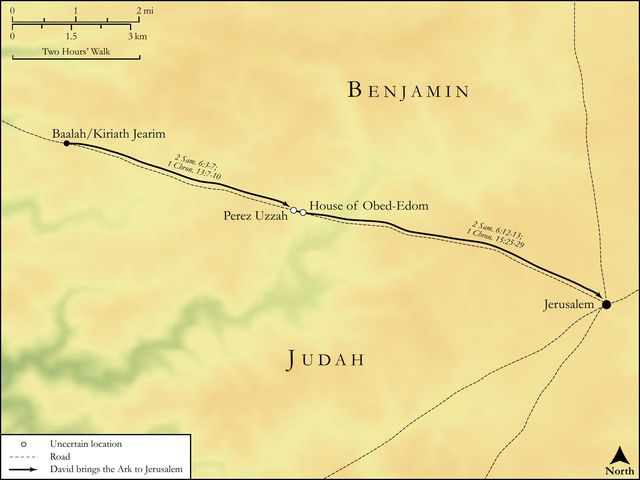
4.He lodged the ark in a good house, the house of Obed-edom a Levite, which happened to be near the place where this disaster happened, and there, (1.) It was kindly entertained and welcomed, and continued there three months, Sa2 6:10, Sa2 6:11. Obed-edom knew what slaughter the ark had made among the Philistines that imprisoned it and the Bethshemites that looked into it. He saw Uzzah struck dead for touching it, and perceived that David himself was afraid of meddling with it; yet he cheerfully invites it to his own house, and opens his doors to it without fear, knowing it was a savour of death unto death only to those that treated it ill. "O the courage," says bishop Hall, "of an honest and faithful heart! nothing can make God otherwise than amiable to his own people: even his very justice is lovely." (2.) It paid well for its entertainment: The Lord blessed Obed-edom and all his household. The same hand that punished Uzzah's proud presumption rewarded Obed-edom's humble boldness, and made the ark to him a savour of life unto life. Let none think the worse of the gospel for the judgements inflicted on those that reject it, but set in opposition to them the blessings it brings to those that duly receive it. None ever had, nor ever shall have, reason to say that it is in vain to serve God. Let masters of families be encouraged to keep up religion in their families, and to serve God and the interests of his kingdom with their houses and estates, for that is the way to bring a blessing upon all they have. The ark is a guest which none shall lose by that bid it welcome. Josephus says that, whereas before Obed-edom was poor, on a sudden, in these three months, his estate increased, to the envy of his neighbours. Piety is the best friend to prosperity. In wisdom's left hand are riches and honour. His household shared in the blessing. It is good living in a family that entertains the ark, for all about it will fare the better for it.
Continue studying 2 Samuel 6:11 across the web’s major study libraries — every link below opens this exact verse, chapter, or book on the destination site.
Read & Compare
 BibleGatewayThis verse in more than 200 translations and 70 languages.
 Bible.comThe YouVersion reader — hundreds of translations, reading plans, and highlights.
 ESV.orgCrossway's official English Standard Version reader.
 NET BibleThe NET translation with 60,000+ translators' notes on every rendering decision.
 STEP BibleTyndale House's free study tool — original text, vocabulary, and scholarly resources.
 BibliaLogos Bible Software's free web reader.
 USCCBThe New American Bible (Revised Edition) with the U.S. bishops' study notes.
Commentaries
 BibleHub CommentariesDozens of classic commentaries on this verse, gathered on one page.
 StudyLightMore than 100 commentary sets — the largest collection on the web.
 BibleRefPlain-English commentary on what this verse means, verse by verse.
 Enduring WordDavid Guzik's free commentary on this chapter, widely used by Bible teachers.
 Bible Study ToolsVerse commentary alongside Greek and Hebrew study aids.
Original Language & Research
- BibleHub InterlinearThe verse word by word — original language, transliteration, and English.
- BibleHub LexiconEvery word's original-language definition and Strong's entry.
 Blue Letter BibleDeep-study tools — Strong's numbers, concordance, and word studies.
 SefariaThe Hebrew text with Rashi and centuries of Jewish commentary.
Sermons, Hymns & Audio


TrulyRandomVerse is not affiliated with these sites and doesn’t control their content. They’re linked because they’re genuinely useful.
Summary
Following the tragic death of Uzzah, King David, in awe and fear of the Lord's holiness, diverted the Ark of the Covenant to the nearby home of Obed-Edom the Gittite. For a period of three months, the Ark, which uniquely symbolized God's manifest presence among His people, resided there. During this time, the Lord poured out comprehensive and tangible blessings upon Obed-Edom and his entire household, powerfully demonstrating that divine presence, when reverently received and honored, brings profound favor, prosperity, and flourishing. This remarkable period served as a vivid testament to God's desire to bless those who approach His sacred presence with due reverence, ultimately encouraging David to complete the Ark's journey to Jerusalem with proper protocol.
Context
ShowHideLiterary Context
This verse serves as a crucial narrative pivot within 2 Samuel 6, which recounts David's initial, fraught attempt to bring the Ark of the Covenant to Jerusalem. The chapter begins with David's enthusiastic but ultimately misguided effort to transport the Ark on a new cart, a method explicitly contrary to Mosaic law, which mandated that Levites carry it on poles (Numbers 4:15). This improper approach culminates in the divine judgment upon Uzzah, who touched the Ark to steady it as the oxen stumbled (2 Samuel 6:6-7). This terrifying event instilled great fear in David, causing him to abandon the immediate plan to bring the Ark to Jerusalem (2 Samuel 6:9-10). Instead, the Ark was diverted to the nearby house of Obed-Edom the Gittite, where it remained for three months. This period sets the stage for the remarkable demonstration of God's blessing described in 2 Samuel 6:11, which subsequently emboldened David to resume the Ark's journey to Jerusalem with proper reverence and celebration (2 Samuel 6:12-15).
Historical & Cultural Context
The Ark of the Covenant was the most sacred object in ancient Israel, representing the very throne of God's invisible presence and His covenant with His people (Exodus 25:22). Its proper handling was governed by strict divine commands, emphasizing God's absolute holiness and the imperative for reverent obedience. Among the nations, the presence of a deity's cultic object was often believed to bring either blessing or curse, depending on how it was treated, and the ark of God brought plague upon the Philistines of Ashdod and blessing upon the house of Obed-edom. The identification of Obed-Edom as a "Gittite" is significant; it suggests he was either a Philistine from Gath or, more plausibly given later references to his Levite descendants serving in the temple (1 Chronicles 26:4-8), a Levite who resided in Gath-Rimmon, a Levitical city near the Philistine city of Gath. Regardless of his precise origin, his designation highlights that God's blessing is not confined to a narrow ethnic or geographical boundary but extends to those who honor His presence, even if they are perceived as "outsiders" or live on the fringes of Israelite society.
Key Themes
ShowHideThis verse powerfully underscores several key themes central to the Old Testament narrative. Firstly, it highlights the holiness and power of God's presence, symbolized by the Ark. While God's holiness can bring judgment when violated (as with Uzzah's death in 2 Samuel 6:7), it also brings profound blessing when approached with reverence and proper protocol. Secondly, the theme of divine blessing is central, demonstrating God's comprehensive favor upon Obed-Edom and his entire household. This blessing encompasses prosperity, well-being, and fruitfulness, showcasing God's generosity and covenant faithfulness. Thirdly, the narrative implicitly emphasizes the critical importance of reverence and obedience in approaching God. Obed-Edom's household, unlike Uzzah, must have handled the Ark with the prescribed reverence, leading to blessing rather than judgment. This stark contrast sets the stage for David's renewed understanding of how to properly approach the divine, a crucial lesson for his reign and the establishment of Jerusalem as Israel's spiritual center (Psalm 24:3-4).
Exposition and Analysis
ShowHideKey Word Analysis
ShowHideThis verb (H3427) means "to sit down," and by implication, "to dwell," "to remain," or "to abide." In this context, it signifies the Ark's settled presence in Obed-Edom's house. It implies a stable, albeit temporary, residence, contrasting with the previous tumultuous journey. The word suggests that the Ark was not merely stored, but truly "dwelt" there, establishing a divine presence that then became the source of blessing.
This primitive root (H1288) means "to kneel," and by implication, "to bless God" (as adoration) or "to bless man" (as a benefit). Here, it refers to God actively pouring out good things upon Obed-Edom. The blessing is comprehensive, encompassing material prosperity, health, family growth, and overall flourishing. It denotes a tangible, observable favor that touched every aspect of life for Obed-Edom and his family, directly attributed to the Lord's agency.
This noun (H1004) primarily means "a house," but in its greatest variation of applications, it refers to a "family" or "household." In this verse, "all his household" signifies that the blessing extended beyond Obed-Edom himself to encompass his entire family, including his children, servants, and all his possessions. This emphasizes the holistic and pervasive nature of God's favor, demonstrating that His presence can bring comprehensive flourishing to an entire domestic unit.
Verse Breakdown
ShowHide"And the ark of the LORD continued in the house of Obededom the Gittite three months:"
This clause sets the scene, specifying the duration and location of the Ark's temporary dwelling. The phrase "the ark of the LORD" explicitly identifies it as the sacred symbol of God's covenant presence, not merely a religious artifact. The period of "three months" is significant; it was long enough for the blessings to become evident and for the news to reach King David, confirming that God's presence, when properly honored, brings life and prosperity, not just judgment. The specific mention of "the house of Obededom the Gittite" highlights the unexpected and perhaps initially fearful hospitality shown by this individual, whose identity as a "Gittite" might have suggested an outsider status.
"and the LORD blessed Obededom, and all his household."
This is the central affirmation of the verse, directly attributing the comprehensive blessing to "the LORD," emphasizing divine agency. The blessing was not coincidental but a direct result of the Ark's presence and, implicitly, Obed-Edom's reverent reception of it. The phrase "all his household" signifies the comprehensive nature of this blessing, extending beyond Obed-Edom himself to his entire family, servants, and possessions. This demonstrates God's holistic benevolence and His desire to extend His favor broadly to those connected to His presence, establishing a powerful contrast with the earlier judgment on Uzzah.
Literary Devices
ShowHideThe verse employs several significant literary devices to convey its profound message. Contrast is a primary device, starkly juxtaposing the judgment upon Uzzah for his irreverent touch of the Ark with the comprehensive blessing upon Obed-Edom and his household for their reverent hosting of the sacred object. This stark difference underscores the critical importance of approaching God's holiness with proper respect and obedience. Symbolism is also central, as the Ark of the Covenant functions as the tangible symbol of God's invisible presence and His covenant faithfulness. Its dwelling in Obed-Edom's house symbolizes the transformative power of divine presence when welcomed appropriately. Furthermore, there is a subtle foreshadowing in the blessing of Obed-Edom, identified as a "Gittite." This detail hints at God's broader redemptive plan, suggesting that His favor is not exclusively limited to the covenant people of Israel but can extend to those perceived as outsiders who embrace His presence, anticipating the inclusion of Gentiles in God's future kingdom.
Theological and Thematic Connections
ShowHideThe narrative of Obed-Edom profoundly illustrates the dual nature of God's holiness: it is both consuming fire and life-giving presence. While Uzzah's death underscores the danger of irreverence and the absolute sanctity of God, Obed-Edom's blessing reveals God's profound desire to bless those who receive His presence with honor and obedience. This demonstrates that God's holiness, when properly acknowledged, is the source of all true blessing and flourishing. The comprehensive nature of the blessing—extending to "all his household"—highlights God's holistic care and the ripple effect of His favor on those connected to a reverent individual. This episode serves as a powerful theological lesson for David and for all believers, affirming that true prosperity flows from a right relationship with God and a deep reverence for His presence.
Reflection and Application
ShowHideThe story of Obed-Edom serves as a timeless reminder of the profound impact of God's presence in our lives and homes. Just as the physical Ark brought tangible blessing to Obed-Edom, the spiritual presence of God through the Holy Spirit dwelling within believers and the centrality of Christ in our families and communities promises true and lasting favor. This narrative challenges us to consider how we "host" God's presence in our daily lives. Do we approach Him with reverence, obedience, and a desire to honor His holiness, or with casual disregard? Cultivating a life of worship, prayer, and obedience to God's Word invites His comprehensive blessing, not just upon ourselves but upon our entire "household"—our families, relationships, work, and all spheres of influence. The blessing on Obed-Edom was observable, prompting David to act; similarly, our lives, marked by God's favor, can be a powerful testimony that draws others to seek His presence and experience His transformative power.
Questions for Reflection
ShowHideFAQ
ShowHideWho was Obed-Edom the Gittite, and why was his house chosen to host the Ark?
ShowHideObed-Edom is identified as a "Gittite," which likely indicates his origin from Gath or a Levite family residing near the Philistine city of Gath. He was, in fact, a Levite of the Kohathite clan, whose hereditary duty it was to carry the Ark (1 Chronicles 15:18). His house was chosen out of necessity and fear after Uzzah's death. David, terrified by God's judgment, did not want to bring the Ark further into Jerusalem and needed a temporary, nearby sanctuary. Obed-Edom's Levite heritage, though perhaps not immediately apparent to David, made his home a fitting, if temporary, repository for the sacred Ark, and his reverent handling of it led to divine blessing.
What kind of "blessing" did Obed-Edom and his household receive?
ShowHideThe Hebrew word for "blessed" (בָּרַךְ, barak') implies a comprehensive and holistic favor from God. While the text doesn't specify the exact nature of the blessings, it would have encompassed prosperity, health, fruitfulness (likely including children, as later genealogies show his numerous descendants who served in the temple; 1 Chronicles 26:4-8), and general well-being. It was a tangible demonstration of God's favor that extended to every aspect of his family's life and possessions, making his household a visible example of divine prosperity. This blessing was so evident that the news reached King David, prompting him to reconsider his fear and bring the Ark to Jerusalem (2 Samuel 6:12).
Christ-Centered Fulfillment
ShowHideThe narrative of the Ark's presence in Obed-Edom's house, bringing comprehensive blessing, finds its ultimate and most profound fulfillment in Jesus Christ. The Ark symbolized God's dwelling among His people, but it was a veiled presence, accessible only to a select few and under strict conditions. Jesus, however, is the very embodiment of God's presence, the Word made flesh who "dwelt among us" (John 1:14). He is the true and greater Ark, the mercy seat where God's holiness and grace perfectly meet, not just above a golden box, but in His very person. Through His atoning sacrifice, Jesus has removed the barrier of sin that prevented humanity from approaching God's holiness without fear of judgment, allowing us to draw near with confidence to the throne of grace. The blessing experienced by Obed-Edom for reverently hosting the Ark is a foreshadowing of the infinitely greater spiritual blessings poured out upon those who "host" Christ in their lives through faith. Believers, indwelt by the Holy Spirit, become temples of God (1 Corinthians 6:19), experiencing not just temporal prosperity but eternal life, peace, joy, and every spiritual blessing in Christ Jesus (Ephesians 1:3). The universal scope of the blessing on Obed-Edom, a "Gittite" from the fringes of Israelite society, also powerfully foreshadows the global reach of Christ's salvation, extending God's favor to all nations who believe, making them part of His household and recipients of His abundant grace, where in Christ there is neither Jew nor Gentile.