


Genesis 39:23
Bible text: King James Version (1769 Blayney text) · Public domain
Bible text: King James Version with Strong's numbers · Public domain
Bible text: Berean Standard Bible · Public domain
Bible text: American Standard Version (1901) · Public domain
Bible text: World English Bible, Messianic edition · Public domain
Bible text: Geneva Bible (1599) · Public domain
Bible text: Young's Literal Translation · Public domain
- אֵין'einnotH369N-mscNoun Singular Masculine Construct
- שַׂרsar[the] commander ofH8269N-mscNoun Singular Masculine Construct
- בֵּיתbeit[the] house ofH1004N-mscNoun Singular Masculine Construct
- הַסֹּהַרha·So·harthe prisonH5470Art ¦ N-msNoun Singular Masculine Absoluteהַtheסֹּהַרprison
- רֹאֶהro·'Eh[was] seeingH7200V-Qal-Prtcpl-msVerb Qal Participle Singular Masculine Absolute
- אֶת'et<obj.>H853DirObjMParticle Object Indicator
- כָּלkolallH3605N-mscNoun Singular Masculine Construct
- מְאוּמָהme·'U·mahanythingH3972N-fsNoun Singular Feminine Absolute
- בְּיָדוֹbe·ya·Doin his handH3027Prep-b ¦ N-csc ¦ 3msNoun Singular common gender Constructבְּinיָדhandוֹhis
- בַּאֲשֶׁרba·'a·Sherin thatH834Prep-b ¦ RelParticle Relativeבַּinאֲשֶׁרthat
- יְהוָהYah·wehYahwehH3068N-properNoun Proper Title
- אִתּוֹ'i·To[was] with himH854Prep ¦ 3msPreposition Definiteאִתּ[was] withוֹhim
- וַאֲשֶׁרva·'a·Sherand [that] whichH834Conj-w ¦ RelParticle Relativeוַandאֲשֶׁר[that] which
- הוּאhu'heH1931Pro-3msPronoun Personal 3rd Singular Masculine
- עֹשֶׂה'o·Seh[was] doingH6213V-Qal-Prtcpl-msVerb Qal Participle Singular Masculine Absolute
- יְהוָהYah·wehYahwehH3068N-properNoun Proper Title
- מַצְלִיחַmatz·Li·ach[was] making successfulH6743V-Hiphil-Prtcpl-msVerb Hiphil Participle Singular Masculine Absolute
English is a literal word-by-word gloss of the Hebrew, not the KJV's wording. Why?
This is the original text the KJV's translators worked from — each Hebrew word with its own literal English meaning in this verse, prepared by scholars at Tyndale House, Cambridge. The KJV translates whole sentences, not word by word, so its wording differs: one Hebrew word can become several English words, and the KJV may choose “the LORD” where the gloss reads “Yahweh”. Both are faithful — they answer different questions. For the KJV's own rendering, switch to the KJV text.
Details
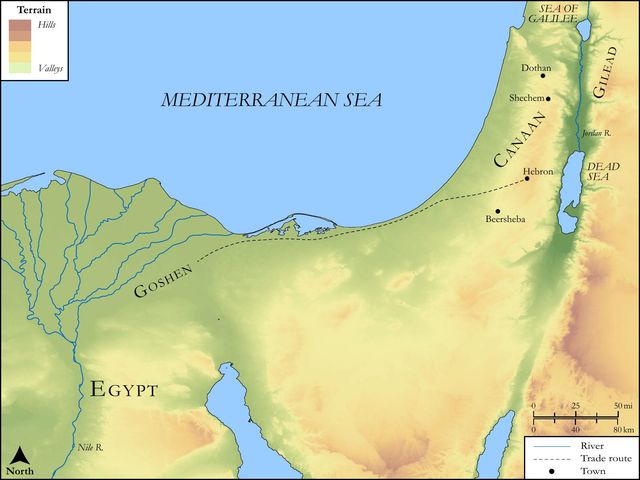
See on the biblical-era maps


Study this verse
Public-domain commentary
Matthew Henry
From his Commentary on the Whole Bible. Henry comments on passages, not single verses — this entry covers Genesis 39:19–23.
Here is, 1. Joseph wronged by his master. He believed the accusation, and either Joseph durst not make his defence by telling the truth, as it would reflect too much upon his mistress, or his master would not hear it, or would not believe it, and there is no remedy, he is condemned to perpetual imprisonment, Gen 39:19, Gen 39:20. God restrained his wrath, else he had put him to death; and that wrath which imprisoned him God made to turn to his praise, in order to which Providence so disposed that he should be shut up among the king's prisoners, the state-prisoners. Potiphar, it is likely, chose that prison because it was the worst; for there the iron entered into the soul (Psa 105:18), but God designed to pave the way to his enlargement. He was committed to the king's prison, that he might thence be preferred to the king's person. Note, Many an action of false imprisonment will, in the great day, be found to lie against the enemies and persecutors of God's people. Our Lord Jesus, like Joseph here, was bound, and numbered with the transgressors. 2. Joseph owned and righted by his God, who is, and will be, the just and powerful patron of oppressed innocence. Joseph was at a distance from all his friends and relations, had not them with him to comfort him, or to minister to him, or to mediate for him; but the Lord was with Joseph, and showed him mercy, Gen 39:21. Note, (1.) God despises not his prisoners, Psa 69:33. No gates nor bars can shut out his gracious presence from his people; for he has promised that he will never leave them. (2.) Those that have a good conscience in a prison have a good God there. Integrity and uprightness qualify us for the divine favour, wherever we are. Joseph is not long a prisoner before he becomes a little ruler even in the prison, which is to be attributed, under God, [1.] To the keeper's favour. God gave him favour in the sight of the keeper of the prison. Note, God can raise up friends for his people even where they little expect to find them, and can make them to be pitied even of those that carry them captive, Psa 106:46. [2.] To Joseph's fitness for business. The keeper saw that God was with him, and that every thing prospered under his hand; and therefore entrusted him with the management of the affairs of the prison, Gen 39:22, Gen 39:23. Note, Wisdom and virtue will shine in the narrowest spheres. A good man will do good wherever he is, and will be a blessing even in bonds and banishment; for the Spirit of the Lord is not bound nor banished, witness St. Paul, Phi 1:12, Phi 1:13.
Continue studying Genesis 39:23 across the web’s major study libraries — every link below opens this exact verse, chapter, or book on the destination site.
Read & Compare
 BibleGatewayThis verse in more than 200 translations and 70 languages.
 Bible.comThe YouVersion reader — hundreds of translations, reading plans, and highlights.
 ESV.orgCrossway's official English Standard Version reader.
 NET BibleThe NET translation with 60,000+ translators' notes on every rendering decision.
 STEP BibleTyndale House's free study tool — original text, vocabulary, and scholarly resources.
 BibliaLogos Bible Software's free web reader.
 USCCBThe New American Bible (Revised Edition) with the U.S. bishops' study notes.
Commentaries
 BibleHub CommentariesDozens of classic commentaries on this verse, gathered on one page.
 StudyLightMore than 100 commentary sets — the largest collection on the web.
 BibleRefPlain-English commentary on what this verse means, verse by verse.
 Enduring WordDavid Guzik's free commentary on this chapter, widely used by Bible teachers.
 Bible Study ToolsVerse commentary alongside Greek and Hebrew study aids.
Original Language & Research
- BibleHub InterlinearThe verse word by word — original language, transliteration, and English.
- BibleHub LexiconEvery word's original-language definition and Strong's entry.
 Blue Letter BibleDeep-study tools — Strong's numbers, concordance, and word studies.
 SefariaThe Hebrew text with Rashi and centuries of Jewish commentary.
Sermons, Hymns & Audio


TrulyRandomVerse is not affiliated with these sites and doesn’t control their content. They’re linked because they’re genuinely useful.
Summary
Genesis 39:23 powerfully encapsulates the profound divine favor and enablement that rested upon Joseph, even amidst the severe injustice of his imprisonment. This verse serves as a climactic summary, demonstrating how the prison keeper's complete trust and Joseph's remarkable administrative success were direct manifestations of the LORD's constant presence and active blessing, mirroring the divine prosperity he experienced earlier in Potiphar's household.
Context
ShowHideLiterary Context
Genesis 39:23 concludes a significant segment of Joseph's narrative, detailing his unjust imprisonment following the false accusations of Potiphar's wife. This verse functions as a powerful thematic echo to Genesis 39:2-3, where the LORD's presence also caused Joseph to prosper and find favor in Potiphar's household. The repeated emphasis on "the LORD was with him" (found in Genesis 39:2, Genesis 39:21, and here in Genesis 39:23) highlights a consistent theological thread throughout Joseph's trials. The immediate verses (Genesis 39:21-22) describe Joseph's initial favor with the prison keeper, setting the stage for the complete trust and delegated authority described in verse 23. This pattern of Joseph rising to a position of authority and trust, despite his circumstances, underscores God's sovereign hand preparing him for his ultimate role in Egypt.
Historical & Cultural Context
Imprisonment in ancient Egypt, particularly for slaves or foreigners, was often harsh and unforgiving. Prisons were not necessarily formal institutions as we understand them today, but could be parts of official residences or military compounds, serving as holding cells or places of punishment. The "keeper of the prison" (H8269, sar) would have been a high-ranking official, likely a chief executioner or a trusted officer of the king, holding immense power over the lives of his prisoners. For such an official to "look not to any thing" under Joseph's hand indicates an extraordinary level of trust and delegation, far beyond typical expectations for a prisoner, especially one accused of a serious crime like attempted rape. This speaks to the remarkable character Joseph displayed, but more profoundly, to the visible, tangible blessing of God that made his work so undeniably effective and trustworthy.
Key Themes
ShowHideThe overarching theme of God's sovereignty is paramount in Genesis 39. Despite human treachery (Joseph's brothers selling him, Potiphar's wife falsely accusing him), God's divine plan for Joseph's life continues to unfold. The repeated phrase "the LORD was with him" emphasizes the theme of divine presence and faithfulness, assuring the reader that God does not abandon His servants in adversity. Joseph's consistent character, marked by integrity and diligence, even in the face of injustice, also stands out. These qualities, empowered by God's presence, lead to divine prosperity and favor, demonstrating that God can work through any circumstance to achieve His purposes, transforming a place of punishment into a platform for preparation, as seen in Joseph's eventual rise to prime minister of Egypt.
Exposition and Analysis
ShowHideKey Word Analysis
ShowHideThis is the covenant name of God, Yahweh (H3068), emphasizing His personal, self-existent, and eternal nature. Its repeated use in this chapter (e.g., Genesis 39:2, Genesis 39:21) underscores that Joseph's experiences are not random occurrences but are under the direct, active, and personal superintendence of the God of Israel. It signifies God's covenant faithfulness to Joseph and His people.
The word "hand" (H3027) here signifies authority, control, and responsibility. When the text states the keeper "looked not to any thing that was under his hand," it means the keeper did not need to supervise or inspect anything that was under Joseph's charge or management. This indicates a complete relinquishment of oversight, a profound level of trust, and an acknowledgment of Joseph's supreme competence and integrity in handling all affairs.
This verb (H6743) means "to push forward," "to advance," "to succeed," or "to be profitable." It denotes a divine enablement that ensures success and indicates God's direct hand in orchestrating favorable outcomes. It's not merely that Joseph was good at what he did, but that God actively caused his endeavors to succeed and flourish, even in the most restrictive and unjust environment of a prison.
Verse Breakdown
ShowHide"The keeper of the prison looked not to any thing [that was] under his hand;"
This clause highlights the extraordinary trust and authority the chief jailer bestowed upon Joseph. It suggests a complete delegation of responsibility, where the jailer had no need to inspect, supervise, or question Joseph's management of the prison affairs. This speaks volumes about Joseph's integrity, administrative competence, and the visible success of his work, which was so evident that it commanded such implicit confidence from his superior.
"because the LORD was with him,"
This is the foundational explanation for Joseph's remarkable standing. It attributes the jailer's trust and Joseph's success not to Joseph's inherent abilities alone, but to the tangible, active presence of Yahweh. God's presence was the source of Joseph's wisdom, favor, and the discernible blessing upon his work, making him exceptionally reliable and effective even in such dire circumstances.
"and [that] which he did, the LORD made [it] to prosper."
This final clause reiterates and reinforces the divine causality behind Joseph's success. It clarifies that every task Joseph undertook, every responsibility he managed, was divinely empowered to succeed. His prosperity was not accidental or merely a result of human skill, but a direct consequence of God's intentional intervention and blessing upon his endeavors, demonstrating God's sovereign ability to work through and overcome human injustice to achieve His purposes.
Literary Devices
ShowHideThe verse employs Repetition of the phrase "the LORD was with him" (or similar sentiments) throughout Genesis 39, reinforcing the central theological truth that God's presence is the ultimate source of Joseph's prosperity and favor, regardless of his circumstances. There is also a strong sense of Divine Causation, where Joseph's success is explicitly attributed to God's direct action ("the LORD made it to prosper"), rather than solely to Joseph's own merits. Furthermore, a subtle Irony is present: Joseph, an innocent man, is imprisoned, yet in this place of confinement and punishment, he experiences profound prosperity and favor, a stark contrast to what one would expect, highlighting God's ability to work good in the most unlikely of places.
Theological and Thematic Connections
ShowHideGenesis 39:23 profoundly illustrates that God's presence and blessing are not contingent upon human freedom or comfortable circumstances, but are a constant reality for His faithful servants, even in the deepest valleys of suffering and injustice. Joseph's story serves as a powerful testament to God's unwavering sovereignty, demonstrating His ability to orchestrate His perfect plan even through the malicious intentions and sinful actions of humanity. Joseph's diligence and integrity, empowered by God's presence, allowed him to flourish and gain trust, showcasing that God blesses and empowers the efforts of those who remain faithful to Him, ensuring their work bears fruit for His purposes.
Reflection and Application
ShowHideGenesis 39:23 offers profound encouragement for believers today, reminding us that God's presence is not dependent on our comfort, freedom, or external circumstances. Even in our personal "prisons"—whether they be physical limitations, emotional struggles, professional setbacks, or relational hardships—the Lord can be powerfully with us, guiding, sustaining, and even causing us to prosper in ways that transcend our immediate situation. Joseph's unwavering diligence and integrity in prison, despite his innocence, prepared him for his future, far greater role as ruler over all Egypt. This illustrates a vital principle: faithfulness in small, difficult, or seemingly insignificant tasks can be God's training ground for greater opportunities and responsibilities. Ultimately, this verse reinforces the truth that God's ultimate plan prevails; despite the injustices Joseph faced, God was working all things together for good, fulfilling His purposes, a truth beautifully articulated by Joseph later in Genesis 50:20, where he declares that what his brothers intended for evil, God intended for good. Our trust in God's sovereignty allows us to endure hardship with hope, purpose, and the assurance that His presence is our truest prosperity.
Questions for Reflection
ShowHideFAQ
ShowHideHow could Joseph prosper in prison, a place of punishment?
ShowHideJoseph's prosperity, as described in Genesis 39:23, was not defined by his physical freedom or comfort, but by God's active presence and blessing upon his work and character. Even in confinement, God enabled him to excel in administrative tasks, gain the complete trust of the prison keeper, and effectively manage the entire prison. This demonstrates that true prosperity is tied to God's favor and enablement, not merely to external circumstances or the absence of hardship. God's presence transformed a place of punishment into a place of preparation and influence.
Does "the LORD was with him" imply that God prevents all suffering for believers?
ShowHideNo, Joseph's story clearly illustrates that God's presence does not prevent suffering or injustice. Joseph endured slavery, false accusation, and unjust imprisonment. Instead, the recurring phrase "the LORD was with him" (Genesis 39:2, Genesis 39:21) assures believers that God is with them through their suffering. His presence provides strength, wisdom, and resilience, and ultimately works all things for good according to His sovereign plan, as powerfully demonstrated in Joseph's journey from prison to becoming prime minister of Egypt.
What does the jailer's "hands-off" approach reveal about Joseph?
ShowHideThe jailer's complete trust, indicated by "looked not to any thing [that was] under his hand," reveals Joseph's exceptional integrity, competence, and reliability. It signifies that Joseph managed the prison affairs with such diligence, honesty, and effectiveness that the keeper had no need to supervise him. This profound level of trust implies that Joseph's work was flawless and that his character was unimpeachable, a direct result of the divine enablement and blessing of the LORD upon his life and work.
Christ-Centered Fulfillment
ShowHideJoseph's journey, particularly his prosperity and rise to authority even while unjustly imprisoned as described in Genesis 39:23, profoundly foreshadows the life, suffering, and ultimate exaltation of Jesus Christ. Like Joseph, Jesus was innocent yet unjustly condemned and subjected to immense suffering, even to the point of death on a cross. Yet, throughout His earthly ministry and even in His passion, God's presence was powerfully with Him, empowering His every action and ensuring the success of His mission, just as the "LORD was with" Joseph. Joseph's rise from the prison to a position of ultimate authority, where he saved his people and countless others from famine, powerfully prefigures Christ's ultimate exaltation to the right hand of the Father, where He reigns as the Savior of humanity, offering spiritual sustenance and deliverance to all who believe. The divine enablement that made Joseph's work prosper ultimately points to the Father's perfect work through the Son, fulfilling God's redemptive plan despite human sin, opposition, and even death, culminating in Christ's victory over sin and death.