


Daniel 6:22
Bible text: King James Version (1769 Blayney text) · Public domain
Bible text: King James Version with Strong's numbers · Public domain
Bible text: Berean Standard Bible · Public domain
Bible text: American Standard Version (1901) · Public domain
Bible text: World English Bible, Messianic edition · Public domain
Bible text: Geneva Bible (1599) · Public domain
Bible text: Young's Literal Translation · Public domain
- אֱלָהִי'e·la·Himy GodH426N-csc ¦ 1csNoun Singular common gender ConstructאֱלָהִGodיmy
- שְׁלַחshe·Lachhe sentH7972V-Peal-Perf-3msVerb Peal Perfect 3rd Singular Masculine
- מַלְאֲכֵהּmal·'a·Khehhis angelH4398N-csc ¦ 3msNoun Singular common gender Constructמַלְאֲכֵangelהּhis
- וּסֲגַרu·sa·Garand he closedH5463Conj-w ¦ V-Qal-Perf-3msVerb Qal Perfect 3rd Singular Masculineוּandסֲגַרhe closed
- פֻּםpum[the] mouth ofH6433N-cscNoun Singular common gender Construct
- אַרְיָוָתָא'ar·ya·va·Ta'lions theH744N-fs ¦ ArtNoun Singular Feminine Definiteאַרְיָוָתָlionsאthe
- וְלָאve·La'and notH3809Conj-w ¦ NegParticle Negativeוְandלָאnot
- חַבְּלוּנִיcha·be·Lu·nithey harmed meH2255V-Pael-Perf-3mp ¦ 1csVerb Pael Perfect 3rd Plural Masculineחַבְּלוּthey harmedנִיme
- כָּלkolas toPrep-k ¦ Prep-lPrepositionכָּasלto
- קֳבֵלko·VelbecauseH6903N-csNoun Singular common gender Absolute
- דִּיdithatH1768ConjConjunction
- קָדָמוֹהִיka·da·Mo·hibefore himH6925N-mpc ¦ 3msNoun Plural Masculine Constructקָדָמוֹbeforeהִיhim
- זָכוּza·KhuinnocenceH2136N-csNoun Singular common gender Absolute
- הִשְׁתְּכַחַתhish·te·Kha·chatit was foundH7912V-Hitpael-Perf-3fsVerb Hitpael Perfect 3rd Singular Feminine
- לִיLito mePrep-l ¦ 1csSuffix Personal 1st Singular common genderלִtoיme
- וְאַףve·'Afand alsoH638Conj-w ¦ AdvAdverbוְandאַףalso
- קָדָמָךְka·da·ma·yikhbefore youH6925N-csc ¦ 2msNoun Singular common gender Constructקָדָמָbeforeךְyou
- מַלְכָּאmal·Ka'king OH4430N-cs ¦ ArtNoun Singular common gender DefiniteמַלְכָּkingאO
- חֲבוּלָהcha·vu·Laha hurtful actH2248N-fsNoun Singular Feminine Absolute
- לָאla'notH3809NegParticle Negative
- עַבְדֵת'av·DetI have doneH5648V-Peal-Perf-1csVerb Peal Perfect 1st Singular common gender
English is a literal word-by-word gloss of the Hebrew, not the KJV's wording. Why?
This is the original text the KJV's translators worked from — each Hebrew word with its own literal English meaning in this verse, prepared by scholars at Tyndale House, Cambridge. The KJV translates whole sentences, not word by word, so its wording differs: one Hebrew word can become several English words, and the KJV may choose “the LORD” where the gloss reads “Yahweh”. Both are faithful — they answer different questions. For the KJV's own rendering, switch to the KJV text.
Details
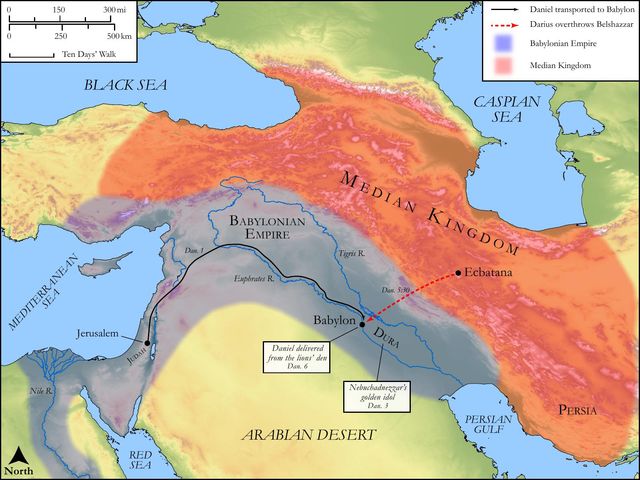
See on the biblical-era map
Study this verse
Public-domain commentary
Matthew Henry
From his Commentary on the Whole Bible. Henry comments on passages, not single verses — this entry covers Daniel 6:18–24. His two-level outline is real structure in the source text, so it is rendered as structure.
Here is, I. The melancholy night which the king had, upon Daniel's account, Dan 6:18. He had said, indeed, that God would deliver him out of the danger, but at the same time he could not forgive himself for throwing him into the danger; and justly might God deprive him of a friend whom he had himself used so barbarously. He went to his palace, vexed at himself for what he had done, and calling himself unwise and unjust for not adhering to the law of God and nature with a non obstante - a negative to the law of the Medes and Persians. He ate no supper, but passed the night fasting; his heart was already full of grief and fear. He forbade the music; nothing is more unpleasing that songs sung to a heavy heart. He went to bed, but got no sleep, was full of tossings to and fro till the dawning of the day. Note, the best way to have a good night is to keep a good conscience, then we may lie down in peace.
II.The solicitous enquiry he made concerning Daniel the next morning, Dan 6:19, Dan 6:20.
He was up early, very early; for how could he lie in bed when he could not sleep for dreaming of Daniel, nor lie awake quietly for thinking of him? And he was no sooner up than he went in haste to the den of lions, for he could not satisfy himself to send a servant (that would not sufficiently testify his affection for Daniel), nor had he patience to stay so long as till a servant would return. When he comes to the den, not without some hopes that God had graciously undone what he had wickedly done, he cries, with a lamentable voice, as one full of concern and trouble, O Daniel! art thou alive? He longs to know, yet trembles to ask the question, fearing to be answered with the roaring of the lions after more prey: O Daniel! servant of the living God, has thy God whom thou servest made it to appear that he is able to deliver thee from the lions? If he rightly understood himself when he called him the living God, he could not doubt of his ability to keep Daniel alive, for he that has life in himself quickens whom he will; but has he thought fit in this case to exert his power? What he doubted of we are sure of, that the servants of the living God have a Master who is well able to protect them and bear them out in his service.
III.The joyful news he meets with - that Daniel is alive, is safe, and well, and unhurt in the lions' den, Dan 6:21, Dan 6:22.
Daniel knew the king's voice, though it was now a lamentable voice, and spoke to him with all the deference and respect that were due to him: O king! live for ever. He does not reproach him for his unkindness to him, and his easiness in yielding to the malice of his persecutors; but, to show that he has heartily forgiven him, he meets him with his good wishes. Note, We should not upbraid those with the diskindnesses they have done us who, we know, did them with reluctance, and are very ready to upbraid themselves with them. The account Daniel gives the king is very pleasant; it is triumphant.
1.God has preserved his life by a miracle. Darius had called him Daniel's god (thy God whom thou servest), to which Daniel does as it were echo back, Yea, he is my God, whom I own, and who owns me, for he has sent his angel. The same bright and glorious being that was seen in the form of the Son of God with the three children in the fiery furnace had visited Daniel, and, it is likely, in a visible appearance had enlightened the dark den, and kept Daniel company all night, and had shut the lions' mouths, that they had not in the least hurt him. The angel's presence made even the lions' den his strong-hold, his palace, his paradise; he had never had a better night in his life. See the power of God over the fiercest creatures, and believe his power to restrain the roaring lion that goes about continually seeking to devour from hurting those that are his. See the care God takes of his faithful worshippers, especially when he calls them out to suffer for him. If he keeps their souls from sin, comforts their souls with his peace, and receives their souls to himself, he does in effect stop the lions' mouths, that they cannot hurt them. See how ready the angels are to minister for the good of God's people, for they own themselves their fellow servants.
2.God has therein pleaded his cause. He was represented to the king as disaffected to him and his government. We do not find that he said any thing in his own vindication, but left it to God to clear up his integrity as the light; and he did it effectually, by working a miracle for his preservation. Daniel, in what he had done, had not offended either God or the king: Before him whom I prayed to innocency was found in me. He pretends not to a meritorious excellence, but the testimony of his conscience concerning his sincerity is his comfort - As also that before thee, O king! I have done no hurt, nor designed thee any affront.
IV.The discharge of Daniel from his confinement.
His prosecutors cannot but own that the law is satisfied, though they are not, or, if it be altered, it is by a power superior to that of the Medes and Persians; and therefore no cause can be shown why Daniel should not be fetched out of the den (Dan 6:23): The king was exceedingly glad to find him alive, and gave orders immediately that they should take him out of the den, as Jeremiah out of the dungeon; and, when they searched, no manner of hurt was found upon him; he was nowhere crushed nor scarred, but was kept perfectly well, because he believed in his God. Note, Those who boldly and cheerfully trust in God to protect them in the way of their duty shall never be made ashamed of their confidence in him, but shall always find him a present help.
V.The committing of his prosecutors to the same prison, or place of execution rather, Dan 6:24.
Darius is animated by this miracle wrought for Daniel, and now begins to take courage and act like himself. Those that would not suffer him to show mercy to Daniel shall, now that God has done it for him, be made to feel his resentments; and he will do justice for God who had shown mercy for him. Daniel's accusers, now that his innocency is cleared, and Heaven itself has become his compurgator, have the same punishment inflicted upon them which they designed against him, according to the law of retaliation made against false accusers, Deu 19:18, Deu 19:19. Such they were to be reckoned now that Daniel was proved innocent; for, though the fact was true, yet it was not a fault. They were cast into the den of lions, which perhaps was a punishment newly invented by themselves; however, it was what they maliciously designed for Daniel. Nec lex est justior ulla qum necis artifices arte perire su - No law can be more just than that which adjudges the devisers of barbarity to perish by it, Psa 7:15, Psa 7:16; Psa 9:15, Psa 9:16. And now Solomon's observation is verified (Pro 11:8), The righteous is delivered out of trouble, and the wicked cometh in his stead. In this execution we may observe,
1.The king's severity, in ordering their wives and children to be thrown to the lions with them. How righteous are God's statutes above those of the nations! for God commanded that the children should not die for the fathers' crimes, Deu 24:16. Yet they were put to death in extraordinary cases, as those of Achan, and Saul, and Haman.
2.The lion's fierceness. They had the mastery of them immediately, and tore them to pieces before they came to the bottom of the den. This verified and magnified the miracle of their sparing Daniel; for hereby it appeared that it was not because they had not appetite, but because they had not leave. Mastiffs that are kept muzzled are the more fierce when the muzzle is taken off; so were these lions. And the Lord is known by those judgments which he executes.
Historical interpretation
Historical reception
1 surviving comment on this verse from the historical church.
Verse 22. "'My God sent His angel and shut up the lions' mouths, and they did me no harm...'" The fierceness of the lions was not altered, but their gaping jaws were closed by the angel, and also their voracious hunger, and that too for the reason that the prophet's good works had gone before him. And so his deliverance was not so much a matter of grace as of reward for his unrightness. And these words might be uttered by every saint, for he has been snatched from the mouths of lions unseen and from the infernal pit, because he has trusted in his God.
Continue studying Daniel 6:22 across the web’s major study libraries — every link below opens this exact verse, chapter, or book on the destination site.
Read & Compare
 BibleGatewayThis verse in more than 200 translations and 70 languages.
 Bible.comThe YouVersion reader — hundreds of translations, reading plans, and highlights.
 ESV.orgCrossway's official English Standard Version reader.
 NET BibleThe NET translation with 60,000+ translators' notes on every rendering decision.
 STEP BibleTyndale House's free study tool — original text, vocabulary, and scholarly resources.
 BibliaLogos Bible Software's free web reader.
 USCCBThe New American Bible (Revised Edition) with the U.S. bishops' study notes.
Commentaries
 BibleHub CommentariesDozens of classic commentaries on this verse, gathered on one page.
 StudyLightMore than 100 commentary sets — the largest collection on the web.
 BibleRefPlain-English commentary on what this verse means, verse by verse.
 Enduring WordDavid Guzik's free commentary on this chapter, widely used by Bible teachers.
 Bible Study ToolsVerse commentary alongside Greek and Hebrew study aids.
Original Language & Research
- BibleHub InterlinearThe verse word by word — original language, transliteration, and English.
- BibleHub LexiconEvery word's original-language definition and Strong's entry.
 Blue Letter BibleDeep-study tools — Strong's numbers, concordance, and word studies.
 SefariaThe Hebrew text with Rashi and centuries of Jewish commentary.
Sermons, Hymns & Audio


TrulyRandomVerse is not affiliated with these sites and doesn’t control their content. They’re linked because they’re genuinely useful.
Summary
Daniel 6:22 encapsulates Daniel's profound declaration to King Darius, affirming his miraculous deliverance from the lions' den. This verse stands as a powerful testament to the sovereign protection of God over His faithful servant, revealing a divine intervention that supernaturally silenced the predatory lions and meticulously vindicated Daniel's blameless character before both the Almighty and the earthly king. It highlights the unwavering faithfulness of Daniel and the ultimate triumph of divine justice over human malice and political intrigue.
Context
ShowHideLiterary Context
Daniel 6:22 serves as the climactic declaration within the narrative of Daniel in the lions' den, a pivotal story in the broader book of Daniel. The chapter opens with Daniel's elevation to a position of immense authority in the Persian Empire under King Darius, which incites intense jealousy among other high-ranking officials. These officials, unable to find fault in Daniel's administrative conduct, devise a cunning scheme, persuading the king to issue an unalterable decree forbidding prayer to any god or man except the king for thirty days, with the severe penalty of being cast into the lions' den. Daniel, despite full knowledge of this decree, maintains his consistent practice of praying to his God three times a day, openly and unashamedly, as described in Daniel 6:10. His unwavering devotion leads directly to his condemnation and subsequent miraculous deliverance, which is revealed in this verse. The king's anxious, sleepless night and his immediate, desperate morning inquiry set the stage for Daniel's calm, confident, and awe-inspiring testimony of divine intervention, marking the resolution of the conflict initiated by the decree.
Historical & Cultural Context
The events unfold during the early period of Persian rule after the fall of Babylon, specifically under King Darius the Mede, who is generally understood to be a satrap or co-regent under Cyrus the Great. The Persian administrative system, characterized by its vast empire governed through satraps and high officials, provided the fertile ground for political intrigue and power struggles, as seen in the officials' plot against Daniel. Royal decrees in Persia were considered immutable and unchangeable, as explicitly highlighted in Daniel 6:8, which made Daniel's situation particularly perilous and seemingly irreversible. Lions were native to the lands of Babylon and Persia and were often kept in pits or dens for public executions, symbolizing the king's absolute power, the finality of justice, and the inescapable nature of punishment. Daniel's survival, therefore, was not merely a fortunate escape but a direct, profound challenge to the perceived omnipotence of the earthly king and a spectacular demonstration of the true God's supremacy over all earthly powers, human laws, and even the natural order.
Key Themes
ShowHideThis verse powerfully encapsulates several overarching themes found consistently throughout the book of Daniel and indeed, across the broader canvas of Scripture. Firstly, it underscores the theme of Divine Sovereignty and Protection, demonstrating God's absolute power and willingness to supernaturally deliver His faithful servants from seemingly insurmountable dangers, echoing the miraculous deliverance of Daniel's friends from the fiery furnace in Daniel 3. Secondly, it highlights Integrity and Innocence, as Daniel explicitly states his blamelessness before both God and the king, affirming that his suffering was not a consequence of wrongdoing but rather a direct result of his unwavering commitment to God's commands. This vindication of the righteous, often in the face of false accusations, is a recurring motif throughout biblical narratives. Thirdly, the narrative showcases Faithfulness Under Persecution, as Daniel's steadfast devotion and consistent prayer life, even in the face of a death sentence, serve as a powerful and enduring example of obedience and trust in God. This encourages believers across generations to maintain their convictions and allegiance to God regardless of external pressures or the cost, a theme profoundly woven into the broader prophetic messages of the book of Daniel.
Exposition and Analysis
ShowHideKey Word Analysis
ShowHideThis Aramaic term (H426), corresponding to the Hebrew elohim or el, refers to the supreme divine being. Daniel's immediate attribution of his deliverance to "My God" emphasizes a deeply personal and intimate relationship with the Creator, clearly distinguishing Him from the pagan deities worshiped in Babylon and Persia, or from the deified king. It underscores the profound monotheistic conviction that fueled Daniel's unwavering actions and ultimately brought about his miraculous salvation.
Derived from a root meaning "purity," this Aramaic word (H2136) signifies blamelessness, righteousness, or moral purity. Daniel's declaration that "innocency was found in me" before God refers to his moral and spiritual uprightness, particularly regarding the specific accusation of disloyalty or rebellion against the king's decree. It asserts that his continued practice of prayer was not a criminal act but rather an act of worship and obedience, which God recognized as pure and righteous.
This Aramaic verb (H5463) means "to shut up" or "to close." In the context of the lions' mouths, it denotes a complete, effective, and supernatural closure, preventing them from harming Daniel. This was not a natural phenomenon, such as the lions being well-fed or lacking appetite, but a direct, divine intervention orchestrated by God's angel, demonstrating God's absolute and miraculous control over creation and its natural instincts.
Verse Breakdown
ShowHide"My God hath sent his angel"
Daniel immediately attributes his miraculous survival not to chance, human intervention, or the king's mercy, but to the direct, purposeful, and sovereign action of his God. The sending of an "angel" (H4398, a divine messenger or agent) signifies a supernatural, targeted act of deliverance, emphasizing God's active, personal, and powerful involvement in the affairs of His faithful servants.
"and hath shut the lions' mouths, that they have not hurt me"
This clause precisely describes the specific mechanism of Daniel's deliverance. The angel's action of "shutting" (H5463) the mouths of the lions indicates a complete and effective incapacitation of their predatory nature and instinct. The stated result, "that they have not hurt me" (H2255, H3809), confirms the undeniable success of this divine intervention, demonstrating God's absolute power to suspend natural laws and instincts for the protection of His chosen ones.
"forasmuch as before him innocency was found in me"
Daniel provides the divine rationale for his deliverance. He asserts that his blamelessness, or "innocency" (H2136), was recognized and affirmed by God. This implies that his continued prayer, though it violated the king's decree, was not a sin in God's eyes but an act of righteous obedience and faithfulness, for which God vindicated him. This establishes the moral and spiritual justification for God's intervention.
"and also before thee, O king, have I done no hurt"
This final clause addresses King Darius directly, stating Daniel's innocence from a human perspective. Daniel clarifies that his actions were not an act of disloyalty, rebellion, or harm (H2248, H3809) against the king or the kingdom. He had committed no crime that would legitimately warrant harm or punishment from the king, thus asserting his moral, ethical, and legal blamelessness in the human court as well, reinforcing the injustice of his condemnation.
Literary Devices
ShowHideThe verse is rich in Testimony, as Daniel delivers a direct, personal, and authoritative account of God's miraculous intervention, serving as a powerful witness to both the king and, by extension, to all future generations. There is profound Symbolism in the lions, which represent overwhelming danger, the destructive power of earthly authorities, and the finality of human judgment; yet, they are rendered harmless by divine command, symbolizing God's ultimate dominion and sovereignty over all created forces and human schemes. The Irony is striking: the very instrument intended for Daniel's agonizing destruction becomes the stage for God's glorious display of power and Daniel's public vindication. Furthermore, the dual declaration of innocence—first before God ("before him innocency was found in me"), then before the king ("and also before thee, O king, have I done no hurt")—employs Parallelism to underscore Daniel's complete and unassailable blamelessness in both divine and human spheres, reinforcing the absolute justice and righteousness of his miraculous deliverance.
Theological and Thematic Connections
ShowHideDaniel's declaration in Daniel 6:22 is a profound theological statement on God's active, personal, and powerful involvement in the lives of His faithful. It affirms that God is not a distant, detached deity but one who hears the cries of His people and intervenes supernaturally to protect them, especially when their suffering is a direct result of their unwavering obedience and faithfulness to Him. This miraculous deliverance serves as a powerful demonstration of God's justice, meticulously vindicating the righteous and exposing the futility and ultimate powerlessness of human schemes against divine will. It reinforces the timeless biblical truth that integrity and faithfulness, even in the face of death and overwhelming odds, are honored by God, who is truly able to deliver from the most dire and seemingly inescapable circumstances.
Reflection and Application
ShowHideDaniel's experience in the lions' den offers timeless and profoundly relevant lessons for believers navigating a complex, often hostile, and morally compromised world. His calm, confident declaration of God's direct intervention, even while standing before the very king who condemned him, exemplifies profound trust, unwavering courage, and an unshakeable conviction in God's sovereignty. In our own lives, we may not face literal lions, but we frequently encounter metaphorical "dens" of fear, anxiety, professional persecution, social ostracization, or seemingly insurmountable personal and spiritual challenges. Daniel's testimony powerfully reminds us that our ultimate security, vindication, and deliverance come not from human power, political maneuvering, or cleverness, but from the sovereign, protective hand of God. It calls us to live lives of uncompromising integrity and blamelessness, knowing that our true audience and ultimate judge is God, and that our faithfulness to Him will ultimately be recognized and rewarded, even if it means enduring temporary hardship or facing formidable opposition. We are encouraged to maintain our biblical convictions, pray without ceasing, and trust implicitly that God is not only able to deliver us from any trial but also to sustain us through it, using our trials for His glory and our spiritual growth.
Questions for Reflection
ShowHideFAQ
ShowHideWas Daniel truly innocent in the eyes of the Persian law, given that he broke the king's decree?
ShowHideFrom a strict, literalistic perspective of the Persian decree, Daniel did indeed violate the letter of the law by continuing his practice of praying to his God. However, Daniel's declaration of "innocency" (H2136, zâkûw) points to a deeper moral and spiritual blamelessness. He had committed no act of disloyalty, treason, or harm (H2248, chăbûwlâh) against the king or the kingdom. His "crime" was an act of worship to his God, which he deemed a higher allegiance than a temporary, politically motivated human decree. Thus, while technically in violation of a specific, unjust law, he was morally and ethically innocent of any genuine wrongdoing against the state, a fact implicitly acknowledged by King Darius's profound distress and earnest desire to save him (see Daniel 6:14).
How did the angel "shut the lions' mouths"? Was it a physical act or a spiritual one?
ShowHideThe biblical text does not specify the exact mechanism, but the Aramaic verb "shut" (H5463, çᵉgar) implies a complete and effective closure or incapacitation. Given that it was an angel (H4398, malʼak) sent by God (H426, ʼĕlâhh), it was undoubtedly a supernatural act. This could have involved a physical restraint, a spiritual influence that removed their predatory instinct, or a combination thereof. The emphasis of the narrative is not on the how the mouths were shut, but on the who—God's direct, miraculous intervention through His divine messenger to supernaturally suspend the natural, predatory behavior of the lions, ensuring Daniel's complete safety. This mirrors other biblical accounts of God's absolute control over creation, such as Jesus calming the storm with a word in Mark 4:39.
Christ-Centered Fulfillment
ShowHideDaniel's miraculous deliverance from the lions' den, and his profound vindication through divine intervention, powerfully foreshadows the ultimate deliverance and vindication found exclusively in Jesus Christ. Daniel's "innocency" (H2136, zâkûw) before God and man, which was the basis for his salvation from physical harm, points to the perfect and absolute innocence of Jesus, the Lamb of God who takes away the sin of the world. Christ, though perfectly blameless and utterly without sin, willingly entered the "den" of death and the grave, not to be preserved from it, but to conquer it definitively. Just as an angel (H4398, malʼak) shut the mouths of the lions for Daniel, God's supreme power ultimately triumphed over death through Christ's glorious resurrection, demonstrating His decisive victory over the ultimate enemy (see Hebrews 2:14-15). Daniel's testimony of God's protective hand assures us that in Christ, we too are delivered from the power of sin and eternal death, and are ultimately vindicated through His imputed righteousness (see Romans 5:18-19). He is the true Lion of the tribe of Judah, who, unlike the lions in the den, reigns in eternal power and delivers His people from all spiritual harm, leading them to everlasting life and an inheritance that is imperishable, undefiled, and unfading (see 1 Peter 1:3-5).