


Genesis 39:2
Bible text: King James Version (1769 Blayney text) · Public domain
Bible text: Berean Standard Bible · Public domain
Bible text: American Standard Version (1901) · Public domain
Bible text: World English Bible, Messianic edition · Public domain
Bible text: Geneva Bible (1599) · Public domain
Bible text: Young's Literal Translation · Public domain
- וַיְהִיvay·Hiand he wasH1961Conj-w ¦ V-Qal-ConsecImperf-3msVerb Qal Consecutive Imperfect 3rd Singular Masculineוַandיְהִיhe was
- יְהוָהYah·wehYahwehH3068N-properNoun Proper Title
- אֶת'etwithH854PrepPreposition
- יוֹסֵףyo·SefJosephH3130N-proper-mNoun Proper Masculine
- וַיְהִיvay·Hiand he wasH1961Conj-w ¦ V-Qal-ConsecImperf-3msVerb Qal Consecutive Imperfect 3rd Singular Masculineוַandיְהִיhe was
- אִישׁ'isha manH376N-mscNoun Singular Masculine Construct
- מַצְלִיחַmatz·Li·achsuccessfulH6743V-Hiphil-Prtcpl-msVerb Hiphil Participle Singular Masculine Absolute
- וַיְהִיvay·Hiand he wasH1961Conj-w ¦ V-Qal-ConsecImperf-3msVerb Qal Consecutive Imperfect 3rd Singular Masculineוַandיְהִיhe was
- בְּבֵיתbe·Veitin [the] house ofH1004Prep-b ¦ N-mscNoun Singular Masculine Constructבְּinבֵית[the] house of
- אֲדֹנָיו'a·do·Navhis master<s>H113N-mpc ¦ 3msNoun Plural Masculine Constructאֲדֹנָיmaster<s>וhis
- הַמִּצְרִיha·mitz·Rithe EgyptianH4713Art ¦ N-msNoun Gentilic Singular Masculine AbsoluteהַtheמִּצְרִיEgyptian
English is a literal word-by-word gloss of the Hebrew, not the KJV's wording. Why?
This is the original text the KJV's translators worked from — each Hebrew word with its own literal English meaning in this verse, prepared by scholars at Tyndale House, Cambridge. The KJV translates whole sentences, not word by word, so its wording differs: one Hebrew word can become several English words, and the KJV may choose “the LORD” where the gloss reads “Yahweh”. Both are faithful — they answer different questions. For the KJV's own rendering, switch to the KJV text.
Details
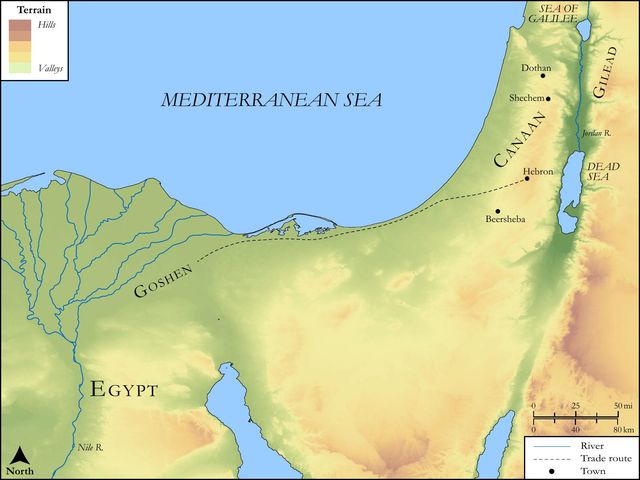
See on the biblical-era maps


Study this verse
Public-domain commentary
Matthew Henry
From his Commentary on the Whole Bible. Henry comments on passages, not single verses — this entry covers Genesis 39:1–6. His three-level outline is real structure in the source text, so it is rendered as structure.
Here is, I. Joseph bought (Gen 39:1), and he that bought him, whatever he gave for him, had a good bargain of him; it was better than the merchandise of silver. The Jews have a proverb, "If the world did not know the worth of good men, they would hedge them about with pearls." He was sold to an officer of Pharaoh, with whom he might get acquainted with public persons and public business, and so be fitted for the preferment for which he was designed. Note, 1. What God intends men for he will be sure, some way or other, to qualify them for. 2. Providence is to be acknowledged in the disposal even of poor servants and in their settlements, and therein may perhaps be working towards something great and important.
II.Joseph blessed, wonderfully blessed, even in the house of his servitude.
1.God prospered him, Gen 39:2, Gen 39:3. Perhaps the affairs of Potiphar's family had remarkably gone backward before; but, upon Joseph's coming into it, a discernible turn was given to them, and the face and posture of them altered on a sudden. Though, at first, we may suppose that his hand was put to the meanest services, even in those appeared his ingenuity and industry; a particular blessing of Heaven attended him, which, as he rose in his employment, became more and more discernible. Note,
(1.)Those that have wisdom and grace have that which cannot be taken away from them, whatever else they are robbed of. Joseph's brethren had stripped him of his coat of many colours, but they could not strip him of his virtue and prudence.
(2.)Those that can separate us from all our friends, yet cannot deprive us of the gracious presence of our God. When Joseph had none of all his relations with him, he had his God with him, even in the house of the Egyptian. Joseph was separated from his brethren, but not from his God; banished from his father's house, but the Lord was with him, and this comforted him.
(3.)It is God's presence with us that makes all we do prosperous. Those that would prosper must therefore make God their friend; and those that do prosper must therefore give God the praise.
2.His master preferred him, by degrees made him steward of his household, Gen 39:4. Note,
(1.)Industry and honesty are the surest and safest way both of rising and thriving: Seest thou a man prudent, and faithful, and diligent in his business? He shall stand before kings at length, and not always before mean men.
(2.)It is the wisdom of those that are in any sort of authority to countenance and employ those with whom it appears that the presence of God is, Psa 101:6. Potiphar knew what he did when he put all into the hands of Joseph; for he knew it would prosper better there than in his own hand.
(3.)He that is faithful in a few things stand fair for being made ruler over many things, Mat 25:21. Christ goes by this rule with his servants.
(4.)It is a great ease to a master to have those employed under him that are trusty. Potiphar was so well satisfied with Joseph's conduct that he knew not aught he had, save the bread which he did eat, Gen 39:6. The servant had all the care and trouble of the estate; the master had only the enjoyment of it: an example not to be imitated by any master, unless he could be sure that he had one in all respects like Joseph for a servant.
3.God favoured his master for his sake (Gen 39:5): He blessed the Egyptian's house, though he was an Egyptian, a stranger to the true God, for Joseph's sake; and he himself, like Laban, soon learned it by experience, Gen 30:27. Note,
(1.)Good men are the blessings of the places where they live; even good servants may be so, though mean, and lightly esteemed.
(2.)The prosperity of the wicked is, one way or other, for the sake of the godly. Here was a wicked family blessed for the sake of one good servant in it.
Historical interpretation
Historical reception
3 surviving comments on this verse. Each one is dated, so this reads as a timeline rather than a list.
Select a marker to jump to its quote. Markers stagger vertically where authors wrote within a few decades of each other.
Lowly servants have grounds on which they may glory; Joseph also was a servant. Those who have passed from freedom into slavery through some exigency have a source of consolation. They have something to imitate, so that they may learn that their status can change but not their character; that among household servants there is liberty; and that in servitude there is constancy. Masters have something to hope for through good and humble servants. Abraham found a wife for his son through a servant of his household. The Lord blessed the Egyptian’s house on account of Joseph, and the blessing of the Lord was granted to all his property in house and in fields. “And he entrusted all things whatsoever were his into the hands of Joseph.” We note that what the masters could not govern, mere servants governed.
What is the meaning of “a man of means”? Everything went well for him, grace from on high preceded him everywhere, and the grace that flourished with regard to Joseph was so obvious as to become plain even to his master, the chief steward. Recall the text says, “His master realized that the Lord was with him, and whatever he did the Lord conducted successfully in his person. Joseph found favor with his master, who set him over his household and entrusted to him all his possessions.” Do you see what it means to be helped by the right hand from above? I mean, behold, a young man, a stranger, a captive slave, yet entrusted by his master with his whole household: “he entrusted everything to him,” the text says. Why? Because along with power from on high Joseph also contributed his own way of doing things. Recall the text states, “He gave him satisfaction”; that is to say, he did everything to his complete satisfaction.
What is the meaning of “the Lord was with Joseph”? Grace from on high stood by him, it is saying, and smoothed over all his difficulties. It arranged all his affairs; it made those traders well disposed to him and led them to sell him to the chief steward so that he should advance gradually and, by proceeding through those trials, manage to reach the throne of the kingdom. But you, dearly beloved, hearing that Joseph endured slavery at the hands of the traders and then experienced the slavery of the chief steward, consider how he was not alarmed and did not give up hope or debate within himself in these terms: “How deceitful were those dreams that foretold such prosperity for me! I mean, look, I have gone from slavery to harsh slavery and a range of masters, from one to another, forced to associate with savage races. Surely we haven’t been abandoned? Surely we haven’t been passed over by grace from on high?” He said nothing of the sort; he gave it not a thought; on the contrary, he bore everything meekly and nobly. “The Lord was with Joseph” after all, “and he became a man of means.”
Continue studying Genesis 39:2 across the web’s major study libraries — every link below opens this exact verse, chapter, or book on the destination site.
Read & Compare
 BibleGatewayThis verse in more than 200 translations and 70 languages.
 Bible.comThe YouVersion reader — hundreds of translations, reading plans, and highlights.
 ESV.orgCrossway's official English Standard Version reader.
 NET BibleThe NET translation with 60,000+ translators' notes on every rendering decision.
 STEP BibleTyndale House's free study tool — original text, vocabulary, and scholarly resources.
 BibliaLogos Bible Software's free web reader.
 USCCBThe New American Bible (Revised Edition) with the U.S. bishops' study notes.
Commentaries
 BibleHub CommentariesDozens of classic commentaries on this verse, gathered on one page.
 StudyLightMore than 100 commentary sets — the largest collection on the web.
 BibleRefPlain-English commentary on what this verse means, verse by verse.
 Enduring WordDavid Guzik's free commentary on this chapter, widely used by Bible teachers.
 Bible Study ToolsVerse commentary alongside Greek and Hebrew study aids.
Original Language & Research
- BibleHub InterlinearThe verse word by word — original language, transliteration, and English.
- BibleHub LexiconEvery word's original-language definition and Strong's entry.
 Blue Letter BibleDeep-study tools — Strong's numbers, concordance, and word studies.
 SefariaThe Hebrew text with Rashi and centuries of Jewish commentary.
Sermons, Hymns & Audio


TrulyRandomVerse is not affiliated with these sites and doesn’t control their content. They’re linked because they’re genuinely useful.
Summary
Genesis 39:2 serves as a profound theological anchor in the narrative of Joseph, declaring that "the LORD was with Joseph" even as he endured the harsh realities of slavery in a foreign land. This pivotal verse immediately follows Joseph's betrayal and sale into Egypt, establishing God's unwavering presence and active favor in his life. It transforms his dire circumstances into a period of remarkable divine enablement and success, setting the foundational stage for his future role in God's redemptive plan for Israel and the surrounding nations.
Context
ShowHideLiterary Context
Genesis 39:2 immediately follows the traumatic events of Joseph's betrayal by his brothers and his subsequent sale into slavery by Midianite traders, as recounted in Genesis 37:28. Chapter 38, which details Judah's interaction with Tamar, serves as a narrative interlude, highlighting the moral decline within Jacob's family even as Joseph's story progresses. Chapter 39 then resumes Joseph's narrative, placing him in the household of Potiphar, an officer of Pharaoh and captain of the guard. This verse is the very first statement regarding Joseph's condition in Egypt, strategically placed to immediately pivot from his desperate plight to underscore the overarching theme of God's sovereign presence and blessing, which transcends human suffering and injustice. It sets the stage for the remarkable rise of Joseph within Potiphar's house, directly attributing his success to divine favor.
Historical & Cultural Context
Joseph's arrival in Egypt places him in a highly structured and advanced civilization. During the Middle Kingdom period (roughly 2040-1782 BCE), when Joseph's story is often situated, Egypt was a dominant power with a sophisticated bureaucracy, a well-developed agricultural system, and a polytheistic religious system. Slavery was a common institution, though the treatment of slaves could vary. Being sold into slavery meant a complete loss of freedom, status, and identity, and often a life of hardship. For a Hebrew like Joseph, forced to serve in an Egyptian household, there would have been significant cultural, linguistic, and religious barriers. The mention of Potiphar as "captain of the guard" indicates a high-ranking official, suggesting a household of considerable influence and responsibility, making Joseph's subsequent rise within it even more remarkable.
Key Themes
ShowHideThis verse introduces and reinforces several crucial themes that permeate the book of Genesis and the broader biblical narrative. Foremost is the theme of Divine Presence and Providence, encapsulated in the recurring phrase "the LORD was with Joseph." This highlights God's active involvement in the lives of His chosen, even amidst adversity, demonstrating His faithfulness to His covenant promises. Another key theme is God's Sovereignty over Human Actions, where even the malicious intent of Joseph's brothers is ultimately woven into God's larger redemptive tapestry, a concept later articulated by Joseph himself in Genesis 50:20. Furthermore, the verse subtly introduces the theme of Prosperity and Blessing beyond Circumstance, showing that true success is not defined by worldly status but by divine enablement and favor, a concept explored further as Joseph flourishes even in prison in Genesis 39:21-23.
Exposition and Analysis
ShowHideKey Word Analysis
ShowHideThis is the sacred covenant name of God, YHWH (often transliterated as Jehovah or Yahweh), derived from a root meaning "to be" or "to exist." It signifies God as the self-Existent, Eternal, and ever-present One who is faithful to His covenant promises. In this context, the use of YHWH emphasizes a personal and active relationship, indicating that God's presence with Joseph was not passive observation but an empowering, protective, and blessing presence, underscoring His covenant faithfulness despite Joseph's dire circumstances.
Derived from an unused root meaning "to rule," this term denotes a sovereign, controller, or owner. It is used for both human and divine authority. Here, it refers to Potiphar, Joseph's human owner and lord. The juxtaposition of "the LORD" (YHWH) being with Joseph, even as he serves a human "master" (ʼâdôwn), highlights the profound theological truth that Joseph's ultimate allegiance and source of blessing lay with God, not with his earthly enslaver. It subtly contrasts human authority with divine sovereignty.
This primitive root means "to push forward," "succeed," "advance," or "be effective." It can be literal or figurative, transitive or intransitive. In Joseph's case, it describes his remarkable success and effectiveness in his assigned duties within Potiphar's household. This "prosperity" is not primarily about accumulating material wealth or gaining freedom, but about divine enablement that allows one to flourish and achieve success in their endeavors, even under restrictive conditions. It signifies God's blessing making Joseph fruitful and effective in all he undertook.
Verse Breakdown
ShowHide"And the LORD was with Joseph"
This is the central theological declaration of the verse. The use of "the LORD" (YHWH) signifies God's personal, covenantal, and active presence. It implies more than mere observation; it denotes God's empowering, protective, and guiding hand in Joseph's life. This presence was not contingent on Joseph's freedom or status, but on God's sovereign choice and faithfulness to His purposes, transforming a seemingly hopeless situation into one marked by divine favor.
"and he was a prosperous man"
This clause directly attributes Joseph's success to God's presence. The term "prosperous" (Hebrew: tsalach) indicates that Joseph was effective, successful, and advanced in his endeavors. This was not a result of his own cunning or strength but a direct consequence of God's blessing and enablement. It speaks to a divine favor that allowed Joseph to excel in his duties, earning the trust and confidence of his master, as further detailed in the subsequent verses of Genesis 39.
"and he was in the house of his master the Egyptian"
This final clause grounds the divine blessing in Joseph's immediate, difficult reality. It highlights the stark contrast between his enslaved status and the remarkable divine favor he experienced. Despite being a slave in a foreign land, under the authority of an Egyptian master, God's presence transformed his circumstances. This emphasizes that God's power and blessing are not limited by human constraints or adverse environments, but can manifest powerfully even within the confines of servitude.
Literary Devices
ShowHideGenesis 39:2 employs several potent literary devices. The most prominent is Juxtaposition, contrasting Joseph's enslaved status ("in the house of his master the Egyptian") with the profound theological reality of God's active presence ("the LORD was with Joseph"). This stark contrast immediately highlights the miraculous nature of Joseph's "prosperity" and emphasizes that his success is divinely rather than circumstantially determined. There is also a subtle use of Foreshadowing, as this initial declaration of God's presence with Joseph hints at the greater divine plan unfolding, ultimately leading to Joseph's exaltation and the preservation of his family. The phrase "the LORD was with Joseph" functions as a Leitmotif (a recurring theme or phrase), appearing multiple times in chapter 39 (Genesis 39:3 and Genesis 39:21), reinforcing the central theological truth that God's presence is the ultimate source of Joseph's success and resilience, regardless of his changing circumstances.
Theological and Thematic Connections
ShowHideGenesis 39:2 is a foundational statement on God's immanent presence and active providence in the lives of His people, even amidst profound suffering and injustice. It teaches that God's faithfulness is not contingent on our circumstances but on His unchanging character and covenant promises. Joseph's "prosperity" in slavery redefines success, shifting it from worldly metrics of freedom or wealth to divine enablement and effectiveness in one's calling, regardless of external conditions. This verse assures us that God can work through human sin and adversity to accomplish His sovereign purposes, transforming what appears to be a setback into a step forward in His grand redemptive narrative. It instills confidence in God's ability to sustain and bless His own, even when they are in the most vulnerable positions.
Reflection and Application
ShowHideGenesis 39:2 offers profound encouragement and a powerful paradigm for believers navigating difficult or unjust situations. It reminds us that our external circumstances, no matter how dire, do not dictate God's ability or willingness to be intimately present with us. Like Joseph, we can experience God's empowering favor and effectiveness even in the most challenging or seemingly insignificant roles. This verse challenges our conventional definitions of "prosperity," inviting us to see true success not as freedom from hardship or accumulation of wealth, but as the ability to be fruitful and effective in God's service, wherever He has placed us, through His enabling presence. Our faithfulness and diligence in seemingly menial or difficult tasks can become the very channels through which God manifests His blessing and prepares us for greater responsibilities, just as Joseph's integrity in Potiphar's house led to his eventual exaltation. Ultimately, this passage instills deep trust in God's overarching plan and providence, assuring us that even when human evil or misfortune seems to prevail, God is actively working all things together for good, shaping us and our circumstances for His glory and our ultimate benefit.
Questions for Reflection
ShowHideFAQ
ShowHideHow could Joseph be "prosperous" while enslaved?
ShowHideThe Hebrew word tsalach (H6743), translated "prosperous," means to succeed, advance, or be effective. In Joseph's case, it refers to his remarkable effectiveness and success in his duties within Potiphar's household. God's presence enabled him to manage affairs with such skill and integrity that his master entrusted everything to him, as detailed in Genesis 39:3-6. This highlights that true prosperity, in a biblical sense, is not solely about material wealth or freedom, but about God's blessing enabling one to flourish and be fruitful even in difficult circumstances, demonstrating divine favor transcending worldly status.
Does "the LORD was with Joseph" imply God causes suffering to achieve His purposes?
ShowHideThis verse does not imply that God caused Joseph's suffering (his brothers' sin and the slave trade). The Bible consistently attributes sin to human free will, not divine instigation. Rather, it emphasizes God's active presence in the suffering, demonstrating His ability to work through human evil and adversity to bring about His redemptive plan. God's presence transformed Joseph's dire situation into a pathway for blessing and future salvation, showcasing His providence over all events without condoning the sin that led to Joseph's enslavement. This is a profound mystery of divine sovereignty and human responsibility, where God's ultimate good can emerge even from the crucible of human wickedness, as Joseph himself later states in Genesis 50:20.
Christ-Centered Fulfillment
ShowHideJoseph's journey, marked by betrayal, unjust suffering, and eventual exaltation to a position of power that saved his people from famine, serves as a profound type of Christ. Just as "the LORD was with Joseph" in his humiliation and enabled his prosperity even as a slave, so too was God the Father intimately present with Jesus through His suffering, crucifixion, and death. Christ, though innocent, was betrayed by one of His own (Matthew 26:14-16), "sold" for a price, and descended into the depths of human suffering and death on the cross (Philippians 2:8). Yet, God exalted Him to the highest place, making Him Lord and Savior (Philippians 2:9-11), not just for a family or nation, but for all who believe, providing salvation from spiritual death and eternal famine. Joseph's role in preserving his family from physical death in Egypt powerfully foreshadows Christ's ultimate role in delivering humanity from spiritual death and eternal condemnation, demonstrating God's sovereign plan to bring ultimate salvation and life through the suffering, faithfulness, and exaltation of His chosen one, Jesus Christ, the true Lamb of God who takes away the sin of the world (John 1:29).