


Genesis 39:1
Bible text: King James Version (1769 Blayney text) · Public domain
Bible text: King James Version with Strong's numbers · Public domain
Bible text: Berean Standard Bible · Public domain
Bible text: American Standard Version (1901) · Public domain
Bible text: World English Bible, Messianic edition · Public domain
Bible text: Geneva Bible (1599) · Public domain
Bible text: Young's Literal Translation · Public domain
- וְיוֹסֵףve·yo·Sefand JosephH3130Conj-w ¦ N-proper-mNoun Proper MasculineוְandיוֹסֵףJoseph
- הוּרַדhu·Radhe had been brought downH3381V-Hophal-Perf-3msVerb Hophal Perfect 3rd Singular Masculine
- מִצְרָיְמָהmitz·Ra·ye·mahEgypt towardsH4714N-proper ¦ SfxNoun Proper LocationמִצְרָיְמָEgyptהtowards
- וַיִּקְנֵהוּvai·yik·Ne·huand he bought himH7069Conj-w ¦ V-Qal-ConsecImperf-3ms ¦ 3msVerb Qal Consecutive Imperfect 3rd Singular Masculineוַandיִּקְנֵhe boughtהוּhim
- פּוֹטִיפַרpo·ti·FarPotipharH6318N-proper-mNoun Proper Masculine
- סְרִיסse·Ris[the] official ofH5631N-mscNoun Singular Masculine Construct
- פַּרְעֹהpar·'OhPharaohH6547N-msNoun Title Singular Masculine Absolute
- שַׂרsar[the] commander ofH8269N-mscNoun Singular Masculine Construct
- הַטַּבָּחִיםha·ta·ba·Chimthe bodyguardsH2876Art ¦ N-mpNoun Plural Masculine Absoluteהַtheטַּבָּחִיםbodyguards
- אִישׁ'isha manH376N-msNoun Singular Masculine Absolute
- מִצְרִיmitz·Rian EgyptianH4713N-msNoun Gentilic Singular Masculine Absolute
- מִיַּדmi·Yadfrom [the] hand ofH3027Prep-m ¦ N-cscNoun Singular common gender Constructמִfromיַּד[the] hand of
- הַיִּשְׁמְעֵאלִיםhai·yish·me·'e·Limthe IshmaelitesH3459Art ¦ N-mpNoun Gentilic Plural Masculine AbsoluteהַtheיִּשְׁמְעֵאלִיםIshmaelites
- אֲשֶׁר'a·SherwhoH834RelParticle Relative
- הוֹרִדֻהוּho·ri·Du·huthey had brought down himH3381V-Hiphil-Perf-3cp ¦ 3msVerb Hiphil Perfect 3rd Plural common genderהוֹרִדֻthey had brought downהוּhim
- שָׁמָּהSha·mahthere towardsH8033Adv ¦ SfxAdverbשָׁמָּthereהtowards
English is a literal word-by-word gloss of the Hebrew, not the KJV's wording. Why?
This is the original text the KJV's translators worked from — each Hebrew word with its own literal English meaning in this verse, prepared by scholars at Tyndale House, Cambridge. The KJV translates whole sentences, not word by word, so its wording differs: one Hebrew word can become several English words, and the KJV may choose “the LORD” where the gloss reads “Yahweh”. Both are faithful — they answer different questions. For the KJV's own rendering, switch to the KJV text.
Details
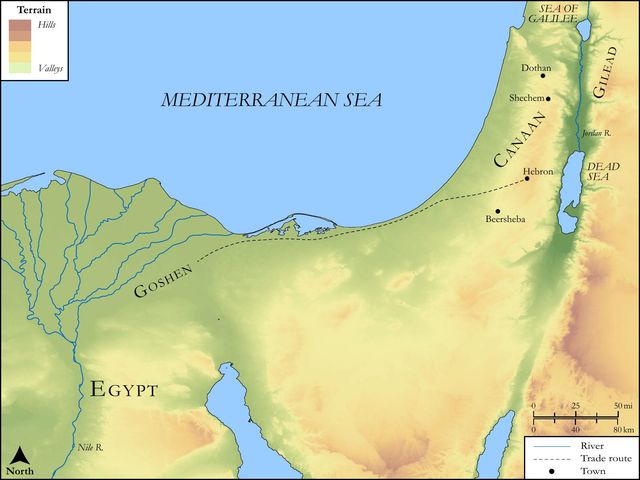
See on the biblical-era maps


Study this verse
Public-domain commentary
Matthew Henry
From his Commentary on the Whole Bible. Henry comments on passages, not single verses — this entry covers Genesis 39:1–6. His three-level outline is real structure in the source text, so it is rendered as structure.
Here is, I. Joseph bought (Gen 39:1), and he that bought him, whatever he gave for him, had a good bargain of him; it was better than the merchandise of silver. The Jews have a proverb, "If the world did not know the worth of good men, they would hedge them about with pearls." He was sold to an officer of Pharaoh, with whom he might get acquainted with public persons and public business, and so be fitted for the preferment for which he was designed. Note, 1. What God intends men for he will be sure, some way or other, to qualify them for. 2. Providence is to be acknowledged in the disposal even of poor servants and in their settlements, and therein may perhaps be working towards something great and important.
II.Joseph blessed, wonderfully blessed, even in the house of his servitude.
1.God prospered him, Gen 39:2, Gen 39:3. Perhaps the affairs of Potiphar's family had remarkably gone backward before; but, upon Joseph's coming into it, a discernible turn was given to them, and the face and posture of them altered on a sudden. Though, at first, we may suppose that his hand was put to the meanest services, even in those appeared his ingenuity and industry; a particular blessing of Heaven attended him, which, as he rose in his employment, became more and more discernible. Note,
(1.)Those that have wisdom and grace have that which cannot be taken away from them, whatever else they are robbed of. Joseph's brethren had stripped him of his coat of many colours, but they could not strip him of his virtue and prudence.
(2.)Those that can separate us from all our friends, yet cannot deprive us of the gracious presence of our God. When Joseph had none of all his relations with him, he had his God with him, even in the house of the Egyptian. Joseph was separated from his brethren, but not from his God; banished from his father's house, but the Lord was with him, and this comforted him.
(3.)It is God's presence with us that makes all we do prosperous. Those that would prosper must therefore make God their friend; and those that do prosper must therefore give God the praise.
2.His master preferred him, by degrees made him steward of his household, Gen 39:4. Note,
(1.)Industry and honesty are the surest and safest way both of rising and thriving: Seest thou a man prudent, and faithful, and diligent in his business? He shall stand before kings at length, and not always before mean men.
(2.)It is the wisdom of those that are in any sort of authority to countenance and employ those with whom it appears that the presence of God is, Psa 101:6. Potiphar knew what he did when he put all into the hands of Joseph; for he knew it would prosper better there than in his own hand.
(3.)He that is faithful in a few things stand fair for being made ruler over many things, Mat 25:21. Christ goes by this rule with his servants.
(4.)It is a great ease to a master to have those employed under him that are trusty. Potiphar was so well satisfied with Joseph's conduct that he knew not aught he had, save the bread which he did eat, Gen 39:6. The servant had all the care and trouble of the estate; the master had only the enjoyment of it: an example not to be imitated by any master, unless he could be sure that he had one in all respects like Joseph for a servant.
3.God favoured his master for his sake (Gen 39:5): He blessed the Egyptian's house, though he was an Egyptian, a stranger to the true God, for Joseph's sake; and he himself, like Laban, soon learned it by experience, Gen 30:27. Note,
(1.)Good men are the blessings of the places where they live; even good servants may be so, though mean, and lightly esteemed.
(2.)The prosperity of the wicked is, one way or other, for the sake of the godly. Here was a wicked family blessed for the sake of one good servant in it.
Continue studying Genesis 39:1 across the web’s major study libraries — every link below opens this exact verse, chapter, or book on the destination site.
Read & Compare
 BibleGatewayThis verse in more than 200 translations and 70 languages.
 Bible.comThe YouVersion reader — hundreds of translations, reading plans, and highlights.
 ESV.orgCrossway's official English Standard Version reader.
 NET BibleThe NET translation with 60,000+ translators' notes on every rendering decision.
 STEP BibleTyndale House's free study tool — original text, vocabulary, and scholarly resources.
 BibliaLogos Bible Software's free web reader.
 USCCBThe New American Bible (Revised Edition) with the U.S. bishops' study notes.
Commentaries
 BibleHub CommentariesDozens of classic commentaries on this verse, gathered on one page.
 StudyLightMore than 100 commentary sets — the largest collection on the web.
 BibleRefPlain-English commentary on what this verse means, verse by verse.
 Enduring WordDavid Guzik's free commentary on this chapter, widely used by Bible teachers.
 Bible Study ToolsVerse commentary alongside Greek and Hebrew study aids.
Original Language & Research
- BibleHub InterlinearThe verse word by word — original language, transliteration, and English.
- BibleHub LexiconEvery word's original-language definition and Strong's entry.
 Blue Letter BibleDeep-study tools — Strong's numbers, concordance, and word studies.
 SefariaThe Hebrew text with Rashi and centuries of Jewish commentary.
Sermons, Hymns & Audio


TrulyRandomVerse is not affiliated with these sites and doesn’t control their content. They’re linked because they’re genuinely useful.
Summary
Genesis 39:1 profoundly marks the dramatic and involuntary transition of Joseph from the favored son of Jacob in Canaan to a purchased slave in Egypt. This verse meticulously details his acquisition by Potiphar, a high-ranking officer of Pharaoh and captain of the royal guard, from the Ishmaelites who had transported him. It serves as a crucial narrative pivot, setting the stage for Joseph's subsequent trials, divine favor, and eventual elevation within a foreign land, thereby initiating a new, unforeseen chapter in God's sovereign plan for the nascent nation of Israel.
Context
ShowHideLiterary Context
Genesis 39:1 immediately follows the traumatic events of Genesis 37, where Joseph's envious brothers conspire against him, first intending to kill him, then selling him into slavery to a caravan of Ishmaelites bound for Egypt (Genesis 37:28). This verse thus acts as the narrative bridge, moving Joseph from the familial strife of Canaan into the foreign, powerful, and culturally distinct realm of Egypt. It shifts the focus from the internal dynamics of Jacob's family to Joseph's individual journey, setting the stage for his remarkable rise and the subsequent preservation of his family, which will culminate in the entire family's migration to Egypt.
Historical & Cultural Context
Egypt was a dominant power among the nations of Joseph's day, known for its advanced civilization, structured bureaucracy, and centralized government under the Pharaoh. Slavery was a common practice, with individuals often acquired through trade, conquest, or debt. The "Ishmeelites" (Ishmaelites) were nomadic traders, descendants of Ishmael (Abraham's son), who frequently traversed the trade routes between Canaan and Egypt. Potiphar's title, "captain of the guard," indicates a high-ranking official, likely overseeing the Pharaoh's personal security, the royal bodyguards, and potentially state executions. Such a position would place him in close proximity to the Pharaoh, granting him significant authority and wealth, allowing him to purchase slaves like Joseph. This historical backdrop underscores the harsh realities of Joseph's situation while simultaneously highlighting the strategic importance of his placement within such an influential household.
Key Themes
ShowHideThis verse introduces several pivotal themes that will unfold throughout Joseph's narrative and beyond. Firstly, the theme of Divine Sovereignty is subtly introduced; despite human malice and betrayal, God is orchestrating events for a greater purpose, turning evil intentions into redemptive outcomes, a concept explicitly stated later in Genesis 50:20. Secondly, the theme of Suffering and Exaltation begins here, as Joseph's descent into slavery is the necessary precursor to his eventual rise to power and prominence. Thirdly, the theme of Providential Placement is evident; Joseph's entry into Potiphar's household, though involuntary, is not random but positions him within the very heart of Egyptian power, a crucial step in God's plan to preserve the nascent nation of Israel during a future famine, as detailed in Genesis 41.
Exposition and Analysis
ShowHideKey Word Analysis
ShowHideMeaning "let him add" or "adding." This name, given by Rachel (Genesis 30:24), carries prophetic weight. Here, it underscores the identity of the individual at the center of this pivotal narrative turn. Despite his current diminished status as a slave, the meaning of his name subtly hints at the future increase and blessing God will bring through him, adding to his family and preserving them.
A primitive root meaning "to descend" or "to go downwards," and causatively, "to bring down." The repeated use of this verb ("was brought down," "had brought him down thither") emphasizes Joseph's forced descent—both physically from Canaan to Egypt, and socially from favored son to slave. This "bringing down" is a motif that will recur, highlighting the depths of his humiliation before his eventual exaltation.
Properly "a butcher," hence "a lifeguardsman" (acting as an executioner), or "a cook." The full title in Hebrew is sar haṭṭabbāḥîm (שַׂר הַטַּבָּחִים), meaning "chief of the slaughterers" or "chief of the executioners." This indicates Potiphar's role was far more significant than a mere military commander. He was a highly trusted official responsible for the Pharaoh's personal security, royal bodyguards, and potentially state executions, granting him immense power and direct access to the highest levels of Egyptian government. Joseph's entry into such a household was thus into the very epicenter of Egyptian power.
A primitive root meaning "to erect, i.e. create; by extension, to procure, especially by purchase." This word starkly highlights Joseph's new reality: he is no longer a son but a commodity, acquired as property. The act of "buying" signifies a complete loss of personal freedom and autonomy, underscoring the brutal nature of slavery in that age and the profound shift in Joseph's status.
Verse Breakdown
ShowHide"And Joseph was brought down to Egypt"
This initial clause immediately establishes the setting and Joseph's new, involuntary status. The passive voice ("was brought down") emphasizes his lack of agency in this transition, a direct consequence of his brothers' betrayal. It signifies a profound geographical and social descent from the land of promise and his privileged position within his family.
"and Potiphar, an officer of Pharaoh, captain of the guard, an Egyptian, bought him"
This identifies Joseph's new owner and provides crucial details about his status and nationality. Potiphar's multiple titles emphasize his high social standing and proximity to the Pharaoh, indicating that Joseph was acquired by a powerful and influential figure within the Egyptian court. The act of "buying" underscores Joseph's reduction to property.
"of the hands of the Ishmeelites, which had brought him down thither"
This final clause clarifies the immediate source of Joseph's acquisition. The "Ishmeelites" are identified as the intermediaries in this transaction, having transported Joseph from Canaan. The repetition of "brought him down" reinforces the theme of descent and the journey that led him to this point, highlighting the complete and utter displacement Joseph has experienced.
Literary Devices
ShowHideThe verse effectively employs several literary devices. Narrative Transition is paramount, as it smoothly shifts the story from Joseph's family drama in Canaan to his individual journey in Egypt, setting the stage for the next major phase of his life. There is a subtle Irony in Joseph's "descent" into slavery being the very means by which God will "elevate" him to save his family and the nascent nation of Israel. The phrase "brought down" functions as a Motif, emphasizing Joseph's physical and social degradation, which contrasts sharply with his future ascent. Furthermore, the detailed description of Potiphar's position ("officer of Pharaoh, captain of the guard") serves as Foreshadowing, subtly hinting at the significant, high-level interactions Joseph will have within the Egyptian court, preparing the reader for his eventual rise to power.
Theological and Thematic Connections
ShowHideGenesis 39:1 profoundly illustrates the interplay of human sin and divine sovereignty. Joseph's forced entry into Egypt as a slave is a direct result of his brothers' envy and betrayal, yet it is simultaneously the divinely orchestrated first step in God's larger redemptive plan. This verse highlights that even through painful and unjust circumstances, God remains actively at work, positioning individuals for His ultimate purposes. Joseph's journey from a favored son to a foreign slave underscores the theme that God often uses unexpected and difficult paths to achieve His glorious will, transforming apparent setbacks into strategic advancements.
Reflection and Application
ShowHideJoseph's immediate plunge into slavery in a foreign land, as depicted in Genesis 39:1, offers a powerful testament to resilience and divine providence in the face of profound adversity. For believers today, this verse serves as a profound reminder that life's most challenging and unjust transitions are not outside the scope of God's sovereign plan. When we find ourselves "brought down" by circumstances beyond our control—whether through betrayal, loss, or unforeseen hardship—Joseph's story encourages us to trust that God is still at work, weaving even our suffering into a larger tapestry of purpose. It challenges us to maintain faith and integrity, knowing that our current difficult "placement" might be a strategic, though painful, step toward an unforeseen future where God intends to use us for His glory and the good of others. This verse invites us to embrace a perspective that sees God's hand even in the most unlikely and unchosen beginnings, believing that He can transform our deepest wounds into platforms for His redemptive work.
Questions for Reflection
ShowHideFAQ
ShowHideWhy was Joseph sold to Potiphar specifically?
ShowHideThe biblical text does not explicitly state why Potiphar was the specific buyer, but his high-ranking position as "captain of the guard" (Hebrew: sar haṭṭabbāḥîm, chief of the executioners/bodyguards) suggests he was a person of considerable means and influence who could afford a slave. From a theological perspective, Joseph's placement in such a prominent household was a crucial step in God's providential plan. It positioned him within the very heart of Egyptian power, allowing him to gain experience in administration and leadership, which would be vital for his future elevation and direct interaction with Pharaoh himself, as seen later in the narrative.
What was the significance of Potiphar's title, "captain of the guard"?
ShowHideThe Hebrew phrase sar haṭṭabbāḥîm (שַׂר הַטַּבָּחִים) literally translates to "chief of the slaughterers" or "chief of the executioners." This indicates that Potiphar was far more than a simple military commander; he was a highly trusted official responsible for the Pharaoh's personal security, the royal bodyguards, and potentially state executions. This role gave him immense power and direct access to the highest levels of Egyptian government, making Joseph's entry into his household a significant, though involuntary, step towards his later prominence and influence in Egypt.
Were the Ishmaelites who sold Joseph related to Abraham?
ShowHideYes, the Ishmaelites were descendants of Ishmael, Abraham's son through Hagar (Genesis 16:15). While they were distant relatives of Joseph's family, their role here is purely as nomadic traders engaged in the slave trade. This highlights the complex and often harsh realities of inter-tribal relations and commerce in that day, where kinship did not always prevent exploitation or involvement in practices like slavery.
Christ-Centered Fulfillment
ShowHideJoseph's journey, commencing with his "bringing down" into Egypt as a slave, serves as a profound and multifaceted type of Christ. Like Joseph, Jesus, though the beloved Son, was rejected by His own people (John 1:11), sold for a price by a betrayer (Matthew 26:15), and descended into the depths of suffering and humiliation, even to death on a cross (Philippians 2:8). Yet, through His willing suffering and subsequent resurrection and exaltation, Christ became the ultimate deliverer, not just for a family or a nation, but for all humanity, providing salvation from spiritual death and bringing believers into God's eternal household (Ephesians 1:7). Joseph's providential placement in Potiphar's house, despite his slavery, foreshadows Christ's willing descent to earth, taking on the form of a servant, to perfectly fulfill God's redemptive plan and ultimately reign as Lord of all (Philippians 2:9-11).