


Genesis 30:24
Bible text: King James Version (1769 Blayney text) · Public domain
Bible text: Berean Standard Bible · Public domain
Bible text: American Standard Version (1901) · Public domain
Bible text: World English Bible, Messianic edition · Public domain
Bible text: Geneva Bible (1599) · Public domain
Bible text: Young's Literal Translation · Public domain
- וַתִּקְרָאva·tik·Ra'and she calledH7121Conj-w ¦ V-Qal-ConsecImperf-3fsVerb Qal Consecutive Imperfect 3rd Singular Feminineוַandתִּקְרָאshe called
- אֶת'et<obj.>H853DirObjMParticle Object Indicator
- שְׁמוֹshe·Mohis nameH8034N-msc ¦ 3msNoun Singular Masculine Constructשְׁמnameוֹhis
- יוֹסֵףyo·SefJosephH3130N-proper-mNoun Proper Masculine
- לֵאמֹרle·Mor<to> sayingH559Prep-l ¦ V-Qal-InfVerb Qal Infinitive Constructלֵ<to>אמֹרsaying
- יֹסֵףyo·Sefmay he addH3254V-Hiphil-Imperf-3msVerb Hiphil Imperfect 3rd Singular Masculine
- יְהוָהYah·wehYahwehH3068N-properNoun Proper Title
- לִיlito <the> mePrep-l ¦ 1csSuffix Personal 1st Singular common genderלִto <the>יme
- בֵּןbena sonH1121N-msNoun Singular Masculine Absolute
- אַחֵר'a·CheranotherH312Adj-msAdjective Singular Masculine Absolute
English is a literal word-by-word gloss of the Hebrew, not the KJV's wording. Why?
This is the original text the KJV's translators worked from — each Hebrew word with its own literal English meaning in this verse, prepared by scholars at Tyndale House, Cambridge. The KJV translates whole sentences, not word by word, so its wording differs: one Hebrew word can become several English words, and the KJV may choose “the LORD” where the gloss reads “Yahweh”. Both are faithful — they answer different questions. For the KJV's own rendering, switch to the KJV text.
Details
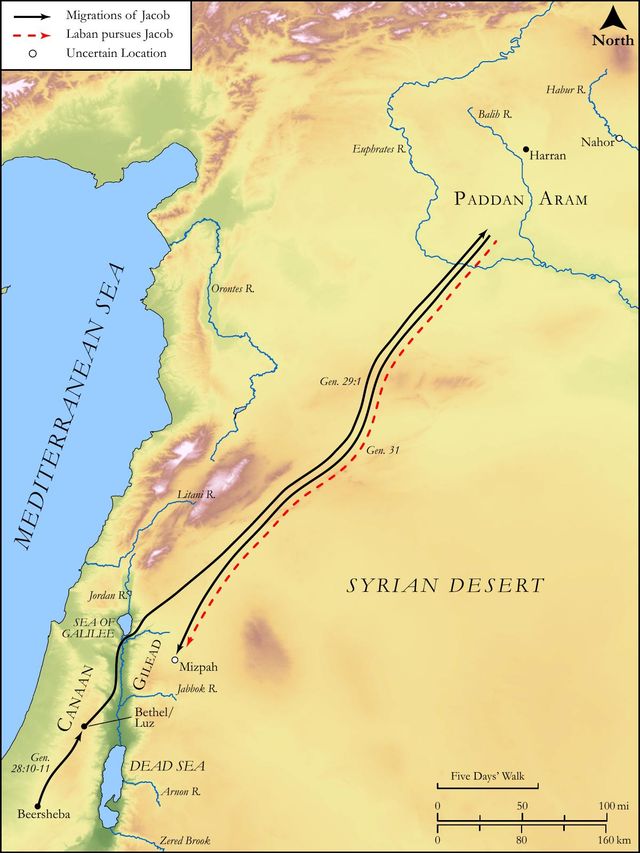
See on the biblical-era maps


Study this verse
Public-domain commentary
Matthew Henry
From his Commentary on the Whole Bible. Henry comments on passages, not single verses — this entry covers Genesis 30:14–24.
Here is, I. Leah fruitful again, after she had, for some time, left off bearing. Jacob, it should seem, associated more with Rachel than with Leah. The law of Moses supposes it a common case that, if a man had two wives, one would be beloved and the other hated, Deu 21:15. But at length Rachel's strong passions betrayed her into a bargain with Leah that Jacob should return to her apartment. Reuben, a little lad, five or six years old, playing in the field, found mandrakes, dudaim. It is uncertain what they were, the critics are not agreed about them; we are sure they were some rarities, either fruits or flowers that were very pleasant to the smell, Sol 7:13. Note, The God of nature has provided, not only for our necessities, but for our delights; there are products of the earth in the exposed fields, as well as in the planted protected gardens, that are very valuable and useful. How plentifully is nature's house furnished and her table spread! Her precious fruits offer themselves to be gathered by the hands of little children. It is a laudable custom of the devout Jews, when they find pleasure, suppose in eating an apple, to lift their hearts, and say, "Blessed be he that made this fruit pleasant!" Or, in smelling a flower, "Blessed be he that made this flower sweet." Some think these mandrakes were jessamine flowers. Whatever they were, Rachel could not see them in Leah's hands, where the child had placed them, but she must covet them. She cannot bear the want of these pretty flowers, but will purchase them at any rate. Note, There may be great sin and folly in the inordinate desire of a small thing. Leah takes this advantage (as Jacob had of Esau's coveting his red pottage) to obtain that which was justly due to her, but to which Rachel would not otherwise have consented. Note, Strong passions often thwart one another, and those cannot but be continually uneasy that are hurried on by them. Leah is overjoyed that she shall have her husband's company again, that her family might yet further be built up, which is the blessing she desires and devoutly prays for, as is intimated, Gen 30:17, where it is said, God hearkened unto Leah. The learned bishop Patrick very well suggests here that the true reason of this contest between Jacob's wives for his company, and their giving him their maids to be his wives, was the earnest desire they had to fulfil the promise made to Abraham (and now lately renewed to Jacob), that his seed should be as the stars of heaven for multitude, and that in one seed of his, the Messiah, all the nations of the earth should be blessed. And he thinks it would have been below the dignity of this sacred history to take such particular notice of these things if there had not been some such great consideration in them. Leah was now blessed with two sons; the first she called Issachar (a hire), reckoning herself well repaid for her mandrakes, nay (which is a strange construction of the providence) rewarded for giving her maid to her husband. Note, We abuse God's mercy when we reckon that his favours countenance and patronize our follies. The other she called Zebulun (dwelling), owning God's bounty to her: God has endowed me with a good dowry, Gen 30:20. Jacob had not endowed her when he married her, nor had he wherewithal in possession; but she reckons a family of children not a bill of charges, but a good dowry, Psa 113:9. She promises herself more of her husband's company now that she had borne him six sons, and that, in love to his children at least, he would often visit her lodgings. Mention is made (Gen 30:21) of the birth of a daughter, Dinah, because of the following story concerning her, ch. 34. Perhaps Jacob had other daughters, though their names are not registered.
II.Rachel fruitful at last (Gen 30:22):
God remembered Rachel, whom he seemed to have forgotten, and hearkened to her whose prayers had been long denied; and then she bore a son. Note, As God justly denies the mercy we have been inordinately desirous of, so sometimes he graciously grants, at length, that which we have long waited for. He corrects our folly, and yet considers our frame, and does not contend for ever. Rachel called her son Joseph, which in Hebrew is akin to two words of a contrary signification, Asaph (abstulit), He has taken away my reproach, as if the greatest mercy she had in this son was that she had saved her credit; and Jasaph (addidit), The Lord shall add to me another son, which may be looked upon either as the language of her inordinate desire (she scarcely knows how to be thankful for one unless she may be sure of another), or of her faith - she takes this mercy as an earnest of further mercy. "Has God given me his grace? I may call it Joseph, and say, He shall add more grace! Has he given me his joy? I may call it Joseph, and say, He will give me more joy. Has he begun, and shall he not make an end?"
Continue studying Genesis 30:24 across the web’s major study libraries — every link below opens this exact verse, chapter, or book on the destination site.
Read & Compare
 BibleGatewayThis verse in more than 200 translations and 70 languages.
 Bible.comThe YouVersion reader — hundreds of translations, reading plans, and highlights.
 ESV.orgCrossway's official English Standard Version reader.
 NET BibleThe NET translation with 60,000+ translators' notes on every rendering decision.
 STEP BibleTyndale House's free study tool — original text, vocabulary, and scholarly resources.
 BibliaLogos Bible Software's free web reader.
 USCCBThe New American Bible (Revised Edition) with the U.S. bishops' study notes.
Commentaries
 BibleHub CommentariesDozens of classic commentaries on this verse, gathered on one page.
 StudyLightMore than 100 commentary sets — the largest collection on the web.
 BibleRefPlain-English commentary on what this verse means, verse by verse.
 Enduring WordDavid Guzik's free commentary on this chapter, widely used by Bible teachers.
 Bible Study ToolsVerse commentary alongside Greek and Hebrew study aids.
Original Language & Research
- BibleHub InterlinearThe verse word by word — original language, transliteration, and English.
- BibleHub LexiconEvery word's original-language definition and Strong's entry.
 Blue Letter BibleDeep-study tools — Strong's numbers, concordance, and word studies.
 SefariaThe Hebrew text with Rashi and centuries of Jewish commentary.
Sermons, Hymns & Audio


TrulyRandomVerse is not affiliated with these sites and doesn’t control their content. They’re linked because they’re genuinely useful.
Summary
Genesis 30:24 marks a pivotal moment in the life of Rachel and the patriarchal narrative, recording the birth of Joseph, her long-awaited first son. This verse encapsulates Rachel's profound relief and forward-looking hope, as she names her son Joseph, declaring that the LORD has not only taken away her reproach but will also "add to me another son," signifying her expectation of continued divine blessing and fruitfulness.
Context
ShowHideLiterary Context
This verse is situated within the complex and often contentious family dynamics of Jacob, Leah, Rachel, and their respective handmaids, Bilhah and Zilpah, as detailed in Genesis 29, Genesis 30. Rachel's barrenness had been a source of deep personal anguish and societal shame, contrasted sharply with Leah's prolific childbearing. The immediate preceding verse, Genesis 30:23, reveals Rachel's initial reaction to Joseph's birth, acknowledging that "God has taken away my reproach." Genesis 30:24 builds upon this by explaining the name Joseph and expressing her future hope, setting the stage for Joseph's significant role in the unfolding narrative of the nascent nation of Israel, particularly his later deliverance of his family from famine, as recounted in Genesis 37-50.
Historical & Cultural Context
In the household of Jacob, a woman's status and honor were profoundly linked to her ability to bear children, especially sons, who would carry on the family name and inheritance. Barrenness was considered a great personal tragedy and often interpreted as a sign of divine disfavor, leading to significant social stigma. The practice of a barren wife giving her maidservant to her husband to bear children on her behalf (as seen with Bilhah and Zilpah) was a recognized custom (as when Sarai gave Hagar to Abraham), aimed at ensuring the continuation of the family line. Rachel's long struggle and ultimate breakthrough with Joseph's birth would have been seen as a powerful demonstration of divine intervention, challenging the cultural despair associated with barrenness and affirming God's active involvement in the lives of His covenant people.
Key Themes
ShowHideGenesis 30:24 contributes to several overarching themes within the book of Genesis and the broader biblical narrative. It highlights the theme of Divine Sovereignty and Providence, as God "remembers" Rachel and opens her womb, demonstrating His control over life and His faithfulness to His promises, even amidst human weakness and conflict, as seen throughout the patriarchal narratives. The verse also underscores the Significance of Names, as Joseph's name carries a dual meaning that encapsulates Rachel's past relief ("taken away") and future hope ("add"), a common biblical motif where names reflect circumstances, character, or destiny. Furthermore, it exemplifies the theme of Hope Amidst Adversity, as Rachel's persistent desire and prayer for a child, despite years of barrenness, are ultimately answered, providing a powerful testament to perseverance in faith, a theme often echoed in stories like that of Hannah in 1 Samuel 1.
Exposition and Analysis
ShowHideGenesis 30:24 records Rachel's naming of her firstborn son, Joseph, and her accompanying declaration of faith and hope, revealing both her immediate relief and her future aspiration.
Key Word Analysis
ShowHideThis name, H3130, is derived from the Hebrew root yasaf (H3254), meaning "to add" or "to increase." The name literally means "He will add" or "May he add." Rachel's choice of name directly reflects her statement in the verse, "The LORD shall add to me another son," expressing her profound hope for future offspring and a larger family. The name itself is a prayer and a statement of faith.
Represented by H3068, this is the personal, covenantal name of God, often translated as Yahweh or Jehovah. Rachel's explicit attribution of the blessing to "The LORD" underscores her recognition of divine agency in Joseph's birth. It signifies that this was not a natural occurrence or a result of human effort alone, but a direct, sovereign act of the self-existent and eternal God, who hears prayers and intervenes in the lives of His people.
This verb, H3254, is a primitive root meaning "to add or augment," often implying continuation or increase. Rachel's use of this verb, "The LORD shall add to me another son," reveals her forward-looking faith. It is not merely a wish but an expressed expectation that the God who has just performed a miracle by granting her Joseph will continue His work and bless her with more children. This highlights her belief in God's ongoing faithfulness and generosity.
Verse Breakdown
ShowHide"And she called his name Joseph;"
This clause signifies Rachel's authority and joy in naming her firstborn son. The act of naming was deeply significant in Scripture, often reflecting the circumstances of birth, the parents' hopes, or a prophetic declaration. By naming him Joseph, Rachel immediately connects his identity to her desire for more children, echoing the meaning of the name "He will add."
"and said,"
This simple conjunction introduces Rachel's accompanying explanation and prayer, which provides the theological and emotional context for the naming. Her words are not just a casual remark but a profound expression of her heart and her understanding of God's work in her life.
"The LORD shall add to me another son."
This is the core of Rachel's declaration. It explicitly attributes Joseph's birth and her future hope to "The LORD" (Yahweh), emphasizing divine agency. The phrase "shall add" (Hebrew yâçaph) directly links to the name Joseph (Yôwçêph), creating a powerful wordplay. Furthermore, this statement reveals Rachel's unquenched desire for more children, specifically "another son," demonstrating her faith that God's blessing is not exhausted by one miracle but is continuous and expansive. This also subtly connects to her earlier statement in Genesis 30:23, where she uses the phonetically similar word 'asaf ("taken away"), implying that Joseph's name simultaneously signifies the removal of her reproach and the promise of future increase.
Literary Devices
ShowHideThe verse employs significant Wordplay, a common literary device in Hebrew narrative, particularly in the naming of children. The name "Joseph" (Hebrew Yosef) is directly linked to the verb yasaf ("to add"), which Rachel uses to express her hope for "another son." However, it also subtly alludes to the phonetically similar verb 'asaf ("to take away"), which Rachel uses in the preceding verse (Genesis 30:23) to describe God taking away her reproach. This dual meaning embedded in the name Joseph encapsulates Rachel's journey from barrenness and shame to fruitfulness and future expectation. This verse also demonstrates Divine Attribution, as Rachel explicitly credits "The LORD" for her son's birth and her hope for future children, highlighting God's active and sovereign involvement in human affairs. Finally, there is an element of Foreshadowing, as Rachel's desire for "another son" is indeed fulfilled with the birth of Benjamin (Genesis 35:16-18), though tragically at the cost of her own life.
Theological and Thematic Connections
ShowHideJoseph's birth, as recorded in Genesis 30:24, stands as a powerful testament to God's sovereign faithfulness and His compassionate remembrance of His people. Despite years of Rachel's barrenness and the complex, often fraught, family dynamics within Jacob's household, God intervenes precisely when He chooses, demonstrating that His plans are not thwarted by human limitations or imperfections. Rachel's naming of Joseph, imbued with both a backward glance at her "reproach" being "taken away" and a forward-looking hope for God to "add" more children, underscores the biblical truth that God is the giver of life and the fulfiller of promises. Her faith-filled declaration reveals a heart that trusts in God's ongoing generosity and power to bless beyond initial provisions, setting a pattern for believers to maintain hope and expectation in God's continued work.
Reflection and Application
ShowHideRachel's journey from barrenness to breakthrough, culminating in the birth of Joseph, offers profound lessons for contemporary believers. Her experience reminds us that God hears our deepest cries and remembers us, even when our prayers seem to go unanswered for extended periods. Like Rachel, we are invited to cultivate a spirit of persistent hope and unwavering expectation, trusting that God's timing is perfect and His capacity to bless is boundless. We are called not only to celebrate the answers to prayer we receive but also to look forward with faith, believing that the God who has acted on our behalf in the past is faithful to continue His work in our lives, adding grace upon grace, and fulfilling His purposes even amidst our imperfect circumstances. This verse encourages us to articulate our desires to God with bold faith, knowing that He delights in giving good gifts to His children.
Questions for Reflection
ShowHideFAQ
ShowHideWhy is the Hebrew name Joseph connected to both "taking away" and "adding"?
ShowHideThe name Joseph (Hebrew: Yosef) is primarily derived from the Hebrew verb yasaf (יָסַף), meaning "to add" or "to increase," directly reflecting Rachel's desire for "another son" in Genesis 30:24. However, in the preceding verse, Genesis 30:23, Rachel also uses the Hebrew verb 'asaf (אָסַף), meaning "to take away," when she declares that God has "taken away my reproach." The phonetic similarity between yasaf and 'asaf creates a clever linguistic wordplay. This suggests that the name Joseph encapsulates both the removal of Rachel's past shame (God "took away" her barrenness) and her future hope for more children (God "will add" to her family), making the name rich with meaning.
What does Rachel's statement "The LORD shall add to me another son" reveal about her faith?
ShowHideRachel's statement reveals a profound and forward-looking faith. Despite having just received a miraculous answer to prayer with Joseph's birth after years of barrenness, she immediately expresses a desire for more children, attributing this future blessing to "The LORD." This demonstrates her belief in God's continued faithfulness, generosity, and power to provide. Her hope was not exhausted by one answered prayer but was sustained by an ongoing trust in God's willingness to bless. It shows a spirit of expectation that God, who has begun a good work, will continue and complete it, reflecting a deep confidence in His character and covenant promises.
Christ-Centered Fulfillment
ShowHideThe birth of Joseph, a son miraculously given after a period of barrenness and reproach, profoundly foreshadows the ultimate "addition" God would bring to humanity through Christ. Just as Joseph was a deliverer for his family, saving them from famine and establishing them in Egypt, Jesus Christ is the ultimate Deliverer who "adds" us to God's eternal family, taking away the reproach of sin and granting us new life. Through Christ, the spiritual barrenness of humanity, marked by sin and separation from God, is overcome. God continually "adds" new believers to His kingdom, fulfilling the promise of a vast spiritual offspring, far exceeding Rachel's hope for just "another son." Jesus Christ, the Lamb of God, is the one through whom God's family truly increases and is sustained, bringing forth spiritual fruit where there was once only desolation, making us fellow citizens with the saints and members of God's household (Ephesians 2:19). Indeed, through Him, we become heirs according to the promise (Galatians 3:29), a spiritual lineage that perpetually grows.