


Genesis 42:6
Bible text: King James Version (1769 Blayney text) · Public domain
Bible text: King James Version with Strong's numbers · Public domain
Bible text: Berean Standard Bible · Public domain
Bible text: American Standard Version (1901) · Public domain
Bible text: World English Bible, Messianic edition · Public domain
Bible text: Geneva Bible (1599) · Public domain
Bible text: Young's Literal Translation · Public domain
- וְיוֹסֵףve·yo·Sefand JosephH3130Conj-w ¦ N-proper-mNoun Proper MasculineוְandיוֹסֵףJoseph
- הוּאhu'heH1931Pro-3msPronoun Personal 3rd Singular Masculine
- הַשַּׁלִּיטha·sha·Lit[was] the rulerH7989Art ¦ Adj-msAdjective Singular Masculine Absoluteהַ[was] theשַּׁלִּיטruler
- עַל'aloverH5921PrepPreposition
- הָאָרֶץha·'A·retzthe landH776Art ¦ N-fsNoun Singular Feminine Absoluteהָtheאָרֶץland
- הוּאhu'heH1931Pro-3msPronoun Personal 3rd Singular Masculine
- הַמַּשְׁבִּירha·mash·Bir[was] the [one who] sold grainH7666Art ¦ V-Hiphil-Prtcpl-msVerb Hiphil Participle Singular Masculine Absoluteהַ[was] theמַּשְׁבִּיר[one who] sold grain
- לְכָלle·kholto allH3605Prep-l ¦ N-mscNoun Singular Masculine Constructלְtoכָלall
- עַם'am[the] people ofH5971N-mscNoun Singular Masculine Construct
- הָאָרֶץha·'A·retzthe landH776Art ¦ N-fsNoun Singular Feminine Absoluteהָtheאָרֶץland
- וַיָּבֹאוּvai·ya·Vo·'uand they cameH935Conj-w ¦ V-Qal-ConsecImperf-3mpVerb Qal Consecutive Imperfect 3rd Plural Masculineוַandיָּבֹאוּthey came
- אֲחֵי'a·Chei[the] brothers ofH251N-mpcNoun Plural Masculine Construct
- יוֹסֵףyo·SefJosephH3130N-proper-mNoun Proper Masculine
- וַיִּשְׁתַּחֲווּvai·yish·ta·cha·vuand they bowed downH7812Conj-w ¦ V-Hishtaphel-ConsecImperf-3mpVerb Hishtaphel Consecutive Imperfect 3rd Plural Masculineוַandיִּשְׁתַּחֲווּthey bowed down
- לוֹloto <the> himPrep-l ¦ 3msSuffix Personal 3rd Singular Masculineלto <the>וֹhim
- אַפַּיִם'a·Pa·yimfaceH639N-mdNoun Dual Masculine Absolute
- אָרְצָה'A·re·tzah[the] ground towardsH776N-fs ¦ SfxNoun Singular Feminine Absoluteאָרְצָ[the] groundהtowards
English is a literal word-by-word gloss of the Hebrew, not the KJV's wording. Why?
This is the original text the KJV's translators worked from — each Hebrew word with its own literal English meaning in this verse, prepared by scholars at Tyndale House, Cambridge. The KJV translates whole sentences, not word by word, so its wording differs: one Hebrew word can become several English words, and the KJV may choose “the LORD” where the gloss reads “Yahweh”. Both are faithful — they answer different questions. For the KJV's own rendering, switch to the KJV text.
Details
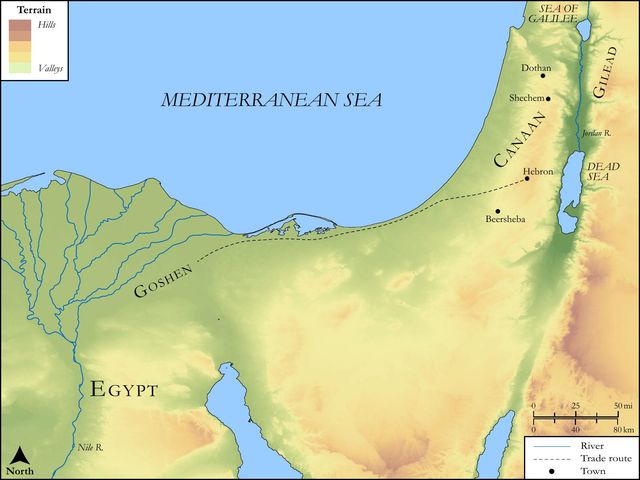
See on the biblical-era maps


Study this verse
Public-domain commentary
Matthew Henry
From his Commentary on the Whole Bible. Henry comments on passages, not single verses — this entry covers Genesis 42:1–6. His two-level outline is real structure in the source text, so it is rendered as structure.
Though Jacob's sons were all married, and had families of their own, yet, it should seem, they were still incorporated in one society, under the conduct and presidency of their father Jacob. We have here,
I.The orders he gave them to go and buy corn in Egypt, Gen 42:1, Gen 42:2. Observe,
1.The famine was grievous in the land of Canaan. It is observable that all the three patriarches, to whom Canaan was the land of promise, met with famine in that land, which was not only to try their faith, whether they could trust God though he should slay them, though he should starve them, but to teach them to seek the better country, that is, the heavenly, Heb 11:14-16. We have need of something to wean us from this world, and make us long for a better.
2.Still, when there was famine in Canaan, there was corn in Egypt. Thus Providence orders it, that one place should be a succour and supply to another; for we are all brethren. The Egyptians, the seed of accursed Ham, have plenty, when God's blessed Israel want: Thus God, in dispensing common favours, often crosses hands. Yet observe, The plenty Egypt now had was owing, under God, to Joseph's prudence and care: if his brethren had not sold him into Egypt, but respected him according to his merits, who knows but he might have done the same thing for Jacob's family which now he had done for Pharaoh, and the Egyptians might then have come to them to buy corn? but those who drive away from among them wise and good men know not what they do.
3.Jacob saw that there was corn in Egypt; he saw the corn that his neighbours had bought there and brought home. It is a spur to exertion to see where supplies are to be had, and to see others supplied. Shall others get food for their souls, and shall we starve while it is to be had?
4.He reproved his sons for delaying to provide corn for their families. Why do you look one upon another? Note, When we are in trouble and want, it is folly for us to stand looking upon one another, that is, to stand desponding and despairing, as if there were no hope, no help, - to stand disputing either which shall have the honour of going first or which shall have the safety of coming last, - to stand deliberating and debating what we shall do, and doing nothing, - to stand dreaming under a spirit of slumber, as if we had nothing to do, and to stand delaying, as if we had time at command. Let it never be said, "We left that to be done tomorrow which we could a well have done today." 5. He quickened them to go to Egypt: Get you down thither. Masters of families must not only pray for daily bread for their families, and food convenient, but must lay out themselves with care and industry to provide it.
II.Their obedience to these orders, Gen 42:3.
They went down to buy corn; they did not send their servants, but very prudently went themselves, to lay out their own money. Let none think themselves too great nor too good to take pains. Masters of families should see with their own eyes, and take heed of leaving too much to servants. Only Benjamin went not with them, for he was his father's darling. To Egypt they came, among others, and, having a considerable cargo of corn to buy, they were brought before Joseph himself, who probably expected they would come; and, according to the laws of courtesy, they bowed down themselves before him, Gen 42:6. Now their empty sheaves did obeisance to his full one. Compare this with Isa 60:14 and Rev 3:9.
Historical interpretation
Historical reception
1 surviving comment on this verse from the historical church.
They did all this out of ignorance for the time being. You see, it was a long time since they had last seen Joseph, and so they no longer recognized their brother’s appearance. After all, it was likely that some change had occurred in him now that he had reached maturity. Still, I’m inclined to think that it all happened as a result of the dispensation of the God of all so that they would fail to recognize their brother either from conversing with him or by sight. After all, how on earth would they have formed such an idea? I mean, they were under the impression that he had become a slave of the Ishmaelites and by now was enduring slavery under the barbarians. Whereas they were in no position to conceive any other idea and so recognize Joseph, he recognized them as soon as he saw them and took every care to conceal his identity, wishing to deal with them as with foreigners.
Continue studying Genesis 42:6 across the web’s major study libraries — every link below opens this exact verse, chapter, or book on the destination site.
Read & Compare
 BibleGatewayThis verse in more than 200 translations and 70 languages.
 Bible.comThe YouVersion reader — hundreds of translations, reading plans, and highlights.
 ESV.orgCrossway's official English Standard Version reader.
 NET BibleThe NET translation with 60,000+ translators' notes on every rendering decision.
 STEP BibleTyndale House's free study tool — original text, vocabulary, and scholarly resources.
 BibliaLogos Bible Software's free web reader.
 USCCBThe New American Bible (Revised Edition) with the U.S. bishops' study notes.
Commentaries
 BibleHub CommentariesDozens of classic commentaries on this verse, gathered on one page.
 StudyLightMore than 100 commentary sets — the largest collection on the web.
 BibleRefPlain-English commentary on what this verse means, verse by verse.
 Enduring WordDavid Guzik's free commentary on this chapter, widely used by Bible teachers.
 Bible Study ToolsVerse commentary alongside Greek and Hebrew study aids.
Original Language & Research
- BibleHub InterlinearThe verse word by word — original language, transliteration, and English.
- BibleHub LexiconEvery word's original-language definition and Strong's entry.
 Blue Letter BibleDeep-study tools — Strong's numbers, concordance, and word studies.
 SefariaThe Hebrew text with Rashi and centuries of Jewish commentary.
Sermons, Hymns & Audio


TrulyRandomVerse is not affiliated with these sites and doesn’t control their content. They’re linked because they’re genuinely useful.
Summary
Genesis 42:6 marks a profound and pivotal moment in the Joseph narrative, depicting his brothers' arrival in famine-stricken Egypt and their unwitting prostration before him, now the land's powerful governor. This scene dramatically illustrates Joseph's remarkable ascent from enslaved prisoner to a position of immense authority, simultaneously revealing the intricate unfolding of God's sovereign plan to fulfill Joseph's prophetic dreams and orchestrate the eventual reconciliation and preservation of Jacob's family.
Context
ShowHideLiterary Context
This verse is deeply embedded within the larger narrative arc of Joseph's life, specifically following his interpretation of Pharaoh's dreams and his subsequent appointment as vizier over Egypt in Genesis 41. The preceding chapters detail Joseph's betrayal by his brothers, his enslavement, and his imprisonment, setting the stage for this dramatic reversal of fortune. The immediate context of Genesis 42 describes the severe famine that has spread beyond Egypt into Canaan, compelling Jacob to send his sons to Egypt to purchase grain. Thus, Genesis 42:6 serves as the climactic point of their initial encounter, where the long-awaited fulfillment of Joseph's youthful dreams begins to materialize, though unrecognized by his brothers.
Historical & Cultural Context
The setting is ancient Egypt during a period of widespread famine, a common natural disaster in the days of the patriarchs, often caused by drought affecting the Nile's annual inundation. Pharaoh's dream of seven years of plenty followed by seven years of famine (as seen in Genesis 41:29-30) reflects a realistic understanding of agricultural cycles in the region. Joseph's role as "governor" (Hebrew: shallîyṭ) signifies a position of immense power, second only to Pharaoh, responsible for the national granaries and the distribution of food. The act of prostration, "bowed down themselves before him with their faces to the earth," was a customary and expected gesture of profound respect, homage, and submission to a superior authority or royalty, as when Jacob bowed himself to the ground seven times before Esau, signifying complete deference and dependence.
Key Themes
ShowHideGenesis 42:6 powerfully contributes to several overarching themes within the book of Genesis and the broader biblical narrative. Foremost is the theme of God's Sovereignty and Providence, demonstrating how God orchestrates human events, even those born of malice (like the brothers' betrayal in Genesis 37:28), to accomplish His divine purposes. It highlights the Fulfillment of Prophecy, specifically Joseph's dreams from Genesis 37:7-9, underscoring God's faithfulness to His word. The verse also introduces the theme of Reconciliation and Forgiveness, as this initial encounter sets in motion the process that will eventually lead to the restoration of Jacob's family. Finally, it foreshadows the Exaltation of the Humble, a recurring biblical motif where God raises up those who have suffered unjustly.
Exposition and Analysis
ShowHideKey Word Analysis
ShowHideThis term denotes someone with potent authority, a ruler, or a prince. Its use here emphasizes Joseph's elevated status and the immense power he wielded over the land of Egypt, directly contrasting with his previous state as a slave and prisoner. He is not merely an administrator but a formidable figure of governance.
Derived from a root meaning "to deal in grain," this word specifically refers to Joseph's role in distributing and selling grain to the people during the famine. The irony is profound: Joseph, who was himself "sold" by his brothers (a different Hebrew word, makar, but sharing the concept of transaction), is now the one selling life-sustaining food, a position of ultimate control and provision.
This verb describes a deep act of prostration, signifying profound homage, reverence, or submission. It literally means "to depress" or "to prostrate oneself." In this context, it perfectly captures the physical act of bowing predicted in Joseph's dreams and emphasizes the complete, albeit unwitting, submission of his brothers to his authority.
Verse Breakdown
ShowHide"And Joseph [was] the governor over the land"
This clause establishes Joseph's powerful and authoritative position in Egypt. He is not merely an official but the supreme authority responsible for the entire land's welfare, second only to Pharaoh. This sets the stage for the dramatic encounter that follows.
"[and] he [it was] that sold to all the people of the land"
This phrase details Joseph's primary function during the famine: the distribution and sale of grain. It underscores his pivotal role as the source of sustenance for Egypt and the surrounding regions, making him the central figure to whom all must appeal for survival.
"and Joseph's brethren came"
This simple statement marks the arrival of the very individuals who had betrayed and sold Joseph into slavery. Their journey from Canaan, driven by the famine, brings them directly into the orbit of the brother they believed was long dead, setting up the dramatic confrontation.
"and bowed down themselves before him [with] their faces to the earth"
This is the climactic action of the verse. The brothers' complete prostration, a gesture of ultimate submission and respect, directly fulfills Joseph's prophetic dreams. The irony is palpable: they bow to the one they despised, unaware of his true identity, thus unknowingly acknowledging his divinely appointed authority.
Literary Devices
ShowHideThe verse is rich with Irony, serving as the primary literary device. The very brothers who once scorned Joseph's dreams of their bowing to him (as detailed in Genesis 37:7-9) are now unknowingly fulfilling those prophecies through their desperate act of prostration. This creates a powerful Dramatic Contrast between Joseph's past suffering and his present exaltation, and between the brothers' past arrogance and their current humility and dependence. The act of bowing itself functions as Symbolism, representing not only their physical submission but also the inevitable triumph of God's plan over human malice. The entire scene operates as a profound Fulfillment of Prophecy, validating the divine origin of Joseph's dreams and underscoring God's meticulous orchestration of history.
Theological and Thematic Connections
ShowHideGenesis 42:6 is a powerful testament to God's absolute sovereignty, demonstrating His ability to weave together human actions, both righteous and sinful, into the tapestry of His overarching redemptive plan. It highlights that even through profound injustice and suffering, God remains faithful to His word, meticulously bringing His prophecies to fruition. This verse underscores the theme of divine reversal, where God exalts the humble and brings low the proud, often using unexpected means to accomplish His will. The brothers' unwitting submission also sets the stage for a journey of repentance and reconciliation, foreshadowing the restoration of a fractured family and the preservation of the nascent nation of Israel.
Reflection and Application
ShowHideGenesis 42:6 offers profound encouragement for believers navigating life's complexities, particularly when facing injustice, betrayal, or prolonged suffering. Joseph's story reminds us that God's sovereign hand is always at work, meticulously orchestrating events, even those seemingly chaotic or malevolent, for His ultimate glory and the good of His people. It challenges us to cultivate unwavering trust in God's perfect timing and His ability to transform our deepest wounds into platforms for His purposes. We are called to embrace humility, recognizing that God often uses the very circumstances we dread to bring about His intended outcomes, often reversing human expectations and demonstrating His power through our weakness. This narrative encourages patient endurance, knowing that God's plan will ultimately prevail, leading to His intended outcome and the fulfillment of His promises.
Questions for Reflection
ShowHideFAQ
ShowHideWhy did Joseph's brothers not recognize him?
ShowHideJoseph's brothers failed to recognize him for several compelling reasons. Firstly, a significant passage of time, over two decades, had elapsed since they last saw him as a seventeen-year-old shepherd boy. Secondly, Joseph's appearance had drastically changed due to his Egyptian attire, shaved head, and likely a more mature physique. Thirdly, his elevated status as the governor of Egypt, a position of immense power and authority, would have been unimaginable to them; they expected him to be dead or a slave, not a ruler. Furthermore, Joseph likely communicated through an interpreter (as implied in Genesis 42:23), further masking his true identity and language. Finally, their own guilt and fear would have clouded their perception, making them less likely to consider the possibility that the powerful Egyptian official before them was their long-lost brother.
Does this event suggest that God causes evil to achieve good?
ShowHideNo, this event does not suggest that God causes evil. Instead, it powerfully demonstrates God's infinite wisdom and omnipotence in His ability to overrule or redeem the sinful actions of humanity for His righteous and redemptive purposes. The brothers' act of selling Joseph into slavery was undeniably evil and motivated by malice and envy. However, God, in His perfect sovereignty, did not instigate their sin but masterfully integrated it into His overarching plan to preserve Jacob's family and the nascent nation of Israel from famine. Joseph himself articulates this profound theological truth in Genesis 50:20, stating, "But as for you, ye thought evil against me; but God meant it unto good, to bring to pass, as it is this day, to save much people alive." God remains holy and just, never the author of evil, yet His sovereign control extends even over the consequences of human sin, enabling Him to bring about ultimate good.
Christ-Centered Fulfillment
ShowHideThe dramatic scene in Genesis 42:6, where Joseph's brothers unknowingly bow before him, serves as a profound type of Christ and a powerful foreshadowing of His ultimate exaltation. Like Joseph, Christ was rejected and betrayed by His own people, sold for a price (thirty pieces of silver, echoing Joseph's twenty pieces of silver in Matthew 26:15), and suffered unjustly, even unto death. Yet, through His suffering and subsequent resurrection and ascension, God used the evil intentions of men to bring about the greatest good—salvation and eternal life for all who believe. Just as Joseph, the provider of bread, became the unrecognized savior of his family and many nations, so too does Christ, the "Bread of Life" (John 6:35), provide spiritual sustenance and salvation, ultimately receiving the submission and worship of all creation. This moment in Genesis powerfully anticipates the future universal recognition and homage paid to the exalted Christ, fulfilling the prophecy that "at the name of Jesus every knee should bow, of things in heaven, and things in earth, and things under the earth" (Philippians 2:10). Joseph's story is a testament to God's redemptive plan, culminating in the supreme work of Christ, who was humbled for a time and then exalted to the highest place, becoming the ultimate deliverer and sovereign Lord.