


Genesis 42:7
Bible text: King James Version (1769 Blayney text) · Public domain
Bible text: King James Version with Strong's numbers · Public domain
Bible text: Berean Standard Bible · Public domain
Bible text: American Standard Version (1901) · Public domain
Bible text: World English Bible, Messianic edition · Public domain
Bible text: Geneva Bible (1599) · Public domain
Bible text: Young's Literal Translation · Public domain
- וַיַּרְאvai·Yar'and he sawH7200Conj-w ¦ V-Qal-ConsecImperf-3msVerb Qal Consecutive Imperfect 3rd Singular Masculineוַandיַּרְאhe saw
- יוֹסֵףyo·SefJosephH3130N-proper-mNoun Proper Masculine
- אֶת'et<obj.>H853DirObjMParticle Object Indicator
- אֶחָיו'e·Chavhis brothersH251N-mpc ¦ 3msNoun Plural Masculine Constructאֶחָיbrothersוhis
- וַיַּכִּרֵםvai·ya·ki·Remand he recognized themH5234Conj-w ¦ V-Hiphil-ConsecImperf-3ms ¦ 3mpVerb Hiphil Consecutive Imperfect 3rd Singular Masculineוַandיַּכִּרֵhe recognizedםthem
- וַיִּתְנַכֵּרvai·yit·na·Kerand he acted as a strangerH5234Conj-w ¦ V-Hithpael-ConsecImperf-3msVerb Hithpael Consecutive Imperfect 3rd Singular Masculineוַandיִּתְנַכֵּרhe acted as a stranger
- אֲלֵיהֶם'a·lei·Hemto themH413Prep ¦ 3mpPreposition Definiteאֲלֵיtoהֶםthem
- וַיְדַבֵּרvay·da·Berand he spokeH1696Conj-w ¦ V-Piel-ConsecImperf-3msVerb Piel Consecutive Imperfect 3rd Singular Masculineוַandיְדַבֵּרhe spoke
- אִתָּם'i·Tamwith themH854Prep ¦ 3mpPreposition Definiteאִתָּwithםthem
- קָשׁוֹתka·ShotharshH7186Adj-fpAdjective Plural Feminine Absolute
- וַיֹּאמֶרvai·Yo·merand he saidH559Conj-w ¦ V-Qal-ConsecImperf-3msVerb Qal Consecutive Imperfect 3rd Singular Masculineוַandיֹּאמֶרhe said
- אֲלֵהֶם'a·le·Hemto themH413Prep ¦ 3mpPreposition Definiteאֲלֵtoהֶםthem
- מֵאַיִןme·'A·yinfrom where?H370Prep-m ¦ InterrogParticle Interrogativeמֵfromאַיִןwhere?
- בָּאתֶםba·Temhave you comeH935V-Qal-Perf-2mpVerb Qal Perfect 2nd Plural Masculine
- וַיֹּאמְרוּvai·Yo·me·Ruand they saidH559Conj-w ¦ V-Qal-ConsecImperf-3mpVerb Qal Consecutive Imperfect 3rd Plural Masculineוַandיֹּאמְרוּthey said
- מֵאֶרֶץme·'E·retzfrom [the] land ofH776Prep-m ¦ N-fscNoun Singular Feminine Constructמֵfromאֶרֶץ[the] land of
- כְּנַעַןke·Na·'anCanaanH3667N-properNoun Proper Location
- לִשְׁבָּרlish·borto buyH7666Prep-l ¦ V-Qal-InfVerb Qal Infinitive Constructלִtoשְׁבָּרbuy
- אֹכֶל'O·khelfoodH400N-msNoun Singular Masculine Absolute
English is a literal word-by-word gloss of the Hebrew, not the KJV's wording. Why?
This is the original text the KJV's translators worked from — each Hebrew word with its own literal English meaning in this verse, prepared by scholars at Tyndale House, Cambridge. The KJV translates whole sentences, not word by word, so its wording differs: one Hebrew word can become several English words, and the KJV may choose “the LORD” where the gloss reads “Yahweh”. Both are faithful — they answer different questions. For the KJV's own rendering, switch to the KJV text.
Details
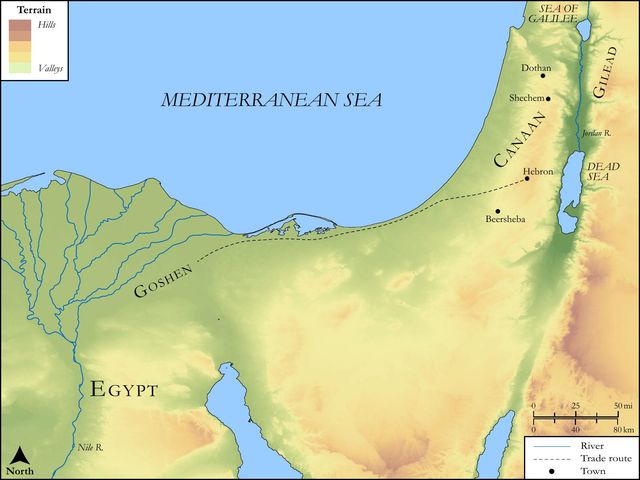
See on the biblical-era maps


Study this verse
Public-domain commentary
Matthew Henry
From his Commentary on the Whole Bible. Henry comments on passages, not single verses — this entry covers Genesis 42:7–20. His two-level outline is real structure in the source text, so it is rendered as structure.
We may well wonder that Joseph, during the twenty years that he had now been in Egypt, especially during the last seven years that he had been in power there, never sent to his father to acquaint him with his circumstances; nay, it is strange that he who so often went throughout all the land of Egypt (Gen 41:45, Gen 41:46) never made an excursion to Canaan, to visit his aged father, when he was in the borders of Egypt, that lay next to Canaan. Perhaps it would not have been above three or four days' journey for him in his chariot. It is a probable conjecture that his whole management of himself in this affair was by special direction from Heaven, that the purpose of God concerning Jacob and his family might be accomplished. When Joseph's brethren came, he knew them by many a satisfactory token, but they knew not him, little thinking to find him there, Gen 42:8. He remembered the dreams (Gen 42:9), but they had forgotten them. The laying up of God's oracles in our hearts will be of excellent use to us in all our conduct. Joseph had an eye to his dreams, which he knew to be divine, in his carriage towards his brethren, and aimed at the accomplishment of them and the bringing of his brethren to repentance for their former sins; and both these points were gained.
I.He showed himself very rigorous and harsh with them.
The very manner of his speaking, considering the post he was in, was enough to frighten them; for he spoke roughly to them, Gen 42:7. He charged them with bad designs against the government (Gen 42:9), treated them as dangerous persons, saying, You are spies, and protesting by the life of Pharaoh that they were so, Gen 42:16. Some make this an oath, others make it no more than a vehement asseveration, like that, as thy soul liveth; however it was more than yea, yea, and nay, nay, and therefore came of evil. Note, Bad words are soon learned by converse with those that use them, but not so soon unlearned. Joseph, by being much at court, got the courtier's oath, By the life of Pharaoh, perhaps designing hereby to confirm his brethren in their belief that he was an Egyptian, and not an Israelite. They knew this was not the language of a son of Abraham. When Peter would prove himself no disciple of Christ, he cursed and swore. Now why was Joseph thus hard upon his brethren? We may be sure it was not from a spirit of revenge, that he might now trample upon those who had formerly trampled upon him; he was not a man of that temper. But,
1.It was to enrich his own dreams, and complete the accomplishment of them.
2.It was to bring them to repentance.
3.It was to get out of them an account of the state of their family, which he longed to know: they would have discovered him if he had asked as a friend, therefore he asks as a judge. Not seeing his brother Benjamin with them, perhaps he began to suspect that they had made away with him too, and therefore gives them occasion to speak of their father and brother. Note, God in his providence sometimes seems harsh with those he loves, and speaks roughly to those for whom yet he has great mercy in store.
II.They, hereupon, were very submissive.
They spoke to him with all the respect imaginable: Nay, my lord (Gen 42:10) - a great change since they said, Behold, this dreamer comes. They very modestly deny the charge: We are no spies. They tell him their business, that they came to buy food, a justifiable errand, and the same that many strangers came to Egypt upon at this time. They undertake to give a particular account of themselves and their family (Gen 42:13), and this was what they wanted.
III.He clapped them all up in prison for three days, Gen 42:17.
Thus God deals with the souls he designs for special comfort and honour; he first humbles them, and terrifies them, and brings them under a spirit of bondage, and then binds up their wounds by the Spirit of adoption.
IV.He concluded with them, at last, that one of them should be left as a hostage, and the rest should go home and fetch Benjamin.
It was a very encouraging word he said to them (Gen 42:18): I fear God; as if he had said, "You may assure yourselves I will do you no wrong; I dare not, for I know that, high as I am, there is one higher than I." Note, With those that fear God we have reason to expect fair dealing. The fear of God will be a check upon those that are in power, to restrain them from abusing their power to oppression and tyranny. Those that have no one else to stand in awe of ought to stand in awe of their own consciences. See Neh 5:15, So did not I, because of the fear of God.
Continue studying Genesis 42:7 across the web’s major study libraries — every link below opens this exact verse, chapter, or book on the destination site.
Read & Compare
 BibleGatewayThis verse in more than 200 translations and 70 languages.
 Bible.comThe YouVersion reader — hundreds of translations, reading plans, and highlights.
 ESV.orgCrossway's official English Standard Version reader.
 NET BibleThe NET translation with 60,000+ translators' notes on every rendering decision.
 STEP BibleTyndale House's free study tool — original text, vocabulary, and scholarly resources.
 BibliaLogos Bible Software's free web reader.
 USCCBThe New American Bible (Revised Edition) with the U.S. bishops' study notes.
Commentaries
 BibleHub CommentariesDozens of classic commentaries on this verse, gathered on one page.
 StudyLightMore than 100 commentary sets — the largest collection on the web.
 BibleRefPlain-English commentary on what this verse means, verse by verse.
 Enduring WordDavid Guzik's free commentary on this chapter, widely used by Bible teachers.
 Bible Study ToolsVerse commentary alongside Greek and Hebrew study aids.
Original Language & Research
- BibleHub InterlinearThe verse word by word — original language, transliteration, and English.
- BibleHub LexiconEvery word's original-language definition and Strong's entry.
 Blue Letter BibleDeep-study tools — Strong's numbers, concordance, and word studies.
 SefariaThe Hebrew text with Rashi and centuries of Jewish commentary.
Sermons, Hymns & Audio


TrulyRandomVerse is not affiliated with these sites and doesn’t control their content. They’re linked because they’re genuinely useful.
Summary
Genesis 42:7 marks a pivotal and dramatic turning point in the Joseph narrative, initiating a series of strategic encounters between Joseph, now the powerful vizier of Egypt, and his unsuspecting brothers. Despite years of separation and his transformed appearance, Joseph immediately recognizes his siblings who have traveled from famine-stricken Canaan to purchase grain. However, he deliberately conceals his true identity and adopts a harsh demeanor, setting in motion a carefully orchestrated series of tests designed to assess their character, repentance, and the state of their familial bonds, particularly concerning their youngest brother, Benjamin, all leading towards an eventual, profound reconciliation.
Context
ShowHideLiterary Context
This verse is situated within the broader narrative of Joseph's life, specifically following his miraculous rise to power in Egypt as detailed in Genesis 41. The preceding chapters detail Joseph's dreams of his family bowing to him (Genesis 37:5-11), his brothers' jealousy and betrayal (Genesis 37:18-36), and his subsequent trials and triumphs in Egypt. The severe famine, prophesied by Joseph and now gripping the entire region, serves as the divine catalyst that brings his brothers, completely unaware of his identity, directly into his presence, thus setting the stage for the fulfillment of his youthful dreams and the unfolding of God's redemptive plan for Jacob's family.
Historical & Cultural Context
The narrative is set in ancient Egypt during a period of widespread famine, a common occurrence in Canaan and Egypt due to unpredictable rainfall patterns or Nile floods. Egypt, with its advanced agricultural systems and the foresight of Joseph's grain storage plan, became the sole source of sustenance for surrounding nations, including Canaan. The practice of foreigners seeking food from a powerful empire like Egypt was customary. Joseph's position as vizier, second only to Pharaoh, granted him immense authority, including control over the grain distribution. The cultural expectation of bowing before a high official, as the brothers do, underscores the vast power disparity and their unwitting submission to their long-lost brother, fulfilling the prophetic imagery of Joseph's dreams.
Key Themes
ShowHideGenesis 42:7 powerfully contributes to several overarching themes within the book of Genesis and the broader biblical narrative. It highlights Divine Sovereignty and Providence, demonstrating how God orchestrates seemingly disparate events—Joseph's enslavement, his rise to power, and the famine—to fulfill His purposes, ultimately preserving the nascent nation of Israel. The verse also introduces the theme of Testing and Transformation, as Joseph's actions initiate a crucible for his brothers, forcing them to confront their past sins and leading to a profound change of heart, which is essential for the subsequent Reconciliation and Forgiveness that defines the climax of the Joseph story. Furthermore, it exemplifies the biblical motif of Hidden Identity and Revelation, where God's chosen instruments or His own plans are often concealed for a time before being revealed in His perfect timing.
Exposition and Analysis
ShowHideGenesis 42:7 captures the dramatic moment of recognition and the deliberate choice Joseph makes to conceal his identity, initiating a complex and pivotal phase in the family's story.
Key Word Analysis
ShowHideThis word, translated as "brethren," refers to a brother in the widest sense, encompassing both literal blood relationship and metaphorical affinity. In this context, it emphasizes the profound familial bond that Joseph instantly recognizes despite the passage of time and his transformed appearance. It underscores the deep-seated identity and history shared between Joseph and those who had betrayed him, laying the groundwork for the emotional complexities of the ensuing narrative.
Translated as "made himself strange" and also underlying "knew them" (in the sense of recognizing), this primitive root means "to scrutinize, to look intently at," leading to "acknowledgment" or, conversely, "to disregard, ignore, be strange toward, dissimulate." Joseph's action, "made himself strange unto them" (וַיִּתְנַכֵּר, vayitnakker), is a deliberate, active performance of feigning ignorance or acting like a foreigner. It signifies his intentional decision to disown or estrange himself from them temporarily, not out of malice, but as a calculated part of his strategy.
This term, meaning "severe" or "hard," is used to describe how Joseph "spake roughly" (קָשׁוֹת, qashot) to his brothers. It conveys a demeanor that is harsh, stern, or difficult. This was not merely a tone of voice but a deliberate posture of authority and severity, designed to intimidate and test his brothers, forcing them into a position of vulnerability and self-examination, rather than an immediate, emotional reunion.
Verse Breakdown
ShowHide"And Joseph saw his brethren, and he knew them,"
This opening clause establishes Joseph's immediate and unequivocal recognition of his brothers. Despite his high Egyptian office, the passage of over two decades, and his changed appearance (Egyptian attire, language, and customs), the familial bond and memory were strong enough for instant discernment. This recognition is unilateral; the brothers do not recognize him, setting up the dramatic irony that permeates the subsequent chapters.
"but made himself strange unto them, and spake roughly unto them;"
This is the pivotal action of the verse. Joseph's decision to "make himself strange" (Hebrew: vayitnakker) signifies a deliberate act of dissimulation, feigning ignorance or acting as a foreigner. Coupled with speaking "roughly" (Hebrew: qashot), meaning harshly or severely, it reveals Joseph's intentional strategy to create distance and tension. This was not an act of revenge but a calculated test to probe their character, assess their remorse for past actions, and determine if they had changed, especially concerning their treatment of Benjamin.
"and he said unto them, Whence come ye?"
Joseph's direct question, delivered in his feigned harsh tone, immediately establishes his authority and puts his brothers on the defensive. It forces them to account for their presence and origin, initiating the formal interrogation that would become part of his testing process. This question also serves to confirm their identity and their connection to Canaan.
"And they said, From the land of Canaan to buy food."
The brothers' response is straightforward and factual, revealing their desperate situation and the reason for their journey. Their answer confirms their origin and their purpose, inadvertently setting the stage for Joseph's next steps in his elaborate plan to test them and eventually reveal himself.
Literary Devices
ShowHideThe verse is rich in literary devices, most notably Dramatic Irony. The audience is privy to Joseph's identity and his recognition of his brothers, while the brothers themselves remain oblivious. This creates profound tension and anticipation, as every interaction is viewed through the lens of this hidden knowledge. The contrast between Joseph's inner recognition and his outward Dissimulation (making himself strange) and Antithesis (knowing them but acting as if he doesn't) highlights his strategic brilliance and emotional control. Furthermore, the scene Foreshadows the eventual fulfillment of Joseph's dreams from Genesis 37, as his brothers, unknowingly, bow before him. The Dialogue is terse and authoritative on Joseph's part, reflecting his assumed role and the power dynamic he establishes.
Theological and Thematic Connections
ShowHideGenesis 42:7 is a critical juncture that underscores God's meticulous and often mysterious work in human history. It reveals that even the most painful betrayals and separations can be woven into a larger tapestry of divine purpose, leading to redemption and restoration. Joseph's actions, though seemingly harsh, serve as a divinely ordained crucible, designed to bring about repentance and transformation in his brothers, ultimately preserving the lineage through which God's covenant promises would be fulfilled. This moment highlights the principle that God's providence often operates through human agency and difficult circumstances to achieve His redemptive ends.
Reflection and Application
ShowHideThe profound drama of Genesis 42:7 invites us to reflect on the intricate ways God works in our own lives and relationships. Joseph's ability to see beyond the immediate circumstances and act with a long-term, redemptive strategy, even when it involved personal pain and calculated harshness, challenges us to consider God's perspective. Are we willing to trust God's sovereignty even when His methods seem unclear or difficult? This passage encourages us to believe that God can redeem even the most fractured relationships and painful betrayals. It also suggests that true reconciliation often requires a process of confronting past wrongs, genuine repentance, and a willingness to extend and receive forgiveness. Just as Joseph's testing refined his brothers, our own trials can be instruments of God's grace, shaping our character and preparing us for His purposes.
Questions for Reflection
ShowHideFAQ
ShowHideWhy did Joseph conceal his identity from his brothers?
ShowHideJoseph's concealment was a deliberate and strategic act, not driven by malice or revenge, but by a deeper, redemptive purpose. He sought to test his brothers' character, assess their repentance for their past betrayal (selling him into slavery), and determine if their hearts had changed, particularly regarding their treatment of Benjamin, Jacob's youngest son and Rachel's only other child. This period of testing was crucial for their spiritual growth, to humble them, bring them to confession, and ultimately prepare them for a genuine, lasting reconciliation that would preserve the family and fulfill God's covenant promises.
Was Joseph's "rough" treatment of his brothers justified?
ShowHideFrom a purely human perspective, Joseph's actions might appear harsh, but within the divine narrative, they served a necessary and redemptive purpose. His "rough" speech and demands were a means to an end: to bring his brothers to a place of self-examination, confession, and repentance. It was a divinely orchestrated crucible designed to expose their past sins, reveal their current character, and prepare them for a profound transformation. This process was essential for the true reconciliation of the family and for God's larger plan for the nascent nation of Israel to unfold. It highlights that God sometimes uses difficult circumstances to bring about spiritual maturity and healing.
Christ-Centered Fulfillment
ShowHideThe narrative of Joseph, particularly his suffering, rejection by his own brothers, and subsequent exaltation to a position of power that ultimately saves his family from famine, serves as a profound type of Christ. Like Joseph, Jesus was rejected by His own people (John 1:11), suffered unjustly at their hands, and was ultimately exalted to the right hand of God (Philippians 2:9-11). From this position of ultimate authority, Christ provides salvation, not merely from physical famine, but from spiritual death, offering reconciliation and eternal life to those who once rejected Him (Matthew 1:21). Joseph's testing of his brothers, leading them to repentance and genuine reconciliation, powerfully mirrors Christ's work in drawing sinners to Himself, revealing His true identity as Savior, and bringing them into a restored relationship with God the Father through His atoning sacrifice (2 Corinthians 5:18-19).