


Genesis 42:8
Bible text: King James Version (1769 Blayney text) · Public domain
Bible text: Berean Standard Bible · Public domain
Bible text: American Standard Version (1901) · Public domain
Bible text: World English Bible, Messianic edition · Public domain
Bible text: Geneva Bible (1599) · Public domain
Bible text: Young's Literal Translation · Public domain
- וַיַּכֵּרvai·ya·Kerand he recognizedH5234Conj-w ¦ V-Hiphil-ConsecImperf-3msVerb Hiphil Consecutive Imperfect 3rd Singular Masculineוַandיַּכֵּרhe recognized
- יוֹסֵףyo·SefJosephH3130N-proper-mNoun Proper Masculine
- אֶת'et<obj.>H853DirObjMParticle Object Indicator
- אֶחָיו'e·Chavhis brothersH251N-mpc ¦ 3msNoun Plural Masculine Constructאֶחָיbrothersוhis
- וְהֵםve·Hemand theyH1992Conj-w ¦ Pro-3mpPronoun Personal 3rd Plural Masculineוְandהֵםthey
- לֹאlo'notH3808NegParticle Negative
- הִכִּרֻהוּhi·ki·Ru·huthey recognized himH5234V-Hiphil-Perf-3cp ¦ 3msVerb Hiphil Perfect 3rd Plural common genderהִכִּרֻthey recognizedהוּhim
English is a literal word-by-word gloss of the Hebrew, not the KJV's wording. Why?
This is the original text the KJV's translators worked from — each Hebrew word with its own literal English meaning in this verse, prepared by scholars at Tyndale House, Cambridge. The KJV translates whole sentences, not word by word, so its wording differs: one Hebrew word can become several English words, and the KJV may choose “the LORD” where the gloss reads “Yahweh”. Both are faithful — they answer different questions. For the KJV's own rendering, switch to the KJV text.
Details
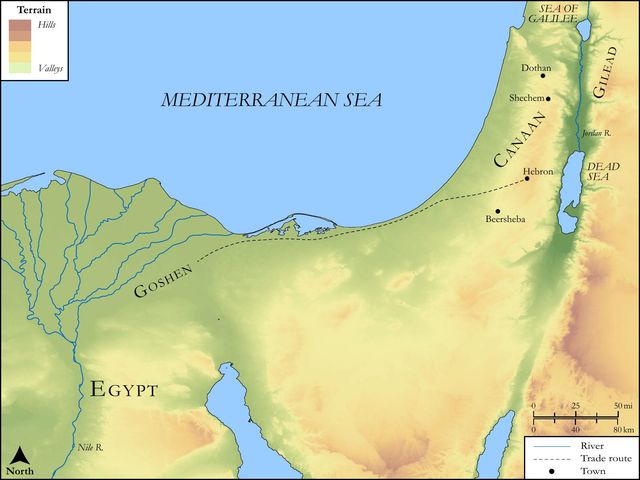
See on the biblical-era maps


Study this verse
Public-domain commentary
Matthew Henry
From his Commentary on the Whole Bible. Henry comments on passages, not single verses — this entry covers Genesis 42:7–20. His two-level outline is real structure in the source text, so it is rendered as structure.
We may well wonder that Joseph, during the twenty years that he had now been in Egypt, especially during the last seven years that he had been in power there, never sent to his father to acquaint him with his circumstances; nay, it is strange that he who so often went throughout all the land of Egypt (Gen 41:45, Gen 41:46) never made an excursion to Canaan, to visit his aged father, when he was in the borders of Egypt, that lay next to Canaan. Perhaps it would not have been above three or four days' journey for him in his chariot. It is a probable conjecture that his whole management of himself in this affair was by special direction from Heaven, that the purpose of God concerning Jacob and his family might be accomplished. When Joseph's brethren came, he knew them by many a satisfactory token, but they knew not him, little thinking to find him there, Gen 42:8. He remembered the dreams (Gen 42:9), but they had forgotten them. The laying up of God's oracles in our hearts will be of excellent use to us in all our conduct. Joseph had an eye to his dreams, which he knew to be divine, in his carriage towards his brethren, and aimed at the accomplishment of them and the bringing of his brethren to repentance for their former sins; and both these points were gained.
I.He showed himself very rigorous and harsh with them.
The very manner of his speaking, considering the post he was in, was enough to frighten them; for he spoke roughly to them, Gen 42:7. He charged them with bad designs against the government (Gen 42:9), treated them as dangerous persons, saying, You are spies, and protesting by the life of Pharaoh that they were so, Gen 42:16. Some make this an oath, others make it no more than a vehement asseveration, like that, as thy soul liveth; however it was more than yea, yea, and nay, nay, and therefore came of evil. Note, Bad words are soon learned by converse with those that use them, but not so soon unlearned. Joseph, by being much at court, got the courtier's oath, By the life of Pharaoh, perhaps designing hereby to confirm his brethren in their belief that he was an Egyptian, and not an Israelite. They knew this was not the language of a son of Abraham. When Peter would prove himself no disciple of Christ, he cursed and swore. Now why was Joseph thus hard upon his brethren? We may be sure it was not from a spirit of revenge, that he might now trample upon those who had formerly trampled upon him; he was not a man of that temper. But,
1.It was to enrich his own dreams, and complete the accomplishment of them.
2.It was to bring them to repentance.
3.It was to get out of them an account of the state of their family, which he longed to know: they would have discovered him if he had asked as a friend, therefore he asks as a judge. Not seeing his brother Benjamin with them, perhaps he began to suspect that they had made away with him too, and therefore gives them occasion to speak of their father and brother. Note, God in his providence sometimes seems harsh with those he loves, and speaks roughly to those for whom yet he has great mercy in store.
II.They, hereupon, were very submissive.
They spoke to him with all the respect imaginable: Nay, my lord (Gen 42:10) - a great change since they said, Behold, this dreamer comes. They very modestly deny the charge: We are no spies. They tell him their business, that they came to buy food, a justifiable errand, and the same that many strangers came to Egypt upon at this time. They undertake to give a particular account of themselves and their family (Gen 42:13), and this was what they wanted.
III.He clapped them all up in prison for three days, Gen 42:17.
Thus God deals with the souls he designs for special comfort and honour; he first humbles them, and terrifies them, and brings them under a spirit of bondage, and then binds up their wounds by the Spirit of adoption.
IV.He concluded with them, at last, that one of them should be left as a hostage, and the rest should go home and fetch Benjamin.
It was a very encouraging word he said to them (Gen 42:18): I fear God; as if he had said, "You may assure yourselves I will do you no wrong; I dare not, for I know that, high as I am, there is one higher than I." Note, With those that fear God we have reason to expect fair dealing. The fear of God will be a check upon those that are in power, to restrain them from abusing their power to oppression and tyranny. Those that have no one else to stand in awe of ought to stand in awe of their own consciences. See Neh 5:15, So did not I, because of the fear of God.
Continue studying Genesis 42:8 across the web’s major study libraries — every link below opens this exact verse, chapter, or book on the destination site.
Read & Compare
 BibleGatewayThis verse in more than 200 translations and 70 languages.
 Bible.comThe YouVersion reader — hundreds of translations, reading plans, and highlights.
 ESV.orgCrossway's official English Standard Version reader.
 NET BibleThe NET translation with 60,000+ translators' notes on every rendering decision.
 STEP BibleTyndale House's free study tool — original text, vocabulary, and scholarly resources.
 BibliaLogos Bible Software's free web reader.
 USCCBThe New American Bible (Revised Edition) with the U.S. bishops' study notes.
Commentaries
 BibleHub CommentariesDozens of classic commentaries on this verse, gathered on one page.
 StudyLightMore than 100 commentary sets — the largest collection on the web.
 BibleRefPlain-English commentary on what this verse means, verse by verse.
 Enduring WordDavid Guzik's free commentary on this chapter, widely used by Bible teachers.
 Bible Study ToolsVerse commentary alongside Greek and Hebrew study aids.
Original Language & Research
- BibleHub InterlinearThe verse word by word — original language, transliteration, and English.
- BibleHub LexiconEvery word's original-language definition and Strong's entry.
 Blue Letter BibleDeep-study tools — Strong's numbers, concordance, and word studies.
 SefariaThe Hebrew text with Rashi and centuries of Jewish commentary.
Sermons, Hymns & Audio


TrulyRandomVerse is not affiliated with these sites and doesn’t control their content. They’re linked because they’re genuinely useful.
Summary
Genesis 42:8 captures a moment of profound dramatic irony and pivotal significance in Joseph's life: Joseph immediately recognized his brothers, who had come to Egypt seeking grain, but they failed to recognize him, their long-lost sibling, now an powerful Egyptian viceroy. This striking asymmetry sets the stage for God's intricate plan of reconciliation, testing, and the ultimate fulfillment of divine prophecy, highlighting Joseph's elevated status and the brothers' spiritual blindness.
Context
ShowHideLiterary Context
This verse is situated within the broader narrative of Joseph's life, specifically following his rise to power in Egypt and preceding the series of tests he orchestrates for his brothers. The preceding chapters detail Joseph's betrayal by his brothers, his enslavement, imprisonment, and eventual elevation to viceroy (Genesis 37-41). The immediate context of Genesis 42 describes a severe famine gripping the land, compelling Jacob to send his ten eldest sons to Egypt to purchase grain. Their arrival and bowing before Joseph, the very act of homage, directly fulfills Joseph's youthful dreams of their sheaves bowing to his (compare Genesis 37:7). This verse, Genesis 42:8, marks the critical point of recognition, initiating the complex process of reconciliation and testing that dominates the rest of the narrative.
Historical & Cultural Context
The famine described was a widespread regional event, necessitating international trade for survival, which was common among the nations round about. Egypt, with its fertile Nile Delta and advanced agricultural practices, was often a granary for the surrounding regions during times of drought. Joseph's position as viceroy (or vizier) was a highly influential role in the Egyptian bureaucracy, second only to Pharaoh. Such officials would have adopted Egyptian dress, language (communicating through an interpreter, as seen in Genesis 42:23), and customs, making Joseph's transformation from a Hebrew shepherd boy to an Egyptian dignitary complete and virtually unrecognizable to those who had not seen him for over two decades. The practice of bowing before a superior or ruler was a standard sign of respect and submission among the Hebrews and the Egyptians alike.
Key Themes
ShowHideGenesis 42 is rich with theological and narrative themes. Divine Providence is paramount, as God's sovereign hand is evident in orchestrating events, turning human evil (the brothers' betrayal) into good (the preservation of the family and nations). The fulfillment of prophecy is a central theme, with Joseph's youthful dreams finding their literal realization. Testing and repentance are also prominent, as Joseph uses his position to test his brothers' character and lead them to a place of genuine remorse and transformation, culminating in Judah's powerful intercession in Genesis 44:18-34. The narrative also explores themes of reconciliation and forgiveness, demonstrating God's redemptive work within broken family relationships. Finally, the hiddenness of God's work is subtly portrayed through the brothers' blindness to Joseph's identity, symbolizing how God often works behind the scenes in ways initially unrecognized by humanity.
Exposition and Analysis
ShowHideThe KJV text, "And Joseph knew his brethren, but they knew not him," succinctly captures the tension and profound significance of this initial encounter. Joseph's immediate recognition underscores his deep memory and the enduring bond of family, despite years of separation and immense personal suffering. His brothers' failure to recognize him, conversely, highlights the radical transformation in Joseph's status and appearance, as well as their own altered perceptions and perhaps suppressed guilt.
Key Word Analysis
ShowHideThis verb (H5234) means "to scrutinize, i.e., look intently at." While it can imply recognition, it also carries the nuance of discerning, acknowledging, or even feigning to be another. In Joseph's case, it denotes a profound, immediate recognition rooted in memory and perhaps an understanding of the divine hand at work. For his brothers, the "not knowing" implies a complete lack of such discernment or recognition, despite direct observation. This word highlights the stark contrast in their perceptions and states of awareness.
This primitive word (H251) means "a brother," used in the widest sense of literal relationship and metaphorical affinity. Here, it refers to Joseph's blood brothers, emphasizing the deep familial bond that Joseph remembered, even as they had forgotten or suppressed their connection to him. The use of "brethren" underscores the personal and intimate nature of the relationship, making the lack of recognition on their part even more poignant.
Verse Breakdown
ShowHide"And Joseph knew his brethren,"
This clause reveals Joseph's immediate and certain recognition of his ten older brothers. Despite the passage of over twenty years, his transformation into an Egyptian official, and the brothers' own changed appearances due to age and hardship, Joseph's memory of his family was clear and strong. This recognition is not merely visual but deeply personal, rooted in their shared history and his awareness of God's overarching plan for his life and their family. It signifies his control of the situation and his understanding of the divine orchestration.
"but they knew not him."
This contrasting clause highlights the brothers' complete failure to recognize Joseph. Several factors contributed to this: his Egyptian attire, shaved head, and high-ranking official's demeanor; the use of an interpreter, obscuring his native tongue; and the sheer improbability of their presumed-dead brother being the powerful viceroy of Egypt. Psychologically, their guilt over their past actions (selling him into slavery) might also have created a mental block, making it unthinkable that this formidable ruler could be the young boy they had wronged. Their lack of recognition underscores their spiritual blindness to God's work in their midst and sets the stage for Joseph's tests.
Literary Devices
ShowHideThe verse employs Irony, specifically dramatic irony, as the audience is privy to Joseph's identity and intentions, while his brothers remain oblivious. This creates tension and anticipation for the unfolding narrative. Contrast or Juxtaposition is central, highlighted by the direct opposition of Joseph's knowledge ("knew") and his brothers' ignorance ("knew not"). This sharp distinction emphasizes the profound change in Joseph's status and the brothers' limited perception. The narrative also utilizes Symbolism, where the brothers' inability to recognize Joseph can symbolize a deeper spiritual blindness or their inability to discern God's hand at work in their lives, particularly in the consequences of their past sin.
Theological and Thematic Connections
ShowHideGenesis 42:8 is a pivotal moment that underscores God's sovereign control over human events, even those marked by sin and suffering. Joseph's recognition of his brothers, contrasted with their ignorance, reveals the hidden yet active hand of God, orchestrating circumstances for His redemptive purposes. This scene initiates a process of divine testing and refinement for the brothers, leading them to acknowledge their past sin and experience genuine repentance. It foreshadows the ultimate reconciliation and preservation of Jacob's family, through whom God's covenant promises would be fulfilled. The narrative demonstrates that God can use even the most grievous human failings to bring about His good and perfect will.
Reflection and Application
ShowHideGenesis 42:8 offers profound lessons for contemporary believers. Just as Joseph's brothers failed to recognize God's providential hand in the person of the Egyptian viceroy, we too can often be blind to God's work in our lives, especially when circumstances are difficult, unexpected, or seemingly unjust. This narrative encourages us to cultivate a posture of trust and discernment, recognizing that God is always at work, even when His methods are hidden or His purposes are not immediately clear. It reminds us that our past sins, though grievous, do not thwart God's ultimate plans but can be redeemed and used by Him for our growth and the good of others. The story also invites self-reflection on our own capacity for spiritual blindness and the necessity of repentance and forgiveness for true reconciliation, both with God and with others.
Questions for Reflection
ShowHideFAQ
ShowHideWhy didn't Joseph's brothers recognize him?
ShowHideSeveral significant factors contributed to their lack of recognition. Over twenty years had passed since they sold him into slavery, during which Joseph underwent a radical transformation. He adopted the appearance, customs, and language of a high-ranking Egyptian official, including a shaved head, Egyptian attire, and likely a different manner of speaking and conduct. Furthermore, they had no reason to believe their presumed-dead brother would be the powerful viceroy of Egypt; such a thought would have been beyond their wildest imagination. Their own suppressed guilt over their past actions against Joseph might also have created a psychological barrier, making it difficult to connect the formidable ruler before them with the young boy they had wronged. The combination of time, transformation, and psychological distance made his recognition virtually impossible for them.
What is the significance of Joseph recognizing his brothers, but they not him?
ShowHideThis asymmetry is profoundly significant on multiple levels. Joseph's immediate recognition highlights his enduring memory, his deep family bond, and his acute awareness of God's unfolding plan, which included the fulfillment of his prophetic dreams (see Genesis 37:5-10). His knowledge gave him control of the situation, allowing him to orchestrate a series of tests designed to assess his brothers' character, repentance, and the welfare of his younger brother, Benjamin. Their failure to recognize him, conversely, underscores the dramatic change in Joseph's status and appearance, God's hidden hand in the events, and their own spiritual blindness or lack of expectation regarding divine intervention. It also created the necessary conditions for Joseph to bring them to a place of genuine remorse and for the family's eventual, divinely orchestrated reconciliation and preservation.
Christ-Centered Fulfillment
ShowHideJoseph's story, particularly the dramatic scene where he recognizes his brothers while remaining unrecognized by them, serves as a profound type of Christ. Like Joseph, Jesus was rejected by His own brethren, the Jewish people (as prophesied in Isaiah 53:3), and sold for a price (Judas's betrayal for thirty pieces of silver, as in Matthew 26:15). He endured suffering and humiliation, yet through His suffering and resurrection, God exalted Him to a position of ultimate authority and power, becoming the deliverer and sustainer of life, not just for His own people but for all who come to Him (compare Philippians 2:9-11). Just as Joseph's brothers eventually bowed before him, unknowingly fulfilling prophecy and receiving sustenance, so too will all humanity ultimately bow before Christ, the true Bread of Life, who provides salvation and sustenance (as declared in John 6:35). Joseph's hidden identity and eventual revelation to his brothers foreshadow Christ's first coming, when He was largely unrecognized by many as the Messiah, and His glorious second coming, when "every eye will see Him, even those who pierced Him" (Revelation 1:7), and He will be revealed in His full glory and power.