


Genesis 42:23
Bible text: King James Version (1769 Blayney text) · Public domain
Bible text: King James Version with Strong's numbers · Public domain
Bible text: Berean Standard Bible · Public domain
Bible text: American Standard Version (1901) · Public domain
Bible text: World English Bible, Messianic edition · Public domain
Bible text: Geneva Bible (1599) · Public domain
Bible text: Young's Literal Translation · Public domain
- וְהֵםve·Hemand theyH1992Conj-w ¦ Pro-3mpPronoun Personal 3rd Plural Masculineוְandהֵםthey
- לֹאlo'notH3808NegParticle Negative
- יָדְעוּya·de·'Uthey knewH3045V-Qal-Perf-3cpVerb Qal Perfect 3rd Plural common gender
- כִּיkithatH3588PrtParticle Conditional
- שֹׁמֵעַsho·Me·a'[was] hearingH8085V-Qal-Prtcpl-msVerb Qal Participle Singular Masculine Absolute
- יוֹסֵףyo·SefJosephH3130N-proper-mNoun Proper Masculine
- כִּיkiforH3588PrtParticle Conditional
- הַמֵּלִיץha·me·Litzthe interpreterH3887Art ¦ V-Hiphil-Prtcpl-msVerb Hiphil Participle Singular Masculine Absoluteהַtheמֵּלִיץinterpreter
- בֵּינֹתָםbei·no·Tam[was] between themH996Adj-fpc ¦ 3mpAdjective Numerical Plural Feminine Constructבֵּינֹתָ[was] betweenםthem
English is a literal word-by-word gloss of the Hebrew, not the KJV's wording. Why?
This is the original text the KJV's translators worked from — each Hebrew word with its own literal English meaning in this verse, prepared by scholars at Tyndale House, Cambridge. The KJV translates whole sentences, not word by word, so its wording differs: one Hebrew word can become several English words, and the KJV may choose “the LORD” where the gloss reads “Yahweh”. Both are faithful — they answer different questions. For the KJV's own rendering, switch to the KJV text.
Details
See on the biblical-era maps


Study this verse
Public-domain commentary
Matthew Henry
From his Commentary on the Whole Bible. Henry comments on passages, not single verses — this entry covers Genesis 42:21–28. His three-level outline is real structure in the source text, so it is rendered as structure.
Here is, I. The penitent reflection Joseph's brethren made upon the wrong they had formerly done to him, Gen 42:21. They talked the matter over in the Hebrew tongue, not suspecting that Joseph, whom they took for a native of Egypt, understood them, much less that he was the person they spoke of.
1.They remembered with regret the barbarous cruelty wherewith they persecuted him: We are verily guilty concerning our brother. We do not read that they said this during their three days' imprisonment; but now, when the matter had come to some issue and they saw themselves still embarrassed, now they began to relent. Perhaps Joseph's mention of the fear of God (Gen 42:18) put them upon consideration and extorted this reflection. Now see here,
(1.)The office of conscience; it is a remembrancer, to bring to mind things long since said and done, to show us wherein we have erred, though it was long ago, as the reflection here mentioned was above twenty years after the sin was committed. As time will not wear out the guilt of sin, so it will not blot out the records of conscience; when the guilt of this sin of Joseph's brethren was fresh they made light of it, and sat down to eat bread; but now, long afterwards, their consciences reminded them of it.
(2.)The benefit of affliction; they often prove the happy and effectual means of awakening conscience, and bringing sin to our remembrance, Job 13:26.
(3.)The evil of guilt concerning our brethren; of all their sins, it was this that conscience now reproached them for. Whenever we think we have wrong done us, we ought to remember the wrong we have done to others, Ecc 7:21, Ecc 7:22.
2.Reuben alone remembered, with comfort, that he had been an advocate for his brother, and had done what he could to prevent the mischief they did him (Gen 42:22): Spoke I not unto you, saying, Do not sin against the child? Note,
(1.)It is an aggravation of any sin that it was committed against admonitions.
(2.)When we come to share with others in their calamities, it will be a comfort to us if we have the testimony of our consciences for us that we did not share with them in their iniquities, but, in our places, witnessed against them. This shall be our rejoicing in the day of evil, and shall take out the sting.
II.Joseph's tenderness towards them upon this occasion.
He retired from them to weep, Gen 42:24. Though his reason directed that he should still carry himself as a stranger to them, because they were not as yet humbled enough, yet natural affection could not but work, for he was a man of a tender spirit. This represents the tender mercies of our God towards repenting sinners. See Jer 31:20, Since I spoke against him I do earnestly remember him still. See Jdg 10:16.
III.The imprisonment of Simeon, Gen 42:24.
He chose him for the hostage probably because he remembered him to have been his most bitter enemy, or because he observed him now to be least humbled and concerned; he bound him before their eyes to affect them all; or perhaps it is intimated that, though he bound him with some severity before them, yet afterwards, when they were gone, he took off his bonds.
IV.The dismission of the rest of them.
They came for corn, and corn they had; and not only so, but every man had his money restored in his sack's mouth. Thus Christ, our Joseph, gives out supplies without money and without price. Therefore the poor are invited to buy, Rev 3:17, Rev 3:18. This put them into great consternation (Gen 42:28): Their heart failed them, and they were afraid, saying one to another, What is this that God hath done to us?
1.It was really a merciful event; for I hope they had no wrong done to them when they had their money given them back, but a kindness; yet they were thus terrified by it. Note,
(1.)Guilty consciences are apt to take good providences in a bad sense, and to put wrong constructions even upon those things that make for them. They flee when none pursues.
(2.)Wealth sometimes brings as much care along with it as want does, and more too. If they had been robbed of their money, they could not have been worse frightened than they were now when they found their money in their sacks. Thus he whose ground brought forth plentifully said, What shall I do? Luk 12:17.
2.Yet in their circumstances it was very amazing. They knew that the Egyptians abhorred a Hebrew (Gen 43:32), and therefore, since they could not expect to receive any kindness from them, they concluded that this was done with a design to pick a quarrel with them, and the rather because the man, the lord of the land, had charged them as spies. Their own consciences also were awake, and their sins set in order before them; and this put them into confusion. Note,
(1.)When men's spirits are sinking every thing helps to sink them.
(2.)When the events of Providence concerning us are surprising it is good to enquire what it is that God has done and is doing with us, and to consider the operation of his hands.
Continue studying Genesis 42:23 across the web’s major study libraries — every link below opens this exact verse, chapter, or book on the destination site.
Read & Compare
 BibleGatewayThis verse in more than 200 translations and 70 languages.
 Bible.comThe YouVersion reader — hundreds of translations, reading plans, and highlights.
 ESV.orgCrossway's official English Standard Version reader.
 NET BibleThe NET translation with 60,000+ translators' notes on every rendering decision.
 STEP BibleTyndale House's free study tool — original text, vocabulary, and scholarly resources.
 BibliaLogos Bible Software's free web reader.
 USCCBThe New American Bible (Revised Edition) with the U.S. bishops' study notes.
Commentaries
 BibleHub CommentariesDozens of classic commentaries on this verse, gathered on one page.
 StudyLightMore than 100 commentary sets — the largest collection on the web.
 BibleRefPlain-English commentary on what this verse means, verse by verse.
 Enduring WordDavid Guzik's free commentary on this chapter, widely used by Bible teachers.
 Bible Study ToolsVerse commentary alongside Greek and Hebrew study aids.
Original Language & Research
- BibleHub InterlinearThe verse word by word — original language, transliteration, and English.
- BibleHub LexiconEvery word's original-language definition and Strong's entry.
 Blue Letter BibleDeep-study tools — Strong's numbers, concordance, and word studies.
 SefariaThe Hebrew text with Rashi and centuries of Jewish commentary.
Sermons, Hymns & Audio


TrulyRandomVerse is not affiliated with these sites and doesn’t control their content. They’re linked because they’re genuinely useful.
Summary
Genesis 42:23 unveils a pivotal moment in Joseph's intricate plan to test his brothers and orchestrate divine reconciliation. It reveals that Joseph's brothers were entirely unaware of his ability to understand their Hebrew conversations, a strategic advantage he secured by communicating with them through an interpreter. This deliberate concealment of his linguistic proficiency allowed Joseph to observe their uninhibited reactions, gauge their character, and overhear their unguarded discussions about their past transgressions, all as part of his meticulously crafted design to assess their hearts and prepare them for a profound family reunion.
Context
ShowHideLiterary Context
This verse is situated at a critical juncture in the Joseph narrative, specifically during the first encounter between Joseph and his brothers in Egypt after decades of separation. Following a severe regional famine that drove them from Canaan to Egypt for sustenance, Joseph's brothers unknowingly bowed before him, fulfilling the prophetic dreams Joseph received in his youth. Joseph immediately recognized them but chose to maintain his disguise, treating them as strangers and accusing them of being spies. His employment of an interpreter, as highlighted in this verse, was a crucial element of this charade. It allowed him to control the flow of information, observe their genuine interactions, and most significantly, listen to their private, remorseful conversations about their past betrayal without revealing his true identity or emotional connection. This strategic maneuver sets the stage for the escalating tests and revelations that follow in the subsequent chapters, ultimately leading to Joseph's grand reveal and the family's reunification.
Historical & Cultural Context
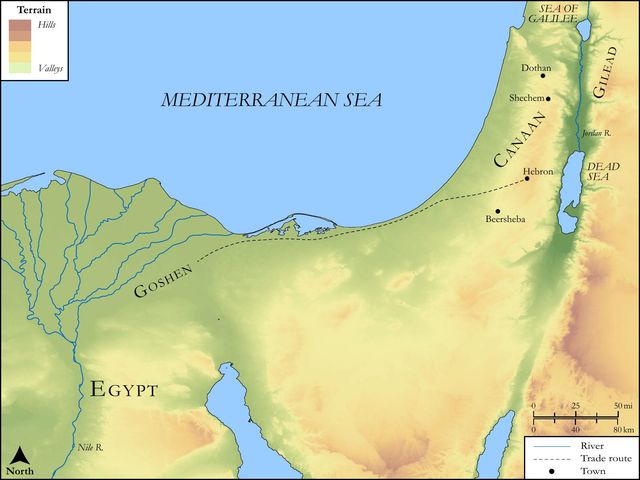
The lands of the patriarchs frequently experienced severe famines, making Egypt, with its Nile-fed agriculture and advanced granaries, a vital source of grain. The position of vizier (second in command to Pharaoh) was one of immense power and authority, often held by individuals of foreign origin who had proven their capabilities. In such high-stakes interactions, particularly between foreign dignitaries or merchants and high-ranking officials, the use of interpreters was a standard diplomatic and commercial practice. This facilitated communication across linguistic barriers and maintained formality, reinforcing the power differential. Joseph's ability to speak Egyptian fluently, a skill acquired over two decades in Egypt, would have been expected of a vizier. His feigned inability to understand Hebrew, therefore, was not unusual from the brothers' perspective, making his ruse culturally plausible and effective.
Key Themes
ShowHideGenesis 42:23 significantly contributes to several overarching themes within the Joseph narrative and the book of Genesis. It powerfully illustrates Divine Sovereignty and Providence, demonstrating how God meticulously orchestrates human actions—even sinful ones like the brothers' betrayal—to fulfill His ultimate purposes, bringing about good from evil. The verse is central to the theme of Testing and Transformation, as Joseph's strategic deception is a divinely guided process designed to test his brothers' hearts, revealing whether they had genuinely changed from the jealous and cruel individuals who had sold him into slavery. This testing process, facilitated by the interpreter, leads to their profound Repentance and Self-Reflection, as they openly acknowledge their guilt concerning Joseph (as seen in Genesis 42:21). Furthermore, Joseph's period of Hiddenness and Strategic Revelation foreshadows God's own often mysterious ways of working, where His plans are veiled until the opportune moment for their powerful unveiling, ultimately leading to Reconciliation and Forgiveness within the family.
Exposition and Analysis
ShowHideKey Word Analysis
ShowHideFrom the primitive root H3045, meaning "to know" in a wide variety of senses, including to ascertain by seeing, to be aware, to discern, to perceive, or to have knowledge. In this context, it emphasizes the brothers' complete lack of awareness or comprehension that Joseph possessed the knowledge of their language, highlighting their profound ignorance of his true identity and linguistic capabilities.
From the primitive root H8085, meaning "to hear intelligently," often implying attention, obedience, or comprehension. Here, it specifically denotes Joseph's intellectual grasp and comprehension of the Hebrew language spoken by his brothers, contrasting sharply with their assumption that he could not. This "understanding" was the secret weapon in Joseph's strategic arsenal.
From the primitive root H3887, primarily meaning "to scoff" or "to make mouths at," but also extending to "to interpret" (from the effort to pronounce a foreign language) or "to intercede." In this verse, it clearly refers to one who translates between languages. The broader nuance of "intercessor" or "mediator" subtly foreshadows Joseph's later role as a pivotal figure mediating between his family and Pharaoh, and ultimately between God's plan and human agency.
Verse Breakdown
ShowHide"And they knew not that Joseph understood [them]"
This initial clause establishes the dramatic irony central to the scene. The brothers, speaking freely among themselves in Hebrew, are utterly oblivious to the fact that the powerful Egyptian vizier before them fully comprehends every word. This ignorance is the foundation of Joseph's strategic advantage, allowing him to observe their true character and hear their unvarnished conversations, particularly their expressions of guilt and fear concerning their past actions.
"for he spake unto them by an interpreter"
This clause provides the immediate reason for the brothers' ignorance. Joseph deliberately chose to communicate through a third party, creating a linguistic barrier that reinforced his disguise as a foreign official. This was a calculated maneuver, not a necessity, enabling him to maintain control, conceal his emotional reactions, and facilitate the uninhibited dialogue among his brothers that was crucial for his test of their hearts.
Literary Devices
ShowHideThe verse effectively employs several literary devices. Dramatic Irony is paramount, as the audience (and Joseph) are privy to information (Joseph's understanding of Hebrew) that the characters (his brothers) are not. This creates tension and anticipation, as the reader watches the brothers unwittingly reveal their deepest fears and guilt to the very person they wronged. The interpreter himself functions as a Symbolism of the barrier Joseph intentionally erected, representing not merely a linguistic divide but also the emotional and relational chasm that needed to be bridged through repentance and reconciliation. Furthermore, the entire scenario serves as Foreshadowing of Joseph's ultimate role as a mediator and deliverer for his family, a role that hinges on his unique position between two worlds (Hebrew and Egyptian, past and present suffering, and future salvation).
Theological and Thematic Connections
ShowHideGenesis 42:23 powerfully illustrates the theme of divine providence, demonstrating God's meticulous orchestration of events, even through human deception and suffering, to achieve His redemptive purposes. Joseph's strategic use of the interpreter allowed him to test his brothers' hearts, revealing their repentance and preparing them for reconciliation. This mirrors God's own methods of allowing trials and hiddenness to bring about spiritual growth and reveal the true state of our hearts, ultimately leading to restoration.
Reflection and Application
ShowHideGenesis 42:23 offers profound insights for believers today, reminding us that God often works in mysterious and seemingly indirect ways to accomplish His divine purposes. Just as Joseph observed his brothers' hearts through a veil of misunderstanding, God intimately knows our true motives, thoughts, and character, often allowing circumstances and trials to expose and refine us. This narrative underscores the critical importance of genuine self-reflection, repentance for past wrongs, and the willingness to face the consequences of our actions. It encourages us to trust in God's sovereign hand, even when our circumstances are confusing or challenging, knowing that He can orchestrate seemingly complex events to bring about reconciliation, healing, and ultimately, good, just as He did for Jacob's family during the severe famine. We are called to examine our own hearts, confess our hidden sins, and embrace the transformative power of God's grace, which can redeem even the most broken relationships.
Questions for Reflection
ShowHideFAQ
ShowHideWhy did Joseph use an interpreter if he understood his brothers' language?
ShowHideJoseph used an interpreter as a deliberate and calculated strategic tactic, not out of necessity. Having lived in Egypt for over two decades, he was fluent in Egyptian, but crucially, he also retained his native Hebrew. By appearing to communicate solely through an interpreter, Joseph achieved several critical objectives. First, it maintained his disguise as an Egyptian official, preventing his brothers from recognizing him or suspecting his true origins. Second, and most importantly, it allowed him to observe their unguarded reactions and overhear their private conversations among themselves. Believing Joseph could not understand them, the brothers spoke freely about their past actions, their guilt over selling Joseph, and their current fears. This unfiltered insight into their hearts was essential for Joseph to gauge their repentance, assess their character transformation, and ultimately orchestrate the complex series of events that would lead to their reconciliation and the preservation of Jacob's family during the famine.
Christ-Centered Fulfillment
ShowHideJoseph's story, particularly his hidden identity, suffering, and eventual exaltation leading to the salvation of his family, serves as a profound and multifaceted type of Christ. Like Joseph, Jesus was rejected by His own people, as prophesied and vividly portrayed in passages like John 1:11 and Isaiah 53:3. He was "sold" for a price (Judas's betrayal, echoing the brothers selling Joseph for twenty shekels of silver, as seen in Matthew 26:14-16), and endured immense suffering, culminating in His crucifixion. Yet, through this suffering, God exalted Him to a position of ultimate power and authority, not merely over a nation but over all creation, as declared in Philippians 2:9-11. Joseph's role as a "hidden" savior who, through a period of testing, brought his brothers to repentance and ultimately provided salvation and sustenance, powerfully foreshadows Christ as the ultimate mediator and savior. Jesus, though fully God, veiled His glory and took on human form (Philippians 2:6-8), allowing Himself to be misunderstood and rejected by humanity, ultimately to bring His spiritual family, the Church, to repentance and provide eternal salvation through His sacrificial death and resurrection (Romans 5:8-10). Just as Joseph's suffering was God's means to preserve His covenant family, Christ's suffering was God's perfect means to redeem and reconcile His spiritual family, the Church, to Himself.