


Genesis 42:22
Bible text: King James Version (1769 Blayney text) · Public domain
Bible text: King James Version with Strong's numbers · Public domain
Bible text: Berean Standard Bible · Public domain
Bible text: American Standard Version (1901) · Public domain
Bible text: World English Bible, Messianic edition · Public domain
Bible text: Geneva Bible (1599) · Public domain
Bible text: Young's Literal Translation · Public domain
- וַיַּעַןvai·ya·'Anand he answeredH6030Conj-w ¦ V-Qal-ConsecImperf-3msVerb Qal Consecutive Imperfect 3rd Singular Masculineוַandיַּעַןhe answered
- רְאוּבֵןre·'u·VenReubenH7205N-proper-mNoun Proper Masculine
- אֹתָם'o·Tam<obj.> themH853DirObjM ¦ 3mpParticle Object Indicatorאֹתָ<obj.>םthem
- לֵאמֹרle·Mor<to> sayingH559Prep-l ¦ V-Qal-InfVerb Qal Infinitive Constructלֵ<to>אמֹרsaying
- הֲלוֹאha·lO'¿ notH3808Interrog ¦ NegParticle Negativeהֲ¿לוֹאnot
- אָמַרְתִּי'a·Mar·tidid I sayH559V-Qal-Perf-1csVerb Qal Perfect 1st Singular common gender
- אֲלֵיכֶם'a·lei·Khemto youH413Prep ¦ 2mpPreposition Definiteאֲלֵיtoכֶםyou
- לֵאמֹרle·Mor<to> sayingH559Prep-l ¦ V-Qal-InfVerb Qal Infinitive Constructלֵ<to>אמֹרsaying
- אַל'almay notH408NegParticle Negative
- תֶּחֶטְאוּte·chet·'Uyou sinH2398V-Qal-Imperf-2mpVerb Qal Imperfect 2nd Plural Masculine
- בַיֶּלֶדvai·Ye·ledagainst the boyH3206Prep-b ¦ N-msNoun Singular Masculine Absoluteבַagainst theיֶּלֶדboy
- וְלֹאve·Lo'and notH3808Conj-w ¦ NegParticle Negativeוְandלֹאnot
- שְׁמַעְתֶּםshe·ma'·Temyou listenedH8085V-Qal-Perf-2mpVerb Qal Perfect 2nd Plural Masculine
- וְגַםve·gamand alsoH1571Conj-w ¦ AdvAdverbוְandגַםalso
- דָּמוֹda·Mohis bloodH1818N-msc ¦ 3msNoun Singular Masculine Constructדָּמbloodוֹhis
- הִנֵּהhi·Nehhere!H2009PrtParticle Interjection
- נִדְרָשׁnid·Rash[is] being requiredH1875V-Niphal-Prtcpl-msVerb Niphal Participle Singular Masculine Absolute
English is a literal word-by-word gloss of the Hebrew, not the KJV's wording. Why?
This is the original text the KJV's translators worked from — each Hebrew word with its own literal English meaning in this verse, prepared by scholars at Tyndale House, Cambridge. The KJV translates whole sentences, not word by word, so its wording differs: one Hebrew word can become several English words, and the KJV may choose “the LORD” where the gloss reads “Yahweh”. Both are faithful — they answer different questions. For the KJV's own rendering, switch to the KJV text.
Details
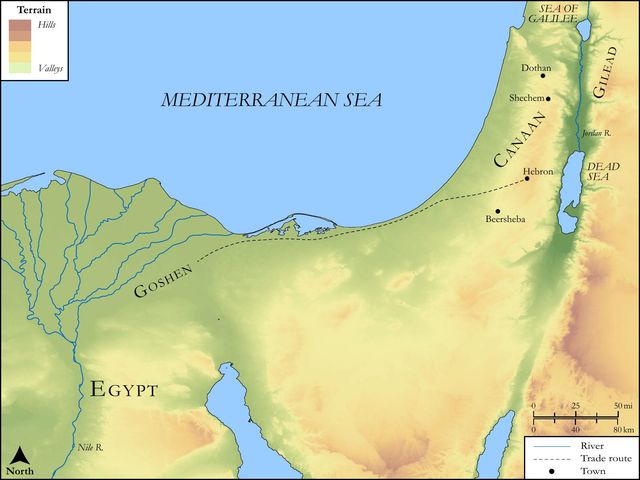
See on the biblical-era maps


Study this verse
Public-domain commentary
Matthew Henry
From his Commentary on the Whole Bible. Henry comments on passages, not single verses — this entry covers Genesis 42:21–28. His three-level outline is real structure in the source text, so it is rendered as structure.
Here is, I. The penitent reflection Joseph's brethren made upon the wrong they had formerly done to him, Gen 42:21. They talked the matter over in the Hebrew tongue, not suspecting that Joseph, whom they took for a native of Egypt, understood them, much less that he was the person they spoke of.
1.They remembered with regret the barbarous cruelty wherewith they persecuted him: We are verily guilty concerning our brother. We do not read that they said this during their three days' imprisonment; but now, when the matter had come to some issue and they saw themselves still embarrassed, now they began to relent. Perhaps Joseph's mention of the fear of God (Gen 42:18) put them upon consideration and extorted this reflection. Now see here,
(1.)The office of conscience; it is a remembrancer, to bring to mind things long since said and done, to show us wherein we have erred, though it was long ago, as the reflection here mentioned was above twenty years after the sin was committed. As time will not wear out the guilt of sin, so it will not blot out the records of conscience; when the guilt of this sin of Joseph's brethren was fresh they made light of it, and sat down to eat bread; but now, long afterwards, their consciences reminded them of it.
(2.)The benefit of affliction; they often prove the happy and effectual means of awakening conscience, and bringing sin to our remembrance, Job 13:26.
(3.)The evil of guilt concerning our brethren; of all their sins, it was this that conscience now reproached them for. Whenever we think we have wrong done us, we ought to remember the wrong we have done to others, Ecc 7:21, Ecc 7:22.
2.Reuben alone remembered, with comfort, that he had been an advocate for his brother, and had done what he could to prevent the mischief they did him (Gen 42:22): Spoke I not unto you, saying, Do not sin against the child? Note,
(1.)It is an aggravation of any sin that it was committed against admonitions.
(2.)When we come to share with others in their calamities, it will be a comfort to us if we have the testimony of our consciences for us that we did not share with them in their iniquities, but, in our places, witnessed against them. This shall be our rejoicing in the day of evil, and shall take out the sting.
II.Joseph's tenderness towards them upon this occasion.
He retired from them to weep, Gen 42:24. Though his reason directed that he should still carry himself as a stranger to them, because they were not as yet humbled enough, yet natural affection could not but work, for he was a man of a tender spirit. This represents the tender mercies of our God towards repenting sinners. See Jer 31:20, Since I spoke against him I do earnestly remember him still. See Jdg 10:16.
III.The imprisonment of Simeon, Gen 42:24.
He chose him for the hostage probably because he remembered him to have been his most bitter enemy, or because he observed him now to be least humbled and concerned; he bound him before their eyes to affect them all; or perhaps it is intimated that, though he bound him with some severity before them, yet afterwards, when they were gone, he took off his bonds.
IV.The dismission of the rest of them.
They came for corn, and corn they had; and not only so, but every man had his money restored in his sack's mouth. Thus Christ, our Joseph, gives out supplies without money and without price. Therefore the poor are invited to buy, Rev 3:17, Rev 3:18. This put them into great consternation (Gen 42:28): Their heart failed them, and they were afraid, saying one to another, What is this that God hath done to us?
1.It was really a merciful event; for I hope they had no wrong done to them when they had their money given them back, but a kindness; yet they were thus terrified by it. Note,
(1.)Guilty consciences are apt to take good providences in a bad sense, and to put wrong constructions even upon those things that make for them. They flee when none pursues.
(2.)Wealth sometimes brings as much care along with it as want does, and more too. If they had been robbed of their money, they could not have been worse frightened than they were now when they found their money in their sacks. Thus he whose ground brought forth plentifully said, What shall I do? Luk 12:17.
2.Yet in their circumstances it was very amazing. They knew that the Egyptians abhorred a Hebrew (Gen 43:32), and therefore, since they could not expect to receive any kindness from them, they concluded that this was done with a design to pick a quarrel with them, and the rather because the man, the lord of the land, had charged them as spies. Their own consciences also were awake, and their sins set in order before them; and this put them into confusion. Note,
(1.)When men's spirits are sinking every thing helps to sink them.
(2.)When the events of Providence concerning us are surprising it is good to enquire what it is that God has done and is doing with us, and to consider the operation of his hands.
Continue studying Genesis 42:22 across the web’s major study libraries — every link below opens this exact verse, chapter, or book on the destination site.
Read & Compare
 BibleGatewayThis verse in more than 200 translations and 70 languages.
 Bible.comThe YouVersion reader — hundreds of translations, reading plans, and highlights.
 ESV.orgCrossway's official English Standard Version reader.
 NET BibleThe NET translation with 60,000+ translators' notes on every rendering decision.
 STEP BibleTyndale House's free study tool — original text, vocabulary, and scholarly resources.
 BibliaLogos Bible Software's free web reader.
 USCCBThe New American Bible (Revised Edition) with the U.S. bishops' study notes.
Commentaries
 BibleHub CommentariesDozens of classic commentaries on this verse, gathered on one page.
 StudyLightMore than 100 commentary sets — the largest collection on the web.
 BibleRefPlain-English commentary on what this verse means, verse by verse.
 Enduring WordDavid Guzik's free commentary on this chapter, widely used by Bible teachers.
 Bible Study ToolsVerse commentary alongside Greek and Hebrew study aids.
Original Language & Research
- BibleHub InterlinearThe verse word by word — original language, transliteration, and English.
- BibleHub LexiconEvery word's original-language definition and Strong's entry.
 Blue Letter BibleDeep-study tools — Strong's numbers, concordance, and word studies.
 SefariaThe Hebrew text with Rashi and centuries of Jewish commentary.
Sermons, Hymns & Audio


TrulyRandomVerse is not affiliated with these sites and doesn’t control their content. They’re linked because they’re genuinely useful.
Summary
Genesis 42:22 captures Reuben's poignant reminder to his brothers of their unheeded warning against sinning toward Joseph, as their current distress in Egypt forces a painful reckoning with their past cruelty and the inescapable consequences of their actions. This pivotal moment reveals their deep-seated guilt and the dawning realization that their present predicament is divine retribution for their heinous crime against their brother decades earlier.
Context
ShowHideLiterary Context
This verse is a crucial turning point within the larger narrative of Joseph and his brothers, specifically during their first journey to Egypt to buy grain during a severe famine. Joseph, now the powerful governor of Egypt, recognizes his brothers but conceals his identity, subjecting them to a series of tests. He accuses them of being spies, imprisons Simeon, and demands they bring their youngest brother, Benjamin, to prove their honesty. It is in this moment of intense fear and distress, believing Joseph (the governor) cannot understand their Hebrew, that the brothers confess their past wrongdoing to one another. Reuben, the eldest, seizes this opportunity to remind them of his earlier, disregarded plea to spare Joseph's life, as recorded in Genesis 37:21-22. This confession and Reuben's statement mark a significant step in their journey toward repentance and reconciliation.
Historical & Cultural Context
The narrative unfolds during a period of widespread famine, a common and devastating occurrence in the days of Jacob that often forced migrations and trade. Egypt, with its predictable Nile floods, was a reliable source of grain, making it a natural destination for those seeking sustenance. The cultural context includes the strong bonds and rivalries within large patriarchal families, the significant authority of the eldest son (Reuben) in family matters, and the deep-seated understanding of divine justice and retribution for grave offenses, particularly those involving bloodshed or severe harm to a family member. The brothers' fear of the "governor" and their immediate assumption of divine punishment reflect a worldview where God actively intervenes in human affairs to exact justice.
Key Themes
ShowHideGenesis 42:22 contributes significantly to several overarching themes in the book of Genesis. It powerfully illustrates the inescapability of sin's consequences, demonstrating that unaddressed guilt can resurface years later, bringing profound distress. It highlights God's perfect justice and sovereignty, showing how He orchestrates circumstances, even through human sin and deception, to bring about His purposes and hold individuals accountable. The brothers' internal turmoil also emphasizes the burden of unconfessed guilt and the psychological toll it takes. Furthermore, the verse subtly points to the theme of divine providence, as their suffering, though perceived as punitive, is ultimately part of God's larger plan to preserve their family and the lineage from which the Messiah would come, echoing the later declaration in Genesis 50:20.
Exposition and Analysis
ShowHideKey Word Analysis
ShowHideThis primitive root means "properly, to miss; hence (figuratively and generally) to sin." It encompasses the idea of failing to meet a standard, incurring guilt, or causing harm. Reuben's use of this word underscores the moral gravity of their actions against Joseph, framing it not merely as a family dispute but as a transgression against a divine standard, implying a spiritual offense with serious consequences.
Derived from a root meaning "to be silent" or "to cease," this word primarily refers to "blood (as that which when shed causes death)." Figuratively, and especially in the plural, it denotes "bloodshed" or "bloodguiltiness." While the brothers did not directly shed Joseph's blood, their intent to kill him (before Reuben intervened) and their subsequent act of selling him into slavery, effectively condemning him to a life akin to death, incurred a form of bloodguilt in their conscience and before God. It emphasizes the sanctity of life.
This primitive root means "properly, to tread or frequent; usually to follow (for pursuit or search); by implication, to seek or ask; specifically to worship." In this context, it carries the strong sense of demanding, exacting, or calling to account. Reuben's statement implies that a higher power (God) is actively seeking or demanding justice for the "blood" of Joseph, indicating an inescapable divine reckoning for their past transgression.
Verse Breakdown
ShowHide"And Reuben answered them, saying, Spake I not unto you, saying, Do not sin against the child; and ye would not hear?"
This opening clause highlights Reuben's role as the voice of conscience and memory within the family. He reminds his brothers of his earnest plea to them, documented in Genesis 37:21-22, where he specifically urged them not to "sin against the child" (Joseph). His rhetorical question, "Spake I not unto you...?" serves as a powerful indictment, underscoring their willful disobedience and disregard for his counsel. The phrase "ye would not hear" (Hebrew: shâmaʻ) implies not just a failure to physically hear, but a refusal to listen intelligently, to obey, or to pay attention to his warning, emphasizing their culpability.
"therefore, behold, also his blood is required."
This climactic declaration reveals the brothers' dawning realization of divine retribution. The "therefore" connects their current distress directly to their past transgression. The phrase "his blood is required" is a potent expression of bloodguilt and divine justice. It signifies that accountability for Joseph's life and the profound injustice done to him is now being demanded by God. Though they sold Joseph rather than directly shedding his blood, their actions were perceived as morally equivalent to murder, incurring a debt that God, the righteous Judge, is now calling due. This statement reflects their profound conviction that their current suffering is a direct consequence of their unconfessed sin.
Literary Devices
ShowHideThe verse employs several powerful Literary Devices. Dialogue is central, as Reuben's direct address to his brothers serves to expose their collective guilt and advance the plot towards reconciliation. The rhetorical question, "Spake I not unto you...?" functions as a form of Reproach or Recrimination, forcing the brothers to confront their past actions and their failure to heed sound counsel. There is profound Irony in their situation: they, who had once held Joseph's life in their hands, are now themselves held captive and vulnerable, facing judgment for their past deeds. The phrase "his blood is required" serves as powerful Foreshadowing, not only of their impending reconciliation with Joseph but also of the broader biblical principle that sin has consequences and that divine justice will ultimately prevail. This also functions as Poetic Justice, as their current distress is a direct, fitting consequence of their past cruelty.
Theological and Thematic Connections
ShowHideThis narrative powerfully illustrates that sin, particularly unconfessed and unrepented sin, carries long-term consequences that can manifest years later, even in unexpected ways. The brothers' anguish and internal torment reveal the heavy psychological and spiritual burden of unaddressed sin, emphasizing the need for confession and repentance for true peace. The events demonstrate God's attribute as a righteous judge who holds individuals accountable for their deeds, ensuring that justice is ultimately served, even if delayed. It also highlights His sovereignty in using human actions and circumstances to bring about His purposes, transforming what was intended for evil into good.
Reflection and Application
ShowHideGenesis 42:22 offers timeless lessons for believers today. Our actions, especially our sins, often have far-reaching consequences, even if not immediately apparent, reminding us that God sees and remembers all things, and accountability is inevitable. The brothers' anguish underscores the importance of acknowledging our wrongs and seeking God's forgiveness, as unconfessed and unaddressed sin can lead to deep internal distress and spiritual torment. This narrative also reassures us of God's perfect justice; while His timing may differ from ours, He ultimately holds all people accountable for their deeds. Finally, the eventual reconciliation between Joseph and his brothers, particularly as seen in Genesis 50:20, offers profound hope that even the most broken relationships can be healed through repentance, forgiveness, and God's sovereign plan.
Questions for Reflection
ShowHideFAQ
ShowHideWhy does Reuben say "his blood is required"?
ShowHideReuben's statement reflects the ancient understanding of bloodguilt, where harm or death inflicted upon an innocent person incurred a divine demand for justice or retribution. Though Joseph was sold into slavery rather than directly murdered, the brothers' malicious intent and the severe injustice done to him meant that his "blood" (representing his life and the profound wrong committed against him) was considered to be "on their hands." Reuben perceives their current suffering as God's righteous demand for accountability for that grave sin, a divine reckoning for their past actions.
Does this event imply God directly punishes sin with immediate suffering?
ShowHideNot necessarily immediately, but certainly eventually. This narrative demonstrates that God's justice is real and that consequences for sin, though sometimes delayed for decades, are ultimately inescapable. While not every suffering is a direct, one-to-one punishment for a specific sin, the brothers' internal conviction that their distress was divine retribution for their past actions highlights the principle that sin has a profound impact and that God, in His sovereignty, can use circumstances to bring about conviction and accountability. The Bible teaches that "whatever one sows, that will he also reap," as seen in Galatians 6:7.
How does this relate to the concept of "sin finding you out"?
ShowHideThis verse is a powerful illustration of the biblical principle, "be sure your sin will find you out" (Numbers 32:23). The brothers had buried their secret for twenty years, believing it forgotten. However, their current distress in Egypt, orchestrated by Joseph under God's providence, forced their hidden sin into the open, causing them to confront their guilt and realize that their past actions had indeed caught up with them. Their internal confession, made without realizing Joseph understood, underscores the inescapable nature of guilt and the truth that God remembers all deeds, even those hidden from human eyes.
Christ-Centered Fulfillment
ShowHideThe brothers' dawning realization in Genesis 42:22, that "his blood is required," profoundly foreshadows the ultimate requirement for justice against sin, which is perfectly satisfied in Christ. Their recognition of bloodguilt for Joseph's suffering points to humanity's universal guilt before a holy God, whose justice demands a reckoning for every sin. Just as Joseph, though innocent, suffered at the hands of his brothers and was later exalted to a position of power to save his family, so Christ, the innocent Son of God, suffered and shed His blood, not because His blood was required from us as a penalty, but because His blood was offered for us as the perfect atonement. Through His sacrifice on the cross, the "blood" of humanity's sin is not required from us, but is covered by His own, offering true reconciliation and redemption where only guilt and judgment once stood. As Hebrews 9:22 declares, "without the shedding of blood there is no forgiveness of sins." Christ's blood, unlike Joseph's, was not shed as a consequence of His own sin, but as the atoning sacrifice for ours, fulfilling the righteous demands of God's law and providing a pathway to peace with God, as beautifully articulated in Colossians 1:20.