


Genesis 42:28
Bible text: King James Version (1769 Blayney text) · Public domain
Bible text: King James Version with Strong's numbers · Public domain
Bible text: Berean Standard Bible · Public domain
Bible text: American Standard Version (1901) · Public domain
Bible text: World English Bible, Messianic edition · Public domain
Bible text: Geneva Bible (1599) · Public domain
Bible text: Young's Literal Translation · Public domain
- וַיֹּאמֶרvai·Yo·merand he saidH559Conj-w ¦ V-Qal-ConsecImperf-3msVerb Qal Consecutive Imperfect 3rd Singular Masculineוַandיֹּאמֶרhe said
- אֶל'eltoH413PrepPreposition
- אֶחָיו'e·Chavhis brothersH251N-mpc ¦ 3msNoun Plural Masculine Constructאֶחָיbrothersוhis
- הוּשַׁבhu·Shavit has been returnedH7725V-Hophal-Perf-3msVerb Hophal Perfect 3rd Singular Masculine
- כַּסְפִּיkas·Pimy silverH3701N-msc ¦ 1csNoun Singular Masculine Constructכַּסְפִּsilverיmy
- וְגַםve·Gamand alsoH1571Conj-w ¦ AdvAdverbוְandגַםalso
- הִנֵּהhi·Nehhere!H2009PrtParticle Interjection
- בְאַמְתַּחְתִּיve·'am·tach·Tiin my sackH572Prep-b ¦ N-fsc ¦ 1csNoun Singular Feminine Constructבְinאַמְתַּחְתִּsackיmy
- וַיֵּצֵאvai·ye·Tze'and it went outH3318Conj-w ¦ V-Qal-ConsecImperf-3msVerb Qal Consecutive Imperfect 3rd Singular Masculineוַandיֵּצֵאit went out
- לִבָּםli·Bamtheir heartH3820N-msc ¦ 3mpNoun Singular Masculine Constructלִבָּheartםtheir
- וַיֶּחֶרְדוּvai·ye·cher·Duand they trembledH2729Conj-w ¦ V-Qal-ConsecImperf-3mpVerb Qal Consecutive Imperfect 3rd Plural Masculineוַandיֶּחֶרְדוּthey trembled
- אִישׁ'isheachH376N-msNoun Singular Masculine Absolute
- אֶל'eltoH413PrepPreposition
- אָחִיו'a·Chivhis brotherH251N-msc ¦ 3msNoun Singular Masculine Constructאָחִיbrotherוhis
- לֵאמֹרle·Mor<to> sayingH559Prep-l ¦ V-Qal-InfVerb Qal Infinitive Constructלֵ<to>אמֹרsaying
- מַהmahwhat?H4100InterrogPronoun Interrogative
- זֹּאתzotthisH2063PrtParticle Demonstrative
- עָשָׂה'a·Sahhas he doneH6213V-Qal-Perf-3msVerb Qal Perfect 3rd Singular Masculine
- אֱלֹהִים'E·lo·HimGodH430N-mpNoun Plural Masculine Absolute
- לָנוּLa·nuto <the> usPrep-l ¦ 1cpSuffix Personal 1st Plural common genderלָto <the>נוּus
English is a literal word-by-word gloss of the Hebrew, not the KJV's wording. Why?
This is the original text the KJV's translators worked from — each Hebrew word with its own literal English meaning in this verse, prepared by scholars at Tyndale House, Cambridge. The KJV translates whole sentences, not word by word, so its wording differs: one Hebrew word can become several English words, and the KJV may choose “the LORD” where the gloss reads “Yahweh”. Both are faithful — they answer different questions. For the KJV's own rendering, switch to the KJV text.
Details
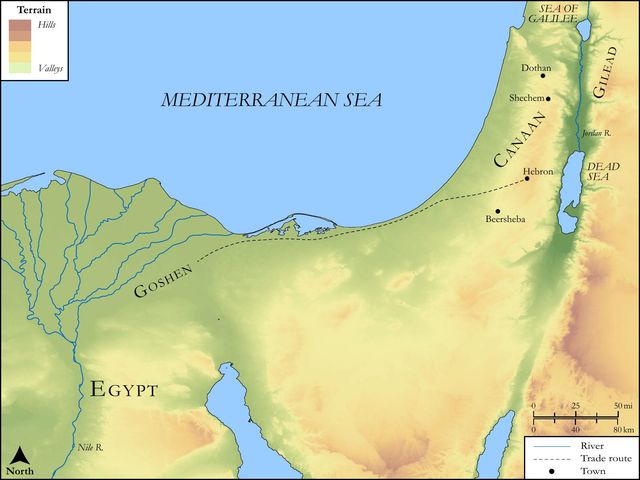
See on the biblical-era maps


Study this verse
Public-domain commentary
Matthew Henry
From his Commentary on the Whole Bible. Henry comments on passages, not single verses — this entry covers Genesis 42:21–28. His three-level outline is real structure in the source text, so it is rendered as structure.
Here is, I. The penitent reflection Joseph's brethren made upon the wrong they had formerly done to him, Gen 42:21. They talked the matter over in the Hebrew tongue, not suspecting that Joseph, whom they took for a native of Egypt, understood them, much less that he was the person they spoke of.
1.They remembered with regret the barbarous cruelty wherewith they persecuted him: We are verily guilty concerning our brother. We do not read that they said this during their three days' imprisonment; but now, when the matter had come to some issue and they saw themselves still embarrassed, now they began to relent. Perhaps Joseph's mention of the fear of God (Gen 42:18) put them upon consideration and extorted this reflection. Now see here,
(1.)The office of conscience; it is a remembrancer, to bring to mind things long since said and done, to show us wherein we have erred, though it was long ago, as the reflection here mentioned was above twenty years after the sin was committed. As time will not wear out the guilt of sin, so it will not blot out the records of conscience; when the guilt of this sin of Joseph's brethren was fresh they made light of it, and sat down to eat bread; but now, long afterwards, their consciences reminded them of it.
(2.)The benefit of affliction; they often prove the happy and effectual means of awakening conscience, and bringing sin to our remembrance, Job 13:26.
(3.)The evil of guilt concerning our brethren; of all their sins, it was this that conscience now reproached them for. Whenever we think we have wrong done us, we ought to remember the wrong we have done to others, Ecc 7:21, Ecc 7:22.
2.Reuben alone remembered, with comfort, that he had been an advocate for his brother, and had done what he could to prevent the mischief they did him (Gen 42:22): Spoke I not unto you, saying, Do not sin against the child? Note,
(1.)It is an aggravation of any sin that it was committed against admonitions.
(2.)When we come to share with others in their calamities, it will be a comfort to us if we have the testimony of our consciences for us that we did not share with them in their iniquities, but, in our places, witnessed against them. This shall be our rejoicing in the day of evil, and shall take out the sting.
II.Joseph's tenderness towards them upon this occasion.
He retired from them to weep, Gen 42:24. Though his reason directed that he should still carry himself as a stranger to them, because they were not as yet humbled enough, yet natural affection could not but work, for he was a man of a tender spirit. This represents the tender mercies of our God towards repenting sinners. See Jer 31:20, Since I spoke against him I do earnestly remember him still. See Jdg 10:16.
III.The imprisonment of Simeon, Gen 42:24.
He chose him for the hostage probably because he remembered him to have been his most bitter enemy, or because he observed him now to be least humbled and concerned; he bound him before their eyes to affect them all; or perhaps it is intimated that, though he bound him with some severity before them, yet afterwards, when they were gone, he took off his bonds.
IV.The dismission of the rest of them.
They came for corn, and corn they had; and not only so, but every man had his money restored in his sack's mouth. Thus Christ, our Joseph, gives out supplies without money and without price. Therefore the poor are invited to buy, Rev 3:17, Rev 3:18. This put them into great consternation (Gen 42:28): Their heart failed them, and they were afraid, saying one to another, What is this that God hath done to us?
1.It was really a merciful event; for I hope they had no wrong done to them when they had their money given them back, but a kindness; yet they were thus terrified by it. Note,
(1.)Guilty consciences are apt to take good providences in a bad sense, and to put wrong constructions even upon those things that make for them. They flee when none pursues.
(2.)Wealth sometimes brings as much care along with it as want does, and more too. If they had been robbed of their money, they could not have been worse frightened than they were now when they found their money in their sacks. Thus he whose ground brought forth plentifully said, What shall I do? Luk 12:17.
2.Yet in their circumstances it was very amazing. They knew that the Egyptians abhorred a Hebrew (Gen 43:32), and therefore, since they could not expect to receive any kindness from them, they concluded that this was done with a design to pick a quarrel with them, and the rather because the man, the lord of the land, had charged them as spies. Their own consciences also were awake, and their sins set in order before them; and this put them into confusion. Note,
(1.)When men's spirits are sinking every thing helps to sink them.
(2.)When the events of Providence concerning us are surprising it is good to enquire what it is that God has done and is doing with us, and to consider the operation of his hands.
Historical interpretation
Historical reception
1 surviving comment on this verse from the historical church.
“There is grain in Egypt”; that is, where the famine is greater, the abundance is greater. There is much grain in Egypt. Surely, and God the Father says, “Out of Egypt I called my son!” Such is the fecundity of that grain, for there could not have been a harvest unless the Egyptians had sown the grain earlier. There is then grain that no one earlier believed to exist. The patriarchs engaged in negotiations in regard to this grain. And they indeed brought money, but the good Joseph gave them the grain and gave them back the money. For Christ is not bought with money but with grace. Your payment is faith, and with it are bought God’s mysteries. Moreover, this grain is carried by the ass, which before was unclean according to the law but now is clean in grace.
Continue studying Genesis 42:28 across the web’s major study libraries — every link below opens this exact verse, chapter, or book on the destination site.
Read & Compare
 BibleGatewayThis verse in more than 200 translations and 70 languages.
 Bible.comThe YouVersion reader — hundreds of translations, reading plans, and highlights.
 ESV.orgCrossway's official English Standard Version reader.
 NET BibleThe NET translation with 60,000+ translators' notes on every rendering decision.
 STEP BibleTyndale House's free study tool — original text, vocabulary, and scholarly resources.
 BibliaLogos Bible Software's free web reader.
 USCCBThe New American Bible (Revised Edition) with the U.S. bishops' study notes.
Commentaries
 BibleHub CommentariesDozens of classic commentaries on this verse, gathered on one page.
 StudyLightMore than 100 commentary sets — the largest collection on the web.
 BibleRefPlain-English commentary on what this verse means, verse by verse.
 Enduring WordDavid Guzik's free commentary on this chapter, widely used by Bible teachers.
 Bible Study ToolsVerse commentary alongside Greek and Hebrew study aids.
Original Language & Research
- BibleHub InterlinearThe verse word by word — original language, transliteration, and English.
- BibleHub LexiconEvery word's original-language definition and Strong's entry.
 Blue Letter BibleDeep-study tools — Strong's numbers, concordance, and word studies.
 SefariaThe Hebrew text with Rashi and centuries of Jewish commentary.
Sermons, Hymns & Audio


TrulyRandomVerse is not affiliated with these sites and doesn’t control their content. They’re linked because they’re genuinely useful.
Summary
Genesis 42:28 powerfully captures the moment of profound shock and terror experienced by Joseph's brothers as they unexpectedly discover their purchase money returned in their sacks. This inexplicable event immediately triggers their deeply troubled consciences, leading them to interpret the unusual circumstance as a direct, and seemingly punitive, intervention from God, intensifying their already acute anxiety about their precarious situation in Egypt.
Context
ShowHideLiterary Context
This verse is a critical turning point within the larger narrative of Joseph and his brothers, specifically following their first journey to Egypt to buy grain during a severe famine. Joseph, now the powerful vizier of Egypt, has recognized his brothers but has chosen to conceal his identity. He has subjected them to a series of tests: accusing them of being spies, demanding they bring their youngest brother Benjamin, and holding Simeon captive. Unbeknownst to them, Joseph has also commanded his steward to secretly return their money into their sacks along with the grain. The discovery in Genesis 42:28 occurs on their return journey, after they have stopped for the night, revealing the first instance of the returned money. This moment sets the stage for the escalating tension and the brothers' growing realization of divine involvement in their plight, which will culminate in their eventual repentance and Joseph's revelation.
Historical & Cultural Context
The setting is ancient Egypt and Canaan during a period of widespread famine, a common and devastating natural disaster in the lands of the patriarchs. Egypt, with its advanced irrigation system from the Nile, was often a granary for the region, making it a natural destination for those seeking food. The concept of "money" (silver) as a medium of exchange was well-established. Crucially, the cultural understanding of divine retribution for sin was prevalent; people often attributed misfortune directly to the gods' displeasure. The brothers' immediate assumption that God was behind their predicament reflects this worldview, particularly given their own unaddressed guilt. The act of returning money secretly could be interpreted in various ways in that culture: a gesture of goodwill, a magical occurrence, or, more ominously, a trap or an accusation of theft, which carried severe penalties.
Key Themes
ShowHideGenesis 42:28 powerfully contributes to several overarching themes in the Joseph narrative and the book of Genesis. It highlights Divine Providence and Sovereignty, demonstrating God's unseen hand orchestrating events for His ultimate purposes, even through human deception and misunderstanding. The brothers' reaction underscores the theme of Conscience and Guilt, revealing how unaddressed sin can distort one's perception of God and lead to profound fear and self-condemnation, as seen in their earlier confession in Genesis 42:21. It also explores the theme of Testing and Transformation, as Joseph's actions, including the return of the money, serve to test his brothers' character and bring them to a place of repentance and spiritual maturity. Ultimately, this verse serves as a crucial step in God's redemptive plan to preserve the covenant family of Israel and fulfill the promises made to Abraham, Isaac, and Jacob, themes that resonate throughout the book of Genesis.
Exposition and Analysis
ShowHideKey Word Analysis
ShowHideMeaning "silver (from its pale color); by implication, money." This word emphasizes the material value of what was returned, but more importantly, it represents the transaction that was supposedly completed. The unexpected presence of the "money" (silver) in their sacks, despite having paid for the grain, is the catalyst for their terror, as it could easily be misconstrued as theft or a setup, jeopardizing their lives in Egypt.
Meaning "to go (causatively, bring) out, in a great variety of applications... fail." In the phrase "heart failed them," this verb is part of a powerful Hebrew idiom (יצא לבם, yatza libbam), literally "their heart went out." This idiom vividly conveys a complete loss of courage, a profound emotional collapse, or being utterly overwhelmed by terror. It signifies a physical and psychological response to extreme dread, indicating that their fear was so intense it felt as though their very life force was draining from them.
Meaning "plural of אֱלוֹהַּ; gods in the ordinary sense; but specifically used (in the plural thus, especially with the article) of the supreme God." The brothers' immediate attribution of the event to "God" (Elohim) reveals their deep-seated theological framework. They instinctively recognized a supernatural, divine hand at work, not merely a coincidence or human error. Their question "What is this that God hath done unto us?" reflects a belief in God's active involvement in human affairs, even if their interpretation of His intent was colored by their guilt.
Verse Breakdown
ShowHide"And he said unto his brethren, My money is restored; and, lo, [it is] even in my sack:"
This opening clause captures the initial discovery. It's likely Levi or Judah who first finds the money, expressing surprise and confusion. The phrase "lo, [it is] even in my sack" (H2009, hinnêh) emphasizes the suddenness and unexpected nature of the discovery, highlighting the immediate shock. The realization that the payment they made for the grain has been mysteriously returned plunges them into a state of alarm, as it defies normal explanation and could have severe repercussions.
"and their heart failed [them],"
This clause describes the immediate and profound emotional impact of the discovery on all the brothers. As discussed in the key word analysis, "their heart failed them" (יצא לבם, yatza libbam) is a vivid Hebrew idiom signifying extreme terror, a complete loss of courage, and a feeling of being utterly overwhelmed. It indicates a visceral, debilitating fear that paralyzed them.
"and they were afraid, saying one to another,"
This phrase further emphasizes their state of terror and the communal nature of their reaction. Their fear was not a silent, internal dread but an overt, shared experience, leading them to vocalize their alarm and seek understanding from each other. The shared fear amplifies the dramatic tension of the moment.
"What [is] this [that] God hath done unto us?"
This concluding question is the theological climax of the verse. It reveals their immediate and instinctive attribution of the inexplicable event to divine intervention. Burdened by their unaddressed guilt over selling Joseph, they interpret this mysterious occurrence not as a fortunate happenstance, but as a sign of divine displeasure or impending judgment. This question underscores their deep-seated belief in God's active involvement in their lives and their fear of His justice.
Literary Devices
ShowHideGenesis 42:28 is rich with literary devices that amplify its dramatic and theological impact. The most prominent is Irony, as the brothers attribute the returned money to God's punitive action, unaware that it is part of Joseph's elaborate, divinely-guided plan for their ultimate good and reconciliation. This creates dramatic tension, as the audience knows more than the characters. The phrase "their heart failed them" employs Idiom, specifically the Hebrew idiom yatza libbam, which vividly conveys extreme dread and a complete loss of courage, painting a powerful picture of their emotional state. The brothers' question, "What is this that God hath done unto us?", serves as Foreshadowing, hinting at the divine hand at work throughout the Joseph narrative, which Joseph himself will later articulate in Genesis 50:20. The money itself functions as Symbolism, representing not just a financial transaction, but also the brothers' deep-seated guilt and the mysterious, unsettling nature of God's providential workings in their lives. The entire scene is imbued with Dramatic Tension, building suspense as the brothers grapple with an event they cannot comprehend, pushing them closer to confronting their past and God's sovereignty.
Theological and Thematic Connections
ShowHideGenesis 42:28 serves as a profound theological statement on divine providence and the human conscience. The brothers' immediate and fearful attribution of the returned money to God's direct action, though rooted in their guilt, ironically highlights the unseen hand of God orchestrating events. What they perceived as a sign of impending judgment was, in fact, an intricate part of God's larger, redemptive plan to preserve Jacob's family and fulfill His covenant promises. This incident underscores how a burdened conscience can distort one's perception of God's character and intentions, leading to fear rather than trust. Yet, even through their fear and misunderstanding, God was sovereignly guiding them toward repentance, reconciliation, and the ultimate preservation of His chosen people.
Reflection and Application
ShowHideGenesis 42:28 offers a profound reminder that God's hand is often at work in our lives, even in circumstances we find perplexing, frightening, or seemingly negative. Like Joseph's brothers, we may initially interpret difficult or unexpected situations as divine punishment or misfortune, failing to discern the larger, redemptive plan God may have in motion. This passage also powerfully underscores the burden of an unaddressed conscience; unresolved guilt can lead to a distorted view of God's character and intentions, causing us to project our own fears onto His actions. For believers, understanding God's sovereignty allows us to trust Him even when circumstances are confusing, recognizing that He can use challenges for our good and for the fulfillment of His eternal purposes. This trust leads us to greater dependence on His grace and a more accurate understanding of His loving, yet just, character. We are called to examine our own hearts, confessing and repenting of sin, so that we might perceive God's work with clarity and respond in faith rather than fear.
Questions for Reflection
ShowHideFAQ
ShowHideWhy were Joseph's brothers so afraid of the returned money?
ShowHideTheir fear stemmed from multiple factors. Firstly, the mysterious and inexplicable nature of the money's return suggested a trap, a setup for a false accusation of theft (which carried severe penalties in ancient Egypt), or a magical occurrence. Secondly, they were already in a precarious situation in Egypt, having been accused of being spies and with Simeon held captive. Most significantly, their overwhelming guilt over selling Joseph into slavery years prior resurfaced. They interpreted the unusual event as a direct sign of divine judgment for their past sins, causing their hearts to fail them in terror.
Does "What is this that God hath done unto us?" imply God was punishing them?
ShowHideWhile the brothers, burdened by their guilty consciences, interpreted the event as a sign of divine punishment or displeasure, from God's sovereign perspective, it was part of His intricate plan for their preservation, reconciliation, and spiritual growth. Joseph later clarifies this divine intention in Genesis 50:20, stating that what his brothers intended for evil, God intended for good. The brothers' immediate reaction, however, reveals their deep-seated belief in God's active involvement in their lives and His ultimate justice, even if their interpretation was flawed.
Christ-Centered Fulfillment
ShowHideThe narrative of Joseph and his brothers, culminating in this moment of fear and eventual reconciliation, powerfully foreshadows the redemptive work of Christ. Just as Joseph, though unjustly wronged and cast out by his own brothers, becomes the unexpected means of salvation and preservation for his family during a time of famine, so Christ, though unjustly rejected and crucified by humanity, becomes the ultimate deliverer and preserver of all who believe. The brothers' journey from deep-seated guilt and paralyzing fear to repentance, confession, and ultimately forgiveness, orchestrated by Joseph's wise and providential actions, mirrors humanity's desperate need for reconciliation with God. This reconciliation is made possible only through the greater Joseph—Jesus Christ—who, like Joseph, was sent ahead by God to preserve life (Genesis 45:5). God's sovereign plan, working through human sin and misunderstanding, ultimately leads to a profound restoration that points directly to the grander reconciliation offered through the Gospel, where the "Lamb of God who takes away the sin of the world" (John 1:29) bears the judgment we deserve, leading us to true peace and forgiveness, fulfilling what Joseph's story only hinted at.