


Genesis 42:29
Bible text: King James Version (1769 Blayney text) · Public domain
Bible text: Berean Standard Bible · Public domain
Bible text: American Standard Version (1901) · Public domain
Bible text: World English Bible, Messianic edition · Public domain
Bible text: Geneva Bible (1599) · Public domain
Bible text: Young's Literal Translation · Public domain
- וַיָּבֹאוּvai·ya·Vo·'uand they cameH935Conj-w ¦ V-Qal-ConsecImperf-3mpVerb Qal Consecutive Imperfect 3rd Plural Masculineוַandיָּבֹאוּthey came
- אֶל'eltoH413PrepPreposition
- יַעֲקֹבya·'a·KoJacobH3290N-proper-mNoun Proper Masculine
- אֲבִיהֶם'a·vi·Hemtheir fatherH1N-msc ¦ 3mpNoun Singular Masculine Constructאֲבִיfatherהֶםtheir
- אַרְצָה'Ar·tzah[the] land of towardsH776N-fsc ¦ SfxNoun Singular Feminine Constructאַרְצָ[the] land ofהtowards
- כְּנָעַןke·Na·'anCanaanH3667N-properNoun Proper Location
- וַיַּגִּידוּvai·ya·Gi·duand they toldH5046Conj-w ¦ V-Hiphil-ConsecImperf-3mpVerb Hiphil Consecutive Imperfect 3rd Plural Masculineוַandיַּגִּידוּthey told
- לוֹloto <the> himPrep-l ¦ 3msSuffix Personal 3rd Singular Masculineלto <the>וֹhim
- אֵת'et<obj.>H853DirObjMParticle Object Indicator
- כָּלkolallH3605N-msNoun Singular Masculine Absolute
- הַקֹּרֹתha·ko·Rotthe [things which] had happened toH7136Art ¦ V-Qal-Prtcpl-fpVerb Qal Participle Plural Feminine Absoluteהַtheקֹּרֹת[things which] had happened to
- אֹתָם'o·Tam<obj.> themH853DirObjM ¦ 3mpParticle Object Indicatorאֹתָ<obj.>םthem
- לֵאמֹרle·Mor<to> sayingH559Prep-l ¦ V-Qal-InfVerb Qal Infinitive Constructלֵ<to>אמֹרsaying
English is a literal word-by-word gloss of the Hebrew, not the KJV's wording. Why?
This is the original text the KJV's translators worked from — each Hebrew word with its own literal English meaning in this verse, prepared by scholars at Tyndale House, Cambridge. The KJV translates whole sentences, not word by word, so its wording differs: one Hebrew word can become several English words, and the KJV may choose “the LORD” where the gloss reads “Yahweh”. Both are faithful — they answer different questions. For the KJV's own rendering, switch to the KJV text.
Details
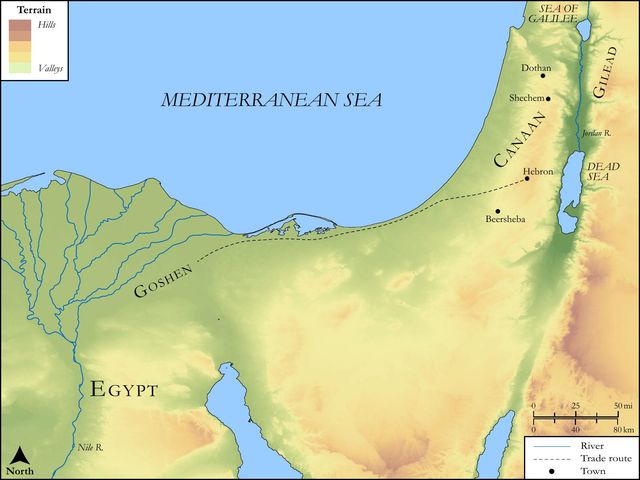
See on the biblical-era maps


Study this verse
Public-domain commentary
Matthew Henry
From his Commentary on the Whole Bible. Henry comments on passages, not single verses — this entry covers Genesis 42:29–38.
Here is, 1. The report which Jacob's sons made to their father of the great distress they had been in in Egypt; how they had been suspected, and threatened, and obliged to leave Simeon a prisoner there, till they should bring Benjamin with them thither. Who would have thought of this when they left home? When we go abroad we should consider how many sad accidents, that we little think of, may befall us before we return home. We know not what a day may bring forth; we ought therefore to be always ready for the worst. 2. The deep impression this made upon the good man. The very bundles of money which Joseph returned, in kindness to his father, frightened him (Gen 42:35); for he concluded it was done with some mischievous design, or perhaps suspected his own sons to have committed some offence, and so to have run themselves into a praemunire - a penalty, which is intimated in what he says (Gen 42:36): Me have you bereaved. He seems to lay the fault upon them; knowing their characters, he feared they had provoked the Egyptians, and perhaps forcibly, or fraudulently, brought home their money. Jacob is here much out of temper. (1.) He has very melancholy apprehensions concerning the present state of his family: Joseph is not, and Simeon is not; whereas Joseph was in honour and Simeon in the way to it. Note, We often perplex ourselves with our own mistakes, even in matters of fact. True griefs may arise from false intelligence and suppositions, Sa2 13:31. Jacob gives up Joseph for gone, and Simeon and Benjamin as being in danger; and he concludes, All these things are against me. It proved otherwise, that all these were for him, were working together for his good and the good of his family: yet here he thinks them all against him. Note, Through our ignorance and mistake, and the weakness of our faith, we often apprehend that to be against us which is really for us. We are afflicted in body, estate, name, and relations; and we think all these things are against us, whereas these are really working for us the weight of glory. (2.) He is at present resolved that Benjamin shall not go down. Reuben will undertake to bring him back in safety (Gen 42:37), not so much as putting in, If the Lord will, nor expecting the common disasters of travellers; but he foolishly bids Jacob slay his two sons (which, it is likely, he was very proud of) if he brought him not back; as if the death of two grandsons could satisfy Jacob for the death of a son. No, Jacob's present thoughts are, My son shall not go down with you. He plainly intimates a distrust of them, remembering that he never saw Joseph since he had been with them; therefore, "Benjamin shall not go with you, by the way in which you go, for you will bring down my gray hairs with sorrow to the grave." Note, It is bad with a family when children conduct themselves so ill that their parents know not how to trust them.
Continue studying Genesis 42:29 across the web’s major study libraries — every link below opens this exact verse, chapter, or book on the destination site.
Read & Compare
 BibleGatewayThis verse in more than 200 translations and 70 languages.
 Bible.comThe YouVersion reader — hundreds of translations, reading plans, and highlights.
 ESV.orgCrossway's official English Standard Version reader.
 NET BibleThe NET translation with 60,000+ translators' notes on every rendering decision.
 STEP BibleTyndale House's free study tool — original text, vocabulary, and scholarly resources.
 BibliaLogos Bible Software's free web reader.
 USCCBThe New American Bible (Revised Edition) with the U.S. bishops' study notes.
Commentaries
 BibleHub CommentariesDozens of classic commentaries on this verse, gathered on one page.
 StudyLightMore than 100 commentary sets — the largest collection on the web.
 BibleRefPlain-English commentary on what this verse means, verse by verse.
 Enduring WordDavid Guzik's free commentary on this chapter, widely used by Bible teachers.
 Bible Study ToolsVerse commentary alongside Greek and Hebrew study aids.
Original Language & Research
- BibleHub InterlinearThe verse word by word — original language, transliteration, and English.
- BibleHub LexiconEvery word's original-language definition and Strong's entry.
 Blue Letter BibleDeep-study tools — Strong's numbers, concordance, and word studies.
 SefariaThe Hebrew text with Rashi and centuries of Jewish commentary.
Sermons, Hymns & Audio


TrulyRandomVerse is not affiliated with these sites and doesn’t control their content. They’re linked because they’re genuinely useful.
Summary
Genesis 42:29 marks a pivotal moment in the unfolding narrative of Jacob's family, describing the return of his ten eldest sons from their first harrowing journey to Egypt. Having endured a severe famine and a perplexing encounter with Egypt's powerful governor, who was, unbeknownst to them, their long-lost brother Joseph, they arrive back in the land of Canaan to deliver a comprehensive and deeply troubling report of all the extraordinary events that transpired, setting the stage for Jacob's profound distress and the subsequent developments in their family's destiny.
Context
ShowHideLiterary Context
This verse immediately follows the brothers' terrifying discovery of the returned money in their sacks, an event that profoundly intensified their fear and confusion after their initial, bewildering encounter in Egypt. The preceding verses detail their journey, their desperate need for grain due to the severe famine, and their unexpected and harsh reception by Joseph, who accused them of being spies. To prove their honesty, they were commanded to bring their youngest brother, Benjamin, to Egypt, with Simeon held captive as collateral. The journey home was fraught with anxiety, culminating in the discovery of the money, which they interpreted as a bad omen. Genesis 42:29 thus serves as the dramatic entry point for their highly anticipated, yet dreaded, report to their father, Jacob, setting the emotional and narrative tension for the ensuing dialogue in Genesis 42:30-38.
Historical & Cultural Context
The narrative is set against the backdrop of a severe, widespread famine that gripped the nations round about Egypt, compelling people from various lands, including Canaan, to seek sustenance in Egypt, which had providentially prepared for such a crisis. In a patriarchal society like ancient Israel, the head of the household, Jacob, held ultimate authority and responsibility for his family's survival and decisions. The concept of family honor and the protection of one's children, especially the youngest and most beloved, like Benjamin (given Jacob's profound grief over Joseph, as seen in Genesis 37:35), were paramount. Travel between Canaan and Egypt was arduous and dangerous, making the brothers' return a significant event, and their detailed report was crucial for Jacob to understand the dire circumstances and make life-or-death decisions for his household.
Key Themes
ShowHideGenesis 42:29 contributes significantly to several overarching themes within the book of Genesis and the broader biblical narrative. Firstly, it highlights Divine Providence and Hidden Purpose, as the seemingly random or calamitous events (famine, Joseph's rise, the brothers' ordeal) are, from the author's perspective, meticulously orchestrated by God to preserve His chosen family and fulfill His covenant promises. Secondly, it underscores the theme of Testing and Moral Transformation for the brothers, as their fear and confusion serve as a crucible designed to expose their past sins against Joseph and lead them toward repentance and humility. Thirdly, it emphasizes Jacob's Enduring Grief and Parental Love, particularly his profound attachment to Benjamin, which is intensified by the presumed loss of Joseph, making the demand for Benjamin an almost unbearable prospect. This moment also sets the stage for the theme of Reconciliation and Restoration, which will ultimately unfold as the family confronts its past and is brought back together. The famine itself, as described in Genesis 41:56, is the catalyst for this entire sequence of events, demonstrating God's sovereign control even over natural disasters.
Exposition and Analysis
ShowHideKey Word Analysis
ShowHideThis primitive root (H935) signifies "to go or come" with a wide variety of applications, including arriving, entering, or even befalling. In this context, it marks the physical completion of their arduous journey back to Canaan, signifying their arrival at the immediate presence of Jacob. The act of "coming" here is not merely a physical movement but the bringing of a weighty burden of news and the onset of a new phase of family crisis.
Derived from a primitive root (H5046) meaning "to front, i.e. stand boldly out opposite," this word implies manifesting or announcing, always by word of mouth to one present. It denotes a comprehensive and direct declaration, not merely a casual mention. The brothers were compelled to "tell" Jacob everything, indicating a full disclosure of the extraordinary and alarming events, requiring courage and honesty, even in the face of their father's anticipated distress.
This primitive root (H7136) means "to light upon (chiefly by accident)," or causatively, "to bring about." While it can imply chance, within the biblical narrative, especially in a book like Genesis, "befell" often carries the nuance of events unfolding by divine orchestration, even when the characters themselves perceive them as random or unfortunate occurrences. Here, it encompasses the entire sequence of their experiences in Egypt, from their encounter with Joseph to the accusations, the demand for Benjamin, the imprisonment of Simeon, and the perplexing return of their money.
Verse Breakdown
ShowHide"And they came unto Jacob their father unto the land of Canaan,"
This clause establishes the setting and the immediate action. The sons, after their perilous journey to Egypt and back, finally reach their familial home and the patriarch of their clan. The mention of "Jacob their father" immediately highlights the familial bond and the authority figure to whom they must report, emphasizing the personal and profound nature of the impending conversation. Their arrival in "the land of Canaan" underscores the geographic return to their ancestral home, a place of promise and identity, yet now also a place of famine and distress.
"and told him all that befell unto them;"
This is the core action of the verse, indicating a comprehensive and unreserved report. The phrase "all that befell unto them" is crucial, signifying that no detail of their extraordinary and often terrifying experiences in Egypt was omitted. This full disclosure is vital for Jacob to grasp the gravity of their situation, the nature of the Egyptian governor's demands, and the immediate threat to Simeon and, by extension, Benjamin. It conveys the weight of their burden and the shocking nature of the news they are about to impart.
"saying,"
This concluding word serves as a direct transition, signaling the commencement of their verbal account. It introduces the direct speech that follows in the subsequent verses, where the brothers will articulate the specific details of their ordeal, leading directly into Jacob's anguished reaction. It sets the stage for the dramatic dialogue and the unfolding of the next phase of God's redemptive plan for this family.
Literary Devices
ShowHideThe verse employs several literary devices to heighten its impact. Foreshadowing is evident as the mere act of "telling all that befell" hints at the profound distress and further trials that Jacob and his family are about to endure, particularly concerning Benjamin. Dramatic Irony is subtly present; the brothers recount events they perceive as random misfortune, unaware that their long-lost brother Joseph is orchestrating everything, and that God's sovereign hand is guiding every step. This creates a tension between the characters' limited understanding and the reader's broader knowledge of the divine plan. The phrase "all that befell unto them" also functions as a form of Summary Statement, encapsulating a complex series of events that will be unpacked in the following verses, building suspense for Jacob's reaction.
Theological and Thematic Connections
ShowHideGenesis 42:29 serves as the critical juncture where the hidden workings of God's providence begin to intersect directly with Jacob's immediate reality. The brothers' arduous task of recounting "all that befell unto them" underscores the inherent weight and responsibility of delivering distressing news, especially within a family context, and highlights the profound impact of truth, however difficult. The narrative continually emphasizes Jacob's deep attachment to his children, particularly his profound sorrow over the presumed loss of Joseph, which makes the demand for Benjamin an almost unbearable prospect. Although the characters remain unaware, these unfolding events—the famine, Joseph's rise to power, and the brothers' forced return to Egypt—are meticulously orchestrated by God. This intricate sequence serves His overarching plan to preserve His chosen family and ultimately bring about reconciliation and salvation, a truth later articulated by Joseph, who recognized God's hand in his suffering and elevation, declaring, "But as for you, ye thought evil against me; but God meant it unto good, to bring to pass, as it is this day, to save much people alive" (Genesis 50:20).
Reflection and Application
ShowHideGenesis 42:29 reminds us that life often presents unforeseen challenges and difficult circumstances beyond our immediate control, much like the brothers' journey to Egypt, which diverged dramatically from their expectations. In such times, the verse implicitly stresses the critical importance of open and honest communication within families or communities, even when the news is dire. The brothers' comprehensive report, though painful for Jacob to hear, was essential for processing events, making informed decisions, and fostering mutual support in the face of overwhelming adversity. This passage encourages us to consider how we communicate difficult truths and how we receive them, emphasizing the need for both honesty and empathy. Ultimately, the broader biblical narrative encourages us, like Jacob's family, to cultivate trust in God's sovereignty, believing that He is actively at work even amidst chaos and apparent threat, weaving all events together for His ultimate purpose and our good, as affirmed in Romans 8:28. Even when circumstances seem to conspire against us, we are called to look beyond the immediate trials to the faithful hand of a provident God.
Questions for Reflection
ShowHideFAQ
ShowHideWhy was it so important for the brothers to tell Jacob "all that befell unto them"?
ShowHideIt was crucial for the brothers to fully disclose the events in Egypt because their lives, Simeon's freedom, and the family's very survival depended on Jacob's understanding and agreement to send Benjamin. They had to explain their prolonged absence, the reason for Simeon's detention in Egypt, and the powerful Egyptian governor's non-negotiable demand for Benjamin's presence. Without a complete and accurate account, Jacob could not make the informed, life-altering decisions necessary to secure their future during the severe famine. Their full report, though painful, was an act of desperate necessity and transparency.
Does the phrase "befell unto them" suggest random chance or divine orchestration?
ShowHideWhile the Hebrew word qârâh (H7136), translated as "befell," can imply events happening by chance or by accident, within the larger narrative of Joseph and his family in Genesis, it is consistently presented as God's sovereign and providential hand guiding the circumstances. Even though the characters themselves might perceive events as unfortunate, coincidental, or random, the biblical author reveals that God is meticulously orchestrating these occurrences for His ultimate redemptive purposes. Joseph himself later explicitly states this divine intention in Genesis 45:5 and Genesis 50:20, affirming that what humans intended for evil, God intended for good. Thus, "befell" here points to events that "happened" to them, but always within the framework of God's overarching plan.
Christ-Centered Fulfillment
ShowHideThe narrative of Genesis 42:29, with the brothers returning to report their ordeal to Jacob, subtly but powerfully foreshadows the hidden divine plan that works through human suffering, misunderstanding, and brokenness to bring about ultimate salvation and reconciliation. Just as God used the seemingly calamitous events in Egypt—the famine, Joseph's betrayal and elevation, and the brothers' subsequent trials—to preserve Jacob's family, from whom the Messiah would ultimately descend, so too does the entire biblical story point to Christ. He is the ultimate Son, sent by the Father, who endured suffering, rejection, and a journey into the "pit" (much like Joseph) to secure the reconciliation and preservation of His people. The unfolding drama, initiated by this report, ultimately leads to the reunion of the family, their sustenance through Joseph's provision, and their eventual dwelling in Egypt, echoing Christ's role as the Bread of Life who gathers His scattered sheep (John 11:52) and provides eternal nourishment and salvation. The painful truth delivered in Genesis 42:29 is a necessary step on the path to a greater, God-ordained redemption, mirroring the cross as the painful, yet essential, means through which God's ultimate plan of salvation in Christ is fulfilled (Luke 24:26-27).