


John 11:52
- καὶkaiandG2532CONJConjunction
- οὐχouchnotG3756PRT-NNegative Particle Negative
- ὑπὲρhuperforG5228PREPPreposition
- τοῦtoutheG3588T-GSNDefinite article Genitive Singular Neuter
- ἔθνουςethnousnationG1484N-GSNNoun Genitive Singular Neuter
- μόνονmonononlyG3441A-ASNAdjective Accusative Singular Neuter
- ἀλλ᾽all᾽butG235CONJConjunction
- ἵναinathatG2443CONJConjunction
- καὶkaialsoG2532CONJConjunction
- τὰtatheG3588T-APNDefinite article Accusative Plural Neuter
- τέκναteknachildrenG5043N-APNNoun Accusative Plural Neuter
- τοῦtou<the>G3588T-GSMDefinite article Genitive Singular Masculine
- θεοῦtheouof GodG2316N-GSM-TNoun Genitive Singular Masculine Title
- τὰtathoseG3588T-APNDefinite article Accusative Plural Neuter
- διεσκορπισμέναdieskorpismenascatteredG1287V-RPP-APNVerb Perfect Passive Participle Accusative Plural Neuter
- συναγάγῃsunagagēHe may gather togetherG4863V-2AAS-3SVerb 2nd Aorist Active Subjunctive 3rd Singular
- εἰςeisintoG1519PREPPreposition
- ἕνhenoneG1520A-ASNAdjective Accusative Singular Neuter
English is a literal word-by-word gloss of the Greek, not the KJV's wording. Why?
This is the original text the KJV's translators worked from — each Greek word with its own literal English meaning in this verse, prepared by scholars at Tyndale House, Cambridge. The KJV translates whole sentences, not word by word, so its wording differs: one Greek word can become several English words, and the KJV may choose “charity” where the gloss reads “love”. Both are faithful — they answer different questions. For the KJV's own rendering, switch to the KJV text.
Details
See on the biblical-era map
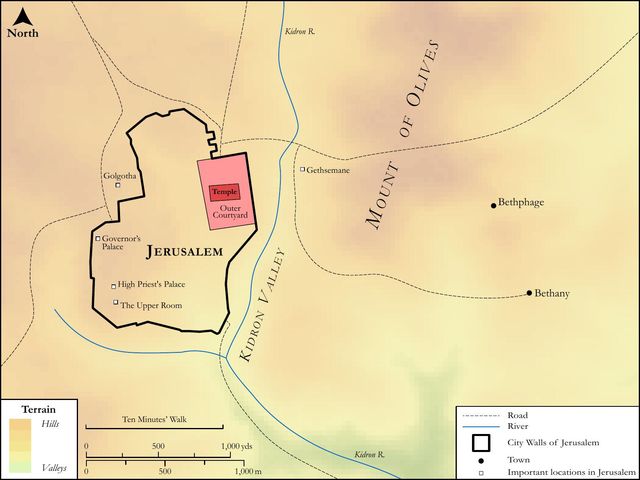
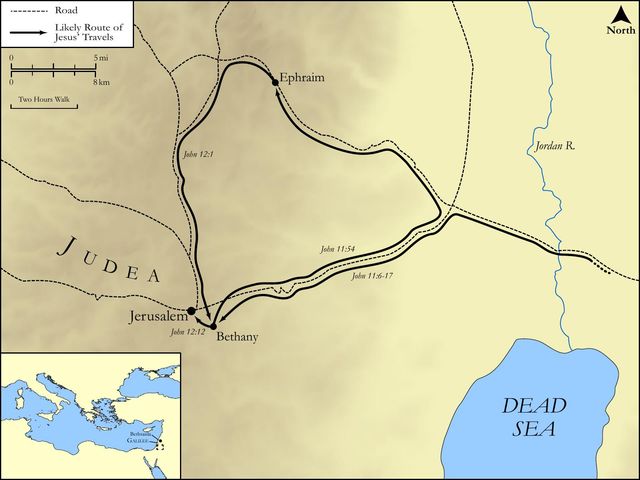
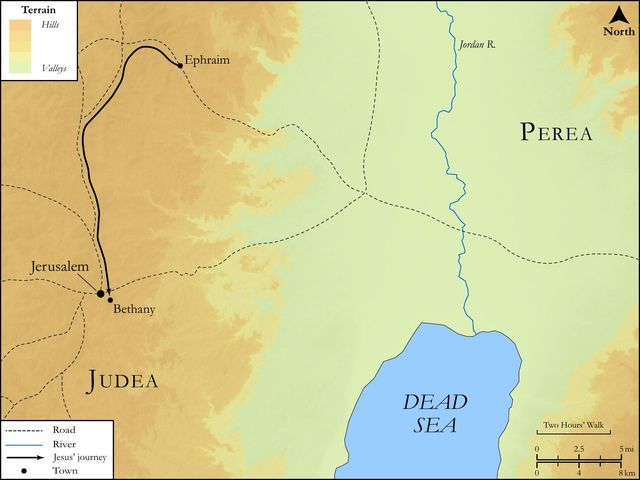
Study this verse
Public-domain commentary
Matthew Henry
From his Commentary on the Whole Bible. Henry comments on passages, not single verses — this entry covers John 11:45–57. His four-level outline is real structure in the source text, so it is rendered as structure.
We have here an account of the consequences of this glorious miracle, which were as usual; to some it was a savour of life unto life, to others of death unto death.
I.Some were invited by it, and induced to believe.
Many of the Jews, when they saw the things that Jesus did, believed on him, and well they might, for it was an incontestable proof of his divine mission. They had often heard of his miracles, and yet evaded the conviction of them, by calling in question the matter of fact; but now that they had themselves seen this done their unbelief was conquered, and they yielded at last. But blessed are those who have not seen and yet have believed. The more we see of Christ the more cause we shall see to love him and confide in him. These were some of those Jews that came to Mary, to comfort her. When we are doing good offices to others we put ourselves in the way of receiving favours from God, and have opportunities of getting good when we are doing good.
II.Others were irritated by it, and hardened in their unbelief.
1.The informers were so (v. 46): Some of them, who were eye-witnesses of the miracle, were so far from being convinced that they went to the Pharisees, whom they knew to be his implacable enemies, and told them what things Jesus had done; not merely as a matter of news worthy their notice, much less as an inducement to them to think more favourably of Christ, but with a spiteful design to excite those who needed no spur the more vigorously to prosecute him. Here is a strange instance,
(1.)Of a most obstinate infidelity, refusing to yield to the most powerful means of conviction; and it is hard to imagine how they could evade the force of this evidence, but that the god of this world had blinded their minds.
(2.)Of a most inveterate enmity. If they would not be satisfied that he was to be believed in as the Christ, yet one would think they should have been mollified, and persuaded not to persecute him; but, if the water be not sufficient to quench the fire, it will inflame it. They told what Jesus had done, and told no more than what was true; but their malice gave a tincture of diabolism to their information equal to that of lying; perverting what is true is as bad as forging what is false. Doeg is called a false, lying, and deceitful tongue (Ps. lii. 2-4; cxx. 2, 3), though what he said was true.
2.The judges, the leaders, the blind leaders, of the people were no less exasperated by the report made to them, and here we are told what they did.
(1.)A special council is called and held (v. 47): Then gathered the chief priests and Pharisees a council, as was foretold, Ps. ii. 2, The rulers take counsel together against the Lord. Consultations of the sanhedrim were intended for the public good; but here, under colour of this, the greatest injury and mischief are done to the people. The things that belong to the nation's peace were hid from the eyes of those that were entrusted with its counsels. This council was called, not only for joint advice, but for mutual irritation; that as iron sharpens iron, and as coals are to burning coals and wood to fire, so they might exasperate and inflame one another with enmity and rage against Christ and his doctrine.
(2.)The case is proposed, and shown to be weighty and of great consequence.
[1.]The matter to be debated was what course they should take with this Jesus, to stop the growth of his interest; they said What do we? For this man doeth many miracles. The information given about the raising of Lazarus was produced, and the men, brethren, and fathers were called in to help as solicitously as if a formidable enemy had been with an army in the heart of their country. First, They own the truth of Christ's miracles, and that he had wrought many of them; they are therefore witnesses against themselves, for they acknowledge his credentials and yet deny his commission. Secondly, They consider what is to be done, and chide themselves that they have not done something sooner effectually to crush him. They do not take it at all into their consideration whether they shall not receive him and own him as the Messiah, though they profess to expect him, and Jesus gave pregnant proofs of his being so; but they take it for granted that he is an enemy, and as such is to be run down: "What do we? Have we no care to support our church? Is it nothing to us that a doctrine so destructive to our interest spreads thus? Shall we tamely yield up the ground we have got in the affections of the people? Shall we see our authority brought into contempt, and the craft by which we get our living ruined, and not bestir ourselves? What have we been doing all this while? And what are we now thinking of? Shall we be always talking, and bring nothing to pass?"
[2.]That which made this matter weighty was the peril they apprehended their church and nation to be in from the Romans (v. 48): "If we do not silence him, and take him off, all men will believe on him; and, this being the setting up of a new king, the Romans will take umbrage at it, and will come with an army, and take away our place and nation, and therefore it is no time to trifle." See what an opinion they have,
First, Of their own power. They speak as if they thought Christ's progress and success in his work depended upon their connivance; as if he could not go on to work miracles, and make disciples, unless they let him alone; as if it were in their power to conquer him who had conquered death, or as if they could fight against God, and prosper. But he that sits in heaven laughs at the fond conceit which impotent malice has of its own omnipotence.
Secondly, Of their own policy. They fancy themselves to be men of mighty insight and foresight, and great sagacity in their moral prognostications.
a.They take on them to prophecy that, in a little time, if he have liberty to go on, all men will believe on him, hereby owning, when it was to serve their purpose, that his doctrine and miracles had a very convincing power in them, such as could not be resisted, but that all men would become his proselytes and votaries. Thus do they now make his interest formidable, though, to serve another turn, these same men strove to make it contemptible, ch. vii. 48, Have any of the rulers believed on him? This was the thing they were afraid of, that men would believe on him, and then all their measures were broken. Note, The success of the gospel is the dread of its adversaries; if souls be saved, they are undone.
b.They foretel that if the generality of the nation be drawn after him, the rage of the Romans will be drawn upon them. They will come and take away our place; the country in general, especially Jerusalem, or the temple, the holy place, and their place, their darling, their idol; or, their preferments in the temple, their places of power and trust. Now it was true that the Romans had a very jealous eye upon them, and knew they wanted nothing but power and opportunity to shake off their yoke. It was likewise true that if the Romans should pour an army in upon them it would be very hard for them to make any head against it; yet here appeared a cowardice which one would not have found in the priests of the Lord if they had not by their wickedness forfeited their interest in God and all good men. Had they kept their integrity, they needed not to have feared the Romans; but they speak like a dispirited people, as the men of Judah when they basely said to Samson, Knowest thou not that the Philistines rule over us? Judg. xv. 11. When men lose their piety they lose their courage. But, (a.) It was false that there was any danger of the Romans' being irritated against their nation by the progress of Christ's gospel, for it was no way hurtful to kings nor provinces, but highly beneficial. The Romans had no jealousy at all of his growing interest; for he taught men to give tribute to Cæsar, and not to resist evil, but to take up the cross. The Roman governor, at his trial, could find no fault in him. There was more danger of the Romans' being incensed against the Jewish nation by the priests than by Christ. Note, Pretended fears are often the colour of malicious designs. (b.) Had there really been some danger of displeasing the Romans by tolerating Christ's preaching, yet this would not justify their hating and persecuting a good man. Note, [a.] The enemies of Christ and his gospel have often coloured their enmity with a seeming care for the public good and the common safety, and, in order to this, have branded his prophets and ministers as troublers of Israel, and men that turn the world upside down. [b.] Carnal policy commonly sets up reasons of state, in opposition to rules of justice. When men are concerned for their own wealth and safety more than for truth and duty, it is wisdom from beneath, which is earthly, sensual, and devilish. But see what was the issue; they pretended to be afraid that their tolerating Christ's gospel would bring desolation upon them by the Romans, and therefore, right or wrong, set themselves against it; but it proved that their persecuting the gospel brought upon them that which they feared, filled up the measure of their iniquity, and the Romans came and took away their place and nation, and their place knows them no more. Note, That calamity, which we seek to escape by sin we take the most effectual course to bring upon our own heads; and those who think by opposing Christ's kingdom to secure or advance their own secular interest will find Jerusalem a more burdensome stone than they think it is, Zech. xii. 3. The fear of the wicked it shall come upon them, Prov. x. 24.
(3.)Caiaphas makes a malicious but mystical speech in the council on this occasion.
[1.]The malice of it appears evident at first view, v. 49, 50. He, being the high priest, and so president of the council, took upon him to decide the matter before it was debated: "You know nothing at all, your hesitating betrays your ignorance, for it is not a thing that will bear a dispute, it is soon determined, if you consider that received maxim, That it is expedient for us that one man should die for the people." Here,
First, The counsellor was Caiaphas, who was high priest that same year. The high priesthood was by divine appointment settled upon the heir male of the house of Aaron, for and during the term of his natural life, and then to his heir male; but in those degenerate times it was become, though not an annual office, like a consulship, yet frequently changed, as they could make an interest with the Roman powers. Now it happened that this year Caiaphas wore the mitre.
Secondly, The drift of the advice was, in short, this, That some way or other must be found out to put Jesus to death. We have reason to think that they strongly suspected him to be indeed the Messiah; but his doctrine was so contrary to their darling traditions and secular interest, and his design did so thwart their notions of the Messiah's kingdom, that they resolve, be he who he will, he must be put to death. Caiaphas does not say, Let him be silenced, imprisoned, banished, though amply sufficient for the restraint of one they thought dangerous; but die he must. Note, Those that have set themselves against Christianity have commonly divested themselves of humanity, and been infamous for cruelty.
Thirdly, This is plausibly insinuated, with all the subtlety as well as malice of the old serpent. 1. He suggests his own sagacity, which we must suppose him as high priest to excel in, though the Urim and Thummim were long since lost. How scornfully does he say, "You know nothing, who are but common priests; but you must give me leave to see further into things than you do!" Thus it is common for those in authority to impose their corrupt dictates by virtue of that; and, because they should be the wisest and best, to expect that every body should believe they are so. 2. He takes it for granted that the case is plain and past dispute, and that those are very ignorant who do not see it to be so. Note, Reason and justice are often run down with a high hand. Truth is fallen in the streets, and, when it is down, down with it; and equity cannot enter, and, when it is out, out with it, Isa. lix. 14. 3. He insists upon a maxim in politics, That the welfare of communities is to be preferred before that of particular persons. It is expedient for us as priests, whose all lies at stake, that one man die for the people. Thus far it holds true, that it is expedient, and more than so, it is truly honourable, for a man to hazard his life in the service of his country (Phil. ii. 17; 1 John iii. 16); but to put an innocent man to death under colour of consulting the public safety is the devil's policy. Caiaphas craftily insinuates that the greatest and best man, though major singulis—greater than any one individual, is minor universis—less than the collected mass, and ought to think his life well spent, nay well lost, to save his country from ruin. But what is this to the murdering of one that was evidently a great blessing under pretence of preventing an imaginary mischief to the country? The case ought to have been put thus: Was it expedient for them to bring upon themselves and upon their nation the guilt of blood, a prophet's blood, for the securing of their civil interests from a danger which they had no just reason to be afraid of? Was it expedient for them to drive God and their glory from them, rather than venture the Romans' displeasure, who could do them no harm if they had God on their side? Note, Carnal policy, which steers only by secular considerations, while it thinks to save all by sin, ruins all at last.
[2.]The mystery that was in this counsel of Caiaphas does not appear at first view, but the evangelist leads us into it (v. 51, 52): This spoke he not of himself, it was not only the language of his own enmity and policy, but in these words he prophesied, though he himself was not aware of it, that Jesus should die for that nation. Here is a precious comment upon a pernicious text; the counsel of cursed Caiaphas so construed as to fall in with the counsels of the blessed God. Charity teaches us to put the most favourable construction upon men's words and actions that they will fear; but piety teaches us to make a good improvement of them, even contrary to that for which they were intended. If wicked men, in what they do against us, are God's hand to humble and reform us, why may they not in what they say against us be God's mouth to instruct and convince us? But in this of Caiaphas there was an extraordinary direction of Heaven prompting him to say that which was capable of a very sublime sense. As the hearts of all men are in God's hand, so are their tongues. Those are deceived who say, "Our tongues are our own, so that either we may say what we will, and are not accountable to God's judgment, or we can say what we will, and are not restrainable by his providence and power." Balaam could not say what he would, when he came to curse Israel, nor Laban when he pursued Jacob.
(4.)The evangelist explains and enlarges upon Caiaphas's words.
[1.]He explains what he said, and shows how it not only was, but was intended to be, accommodated to an excellent purpose. He did not speak it of himself. As it was an artifice to stir up the council against Christ, he spoke it of himself, or of the devil rather; but as it was an oracle, declaring it the purpose and design of God by the death of Christ to save God's spiritual Israel from sin and wrath, he did not speak it of himself, for he knew nothing of the matter, he meant not so, neither did his heart think so, for nothing was in his heart but to destroy and cut off, Isa. x. 7.
First, He prophesied, and those that prophesied did not, in their prophesying, speak of themselves. But is Caiaphas also among the prophets? He is so, pro hâc vice—this once, though a bad man, and an implacable enemy to Christ and his gospel. Note, 1. God can and often does make wicked men instruments to serve his own purposes, even contrary to their own intentions; for he has them not only in a chain, to restrain them from doing the mischief they would, but in a bridle, to lead them to do the service they would not. 2. Words of prophecy in the mouth are no infallible evidence of a principle of grace in the heart. Lord, Lord, have we not prophesied in thy name? will be rejected as a frivolous plea.
Secondly, He prophesied, being high priest that year; not that his being high priest did at all dispose or qualify him to be a prophet; we cannot suppose the pontifical mitre to have first inspired with prophecy the basest head that ever wore it; but, 1. Being high priest, and therefore of note and eminence in the conclave, God was pleased to put this significant word into his mouth rather than into the mouth of any other, that it might be the more observed or the non-observance of it the more aggravated. The apophthegms of great men have been thought worthy of special regard: A divine sentence is in the lips of the king; therefore this divine sentence was put into the lips of the high priest, that even out of his mouth this word might be established, That Christ died for the good of the nation, and not for any iniquity in his hands. He happened to be high priest that year which was fixed to be the year of the redeemed, when Messiah the prince must be cut off, but not for himself (Dan. ix. 26), and he must own it. 2. Being high priest that year, that famous year, in which there was to be such a plentiful effusion of the Spirit, more than had ever been yet, according to the prophecy (Joel ii. 28, 29, compared with Acts ii. 17), some drops of the blessed shower light upon Caiaphas, as the crumbs (says Dr. Lightfoot) of the children's bread, which fall from the table among the dogs. This year was the year of the expiration of the Levitical priesthood; and out of the mouth of him who was that year high priest was extorted an implicit resignation of it to him who should not (as they had done for many ages) offer beasts for that nation, but offer himself, and so make an end of the sin-offering. This resignation he made inwittingly, as Isaac gave the blessing to Jacob.
Thirdly, The matter of his prophecy was that Jesus should die for that nation, the very thing to which all the prophets bore witness, who testified beforehand the sufferings of Christ (1 Pet. i. 11), that the death of Christ must be the life and salvation of Israel; he meant by that nation those in it that obstinately adhered to Judaism, but God meant those in it that would receive the doctrine of Christ, and become followers of him, all believers, the spiritual seed of Abraham. The death of Christ, which Caiaphas was now projecting, proved the ruin of that interest in the nation of which he intended it should be the security and establishment, for it brought wrath upon them to the uttermost; but it proved the advancement of that interest of which he hoped it would have been the ruin, for Christ, being lifted up from the earth, drew all men unto him. It is a great thing that is here prophesied: That Jesus should die, die for others, not only for their good, but in their stead, dies for that nation, for they had the first offer made them of salvation by his death. If the whole nation of the Jews had unanimously believed in Christ, and received his gospel, they had been not only saved eternally, but saved as a nation from their grievances. The fountain was first opened to the house of David, Zech. xiii. 1. He so died for that nation as that the whole nation should not perish, but that a remnant should be saved, Rom. xi. 5.
[2.]The evangelist enlarges upon this word of Caiaphas (v. 52), not for that nation only, how much soever it thought itself the darling of Heaven, but that also he should gather together in one the children of God that were scattered abroad. Observe here,
First, The persons Christ died for: Not for the nation of the Jews only (it would have been comparatively but a light thing for the Son of God to go through so vast an undertaking only to restore the preserved of Jacob, and the outcasts of Israel); no, he must be salvation to the ends of the earth, Isa. xlix. 6. He must die for the children of God that were scattered abroad. 1. Some understand it of the children of God that were then in being, scattered abroad in the Gentile world, devout men of every nation (Acts ii. 5), that feared God (Acts x. 2), and worshipped him (Acts xvii. 4), proselytes of the gate, who served the God of Abraham, but submitted not to the ceremonial law of Moses, persons that had a savour of natural religion, but were dispersed in the nations, had no solemn assemblies of their own, nor any peculiar profession to unite in or distinguish themselves by. Now Christ died to incorporate these in one great society, to be denominated from him and governed by him; and this was the setting up of a standard, to which all that had a regard to God and a concern for their souls might have recourse, and under which they might enlist themselves. 2. Others take in with these all that belong to the election of grace, who are called the children of God, though not yet born, because they are predestinated to the adoption of children, Eph. i. 5. Now these are scattered abroad in several places of the earth, out of all kindreds and tongues (Rev. vii. 9), and in several ages of the world, to the end of time; there are those that fear him throughout all generations, to all these he had an eye in the atonement he made by his blood; as he prayed, so he died, for all that should believe on him.
Secondly, The purpose and intention of his death concerning those persons; he died to gather in those who wandered, and to gather together in one those who were scattered; to invite those to him who were at a distance from him, and to unite those in him who were at a distance from each other. Christ's dying is, 1. The great attractive of our hearts; for this end he is lifted up, to draw men to him. The conversion of souls is the gathering to them in to Christ as their ruler and refuge, as the doves to their windows; and he died to effect this. By dying he purchased them to himself, and the gift of the Holy Ghost for them; his love in dying for us is the great loadstone of our love. 2. The great centre of our unity. He gathers them together in one, Eph. i. 10. They are one with him, one body, one spirit, and one with each other in him. All the saints in all places and ages meet in Christ, as all the members in the head, and all the branches in the root. Christ by the merit of his death recommended all the saints in one to the grace and favour of God (Heb. ii. 11-13), and by the motive of his death recommends them all severally to the love and affection one of another, ch. xiii. 34.
(5.)The result of this debate is a resolve of the council to put Jesus to death (v. 53): From that day they took counsel together, to put him to death. They now understood one another's minds, and so each was fixed in his own, that Jesus must die; and, it should seem, a committee was appointed to sit, de die in diem—daily, to consider of it, to consult about it, and to receive proposals for effecting it. Note, The wickedness of the wicked ripens by degrees, James i. 15; Ezek. vii. 10. Two considerable advances were now made in their accursed design against Christ.
[1.]What before they had thought of severally now they jointly concurred in, and so strengthened the hands one of another in this wickedness, and proceeded with the greater assurance. Evil men confirm and encourage themselves and one another in evil practices, by comparing notes; men of corrupt minds bless themselves when they find others of the same mind: then the wickedness which before seemed impracticable appears not only possible, but easy to be effected, vis unita fortior—energies, when united, become more efficient.
[2.]What before they wished done, but wanted a colour for, now they are furnished with a plausible pretence to justify themselves in, which will serve, if not to take off the guilt (that is the least of their care), yet to take off the odium, and so satisfy, if not the personal, yet the political conscience, as some subtly distinguish. Many will go on very securely in doing an evil thing as long as they have but something to say in excuse for it. Now this resolution of theirs to put him to death, right or wrong, proves that all the formality of a trial, which he afterwards underwent, was but show and pretence; they were before determined what to do.
(6.)Christ hereupon absconded, knowing very well what was the vote of their close cabal, v. 54.
[1.]He suspended his public appearances: He walked no more openly among the Jews, among the inhabitants of Judea, who were properly called Jews, especially those at Jerusalem; ou periepatei—he did not walk up and down among them, did not go from place to place, preaching and working miracles with the freedom and openness that he had done, but while he staid in Judea, he was there incognito. Thus the chief priests put the light of Israel under a bushel.
[2.]He withdrew into an obscure part of the country, so obscure that the name of the town he retired to is scarcely met with any where else. He went to a country near the wilderness, as if he were driven out from among men, or rather wishing, with Jeremiah, that he might have in the wilderness a lodging place of way-faring men, Jer. ix. 2. He entered into a city called Ephraim, some think Ephratah, that is, Bethlehem, where he was born, and which bordered upon the wilderness of Judah; others think Ephron, or Ephraim, mentioned 2 Chron. xiii. 19. Thither his disciples went with him; neither would they leave him in solitude, nor would he leave them in danger. There he continued, dietribe, there he conversed, he knew how to improve this time of retirement in private conversation, when he had not an opportunity of preaching publicly. He conversed with his disciples, who were his family, when he was forced from the temple, and his diatribai, or discourses there, no doubt, were very edifying. We must do the good we can, when we cannot do the good we would. But why would Christ abscond now? It was not because he either feared the power of his enemies or distrusted his own power; he had many ways to save himself, and was neither averse to suffering nor unprepared for it; but he retired, First, To put a mark of his displeasure upon Jerusalem and the people of the Jews. They rejected him and his gospel; justly therefore did he remove himself and his gospel from them. The prince of teachers was now removed into a corner (Isa. xxx. 20); there was no open vision of him; and it was a sad presage of that thick darkness which was shortly to come upon Jerusalem, because she knew not the day of her visitation. Secondly, To render the cruelty of his enemies against him the more inexcusable. If that which was grievous to them, and thought dangerous to the public, was his public appearance, he would try whether their anger would be turned away by his retirement into privacy; when David had fled to Gath, Saul was satisfied, and sought no more for him, 1 Sam. xxvii. 4. But it was the life, the precious life, that these wicked men hunted after. Thirdly, His hour was not yet come, and therefore he declined danger, and did it in a way common to men, both to warrant and encourage the flight of his servants in time of persecution and to comfort those who are forced from their usefulness, and buried alive in privacy and obscurity; the disciple is not better than his Lord. Fourthly, His retirement, for awhile, was to make his return into Jerusalem, when his hour was come, the more remarkable and illustrious. This swelled the acclamations of joy with which his well-wishers welcomed him at his next public appearance, when he rode triumphantly into the city.
(7.)The strict enquiry made for him during his recess, v. 55-57.
[1.]The occasion of it was the approach of the passover, at which they expected his presence, according to custom (v. 55): The Jews' passover was nigh at hand; a festival which shone bright in their calendar, and which there was great expectation of for some time before. This was Christ's fourth and last passover, since he entered upon his public ministry, and it might truly be said (as, 2 Chron. xxxv. 18), There never was such a passover in Israel, for in it Christ our passover was sacrificed for us. Now the passover being at hand, many went out of all parts of the country to Jerusalem, to purify themselves. This was either, First, A necessary purification of those who had contracted any ceremonial pollution; they came to be sprinkled with the water of purification, and to perform the other rites of cleansing according to the law, for they might not eat the passover in their uncleanness, Num. ix. 6. Thus before our gospel passover we must renew our repentance, and by faith wash in the blood of Christ, and so compass God's altar. Or, Secondly, A voluntary purification, or self-sequestration, by fasting and prayer, and other religious exercises, which many that were more devout than their neighbours spent some time in before the passover, and chose to do it at Jerusalem, because of the advantage of the temple-service. Thus must we by solemn preparation set bounds about the mount on which we expect to meet with God.
[2.]The enquiry was very solicitous: They said, What think you, that he will not come to the feast? v. 56.
First, Some think this was said by those who wished well to him, and expected his coming, that they might hear his doctrine and see his miracles. Those who came early out of the country, that they might purify themselves, were very desirous to meet with Christ, and perhaps came up the sooner with that expectation, and therefore as they stood in the temple, the place of their purification, they enquired what news of Christ? Could any body give them hopes of seeing him? If there were those, and those of the most devout people, and best affected to religion, who showed this respect to Christ, it was a check to the enmity of the chief priests, and a witness against them.
Secondly, It should rather seem that they were his enemies who made this enquiry after him, who wished for an opportunity to lay hands on him. They, seeing the town begin to fill with devout people out of the country, wondered they did not find him among them. When they should have been assisting those that came to purify themselves, according to the duty of their place, they were plotting against Christ. How miserably degenerate was the Jewish church, when the priests of the Lord were become like the priests of the calves, a snare upon Mizpeh, and a net spread upon Tabor, and were profound to make slaughter (Hos. v. 1, 2),—when, instead of keeping the feast with unleavened bread, they were themselves soured with the leaven of the worst malice! Their asking, What think you? Will he not come up to the feast? implies, 1. An invidious reflection upon Christ, as if he would omit his attendance on the feast of the Lord for fear of exposing himself. If others, through irreligion, be absent, they are not animadverted upon; but if Christ be absent, for his own preservation (for God will have mercy, and not sacrifice), it is turned to his reproach, as it was to David's that his seat was empty at the feast, though Saul wanted him only that he might have an opportunity of nailing him to the wall with his javelin, 1 Sam. xx. 25-27, &c. It is sad to see holy ordinances prostituted to such unholy purposes. 2. A fearful apprehension that they had of missing their game: "Will he not come up to the feast? If he do not, our measures are broken, and we are all undone; for there is no sending a pursuivant into the country, to fetch him up."
[3.]The orders issued out by the government for the apprehending of him were very strict, v. 57. The great sanhedrim issued out a proclamation, strictly charging and requiring that if any person in city or country knew where he was (pretending that he was a criminal, and had fled from justice) they should show it, that he might be taken, probably promising a reward to any that would discover him, and imposing a penalty on such as harboured him; so that hereby he was represented to the people as an obnoxious dangerous man, an outlaw, whom any one might have a blow at. Saul issued out such a proclamation for the apprehending of David, and Ahab of Elijah. See, First, How intent they were upon this prosecution, and how indefatigably they laboured in it, now at a time when, if they had had any sense of religion and the duty of their function, they would have found something else to do. Secondly, How willing they were to involve others in the guilt with them; if any man were capable of betraying Christ, they would have him think himself bound to do it. Thus was the interest they had in the people abused to the worst purposes. Note, It is an aggravation of the sins of wicked rulers that they commonly make those that are under them instruments of their unrighteousness. But notwithstanding this proclamation, though doubtless many knew where he was, yet such was his interest in the affections of some, and such God's hold of the consciences of others, that he continued undiscovered, for the Lord hid him.
Historical interpretation
Four Centuries of Reception
12 surviving comments on this verse. Each one is dated, so this reads as a timeline rather than a list.
Select a marker to jump to its quote. Markers stagger vertically where authors wrote within a few decades of each other.
Now, as our Lord Jesus Christ, who is also God, was prophesied of under the figure of a lion, on account of His royalty and glory, in the same way have the Scriptures also aforetime spoken of Antichrist as a lion, on account of his tyranny and violence. For the deceiver seeks to liken himself in all things to the Son of God. Christ is a lion, so Antichrist is also a lion; Christ is a king, so Antichrist is also a king. The Saviour was manifested as a lamb; so he too, in like manner, will appear as a lamb, though within he is a wolf. The Saviour came into the World in the circumcision, and he will come in the same manner. The Lord sent apostles among all the nations, and he in like manner will send false apostles. The Saviour gathered together the sheep that were scattered abroad, and he in like manner will bring together a people that is scattered abroad. The Lord gave a seal to those who believed on Him, and he will give one like manner. The Saviour appeared in the form of man, and he too will come in the form of a man. The Saviour raised up and showed His holy flesh like a temple, and he will raise a temple of stone in Jerusalem. And his seductive arts we shall exhibit in what follows. But for the present let us turn to the question in hand.
(Hom. lxiv. c. 3) Him of whose divinity they had received such certain proofs, they call only a man.
(Hom. lxiv. 3) They say this to alarm the people; as if they were incurring the suspicion of setting up an usurper. If, say they, the Romans in crowds follow Him, they will suspect us of setting up a tyranny, and will destroy our state. But this was wholly a fiction of their own. For what was the fact? Did He take armed men about with Him, did He go with horsemen in His train? Did He not rather choose desert places to go to? However, that they might not be suspected of consulting only their own interests, they declare the whole state is in danger.
(Hom. lxiv) When they hesitated, and asked, What do we? one of them gave most cruel and shameless advice, viz. Caiaphas, who was High Priest that same year.
(Hom. lxv. 1) See the great virtue of the Holy Spirit, in drawing forth a prophecy from a wicked man. And see too the virtue of the pontifical office, which made him, though an unworthy High Priest, unconsciously prophesy. Divine grace only used his mouth; it touched not his corrupt heart.
(Hom. lxv. 1) They sought before to kill Him; now their resolution was confirmed.
They said that they would kill Jesus, lest the Romans should come and take away their place and nation; and when they had killed Him, these things happened unto them, and when they had done that by doing which they thought to escape, they yet did not escape. He who was slain is in Heaven, and they who slew have for their portion hell. Yet they did not consider these things; but what? "They desired," It saith, "from that day forth to kill Him," for they said, "The Romans will come, and will take away our nation; and a certain one of them, Caiaphas, being High Priest that year, said," (being more shameless than the rest,) "Ye know nothing." What the others made matter of doubt, and put forth in the way of deliberation, this man cried aloud, shamelessly, openly, audaciously.
It was, moreover, no small thing that even an enemy should prophesy this. This might draw over others also. For in respect of his will, matters fell out contrariwise, since, when He died, the faithful were on this account delivered from the punishment to come. What meaneth, "That He might gather together those near and those afar off"? He made them one Body. The dweller in Rome deemeth the Indians a member of himself. What is equal to this "gathering together"? And the Head of all is Christ.
Seest thou how great is the force of the High Priest's authority? or, since he had in any wise been deemed worthy of the High Priesthood, although unworthy thereof, he prophesied, not knowing what he said; and the grace merely made use of his mouth, but touched not his accursed heart. Indeed many others have foretold things to come, although unworthy to do so, as Nebuchadnezzar, Pharaoh, Balaam; and the reason of all is evident. But what he saith is of this kind. "Ye still sit quiet, ye give heed but carelessly to this matter, and know not how to despise one man's safety for the sake of the community." See how great is the power of the Spirit; from an evil imagination It was able to bring forth words full of marvelous prophecy. The Evangelist calleth the Gentiles "children of God," from what was about to be: as also Christ Himself saith, "Other sheep I have," so calling them from what should afterwards come to pass.
But what is, "being High Priest that year"? This matter as well as the rest had become corrupt; for from the time that offices became matters of purchase, they were no longer priests for the whole period of their lives, but for a year. Notwithstanding, even in this state of things the Spirit was still present. But when they lifted up their hands against Christ, then It left them, and removed to the Apostles. This the rending of the veil declared, and the voice of Christ which said, "Behold, your house is left unto you desolate." And Josephus, who lived a short time after, saith, that certain Angels who yet remained with them, (to see) if they would alter their ways, left them. While the vineyard stood, all things went on; but when they had slain the Heir, no longer so, but they perished. And God having taken it from the Jews, as a glorious garment from an unprofitable son, gave it to right-minded servants of the Gentiles, leaving the others desolate and naked.
And, in truth, had sought to do so before; for the Evangelist saith, "Therefore the Jews sought to kill Him"; and, "Why seek ye to kill Me?" But then they only sought, now they ratified their determination, and treated the action as their business.
Among all the miracles wrought by our Lord Jesus Christ, the resurrection of Lazarus holds a foremost place in preaching. But if we consider attentively who did it, our duty is to rejoice rather than to wonder. A man was raised up by Him who made man: for He is the only One of the Father, by whom, as you know, all things were made. And if all things were made by Him, what wonder is it that one was raised by Him, when so many are daily brought into the world by His power? It is a greater deed to create men than to raise them again from the dead. Yet He deigned both to create and to raise again; to create all, to resuscitate some.
We have, however, read in the Gospel of three dead persons who were raised to life by the Lord, and, let us hope, to some good purpose. For surely the Lord's deeds are not merely deeds, but signs. And if they are signs, besides their wonderful character, they have some real significance: and to find out this in regard to such deeds is a somewhat harder task than to read or hear of them. We were listening with wonder, as at the sight of some mighty miracle enacted before our eyes, in the reading of the Gospel, how Lazarus was restored to life. If we turn our thoughts to the still more wonderful works of Christ, every one that believeth riseth again: if we all consider, and understand that more horrifying kind of death, every one who sinneth dies. But every man is afraid of the death of the flesh; few, of the death of the soul.
If, then, the Lord in the greatness of His grace and mercy raiseth our souls to life, that we may not die for ever, we may well understand that those three dead persons whom He raised in the body, have some figurative significance of that resurrection of the soul which is effected by faith: He raised up the ruler of the synagogue's daughter, while still lying in the house; He raised up the widow's young son, while being carried outside the gates of the city; and He raised up Lazarus, when four days in the grave. Let each one give heed to his own soul: in sinning he dies: sin is the death of the soul. But sometimes sin is committed only in thought. Thou hast felt delight in what is evil, thou hast assented to its commission; thou hast sinned: that assent has slain thee; but the death is internal, because the evil thought had not yet ripened into action.
"But Mary was she who anointed the Lord with ointment, and wiped His feet with her hair, whose brother Lazarus was sick. Therefore his sisters sent unto Him, saying." We now understand whither it was they sent, namely, where the Lord was; for He was away, as you know, beyond the Jordan. They sent messengers to the Lord to tell Him that their brother was ill. He delayed to heal, that He might be able to raise to life.
"But when Jesus heard that, He said, This sickness is not unto death, but for the glory of God, that the Son of God may be glorified." Such a glorifying of Himself did not add to His dignity, but benefited us. Hence He says, "is not unto death," because even that death itself was not unto death, but rather unto the working of a miracle whereby men might be led to faith in Christ, and so escape the real death. And mark how the Lord, as it were indirectly, called Himself God, for the sake of some who deny that the Son is God. For there are heretics who make such a denial, that the Son of God is God. Let them hearken here: "This sickness" He says. "is not unto death, but for the glory of God." For what glory? For the glory of what God? Hear what follows: "That the Son of God may be glorified."
"Jesus saith unto her, Thy brother shall rise again." This was ambiguous. For He said not, Even now I will raise thy brother; but, "Thy brother shall rise again. Martha saith unto Him, I know that he shall rise again in the resurrection, at the last day." Of that resurrection I am sure, but uncertain about this. "Jesus saith unto her, I am the resurrection." Thou sayest, My brother shall rise again at the last day: true; but by Him, through whom he shall rise then, can he rise even now, for "I," He says, "am the resurrection and the life." Give ear, brethren, give ear to what He says.
"He that believeth in me, though he were dead, yet shall he live: and whosoever liveth and believeth in me shall never die." What meaneth this? "He that believeth in me, though he were dead," just as Lazarus is dead, "yet shall he live;" for He is not the God of the dead, but of the living. Believe then, and though thou wert dead, yet shalt thou live: but if thou believest not, even while thou livest thou art dead.
"When Jesus therefore saw her weeping, and the Jews also weeping, who were with her, He groaned in the spirit, and troubled Himself, and said, Where have ye laid him?" Something there is, did we but know it, that He has suggested to us by groaning in the spirit, and troubling Himself. For who could trouble Him, save He Himself? Therefore, my brethren, first give heed here to the power that did so, and then look for the meaning. Thou art troubled against thy will; Christ was troubled because He willed. Jesus hungered, it is true, but because He willed; Jesus slept, it is true, but because He willed; He was sorrowful, it is true, but because He willed; He died, it is true, but because He willed: in His own power it lay to be thus and thus affected or not.
I have spoken of the power: look now to the meaning. It is a great criminal that is signified by that four days' death and burial. Why is it, then, that Christ troubleth Himself, but to intimate to thee how thou oughtest to be troubled, when weighed down and crushed by so great a mass of iniquity? For here thou hast been looking to thyself, been seeing thine own guilt, been reckoning for thyself: I have done this, and God has spared me; I have committed this, and He hath borne with me; I have heard the gospel, and despised it; I have been baptized, and returned again to the same course: what am I doing? whither am I going? how shall I escape? When thou speakest thus, Christ is already groaning; for thy faith is groaning. In the voice of one who groaneth thus, there comes to light the hope of his rising again.
"Jesus wept. Then said the Jews, Behold how He loved him!" "Loved him," what does that mean? "I came not to call the righteous, but sinners to repentance." "But some of them said, Could not this man, who opened the eyes of the blind, have caused that even this man should not die?" But He, who would do nought to hinder his dying, had something greater in view in raising him from the dead.
"Jesus therefore again groaning in Himself, cometh to the tomb." May His groaning have thee also for its object, if thou wouldst re-enter into life! Every man who lies in that dire moral condition has it said to him, "He cometh to the tomb." "It was a cave, and a stone had been laid upon it." Dead under that stone, guilty under the law. For you know that the law, which was given to the Jews, was inscribed on stone. And all the guilty are under the law: the right-living are in harmony with the law. The law is not laid on a righteous man. What mean then the words, "Take ye away the stone"? Preach grace. For the Apostle Paul calleth himself a minister of the New Testament, not of the letter, but of the spirit; "for the letter," he says, "killeth, but the spirit giveth life."
"Martha, the sister of him that was dead, saith unto Him, Lord, by this time he stinketh: for he hath been dead four days. Jesus saith unto her, Have I not said unto thee, that, if thou believest, thou shalt see the glory of God?" What does He mean by this, "thou shall see the glory of God"? That He can raise to life even one who is putrid and hath been four days dead. "For all have sinned, and come short of the glory of God; and, Where sin abounded, grace also did superabound."
"Then they took away the stone. And Jesus lifted up His eyes, and said, Father, I thank Thee, that Thou hast heard me. And I knew that Thou hearest me always: but because of the people that stand by I said it, that they may believe that Thou hast sent me. And when He had thus spoken, He cried with a loud voice." He groaned, He wept, He cried with a loud voice. With what difficulty does one rise who lies crushed under the heavy burden of a habit of sinning! And yet he does rise: he is quickened by hidden grace within; and after that loud voice he riseth. For what followed? "He cried with a loud voice, Lazarus, come forth. And immediately he that was dead came forth, bound hand and foot with bandages; and his face was bound about with a napkin." Dost thou wonder how he came forth with his feet bound, and wonderest not at this, that after four days' interment he rose from the dead? In both events it was the power of the Lord that operated, and not the strength of the dead.
"Then many of the Jews who had come to Mary, and had seen the things which Jesus did, believed on Him. But some of them went away to the Pharisees, and told them what things Jesus had done." All of the Jews who had come to Mary did not believe, but many of them did.
"Then gathered the chief priests and the Pharisees a council, and said, What do we?" But they did not say, Let us believe. For these abandoned men were more occupied in considering what evil they could do to effect His ruin, than in consulting for their own preservation.
"And one of them, named Caiaphas, being the high priest that same year, said unto them, Ye know nothing at all, nor consider that it is expedient for us that one man should die for the people, and that the whole nation perish not. And this spake he not of himself; but being high priest that year, he prophesied." We are here taught that the Spirit of prophecy used the agency even of wicked men to foretell what was future; which, however, the evangelist attributes to the divine sacramental fact that he was pontiff, which is to say, the high priest.
"Then, from that day forth, they took counsel together for to put Him to death. Jesus therefore walked no more openly among the Jews; but went thence unto a country near to the wilderness, into a city called Ephraim, and there continued with His disciples." Not that there was any failure in His power, by which, had He only wished, He might have continued His intercourse with the Jews, and received no injury at their hands; but in His human weakness He furnished His disciples with an example of living, by which He might make it manifest that it was no sin in His believing ones, who are His members, to withdraw from the presence of their persecutors, and escape the fury of the wicked by concealment, rather than inflame it by showing themselves openly.
(Tr. xlix. 27) Caiaphas prophesied of the Jewish nation alone; in which nation were the sheep, of which our Lord says, I am not sent but unto the lost sheep of the house of Israel. (Matt. 15:34) But the Evangelist knew that there were other sheep, not of this fold, which were to be brought in, and therefore adds, And not for that nation only, but also that He should gather together in one the children of God that were scattered abroad; i. e. those who were predestined to be so: for as yet there were neither sheep, nor children of God.
Caiaphas makes a true statement, his words being verified not by the perversity of the people but by the power and wisdom of God.… Nevertheless, his language was made to indicate something true, spoken by one in the official position of a prophet. For he proclaims beforehand of what good things the death of the Christ would become the source. He speaks of what he does not understand, glorifying God (as Balaam did) under constraint, since he was holding the prerogative of the priestly order. The prophecy was given, as it were, not to him personally but to the outward representative of the priesthood. Or, indeed, it may have been the case that the words spoken by Caiaphas were accomplished and happened afterward without his having received any prophetic gift whatever. For it is probable that what some people say will really happen, although they may say it without really knowing whether or not it will happen. Caiaphas then said that the death of Christ would be for the Jews only. But the Evangelist says that it would be for all humankind. For we are all called the offspring and children of God inasmuch as he is the Father of all, having by way of creation begotten as it were and brought into existence the things that were not. And also [we are called his children] because we had from the first the honor of being made in his image, and were allotted the supremacy over earthly things, and were accounted worthy of the divine covenant and enjoyed the life and bliss of paradise. But Satan, unwilling to let us remain in that condition, scattered us and in diverse ways led humanity astray from its nearness to God. And the Christ collected us all together again and brought us through faith into one fold, the church. He united us under one yoke, all being made one, Jews, Greeks, Barbarians, Scythians. We are fashioned again into one new person and worship one God.
Behold, the very thing of which we were speaking, the very thing which the Jews were secretly exercising themselves to bring into effect, this their high priest openly counsels them to do, even to kill the Christ; saying that it would be for the nation, although the nation was unjust. And he makes a true statement, his words being verified not by the perversity of the people, but by the power and wisdom of God. For they, to their own destruction put the Christ to death, but He, being put to death in the flesh, became for us a source of all good things. And what he calls the destruction of the nation, namely, the being under the hand of the Romans and losing the shadow of the law: the very thing which they were seeking to turn away, they actually suffered. Prompted therefore by an unlawful principle, Caiaphas said what he did; nevertheless his language was made to indicate something true, as being spoken by one in the official position of a prophet. For he proclaims beforehand of what good things the death of the Christ would become the source, saying that which he did not understand, and glorifying God (as Balaam did) under constraint, since he was holding the prerogative of the priestly order: the prophecy being as it were given, not to him personally, but to the outward representative of the priesthood. Unless indeed, as may have been the case, the words spoken by Caiaphas were accomplished and came to pass afterwards, without his having received any prophetic gift whatever. For it is probable that what some people say, will really happen, although they may say it without certainly knowing that it will come to pass. Caiaphas then said that the death of Christ would be for the Jews only, but the Evangelist says that it would be for all mankind. For we are all called the offspring and children of God inasmuch as He is the Father of all, having by way of creation begotten as it were and brought into existence the things that were not. And also, because we had from the first the honour of being made in His image, and were allotted the supremacy over earthly things, and were accounted worthy of the Divine covenant, and enjoyed the life and bliss of Paradise. But Satan, being unwilling that we should remain in that condition, scattered us, and in divers manners led man astray from his nearness to God. And the Christ collected us all together again and brought us through faith into one fold, the Church; and united us under one yoke, all being made one, Jews, Greeks, Barbarians, Scythians; and we are fashioned again into one new man, and worship one God
His persecutors accomplished this wicked purpose and put him to death, thinking to extinguish the devotion of his followers. But faith grew from the very thing that these cruel and unbelieving men thought would destroy it.… Even that which human cruelty had executed against him he reduced to the purposes of his mercy.
Continue studying John 11:52 across the web’s major study libraries — every link below opens this exact verse, chapter, or book on the destination site.
Read & Compare
 BibleGatewayThis verse in more than 200 translations and 70 languages.
 Bible.comThe YouVersion reader — hundreds of translations, reading plans, and highlights.
 ESV.orgCrossway's official English Standard Version reader.
 NET BibleThe NET translation with 60,000+ translators' notes on every rendering decision.
 STEP BibleTyndale House's free study tool — original text, vocabulary, and scholarly resources.
 BibliaLogos Bible Software's free web reader.
 USCCBThe New American Bible (Revised Edition) with the U.S. bishops' study notes.
Commentaries
 BibleHub CommentariesDozens of classic commentaries on this verse, gathered on one page.
 StudyLightMore than 100 commentary sets — the largest collection on the web.
 BibleRefPlain-English commentary on what this verse means, verse by verse.
 Enduring WordDavid Guzik's free commentary on this chapter, widely used by Bible teachers.
 Bible Study ToolsVerse commentary alongside Greek and Hebrew study aids.
Original Language & Research
- BibleHub InterlinearThe verse word by word — original language, transliteration, and English.
- BibleHub LexiconEvery word's original-language definition and Strong's entry.
 Blue Letter BibleDeep-study tools — Strong's numbers, concordance, and word studies.
 CNTR CollationThe earliest Greek manuscripts of this verse, collated letter by letter.
Sermons, Hymns & Audio


TrulyRandomVerse is not affiliated with these sites and doesn’t control their content. They’re linked because they’re genuinely useful.
Summary
John 11:52 serves as a profound interpretive commentary by the Apostle John, revealing the universal and divine scope of Jesus's impending atoning death. It clarifies that Christ's sacrifice was not merely for the Jewish nation, as the high priest Caiaphas had unwittingly prophesied, but was intended to gather into a unified body all those, both Jew and Gentile, whom God had chosen as His children, regardless of their current dispersion.
Context
ShowHideLiterary Context
This verse immediately follows the pivotal event of Lazarus's resurrection in John 11. This astonishing miracle, while demonstrating Jesus's divine power over death, simultaneously hardened the hearts of the religious leaders, particularly the Sanhedrin. Their fear of a Roman crackdown due to Jesus's growing popularity led Caiaphas, the high priest, to declare it "expedient for us, that one man should die for the people, and that the whole nation perish not" (John 11:50). John then intervenes, explaining that Caiaphas's statement, though uttered from political expediency, was a divine prophecy, revealing God's true, far-reaching purpose for Jesus's death. Verse 52 expands on this, clarifying that the scope of this atoning work extended beyond "that nation only" to include all of God's scattered children.
Historical & Cultural Context
The backdrop is first-century Judea under Roman occupation. The Jewish religious leaders, particularly the Sanhedrin, operated under the watchful eye of Rome, constantly fearing any popular movement that might provoke Roman intervention and jeopardize their limited autonomy. Caiaphas's concern was primarily political: sacrificing one man (Jesus) to preserve the Jewish nation from Roman wrath. The term "nation" (Greek: éthnos) here primarily refers to the Jewish people. However, John's commentary transcends this narrow, ethnocentric view, hinting at the future inclusion of non-Jews (Gentiles) into God's covenant people. The idea of a "scattered" people would resonate with the Jewish diaspora, but John applies it more broadly to all people, both Jew and Gentile, who would come to believe.
Key Themes
ShowHideJohn 11:52 profoundly contributes to several major themes within John's Gospel and the broader biblical narrative. Firstly, it underscores the universal scope of salvation, revealing that Jesus's atoning work was not limited to a single ethnic group but was for "the children of God that were scattered abroad," foreshadowing the inclusion of Gentiles into God's family. This aligns with the Gospel's overarching message that God's love extends to the entire world, as famously stated in John 3:16. Secondly, the verse highlights God's ultimate desire for gathering and unity. The phrase "gather together in one" speaks to the formation of the Church, where diverse believers are brought into a singular spiritual family under Christ, breaking down traditional barriers (Ephesians 2:14-16). Finally, it powerfully illustrates divine sovereignty, demonstrating that even the machinations and unwitting declarations of human leaders are ultimately orchestrated by God to fulfill His redemptive plan, which far surpasses human understanding or political maneuvering.
Exposition and Analysis
ShowHideKey Word Analysis
ShowHideMeaning "to lead together, i.e., collect or convene." This word emphasizes the active, intentional work of Jesus to bring disparate individuals into a unified whole. It evokes the imagery of a shepherd gathering his flock, a common biblical metaphor for God's care for His people and Christ's role in bringing them into His fold.
(téknon), meaning "a child (as produced)," and G2316 (theós), meaning "the supreme Divinity." This phrase denotes a spiritual relationship of belonging and adoption, rather than merely a physical or national lineage. It refers to those who are spiritually born of God through faith in Christ, a concept introduced early in John's Gospel (John 1:12). These are individuals who have received Christ and been given the right to become God's children.
Meaning "to dissipate, i.e., to rout or separate; specially, to winnow; figuratively, to squander." This term vividly describes a state of dispersion, fragmentation, or disunity. It implies a people who are not yet unified, either geographically, ethnically, or spiritually. Jesus's death is presented as the means to reverse this scattering, bringing them together into a single, cohesive body.
Verse Breakdown
ShowHide"And not for that nation only"
This clause directly refutes the limited, nationalistic scope of Caiaphas's prophecy in John 11:50. John, inspired by the Holy Spirit, clarifies that while Caiaphas spoke of preserving the Jewish nation from Roman destruction, God's true purpose for Jesus's death extended far beyond this singular ethnic group. It sets up a contrast, moving from a narrow, temporal concern to a broad, eternal one.
"but that also he should gather together in one"
This phrase reveals the positive, unifying purpose of Christ's death. The conjunction "but also" introduces an expansive, inclusive dimension. Jesus's sacrifice is portrayed as the catalyst for a divine act of collection—bringing together those who were separate. The phrase "in one" (Greek: eis heîs) emphasizes the desired outcome of perfect unity and cohesion, forming a singular spiritual entity, the body of Christ.
"the children of God that were scattered abroad"
This identifies the beneficiaries of Jesus's gathering work. These are not merely the physical descendants of Abraham, but those who are spiritually born of God, regardless of their ethnic or geographical location. The term "scattered abroad" highlights their prior state of dispersion, whether referring to the Jewish diaspora, the spiritually lost among all peoples, or simply humanity's fragmented state apart from Christ. Jesus's death is the magnet that draws them together.
Literary Devices
ShowHideJohn 11:52 is rich in literary devices. The most prominent is Irony, as Caiaphas, intending to speak a political expedient, unwittingly utters a profound Prophecy of Christ's universal atoning work. John's commentary clarifies this divine irony, transforming a human declaration of death into a revelation of life for all. There is also strong Symbolism in the imagery of "gathering together" those who were "scattered abroad," evoking the biblical motif of a shepherd gathering his sheep (John 10:16). This symbolizes the formation of the Church, a unified community drawn from all nations. Furthermore, the verse employs Contrast, setting the limited scope of "that nation only" against the expansive vision of "the children of God that were scattered abroad," highlighting the universal reach of God's redemptive plan.
Theological and Thematic Connections
ShowHideJohn 11:52 is a cornerstone for understanding the New Testament's emphasis on the universal nature of God's salvation and the unity of the Church. It expands the scope of God's redemptive work beyond ethnic or national boundaries, demonstrating that Christ's sacrifice was for all humanity, those whom God would call His own. This verse anticipates the Great Commission and the global expansion of the Gospel, affirming that God's plan has always been to reconcile a diverse people to Himself, forming one new humanity in Christ. It underscores that true spiritual lineage is not based on physical descent but on being "children of God" through faith.
Reflection and Application
ShowHideJohn 11:52 calls believers to embrace a radical, expansive vision of God's kingdom. It challenges us to look beyond our own cultural, national, or denominational affiliations and to recognize the profound unity we share as "children of God," purchased by the same sacrifice of Christ. This verse fosters a deep appreciation for the inclusive nature of the Gospel, compelling us to participate in God's mission to gather the "scattered abroad" into His family. It reminds us that our primary identity is found in Christ, not in earthly distinctions, and that our efforts should be directed toward fostering unity within the Church, reflecting the very purpose for which Christ died. This understanding should motivate us to overcome divisions, extend hospitality to all believers, and actively engage in evangelism to those who are still outside the fold.
Questions for Reflection
ShowHideFAQ
ShowHideWhat does "that nation only" refer to in John 11:52?
ShowHide"That nation only" refers specifically to the Jewish nation (Greek: éthnos), as spoken by the high priest Caiaphas in John 11:50. Caiaphas's concern was to prevent the entire Jewish people from being destroyed by the Romans due to Jesus's growing popularity. John's commentary in verse 52 clarifies that while Caiaphas's words were politically motivated and limited to the Jewish people, God's true purpose for Jesus's death was far broader and more inclusive.
Who are "the children of God that were scattered abroad"?
ShowHideThis phrase refers to all individuals, both Jew and Gentile, who would come to believe in Jesus and be spiritually born into God's family (John 1:12). The "scattered abroad" aspect can refer to the Jewish diaspora, but more broadly, it encompasses all people throughout the world who are separated from God and from each other by sin. Jesus's death serves to gather these diverse individuals into one unified body, the Church, regardless of their geographical location, ethnic background, or social status.
How does John 11:52 relate to the concept of the Church?
ShowHideJohn 11:52 is a foundational verse for understanding the nature and purpose of the Church. The phrase "gather together in one the children of God that were scattered abroad" directly foreshadows the formation of the Church as a unified body composed of believers from every tribe, tongue, and nation (Revelation 7:9). It teaches that the primary purpose of Christ's death was not just individual salvation, but the creation of a new, unified community—a spiritual family where all distinctions are transcended by their common identity as children of God in Christ.
Christ-Centered Fulfillment
ShowHideJohn 11:52 stands as a powerful declaration of Christ's ultimate mission, revealing that His death was the divine instrument for the grandest act of unification in human history. Jesus, the Good Shepherd, laid down His life not only for the "sheep of this fold" (Israel) but also for "other sheep I have, which are not of this fold: them also I must bring, and they shall hear my voice; and there shall be one fold, and one shepherd" (John 10:16). His sacrifice on the cross became the magnetic force, drawing together into a single, unified body those who were scattered by sin, division, and ethnic barriers. He is the cornerstone upon whom this new spiritual temple is built, reconciling both Jew and Gentile to God in one body through the cross, thereby putting to death the hostility (Ephesians 2:14-16). Through His shed blood, Jesus fulfilled the ancient prophecies of a Messiah who would gather the dispersed people of God, not just physically, but spiritually, creating a new humanity where all who believe are "one in Christ Jesus" (Galatians 3:28). Thus, John 11:52 points directly to Christ as the sole means by which God's scattered children are brought into His eternal family, fulfilling His redemptive purpose for all creation.