


Genesis 42:27
Bible text: King James Version (1769 Blayney text) · Public domain
Bible text: Berean Standard Bible · Public domain
Bible text: American Standard Version (1901) · Public domain
Bible text: World English Bible, Messianic edition · Public domain
Bible text: Geneva Bible (1599) · Public domain
Bible text: Young's Literal Translation · Public domain
- וַיִּפְתַּחvai·yif·Tachand he openedH6605Conj-w ¦ V-Qal-ConsecImperf-3msVerb Qal Consecutive Imperfect 3rd Singular Masculineוַandיִּפְתַּחhe opened
- הָאֶחָדha·'e·Chadthe oneH259Art ¦ Adj-fsAdjective Numerical Singular Feminine Absoluteהָtheאֶחָדone
- אֶת'et<obj.>H853DirObjMParticle Object Indicator
- שַׂקּוֹsa·Kohis sackH8242N-msc ¦ 3msNoun Singular Masculine Constructשַׂקּsackוֹhis
- לָתֵתla·Tetto giveH5414Prep-l ¦ V-Qal-InfVerb Qal Infinitive Constructלָtoתֵתgive
- מִסְפּוֹאmis·Po'fodderH4554N-msNoun Singular Masculine Absolute
- לַחֲמֹרוֹla·cha·mo·Roto his donkeyH2543Prep-l ¦ N-csc ¦ 3msNoun Singular common gender Constructלַtoחֲמֹרdonkeyוֹhis
- בַּמָּלוֹןba·ma·Lonat the lodging placeH4411Prep-b ¦ N-msNoun Singular Masculine Absoluteבַּat theמָּלוֹןlodging place
- וַיַּרְאvai·yaR'and he sawH7200Conj-w ¦ V-Qal-ConsecImperf-3msVerb Qal Consecutive Imperfect 3rd Singular Masculineוַandיַּרְאhe saw
- אֶת'et<obj.>H853DirObjMParticle Object Indicator
- כַּסְפּוֹkas·Pohis silverH3701N-msc ¦ 3msNoun Singular Masculine Constructכַּסְפּsilverוֹhis
- וְהִנֵּהve·hi·nehand there!H2009Conj-w ¦ PrtParticle Interjectionוְandהִנֵּהthere!
- הוּאhu'itH1931Pro-3msPronoun Personal 3rd Singular Masculine
- בְּפִיbe·Fi[was] in [the] mouth ofH6310Prep-b ¦ N-mscNoun Singular Masculine Constructבְּ[was] inפִי[the] mouth of
- אַמְתַּחְתּוֹ'am·tach·Tohis sackH572N-fsc ¦ 3msNoun Singular Feminine Constructאַמְתַּחְתּsackוֹhis
English is a literal word-by-word gloss of the Hebrew, not the KJV's wording. Why?
This is the original text the KJV's translators worked from — each Hebrew word with its own literal English meaning in this verse, prepared by scholars at Tyndale House, Cambridge. The KJV translates whole sentences, not word by word, so its wording differs: one Hebrew word can become several English words, and the KJV may choose “the LORD” where the gloss reads “Yahweh”. Both are faithful — they answer different questions. For the KJV's own rendering, switch to the KJV text.
Details
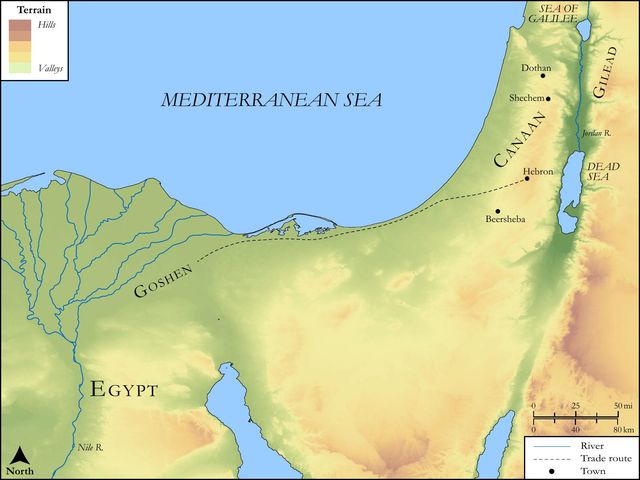
See on the biblical-era maps


Study this verse
Public-domain commentary
Matthew Henry
From his Commentary on the Whole Bible. Henry comments on passages, not single verses — this entry covers Genesis 42:21–28. His three-level outline is real structure in the source text, so it is rendered as structure.
Here is, I. The penitent reflection Joseph's brethren made upon the wrong they had formerly done to him, Gen 42:21. They talked the matter over in the Hebrew tongue, not suspecting that Joseph, whom they took for a native of Egypt, understood them, much less that he was the person they spoke of.
1.They remembered with regret the barbarous cruelty wherewith they persecuted him: We are verily guilty concerning our brother. We do not read that they said this during their three days' imprisonment; but now, when the matter had come to some issue and they saw themselves still embarrassed, now they began to relent. Perhaps Joseph's mention of the fear of God (Gen 42:18) put them upon consideration and extorted this reflection. Now see here,
(1.)The office of conscience; it is a remembrancer, to bring to mind things long since said and done, to show us wherein we have erred, though it was long ago, as the reflection here mentioned was above twenty years after the sin was committed. As time will not wear out the guilt of sin, so it will not blot out the records of conscience; when the guilt of this sin of Joseph's brethren was fresh they made light of it, and sat down to eat bread; but now, long afterwards, their consciences reminded them of it.
(2.)The benefit of affliction; they often prove the happy and effectual means of awakening conscience, and bringing sin to our remembrance, Job 13:26.
(3.)The evil of guilt concerning our brethren; of all their sins, it was this that conscience now reproached them for. Whenever we think we have wrong done us, we ought to remember the wrong we have done to others, Ecc 7:21, Ecc 7:22.
2.Reuben alone remembered, with comfort, that he had been an advocate for his brother, and had done what he could to prevent the mischief they did him (Gen 42:22): Spoke I not unto you, saying, Do not sin against the child? Note,
(1.)It is an aggravation of any sin that it was committed against admonitions.
(2.)When we come to share with others in their calamities, it will be a comfort to us if we have the testimony of our consciences for us that we did not share with them in their iniquities, but, in our places, witnessed against them. This shall be our rejoicing in the day of evil, and shall take out the sting.
II.Joseph's tenderness towards them upon this occasion.
He retired from them to weep, Gen 42:24. Though his reason directed that he should still carry himself as a stranger to them, because they were not as yet humbled enough, yet natural affection could not but work, for he was a man of a tender spirit. This represents the tender mercies of our God towards repenting sinners. See Jer 31:20, Since I spoke against him I do earnestly remember him still. See Jdg 10:16.
III.The imprisonment of Simeon, Gen 42:24.
He chose him for the hostage probably because he remembered him to have been his most bitter enemy, or because he observed him now to be least humbled and concerned; he bound him before their eyes to affect them all; or perhaps it is intimated that, though he bound him with some severity before them, yet afterwards, when they were gone, he took off his bonds.
IV.The dismission of the rest of them.
They came for corn, and corn they had; and not only so, but every man had his money restored in his sack's mouth. Thus Christ, our Joseph, gives out supplies without money and without price. Therefore the poor are invited to buy, Rev 3:17, Rev 3:18. This put them into great consternation (Gen 42:28): Their heart failed them, and they were afraid, saying one to another, What is this that God hath done to us?
1.It was really a merciful event; for I hope they had no wrong done to them when they had their money given them back, but a kindness; yet they were thus terrified by it. Note,
(1.)Guilty consciences are apt to take good providences in a bad sense, and to put wrong constructions even upon those things that make for them. They flee when none pursues.
(2.)Wealth sometimes brings as much care along with it as want does, and more too. If they had been robbed of their money, they could not have been worse frightened than they were now when they found their money in their sacks. Thus he whose ground brought forth plentifully said, What shall I do? Luk 12:17.
2.Yet in their circumstances it was very amazing. They knew that the Egyptians abhorred a Hebrew (Gen 43:32), and therefore, since they could not expect to receive any kindness from them, they concluded that this was done with a design to pick a quarrel with them, and the rather because the man, the lord of the land, had charged them as spies. Their own consciences also were awake, and their sins set in order before them; and this put them into confusion. Note,
(1.)When men's spirits are sinking every thing helps to sink them.
(2.)When the events of Providence concerning us are surprising it is good to enquire what it is that God has done and is doing with us, and to consider the operation of his hands.
Continue studying Genesis 42:27 across the web’s major study libraries — every link below opens this exact verse, chapter, or book on the destination site.
Read & Compare
 BibleGatewayThis verse in more than 200 translations and 70 languages.
 Bible.comThe YouVersion reader — hundreds of translations, reading plans, and highlights.
 ESV.orgCrossway's official English Standard Version reader.
 NET BibleThe NET translation with 60,000+ translators' notes on every rendering decision.
 STEP BibleTyndale House's free study tool — original text, vocabulary, and scholarly resources.
 BibliaLogos Bible Software's free web reader.
 USCCBThe New American Bible (Revised Edition) with the U.S. bishops' study notes.
Commentaries
 BibleHub CommentariesDozens of classic commentaries on this verse, gathered on one page.
 StudyLightMore than 100 commentary sets — the largest collection on the web.
 BibleRefPlain-English commentary on what this verse means, verse by verse.
 Enduring WordDavid Guzik's free commentary on this chapter, widely used by Bible teachers.
 Bible Study ToolsVerse commentary alongside Greek and Hebrew study aids.
Original Language & Research
- BibleHub InterlinearThe verse word by word — original language, transliteration, and English.
- BibleHub LexiconEvery word's original-language definition and Strong's entry.
 Blue Letter BibleDeep-study tools — Strong's numbers, concordance, and word studies.
 SefariaThe Hebrew text with Rashi and centuries of Jewish commentary.
Sermons, Hymns & Audio


TrulyRandomVerse is not affiliated with these sites and doesn’t control their content. They’re linked because they’re genuinely useful.
Summary
Genesis 42:27 describes a pivotal and unsettling moment during the return journey of Joseph's brothers from Egypt. As one of them pauses at an inn to feed his animal, he discovers the money they had paid for grain mysteriously returned to his sack. This inexplicable finding immediately ignites fear, confusion, and a burgeoning sense of dread among the brothers, serving as the initial unraveling of Joseph's elaborate plan to test their character and orchestrate their repentance and eventual reconciliation.
Context
ShowHideLiterary Context
This verse is strategically placed within the climactic arc of the Joseph narrative, specifically after the brothers' initial encounter with Joseph (unbeknownst to them) in Egypt and their first purchase of grain. Having been accused of being spies and having Simeon held hostage, they are now on their way back to Canaan, burdened with the task of bringing Benjamin to Egypt to prove their honesty. The discovery of the money in the sack's mouth is the first tangible sign that their situation is far more complex and divinely orchestrated than they realize, building immense narrative tension and setting the stage for the escalating drama and Joseph's subsequent tests in Genesis 43.
Historical & Cultural Context
The journey described reflects the realities of travel in that age, where caravans would stop at "inns" or caravanserai—simple lodging places often consisting of an open courtyard for animals and basic shelter for travelers. The practice of carrying provisions, including fodder for donkeys (asses), was essential for such journeys. The concept of money being returned, especially under suspicious circumstances, would have been deeply unsettling, potentially implying a theft accusation or a divine curse, given the strong cultural emphasis on honesty and divine retribution for wrongdoing. Their fear is rooted in a cultural understanding of justice and accountability, particularly when dealing with powerful foreign officials.
Key Themes
ShowHideThis verse contributes significantly to several key themes within the Joseph narrative and the broader book of Genesis. It highlights Divine Providence, as God subtly works through Joseph's seemingly manipulative actions to bring about His ultimate redemptive plan for Jacob's family, echoing the theme seen in Genesis 50:20. The discovery also intensifies the theme of Guilt and Conscience, forcing the brothers to confront their past sin against Joseph, as their immediate reaction in Genesis 42:28 reveals their deep-seated fear of divine retribution. Furthermore, it masterfully builds Suspense and Mystery, keeping both the brothers and the reader on edge, anticipating the eventual revelation of Joseph's identity and the resolution of the family's long-standing conflict.
Exposition and Analysis
ShowHideKey Word Analysis
ShowHideThis term (H2543) refers to a male donkey, a common beast of burden in Egypt and Canaan, essential for travel and transport of goods like grain. The mention of the ass highlights the practical, everyday context of the discovery, occurring during a routine stop to care for their animals, making the sudden revelation of the money even more jarring and unexpected.
Derived from a root meaning "pale color," this word (H3701) refers to silver, which served as the primary form of currency. The discovery of their "money" (silver) in their sacks, when they believed they had paid for the grain, is the central anomaly that triggers the brothers' distress. It represents not just a financial return, but a profound and inexplicable breach of their transaction, leading to deep suspicion and fear.
This primitive root (H7200) means "to see, literally or figuratively," encompassing a wide range of applications from simple observation to discerning, perceiving, or even having visions. Here, it signifies a sudden, unexpected, and impactful seeing. The brother "espied" the money, implying an immediate and undeniable visual recognition that caught him off guard, leading to an instant realization of the strange circumstances.
Verse Breakdown
ShowHide"And as one of them opened his sack"
This clause sets the scene, indicating a routine action taken by one of Joseph's brothers. The "sack" (H8242, saq, referring to coarse cloth or sacking) was used to transport the grain they had purchased. The act of opening it is mundane, yet it immediately precedes a profound revelation.
"to give his ass provender in the inn"
This further grounds the scene in the practicalities of ancient travel. "Provender" (H4554, miçpôwʼ, fodder) was essential for their animals. The "inn" (H4411, mâlôwn, a caravanserai or lodging place) signifies a necessary stop for rest and replenishment on their long journey back to Canaan. The ordinary nature of this act contrasts sharply with the extraordinary discovery that follows.
"he espied his money; for, behold, it [was] in his sack's mouth."
This is the climactic moment. The brother "espied" (H7200, râʼâh, saw) his "money" (H3701, keçeph, silver). The phrase "for, behold, it [was] in his sack's mouth" emphasizes the immediate and undeniable nature of the discovery. The money was not hidden deep within, but was readily visible at the opening (H6310, peh, mouth/opening) of his "sack" (H572, ʼamtachath, a bag). This direct, undeniable evidence of the returned payment, under inexplicable circumstances, instantly creates a crisis of fear and suspicion.
Literary Devices
ShowHideThe verse employs several powerful literary devices to heighten its impact. Suspense is masterfully built as the reader, unlike the brothers, knows Joseph's plan, creating dramatic irony. The mundane act of feeding an ass at an inn serves as a deceptive calm before the storm of discovery, making the revelation more impactful. There is a subtle Irony in the fact that Joseph's act of apparent generosity (returning the money) is perceived by his brothers as a potential accusation or a sign of impending doom, highlighting their burdened consciences. The phrase "behold, it was in his sack's mouth" functions as a form of Anagnorisis (discovery or recognition) for the brother, though the full implications of this discovery are yet to be revealed. The money itself can be seen as a Symbol of their past sin against Joseph; its inexplicable return forces them to confront their unconfessed guilt, as they instinctively link the strange event to divine judgment.
Theological and Thematic Connections
ShowHideThis seemingly simple verse is a crucial pivot point in the unfolding narrative of God's providence. While Joseph is the immediate orchestrator of these events, the mysterious return of the money, though unsettling for the brothers, is a crucial step in God's sovereign design to bring about reconciliation within Jacob's family and preserve them through the famine. It highlights how God can use even perplexing or distressing circumstances to guide His people towards repentance and His ultimate purposes. The brothers' immediate fear and subsequent self-reflection underscore the biblical truth that unaddressed sin can weigh heavily on the conscience, and that God, in His wisdom, often allows circumstances to expose and deal with such hidden matters, ultimately leading to restoration.
Reflection and Application
ShowHideThe discovery of the money in the sack's mouth serves as a profound reminder that even amidst seemingly chaotic or inexplicable circumstances, a divine purpose may be unfolding. Like Joseph's brothers, we often face situations that bring distress or confusion, where the reasons behind events are unclear. We may feel accused, bewildered, or even targeted by forces beyond our control. However, the larger biblical narrative encourages us to trust in God's sovereign plan, even when it involves challenging or mysterious situations that seem to defy logic or fairness. This incident also powerfully underscores how unaddressed past actions, particularly those involving injustice or betrayal, can weigh heavily on the conscience and resurface in unexpected ways. It prompts deep self-examination and highlights the profound human need for genuine repentance, forgiveness, and reconciliation, both with God and with those we have wronged. It challenges us to consider what "hidden money" might be in our own "sacks"—unconfessed sins or unresolved conflicts—that God might be bringing to light for our ultimate good and spiritual growth.
Questions for Reflection
ShowHideFAQ
ShowHideWhy was the money returned to their sacks?
ShowHideJoseph orchestrated the return of the money to his brothers' sacks as a deliberate and strategic part of his elaborate plan to test them and bring about their repentance and reconciliation. His intentions were multifaceted: primarily, to provoke their conscience and bring their past sin against him to mind, thereby creating a situation of distress that would force them to confront their guilt. This act also served to compel them to return to Egypt with Benjamin, a crucial step for the full family reunion and reconciliation he desired. It was a calculated move to deepen their predicament and reveal their true character, paving the way for the dramatic events described in Genesis 43 and Genesis 44.
Christ-Centered Fulfillment
ShowHideThe narrative of Joseph, particularly his suffering, hidden identity, and ultimate role as a deliverer, profoundly prefigures the person and work of Jesus Christ. Just as Joseph was rejected by his brothers, sold for a price, and yet exalted to a position of power to save his family from famine, so too was Jesus rejected by His own people, betrayed for thirty pieces of silver (Matthew 26:15), and crucified, only to be resurrected and exalted as Lord and Savior (Philippians 2:9-11). Joseph's act of secretly returning the money, creating a crisis that led to the brothers' repentance and reconciliation, mirrors Christ's work on the cross. Through His sacrifice, Christ confronts humanity with its sin, yet provides the means for forgiveness and reconciliation with God (2 Corinthians 5:18-19), ultimately preserving His people and offering spiritual sustenance in a world spiritually famished (John 6:35). Joseph's hidden identity and eventual revelation to his brothers also foreshadow Christ's future revelation in glory, when every knee will bow and every tongue confess His Lordship (Revelation 1:7).